
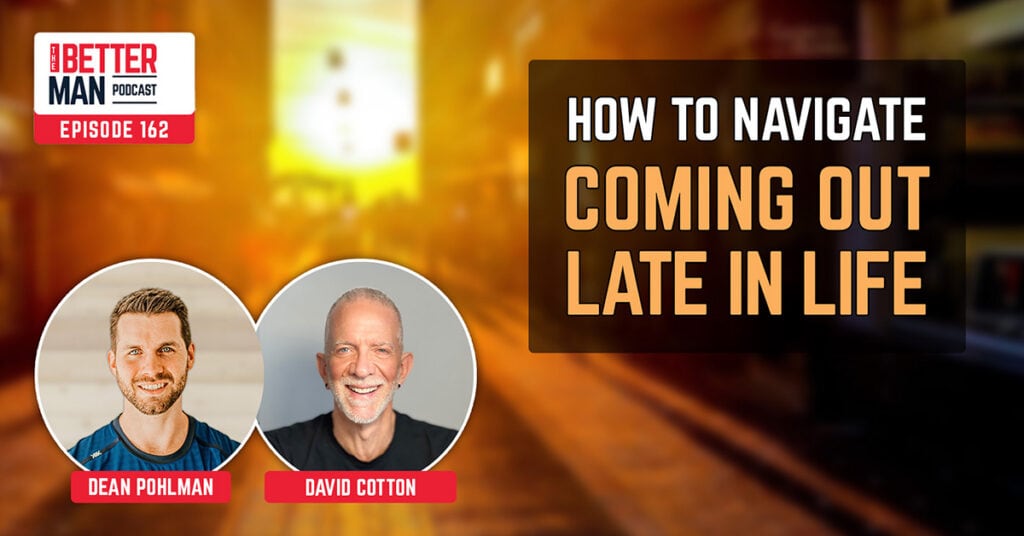
Coming out is never easy. Despite the societal progress we’ve made culturally, there is a large swath of men who would, quite literally, rather be hit by a truck than come out.
This pressure, if you feel it, only compounds with age. Especially if you’re also married to a woman and have kids, like today’s guest David was.
David didn’t come out until his late 50s – after a successful career in the U.S. Air Force as Brigadier General, after being married to a beautiful woman, and after having kids.
The truth was, he had always wondered and had inklings about his true self. But he buried them and focused on his career and parenthood.
But after his kids moved out, he couldn’t wear the three-foot mask over his true self any longer.
Coming out was one of the hardest things he’s ever done.
And it completely changed his personality. He went from being an introvert to an extrovert, and he uses his real personality to help other men who are coming out late.
If you’ve been struggling with whether or not you’re gay – or you just want to learn more about what gay men go through so you can be more compassionate and empathetic, listen now.
Here’s what David and I discuss:
- Why it’s never actually too “late” to come out (even though it might feel like it)
- Why “letting people in” instead of “coming out” can make it easier
- How to better navigate coming out (especially if you’re married and have kids)
Listen now!
The Better Man Podcast is an exploration of our health and well-being outside of our physical fitness, exploring and redefining what it means to be better as a man; being the best version of ourselves we can be, while adopting a more comprehensive understanding of our total health and wellness. I hope it inspires you to be better!



Use the RSS link to find the Better Man Podcast on other apps: http://feeds.libsyn.com/404744/rss
Episode 162 Highlights
- Why the BEST way to improve your mental health is by moving your physical body (4:40)
- How to better handle coming out later in life (even if you’ve already married a woman and have had kids like David) (8:16)
- How cultural and subconscious homophobia can delay your coming out (14:30)
- Why letting your loved ones “in” (instead of “coming out”) makes these tough conversations easier and less daunting (15:31)
- Dr. Joe Kort’s (a sex therapist) “Beach Test” that can help confused men decide if they’re gay or not (24:57)
- How finally accepting yourself as gay can alter your entire personality (David lived his life as an introvert until he came out) (26:16)
- The strange way your repressed fears get projected onto others (David first noticed this as the U.S. Air Force Brigadier General – where being gay could get him fired back then) (44:01)
Dean Pohlman: Hey guys, it’s Dean. Welcome to the Betterment Podcast. Today’s episode is an interview with David Cotton. He’s a life coach and a host of the out late with David podcast. He’s a retired Air Force brigadier general who’s formerly married to a woman and has two kids and came out in his late 50s. And this is an important topic to discuss because it is a fun one that is very prevalent, shockingly so, that I’ve noticed in my own interactions with men within our community.
Dean Pohlman: And that has to do with coming out later in life, specifically men going through their entire lives as a straight man, married to a woman and then coming out in their 40s. They’re 56 years and even into their 70s. In this conversation, we touch on a variety of topics, including David’s experience, as well as general experiences of other men coming out late in life, including David’s early and his middle life.
Dean Pohlman: Growing up and having a career in environments where being gay was wrong. Talk about how he experienced gay thoughts throughout his entire life, but he was able to shut them out by having a purpose, by being dedicated to his family and how he actually lived a happy life. Despite that, we also talk about how he eventually came out to his wife, his family, what their responses were, and how his life has changed since, and also how he completely changed the type of person that he was as a result of coming out, how he used to be introverted and shy and now he’s an extroverted man, deeply interested in discussing other people’s challenges and stories.
Dean Pohlman: So I think this is a really important conversation to have, just because it does highlight a large, proportion of our community. And I think that you guys will get a lot out of this. So I hope you enjoy this interview. David comes with a lot of vulnerability. And it’s a great conversation to listen to.
Dean Pohlman: So I hope you hope inspires you. And I hope it inspires you to be a better man. Hey guys, it’s Dean. Welcome to the Better Man podcast. Today’s episode I have David Cotton here from out late. David is a manual yoga member. For a long time now. I have seen his life evolve and change over the last decade significantly.
Dean Pohlman: And, I’m excited to. Yeah, one way of describing it, and I’m excited to have it on to to tell his story. So, thank you for coming.
David Cotton: Well, Dean, it’s an honor to be here. You’ve been part of my transformation long before either of us knew where my life was taking me. And your life was taking you. Yeah.
Dean Pohlman: Cool. All right, so, where do I start? So I first met David as a as probably, like, 2016, I want to say maybe 27. Okay. 26 and you were, you know, you were part of the members area. You were doing the workouts. I remember you as being one of our, you know, at the time, more significant success stories in the sense of coming in at a certain fitness level and starting to improve in those areas and then, you know, and then starting to delve into other areas you were working with, my trainer Jesse from Central Athlete, and you started lifting weights, and then you got jacked and then, yeah.
Dean Pohlman: So you’ve been, you know, with Ben for yoga for a while. And then I started seeing, you know, and then I started, I think I can’t remember how I learned about what else was going on. And I keep seeing what else was going on, and, you know, significant life changes, like, it’s some mystery. But, you know, you’ve obviously created a whole thing, a whole community, a whole podcast around it.
Dean Pohlman: So I don’t know, I’ll let you I’ll let you just I’ll turn it over to you because I’m, you know, I like my question. Asking ability is apparently not great today. Kaya, we had to put Kaya down yesterday, so I’m operating at, I would say 65 to 70%.
David Cotton: So, And I’m so sorry to hear that. I can’t imagine how that must feel. You know my little guy Tucker. Yeah, I took him to boarding today, so he’s running around playing with other dogs. But I know that it’s heavy. So I’m with you?
Dean Pohlman: Yeah. We knew was coming, but still. So, So. Yeah. So. So you’re you’re.
David Cotton: Working on some sound. You were 426. Yeah. I found you before 2016. I remember watching on YouTube when I lived in Virginia. And you’re out in front of your apartment under, I think, an oak tree, trying to avoid the acorns and bare feet to do your poses. Before you had actually started Man Flow Yoga, like it has grown today into this great enterprise helping so many people.
David Cotton: And we finally connected when I got to Iowa in 2016, became a member, started with DVDs and realized the effect it was having on me. I thought I was always in shape. I was a runner my whole life, and that’s how I used to keep my mental health stable, was running and as you know, I had a problem with that for a while.
David Cotton: So you actually created something, I think, like David running workouts or something for damaged feet, for plantar fasciitis, which I really appreciated then. And even hired you for a while to be my coach. And so you coached me remotely on yoga, which was very helpful. Remember, had my two cameras set up so you could see my poses from all angles, and I detailed maybe a bit too much.
Dean Pohlman: I’d expect nothing less, from a retired brigadier general. So.
David Cotton: Yeah. Yeah. So, so that was part of my fitness journey. And then actually, you introduced me to Jesse O’Brien of Central Athlete, and that’s when I really got into weight and went from a guy who was almost, like 36, 37 inch ways to now I’m 29 or 30. You got down to body fat around 8%, and now it’s probably around 12.
David Cotton: Yeah, because can’t keep it down there too much. So it really got me focused to realize that for me, my mental health is all around my fitness and my body and how I move and how I. I wake up each day because it’s the one asset I can control is me, how I think and what I do. And that just changed my perspective and took ownership for my life.
David Cotton: And I really, truly believe that having met you and started that fitness journey and built upon what I was already doing and then Jesse, it gave me the courage to then process who I was with myself. And the end. In my late 50s, I realized, David, you’re a gay man. You’ve always had these thoughts. You’ve never done anything with them.
David Cotton: You met a beautiful woman, got married, fell in love, had kids. And. But you’re living this conflict all the time that your exercise doesn’t resolve every time. But think about it to do that. But it did give me the courage and the strength to realize that again, I can control my thoughts and my body of how I move through the world, and it’s the one assets that’ll keep me going as I live.
David Cotton: So let’s bring this all together for true mental and physical health.
Dean Pohlman: Yeah, and that’s what I. That’s what I meant to say at the beginning, is the one big reason why I wanted to have you on the podcast is because within the Man Flow Yoga community, I have heard way more stories then, you know, I imagined I would from men who were married to women their entire lives. And for some of them, you know, they, you know, they got to it seems like some of them were, you know, they figured out early, relatively early on, like there were, I think a few of them, like maybe in the 30s and 40s, you know, figured, figured out, like, oh, you know what?
Dean Pohlman: I’m actually not, I’m actually not supposed to be in this relationship. I’d rather be with men. And but but there is a huge. I found much more of a trend of people in their 60s and in their 70s. So coming out late, like you said, coming out late in life, not coming out middle in life, but, you know, coming out much later in life.
Dean Pohlman: And it was, I actually interviewed, not interviewed, but I launched this kind of experimental community called the Engage Platform in 2024. I think it ended up not working out, but we did have a pretty significant onboarding, questionnaire. And through that, I learned that 10%, 10% of the total participants came out in their 60s or 70s, were married to women, and then came out and remarried to men.
Dean Pohlman: And they’re like late 60s. One guy was 72 when it happened. Like his, you know, his wife died at 71. And then like the next year, he was married to a man. And so I wanted to have you on just to speak to this. The demographic that this is, you know, does just way more significant, way more out there.
Dean Pohlman: Then I, I had to make the pun, but way more out there than than I thought, existed. So anyways. Yeah, that that was and.
David Cotton: You know, we have the podcast now out late with David and it’s, it’s primarily men telling their stories of coming out later in life. But late is a relative term. I’ve had. I’ve also I’ve coached I have clients and guys I know that came out late 29, 30 ish, up to 80 something. And so late is a relative term on the individual, because even the one that was 30 said, oh man, I’m so late in life, I’ve already done this in this late maybe.
David Cotton: And what they think that they are. But the reality is, whatever the right time is the right time. There’s nothing. It’s early, there’s nothing. Get late. That’s the first thing to work on is you are where you are. You can’t change the past. You can accept it. You could grieve it. You could have some sadness. But don’t get obsessed about it because you can’t change it.
David Cotton: It’s already past. It’s past. Yeah. And the future. Oh, what am I going to do? I don’t want to destroy this family. I don’t destroy my relationships. There’s so much fear that they’re stuck in inaction. And so they may be for decades. Like myself, I didn’t accept who I was, I had inklings, I mean, now I look back and say, yeah, I was gay from when I was a single digit kid, you know, from the thoughts that I had but didn’t act on them.
David Cotton: And so I moved through life with this bundle of thoughts in my head to where the pressure became so great I had to do something with it. Yes, there was the fear for the future, but I realized don’t fear the future that’s yet to be written. Approach it and deal with it every single day, and just live through life in a true, genuine way without trying to do harm for others.
David Cotton: Harm may happen when I came out that harmed others, disappointed people, some happy, some sad. But I had, now the shame associated with that too. So you got to deal with that. There’s guilt, you know, the person that you’re coming out to, if they’re your partner and they have no inkling, it’s like dropping 600 pounds of bricks on their head.
David Cotton: I’ve had maybe months or years to think about it, and they have a microsecond to process it. So you just have to work through what that whole process is and what serves you best, because you’re the one. Again, you control your thoughts and how you live and your body. So how do you want to be as a kind, caring, compassionate, understanding individual, even though there may be some pain involved in the process?
Dean Pohlman: Yeah. And, you know, that’s I can think about how the fear I can I can see how the fear of destroying the family, the shame, the guilt surrounding, you know, just being gay because it doesn’t matter if you choose to be homophobic, but just because we are in a society, you subconsciously absorb the you subconsciously absorb those, you know, that that those discriminatory beliefs, those, you know, and, and that’s something that, that I’ve realized as I’ve, you know, this is this is something that has brought me face to face with a lot of my subconscious homophobia just because, you know, for, however many years I’ve been running a community that does have
Dean Pohlman: a disproportionately large, you know, audience of a community of, of gay men. And so it showed me how there are some ways that I and some of my responses are and some of my internal responses to things, I’m like, oh, that, you know, where does that come from? What’s the why? You know, why do I why do I feel that strongly or that angry toward toward that response?
Dean Pohlman: And, you know, just through conversations that I’ve had with myself and, you know, just, you know, getting curious about my own thoughts and my own beliefs, realize, oh, there’s there’s a subconscious level of homophobia that I’ve absorbed just from, you know, growing up in society, playing sports, as a kid, not wanting to be labeled as gay myself, not wanting to feel.
Dean Pohlman: Because I think what also comes with that is this feeling of inferiority. Right? It’s like it’s a put down. It’s not a it’s not something that, you know, it’s it’s it’s something that people have to I don’t, I don’t know, I’m speaking for a different, you know, demographic, but I, but it’s not something that is typically thought of as a positive, in our society.
Dean Pohlman: And there’s one thing that I can I can remember, being back in college and, I always believe that coming out had to be something that someone did. Like, you couldn’t just like it was, it had to be this big event. Right. And so I remember I had a roommate in college who basically, said something to me that happened.
Dean Pohlman: That was his way of telling me, like, oh, yeah, I’m gay. Right. And and for a while I look back at that event and I thought, oh, he’s he’s coming out to me. And then I also started to question, like, well, why did he have to come out to me to be like, why did he have to do that to begin?
Dean Pohlman: Like, why did you know? Like it’s like this thing that is expected of gay men that they have to come out. It’s not just, oh, no, this guy’s gay. Like, you don’t have to ask. You have to have someone confirm and tell you that there they’re gay. That was. Anyways, that was just some of, those are some of my experiences, that I’ve had and things that I felt worth, worth sharing as this fits into this, this conversation.
David Cotton: Yeah. I can understand that of of the homophobia, I had it as well. I remember thinking to myself when I was in denial, when someone would talk about, you know, the gay lifestyle, which there is no lifestyle but the lifestyle, I’d say, yeah, I’d say.
Dean Pohlman: Is.
David Cotton: Exactly. I would say as long as they, you know, live their life and don’t thrusted upon me, I’m okay with that. Well, that was my homophobic response to my own thoughts, to try to keep myself from accepting that I was gay. Indeed, it was to pivot and shift to do that. It’s interesting. I had no data to back this up, but anecdotally, it seems like sometimes some of the biggest and loudest anti-gay individuals may end up being gay or not straight themselves, and that was just their defensive mechanism to do that, because they have some shame in their culture.
David Cotton: They don’t want to be that way, or that they don’t feel that they can accept because of where they are in life, and they think that there’s too much that would be damaged, which is really sad because it to your point, why should somebody have to come out? I tell people that I coach, you don’t have to come out to anybody.
David Cotton: I don’t remember where I heard this. I did not come up with this. But let people into your life, let them in. So in this case, I would say the roommates are such a relationship with you as a friend that they believed it be important to be honest and true in the friendship to say I’m gay or I’m not straight, whatever the situation was, and therefore that helped them be in a better friendship with you and to test the waters to see how you react.
David Cotton: You know, if there was going to be something that’s going to happen negative, rather find out sooner rather than later. I to this day, if it’s not already known, work into the conversation somewhere if I feel it’s important based on the ongoing relationship. Because if it’s going to be a hard thing for them to overcome and deal with, I’m probably gonna move on.
David Cotton: Why spend the effort and time if it’s going to cause me a lot of negative energy and angst on my myself? I used to in a in the business world, I was, a senior leader in a company, and I wore a little pride flag, not a flag, but just the colors here on my lapel, which was one way to telegraph to the world.
David Cotton: And I remember it was actually a former podcast guest on Larry David said, man, I couldn’t believe he used to do that. It took so much courage. You know, I can’t do that in my company. He’d been out longer than I had. He had had a partner. He’d raised his kids with this other man, but it just didn’t have the courage to do that because he felt to be too many negatives in his business life, that he’d lose customers and clients once he was on the show.
David Cotton: That was kind of his way to get over the anxiety, you know, because he went public on a podcast and said I could release it. It took away all that anxiety he had, and it didn’t hurt his business. People didn’t care. They hired him for his skill and competency, not for his sexuality. Just like, you know, we don’t hire you in Man Flow Yoga because your hair color.
David Cotton: We hire you because you help us, you know, build and control our body. And part of a community of like minded people that are looking to better themselves.
Dean Pohlman: Yeah. I mean I’ve, I’ve, I’ve had you know when we’ve hosted there our be the Better you retreats. This is where we get you know anywhere from 12 to this next one’s going to have 17. But we get, you know, a small group of men together and we have very, you know, meaningful, conversations with the depth that you don’t aren’t able to have from without being in this kind of environment.
Dean Pohlman: And, you know, when you look around at the demographics, there, again, I think it’s about one third, close to one half, gay men and something that, you know, the experiences that I’ve heard from those guys. There’s one guy in particular who said that he went to a a business conference. I think he he works in finance, and he mentioned that he had a partner.
Dean Pohlman: And, you know, there are people who are there was one guy, I think in particular reacted negatively to it and was kind of standoffish. And so he that’s taught him to be very, you know, very selective about who he talks with. I think I’ve also seen it’s also created this unwillingness of men to interact with other groups of men.
Dean Pohlman: So it’s, you know, it’s it’s it’s I use the word funny, but, you know, there’s a lot of guys who are interested in coming to man for yoga events. And they’re like, well, I don’t normally go to groups with other men. And I’m like, oh yeah, no, no, no, this is like, you’ll be fine. You know, I because I, because I have confidence, you know, because it’s, I think they have this idea in their mind that like, oh it’s going to be a bunch of like, you know, straight jacked guys in their 30s like Dean.
Dean Pohlman: And I’m like, no, not really.
David Cotton: Yeah, yeah. Not sure. Graphics for your members. Yeah.
Dean Pohlman: Yeah yeah. Like you know our you know our demographics are 40, 50, 60. And you know, we don’t have we don’t have a, we don’t have a survey question. We don’t ask you to choose your sexuality when you sign on, but, you know. Yeah. No, that’s we’d have to, you know, I’ve, we’ve joked about making, like, a different type of, question that would like you know, it’s a bad joke.
Dean Pohlman: No, it’s a joke. I think it’s funny, but, you know, making a joke, like, how do you ask someone they’re gay without asking? They’re gay specifically, right? Just make some sort of question that that that’s in line with. Anyway, I’ve said too much. But anyways, we we don’t have a we don’t have a question like that obviously. But you know, if we had to guess, you know, we’re looking at, you know, minimum 20% and upwards of 40, 50%, you know, no.
Dean Pohlman: Sorry, I, I think, I think there is this general reluctance, there definitely is this general reluctance of men to share that they are gay with other groups of men, is my point.
David Cotton: Now, the interesting thing that came to mind when you’re talking there, if the percentage is that high from the LGBTQ plus community as members of Man Flow, what’s their motivation? Is it because they are like minded and just want to be physically fit, or is there some pressure from their in being included in their community, and they want to continue to look healthy and vital.
David Cotton: And so therefore fitness is a focus. And they find that way, you know, to help them in that in that way. Yeah. Yeah, it’s I mean, I’ll admit that. I mean, it’s not I came out at 58 or 59 somewhere on there, and I was approaching my 60th birthday and I had decided and working with you and Jesse, I wanted to be in my best shape ever.
David Cotton: At 60, I had just come out. I was thinking that way. And so it was that I’ve made this big change in my life I want to be around for. I want to be experiencing it. I don’t want to be sitting by myself wherever I end up living doing woe is me. But I wanted to be active and vital to be able to jump on my bike, do social things with with people, engage with my family and kids, too.
David Cotton: I mean, I still have children and still have a family, so, you know, want to stay healthy and active for them as well. But I would think to be honest, if I’m honest, try to be, is that my sexuality? And that pivot of acceptance also was reflected in why I wanted to to be more fit and active as well.
David Cotton: You want to be attractive, you want to be desirable. You want people to look at you and say, I want to meet that person, even for friends. Because when I came out, it wasn’t just me. I lost friends. I lost, you know, a lifetime of connections. Some people still to this day won’t return my texts or phone calls because I disappointed them in my decision to to accept, to get lifestyle, to choose to be good.
David Cotton: You don’t choose to be gay. You choose to accept yourself.
Dean Pohlman: It’s because it’s so easy.
David Cotton: Why would you choose? Why would somebody who has to, in their mind, fight for everything and be defensive? Or try not to be defensive? Why would you choose to take that course of action? If I could just sit back and keep everything the way it was, I got so deep, dark, depressed, driving to work, crime eyes out, listening to podcasts in the car, not reading my Kindle without all these books on my Kindle about coming out and what that meant and how to process it.
David Cotton: And I remember driving across this bridge, across this river on the way to work, just hoping a truck would come and knock my car off over the bridge and kill me just to be done with it, because there was so much depression and anxiety. And that’s when I decided I just have to, you know, accept myself and yeah, and tell those that need to know as we go forward.
Dean Pohlman: Yeah. So it eventually got to a point where you couldn’t hold it in anymore.
David Cotton: Not for not. And my wife had no idea what was going on. She knew something was going on, but I didn’t have the courage to tell her until I finally came out to her and told her. And she had no inkling. No idea at all. Yeah.
Dean Pohlman: That’s. And that’s that’s the part that, you know, is that’s scary to me in some ways in the sense that, you know, it can just, you know, people without knowing. Right. Just had no idea. But I also go back to thinking about and this is the next question I want to ask you is what were the what were the I mean, there’s a bunch of questions here, but like, what were the early indicators or what were the, how did you just get through life without acknowledging those things?
Dean Pohlman: How did you also how how were you and your wife able to have a deep connection and how to quit? I mean, I get it not as not as, you know, not all couples are as deeply connected as others, but, you know, at the same time, you know, for Marissa, for example, like, if I come home and I didn’t do the dishes like she wanted me to, or if, like, I forgot to do something that she wanted me to, she looks at me, she sees my eyes and she’s like, what did you do?
Dean Pohlman: I’m like, she knows. Like there’s nothing that I can hide from, from her. And so it makes me think about, you know, like people in your situation, like, how did how did that just.
David Cotton: You know, in my, in my case, I had done nothing. So there was nothing to be guilty of. So nothing to see in my eyes. Yeah. Well, it was was my thoughts. And I had those thoughts. And I used to fool myself that those were just normal thoughts. That all guys have these thoughts. You genuinely fell in love with this woman.
David Cotton: You had a great dating relationship. We had a great marriage, fell in love, had two beautiful children. Yeah. I was in the military almost 30 years, had moved around the world. We were there together. We had a great life, good extended family. It was all positive. There was nothing negative in that. But these thoughts kept popping up in my head about my sexuality.
David Cotton: And now there’s a therapist. I think he’s Wisconsin or Missouri, Michigan, Joe Court, and there’s the Joe Court test, which is some shame and actually saying this out loud. You know, when you walk onto a beach, everyone’s there. Men, women and children all dressed for the beach. Where do your eyes go? My eyes would go to the men.
David Cotton: I was attracted to my wife loved my wife, but my eyes would go to the men or at large. And that kept coming back in my head once I heard him say that and said ooh, you know that. That’s if that’s the way I’m program, that’s the way I was designed, my design specification that I’m prospected towards men more than women.
David Cotton: So then I saw that my bisexual I am not. And I believe in bisexuality. Some think it’s just a stepping stone to being gay or lesbian, but, I believe in bisexuality. And so for me, it was just keeping those thoughts in my head. And I used to tell people I had a three foot mask that I would wear, and I’m a much different personality in the way I speak and interact with people.
David Cotton: If you’ve done the Myers-Briggs personality test, I was an INTj, a very introverted person who would rather stand behind the plant at a party, and it would work as a checklist to get things done and get it done. I realized that that that personality that I was presenting to people was my cover to get through life and you and get the the respect and honor as a human being for getting stuff done.
David Cotton: I was driven to get stuff done. I’m the guy that would work on the weekend, you know, at my job, just to keep ahead of the game to do that. And really, I’m more of an ENFP, an extroverted guy who would rather give you a hug and hear about your life, personal story, and how I can help you is who I truly am at my core.
David Cotton: But that was all covered with all this. The shame and guilt and a way of being that really wasn’t me. But that’s what I did to cope, to get through life. Because I was always held to a high standard from the moment I was born all through school of, you know, you’re going to do well, you’re going to succeed.
David Cotton: And I was driven, I, I had opportunity, I took advantage, and that’s why I ended up being, you know, I’m a retired Air Force general. Brigadier general. It’s just go, go, go.
Dean Pohlman: Yeah. So this was a so you basically used your checklist and your to do list and just getting things done as a coping mechanism, coping mechanism to, to deal with those thoughts.
David Cotton: Well. And also to get a yes but also to get validation as a human being as I were to get validation that I would get that, the satisfaction of being successful because, deep down, that wasn’t an option. I’m not to be,
Dean Pohlman: Did you and so did you ever slow down enough or did you ever, you know, finish a significant portion of your to do list and felt like. And did you feel those thoughts coming more as, you know, as you had more mental space or.
David Cotton: I would say there are lots of things in the military I was in before. Don’t ask, don’t tell where. You always feared of a lifestyle polygraph, where they put the strap across your chest and ask you questions and see how the polygraph goes on some positions. So there was that fear. They used to ask three questions every time your security clearance came up.
David Cotton: Are you a communist? Are you a member of an organization that would advocate the overthrow of the U.S government? Our constitution? Are you on the sexual? All three of those had to be a no. And if there was doubt, then you were subject to well, let’s ask you more questions. Put on a polygraph and go from there.
David Cotton: They don’t do that. Now, I understand, but that was always there.
Dean Pohlman: There’s only the second question now, I think. I don’t think communism.
David Cotton: Is.
Dean Pohlman: I serious? I think I’ve done, I’ve gone through the screening process in a different life. And I think the only question that I was ask was, are you an advocate of the violent overthrow of the United States government or whatever?
David Cotton: Don’t you remember the question mark rather than I did? But yes.
Dean Pohlman: Yes, something like that.
David Cotton: Yeah. It’s in your.
Dean Pohlman: No.
David Cotton: I know your previous life, I remember that, yes. We’ve been some of the same countries actually. So that came up. And so there was that part of it, you know, that kind of kept it, down. And then by the time that you and I, in 2016, we’d have a few phone calls now and then, I was no longer in active duty.
David Cotton: I’d retired in 2011. Don’t ask, Don’t Tell ended in that same year, but I still had not accepted who I was. I was no longer a senior executive of the Defense Department, so I went back. As I said, I did, that I was now working in a university. And so all that different culture, different climate, kids are out of the house in college.
David Cotton: So lots of things in life had changed. So I wasn’t surrounded by that military pressure that I had before. I didn’t have a security clearance anymore. So I didn’t get those questions, even though the questions had changed. But that was gone, and I had more time to think and relax, actually, and live life and be introspective. In some ways, the the guilt there is, is, you know, that should have been the time to really then double down and enrich the relationship I was in.
David Cotton: But I could not get past the fact that the thoughts are coming back of who I really was. And I didn’t feel I could live with those thoughts in close communion with my spouse, and I’d be dishonest. And I just couldn’t do that. So I had to be honest. Yeah. So being honest, I knew it was going to cause pain and hurt, but I still felt it was best to be honest because I couldn’t continue again.
David Cotton: I wanted that truck that hit my car and knocked me over the bridge and to the ravine.
Dean Pohlman: Yeah. Which I think is worth mentioning because you’d rather get hit by a truck than come out. I mean.
David Cotton: Yeah, well, and then unfortunately, people kill themselves. I’ve had listeners who I have spent time with on the phone, and they do have a therapist, that said, they did not kill themselves because they heard the stories of others and they realized that they were not so strange and unique, that they were struggling with the same thing that the other guys were struggling with.
David Cotton: And this is of all ages, it’s a common theme that comes up is that, you know, not living is seems easier to moment than living your true self being true. Or living in deception, you know, would be the alternative there. But all it does is move the problem to somebody else. It doesn’t solve it at all.
David Cotton: And so I’ll pause here. Second, there is a national suicide hotline 988. You still dial that on your cell phone 988. And you immediately get connected to the National Suicide Hotline for mental health reasons. And if you’re a veteran, dial 9881 and you get someone who is connected to veterans resources as well to do that. And when I work with clients, one of the first questions I have is, do you have a therapist?
David Cotton: Depending on where they are, because I don’t do something that a therapist does, I. I work for people that want to excel, but not somebody who’s working through trauma. That may be the basis of what their issues are. Yeah.
Dean Pohlman: Well, that’s good that you, you’re not the life coach that says I can also heal your trauma, because that is a different you.
David Cotton: Know, I’ve spent complimentary consultation calls where I felt that I was not the right fit. And I’m here to talk to a therapist that had not. So we bring up the Psychology Today website, start putting in where they live in the filters and that becomes in the coaching session is the takeaway task is what are 4 or 5 therapists that you feel comfortable contacting tomorrow to see if you can, you know, engage with them and whether they can help you through what you’re working through.
Dean Pohlman: That’s that’s interesting. I’ve used the same, you know, different, different, coaching session but same, same tactic. I’m like, are you seeing somebody? Because it sounds like you got a lot going on. So Psychology Today anyways.
David Cotton: Psychology today.com.
Dean Pohlman: Yes. And this is the thing I was thinking is so you mentioned obviously, you know, you’ve have you been in them, were you in the military your entire life. Did you do.
David Cotton: Yeah. In in college, college, ROTC and then full career almost 30 years.
Dean Pohlman: Okay. So started in ROTC and so being in the military obviously that’s like one community where you know this would not be as accepted. And then you’re also curious about where you grew up and what was the environment in the community and the values which you grew up in.
David Cotton: Yeah, a small Midwestern town in Iowa. It was the home of Maytag. When Maytag had production and executive offices, and those types of things was on a small town. But it was I was born in 59, grew up there in the 60s and 70s. You just didn’t identify as being homosexual for one, in the DSM, that’s the the diagnostic manual for psychologists and psychiatrists, homosexuality was listed as a mental illness until 1970.
David Cotton: Maybe it’s in the 70s, early 70s. And so you were mentally ill, which could mean all sorts of things and all types of actions. And and then in the military, if you recall from the Eisenhower administration in the 50s, Ford was on call the Lavender Scare at the same time there was the Red scare. Hence the communists are your communist question.
David Cotton: But the homosexual question came from the Lavender Scare, where if you were considered to be a homosexual, of course you’d have to be closeted because it was a mental illness and therefore you were compromised, and therefore you put the country at risk because they could say, oh, we know this guy’s queer. Therefore we’re going to use it against him to get information and compromise him.
David Cotton: So that was the rationale for that. But there’s so the culture, the small town. Your point was, I had one friend that I assume was gay. I found out recently I actually verified his that died died of Aids. I found out, I believe so, that he was gay, but he never told me. We used to hang out, and we were friends, and, you know, we were connected as human beings, but just as emotional friends that way.
David Cotton: So there wasn’t a lot of role models. There was nothing to do. And when you did see Gay represented things on television, it was usually like, there’s a comedian in white dress and drag, or we just speak so very.
Dean Pohlman: Sassy.
David Cotton: You know, that would be kind of stereotypical, like a Paul Lynde or something like that. And you hear negative comments from those in the inner circle of life, you know, relatives or friends of how that was like, oh, that’s disgusting or that’s strange, or you know, that’s cute, but I’m sure glad that there’s nobody around here like that, you know, types of things.
David Cotton: Just a small community.
Dean Pohlman: Yeah. Just made me think of the Sweet Home Alabama movie. You know, the the one guy. Anyways, random random thought that, but, yeah, I, it’s so, so when your, your only exposure to being gay is the you know, the stereotypical over gender, whatever generalization road overly dramatic descriptions that you see on TV or you know, when you’re hearing about it described negatively within your community, then you know, what does that mean when you experience those sorts yourself?
David Cotton: In those times.
Dean Pohlman: Yeah, yeah. So if that’s the background for it, if that’s the that’s your background growing up and you have gay thoughts and like what’s the. Yeah.
David Cotton: You mean me because how people react to those folks a lot of times you know even the situation comedy you know, the butt of the jokes might be the, we’ll say, the flamboyant character that ever said gay. But there was that flamboyant, that strange uncle that, you know, the comic relief person that has some mannerisms that aren’t straight, heterosexual normative, you know, they’re they’re not masculine or what’s masculine like.
David Cotton: It’s a whole nother, you know. Yeah. What masculine is and toxic masculinity.
Dean Pohlman: Yeah. I remember, you know, just touching on the masculine thing, I think, you know, just again going back to some of those clubs, subconscious beliefs that you just absorbed from the society, I think I grew up just thinking masculinity, is superior. And so the way that I become better is by adopting as many masculine behaviors as possible and looking down on feminine behaviors.
Dean Pohlman: I think a much, a much more productive way of thinking about it is by taking away the gender association with feminine and masculine and thinking more about, you know, the comparison or the metaphor of the the ship in the sea.
David Cotton: Or.
Dean Pohlman: Yin and yang or, you know, something like that. And so that now there’s no now there’s no connotation attached to, oh, I’m a man. So I want to be more masculine or and I’m a woman, so I want to be more feminine, and then I’ll be better as a woman or better as a man.
David Cotton: Anyways, oops.
Dean Pohlman: Mimi made me think about that. So you’re growing up in this environment, where, you know, you you cannot be yourself. How did that evolve as you got older and, you know, you had kids and you were more independent adult?
David Cotton: Other thoughts were still there. And as I said earlier, I just thought it was normal. Just normal thinking, sense. I had found a life that that suited me. Well. Yeah. You know, marriage, children, family. But in retrospect, now, I understand why I really didn’t. Wasn’t successful at dating in high school. I had really one girlfriend, and she chose me.
David Cotton: So she’s the one who took the initiative. And in college, it was the same way. I really didn’t pay anyone. I had a couple, but they were more of. You needed to have a day to go to some event. So there was no girlfriend there. So all these things of the past became more apparent when I accepted myself and look back in time and say, oh, that’s why this and this and this and that.
David Cotton: That’s why I’d rather be doing this than that. Even though just, you know, kind of swim along through life. Yeah. Okay.
Dean Pohlman: Got it. So, so how often did the thoughts come up? Was it, I mean, was this, like, a daily occurrence or was it when you noticed, you know, once a week or every few weeks when you had this, you know.
David Cotton: And my, I would say when I was married and, and focused on marriage and family and I was happy and full of joy, there weren’t that often. It was I was focused on, you know, us as a couple and a family and my military career, you know, what’s the next assignment? What’s this assignment, you know, trying to get pregnant, having kids, working through all that and then moving with kids and new schools and, you know, being the soccer parent to watch your kids out there on the on the pitch and scout leader, it’s all so life gets busy and so that if anything keeps me occupied in a positive way to focus on the
David Cotton: family, which was important and responsible, and it’s what I wanted to do as well. It was after those types of things diminished, then the mind had more free time. You’ll experience this later on when your children are up. You’ll have more free time and get back to the things that aren’t focused on those family activities, and to grow the family because they’re now on their own.
David Cotton: They’re living their own life. So now you’re supporting cast members, a parent and, you know, living with your spouse and going to that next, the next level, you know, in the relationship. And again, unfortunate for my, my spouse at the time is that then that my mind was now thinking about things that I had consciously or unconsciously suppressed and chose not to deal with, and got to the point where the depression took over tours.
David Cotton: Literally one day we had a walk in closet and I was in the fetal position on the floor in the dark going, what do I do? You know, it’s just it was horrible. It was just horrible.
Dean Pohlman: Yeah. I can imagine that’d be, you know, for someone like yourself. Who. So, you know, I guess I’m just, you know, I’m drawing the parallel to myself. If it’s as someone who is also very success oriented and very, you know, feels very in control a lot of the time, getting into a situation in a situation like that, where you just feel so out of control, I can imagine and I can understand that that’s not only a a situation where you haven’t been in before, where you feel this huge lack of control.
Dean Pohlman: But also, yeah, just not being able to handle it and having the response that you did.
David Cotton: Being control was my thing. That was my M.O.. I mean, that was I felt in the family I was to be the stable rock picker, as well as in my job. I was a lot of times a, a unit commander or a senior leader, and therefore I was to be in control and not show vulnerability or uncertainty because my job was to lead and inspire.
David Cotton: And how can you do that if folks are trembling around you because you’re and you’re unsure? Yeah, I don’t have the answers. My job actually was to be present and mentor those that had the the answers, but they would be better served if I appeared to be strong and grounded.
Dean Pohlman: Yeah. So you were just so dedicated to your purpose there that you were able to block out this whole side of you?
David Cotton: Yeah. Well, I had, I had I dealt with that side of me while I was in my career for most of my career. It would have ended it instantly.
Dean Pohlman: Right?
David Cotton: Would have stopped, which then now I’ve got a family who’s depending on me for income, And for retirement afterwards and college and all those things. And if, let’s say I was halfway through my career and say, you know, I’m really gay. When stopped instantly. All right. Those days, interestingly, one of my fears was, as a unit commander, thank God this never happened.
David Cotton: I was always afraid that someone would come to me and make an allegation that someone was a homosexual, because I didn’t know. And and to then hear that and then make sure that was sufficiently and appropriately investigated. You would think that would be a signal to why are you had this fear that this is going to happen.
David Cotton: And self you know, you know, I look at unless what I believe is my own self had that same fear not only for others. And then I had people in my units. There was one guy, very attractive man, athletic fit. I mean you look at him and say, man, he’s gorgeous. Why didn’t you ever girl on his arm, you know, coming to events.
David Cotton: So I don’t know hear about the girlfriend or once the don’t ask don’t tell and all that change and it’s okay to be out in the military. He has a husband and he has a son, opted together and have a beautiful career and he’s reached the senior rank himself. You know, he, but he couldn’t live his true life in the way that he needed to.
David Cotton: And what to do. Yeah, but for me, it would have been everything based on where I was generationally compared to him.
Dean Pohlman: Yeah. I mean, so yeah, I mean, in that situation where you have two kids where you’re, you know, the, the leader of your, your unit, you you’re in a situation where you would not be willing to prioritize yourself. And then so, so now kind of tell me about what happened after you, especially as you got near toward the end of your military career.
Dean Pohlman: You know, as you get into your, in your late 50s, maybe, and the kids are out now, it’s just you and your wife and, you know, was it just it just became uncomfortable to to be with her. And I know this is like I’m walking you back through things that you probably are very uncomfortable. So I appreciate you doing it with me.
Dean Pohlman: I’ve had some people describe this, this, this podcast as walking someone to a therapy session. Yes. I like to publicize your worst, your your worst fears and anxieties and conversation medium. But yeah, I could you tell me about that at that time period.
David Cotton: So again I was no longer in a government job. I was working in a place where I had more mental time and the kids were out of the house, you know, going to college. And the thoughts just kept coming back in my mind. And wow. What was your how’d you frame your question again.
Dean Pohlman: Yeah. So, you know, so you had this first period of your life where you were, you know, you just shut the thoughts out, and then you had the second period of your life where you’re in your 20s, 30s, 40s, you’ve got kids, their priority. You’re focusing on your success. You’re focusing on your responsibilities as a leader, your role as a father.
Dean Pohlman: But then once you get out of those roles and now you’re not as active as a parent and more, you have more time. You have more mental space. And you’re no longer working with an organization where you’re not allowed to be what you are now. How did that start to come out? More. And it started. Those thoughts became more, you know, pervasive.
Dean Pohlman: That became harder to ignore. Just kind of tell me about that situation.
David Cotton: Okay. Thank you. Yeah. There was a moment which it is embarrassing to say this, but I’ve said it on another podcast, so I’ll say it again. I was on a business trip and I was sitting, I was in Key West, Key West, Florida, which has a large gay population, and I think the business trip was in May.
David Cotton: So it’s a near pride events and activities that kind of shift around the country depending on whether when they have there’s little pride events or things. And we’re sitting on this patio having a brunch or lunch and beautiful sunny day and this, this little parade goes by and it’s folks waving pride flags and they’re having fun. And they look left so relaxed.
David Cotton: And I remember sitting there going, ooh, I wish I was down there with them walking the street right now. That was the first time it really hit me.
David Cotton: And that was maybe 20, I don’t know, 17, 18. Somewhere in there it really hit me. And that got my mind going. And then I found podcasts like Growing Rainbows, which is no longer produced, but it’s still out there. Doctor Ginger Campbell, she was a VA, MD, and she has other podcasts which are have actually won lots of awards on brain science and listen to her podcasts.
David Cotton: And just every time there’s a new episode, I just chew those up and I’d cry driving to work, which then got me into books on my Kindle. Because a Kindle is a safe space. You don’t know what’s on my Kindle, but I carry a book. You can see it. Yeah. Are you go to a bookstore or somebody’s going to see me pick up a book?
David Cotton: And what are they going to think? You know, so you’re doing everything on the down low. Still not doing anything physically. Never, never, never. I was in I was married. So, you know, under the marriage, 10%. You know, a lot of the bouts, read a lot of books, listen to podcasts. And didn’t talk to anybody else.
David Cotton: It was all in my head. And then, and later on in that journey, I was, a conference in Florida, Orlando, actually, sitting in the audience. And it was boring. Oh, my God, it was boring. It’s one of those where you could give all of the lectures yourself, but you were paid to go there, so I went, I was taking notes and had my Kindle, of course, and that’s when I went back to the hotel room that night and looked in the mirror and just said, David Cotton, you’re a gay man.
David Cotton: Came out to myself. That’s the first step. And what’s interesting, another guest on my show, she did a study, a small study of men that came out later in life, most in their 50s. Then the mirror was a device that many of us use. We looked in a mirror to look ourselves in the eye and to state our truth out loud with nobody else in the room.
David Cotton: And then from that point, it was, okay, now that I’ve done this, now what do I do? What do I tell? And so, in my case, a friend had come out 20 years before me. I also was a coach on the side had been through. So I’m at my house, crouched down outside with the wind blowing. I’m leaves or something, and I call him on the phone.
David Cotton: You just tell him, you know, I came out to him and then he helped me through how to deal with that and how to process it, but I thought it was interesting. He said, I thought you were gay 20 some odd years ago. And that’s why whenever you were in the area where he lived, that’s why I avoided you.
David Cotton: Oh, because I didn’t want to disrupt your life. I thought, wow, how did he know? But he did. He just sensed it.
Dean Pohlman: Yeah.
David Cotton: So then it then coming out to my spouse, that was. Very impactful. Negative devastating I guess to carry out my characterization of it now because she didn’t have any idea for the kids. They were accepting one of the children cried and left this space, but found out later because we were the last parents of the friend group, that we’re still married.
David Cotton: So they agreed that their parent would be divorced, and the other gave me a big hug. And then later one of them came out themselves.
David Cotton: Yeah. And I said there that that one then felt comfortable because of the vulnerability I presented. Yeah, they felt comfortable to be themselves and therefore I would say to their lifetime advantage, they now get to pursue their life in the way that they feel serves them best and not have to be burdened by what I did for my generation.
David Cotton: But even though there’s even people that are young today that have those same feelings that I had, even though I was born 59, you know, coming out at age 58, 59. But there’s folks that are born in the last 20 years that feel that same pressure. That’s all we have. The Trevor Project, where, it’s a great source for anyone to call but you for sure that if they’re struggling with those thoughts and how they deal with them and interact with their family, they know the Trevor Project, that’s even cool on their web browser.
David Cotton: I forget that they even have a kid. You just tap on your keyboard and it makes your screen go blank. So if somebody walks in the room but you don’t want to show somebody that you’re looking at the Trevor Project website will immediately go away. And they have counselors, a friend of mine here in Palm Springs actually does phone counseling for folks, and it’s sad to say, but he’s had people who have, you know, committed suicide mid call because while that person is so depressed, I used to be the member of organization work about scholarships for kids that advocated for equality, inclusion, their small Iowa community, and someone to come out or transition.
David Cotton: But they’d be disowned by their family, so they’d show up for the awards breakfast with a school counselor or friend because the family had said, that’s not us, you’re out. So it still happens today. It’s not just my generation. It’s still happening today. Yeah, acceptance.
Dean Pohlman: Yeah. So sad.
David Cotton: Yeah. Which is why I’m so vocal now too. I just like the podcast. We don’t. We don’t monetize it. We don’t put ads. We just provide it as a service just to get the information out there. We want people to know that they’re not unique, that there is a community and they can get through it. It may not seem like it today, but you really can.
David Cotton: You’ve got to do the work, study that. It’s just like a workout. Your muscles are going to hurt the next day. Your brain’s going to hurt as you go through it. You’re going to have some uncomfortable decisions to make, some conscious conversations. But you can come through this whatever your age is and stage of life, and some choose just to live the life they’re in because they feel that serves them better than coming out or letting somebody in.
David Cotton: They said, well, I, I value too much what I’m doing today, so I’ll just live the way I have been. Yeah.
Dean Pohlman: Yeah, definitely. So I can see people in that situation as well. They’re like, well, it’s just the reality. I’m doing the best that I can without, you know, doing, you know, there’s.
David Cotton: Organizations that do that. There’s one called Husbands Out to Wives. And in many of those cases they attempt it’s men attempt to stay, many of them in union with their spouse and then figure out how to live as a gay or bisexual man married to a woman. In this case, that is straight. Yeah. How do they navigate that?
Dean Pohlman: Yeah, well, I have I have two more questions and then I want to, you know, I do want to do a follow up interview, and I’d love to hear about the stories of the men that you know, you’re having on your podcast and that, you know, to what extent you can disclose coaching. But, you know, looking back at your 30s, your 40s, were you happy?
David Cotton: Oh, yeah. I was just giddy, I was thrilled, I mean, I’ve got a lovely woman. This my wife and I’m in love with her. We’ve got, you know, kids. It was hard to to have them. We had them, you know, you got all those fun times. I mean, I go back and, you know, you just can’t. You can’t take those memories away, which I’m glad they’re still there, you know, of holding them in their arms.
David Cotton: As I said in a sitting on the soccer field watching them play are, you know, they’re developmental. The first step was, you know, them being successful and even the tears and all those things that, you know, as being a dad, I mean, being a dad was a fantastic thing. And I enjoy it today. Yeah. So yeah, I was happy.
David Cotton: I had friends, family. Well, I some would say, well, you were happy you had everything in the world that most don’t have. Why do you need more? Well, it wasn’t needing more. I wasn’t true to myself, and I had to before I died. I had to be true to myself. I had to live honestly, when I came out to my mother, my father had already passed.
David Cotton: I’m curious what our conversation would have been. I believe she’d be totally supportive just by the type of person that he was, my mother said, though. Oh, David, what did your father and I do that didn’t allow you to feel you could be yourself? Wasn’t you at all? I said everything you guys were the example of how to be yourself and accepting.
David Cotton: It was just it was me and the way I felt in the society and culture that I was growing up in. So it wasn’t you at all. It was. It was me. Yeah. Okay.
Dean Pohlman: And then, then my last question is kind of the obvious one, but you were you were attracted to your wife. This in this entire time?
David Cotton: Yeah. Yeah, sure. There was. Yeah. Gorgeous woman. Beautiful who? I can remember what? You were the first date, which is a blind date in the 4th of July to go to the fireworks. You know, if you can see the top and the shorts and just, you know.
David Cotton: Yeah. Okay.
Dean Pohlman: Cool. All right, well, thank you for answering all my random questions and had this great conversation. I’m looking forward to doing another one. I also want to make sure that people know about. So we’ll list all the resources that we mentioned in this, in this episode. But I also want to, you know, specifically ask you where can people listen to Out Late with David and anything else that you’re working on.
David Cotton: Or on their, on their phone or their whatever device they use, go to their podcasting platform and just look up outlet with David and it’ll pop up. Or you can go to outlet with david.com, and that has a link to all of the shows. We have a YouTube channel. You can get to the YouTube channel as well. The current episode is available directly on that site.
David Cotton: There’s also links to my coaching or they go to David cotton.com that gets you to my coaching site, where it tells more about me, and links to if you want to set up a complimentary consultation. And I do lots of those, you know, talk people through some initial stages. Like I said, sometimes it’s helping them find resources through Psychology Today and to do that or to see what their journey is or what their needs are.
David Cotton: And when I coach, it’s not just on coming out or not. I have the spectrum of folks that want a change in their life now. Dysfunction a therapist gets dysfunction. Dysfunction. I take you from here to you want something more in your life that’s not there. What is that? Yeah. But David cotton.com and outlet with david.com. Okay.
Dean Pohlman: Great. All right. Well David it’s good to catch up. Good to see you again. Yes. Different different guy than I’ve seen on the videos in the past for sure. Yeah. I mean totally. But like you mentioned, you know, totally different person.
David Cotton: It’s grown. We’ve both taken advantage of life and have made good things out of it. And I want to thank you for helping so many people that you don’t even know. Again, I remember watching you on YouTube trying not to stand on the acorns. You know how doing poses in Texas, you know, from what you have today. And when you’d call me occasionally when I was working at that university just to say, check and say, how’s man flow yoga?
David Cotton: Go on. You know, I just, I really like, wow, this guy really cares about his business. He is going the extra mile to reach out and do random calls to his, his followers.
Dean Pohlman: Yes, I remember that. I used to do drives and I would do random calls to people, just go through my contact list and I’d call phone numbers and, I don’t do that anymore. So. So if you’re listening and expecting a random call from me, I haven’t done that in a long time. So please don’t expect random call from me.
David Cotton: The launch of your first book. That was all fun. Yes, yes.
Dean Pohlman: Thank you. Yeah, I appreciate it. All right, guys, I hope you enjoyed this episode. I hope it inspires you to be a better man, whatever that means for you. And, I’ll see you on the next one. Thanks, Kim. David. Thank you. All right. Bye, guys. All right, guys, I hope you enjoyed, that episode again. Everything from that we discussed in this episode is going to be in the show notes.
Dean Pohlman: So look for links in there. I encourage you to check out David’s podcast if you want to hear more of these stories. Again, that’s called out Late with David. If you’re enjoying this podcast, by the way, please leave a review wherever you listen. Leave a five star review. Say something nice. We really. I’d really appreciate it.
Dean Pohlman: If you have, any desire to learn more about Man Flow Yoga and me, what I do with Man Flow Yoga, check out our free seven day trial. You can sign up at any time at Man Flow Yoga com slash join. We also have a free seven day challenge, which you can learn more about. Totally free and a credit card required at Mandalay yoga.com/7 DC.
Dean Pohlman: That’s what I got for you today, guys. I hope you enjoyed this episode. Apologies if I wasn’t my usual self again. Going through some stuff, with, Kaya passing away recently and, yeah, that’s it. So I hope to see you guys on the next episode. I hope it inspires you to be a better man.
[END]


Guest Bio
David Cotton is a certified life transition & personal development life coach, retired U.S. Air Force Brigadier General, and former corporate executive who now dedicates his life to helping others step into their truth and live with intention. After decades of living in alignment with expectations rather than identity, David came out as a gay man later in life — a transformational experience that fuels his passion for guiding others through life’s biggest transitions.
David specializes in coaching men who are coming out later in life, as well as individuals of all backgrounds seeking clarity, courage, and authenticity in the face of personal change. His coaching practice is rooted in deep empathy, strategic reflection, and a belief that it’s never too late to become the person you were always meant to be.
He is also the creator and host of Out Late With David, a podcast that amplifies powerful, heartfelt stories of people who have come out later in life — often after years of silence or living in the shadows. Through real conversations and unflinching honesty, David offers listeners hope, insight, and a sense of belonging.
Resources mentioned in this episode:
- David Cotton Coaching: Whether you’re transitioning through a tough period in your life (like coming out) or you just want to get more out of your life, David’s coaching might be able to help. Learn more here: https://davidcottoncoaching.com/
- Out Late with David Podcast: While coming out (especially “late”) is never easy, hearing other men share their stories helps. That’s what Out Late with David is about. Listen to it here: https://www.outlatewithdavid.com/
- Find more of David’s Coming Out Resources: If you want more resources for coming out, check out David’s Linktree here: https://linktr.ee/davidacotton
Want to unlock more flexibility and strength, reduce your risk of injury, and feel your absolute best over the next 7 days? Then join the FREE 7-Day Beginner’s Yoga for Men Challenge here: https://ManFlowYoga.com/7dc.
Tired of doing a form of yoga that causes more injuries than it helps prevent? The cold, hard truth is men need yoga specifically designed for them. Well, here’s some good news: You can start your 7-day free trial to Man Flow Yoga by visiting https://ManFlowYoga.com/join.
Like what you’re hearing? Sign up for the mailing list:
Rate & Review
If you enjoyed today’s episode of The Better Man Podcast, hit the subscribe button on Apple, Spotify, or wherever you listen, so future episodes are automatically downloaded directly to your device.
You can also help by providing an honest rating & review over on Apple Podcasts. Reviews go a long way in helping us build awareness so that we can impact even more people. THANK YOU!
More Podcast Content
The Story of Jim’s Death & Rebirth | Jim A. | Better Man Podcast Ep. 168
After retiring from a high-stress career, Jim A. nearly died following a back injury and an accidental Ibuprofen overdose. His health…

Are Humans Herbivores By Design? | Dr. Douglas Graham (Creator of the 80-10-10 Diet) | Better Man Podcast Ep. 167
Dr. Douglas Graham explains why he believes humans are “herbivores by design” through his 80-10-10 Diet. By prioritizing raw fruits and…
Surviving in the Face of Trauma | Vince Benevento (Boys Will Be Men author & therapist) | Better Man Podcast Ep. 166
Therapist Vince Benevento discusses his son’s 135-day battle for survival and how that trauma redefined his approach to mental health. He…
Remembering Who You Are | Mark Divine (Retired Navy SEAL Commander) | Better Man Podcast Ep. 165
Retired Navy SEAL Mark Divine joins the show to discuss how meditation and mindfulness bridge the gap between societal conditioning and…
How an Athletic Mindset Extends Your Physical Longevity Even If You’re Not an Athlete | Greg Herceg (The Volleyball Strength Coach) | Better Man Podcast Ep. 164
Unlock physical longevity by adopting an athletic mindset, regardless of your sports background. Greg Herceg joins the show to share how…
Building A Life That Matters | Brian Dubow (Hit of Happiness) | Better Man Podcast Ep. 163
Brian Dubow joins the show to share his journey from empty success to authentic joy. After a quarter-life crisis revealed his…


Great subject. Thanks for being a supporter!