There are certain athletic principles that can significantly increase your longevity and your quality of life. And no, you didn’t have to grow up playing sports or thinking of yourself like an athlete to adopt these principles.
In fact, adopting an athletic mindset is one of the most important things you can do if you’re over 40 years old because it protects you from injuries, increases your strength (which is one of the best predictors of lifespan), and reframes your entire approach to fitness.
That’s why I invited Greg Herceg, The Volleyball Strength Coach, onto today’s episode. Greg helps adult and recreational volleyball players extend their careers because he’s cracked the code for extending physical longevity.
He’s an absolute wealth of knowledge when it comes to injury prevention, increasing your fitness longevity (and your overall longevity), and becoming more confident in functional movements especially as you get older.
If you find yourself getting injured too often or you want to do everything in your power to build a body that’s injury-proof, listen now.
Here’s what Greg and I discuss:
- What most middle-aged men are missing from their workouts
- Why isometric exercise (like yoga postures) is the most effective pain relief exercise you can do
- The simple injury prevention formula that keeps you active as you age
- Why adopting an athletic mindset is perhaps even more important for non-athletes
Listen now!
The Better Man Podcast is an exploration of our health and well-being outside of our physical fitness, exploring and redefining what it means to be better as a man; being the best version of ourselves we can be, while adopting a more comprehensive understanding of our total health and wellness. I hope it inspires you to be better!



Use the RSS link to find the Better Man Podcast on other apps: http://feeds.libsyn.com/404744/rss
Episode 164 Highlights
- How Greg chopped at least five years off his volleyball career by making innocent training mistakes in the gym that most guys make too (9:22)
- The “strength through length” secret for getting stronger without increasing your risk of injury (9:58)
- The 2 completely separate root causes of knee pain (and why both versions require a different recovery protocol) (12:53)
- How isometric holds have a direct pain elimination effect for tendon-specific issues (15:39)
- Why you should almost NEVER use ice on injuries (contrary to popular belief, ice prolongs recovery!) (17:30)
- The subtle way training the spine to move (instead of training the spine to be stable) goes a long way towards increasing your physical longevity (23:52)
- The single fastest way to exponentially increase your risk of injury (28:27)
- How low-intensity athletic movements can delay your death (and why these movements might be more important for non-athletes) (34:07)
- The scientific explanation behind why injuries become more common with age (it has to do with the natural loss of elastin that starts in your 20s… but it doesn’t have to be permanent!) (36:38)
- How to prevent the aging process from deteriorating your body by simply playing like a kid (47:37)
Dean Pohlman: Hey guys. It’s time. Welcome to the Better Man podcast. Today’s episode is an interview with Greg Herceg, the volleyball strength coach. And this is an episode that’s valuable for both athletes and non-athletes alike. We’re going to be covering what most middle age and older guys aren’t doing enough of in their workout programs. Since this is a big one.
Dean Pohlman: Why you should be doing more isometrics, i.e. yoga postures. If your goal is pain relief, why you should stop icing your injuries. What is the formula that you need to understand to avoid preventable injuries? Especially for you guys who keep getting injured and athlete mentalities that even self-identified non-athletes can benefit from? This was a really informative interview. Greg is also a friend of mine.
Dean Pohlman: He’s a fellow Clevelander. I love Midwesterners because that’s what I am. And, I think you’re going to get a lot of out of this episode. So yes, Greg’s a volleyball strength coach, but these are principles that will apply to anybody who wants to stay active for as long as possible. I hope you guys enjoy the interview. I hope it inspires you to be a better man.
Dean Pohlman: Anyways, welcome to the Better Man podcast. We are talking about a product that is not sponsoring this podcast but is pretty cool. Anyways, called Mighty Mind and Anyways, Greg is here today. Greg, Herzig, Herzig, Herceg mia, close and Herceg. Okay, I like it’s probably better than most people though.
Greg Herceg: Definitely. And you probably say it like more traditional. It’s not how it’s supposed to be said than we do. Yes. Okay.
Dean Pohlman: What’s the origin?
Greg Herceg: Hungarian. Hungarian? Okay.
Dean Pohlman: Cheek sent me.
Greg Herceg: I no idea.
Dean Pohlman: No, that’s the, What’s the guy’s name? Have you heard of the book flow? The Psychology of Optimal Experience I.
Greg Herceg: Have, yeah, okay. That’s what.
Dean Pohlman: That’s what his name is. It’s like a very Hungarian long last name. Anyways, so thanks for joining me on the betterment podcast, Greg.
Greg Herceg: Thanks for having me. I’m pumped. Yeah.
Dean Pohlman: So Greg and I, are Clevelanders. We have, you know, in, unofficially referring to this episode as the Cleveland episode as we are both in Cleveland. I met Greg at kind of a well, we call it like an influencer mastermind. I don’t I don’t know what to call it. Influencer retreat.
Greg Herceg: Yeah. Business mastermind.
Dean Pohlman: Business mastermind. And I don’t I don’t particularly special. Yes. I don’t particularly enjoy the term influencer. But also, you know, if the term works and it’s whatever. But yeah, so we met a few years ago and I was very pleased to, you know, recognize that Greg was from Cleveland. Got to share some pretty, pretty, pretty intimate, vulnerable moments going through, like, what were our real drives in life?
Dean Pohlman: And also, Greg and I had some very similar struggles, like, I think, you know, and we had this exercise where we were supposed to, like, pretend that we just won or like sell like one or like a choose something that we didn’t want to achieve for years. And like everyone’s like, you know, jumping up and down. And I’m looking at Greg and he’s looking at me and we’re both like, what the.
Greg Herceg: What are we?
Dean Pohlman: We’re not. We didn’t actually win. This is just weird. So anyways, that’s a whole nother topic, but, but yeah, today I wanted to talk kind of about just, being an athlete and getting older as an athlete, because that’s something that both Greg and I live every day, but also that’s who we work with. So, Greg, do you want to talk about what you do with the strength volleyball coach for sure.
Greg Herceg: Really quick. Yeah. So my name is Greg Herceg. I am the volleyball strength coach on all social media platforms. And basically we do online fitness for volleyball players, primarily 25 and older, like adult and recreational players. We have, you know, for like our one on one coaching. We work with younger athletes. We have like a, a membership, a workout membership that anybody can do.
Greg Herceg: But we’re really focused on kind of that adult semi-pro people who have real jobs, but they just want to like win more tournaments, win more leagues. Look better, feel better while doing it, really specialize in like increasing vertical, increase performance. But a lot of like the joint pain, knee pain, shoulder pain, back pain, that type of stuff that goes on top of the, the performance side of things.
Greg Herceg: And, and even from the weight loss, muscle gain standpoint and just kind of tailoring the one on one kind of online training to like the busy adult athletes, which I feel like we’ll talk about today and how to, you know, work around jobs and families and all those type of things so you can still, you know.
Dean Pohlman: Like families getting in the way of your training priorities turn.
Greg Herceg: Yeah. And you just can’t get away with, you know, two hours in the gym every day like you could when you were a teenager. So, like, how do we navigate that while still you know, taking care of all the other stuff we have to take care of? So, yeah, it’s been awesome. Been doing it. Well, I just got a little bit further back.
Greg Herceg: I’ve been playing volleyball for over 20 years, so I played for Ball State University. I was a D1, like all conference opposite. So right side hitter for Ball State. While I was there, I got my undergrad in exercise science state got my master’s degree in sports performance. So I was like training the D1 athletes and then doing on the side like CrossFit and Olympic lifting coaching, and then went for a while, kind of took a step away from volleyball, but did more of like that in like the the general population in person training.
Greg Herceg: So just working at like, you know, gyms to pay the bills, stuff like that. But more on the muscle game fat loss side of stuff. And then, when Covid shut the gyms down, I started training local volleyball players in person, you know, in my garage, just documenting their progress. Started the Instagram page. And then, from there, just kind of grew it as a side business until I was able to, you know, just leave my in-person training, start doing it full time.
Greg Herceg: So I’ve been full time since December of 2022, been able to hire some assistant coaches, you know, help more people. And we’ve trained, like, well over a thousand, a thousand athletes at this point. But again, now we just we hyper focus on that kind of like adult, you know, older people because that’s me. I mean, I’m a semi, a recreational player at this point.
Greg Herceg: You know, I just played beach volleyball doubles, retired from indoor twice, but, you know, just helping kind of that community that, I mean, just, you know, being able to keep playing for as long as possible. Yeah.
Dean Pohlman: Cool. I mean, I totally resonate with, you know, training the people that are just different versions of yourself. I mean, you know, I created man for yoga to be a fitness centric, like, you know, male centric approach to yoga that I wish I had, when I had gotten started.
Greg Herceg: So, I,
Dean Pohlman: I sympathize with that.
Greg Herceg: Yeah. It’s easy to like. I mean, when I was getting into this, it’s like, cool. Who’s the people I can help the best? It’s like, well, I know a lot about me. So, like, I’ll find people like me and those are the people who I can probably help. And that’s like, that’s why we don’t train college kids or high school kids, like, our system’s not built around, like working around school and like all that kind of stuff.
Greg Herceg: And it’s like, I got to go do my homework. I can’t go to the gym. Like, we don’t really. Just like, that’s what that it’s, you know, it could fit, but we just we like to niche down to the people who we feel like we can help the best. Yeah.
Dean Pohlman: Totally. I mean, and we talked about this before we started, but I think one thing that’s an interesting concept and for me is largely guard guided my fitness. Through my, my late 20s and my early 20s and definitely now in my 30s. But it’s kind of just fixing all the things that I broke when I was training like an idiot in my teens.
Dean Pohlman: Like. And it wasn’t because I was doing it out of like, you know, I wasn’t like disregarding fitness, conventional knowledge outright. I wasn’t saying like, oh, I’m smarter than you. I’m going to do weighted jumps, weighted box squat jumps with like, you know, 225 pounds on my back instead of just doing like an unweighted jump. It was because I didn’t know any better.
Dean Pohlman: Like there was no, you know, unless you were getting unless you were, I don’t know, maybe if you were D1 athlete, maybe if you had like a really good strength coach in high school, then maybe you were getting the right training. But even those guys, you know, they’re not they’re not really pushing flexibility training. They’re not saying like, hey, let’s make sure that your core is really strong.
Dean Pohlman: Before before we start doing a back squat, there’s just kind of like, hey, here’s your weightlifting program. Go ahead and go, oh, you sit all day when you’re, you know, at school, you’re at a desk all day. It doesn’t matter. We don’t have to. We don’t have to address tight hip flexors. We don’t have to fix your posture.
Dean Pohlman: We’re just going to go straight into a bench press straight into a straight into a back squat. Let’s try doing hang queens. You have proper technique. No that’s fine. We’ll just try. You know. So I’m curious for you, what were some of the things that you learned about, you know, when you started? Well, you have an actual masters in exercise, but what were some of the things that you learned about that you were doing wrong in your training when you were younger?
Greg Herceg: Man, that a lot. You know, so I came from a which we had we had good strength conditioning in college, a ball state like it was solid, but it was a very, Olympic lifting focused program. So everything was like squat, clean snatch, push press, you know, front squat, all that kind of stuff, which was great. It really, you know, kind of helped me develop my love for lifting that.
Greg Herceg: I kind of had started, you know, in middle school and high school and actually learned what I was doing. But, you know, going back, there’s a lot of things that I kind of learned after that along the way that really help with things like knee pain or like shoulder pain or like, you know, training tendons, doing isometrics, you know, including more of that kind of stuff to really help.
Greg Herceg: Because if I would have had the information I had now, if I had that back in college, like I would have felt so much better. I took like five years off of playing volleyball because my body was like just a mess. So if I had access to that information back then, like I would have been a total game changer.
Greg Herceg: And a lot of it was like the kind of strength through length, like I did a lot of stuff with these other toes guy for like 18 months or so. You know, when I first started doing this. So like training through the full range of motion and that kind of stuff I think was really beneficial, in some ways.
Dean Pohlman: Length.
Greg Herceg: Strength through length. That’s one of his kind of catchphrases that has really stuck with me. And, you know, in a few years since I haven’t been doing that. But, a lot of that was like super helpful. And it’s, you know, more than just like, how much can you squat? How much can you snatch, how much can you clean?
Greg Herceg: Like, there’s like way more to it that you can get a lot of benefit from. And so that was she was doing a lot more single leg work, doing a lot more, something we can talk about, you know, as we’re talking about getting into older athletes is like the elasticity and like, what true plyometrics really are and how to maintain your elastic qualities as you get older, because that can be tough.
Greg Herceg: But that kind of stuff that we just didn’t really do, a ton of it was just like, you know, we played a lot of volleyball. So like, we got a lot of it there. And then the weight training into that. And then I went into CrossFit. So that was like a whole different level of like craziness.
Greg Herceg: You know, I get out of D1 volleyball and I’m like, my knees are destroyed, my shoulders destroyed. I’m going to go do CrossFit and, like, maybe that’ll fix my joints. Yeah. And, I didn’t. So spoiler alert.
Dean Pohlman: CrossFit is for everybody. If you have bulletproof joints and you have the, you know, the strength and mobility of an elite.
Greg Herceg: Athlete, if you have enough gear to just hold your body together. Gear as in physical gear, you know, knee sleeves, belts, wraps, all that kind of stuff, if you can, if you can hold your body together with that, then you’re good.
Dean Pohlman: Yeah. If only that were a thing. I’d buy that, you know, if it was, if it worked. But, you know, eventually those weaknesses come out.
Greg Herceg: Yeah.
Dean Pohlman: I mean, the, Yeah. So take me through kind of being an athlete and just being just feeling kind of, you know, those beat up knees. Beat up shoulders, like, what was the what were the conversations around that was did everyone just kind of look at each other and say like, oh my knees. And then you said, oh, my knees are too cool.
Dean Pohlman: Let’s go back to working out. Or like, was there any sort of like, hey, we’re going to fix this or like, what was that?
Greg Herceg: So in college it was more like, finish practice, put some ice on your knees, come back the next day, warm up, you know, go do the heat packs. Go to practice on the ice, on your knees. There wasn’t. Unless you had an injury. There wasn’t a whole lot of like rehab that went into it. And again, we had a good athletic training department.
Greg Herceg: But it’s like they can’t just deal with that for everybody. And so it took me a long time to really figure out what to do with the knees because, you know, then the well, first of all, right after that is when, becoming a supple leaper came out. So everybody got obsessed with the mobility, the foam rolling, all those kind of things, everything in external rotation, you know, push the knees out on everything you do.
Greg Herceg: Yeah. And a lot of the, the mentality around, oh, if you have knee pain, then you have to fix the muscle imbalances like your glutes are weaker, all of your hamstrings are weak. All these kind of things which in one part of knee pain that that can be a real thing like people people use knee pain is like a single term of like there’s only one way to fix it.
Greg Herceg: When there’s not, there’s two. Essentially, I like to think about it and two completely separate things. There’s like jumpers, knee like the tendon things, patellar tendonitis, quad tendonitis, those type of things, which there’s an aspect of, like if your hamstrings and glutes are stronger, there’s less load that goes under the knee, sure. But you can also just do ISOs and just get your knee tendons stronger and the pain can just go away.
Greg Herceg: But then there is like the patella femoral pain stuff. So like, knee tracking issues, contra Malaysia, which I also deal with, that kind of things, which is more of a stem of like the muscle imbalances, the movement quality, the movement patterns, those type of things. But what I found is like people try to take that aspect of like, just move better, strengthen your glutes, you know, these things and apply it to jumper’s knee when it’s like, I could have just on some leg extension ISOs and like it probably would have gone away years ago as opposed to like avoid the knee, work on the glute and, you know, put more load there.
Greg Herceg: Right? Yeah.
Dean Pohlman: Okay. That makes sense. So kind of like the newer idea of don’t look at like the area itself that’s causing the pain, but kind of be smarter quote unquote. Look at the supporting area. Strengthen that. In reality, maybe, maybe a better approach is blending, you know, more. Now, I won’t say old school training, I guess maybe traditional strength training with mobility.
Dean Pohlman: And I think, I mean, ultimately figuring out what is the solution for this rather than, you know, try. But it’s it’s hard. I talked about this, actually. I had Kelly start on the park. He was the last guy I interviewed. And, we talked about, you know, there’s just so much information and you don’t know where you’re supposed to find the solution that works for you.
Dean Pohlman: I mean, in an ideal world, everyone has a one on one coach who has knowledge.
Greg Herceg: Of.
Dean Pohlman: Every fitness discipline and can help you integrate all of these things into one comprehensive program. And I work with a lot of people one on one. I know you ask people one on one, and that’s one of the things that we do is like we try to figure out, like, what are all the different things that you’re doing?
Dean Pohlman: Hey, cool. Let’s like, let’s try and figure this out. Let me try and quarterback all these different approaches that you’re doing and put them together into, like, you know, a weekly program for you somehow. But it takes a lot of knowledge to be able to do that. So.
Greg Herceg: Yeah. And it’s, you know, we do some like pretty basic tasks for that. It’s like my knees hurt. Where’s the pain? It’s below my kneecap. Okay, try this I so hold does the pain after like 30s. Like, does the pain get better? Like yes or no. If it gets better, it’s like, cool, you know, because ISO isometric holds.
Greg Herceg: If there is really a tenderness, you have like a pain reduction benefit in themselves, right. Like the sometimes the pain, if it’s not damaged, the pain can just be like your brain thinking that something bad is going to happen if you put load on this tendon. So it sends out these pain signals and it’s like, don’t do that because I think we might get hurt.
Greg Herceg: But if you can put it through, you know, an ISO hold where it can slowly tell your body like, no, we’re not going to get hurt through this range of motion with this load. Then the pain will just go away, even temporarily. Right. But if the the ISO starts to have that analgesic effect and the pain goes away, it’s like, cool.
Greg Herceg: We know we can attack ISOs or eccentric squats or squats as a way to help with that knee pain, where maybe we also are working on movement quality and, you know, glute strength and things like that. But it’s like we know this is a strategy we can use to attack this because we just watched it work in real time.
Greg Herceg: So like we can use that as a very basic test. Yeah.
Dean Pohlman: So and just for so you’re using like you’re using physical therapy language, which I only know because my wife is a physical therapist detox. But so in yoga, you know, we do yoga poses, right. So when you’re holding a pose that is an isometric exercise. And when we say analgesic property, that means pain relieving, right. So, so all these things that we’re talking about, a lot of these things you’re going to do in yoga.
Dean Pohlman: So yoga can be really good. Anyways, point being here that yoga can be really good for pain relief. So I want to go back to something because I get this people, a lot of people in our community use kind of outdated information when it comes to health and wellness, specifically when it comes to exercise here. What is your what are your views on ice and using ice as pain relief?
Dean Pohlman: Using ice is like a, you know, as a as a treatment method.
Greg Herceg: This is so funny that we’re cycling back to Cali. Start again because in 2013 he put out the first video with Mark Pro saying like ice doesn’t like stop icing. And I was trying to tell people like, because this is when I first started grad school. I’m like, watch this video. Like it makes so much sense. You know what I mean?
Greg Herceg: Everybody thought I was crazy because I had just six months earlier been icing my knees every day.
Dean Pohlman: Right? No need to. I been icing for I was icing through like 2012, 2013 doesn’t exactly.
Greg Herceg: And like I still that video still out there. I found it recently. Yeah. And so that really kind of started that for me at this point for localized, I, I don’t recommend it at all. We and I know the guy who created the rice protocol also redacted that information and said, hey, don’t do what I told you to do.
Greg Herceg: Yeah.
Dean Pohlman: That’s the sort of thing. Yeah. This guy Gary, Griner. Gary. Right? I forgot what his name. Vinyl, I think. But, yeah, he has this book called ice, and he is the guy who literally invented the rice protocol. Rest, ice compression elevation came out and said, stop icing your knee. And, and. Yeah, so, like, Mark Pro is like, which is interesting kind of because Mark Mark Pro kind of dropped off the map.
Dean Pohlman: You know, they were super popular in like the 2020 tens. And I talked to, I talked to Brian McKenzie, who is an exercise science guy. Had him on the podcast too, and I asked him about that. He’s like, oh, no, that’s still like a thing that’s still like, I use that for my hip recovery. Like, I had a hip hip replacement and I had it on for eight hours a day.
Dean Pohlman: So I got back up my mark, bro. I had to replace the battery because I haven’t used in eight years, but it still works.
Greg Herceg: So yeah, I think it was in that video where Kelly explained that the reason we used ice is because, like, that’s what was available. Like you got her on the football field is like, cool, we got some ice, throw it on there. It makes the pain go away. Right. It can it can remove the inflammation, you know, immediately or whatever it is.
Greg Herceg: Or mostly it makes it feel better. So we don’t do I feel. Yeah exactly. Yeah. Numbs it so it stops hurting. I recommend against it for my clients. Now that being said, I think there are times where like whole body, like, you know, cold plunge, ice baths. I think that is viable. I actually did, January of 2022 or 2023.
Greg Herceg: I did an ice bath every day through the month of January just to see what happened. And I’m in Cleveland, by the way, so it’s like, right below freezing, like the ice bath is warmer than it is outside when I’m doing this, like half the days. And I felt amazing. But now I use it like, I’ll kind of crave it, like, I think if if I just have this innate sense, like, my kind of systemic inflammation is just pretty high, or if, like, you know, I’m reliant on other sources of dopamine, then it’s like, my body’s like, could do an ice bath, you know what I mean?
Greg Herceg: But my my joints do feel really good. My body did feel really good. I think that’s a strategy we can implement from time to time. Like, if it’s up, you know, I don’t recommend it every day, but I have a client who just. They built a new gym across the street from his house that has a cold plunge and sauna in it.
Greg Herceg: So I told him I’m like, probably sauna, like every day or almost every day. And ice baths, maybe once or twice a week, if you feel like it. You know, if you feel like you need it, you can, Yeah. And, but that’s just it’s a totally different situation than, like, localized ice versus you know, kind of systemic full body submersion.
Dean Pohlman: Yeah. That’s kind of what and that’s what that’s what Brian Mackenzie said too. He said sauna has been shown to be the heat has been shown to be more effective than the cold. But cold can also be useful. But you know, I mean, you look at you look at athletes, right. You look at particularly NBA or NBA athletes because they’re they’re running on, you know, a half hardwood floor for however many minutes per game, jumping, landing on that.
Dean Pohlman: And, those guys do ice baths after every like it’s after every game after every I don’t know, it might even be a for every practice, but like for inflammation, you know, it’s something that is, you know, it’s something that is used really regularly. So, you know, anyways, I’m, I’m thinking of some people are like, ice baths have been shown to be ineffective.
Dean Pohlman: Like by who?
Greg Herceg: They got really popular about the time that I was doing that. Like where all this information, information started coming out about ice baths. So then people started looking into it, doing more research, and they’re like, it’s not as cool as we thought. Then the research started coming out about how it can negatively affect hypertrophy. And so, you know, they’re like, don’t do it directly post-workout and that kind of stuff.
Greg Herceg: So you do have to kind of time it properly. Like I think best case scenario, if you do it like earlier in the day, earlier in the morning, and then as long as you give yourself enough time to, you know, warm up and kind of come back to baseline before you do anything physical, like that’s probably best case scenario.
Greg Herceg: You also don’t want to do it like late at night, because it’ll just get you pretty sympathetic and ramped up, and then it’s harder to go to sleep. But, you know, sometimes just got to do what you got to do too. So. Yeah.
Dean Pohlman: Yeah. And I use it, I try to use it on my off days. So I do it the day after I do a lifting session or resistance, you know, heavy resistance training. So I work at like 4 p.m. I do my cold ones usually Tuesdays, Thursdays, maybe Saturdays if I am able to. And I do it for like, you know, three, 4 or 5 minutes and I do it in the morning and I’m not in there like trying to like, how long can I hold myself in here?
Dean Pohlman: I’m starting to shiver. How much longer? I know you get to the point where your body is like, hey, dude, we we’ve had enough now and then you get out. It’s not like this competition to stay in longer than the other guy.
Greg Herceg: That’s that’s.
Dean Pohlman: You know, you don’t need to do that. That’s not that’s not helpful. But anyways, moving on from ice. So what are some of the, some of the other things. So I’m that actually had you brought the knee pain. Because, that’s something that, you know, people have tons of issues with all the time I’ve been having the issues.
Dean Pohlman: Mostly fix them because I know what to do at this point. But what are some of the other things that, that people have issues with, with their training due to previous training issues?
Greg Herceg: Yeah. One thing that I saw. Oh, okay. Here’s a good one. Only focusing on core stability and the anti rotation aspects of core training. That is something that was also really popular around that same time because a lot of people that we are getting core training information from were like powerlifters and Olympic weightlifters. So they need to be rock steady, stable for their lifting.
Greg Herceg: But when it comes to like being a human or just being athletic and doing athletic things like movement and rotation through your core is generally much more important than, you know, resistance and how stable you can be. I still train boys, but I think that’s a big thing. Is training the spine to move, not training. The more so than training the spine to be stable.
Greg Herceg: And, a lot of that information again came out around the same time. Like you see knees over toes, guys doing Jefferson curls and people start to look at that or it’s just like, yeah, looks like the worst exercise you could possibly do. You know, I do a lot of stuff with like, David Wack, like the whack method, which is a lot of rotation.
Greg Herceg: His is all about like spinal engine, like rotating, side bending, that kind of thing. You know, looking at like, sprinting mechanics. And as a volleyball player, like your ability to rotate and side bend is basically everything we do, you know. So, I think that’s been a big thing is, is I’ll notice that if I go back to more like traditional lifting, like doing a lot of heavy squatting, Olympic lifting, that kind of stuff.
Greg Herceg: And I’m not incorporating the flexibility or the rotational components in it. I can tell just by the way I walk like I’m more stiff. My feet are like, turned out and I’m walking like real stiff. Like I can feel it. So then when I start to incorporate some of the stuff again, or go back to doing my mobility and flexibility work, you know, incorporated in the workouts, then I can start to like, walk normally again.
Greg Herceg: And, my back, like, loosens up is not so stiff. I’m not so stuck in extension, you know, like I would if I’m just like, lifting really heavy.
Dean Pohlman: Yeah. You know, that that hits home with me because I, I just, I just tweaked my back again this week. And you’re like, you know, Dean, you’re like, but you’re yoga. I like how you tweak in your back. And, it’s because I’m not doing a fast movements. I’m like, I’ve, I’ve gotten, I think, I don’t know if it was my yoga background or what it was, but I think I just became kind of I can really interested in doing very slow, controlled movements.
Dean Pohlman: But, you know, I still think I’m an athlete sometimes. And so I’ll move quickly. And I was I was literally putting a shoe on. Okay. I was standing on one foot putting a shoe on, and I had to like, push hard to get it to slip on. And I felt something in my back, just like a little, like just a little thing.
Dean Pohlman: And I’m like, I know what that is. And then, you know, six hours later, I’m like, lying in bed. Like, I should have taken an ibuprofen before I went to sleep, because. Yeah. So I like that. I think it’s, I think people need to. It just makes sense to me that people need to learn how to rotate, how to move.
Dean Pohlman: But how to do it in like a kind of like a, like an a functional functional, a sense of like normal movement, not like trying to like, you know, I think there’s there’s a place for doing something like a yoga pose or like a, you know, a very controlled. I’m going to work on keeping my hips squared straight forward and do these very mindful thoracic movements, like twisting from side to side.
Dean Pohlman: But then, on the other hand, you also want to be able to just like, you know, grab a ball and like throw it against the wall sideways and just like do it naturally instead of like thinking, okay, am I controlling everything? Are my goods engaging our my knees here? Right. So you have to learn how to also move you know, fast.
Dean Pohlman: And David. Well, that’s the second time I’ve heard that name in like the last week and a half, so I’m gonna have to take a look at.
Greg Herceg: Do you know who he is?
Dean Pohlman: Look at him. I don’t know who he is.
Greg Herceg: He invented the Bosu ball, and so he. He gets a lot of, flack for that. For people who don’t understand how to use a Bosu ball, which is like a hell that I’m willing to die on. It’s the people who hate on me. Just don’t know how to use it. And though the actual implementation of it but ironically, I got introduced to David Wack by Mike Bledsoe from Barbell Shrugged.
Greg Herceg: They had the episode with David Wack on there, which, you know, coming back to him like he’s introduced me to a lot of the people that I still utilize in my training. So David Wack, Cal Dietz would try phaser training. Julian Pino from Strong Fit, like a lot of people that I use and our training methodologies were introduced to me through Barbell Shrugged, which is so interesting, I think.
Greg Herceg: I think Ben Patrick is like knees over toes. Guy is probably the only one that I use on a really regular basis who, like, wasn’t, which is so interesting. But I wanted to come back to something you said because you’re talking about these explosive movements, especially for the core and things like that. And one big point that I really like to hit home with our clients are just like, you know, followers or whatever is the best way to get injured is spikes and volume and intensity of movement.
Greg Herceg: So like if you say, say just as a volleyball player, right? You don’t play at all for three months and then you go play a tournament that’s a massive spike in volume and intensity. It’s essentially asking to get injured right? Or if you only ever do slow, controlled movements and you never do anything fast, and then you go out to the basketball court and you try to do something explosive.
Greg Herceg: That’s a spike in intensity, and your body’s just not really equipped to handle that at that point. And as you get older and older, you get less and less equipped to handle that. Right? Coming back to, you know, maintaining elasticity and things like that. So we really want to maintain like keep some sort of baseline level of whatever we’re trying to do so that we’re avoiding re spikes in volume and intensity as often as possible to minimize injury risk as much as we can.
Dean Pohlman: So that leads me to what I think is a great question. But how do you build up to doing fast movements? But you know, if I’m like, so for me, for example, like, I’m coming. I haven’t played the cross in years, right? I’ve been doing lifting. I’ve been doing yoga, I’ve been doing walks, maybe some very light jogging.
Dean Pohlman: But I’m not doing any sort of things, like, really fast. So how do I go from what I’m doing now to let me move faster? But let me do it in a way where I’m not going to throw my back out. Putting a putting a shoe on.
Greg Herceg: Yeah, yeah. So if you were, you know, using the lacrosse example, right. We got to look at change of direction, sprinting, stopping, decelerating those type of things. Yeah. Yeah. Two things that I would start with like pretty much off the bat. One is like a multi-directional warmup that I kind of took from Cal Dietz, who talked about it, and tri phase of training to the second book, where it’s basically like, I’ll do this, where it’s like, I’ve just got a distance that I’m using as a warm up, and it’s like, I’ll just jog forward and backward and then I’ll side shuffle, side shuffle, and then I’ll carioca down carioca back where you’re like, twisting
Greg Herceg: your hips, right? Yeah. And so you’re just. And you’ll do that for like two, three, five minutes and it’s just a really low intensity multi-directional warm up. You’re going forward, backward side to side, you’re rotating, and you can throw whatever you want in there a skips, you know, like an anything you want to do is just a really low intensity, like building up your basic foundation of just athletic movements.
Greg Herceg: Again, these are things that would be like, you know, the most simple movements in like a dynamic warmup, right? Yeah.
Dean Pohlman: So, so just to put this into language that if you didn’t grow up playing sports, if you like listening to Greg. So think of what people do before they do a practice or do a game. If you think back to like maybe what you did in middle school sports or what you were forced to do in gym class, maybe.
Dean Pohlman: But these are just kind of like the movements that you see people doing when they’re warming up for sports. Or if you go to like a soccer game, for example, and you see the, the, the reserves, on the side of the field, like doing different kinds of drills to warm up. Like this is the kind of movement that we’re talking about.
Dean Pohlman: So not like the full out sprinting, but little things that are kind of somewhere between, you know, not moving and okay, mimicking. Here’s what I’m going to be doing when I am like doing my full, unrestricted athletic movements on the field.
Greg Herceg: Yeah, it’s like building up just like a very low intensity, like foundational level of those type of things. Right? Yeah. And the other thing you could look into doing would be like, just some low intensity plyometrics. And so I think plyometrics are a big thing. There’s, there’s a big understanding about what that actually is or people think, like all jumping is like plyometric training.
Greg Herceg: They just use those terms interchangeably. And they’re they’re just not, technically, you know, depending on how detailed you want to get, plyometrics are either like leaps, hops and bounds. So, and what we would want to do and I’ll explain, but what you would want to do is just do really like low intensity sets of like 20 reps of these where you’re just kind of like bouncing on the balls of your feet, you know, and like kind of getting some of that elastic ability back.
Greg Herceg: So basically jumping from 2ft to 2ft, what we typically think of is like a jump, right? Yeah. I hop is one foot to the same foot and then bound is one foot to the other foot. And that’s like the traditional terms of plyometrics back in like, you know, the, the Russian, track and field, your vacation ski type of stuff back from, you know, what is it, 70s and 80s or whatever, maybe even earlier.
Greg Herceg: Okay. But yeah, so just, you know, practicing some of those, it’s same kind of concept, low intensity, high, high reps of these athletic movements. And then over time, you would just build up the intensity of what you’re doing, where you’re trying to jump a little bit higher, trying to hop a little bit further, or you’re going different directions and just kind of regaining some of that, you know, foundational athletic kind of just movement.
Dean Pohlman: So like a rebounder, which is like a mini trampoline is this, is that like a way to do it where it’s less impact but still like the similar like.
Greg Herceg: Is that kind of up kind of. Yeah. So what you’re doing like that’ll still put a good amount of impact on maybe like your knees, your hips, your back, it wouldn’t be putting as much impact because you have to like you still have to decelerate. But it’s over a longer time duration. What you’re not getting is like the foot contacts, which is something that would be really important to rebuild, you know, like prevent maybe like an Achilles or a calf injury.
Greg Herceg: You know, you need like that elasticity through the foot, ankle calf too, because that’s where like athletic movement is really derived from like your contact point on the ground. So you would want to regain that. But even just like two feet, just like jumping in place, you know what I mean? Like something like that or one foot or like side to side a little bit, like even some stuff like that is like pretty just low barrier to entry that I think everybody should do.
Greg Herceg: Doctor Amy Galpin said years ago, when you start jumping, you start dying. And so as we’re looking at, you know, talking about older athletes or how to stay athletic as you get older, like just continue some like jumping or high power output things for as long as you’re able to, at whatever level you’re able to so that you can like keep that, you know, it’s not only just the muscles in the tendons, but like your bone strength from the impact.
Greg Herceg: All those type of things all play a role in that. And why you want to continue.
Dean Pohlman: Yeah. So like, let’s talk about that, working out and getting older. So how do people as, you know, as people move, as guys move into their the 30s, their 40s, their 50s, you know, compared to what they were doing when they were younger, how do they have to change their workout program? So like their week to week workout training?
Dean Pohlman: How does that how does that change as you get older? How are the workout? Some cells differ.
Greg Herceg: As you get older. A couple things we focus on is like priorities, right? So it’s like, hey, you know, you’ve got a job, you’ve got a family. Like you can’t go to the gym five days a week for two hours. So the majority of our clients lift 3 or 4 days a week, and it’s either three full body days, two up or two lower, or like an upper or lower full.
Greg Herceg: We really like a lot lately we’ve been using that like upper body, lower body, full body, and we try to keep our workouts like 60 to 75, maybe 90 minutes tops, where we’re just like focusing on, you know, the main stuff they need for volleyball performance. So we still have to jump, we still have to squat. We do.
Greg Herceg: We still keep a lot of like those those main important compound movements in there because they’re they’re looking for, you know, increasing their vertical things like that. But I think, you know, it would really depend on your goals as far what you’re doing, as if your goal is just to look good. Like you can go do a lot of machines, you can optimize for hypertrophy, and you can do that kind of stuff, which is fine.
Greg Herceg: It’s definitely better than doing nothing if you’re trying to optimize for performance. You know, we would want to be a little bit more like functional. If you want to call it that, doing things that are related to the activity you’re trying to improve. So like we don’t do, you know, we do squats or box squats or Olympic lifting, kettlebell swings, you know, those type of things to maintain the core, improve the qualities we’re looking for.
Greg Herceg: But even with, you know, the older population, that’s why we want to keep those plyometrics in there, try to, you know, maintain that elastic system as much as we can because you really like you lose. I’ll take one step back. One of the reasons that there’s an increased injury rate as you get older is because just the elastic capabilities of your muscles and tendons start to decrease.
Greg Herceg: You start to like lose elastin in your muscles, in your tendons, like they’re more susceptible to injury because they’re become more stiff and more brittle. And our ability to increase our elasticity, increase like those type of things really stops like kind of in our 20s. Like it gets a lot harder to build that. So obviously we still want to try to build that as we’re in, like our, you know, late 20s, 30s, 40s, everything like that, or at least at a minimum maintain that for as long as we can through, you know, jumping and plyometric training or speed work, sprinting, those type of things.
Greg Herceg: Yeah.
Dean Pohlman: I think there’s a I think there’s a big perception out, like doing those kinds of things is going to get people injured, and that’s why they don’t do it. Like I’m thinking of bringing this information to, you know, my kind of my core audience of, of guys in their, their 50s, early 60s, late 40s and saying, hey, guys, we need to, like, start doing more plyometrics.
Dean Pohlman: And I think the response is going to be, you know, I just assume it will be you. I’m I’m going to get injured doing that. So what would you say to that?
Greg Herceg: It’s I would just cycle back to spikes and load in intensity. Right. So like if you take one of those guys and you say, go sprint as fast as you can right now, they are probably going to get hurt. Like pull a hamstring, pull a calf, pull a hip flexor. Right. Because it’s a massive spike in intensity.
Greg Herceg: And so it’s just going back to what we call the low intensity or extensive plyometrics. And like literally like I said, just hop up and down or jump up and down on both feet 20 times, you know, I mean, do like three sets of that. And next week maybe we can work on going side to side or like next workout or like it’s really just building up that foundation, increasing the intensity over time.
Greg Herceg: Like it’s just like lifting or like anything like even with yoga, like if you started with some of the most intense poses for a really long duration, like people wouldn’t, it wouldn’t work, right. You have to build up a foundation of the the baseline things first and then build upon that. It’s the same thing with athletic training where you want to just, you know, can you run around the block before we work on running?
Greg Herceg: Sprinting. Right. Like you said, you’d been doing some low intensity, like, lowered, like jogging, things like that. I think that’s great. Like, that’s a solid starting point. You know, if you wanted to get back into sprinting, you know, it just time yourself and it’s like, cool, I’m going to go a little bit faster and I’m going to go a little faster.
Greg Herceg: And it’s like, well, now instead of a mile I’m going to go 400m, but I’m going to go like pretty fast, right? Yeah. And just building up the intensity as you go over the course of like months. Right. Which is where I mean, a good, you know, program kind of comes into play for something like that. Right?
Dean Pohlman: I think that’s where yeah. Like that’s where I always mess up when I try to get back into something. I’m like, okay, like, let me do a little bit more. And then, you know, you, you talk about like, well, what’s the appropriate amount of like, how fast should you be scaling? And I think it’s like, I think the general advice that I’ve heard is like 10% per, is it 10% per week or like 10% per month, like it’s, it’s an A, it’s like a such a small like ramp that you’re like okay, so I’m going to do 100 yards like now.
Dean Pohlman: And then next week I’ll do 110. You’re like, it’s just such a small number that you’re like, surely it’s not going to be effective. And like, how do I even I don’t even do a workout that short.
Greg Herceg: But yeah, but then you come across 52 weeks, you know, and then a year from now, what does that 500%, 520%, you know, improvement on whatever you’re doing. So, you know, small increments. I will say one part about it too. There’s like the, you know, listen to your body, things like that. Yeah. Conversation I was having this morning with my buddy Pete was so he we were bench pressing.
Greg Herceg: He had just, like, lifted some upper body yesterday, so it doesn’t feel like a 100%, and he hit like, 300 on the bench press, and it was like, not a max. But he’s like, he’s like, man, that feels good. Like, maybe I should keep going. And I’m like, he’s like, what are you thinking? I’m like, what’s the risk versus the reward?
Greg Herceg: Right? So it’s like you put on 315. What’s the reward? Probably nothing. Right. Like you’ve already done 315 before. What’s the risk? You blow out a shoulder, you blow out a pack, something like that. Because you’re you’re already fatigued. And he’s like, okay, I get it. And what I, I have learned over the past few years is, getting I had this mentality of like, let’s just do it and see what happens.
Greg Herceg: You know what I mean? I did that for a long time, and, for a while, for a while it really worked out well. It worked out really well for me in my volleyball career, because I learned a lot of what not to do when physically playing. But then as I got older and it’s like, now I’ve got kids and it’s like that, let’s just see what happens.
Greg Herceg: The, the what happens. That’s I’m being bad. And it’s like, well, now I can’t play with my kids now, I can’t carry my son up to bed because I blew my calf out, which is something that I really did with that mentality. So I’ve really like been able to in the past few years, get rid of the ego of like, oh, I bet I can do one more.
Greg Herceg: Let’s just see what happens. Like, yeah, but what’s, what’s the worst that can happen? Like, is a lot worse than it was when you didn’t have these responsibilities.
Dean Pohlman: Yeah. That’s always a great conversation to have with your partner. Like, hey, no, I can’t be with the kids for the next month because my back hurts.
Greg Herceg: Like, because I’m doing something stupid.
Dean Pohlman: Yeah, like. And what were you doing? Were you doing something? No, no, I was just trying to know. Okay. You’re an idiot. Thank you. Like, Yes, I know exactly. So. All right. So priorities. Kind of, making sure that you’re doing plyometrics, what’s kind of like. I mean, what’s how do you how would you fit this into a weekly workout program like, so we’ve got, you know, we’ve got to do we’ve got to do cardio, like, I’m just and I’m just posing this question to this question that I get a lot.
Dean Pohlman: Right. So how do you get in your cardio. How do you get in your plyometrics. How do you get in strength training like what’s the ideal like weekly workout routine look like?
Greg Herceg: I typically do the plyometric stuff at the beginning of just like a leg day. So okay, you know, if we it’s if you look at a traditional strength and conditioning workout, it’s like you warm up, you do your, you know, your, cardiovascular warm up, you do your dynamic warm up. And then you would want to do your plyometrics and like kind of your power work, your explosive stuff after that.
Greg Herceg: Then you get into your strength training, you know, your main stuff, and then you do your compound stuff after that. So if we’re looking at what our clients do, let’s say we’re doing like an upper body, a lower body and a full body at the beginning of the lower body is typically when we do our plyometrics and our jumping.
Greg Herceg: And then something we switch to recently is at the beginning of the full body. Instead of doing more jumping, we do more like speed and agility work. And then if we want to do some cardio or conditioning, we typically do that at the end of the upper body day. So, that way we’re not doing it like when the legs are already like really fatigued or things like that.
Greg Herceg: It’s like you do your upper body lift and then we can hit some intervals or we can, you know, do some kind of, conditioning or something at the end of that, or you just do cardio on a different day, like just make it its own session and you can even do, like, all of that together. Like do some pliers, do a little bit of speed work and then finish off with some low intensity cardio at the end or moderate intensity, go for a run something like that and make it like kind of an athletic day.
Greg Herceg: You can absolutely do that too. It’s just like a person who wants to maintain, you know, some physicality. Okay, cool. All right.
Dean Pohlman: Let’s get into our rapid fire questions. So what’s your one have a belief or mindset that is help you the most with your overall health and wellness?
Greg Herceg: Say that one more time.
Dean Pohlman: One habit, belief, or mindset that has helped you the most with your overall health and wellness?
Greg Herceg: I would the first thing that comes to mind is just consistency within, like, you know, maintaining a certain amount of workouts per week, like they say, one of the one of the best weights and one of the best ways to, lose weight is to never get fat in the first place. Right? So it’s like if you just, like, maintain, you know, from the time you’re younger to however old you get your 30s, 40s, 50s, if you can just maintain some baseline of I work out at least twice a week, then that consistency just compounds over a long amount of time.
Greg Herceg: And so that’s a habit like I unless it’s planned as like a dealer week, I haven’t taken a week off of working out probably in two decades. You know what I mean? Like even on vacation, like you can do some stuff. Like last time I went out to Austin, I was at, you know, another mastermind, and there was no gym, but there was a really big hill.
Greg Herceg: So we were just, like, walking up and down the hill, running and carrying the 50 pound water jugs, you know, like there’s a bunch of fitness coaches. So, like, we had to do something. Yeah. It’s just like, you know, something is better than nothing. Stay consistent. Okay. Cool.
Dean Pohlman: What’s one thing that you do for your health that is often overlooked or undervalued by others?
Greg Herceg: Balance, I think, is a big one. So like, I maintain my diet pretty well, but I also don’t obsess over it. And so that has helped me maintain like a pretty decent level of body fat, a pretty decent level of, you know, strength and athleticism where I can still go on a date night tonight with my wife and I had birthday cake and ice cream a couple days ago.
Greg Herceg: So I think, you know, I know how crazy I felt that the next day, too. I was just like a water balloon. Like just so bloated. But I think maintaining some of that balance, and it’s like, you can turn it on or turn it off, you know, the intensity need. But, that’s been a big one, I think.
Greg Herceg: Okay.
Dean Pohlman: What’s the most stressful part of your day to day life?
Greg Herceg: So I run this business, you know, not by myself, but, like, this is my full time job. I have two kids. My wife stays home with the kids, and, you know, so I provide for the family. So it’s that pressure of, just having to do all of the stuff every day, whether you want to do it or not.
Greg Herceg: It’s got to get done. And, you know, there’s just the pressure of behind, just providing. Yeah. And, it’s tough, but like, it’s really good motivation. I do really like it at the same time. Yeah, I hear that.
Dean Pohlman: What’s your best piece of advice for men who want to be healthier?
Greg Herceg: Do plyometrics.
Dean Pohlman: Do by.
Greg Herceg: Metrics. Just just say athletic. Right. So like lifting is great. Keep doing it. How strong you are is the biggest predictor of how long you’re going to live. There’s multiple studies that have shown that, but maintain some of that athleticism. You know, just jump around, hop around, run, play like a kid. That’s a really good one.
Dean Pohlman: Do you play like a kid?
Greg Herceg: I absolutely like roll around on the floor, jump off a staff or sprint up the stairs. You know, like when you’re a little kid, you’re like, how fast can I run up the stairs? I still do that all the time. And that allows us to help maintain, you know, that athletic qualities, that elastic qualities, those type of things that we tend to lose when we get older.
Greg Herceg: And I like to say, we don’t we don’t stop playing because we get older. We get older because we stopped playing. That’s a good one. Yeah.
Dean Pohlman: I talked to my wife about that, a couple days ago. I said, wouldn’t it be cool if we had, like, a Saturday morning? Get together of the adults in our neighborhood? If we were, we just had, like, a workout, but it was like part workout, part play. Like, we just had these little games set up or like, yeah, you’re doing a workout, you’re being active, but you’re also just like playing, because that’s one thing that I just don’t do enough of.
Dean Pohlman: Like, yeah, I play with my kids. But like as far as, like playing and losing myself in movement and really just like having fun, like, I’m not having to worry.
Greg Herceg: About getting hurt because you maintain, you know, those baseline components and, and some of your training, your day to day life, like.
Dean Pohlman: Exactly.
Greg Herceg: Yeah. Don’t want to blow out an Achilles playing kickball with the neighborhood family.
Dean Pohlman: You know, that would that would be awful. So, Yeah. All right. Greg, well, thanks for joining me today. That was an awesome conversation. Appreciate you.
Greg Herceg: Yeah. Thanks for having me. Come back anytime you want.
Dean Pohlman: So just for people who want to look you up.
Greg Herceg: How are they going to find you yet? Primarily on Instagram, it’s the volleyball strength coach. Starting to get on YouTube. My first official YouTube video is being edited as we speak, so will be up soon. And so I’ll be posting once a week on there. Ideally, it’s still going to be at the volleyball stream coach.
Greg Herceg: I’m also on TikTok, but. And Facebook. But Instagram is my primary place I post every day. And so you can find me there if you’re interested in programs. I have one on one coaching. I have a membership. You know, that you can just sign up to do the workouts, but, yeah, if you want to find me, Tom, you can’t tell me you came from this podcast.
Greg Herceg: And. Abby. Sweet.
Dean Pohlman: Cool. All right. Oh, that reminds, I forgot to tell you that we’re working with, a top five. I don’t know if I can tell which program it is, but working with the top five, college, top five, and, I don’t know, they’re they’re consistently very good. And whatever the NCAA volleyball league is, so we’re developing a program for them, hopefully working with them, this coming summer.
Dean Pohlman: But, and also you and your YouTube channel, I see a yoga for volleyball series in our future, if you’re down at. I’m just going to I’m just going to make you do yoga and try to make you feel as awkward as possible.
Greg Herceg: But, I’ve done some yoga. I’m more flexible than people, expect me to be.
Dean Pohlman: So I feel like you’ll do pretty well.
Greg Herceg: So let’s do it.
Dean Pohlman: Sweet. All right, guys, well, thanks for joining me. Hopefully you got something out of this episode. I hope it inspires you to be a better man. I will see you on the next one. All right, guys, I hope you enjoyed that interview. Thank you for being here. You can check out Greg’s information. The volleyball strength coach.
Dean Pohlman: All the links are going to be in the show. Notes. Check them out. He also does one on one training if you’re interested. And I would say that his stuff is great for not just volleyball people, but also for anybody who wants to build strength, who wants to build muscle and stay active, be able to have strong knees and jump, because that’s what volleyball does a lot of.
Dean Pohlman: Anyways, if you enjoyed this episode, please leave a review. You can do that on Apple Podcasts. You can do that on Spotify. We also have video versions of this podcast in the mental yoga app and numbers area, as well as on the YouTube channel or the Betterment Podcast YouTube channel. And you’ll get to see me holding a ridiculous microphone for the intro and outro.
Dean Pohlman: So if you get to see the video versions, if you’re not already part of the mantle yoga community, you can learn more and sign up for a free seven day trial at Mansel yoga.com/drawing. If you are part of the community, I want to say thank you so much for being here. These episodes are really made with you guys in mind.
Dean Pohlman: You guys give me ideas, for what? To talk about. And, hopefully you guys are finding benefit from this. If you need a little bit more of a push before you try a free seven day trial, I also have a free seven day beginner’s Yoga for men program. You can sign up for that at Mansell yoga.com/7dc just tell me your email address and I’ll know where to send it.
Dean Pohlman: All right guys, that’s all I’ve got for you today. Hopefully you are enjoying this season of the betterment podcast. Be sure to come back every Thursday. That’s when we release new episodes. This season is a combination of both experts and member interviews, and I encourage you to go check out, the veteran podcast website, Mansell yoga.com/pmp and the YouTube channel and the members area.
Dean Pohlman: You can see the full list of episodes. There’s a lot of stuff in here. Okay, guys, hope you’re enjoying this. I hope this inspires you to be a better man. I’ll see you guys on the next one.
Greg Herceg: Bye.
[END]
Guest Bio
Greg Herceg is The Volleyball Strength Coach. He coaches adult and recreational volleyball players to extend their careers by increasing their vertical, improving their performance, and eliminating their pain.
Resources mentioned in this episode:
- Find Greg on Instagram: @the.volleyball.strength.coach
Man Flow Yoga Events: We just announced new locations for 2026 in-person events. Find the full list of cities we’re coming to here: https://manflowyoga.com/man-flow-yoga-events/
Want to unlock more flexibility and strength, reduce your risk of injury, and feel your absolute best over the next 7 days? Then join the FREE 7-Day Beginner’s Yoga for Men Challenge here: https://ManFlowYoga.com/7dc.
Tired of doing a form of yoga that causes more injuries than it helps prevent? The cold, hard truth is men need yoga specifically designed for them. Well, here’s some good news: You can start your 7-day free trial to Man Flow Yoga by visiting https://ManFlowYoga.com/join.
Like what you’re hearing? Sign up for the mailing list:
Rate & Review
If you enjoyed today’s episode of The Better Man Podcast, hit the subscribe button on Apple, Spotify, or wherever you listen, so future episodes are automatically downloaded directly to your device.
You can also help by providing an honest rating & review over on Apple Podcasts. Reviews go a long way in helping us build awareness so that we can impact even more people. THANK YOU!
More Podcast Content

Are Humans Herbivores By Design? | Dr. Douglas Graham (Creator of the 80-10-10 Diet) | Better Man Podcast Ep. 167
Dr. Douglas Graham explains why he believes humans are “herbivores by design” through his 80-10-10 Diet. By prioritizing raw fruits and…
Surviving in the Face of Trauma | Vince Benevento (Boys Will Be Men author & therapist) | Better Man Podcast Ep. 166
Therapist Vince Benevento discusses his son’s 135-day battle for survival and how that trauma redefined his approach to mental health. He…
Remembering Who You Are | Mark Divine (Retired Navy SEAL Commander) | Better Man Podcast Ep. 165
Retired Navy SEAL Mark Divine joins the show to discuss how meditation and mindfulness bridge the gap between societal conditioning and…
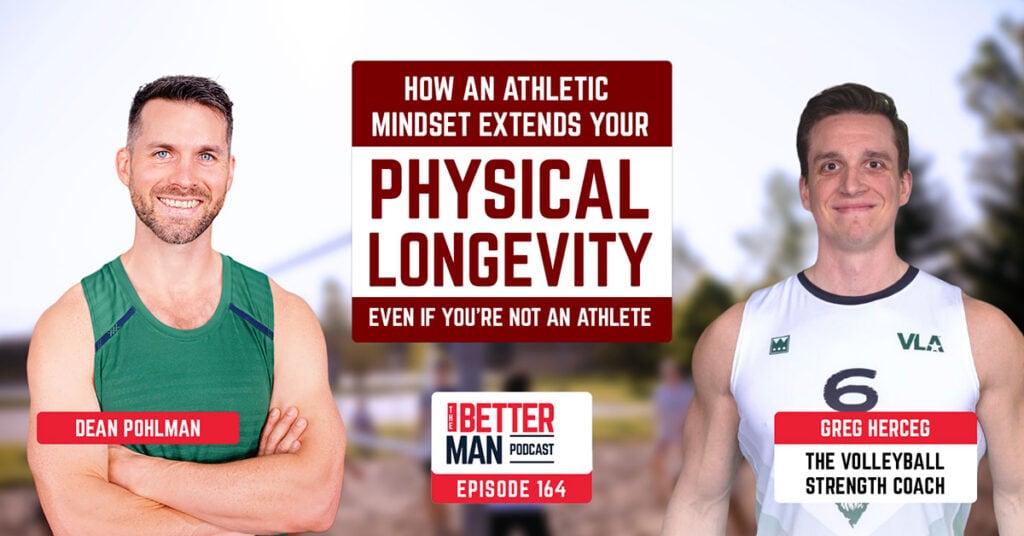
How an Athletic Mindset Extends Your Physical Longevity Even If You’re Not an Athlete | Greg Herceg (The Volleyball Strength Coach) | Better Man Podcast Ep. 164
Unlock physical longevity by adopting an athletic mindset, regardless of your sports background. Greg Herceg joins the show to share how…
Building A Life That Matters | Brian Dubow (Hit of Happiness) | Better Man Podcast Ep. 163
Brian Dubow joins the show to share his journey from empty success to authentic joy. After a quarter-life crisis revealed his…
How To Navigate Coming Out Late In Life | David Cotton | Better Man Podcast Ep. 162
David Cotton’s story proves it is never too late to come out. After a career as an Air Force Brigadier General…