Everyone lives in a world of their own creation through their conditioning, their thought patterns, and their behaviors. The problem is, this route leads to pain because it severs the connection with your true identity.
When you’re disconnected from your true identity, and you forget to remember who you are, you’ll wake up one day and realize you’re living a complete lie. Instead of creating a life that makes you happy and fulfilled, you trade your future for someone else’s opinion of you.
Today’s guest, retired Navy SEAL Commander Mark Divine, was lucky enough to discover this early in his life thanks to his meditation practice.
His conditioning told him that he was going to business school to join the family business. But a few months after getting his MBA and CPA, Mark decided to give it all up to become a Navy SEAL because his meditation practice created enough stillness that he remembered he was a warrior.
Despite being a “civilian” (who have terribly low success rates of becoming a SEAL – only about 10 to 15% make it), Mark’s meditation practice allowed him to reconstruct his identity and become the #1 student in SEAL training.
As Navy SEAL Commander, Mark introduced other SEALs to meditation, yoga, and fully integrating the body, mind, and spirit. Since he’s retired, his Navy SEAL training program (called SEALFIT) has had incredible success.
Mark’s students who went through his SEALFIT program had a 90% success rate of joining the SEALs (which is even more impressive when you realize the failure rate is between 85-90%).
He’s also authored several best-selling books that are designed to help anyone rediscover their true identity.
This conversation won’t just open your eyes, but it will be deeply inspiring too. Listen now.
Here’s what Mark and I discuss:
- How to start meditating and the reason why so many people fail at it
- Why remembering who you truly are helps you stumble on your true identity
- How integrating all your training can greatly accelerate your journey to self-awareness
Listen now!
The Better Man Podcast is an exploration of our health and well-being outside of our physical fitness, exploring and redefining what it means to be better as a man; being the best version of ourselves we can be, while adopting a more comprehensive understanding of our total health and wellness. I hope it inspires you to be better!



Use the RSS link to find the Better Man Podcast on other apps: http://feeds.libsyn.com/404744/rss
Episode 165 Highlights
- How your mind gets conditioned (by your parents, society, schooling, and more) from the very second you open your eyes in this world (4:14)
- This book can reframe spirituality for you (without any religious overtones) and make it easier for you to tap into “Zen” (8:28)
- How to become still enough to hear your soul’s whispers and discover your true calling (12:54)
- The #1 source of angst among men in the world (and the trick Mark used to avoid living a life of quiet desperation) (14:00)
- 3 things you must do to break through separation and tune into “Unity Consciousness” that turns the universe into your silent partner (15:35)
- Why the “descriptive-prescriptive fallacy” makes meditation impossible (and a simple mindset shift that makes mediating as simple as riding a bike) (20:27)
- How to change the very nature of what you believe to be true about yourself (32:03)
- The incredible story about how Mark used meditation to change his identity, join the Navy SEALs off the street, and become the #1 student in his SEAL training (37:42)
- Why figuring out how to navigate “VUCA” is like becoming Neo in the Matrix (in fact, according to Mark, this is what SEAL training is all about) (40:19)
- How training to be softer, more flexible, and more durable is the ultimate “strength training” for men (54:29)
Dean Pohlman: Hey guys, it’s Dean, welcome to the Better Man Podcast. Today’s episode has a very special guest. This is Mark Divine. He is a retired U.S. Naval Seal commander. He’s an entrepreneur. He’s an author. He’s responsible for creating the Seal Fit and Unbeatable mind programs. He’s also responsible for integrating yoga and meditation training into Seal training. So this is a guy who comes from two different worlds and integrates them.
Dean Pohlman: And for that reason alone, this is a very special interview. During the conversation I had with him, you can tell that Mark is just a uniquely focused, calm human being. It’s a testament to the meditation, that he’s done to the military training that he’s done. And I think that everybody, regardless of background or goals or whatever, will truly benefit from listening to this conversation.
Dean Pohlman: This was a very powerful conversation. It was very inspiring and I hope it inspires you to be a better man. Hey, guys. Welcome back to the Better Man podcast. We’ve got Mark Devine here. Mark, just want to say I’ve known you for a long time, which you already know, but, I’m excited to have this conversation with you.
Dean Pohlman: And I think this is a really unique perspective that we’re bringing. So I hope lots of other people tune in as well.
Mark Divine: Thanks to him. Appreciate it. I can be sure you have me on. Super. Nice to meet you. Yeah, yeah.
Dean Pohlman: So, so for those of you who don’t know, so Mark Devine is a was a commander, retired commander. You retire with the rank of commander? That’s right. Of of the Navy Seals and, he was one of the first guys who really made, was trying to make yoga kind of more mainstream. For men’s fitness.
Dean Pohlman: And he. I actually found a book of his, I think, ten years ago, called Kokoro Yoga. And that was, you know, I learned this later on, but that was that was essentially what the format that you were using to teach Navy Seals, yoga postures for, for their fitness. So that’s how I first learned about you. And then, you know, I had someone, someone from your team reached out and said, hey, we’ve got Mark Devine.
Dean Pohlman: He’s a blank point, but I’m like, I already know who Mark Devine is. Yes, I want him on the show. Yeah. But I think what’s also really, you know, unique about you is you bring this unique perspective as a guy who is, you know, into spiritual work, but also someone who comes from a, you know, a very, you know, you’re in a you’re in a military position and you’re in the highest rankings of I mean, you’re the Navy Seals are you know, that they’re the best.
Dean Pohlman: So we you know, you have these two contrasting kind of identities. And I’m really curious about, you know, how you view other things from that. So, so yeah, I guess I’ll kind of I’ll kind of start there and turn it over to you and, and see where you want to go.
Mark Divine: Yeah, we’ll we’ll see where spirit takes us. How about that?
Dean Pohlman: Yeah.
Mark Divine: Well, it’s probably germane to the state that, I was a martial artist long before I found yoga. I found out later, through my own inquiry, that the martial arts and yoga share a rich history, right? Can embody dharma. Was a Yogi who came kind of traveled through Tibet and ended up at the Shaolin Monastery. And,
Mark Divine: And he taught the monks their meditation, which became Chan, which became Zen. But he also taught them how to defend themselves, and that became the Shaolin martial arts. So this guy was a was a Yogi from, you know, a yoga master. Not stretching. Been the Yogi, but, you know, true yoga in the sense of the of the word from the from the Indian.
Mark Divine: You know, Himalayas. But anyway, so I was in New York, 21 years old, had just graduated from, Colgate University, upstate New York, and I was following, you know, my my training and conditioning. I don’t mean physical training, although that was part of it, but like how I was conditioned by my family and by my, by my, you know, the whole story of the time and place that I grew up, right, is that people realize, have to realize that the moment you open your eyes, your mind is being trained and conditioned right by your parents, by society, by school, by, you know, church, etc..
Mark Divine: And so my training conditioning was you’re going to go out and then be successful in business. And, we have a family business, by the way, for you, it’s over 100 years old. And so you’re going to go get this, you know, an MBA. And I had a job with Coopers Lybrand. I’m going to be the CPA and saw great training.
Mark Divine: MBA, CPA looks all really good. And then you can come home and, you know, you eventually run the family business. That’s what divines do. So I find myself at NYU Stern School of Business studying accounting of all things, which I had zero interest in. But I was doing it because that’s the story, right? That was the story ended up, transferring an MBA in finance, became a certified public accountant.
Mark Divine: But during the time, the most significant thing that happened to me, Dean, was I stumbled into this, this martial arts school. So I was an athlete already. I was a competitive swimmer, triathlete. I road crew at college. And I think, you know, I must have had lifetimes as a Yogi because there was not a bone in my body that didn’t think I would continue to move until I day I died.
Mark Divine: Right? By moving the body and staying fit and healthy and honoring this body for the capacity it had and for, you know, it being the vehicle for my soul was something that just I just understood and so I while simultaneously, I saw everyone around me in New York in that, that, you know, corporate ladder kind of rat race as pasty fat and getting sicker every day.
Mark Divine: And I just vowed never to be that. So I, you know, I ran in the morning and went to gym at lunchtime and did a high intensity workout before we even knew I’d hit, was talking about 1985, and I was looking for something to do in the early evening before I went to night school. And that’s where I found, Soweto Karate right.
Mark Divine: Which is a form of Japanese karate, a spin off of Coke. And I and, just so happens the grandmaster was also a Zen teacher. And on Thursday nights after the black ball class, I stayed one night to watch. And, you know, they pulled off these little wooden benches and about ten of the senior black belts sat down and started meditating.
Mark Divine: And I was like, wow, what is that? And they said, well, that’s that Zen. I said, well, can I join? They said, well, you have to talk to Nakamura. But before you do that, read this book by a guy named Suzuki. It’s called Zen Mind, Beginner’s Mind. So I went to the library, got the book, and it kind of pop my brain because was talking about all these spiritual principles, but in language that was not religious, it was not anything that I’d ever come across.
Mark Divine: Right?
Dean Pohlman: Did you did you grow up in the church?
Mark Divine: Yes. And no. Episcopalian, which is kind of like Catholic. Super like. Yeah. My mom was pretty devout. We would go on Sundays. I went to, you know, I went to the school and everything. But, I don’t I never really latched on to it, right. I didn’t I thought a lot of the stories were kind of silly, and I believed in the whole messaging of Jesus and everything, but I didn’t believe in the church message.
Dean Pohlman: But you kind of had, you know, that was your first exposure to spiritual principles. What was within that framework that was kind of not accessible or not understandable. So now you accessible to me?
Mark Divine: Correct. I thought the I thought the stories were a little silly. I didn’t believe in this whole idea of meeting this intermediary. I was very in touch with myself in certain ways because of, my time in nature. I. You got to understand, I grew up in a very small area in upstate New York, and, and this is a 60s, so we didn’t have TV, we didn’t have social media, we didn’t have iPhones.
Mark Divine: And I spent practically every waking hour outside. And oftentimes I was alone. And we had a, house on Lake Placid where they had the Olympics. And we spend our entire summers there. And so I was always roaming around the woods or in and on and on to the lake. And I developed a real, capacity to be comfortable in stillness and, and alone.
Mark Divine: And I felt like a real reverence for nature, like God was there everywhere. I don’t think I articulated it that way until much later when I started meditating with Nakamura at the Saito place, because when I would sit down on that bench and start meditating under Zen, I felt the same, energy, right of, like, deep connection to everything.
Mark Divine: So I think that’s one of the reasons that why I succeeded in the meditative path as opposed to like finding it through a church, you know, traditional religious path. And the book use language that was much more about, like, human potential. And this is all about training the mind, right? Is, you know, spiritual capacity, evolution, satori or enlightenment.
Mark Divine: It was something that you could strive for or attain if you, you know, if the circumstances with. Right and if you trained for it right. That’s very different, right, than having an intermediary and just, you know, hoping and praying, it gives you the responsibility back. And so now I was like, okay, I can actually do something about this.
Mark Divine: And I want to develop myself not just physically but also mentally and spiritually. And later on, I learned emotionally had to be part of that. And I had a really kind of a challenging, emotional upbringing because my father was pretty abusive and, you know, major alcoholic. So I had to, you know, do a lot of the trauma work and the emotional healing there.
Mark Divine: So that’s how I got into, like, Zen later. Learning that Zen and yoga are, like, literally mean the same exact thing. Reintegration, whole mind coming together, right? Integration of mind, body and spirit. So my, in the martial arts was like the movement practice. That’s like the asana. And then there was breathwork, pranayama. And then there was the meditation, which was concentration.
Mark Divine: Right? Meditation. Your heart also sensory development, ultimately leading to state to samadhi, which I 100% experienced after within about two years of taking up the training and doing it every day, you know, about 20 minutes of of practice every morning after my run, longer practices in the evening, in the weekend. And then we would do these four day, five day retreats at the Zen Mountain Monastery in upstate New York.
Mark Divine: My I could actually see before my very eyes, my mind transforming and changing right now, mind you, being, of course, I was 21, 22, 23, so my brain was actually still developing. This is why any of your younger listeners, if you can really take a serious look at, meditation at that age, it can transform your life very quickly because your brain is already going through very rapid changes and growth, and now you’re directing that growth.
Mark Divine: You’re not letting it happen, randomly or being directed necessarily alone by the outside, you know, external inputs or your academic training. So you’re taking a much more multi-dimensional approach to developing the mind. And that’s what happened to me. And,
Mark Divine: And I could describe the process later on, but it led to periods of deep peace, like what Michael would call flow, right? Where everything kind of came together and is everything felt really rich and almost electric around me. And, you know, I’d be I feel like I’m walking about an inch off the, the, the ground when I would leave the meditation and in those, those moments of, timeless reality, sometimes it would last just a moment, sometimes for 10 or 15 minutes.
Mark Divine: I would always, not always, but I would often and increasingly come back with some information or knowingness that I didn’t really know before. And one of the things that kept coming back to me was this sense that I was a warrior, that I was meant to be a warrior.
Mark Divine: Right. So you might like in this to like your soul’s voice, right? Or whisper, you know, the silence was able. I was able to kind of just be still enough to hear, make my calling, I guess, if you will. So that led to kind of an early existential crisis, right. So I was waking up to who I was meant to be, why I’m here on this planet.
Mark Divine: But I was in complete misalignment with that running, barreling down the road toward the money, you know, toward the family business, toward, you know, what would have been a disaster for me, but I probably wouldn’t have discovered or the disaster would have been like a freight train, you know, heading toward a cliff over a 20 year period. And I would have been in my 40s like so many other guys, wondering what the hell happened, why am I so miserable?
Mark Divine: And, right, living this life of quiet desperation and not even understanding? That’s because I completely missed and would have missed my calling. I think that’s one of the biggest sources of angst in the world, especially among men, because there’s so many more just get funneled into these career paths that really might have nothing to do with who we are and what we’re supposed to do, and how we’re supposed to serve.
Mark Divine: So I feel very grateful that I found Zen and and it slowed me down and parked me on a little wooden bench for 20 minutes to a half an hour every day. So I could slow down my mind could clear, like, you know, the dust settling in a, you know, you know, fishbowl. And I could hear that calling the voice of the calling to be a warrior.
Mark Divine: So I started to ask better questions, you know, okay, if I’m not supposed to do that, I’m supposed to be a warrior, then how? What does that look like? I certainly didn’t grow up in a military family. My father had a pretty strong negative opinion toward the military. Right. It was a place that you were in. If you had no other options, right?
Mark Divine: Basically, if you’re a loser, in his words. So it’s never discussed. So like, I was able to call my dad and, you know, ask him about this, he he would love me. He would have laughed me out of the room and judge me. But anyways, when you get close to your calling, when you get when you start asking the right questions.
Mark Divine: Then the universe does something magical. It starts to provide you answers, right? That’s where the saying, you know, when the teachers and the students ready, the teacher appears, the students asking the right questions. And so the teacher appears. The universe. Right. It’s like we live in unity consciousness that is, has the appearance of multiple multiplicity of separation, and it will always be experience of separation unless you start to slow down and, connect with, connect with your heart and to start asking better questions.
Mark Divine: And then suddenly the universe starts to look like a, like a, a silent partner, providing you the exact support when you need it in the form of a message or person showing up in your life. Right. And so my message was, I was walking home from, from school one night, and I walked past just randomly, a Navy recruiting office, and I saw a poster I didn’t even know is a recruiting office, but I just saw a poster.
Mark Divine: And in the title of the poster was Be Someone Special. And it didn’t say anything about the seals, but it was images of Navy Seals during where could they cool stuff for me, right? Freefall parachuting, locking out of its submarine ocean in the middle of the night. That kind of stuff. And I remember just staring at that poster, said, that’s how I’m supposed to be a warrior.
Mark Divine: It was very inspiring to me, and I knew that I was badass and hard to get in and hard training the hardest in the world, because I had heard of the Seals, and I just immediately knew that that’s that’s where that’s where I know how I’m supposed to serve as a lawyer.
Dean Pohlman: Can I can I go back to when you were first starting to meditate and can you maybe talk me through what was your experience as you were starting to meditate and, and, you know, because everyone thinks that meditation is about, you know, just don’t have any thoughts, right? Everyone has misconceptions that limitation is, can you walk me through what your early meditations were like?
Dean Pohlman: Like kind of bridging the gap between, okay, I’m starting out as a beginner to meditation. And then, you know, eventually what does meditation look like as you get more and more denser?
Mark Divine: It’s a great question. So for me, I just all I needed to do was follow the instructions. And so it’s helpful as a beginner to have a good set of instructions. Right. So that’s what the system like Zen or Tibetan Buddhism or, you know, you don’t find it much in yoga in the West because the systematic teaching of meditation didn’t really come with, you know, with the United States.
Mark Divine: Right. You find it a little bit like through Self-Realization fellowship, which is Paramahansa Yogananda, and a couple others. But generally those are characterized as, not necessarily yoga, but as mysticism or something, at any rate. So the simple beginner practice in Zen Zen starts, because it’s very stripped down, focused path. There’s, there’s a multitude of paths, but the two primary meditative paths are concentration, which later will open up to mindful awareness.
Mark Divine: I’ll explain how that works and what happened to me, or mindfulness. And, and that’s at least how it’s been taught in the United States. And then people also throw in there like guided visualization, which is not a meditation that’s really a concentration. Or you could just put in a separate bucket even, or like TM is largely a concentration mantra practice.
Mark Divine: So they don’t characterize it as that. They call it a monitoring practice. But monitoring and mindfulness are very close. Again, I can probably get pushback from a TM person, but, I’ve practiced all of them and TM uses a mantra, so it’s more of a mantra at any rate. So back to your original question, Zen. And Nakamura said, okay, here’s here’s your here’s your instructions.
Mark Divine: You’re going to do nostril breathing, right? So there’s some breath control work in there. You’re going to slow your breathing down, and you’re going to slowly inhale to roughly kind of five. And then you’re going to slowly exhale through your nose to a kind of five deep diaphragmatic belly breathing. Right. So you’re getting what I now call arousal control through that massage of the vagus nerve.
Mark Divine: And and you’re not going to think of anything while you do that. You’re just going to concentrate on that inhale and then exhale. And when you’re done with that, you’re going to count one. And then you’re going to do it again. And your goal is to not think of anything. So so just focused. So you made a comment earlier right.
Mark Divine: People think meditation is just just not thinking or distilling thoughts. That’s that’s a long term outcome of the practice. But it’s not something you can actually do as a right.
Mark Divine: So it’s kind of like a we like we call the descriptive prescriptive fallacy. Right. The to to prescribe sitting down and not thinking is going to doom someone to failure, but to to describe the experience of having long periods of silence absent of thought. That’s definitely possible because that’s just the outcome of a long period of practice.
Mark Divine: So instead of trying not to think, what you do is you try to think of just one thing. Yeah, you hold your attention on one thing, and that one thing is the inhale and the exhale and count one. Right. It’s extraordinarily hard because your mind immediately wants to start. It gets bored. Right. It’s it’s you’re were trained to be distractible and distracted all the time and bored if we’re sitting doing nothing and certainly inhaling and exhaling, counting one looks a lot like nothing to your ego, right?
Dean Pohlman: So that’s just one. So you inhale and you you’re not counting one, 2345.
Mark Divine: Exhale inhale and exhale one in and exhale two.
Dean Pohlman: Oh there’s two okay I just said one over and over and.
Mark Divine: No not over. So I could have been more clear. But the goal was to get to ten okay. It did. It literally took me like six months before I got even close to ten without it.
Dean Pohlman: Thinking of other stuff, getting right, okay.
Mark Divine: Without getting distracted around thinking. And so in the beginning, I like most people, I trick myself. I would go inhale, exhale one, you know, like I’m doing I’m doing pretty good and I would get to ten. I’m like, that’s pretty easy. And you know, it took maybe a week or two before I realized, oh, you know, actually thinking the entire time.
Dean Pohlman: Yeah.
Mark Divine: Right. I’ve got this yeah, recursive dialog going on. But I’m like, so we learn quickly that we can also split our attention. We can hold our attention. And, you know, like so one in the inhale for two counting the ten while simultaneously our mind is running on. Right.
Dean Pohlman: Yeah. So that’s that’s been my experience of meditation is I’m usually good for a few breaths. And then I start thinking about how to talk about meditation on social media. Right. How do I describe this to people? Right. Yeah. I’m like and then I’m like, oh crap, I’m doing that thing again. Okay, go back to the key.
Mark Divine: It’s just like with fitness or, you know, when I first started Ashtanga yoga, when I was a soup sandwich, you know what I mean? I practically lost control of my body. It was so hard. And just through daily repetition, you know, over the course of a year and a half to two years, I could finally complete the first series.
Mark Divine: And we ran to the second series. So, you know, or learning how to Olympic or anything really, like any physical training thing like that requires the mastery of complex movements like yoga or, tai chi, you know, martial arts. It’s just repetition. So meditation is the same thing. You’re training your brain and you have to just get the reps in.
Mark Divine: And over time, you begin to notice the differences that begin to notice the the effects of the meditation. But it’s pretty subtle with meditation and we’re not taught really well what to look for. So back to why it’s also helpful to have a guide or a teacher that you respect is if the teacher says, just show up and sit and do the work and the results will come, then you’re more likely to just so show up and sit and do the work and, you know, hope the results will come, even though you may not have evidence of it early on.
Mark Divine: Whereas if you try to do it on your own and you’re just using an app like headspace, like it’s very easy to trick yourself that you suck at it or that, it doesn’t work for you, right? You’re different somehow. And so most people get distracted and quit, right? But I, I really respected this Nakamura. He was he was a real father figure for me.
Mark Divine: You know, total contrast to my biological father. And so I revered this guy. I almost didn’t want to let him down. And so I stuck with it. And I think that plus, my familiarity with being alone in nature and already having, you know, some ability to to kind of be still and not get bored with it, led to some great success.
Mark Divine: And so but but it wasn’t quick by any stretch of the imagination. You know it. Like I said, it took me about six months to where I can legitimately do the practice as prescribed and get close to ten or if not ten. And then I would start to, the process for me and this is, this is where I made a comment earlier that concentration training, I think, especially for a Westerner, is should be the prerequisite.
Mark Divine: And not only that, but a healthy physical body is as a prerequisite. This is why I think yoga is such a profoundly valuable tool, because your body’s going to get really healthy, multidimensional, healthy, inside and out, while you’re also really stabilizing your mind through the breath practices, both of which set the conditions for you to be able to be very successful and effective at meditation with your meditation.
Mark Divine: But if your body’s out of shape and your brain, then your brain is out of shape and it’s going to be operating in a, you know, a high beta gam all the time, and which is going to lead to the feelings of anxiety and racing thoughts, you’re never going to succeed if you just sit down and try to meditate.
Mark Divine: So getting the body healthy. This is why in the eight limbed system of yoga, after the Yamas and Neom is, which are the ethical principles and the disciplines, right? Then came asana, which is the physical practice, the movement practice. Then you would, you know, especially the younger and newer, people coming to the traditions would spend a lot of time there just to get the body ready to sit and meditate.
Mark Divine: And then after asana came pranayama breathwork to stabilize the mind and help you turn your attention inward. And then your hara, which is the, you know, sensory awareness and turning, you know, listening to your inner senses instead of just the outer. And then came concentration training. Just like in Zen, concentration came before meditation. So there is a sequencing to this.
Mark Divine: But I had stumbled upon martial arts with Zen, had the exact same sequence physical training through karate and breathwork, through the karate and movement and and and an ethical foundation through the warrior disciplines of karate is no different than Yamas armas. And then we got into concentration and that’s where they stopped. At least that’s where the training I got stopped.
Mark Divine: But what happened then was after a chunk of time, right by six months, between 6 and 9 months or six months in a year, I had gotten really good at at that attention to try and concentrate to where I could really, really dial it in. And it took effort, you know, almost like I remember a breaking a sweat sometimes, like, because you’re really focusing on that one thing that’s efforting.
Mark Divine: And Efforting will only get you so far in meditation, but it’s necessary. Like I said, it’s necessary prerequisite to to what happens next. So with all that effort, it starts to become your your mind gets more focused, right? You get really focused. It’s great for getting shit done right because you’re gathering up all the energy they used to like throw out like a floodlight.
Mark Divine: Those 60,000 thoughts that you have every day. But but you now you’re learning to really, really narrow it so your mind’s becoming more like a, like a flashlight or a laser beam. Maybe you cut through things really well, really get deep and do deep work and understanding. But with that level of concentrated effort, it also becomes very clear when your mind pops off of that and starts thinking again.
Mark Divine: And so you’re able to be like, oh no, I’m not. I’m thinking I can bring it back really quickly. And so you your ability to hold your attention gets better and your concentration gets better. And your observation that you split your attention gets better. And so then what naturally happened with me is that I started to ask, oh, well, this is interesting because there’s part of me that’s over here thinking, and there’s part of me that’s concentrating, and then but there’s part of me that is just aware of both observing, both.
Mark Divine: Like, that’s really wild and like, there’s my brain is like, now split or it’s there’s three things going on. Apparently there’s thinking, there’s concentrating on one thing, and then there’s the observation of both of those things happening.
Mark Divine: And so I started to really just sit with that observer. And what happened was I started to see that the thoughts that kept coming up were really recursive. And repetitive. Looping a lot of them, you know, fear based rumination could have, should have, would is and they were all colored by.
Mark Divine: That conditioning I talked about of who Mark was from, you know, birth up until this point in time in him. And I could see all that like as if I was watching a movie.
Mark Divine: And yet I could also see very clearly or experience very clearly that that wasn’t who I was because I was watching.
Dean Pohlman: So you had a very clear experience that that was different from your true self or your higher self?
Mark Divine: Yes. Or whatever you want to call it. I call it awareness.
Dean Pohlman: Awareness.
Mark Divine: And and I use the term witness when I teach it. So, so to really try to, you know, you first kind of get a taste of the witness. And I can guide people to that because it’s that aspect of you that just actually knows that you’re alive, feels the aliveness. You know, the I am this is another term that’s used like I am witness and everything else is thought.
Mark Divine: And that thought has a certain quality to it. Based upon your training and conditioning, based upon the world you’ve experienced, your beliefs, your perceptions. So I quite naturally opened up into this mindful awareness that, oh, I am not my thoughts. Yeah, thoughts happen, but I am not my thoughts. So if I know my thoughts, then I can change them.
Mark Divine: And I don’t mean just like like the statement of changing your mind. I mean like literally change the very nature of what you believe to be true about yourself, your identity. So combining that insight with this growing sensation I had that I was meant to be a warrior. I was like, okay, if I am not my thoughts and I’m getting these messages, I’m supposed to be a warrior, then I need to reconstruct my identity, to start to perceive and believe that I’m a warrior.
Mark Divine: So the martial arts were already chipping away at that, right? I was getting a lot of great, you know, hand-to-hand combat training, you know, the total warrior, right? Mind, body, spirit. But you think of, like, in the samurai. That’s that was the training I was going through. And I trained hard six days a week, and I started to read everything I could about special operations.
Mark Divine: And, you know, there wasn’t a ton back in the 80s, but, you know, it was enough books by seals written, you know, from Vietnam and other things. And I started to visualize myself as a Navy Seal trainee. I had a video which was also called Be Someone Special, which was a Navy recruiting video, which is funny, that they would even have it because the Seals were a secret organization at the time, and and the recruiters tried to like they warned me they told me not to try because it’s too hard to get into, especially for a civilian like me.
Mark Divine: And the recruits all came from, you know, seasoned military vets in the, in the Navy or Marine Corps or Army, even, so I began to retrain my mind, in other words, and recondition it. And that required me to get very clear on, you know, who I believe that I was. And I developed, you know, lists and, and boiled it down into, pretty brief statement.
Mark Divine: Right. So I use three kind of anchors. What is my purpose as I go? My purpose is to be a warrior so I can serve right. I can serve my country and ultimately humanity. And then what am I passionate about? Right. And so I had to get clear about what my likes and dislikes were. And when I found theirs, I didn’t grow up with the ability to really ask that question or think about it.
Mark Divine: I was kind of like told what to think, which, you know, which leads to codependence that comes that happens pretty frequently in a it’s not a direct result of growing up in a dysfunctional family. So I had to get clear, starting with what I don’t like and what I realized. I don’t like practically anything about the lifestyle I’ve chosen.
Mark Divine: Right? Except for except for the martial arts. I didn’t like the people I was working with. I didn’t like the work I was doing. I didn’t like living in New York. I didn’t like being inside all the time. I didn’t like wearing a suit. I didn’t even really care about the money. So I was basically living a lie.
Mark Divine: And in that practice and journaling on this and really getting clear about what I didn’t like, expose that to me. So then I started to ask, you know what? What do I like? And, you know, that’s when I started to say, well, I really like training. I like meditating, I like being outside, I like adventure, I like risk, I love fitness, okay.
Mark Divine: And then I had to ask, what are my principles? What do I value? In other words? And in a similar thing, I really didn’t value money. I didn’t value,
Mark Divine: Then value the things that I was doing, even though I was doing them to look good. So I saw that. Right? I was trading, my future for.
Mark Divine: Someone else’s, opinion of me.
Dean Pohlman:
Mark Divine: And that’s when I said I’m not going to do that any longer. Right. I don’t care what my parents think about me. If I leave, I don’t care what my friends think about me. I don’t care what my peers think about me if I turn away from the money because this is not their life. This is my life.
Mark Divine: So that’s that’s the power of opening up to this mindful awareness. When you can see your life as a drama or a story, a play, and you say, well, I’m a participant in that play, but I’m also the author of the play, and I’m sitting in the audience watching it. So if it’s entertaining and you love the outcome, great.
Mark Divine: Just refine it, keep it going. But if you’re watching that play and you see that the character you’re playing is in a slow moving train wreck, then you might want to rebuild the script right in real time. So the the play has a different direction to it, right? Act two is suddenly Mark’s not a Navy. I’m not a CPA and MBA earn a ton of money, but act two is Mark is now in a world class elite Navy Seal officer, right?
Mark Divine: Doing adventurous and dangerous things and serving humanity and serving his country. Yeah, so that’s the story. I rewrote the identity to build upon those principles and my passion and my purpose. Then I was off to the races. In November of 1989, I got my MBA from stern. I got my CPA from New York. I got my black belt from Nakamura, and I walked away from it all to go to Officer Candidate School and then under Seal training in 1990, meditation was every bit as responsible for that as I was, right?
Mark Divine: I mean, that was the that was the tool and the process and what it did to my brain was extraordinary. And when I went to Seal training, you know, my class number 170, we had 185 hardcore students in it. And by the end of the training, six months later, we had 19 and I was number one graduate. And the six other guys who kind of formed up with me in the first couple weeks, we call it a boat crew.
Mark Divine: They were standing there with me because I taught them these, you know, basic, simple skills about how to stay calm in the midst of all the stress, right through breath control training. This is where when I started seeing fit, I use a process called box breathing, which is just controlled breathing, you know? And so I taught them box breathing.
Mark Divine: And then I taught them mental management and how to, you know, make sure that we all had a very positive, internal dialog to ourselves as well as to each other, because I learned that through karate, through the fighting, a karate that if you start talking to yourself negatively or thinking, you know, negative thoughts that you lose every time.
Mark Divine: So the I learned the power of your thoughts. Your thoughts shape your reality, and your thoughts are sending signals to your body all the time. And so negative thoughts weaken you and positive thoughts strengthen you. So, I taught them that and we practiced that, and I taught them the visualization practice. I said, you know, this is really helpful for me.
Mark Divine: We got to visualize the wind. So what’s what’s the wind like? It looks like us all graduating, you know, together. And so we would talk about that and we would visualize it. And then any time we had a heart evolution, we’re like, let’s talk about what is what is the wind look like. Let’s get a clear picture.
Mark Divine: So we’re all shooting for the same thing right? And then I also taught them, How to see arousal control is, is the ability to be calm. But, you know, if you’ve got nonstop stress and chaos coming at you, we call that Vuca volatility uncertainty complexity ambiguity. So seal trading is basically training you to navigate Vuca. And if you can’t do it you’re out.
Mark Divine: And so I taught them basically how to be like kind of neo in the matrix business. Well before the movie was out to where, you know, if an instructor starts screaming something at you, people immediately take that on and their their thoughts get and emotions get completely wrapped up and engage and they lose autonomy. They lose control, and then they start spinning out of control.
Mark Divine: And then their their thoughts start going negative. I can’t do this. You know, this is crazy. And then they forget why they’re there and they quit. And so I taught them that those words.
Mark Divine: Are like, you can stop them in midair and you can have you can put this invisible forcefield up and you you might hear words and you might, you know, feel them coming at you, but you don’t engage with them.
Mark Divine: Right. You stay quiet inside doing your breathing and managing your mind. And then together as a team, we’re going to pause and we’re to, you know, figure out what is actually being said. Or as an individual in that scenario, you’re you’re able to create a space between the stimulus and your response and formulate a productive response. And that we got really good at that, right where it was nearly instantaneous.
Mark Divine: So we were always acting and responding better than the other boat crews and the other, you know, people in our class because of these skills.
Mark Divine: You know, later on when I got out of active duty, you know, after a couple other entrepreneurial endeavors, I decided I really wanted to go back and teach these skills to the sales. And so that’s when I started seeing fit. And my first, like, real foray into trying to develop these things was a I developed a 30 day academy, imagine, like an American Shoreline Academy, so that students would come and live with me at my institute training center for 30 days at a time.
Mark Divine: We’ve put them up, we’ve set them. We train from, you know, for 3 to 5 in the morning until 10:00 at night. The graduation ceremony after 30 days was 50 hours nonstop training, no sleep. And that was to simulate Hellwig, Navy Seal, Hellwig. And it was such an incredibly, intense and creative time for me, because then you’ll treat this as someone who has designed yoga and different programs, like here I am.
Mark Divine: I’m responsible for these warriors, all of them fit for 30 days. So I need I need the curriculum, I need and I need to innovate. It needs to be effective, because these guys are going to go off into the hardest training in the world. Navy Seal training or Special Forces or SAS. And I want to I know what success looks like because I’ve seen that in folks like Nakamura and in my, actual Seal training.
Mark Divine: You know, were the most elite warriors, had this capacity that I was talking about either naturally or they, you know, had some mentors like I did. But it’s a very small percentage because the Seals didn’t teach these things. They do now as a result of our work in Seal Fit, but they didn’t back them. So I build a, physical training regimen, which which is called Seal Fit, which became a bestselling book called Eight Weeks to Seal Fit.
Mark Divine: And, I combined, you know, strength training and durability training and high intensity interval training and, stamina work and stability and, you know, the things that the seals would need and within the durability bucket, I used yoga asana and breathwork,
Mark Divine: But what I found after, you know, maybe like the first session was that I had to teach it differently because these young men, mind you, this is again, 2006 ish time frame nine, when I started that, and even back then, like, yoga was not anywhere near as ubiquitous as it is now, and especially amongst men. They just want to touch it.
Mark Divine: And, so I had the, I call it taking the fu out of the kung fu. I had to like, turn it into drills and I had to lace it with warrior language, and I had to, I had to show that it could be extremely effective as a workout or as a complement to a workout. Right. And so I created something called Warrior Yoga.
Mark Divine: And later on I had to change the name because there was a dude out there who had a program called Warrior Yoga, and he wouldn’t license it to me or sell it to me.
Dean Pohlman: Yeah. You could you can just explain to him like, no, I’m. I am the warrior. Yeah. You’re you’re I just give it to me. Oh, sure.
Mark Divine: Yeah. That’s right.
Dean Pohlman: I’ll take care of it.
Mark Divine: He wouldn’t do it. So that’s for Kokoro Yoga and Kokoro. I was really intrigued with that word because it meant, merging heart and mind in your actions or whole mind. So is is so kokoro and Zen and yoga in terms of that? What the what it means are very, very similar.
Mark Divine: And and launched a program, and my daughter, by that time, my stepdaughter was a yoga instructor and so she helped me and we ended up launching a whole program called Kokoro Yoga, which also, as you mentioned earlier, had a book, by Saint Martin’s and, and that became a whole program in and of itself.
Mark Divine: But initially I was just using it to help the Seals. It was a, it was a, a bucket for me to like bring them these skills, you know, mindfulness, movement, concentration, breathwork, visualization. So we were training it all in these 30 day academies.
Mark Divine: And then later on, after doing this for a few years, I had more and more civilians come and say, hey, listen, we want to do this training, but I’m not I’m not a military guy. Excuse me, do you still offer it for us? And I said, I can. And so that’s where I built the program called unbeatable mind, which is a it’s kind of like an American yoga, but, you know, you choose the asana, you choose the movement, practice.
Mark Divine: It’s not prescriptive, right? It’s.
Mark Divine:
Mark Divine: It’s recommended. Right. So what was prescription? Prescriptive was, a set of practices that would lead to your own evolution really quickly accelerated development. So when Bill of mind became, accelerated vertical development, meaning you’re going to change the nature of your perceptions and your reality and who you who you believe you are through the five what I call the five mountains physical, mental, emotional, intuitional and spiritual development.
Mark Divine: And we would train them all together, not as separate things, but as different aspects of your body mind that are just different experiences of the same thing. And that became a book I published that one, actually earn way more money with that book than any of the others because it’s self-published. You keep 75% the royalties.
Mark Divine: Anyway, it’s been incredible journey. Great thing for me is I’m sure your love’s a teacher. Like, we share that if you’re not practicing as a teacher, then you’re not a legitimate teacher. So I’ve never stopped practicing. Every day, 20 minutes of arson and breathwork, meditation, visualization, and a hard core workout today. Today I did it. 62 years old.
Mark Divine: You know, never going to change. I’ll be doing it when I’m 152. It’s it’s just who I am, right? And so, you know, for your audience, you guys, like, you just start training in it first, you know, it’s crawl, walk, run first. It’s hard, and then it gets easier, and then it becomes joyful, and then it just becomes who you are.
Mark Divine: And it gets a lot easier when you stop thinking, oh, I’ve got to do my breath work over here, and then I’ve got to do my workout over here, and then I’ve got to do my yoga over here. And then I got to do my spiritual work with my Bible study or church over there. And you start to bring them all together every training session.
Mark Divine: You’re training your body, mind and your spirit.
Mark Divine: And so, you know, the way I taught in the seals, like every session, every hard core workout, we start with meditation, with breathwork, box breathing, with visualization and intention prayer, if you will. For some of them. And then we would practice mindful movement or mindfulness. So treating, you know, even kettlebell swings like an asana, like being very, very thoughtful about every movement, about your stance, about your hip movement, the posture alignment, teaching them that every movement starts with intention and then with the breath, and then with the movement of the spine, and then your core and then the extremities and and so every time we train, if you feel this evolutionary movement, because you’re
Mark Divine: not just training the body, you’re training the body, the mind, you’re integrating. Right. And that has the effect of greatly accelerating your journey to self-awareness.
Dean Pohlman: So beautiful. Wow. It’s,
Mark Divine: And all that from a Navy Seal commander, you know?
Dean Pohlman: Right. I mean.
Mark Divine: You saw there’s a whole background backdrop to that, right? I’m just. I was more than that when I went into the seals at the Seals provided a lot. But even that, I think it was like all that extra training. I the way I approached it, right, with that mindfulness and with an awareness is why that, like, I think that it amped up the effect on me because seals already train your mind pretty, you know, pretty well, like some extraordinary guys, you know, who just get even more extraordinary as a result of the the intensity level of the, you know, physical and mental training that the seals put you through.
Mark Divine: So if you can add to that, like they are now finally doing, if you add to that the visualization, breathwork, mindfulness, you know, positivity, all that. It’s like, development on steroids. Yeah.
Dean Pohlman: Well, I want to I have a ton of other questions, but we’re pretty much out of time. So I’m going to go, we’re going to do.
Mark Divine: Have to do this again.
Dean Pohlman: And we’re doing another one. We’ve got a follow up on planned, which is awesome. And I really want to talk more about, since this is a big exploration just on men’s health overall and men’s self-improvement, I really want to talk more about kind of, you know, being in this, being in the military, being exposed to kind of hyper masculinity, you know, ideas that are ultimately self destructive.
Dean Pohlman: And I think missing the point of what it be, what it means to be a man, you know, balancing that with, hey, I’ve got a, you know, a balance. I, you know, I feel like you have a more balanced approach. Right. That is probably better. Which is kind of the idea behind the Better Man podcast.
Dean Pohlman: There’s a better way to be better. Can I.
Mark Divine: Address this real quick? Real quick? Yeah, I.
Dean Pohlman: Know we have to do it. It’s a it’s a it’s a preview for the for the full preview.
Mark Divine: So most people would have heard of my teammates, Jocko and Goggins. Great guys. I know them both. I highly respect, Jocko as, like, one of the best warriors our nation has ever produced.
Mark Divine: And I think. And Jacko’s a jiu jitsu guy. And I think that he is much more balanced along the way we’re talking about. But the image he projects is still kind of like, just get it done. Yeah. He, you know, Carter is better. He probably wouldn’t disagree with that. Goggins is full on radically unbalanced in that regard.
Mark Divine: Right. Go harder. Longer. Suck it up, buttercup. You’re capable of 40 times more. And he and he lives that life. But there’s no balance there.
Mark Divine: And right. It’s like the yin yang. You got to have balance, or else the universe will find it for you. Usually in the form of injury or breakdown. Right?
Mark Divine: When I train the seals. I would use a metaphor. I had to, you know, I had to use metaphors and like, stories. Right? This is the best way to teach, especially young men. So I would say, you know, hey, everyone wants to be like, freakin tough guy. The mighty Oak, right? It looks good. You can go pump the pig and put some huge muscles on, but you also have to be extremely flexible and durable and relax in the in the Seals.
Mark Divine: The Marine Corps has a term called Semper fi, which means always faithful. Well, the seals jokingly use Semper Gumby, and that means always flexible. You can’t find a way, make a way. But if you’re so stuck on yourself and you think that you’re gonna, you’ve got to have all the answers. You know, you’re that rigid, mighty oak night.
Mark Divine: You’re going to get your ass handed to you as a seal. You got to be really flexible and pliable and adaptable and bendy, you know what I mean? That’s why yoga is so good for seals. Not just for their physical body, for durability and flexibility and adaptability, but their minds. So I said, if the tsunami is coming, would you rather be the mighty oak or a reed in that scenario?
Mark Divine: And they’re like, oh, mighty oaks going to get swept away. And the reed was just going to lay down and then pop back up. They said, yeah, and that snare, I’d rather be the reed because, yeah. So you gotta train for that too. It’s actually easy to train to be the mighty Oak and go hard. Hard, hard. It’s harder to train to be soft, especially for men.
Mark Divine: But it’s going to make you stronger. Real strength.
Mark Divine: And they got it right. And once they really got that, then they really understood the value of yoga.
Dean Pohlman: Amazing. All right. I’ve got I’ve got five questions. Rapid fire, just whatever feels right. So first one is what do you think is the one habit, belief or mindset that’s helped you the most with your overall happiness or fulfillment?
Mark Divine: To eradicate negative thoughts and conditioning back a story. I know the the rapid fire, but I use the, you know, the Native American story about feeding the courage Wolf. And I use that in my teaching to, to to help people understand how important it is to stay positive because you got two wolves in your in your body.
Mark Divine: One is the fear wolf who lives in your head. And then you have the courage Wolf lives in your heart. And the one that you feed the most is the one that dominates your personality. So if you feed fear, if you got negative thinking, could have, should have, would, can’t well not get enough then you’re just you’re destroying your your self-identity and your sense of unworthiness, your sense of self.
Mark Divine: And then you’re actually weakening yourself. And that’s going to lead to sickness, injury or, or death. You could. So that was me because I grew up in a very toxic home, a lot of negative thinking. I had to literally rewire my entire internal representation in language.
Dean Pohlman: What is one thing you do for your health that you think is overlooked or undervalued by others?
Mark Divine: I started practice of box breathing the moment I wake up every single day in this practice, you know, deep nasal, diaphragmatic breathing, five count in five can hold, five can out, five can hold. That alone. I’ve seen it transform people’s lives. If you stick to it, do it every day as a daily practice, ideally 20 minutes in the morning, 20 minutes evening, but if not 20 minutes in the morning, you can’t do 20, do ten.
Mark Divine: But daily discipline that that alone will transform your life. All right.
Dean Pohlman: What’s the most stressful part of your day to day life?
Mark Divine: My son.
Mark Divine: Will have to have a whole conversation on parenting. I don’t know if I could add much.
Dean Pohlman: Yeah. Yeah, that’s that’s.
Mark Divine: A he’s a great guy, by the way. Just fantastic. But a boy. Fun to watch him.
Dean Pohlman: Yeah. What? Let’s see. He’s 26.
Mark Divine: By the way.
Dean Pohlman: He’s 26. Okay. Let’s.
Mark Divine: Let’s you think I’m talking about a little kid noise, which is flies frustrated.
Dean Pohlman: Yes. Yeah. He’s he’s he’s he’s old enough but young enough at the same time.
Mark Divine: He’s right in that the that space.
Dean Pohlman: Yeah. My last question. What do you think is the biggest challenge facing men right now?
Mark Divine: Yeah, I it comes back down to identity. I think our culture has really torched public perception, torched men’s identity through the conditioning, through social media, through even,
Mark Divine: Just languaging, you know, wokeism, whatever. Right?
Mark Divine: Men have been.
Mark Divine: Kind of demonized by the feminist movement.
Mark Divine: That’s that’s kind of a big cross to bear. And so they overcompensate, right, by thinking they got to be weak and they got to not, you know, project toxic masculinity. And so but then men who do go overboard you know, then they kind of legitimize this idea that there’s toxic masculinity because they’re just over the top right, wearing it on their sleeve.
Mark Divine: So it’s confusing. There is a real simple solution. And it’s it’s exactly what we’ve talked about on this podcast is stop believing other people’s bullshit and figure out who you are.
Mark Divine: In fact, you can even say, remember who you are because there’s a part of you that never lost that it’s always there, always present you just you just learned to ignore it. You’re looking in the wrong places. You’re looking out there for examples of how you should act or for feedback and how you should act and be. And the answer is not out there.
Mark Divine: It’s in here. So if you want to get back into balance and you want to be a real man, then learn to slow down and sit in stillness.
Mark Divine: And get to know who you really are.
Dean Pohlman: Yeah. I mean, that’s, that’s been the message that I got from this. It’s been, very inspiring to me to to remember the importance of of a meditation practice. Yeah. And breathing. So. Well, I thank you for your time.
Mark Divine: You know, it’s hard to fine everybody.
Dean Pohlman: And we’ll have you back on shortly to do that follow up. Which I’m really looking forward to. Is there anything you want to, say to people, before we sign off?
Mark Divine: You know what? We we are, living the world that we created, right? So if you don’t, you’re not happy with the world, then change it. But you got to change it in your mind first, right? You know, especially when everyone’s all focused on politics and negative news, or. Well, I’m not saying go out and change it out there.
Mark Divine: I’m saying change what you put in your mind. Change the way your mind works in starting to start to have a much more positive, vision of yourself and your future, your future self, and watch the world change around you because you are the you’re the author, right? The producer and the actor in your own little drama. Your world is the only world that you have.
Mark Divine: There’s not one world out there. There’s 8 billion worlds from the human perspective. So own your world.
Mark Divine: And create a more beautiful world that you get to play in and have a ball and be a man, a good man.
Dean Pohlman: A good man. All right, guys, better man, a better man, a human, better human, better human. Yeah. Well, guys, I hope you enjoyed this episode again. Follow up. Follow episode and coming. Mark. Thanks again. Yeah, guys, I hope this inspires you to be a better man. I will see you on the next episode. All right, guys, thanks for tuning in.
Dean Pohlman: I really hope you enjoyed this episode. This was a this was one that really inspired me. I’m looking forward to renewing my meditation practice and hopefully achieving the same level, or maybe even just a fraction of the level of, mental fortitude and kind of sense of peace that Mark has been able to, do on his own.
Dean Pohlman: And I hope it inspires you as well. So if you if you are enjoying this podcast, by the way, I encourage you to leave a review. You can do that on Apple, on Spotify. There’s also video versions of the podcast on YouTube and ad free in the mental yoga app and numbers area. If you have thought about joining mental yoga, we do have a free seven day trial.
Dean Pohlman: Go to mental yoga.com/join to learn more. And if you’re not quite ready for the trial, we do have a free seven day challenge. Pain relief challenge to get you started at Mandala yoga.com/7 DC and Marvel Yoga is the the umbrella brand kind of behind the betterment podcast. Man, for yoga, if you’re not aware, is kind of, a fitness centric approach to yoga for men.
Dean Pohlman: And I started the betterment podcast about eight years after starting then for yoga as a way to complement the physical fitness focus, to address the other aspects of men’s health and men’s self-improvement. Because ultimately, for me, mental yoga is one method that I focus on self-improvement. And the betterment podcast is a way for me to explore other aspects of self-improvement as well.
Dean Pohlman: So hopefully you’re getting something out of this. I appreciate you being here, and I look forward to seeing you on the next episode. As always, I hope this inspires you to be a better man. Links for anything Mark divine related in the description here. All right, guys. See you next time.
[END]

Guest Bio
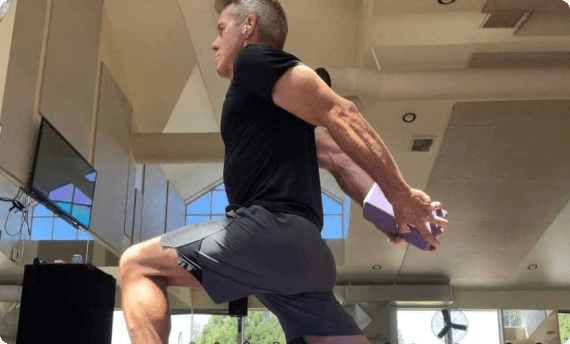
Dr. Mark Divine | PHD is a retired Navy SEAL Commander, New York Times Best-Selling Author, Founder / CEO of SEALFIT and Unbeatable Mind, founder of multiple million-dollar businesses, lifetime Martial Artist, Ashtanga Yoga teacher, and host of the Unbeatable Mind podcast (recently rated #1 health podcast and #30 overall on itunes).
The U.S. Navy selected him to create a nationwide leadership and mental-performance program for the SEALs, designed to help elite teams excel under extreme stress.
Resources mentioned in this episode:
- Find Mark’s programs, coaching, books, and podcast on his site here: https://markdivine.com/
Man Flow Yoga Events: We just announced new locations for 2026 in-person events. Find the full list of cities we’re coming to here: https://manflowyoga.com/man-flow-yoga-events/
Want to unlock more flexibility and strength, reduce your risk of injury, and feel your absolute best over the next 7 days? Then join the FREE 7-Day Beginner’s Yoga for Men Challenge here: https://ManFlowYoga.com/7dc.
Tired of doing a form of yoga that causes more injuries than it helps prevent? The cold, hard truth is men need yoga specifically designed for them. Well, here’s some good news: You can start your 7-day free trial to Man Flow Yoga by visiting https://ManFlowYoga.com/join.
Like what you’re hearing? Sign up for the mailing list:
Rate & Review
If you enjoyed today’s episode of The Better Man Podcast, hit the subscribe button on Apple, Spotify, or wherever you listen, so future episodes are automatically downloaded directly to your device.
You can also help by providing an honest rating & review over on Apple Podcasts. Reviews go a long way in helping us build awareness so that we can impact even more people. THANK YOU!
More Podcast Content
The Story of Jim’s Death & Rebirth | Jim A. | Better Man Podcast Ep. 168
After retiring from a high-stress career, Jim A. nearly died following a back injury and an accidental Ibuprofen overdose. His health…

Are Humans Herbivores By Design? | Dr. Douglas Graham (Creator of the 80-10-10 Diet) | Better Man Podcast Ep. 167
Dr. Douglas Graham explains why he believes humans are “herbivores by design” through his 80-10-10 Diet. By prioritizing raw fruits and…
Surviving in the Face of Trauma | Vince Benevento (Boys Will Be Men author & therapist) | Better Man Podcast Ep. 166
Therapist Vince Benevento discusses his son’s 135-day battle for survival and how that trauma redefined his approach to mental health. He…
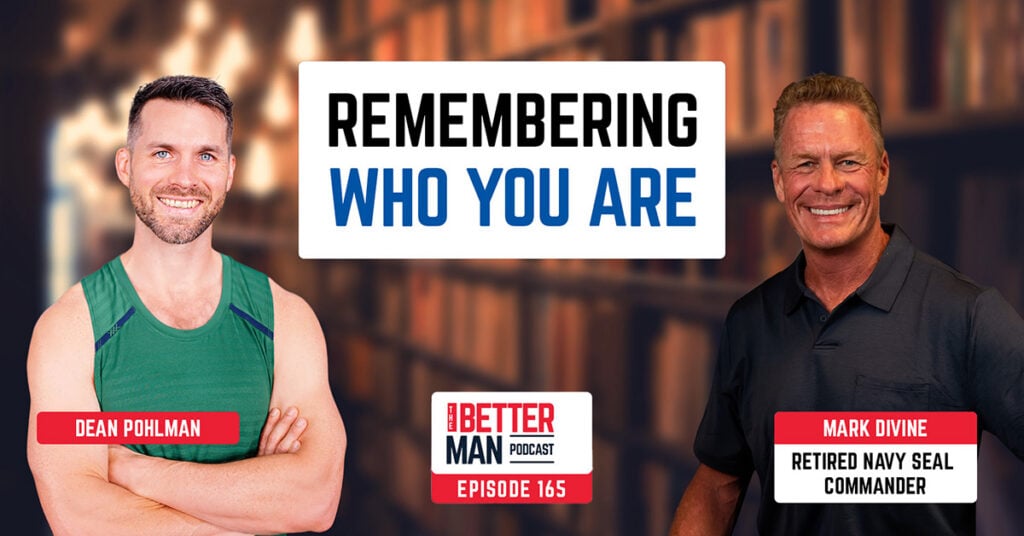
Remembering Who You Are | Mark Divine (Retired Navy SEAL Commander) | Better Man Podcast Ep. 165
Retired Navy SEAL Mark Divine joins the show to discuss how meditation and mindfulness bridge the gap between societal conditioning and…
How an Athletic Mindset Extends Your Physical Longevity Even If You’re Not an Athlete | Greg Herceg (The Volleyball Strength Coach) | Better Man Podcast Ep. 164
Unlock physical longevity by adopting an athletic mindset, regardless of your sports background. Greg Herceg joins the show to share how…
Building A Life That Matters | Brian Dubow (Hit of Happiness) | Better Man Podcast Ep. 163
Brian Dubow joins the show to share his journey from empty success to authentic joy. After a quarter-life crisis revealed his…