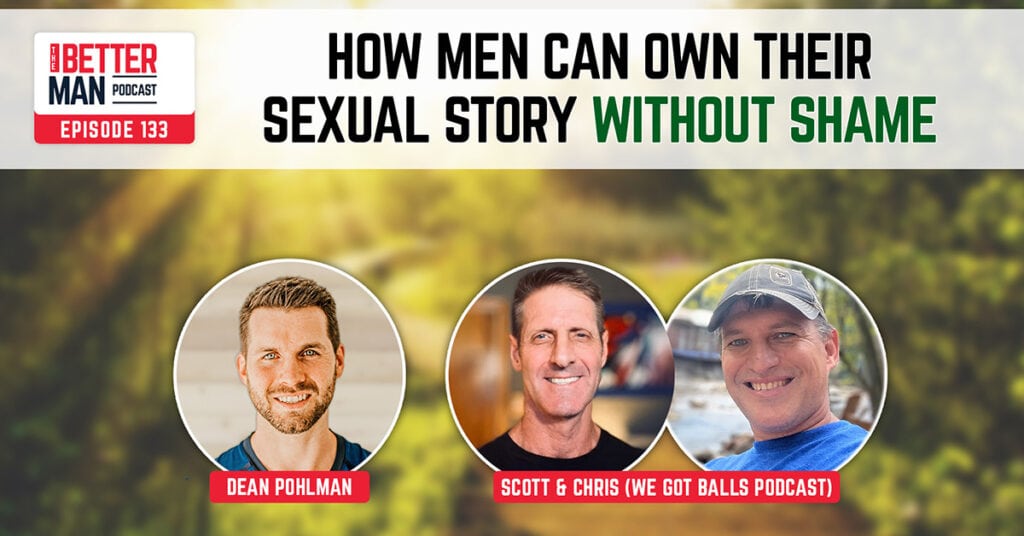
When you want to be a better man, there are an endless number of routes you can go down: Exercise, relationships, personal development, mental health, and the list goes on.
And yet, there’s one route that’s so dark and gloomy and lonely that it never even crosses the minds of most men: Your sexual story.
That’s why I invited Scott and Chris from the We Got Balls Podcast back onto today’s episode.
Thinking about, addressing, and then owning your sexual story is not easy. In fact, it’s one of the most difficult challenges you’ll ever face.
But you know what?
We all have sexual stories. Some are wicked and involve sexual abuse. Others are mild and involve more silence than anything. But all of them create shame. And this shame, while you may be able to handle it most of the time, can disrupt your relationships, butcher your confidence, and blossom into addiction. Especially when it’s stacked upon the stresses of everyday life.
This is not an easy episode to listen to. Scott in particular shares the ins and outs of his dark sexual story (spoiler: it involves sexual abuse).
But if you’re struggling with addressing and owning (or even remembering) your sexual story, I encourage you to listen to the entire show. You’re not alone. And every man deals with their own sexual story which creates the shame cycle many find themselves trapped in without understanding why.
Here’s what Scott and Chris share in this episode:
- Why you must engage your story if you want to get rid of the shame
- How your family dynamics create the script for your sexual story
- How to heal your sexual brokeness
Listen now!
The Better Man Podcast is an exploration of our health and well-being outside of our physical fitness, exploring and redefining what it means to be better as a man; being the best version of ourselves we can be, while adopting a more comprehensive understanding of our total health and wellness. I hope it inspires you to be better!



Use the RSS link to find the Better Man Podcast on other apps: http://feeds.libsyn.com/404744/rss
Episode 133 Highlights
- Why do men have so much shame around their sexual story (and how to overcome it) (2:16)
- How being open about your sexual story can prevent an affair, divorce, and heartbreak (4:05)
- The weird way sexual abuse and emotional disruption gets passed down through generations (even if you don’t have any personal experience with it) (6:15)
- The “Engage Your Story” secret for changing the meaning you’ve ascribed to traumatic situations so they don’t haunt you anymore (14:08)
- How to have healthy sexuality that you can sustain long-term (and why it’s such a hard conversation for men) (18:28)
- Here’s why 38% of sexual abuse victims don’t remember it (even if it’s been documented by third parties) (23:13)
- Why addiction, no matter what kind of addiction, is the go-to solution for men to cover up deep, subconscious pain (26:21)
- How recovery groups pile on shame instead of alleviating it (and why having a kind friend can make recovery easier and more effective) (29:17)


Resources mentioned on this episode:
- Subscribe to the We Got Balls Podcast hosted by Scott and Chris on YouTube here: https://www.youtube.com/@WeGotBallsPod
- Buy Unwanted: How Sexual Brokenness Reveals Our Way to Healing by Jay Stringer (the book mentioned in this episode) on Amazon here: https://amzn.to/3QRkif2
Dean Pohlman: Hey guys, it’s Dean. Welcome to the Better Man podcast. Today’s episode is an interview with Scott and Chris from the We Got Balls podcast. We’re continuing our conversation. And in this topic, it’s going to be specifically on owning your sexual story. We talk about how understanding your sexual history, understanding your sexual abuse, if there was any, extra understanding sexual trauma and how understanding that and being able to examine it and potentially rewrite your understanding of it can help you be a better man, a better father, and a better partner.
Dean Pohlman: So I think this is a really great episode. I think it’s highly beneficial for anybody, even if you think that this isn’t part of your story, and I encourage you to give it a listen. So guys, I hope this inspires you to be a better man. Here we go. Hey guys. This seen welcome to the Better Man podcast.
Dean Pohlman: Today I’ve got repeat guest Scott and Chris from We Got Balls. Today we’re talking about how you can be a better partner or a better father and a better man by owning your sexual story. And I’ve always been intrigued by this concept of what is your story? This is something that we’re not really taught what this meaning is.
Dean Pohlman: And so we’re going to get into this, and specifically around this, this, the spear of what is your sexual story? So I will turn it over to Scott. No. Chris. Chris.
Chris Inman: Yeah. Let’s hear from you. Let me let me take that one of the top. Thanks for asking. That’s a great question. You know, when we talk about story and big picture, my story is just my understanding of my experiences. So, a childhood story is how I view my growing up years. And the crazy thing about being a kid is I didn’t know any better.
Chris Inman: I didn’t have anything to compare it to. So what happened is what happened. And so most people just feel like their story was okay, pretty good. Maybe there was some big trauma, like car crash style experiences in your childhood that mark some negative, memories. But for the most part, people are. You know, I had a mom and a dad, or I didn’t have a dad, or I was adopted or, you know, so that’s kind of the story narrative, but specifically around your sexual story and which is a question that we kind of stumped people on in that trust.
Chris Inman: Scott, when we asked that question, it’s kind of like, yeah.
Dean Pohlman: I don’t know what my sexual story is. Well, I mean, I probably could figure out, oh, no, I know what my sexual story is. Nevermind. I figured it out. Well, how are you going? Oh.
Scott Cone: Well, there’s probably a lot of shame around your sexual story. It turns out, just like there is for all of us. Because it’s not. We don’t talk about sex. Particularly if you grow up in any kind of conservative religious background. There’s a lot of silence around sexuality or there’s a lot of shame or both. And so the way sexuality is talked about is just kind of crickets or, you know, it’s pathologized as bad, bad, bad until you get married.
Scott Cone: And then it’s all good, good, good. And so that’s on the conservative side. And on the progressive side, it’s like, yeah, I have sex with whoever you want, whatever you want, whenever you want. There are no rules except for consent. Yeah. And so you’ve got these two polar opposites, you know, and how our sexual story is engaged either in our family or our religious system or the culture at large.
Scott Cone: And all of those things impact how you end up kind of relating to your own body, relating to yourself, relating to other people. And then you’re developing sexuality.
Dean Pohlman: So, yeah, and this is something that we touched on in the last episode, we talked about why sexual wellness needs to be a bigger part of overall health and holistic health. And that was something that, you know, I considered important just from like a connection and, you know, connection, intimacy and, you know, stress relief. And I mean, for all the things that sex does and, you know, it makes kids.
Dean Pohlman: So I’ve got kids because of that. So that’s cool. But yeah, talking about it in, you know, in understanding yourself, that’s going to be interesting.
Chris Inman: Yeah. So for me, my sexual story was what Scott was talking about. Very religious, you know, grew up in a religious home. My dad was a pastor. So sex was bad until you got married. And so we did talk about it. We did. It didn’t come up, but in the background, my dad don’t say so. I have a story.
Chris Inman: My dad has a story. My dad’s story was he was struggling in his marriage to my mom and started having an affair, which broke up their marriage. So there’s this narrative around sexuality that nobody talked about it. We just it’s hush hush family secret stuff. But then that set me when it was time for me to kind of be curious about sex into a kind of a wilderness, a wasteland of nothingness, of sex is bad.
Chris Inman: Don’t talk about this. So that’s when, you know, I discovered porn. That’s when a really a desire for for me to act out with sex became really, really strong all through my teenage years. And so that this shame, as Scott was talking about around sexuality, created this split in me, where over here I have this upstanding, you know, very moral person.
Chris Inman: And then over here I’ll pretty much look at anything and use it, masturbate and, and just, you know, waste hours and hours of my time back. Whole weekends of my time. Sometimes you just indulge this, which, again, that’s me and my dad. There’s a whole nother side of this when we want to get to our own kids.
Chris Inman: But that’s my sexual story. Scott. What about you?
Dean Pohlman: I just I just had a flashback to Victoria’s Secret catalogs.
Scott Cone: Oh, yeah.
Dean Pohlman: That was like the. That was your first exposure? Like, why is this in the mail? I don’t know, I’m just going to look at this for a few minutes.
Chris Inman: Mine was going to the book store and looking at, naked photography books was kind of my introduction.
Dean Pohlman: Yeah. That’s art. Yes.
Chris Inman: Oh, that was an art course. Yeah. Very.
Scott Cone: Very culturally refined. Yeah. So I’m glad you started, Chris talking about your sexual story in the context of your family, because that is the important place to start. And just to reiterate the importance of story, there are only two things that make us who we are as human beings. One is epigenetics, which is how, the susceptibility to environmental stress gets passed down not genetically, but epigenetics, which is a change in the gene expression that makes us more susceptible to environmental stress.
Scott Cone: So if you have a family that’s got a lot of poverty or a lot of emotional disruption, or there’s sexual abuse back for 2 or 3 generations, what ends up happening is that susceptibility to the same type of stressors gets passed down. Epigenetics. And that has an impact on us. So there is some kind of intergenerational transmission of trauma.
Scott Cone: So one of the interesting things that you can do is kind of start to make a family tree and look at what have been the stories that kind of exist around grandma and grandpa. And you know, you’ve got you’ve got grandmas and grandpas or great grandmas and grandpas, you’ve got eight of those typically. But you may not have a, kind of a typical family system.
Scott Cone: There may be a lot of divorce, there may be abandonment. So what are the stories that kind of get passed down in your family tree for three and four generations? But the thing that ends up shaping us the most is our experiences that we have, and the earlier the experiences and the more emotionally powerful they are and the closer the relationships with others who we have those experiences because nothing shapes us more than our relationship with other people.
Scott Cone: Those are the things that really form us and shape us. And it turns out then, that your parents have the greatest ability to impact your story. So starting in the family of origin, my my mom and dad’s story, what is my relationship with my mom and dad? What was it like to be related to my mom? What was it like to be related to my dad?
Scott Cone: Because they’re modeling for me. He’s kind of, metaphysical categories of male, female, husband, wife, mother, father. And that’s how we start to make sense out of reality is these internal working models. So Chris was great. It was great to see him start there, because that’s where we invite everybody to start, not with your sexual story, but with your family story, because you have to see the soil in which your sexuality emerges.
Scott Cone: Is your family. And and a lot of our cases, there’s not a lot of care, there’s not a lot of attunement. You might have a very rigid family where there’s a lot of rules and regulations, but not a lot of relational warmth. On the other hand, you might have a lot of disengagement. You were a latchkey kid. You had to cook for yourself.
Scott Cone: You had to clean up after yourself. You had to come home after school and just watch TV. And so how your parents either engaged or didn’t engage you, how they read emotions on you, how they interacted with you, forms your ability to both regulate your emotions, to bond with others, and then to develop a healthy or an unhealthy way to go about seeking sexual connection.
Scott Cone: Nothing is more important than that. So for me, you know, my my experience was my mom and my dad, got pregnant with me before they got married. And that brought some stress into my mother’s life. She was she had an alcoholic father. She was pretty in intertwined in her life with her father. For example, as an eight year old girl, she would have to go into the bars and get him to come home, and then he would come home and fight with my grandma, and she would slip out the back door and go to the neighbors to avoid the distress of listening to them fight all night long.
Scott Cone: Well, how did that shape her? It shaped turn away where she’s not particularly fond when she’s 19, of having a baby. And so her my dad get married. And my early experiences with her were really, in fact, up until my mid 20s were fairly hostile. And that sense within me that I’m not wanted here starts to develop really early on.
Scott Cone: My dad, on the other hand, you know, he’s a typical, very misogynistic dude in the 70s. So if you’ve ever seen Mad Men, he’s like Don Draper in the business world. And my first exposure to porn was at five, crawling up on the cupboards and the shelves in our basement and discovering a five foot high stack of Playboys.
Scott Cone: So what does that early exposure to, you know, nudity in a sexual context do to my little brain is it starts to teach me this is how we enjoy other people. We strip them naked and we look at their bodies. And so, that’s the context. And then also my dad’s a really sporty, you know, sporty guy. He liked football, basketball, baseball.
Scott Cone: I’m about a year younger than all my classmates, so I don’t have the hand-eye coordination as a little guy at five to participate with them as an equal. And I feel really ostracized from that. And also got some bullying in this neighborhood we moved into around that same time. And then one of the guys becomes a friend of mine, the guy that led kind of the group that beat me up.
Scott Cone: He’s a couple years older than me, and I’m down at his house one day and he invites me into a sexual experience using a really crude word for anal sex. And I’m like, what’s that? And he tells me, and now I’m faced with the choice, do I do this thing and keep the friendship? Or do I go, oh, that’s weird, I’m not going to do that.
Scott Cone: And I chose to keep the friendship, and that moment creates a lot of arousal in my body, a lot of shame, a lot of confusion, because I don’t know what’s going on. And I leave that experience with both this kind of duality of, wow, that felt really good to be touched and held and accepted and belonging. But that felt really weird.
Scott Cone: And I think I’m I think there’s something wrong with me for liking this. So that’s my early experience with sexuality in that context, and the reason that it’s important that I tell the story that way is because what I do next in taking that, that early sexual experience. And then when I hit puberty, starting to have sexual experiences with guys my age, friends spending the night, it helps me make sense out of why that happened.
Scott Cone: Now, I could put that in kind of a cultural the cultural way to see that would be, well, I’m gay, I was born gay, and I just start experimenting out of my gayness because that’s how life goes. But that’s not what seemed true for me. And so which seemed true for me is to try to make sense as an adult.
Scott Cone: Out of all these experiences and why I started experiencing arousal and attraction to other guys in puberty and acted on that and put that in the context of who I really want to be as a man. And I wanted to be married to a woman. I wanted to have children. And so that’s the framework that I wanted to operate under.
Scott Cone: But as an adult, I found myself struggling with that duality still. And so it took me really taking the time. Most guys don’t have the time to do this until they’re in their late 40s, early 50s. You know, when you start thinking about the next stages of life, kind of your kids are grown. And I had six kids and we’d gone through some real struggles with one of our children with substance abuse, and she ended up dying.
Scott Cone: And it it really caused a crisis in my sexual life to get me to a place to start looking at what is my story, not just my sexual story, but how does my sexual story fit into the bigger story of how I came to see myself, how I learned to relate to my mom and dad? How I then relate to my wife in an intimate relationship, how I parent, and to kind of make some changes in that.
Scott Cone: So it turns out you can’t really do much about the story that you’ve been given, but once you engage your story, you can go back and you can start to make changes in the meaning that you’ve ascribed to all the experiences you’ve had. And you can point yourself in a direction that’s different than the way you’ve been living.
Scott Cone: If that where you’ve been living is disruptive to your relationships, your own sense of who you want to be, all that you know, stuff that we’re we’re trying to be better men. And so how do you do that? You have to do it intentionally. And that’s hopefully that puts kind of my story and Christmas story in the context of the bigger picture.
Scott Cone: Here is if you’re trying to be a better man, the best thing you can do is start to engage your story. That’s for your marriage, that’s for your parenting. That’s for every area of your life, including your sexuality. And it starts with kind of looking back and being curious rather than condemning or, you know, just trying harder, just stopping behavior.
Dean Pohlman: Yeah. Wow. I mean, thank you for sharing that. And, you know, I, I respect and I’m grateful for your courage and and sharing that story.
Scott Cone: So. Yeah. Thank you.
Dean Pohlman: Yeah. I mean, I can’t imagine, the, I mean, the pain of losing a child, that’s, you know, and then. Yeah, having to figure out that early experience on your own, I would assume, years later.
Scott Cone: Well, that’s that’s a so we talked about what are questions that we ask the guys. One of the important questions, Chris and I ask for a guy who tells us, his sexual story and it’s clear that what happens is abuse because the, the term that the seven year old uses with me. But fuck right. What does a seven year old doing with that term in his mouth?
Scott Cone: It sounds just as inappropriate in a seven year old’s mouth as the actual activity, doesn’t it?
Chris Inman: Well, he was given the term right, but he was also given the the idea for the activity. Nobody just wakes up and says, I want to stick my penis in random places. Maybe you experiment here and there, but to be able to tie those two things together, there’s a story with that.
Scott Cone: And until I started telling that story to other guys, Dean, I blamed myself. Yeah, there’s something wrong with that. I got aroused. It felt good to have his body on top of mine, you know, to feel that those feelings in my body to get an erection and all that stuff. But until I started engaging the story, I couldn’t see that that was a sexually abuse of experience.
Scott Cone: Now, how can a seven year old abuse a five year old? Well, if a seven year old has been abused and learns what anal sex is by an older boy, which often happens, he can pass that down. That’s abuse. So until we engage our stories, most men who have been sexually abused don’t recognize they were sexually abused because it was with another man, and they experience arousal in the context of being abused with another man.
Scott Cone: They think they wanted it or they invited it, or they have this sense of complicity. And so you kind of have to tell the stories with other guys, just like we did here for somebody to go. Have you ever considered that, that was sexual abuse. And until somebody asked me that question the answer would have been no, I was never sexually abused.
Chris Inman: In fact in in the opposite would be something was wrong with you that you enjoyed it.
Scott Cone: Yeah.
Chris Inman: Exactly. The feeling in someone’s body is they’re telling their story as I’m bad, there’s something that’s wrong with me. And so. And you talk about how that passes down to the next generation when I don’t do any work around that story, what happens is I carry that same shame into my sexual conversations with my kids.
Scott Cone: Yeah.
Chris Inman: So I don’t talk about it like my dad or I go the other direction and I sit down and have an American Pie style sex talk with my son, or I show him a bunch of porn magazines, and I offer him this smorgasbord of sexuality that’s out there without any containment, without any modeling. Just here, go have fun.
Chris Inman: And Scott mentioned earlier, just just make sure you get consent. Consent is the only rule which is chaotic in and of itself. I mean, we live in a hookup culture right now that was created because consent was the only rule and people’s hearts are breaking and they can’t get built long term relationships and they judge people prematurely. And all that comes out of a sexual story that wasn’t around.
Chris Inman: Okay, how do we have healthy sexuality where we can sustain this long term? And that’s a hard conversation to have.
Dean Pohlman: I can ask Scott, can I ask some follow up questions?
Scott Cone: Oh for sure. Yeah.
Dean Pohlman: So when you I mean, I’m assuming you did you did you. So a quick, quick question, did you remember that this happened as you were growing up or did you did you have this like memory come back when you were like in your 20s and you’re like, oh shit, I remember this, this thing happened? Or was it just constantly.
Dean Pohlman: Yeah. Great. Your mind.
Scott Cone: Great question. No, it was constantly in the back of my mind. I chase the trajectory of where my life changed to that moment.
Scott Cone: So I have an split. So memory is two types we call implicit memory and explicit memory. Implicit memory is when something happens in my body that I can’t really locate as a memory where there’s a narrative to it. But, you know, my wife throws me a certain glance and suddenly I’m filled with anger. That’s an implicit memory that’s been triggered in me, based on maybe how my mother related to me with a lot of disdain or disapproval, criticism, you know, shame.
Scott Cone: And so when my wife reflects that on her face, I’m quick to read that and I’m quick to react emotionally because in my body that comes across as a threat. So a lot of that implicit memory is kind of embedded in your nervous system, and it triggers automatically and involuntarily when we’re talking about stories, we’re talking about explicit memory, explicit narrative.
Scott Cone: I’ve got a story that has a beginning, middle and an end. Now, when it comes to sexual abuse, the interesting thing is because it’s an overwhelming experience for a child, if you’re a child, you’re not supposed to be having sex until you get into puberty and you start to develop, and hopefully you’re developing with a context to understand what your body does when it’s aroused, what sexuality does, what it’s for.
Scott Cone: You know? That’s why the education of your kids is so important, to talk to them repeatedly about their body and about sexuality, not just to have one big, awkward conversation, but to make it a part of a natural conversation throughout life like this is that’s that’s your penis. Your penis gets hard. That’s a good thing, right? And so you grow up with a sense of goodness about your sexual body and sexuality as a whole.
Scott Cone: But when you don’t get that and then you have a sexual experience, it’s confusing because a five year old isn’t intended to have a sexual experience. That’s why we prevent adults from having sex with children. Most civilized countries do. We know fundamentally that sex is a different experience than shaking your hand. That’s why we don’t allow people to have sex in public.
Scott Cone: So there is this idea that whether you’re really kind of out there on the hookup side of things and, well, whatever goes or you’re over here on the shaming. So everybody knows intuitively sex is a different kind of thing than everything else.
Chris Inman: Yep.
Scott Cone: And and so, in this particular instance, though, when you don’t have a context for understanding what sex is and you have an experience, it becomes the arousal and the goodness of physical touch and a sense of being chosen, a sense of being a belonging. You know, we’re created to belong. We’re created to be a part of. And if you grow up in a situation in your family or with other kids, and you feel alienated and alone, and then somebody brings sexual experience into that, it’s going to kind of wire together.
Scott Cone: So neurons that fire together, wired together, and it’s going to create this wiring in your nervous system and in your brain structures that pair sexual will experience sexual touch with a sense of confusion, but also a sense of belonging. Right. And there’s there’s this conflict that starts in our lives. And what ends up happening then is if we don’t do the job of actually going back and exploring what our current sexual behavior might be pointing to in our past, that needs to be engaged, we’ll repeat that stuff inadvertently, just unconsciously.
Scott Cone: Yeah, but here’s the thing to answer your your pointed question is 38% of people who are sexually abused have no memory of the abuse, even though it’s been documented by third parties. And that’s because the brain has a factor known as dissociation, where when you have an overwhelming experience, if it’s too much for your nervous system, your brain and your body separate like kind of temporarily to create this brain state that allows you to go through that overwhelming experience without it being as painful as it would be.
Scott Cone: Yeah, it didn’t dissociate. And so a lot of people dissociate to the point of amnesia. And that’s why, you know, when we start doing story work with guys, it’s common for guys to recover memories. You know, they’ll start to get flashes. And then if they experience more and more care in the, in the, in the way we engage stories, they’ll start to get a whole story that emerges.
Scott Cone: It’s not a made up memory. We’re not inserting the memory in their brain and saying, oh, you were abused. You were abused. Right? But it’s they’re naturally recovering from implicit memory, something that they have no explicit remember remembrance of. So that is that’s a fairly common thing.
Dean Pohlman: Okay. So then when you decided to end so quick answer, was it the the loss of your, your daughter. Was it your your daughter. Yes it was. So it was the loss of your daughter. Did that lead you to start to deal with, the sexual abuse from your childhood, or was there something else that led you to to really look hard at it?
Scott Cone: Yeah. It was it was a combination of, a lot of stress in my life and dealing with the loss of my daughter over the course of 21 years. You know, I was holding a lot of this tension in my body. Yeah, and I wasn’t regulating my nervous system because I wasn’t even aware of emotional regulation as a thing that needed to be engaged.
Scott Cone: And so I was constantly in this state of fight, flight, freeze going back and forth.
Dean Pohlman: You had enough. So, like all the other stress of life. And then because normally a lot of people can handle these things, right? They they can handle this low level of long lasting trauma as long as all the other stressors of life don’t this don’t add up enough. But then when you get too much, then you’re like, oh crap, I really have to deal with this now.
Dean Pohlman: And so what I really want to understand, and I think what this podcast has done a good job of is, can you help me understand what you did? What was your process for processing the sexual abuse when you really started to move through it and make meaning of it? And like you talked about figuring out what was true?
Dean Pohlman: What did that look like specifically for you?
Scott Cone: Yeah. So I had to I had to look at what my behavior, my sexual behavior was like. And at the time, right around about a year before my daughter died, I started engaging in, sexting with other guys. So this is a behavior I’d never done before. And all of a sudden, it’s coming up at this time of tremendous stress.
Scott Cone: And then when she dies, it’s just I’m in a full blown relapse into sexual addiction. So for most men, we turn to addictive ways kind of acting out. In fact, almost all addictions are driven by males. So gambling addiction, sex addiction, alcohol, drug addiction, workaholism, anything that’s kind of an addictive way of escaping emotional pain is is predominantly a male thing.
Scott Cone: Women tend to internalize what’s.
Dean Pohlman: Terry is a Terry Neal. The the don’t talk about no is there’s a book I think it’s by, men’s health expert. His name is Terrence Neal. Does that sound right?
Scott Cone: And not for me. I haven’t heard of him.
Dean Pohlman: Terrence Neal. Okay, so he’s got a book. I can’t remember his name for sure, but there’s a book that I read about this. And basically, men, instead of dealing with their emotions and just engaging with the depression and and anxiety, they do addiction instead to. That’s void. The thing that’s right in women. So that’s why women have a higher rate of depression, anxiety.
Dean Pohlman: Because men are busy addict doing addicting behaviors that allow them to association.
Chris Inman: Think we’re better dissociated than women are.
Dean Pohlman: Okay. Yeah.
Scott Cone: Cool. Yeah. And and men. So we like to sum it up by saying men act out, women act in, women turn all of their anxiety and depression inward. Men go out and try to engage the world. That’s just the difference between the male and female brain is we’re acting out. We’re trying to change, you know, the external environment to match what we want in our internal reality.
Scott Cone: So that’s why all addictions are driven by men. And, and, so it took a sexual crisis in my adult life and my wife discovering this and kind of being, oh, shit, now we’re back in therapy again, like what is going on? And so I had created my own crisis. But actually in the process of doing that, it was my own body kind of inviting me.
Scott Cone: Hey, Scott, there’s some unfinished business back here in the past that really needs to be attended to. And I had never really done the work of thinking about my story and thinking about these experiences. And sure enough, there’s a story of about one years old where where a photo of me naked was used in my family as a as a way to kind of joke and laugh and, and but it created a lot of confusion and shame for me.
Scott Cone: So we tend to with our unengaged trauma, we tend to go back to the survival strategies that we had as a child to cope with the unsurmountable pressure in our lives until we create this crisis and then we have to face it like, what am I going to do now? And so both the, the, the thing of handling the situation with my daughter, plus my own relapse into sexual addiction is what forced me to start dealing with the story.
Dean Pohlman: Yeah. And so what did you do as you dealt with the story? What were like the specific actions, the processes you mentioned you did therapy? Were men’s groups helpful? Like what did what did you do?
Scott Cone: Yeah. Like Chris was helpful.
Dean Pohlman: Okay.
Chris Inman: So in a, in a group processing of our own stories, helping people facilitate that. And so what we what we did is bonded as friends. And so we were able to kind of talk this this language to each other, man to man, which is which is what was I mean, everybody needs a kind friend or friends to be able to get to the heart of this shit, because it’s really deep and dark and lonely.
Scott Cone: Okay. And prior to that, I had been involved in kind of a 12 step recovery group here in Houston, and I had friends. But as soon as half happens in a lot of addiction recovery groups, the emphasis was all on stopping behavior and just trying harder and doing more stuff. And I didn’t really have an experience of somebody being with me without making any demands of me and without judging me.
Scott Cone: And that’s what Chris really opened the door to, is experiencing relationship in a way that didn’t bring more shame, but actually helped me face my shame and deal with a lot of my unruly behavior and start to be curious because of his kindness. Start to ask questions about why do you think that turned you on so much? Why do you think you did that particular thing at that particular time?
Scott Cone: Have you ever thought about that? And sure enough, there’s a story that goes from my current sexual struggles back to the past that as I can start to engage that in the presence of other kind and caring witnesses, I can start to actually be curious about that story. And rewrite what so so the technical the technicalities of this.
Scott Cone: As I started to write my stories out and I started to share them with other guys who could go through them with me and offer me a tune, mental and emotional caring in the midst of that. Because every time you write out a story and share it, you’re entering back into the emotional intensive of that story and how it shaped you.
Dean Pohlman: Yeah.
Scott Cone: And you’re getting what you didn’t get as a child, because if you ask the question to guys will after you had that experience with that older boy and you went home and told your mom and dad, what did they say? The answer is, oh, I never told them, why? Because I knew it would make it worse. Right?
Scott Cone: I knew either they wouldn’t pay attention to me, or they would scream and yell and create a worse situation. But what I didn’t know, I didn’t have an experience where I could go and just be authentic about what had happened to me, and have some care and connection offered in that experience. And that’s what creates trauma. It’s not what actually happens to us.
Scott Cone: It’s what happens in us when we’re alone with the things that have caused a lot of disruption. So we heal that in a kind of therapeutic relationship or friendship or group by actually doing the reversing the effects of trauma. Trauma causes us to isolate, to become very fragmented in our thinking, compartmentalized right, and to dissociate. And so we create an environment where you can share your stories and your with others, where you can start to put the pieces of the puzzle that have been scattered all over your brain and memory together to make sense out of what’s happened, and to stop disconnecting from your body and going to the addictive things, to kind of get
Scott Cone: temporary relief and start to be more present with yourself and doing things like yoga, meditation, mindfulness, meditation, calling other guys and just connecting, you know, being a group where you can tell your stories, those kinds of things that we know actually heal the effects of trauma. And slowly my nervous system and my brain begin to change, and so does my view of myself and how I do like.
Dean Pohlman: Wow. I mean, so many thoughts. You know, I’m thinking, you know, when you’re trying to consider or like, how do you even think that you need to look at your sexual past as an area of opportunity, right? Because if you’re just into this, hey, how do I be a better man? There’s so many different. There’s so many different routes that you could go.
Dean Pohlman: You could be like, well, I need to learn how to be better in my relationships. Or you could say, well, I need to work on my, my ability to be patient or I need to work on, my, my work life balance. And so, you know, there’s so many different roads that you can take, and then, you know, how do you figure out, like, I’m going to go down the learning my sexual story, learning my sexual history path because I think this is going to help.
Dean Pohlman: So, I mean, I don’t really have anything to ask, or anything, to offer other than, wow, there’s like there’s just so many different ways that you could think of addressing how to improve yourself. And, you know, this is just like, this is just one choice, I guess,
Chris Inman: Being just leave it open because what we find is asking the question and leaving it unanswered invites guys to do the work they need to do.
Scott Cone: I mean, you were doing that with me here, Dean. You were kind of modeling that, like, how do I get up and how did this happen? So a lot of it’s about just having other people who are willing to be with you and to listen to those stories and to ask you kind questions. Not like you shouldn’t have been doing that.
Scott Cone: Why were you doing that or why didn’t you do this or you know, right, right. There are a lot of questions that people ask that aren’t really questions. They’re accusations or you should have done better or whatever, but to actually be a kind presence that you can just say what happened to you instead of, why are you doing what you’re doing?
Scott Cone: What happened to you?
Dean Pohlman: Yeah, I mean, I, it’s something that I thought about and I jotted down in my notes very early on in this conversation was how you’re how your upbringing, specifically how your parents interact with you and the level of attention and nurturing that you receive from. Then how does that affect how you go see connection from other people?
Dean Pohlman: You know, I guess just my thought there is if you get what you need from your parents, if you feel like you’re getting, you know, the right level of nurturing and attention, then I just I just have to assume that you’re less likely to go, you know, seek out that connection from other people.
Scott Cone: That’s right. Or you’ll you’ll seek it out in a way that is consistent and aligned with your values and how you see yourself and who you want to be. But where we get off track is we end up going for the quick, easy, like, immediate charge of feel goodness. It’s generated by an addictive behavior, sure. And that becomes our style of relating to ourselves and the world.
Scott Cone: And we’re not created to do this by ourselves. Were created to do this with others. And so you’re you’re absolutely right. When you don’t get the nurture and care in your family, you’ll go looking for it elsewhere. And oftentimes that’s through sexual means, because there’s nothing else that generates more immediate and intense pleasure than a sexual experience.
Dean Pohlman: Yeah, I mean that that kind of explains my 20s, sex was sex was safe. Like sex was sex was relatively safe connection. Like even though it was physically very intimate, it was emotionally, it didn’t have to be intimate. So it gave me, you know, it gave me that connection that I wanted, without requiring me to do the uncomfortable vulnerability, that I really wanted.
Scott Cone: Yes. Yeah.
Dean Pohlman: So that was my sexual story. I figured that’s why. That’s why. That’s why I at the moment, at the beginning, I was like, wait, I don’t know. I said, oh, I know, I know it every month. Yeah. I’ll keep digging. But but.
Scott Cone: Now, you know, so, so go a little deeper because what you did in your 20s was coming from what happened in your teens. And those single digit years. Right? So.
Dean Pohlman: Oh, yeah. No, it was coming from the perceived lack of nurturing, as I say, perceived to like, give my parents some grace. It was come from, you know, a feel of a lack of nurturing from, and a lack of vulnerability and, just a lack of, I think, connection overall. I just, I grew up in one of those households where it’s, it’s focused on, you know, it’s focused on success.
Dean Pohlman: It’s not focused on valuing emotions. It’s focusing on success. And I know that, you know, now that I’m older, I understand, some of the things that my parents went through and why that was, those were the values that were emphasized. And I don’t, I don’t I don’t blame them. It’s something I’ve been recently exploring, though, is absolving myself of their burden and looking at, you know, looking at the looking at the trauma, trauma, quote unquote.
Dean Pohlman: Also, just to make the term simple, in my own life and saying, oh, that’s, that’s that’s my mom’s. I don’t I don’t need to have that. Like, that’s not my responsibility.
Scott Cone: That’s right, that’s right. Yeah. So you’re starting to kind of be curious about it and do the work and see how then those early interactions with mom and dad end up showing up in our sex life.
[END]Want to improve your sexual wellness, get stronger erections, and last longer in bed? Then join the FREE 7-Day Sexual Wellness Challenge here: https://shrtlnk.co/uA27H
Want to unlock more flexibility and strength, reduce your risk of injury, and feel your absolute best over the next 7 days? Then join the FREE 7-Day Beginner’s Yoga for Men Challenge here: https://ManFlowYoga.com/7dc.
Tired of doing a form of yoga that causes more injuries than it helps prevent? The cold, hard truth is men need yoga specifically designed for them. Well, here’s some good news: You can start your 7-day free trial to Man Flow Yoga by visiting https://ManFlowYoga.com/join.
Like what you’re hearing? Sign up for the mailing list:
Rate & Review
If you enjoyed today’s episode of The Better Man Podcast, hit the subscribe button on Apple, Spotify, or wherever you listen, so future episodes are automatically downloaded directly to your device.
You can also help by providing an honest rating & review over on Apple Podcasts. Reviews go a long way in helping us build awareness so that we can impact even more people. THANK YOU!
More Podcast Content
Surviving in the Face of Trauma | Vince Benevento (Boys Will Be Men author & therapist) | Better Man Podcast Ep. 166
Therapist Vince Benevento discusses his son’s 135-day battle for survival and how that trauma redefined his approach to mental health. He…
Remembering Who You Are | Mark Divine (Retired Navy SEAL Commander) | Better Man Podcast Ep. 165
Retired Navy SEAL Mark Divine joins the show to discuss how meditation and mindfulness bridge the gap between societal conditioning and…
How an Athletic Mindset Extends Your Physical Longevity Even If You’re Not an Athlete | Greg Herceg (The Volleyball Strength Coach) | Better Man Podcast Ep. 164
Unlock physical longevity by adopting an athletic mindset, regardless of your sports background. Greg Herceg joins the show to share how…
Building A Life That Matters | Brian Dubow (Hit of Happiness) | Better Man Podcast Ep. 163
Brian Dubow joins the show to share his journey from empty success to authentic joy. After a quarter-life crisis revealed his…
How To Navigate Coming Out Late In Life | David Cotton | Better Man Podcast Ep. 162
David Cotton’s story proves it is never too late to come out. After a career as an Air Force Brigadier General…
The “Core 4” Weight Loss Starter Kit (The Simplest Way To Lose Weight) | Brooks Coleman, Certified Nutrition Coach | Better Man Podcast Ep. 161
Stop the weight loss overwhelm. Join Certified Nutrition Coach Brooks Coleman to learn the “Core 4” strategy—a simple, reliable antidote to…