Today’s guest, Boys Will Be Men author and therapist, Vince Benevento has spent decades of his life helping men battle their own demons and heal their internal environments.
Vince was originally attracted to men’s mental health after facing his own share of demons in his 20s. But he never imagined how much he’d need to lean on his decades of experience when his life was uprooted in the face of an unspeakable trauma…
One day, out of absolutely nowhere, one of his sons developed an unexpected rash that suddenly turned into life-threatening illness. His son spent 135 days in the hospital. Went through multiple surgeries. And at one point, he had a sub 10% chance of surviving.
Vince and his wife spent every second in that hospital with their son as he fought to survive. And despite being a therapist, an experience as traumatic (and random) as this caused a swelling of big, heavy emotions.
Vince admits that he didn’t handle those 135 days in the hospital in the best way. But his son survived. Vince changed as a result. And he gives some pointers on how he would act today if he was thrown into a similar situation, which you’ll find instantly applicable to any traumatic event that happens in your life.
Today’s show is a masterclass in courageous vulnerability. And you’ll learn a lot about how to soothe your own internal environment too.
Listen now.
Here’s what Vince and I discuss:
- How men can have more meaningful and vulnerable conversations with each other
- The one area I’m personally stuck at in my healing journey (and why so many men get stuck at this point)
- And, of course, Vince shares the story about how he handled his son’s life-threatening illness
The Better Man Podcast is an exploration of our health and well-being outside of our physical fitness, exploring and redefining what it means to be better as a man; being the best version of ourselves we can be, while adopting a more comprehensive understanding of our total health and wellness. I hope it inspires you to be better!



Use the RSS link to find the Better Man Podcast on other apps: http://feeds.libsyn.com/404744/rss
Episode 166 Highlights
- How conventional dialogue between men chokes out your emotions and your ability to connect meaningfully with other guys (5:06)
- How to heal yourself so when your childhood wounds get poked you don’t revert back into your old patterns or search for external support (6:13)
- The counterintuitive way the traits you pride yourself on are the very things that box you in an emotional wall (16:22)
- The “Do, Not Be” trap that guys are particularly vulnerable to that causes you to replace your emotional fulfillment with meaningless achievements (16:32)
- Why success blows up so many marriages and relationships fathers have with their kids (17:23)
- How Vince handled one of the most traumatic experiences a parent have (and how he would handle it differently today): his son ended up with a life-threatening illness out of nowhere, spent 135 days in the hospital, and at one point had a sub 10% chance to survive (20:43)
- Why surrendering to deeply traumatic experiences, as wrong as it may sound, gives you the deepest sense of freedom, peace, and relief (39:51)
Dean Pohlman: Hey guys, it’s Dean. Welcome to the Batman podcast. Today’s episode is an interview with Vince Benevento in his new book, boys Will Be Men. Author and therapist Vince Benevento draws on decades of professional experience and his own journey through young adulthood to explore the challenges facing modern men. He recently published this book, boys Will Be Men, and he is the founder and director of Causeway Collaborative, which is a collection of mental health practices in the Connecticut and surrounding areas.
Dean Pohlman: In this episode, we get a bit into Vince’s own mental health journey. And how he’s been able to heal himself through his work with young men. A father of three himself. Vince also discusses a recent traumatic experience in which his son spent 150 nights in a hospital, due to an unexpected rash that turned into a life threatening situation.
Dean Pohlman: And we get really into this, and I ask him questions about how he got through it, how it changed him. And yeah, how he dealt with it as he was going through it. So, this is a great conversation. I think it’s a great example of how men can have more engaging conversations with one another. And I hope it also gives you some ideas about how to deal with your own trials and tribulations.
Dean Pohlman: So, here we go. Vince. Thanks, guys for listening, and I hope this inspires you to be a better man. Hey, guys, it’s Dean. Welcome back to the betterment podcast. Today. I’ve got Vince here with me and we’re going to be talking about, men’s mental health. I think that’s the overall overall category. Yeah. For sure.
Dean Pohlman: Yeah. So and I told, you know, I told Vince right before we started that I’m going to kind of selfishly take this in the direction that I have passion for this, which is my current situation as a, you know, kind of a dad who’s navigating a lot of the things that are, you know, that are talked about in your, in your book.
Dean Pohlman: So a lot of the things like, you know, how do you how do you balance your own, your how do you balance your own needs with, you know, with parenting and how should you be parenting? You know, you’ve got you. I think we kind of know that the generation before us probably didn’t care enough about our feelings, and now we’re like, okay, do we need to think about every feeling?
Dean Pohlman: Sure. Should we? You know, I’ve read a lot of parenting books. My I’ve read good inside. I’ve read like, hunt gather parent are the two that that I remember of the most. And I tend to have I’ve read but I also going through the those examples I’m like, this doesn’t feel like me. Like, I don’t know if I can do this and I should.
Dean Pohlman: I think there’s also differences between how, you know, how my wife would parent and how I would parent, like, I don’t I’m not going to, you know, I don’t I don’t think it makes sense that we both have the same exact styles, you know, so.
Dean Pohlman: Sure. Yeah.
Dean Pohlman: So yeah, that’s where I’m at. And I’m just coming off the weekend we talked about this, but it’s it’s Monday morning, so I’m just coming off of you know, my, my, my parenting intensive and, you know, just getting into the, getting into the office and, kind of, you know, setting up for the week and trying to you know, decompress a little from the weekend, but, you know, I’m it’s I don’t know what this this might be for you guys listening who have kids, you know, this, you might be in a similar situation.
Dean Pohlman: But for me, like, in a lot of ways, the beginning of the week is my weekend because it’s like the easiest part of my week.
Dean Pohlman: Yeah. No. For the yeah.
Dean Pohlman: You know. Yeah. The weekend can be a lot more strenuous. It can be a lot more stressful than, you know, working for me is a lot less stressful than I think, than parenting in many ways. Especially especially, you know, when I was first starting out, it was really challenging. And so, like, I looked forward to Mondays. That was like my breath of fresh air.
Dean Pohlman: Definitely better now than it was. But, anyways, so that’s my two minute rant, about setting this conversation up and, Yeah. How are you doing, Vince? What’s up?
Dean Pohlman: Yeah. No, we’re, we’re we’re we’re good. Man. I, I appreciate you. I appreciate you asking. So, Yeah, I mean, you know, obviously most of the listening audience doesn’t know me, isn’t familiar with me. So, you know, my my name is Vince. Vince Benevento. I’m a, counselor and a coach and, mental health advocate for men.
Dean Pohlman: I’ve been in the space for as long as I’ve done anything professionally. I came out of school. I was a, in-home nonprofit. Mental health counselor. Which basically meant that I used to go to kids houses who were on probation or kids who messed up or got arrested or whatever, and provide them with support.
Dean Pohlman: So I was doing support for young men before you could even really call it therapy, for sure. And, you know, had my own, you know, and I write about this. I wrote a book, which is, you know, part of the reason why I’m here, you know, talking to Dean, about men’s mental health. It’s called boys Will be Men.
Dean Pohlman: Eight lessons for the lost American male. So, you know, had my own issues with mental health that brought me to this work. You know, had my own issues within my family system, with substance use, with all these challenges that, you know, guys face in varying iterations and to varying degrees. So, you know, have have really thought long and hard about the ways that, you know, men can work to support themselves and find support in one another.
Dean Pohlman: You know, cut through sort of the, the normal, you know, conventional dialog that I think, you know, chokes out a lot of guys, truthfully, in terms of the mundane nature of the, you know, talking about sports, talking about the weather or talking about kids, that ball, ball field, so on and so forth. So, you know, how do we assist and, you know, kind of cultivate men’s ability to talk in real ways with other guys and like be in community and develop relationship, which, you know, is why I love what Dean’s doing here.
Dean Pohlman: So, you know, super, you know, happy to be here. And, and, you know, it’s a privilege to just be having this conversation, quite honestly. So.
Dean Pohlman: Yeah. Thank you. Well, here’s a here’s a topic that’s been on my mind a lot.
Dean Pohlman: Yeah, sure.
Dean Pohlman: Man, you kind of you kind of set it up. But, you know, as we, as we get older, as we get older, as we transition from young adults into whatever, whatever this is, whatever young middle adults, I guess I’m young, middle aged nut, young, young, middle aged now. Sure. And, a concept that I’ve been thinking about a lot is, is how do you heal yourself?
Dean Pohlman: Because at some point, you know, you have to give up the idea that it’s my parents fault, right? I don’t think it’s. Yeah. I think at some point, you have to just not even you have to. I think at some point you just realize, oh, my dad wasn’t Superman, you know, like, he wasn’t perfect. And rather than rather than belittle that relationship and rather than be little, that relationship or, you know, feel resentful, how do you start to heal yourself?
Dean Pohlman: I think the concept that I’ve, that, that I’ve thought about or maybe the, the phrase that I would use when I think about this is how do I give myself what I feel like I needed now, like instead of, you know, when that, when that, when that childhood wound is, you know, is kind of poked again. Yeah. How do I do deal with that on my own versus how do you, versus, you know, like seeking someone else to, you know, say, oh, it’s okay, Dean.
Dean Pohlman: And I’m wondering for you, you know, the way that you could answer this maybe is what were some of your childhood wounds that you got to work on? And how did you, you know, how did you heal yourself? What were some of those processes looked like?
Dean Pohlman: Yeah, yeah. I appreciate the question. And, you know, I think it’s a it’s an important question for people and men specifically, in my opinion, to ask, you know, I’ll start with the healing mechanism and then work backward to the, to the wounds, if you don’t mind. So, yeah, you know, the, the healing mechanism, honestly, for me, was, gravitating towards this work, you know, and I was a, you know, as I mentioned, off the top, like, I was a wayward substance abusing, you know, very mental health afflicted.
Dean Pohlman: I was diagnosed with a mood disorder when I was 19. I was hospitalized at 19. So, like, I had some deep, mental health challenges and baggage and trauma and emotional wounds, and, you know, many of those self-inflicted, by the way. Right. And so I think that’s an important separation, like, you know, the prevailing, assumption is often to, like, identify the culprit or the, you know, the perpetrator.
Dean Pohlman: And oftentimes we are the I am my own perpetrator, you know, from the wounds that I inflicted. And so I think that that’s an important piece too. But, but for me, it was, you know, when I was seeking help and seeking support, there wasn’t really anything that I like wrapped myself around that was immensely appealing as, like, an oppositional 20 something, you know, thought I knew everything, but knew very little kind of guy, you know?
Dean Pohlman: And so, you know, when I, when I started working in the therapeutic space, I started puzzling and was very curious around, like, what are the ways in which men uniquely will be more able to engage in support? Right. And what are the active processes that might work better for guys than like, you know, couch therapy for 45, you know, talking about your feelings specifically with somebody who is, you know, maybe older, you don’t connect with from a, you know, subject matter interest perspective.
Dean Pohlman: So, you know, we postulated that doing the work a different way, that was something that would resonate with men, you know, would be, you know, a, a, a, a beneficial action in general and, and open up services to a population that were much needed. But also it was very healing for me. Right, because it allowed me to think about what I might have benefited from as a younger version of myself, and allowed me to practice that stuff as still a guy who was like, you know, in my early to late 20s and then early 30s, and, and work through some of my own emotional burden and emotional baggage, you know, alongside that
Dean Pohlman: sort of parallel process. So, you know, helping others, serving others, coaching others, mentoring others, teaching others. We’re all a little bit different ways for me to help heal others and then subsequently heal myself. And with a little bit of my own kind of vibe and special sauce based on not only my unique personality, but again, what I thought would resonate with a certain certain archetype of folks too.
Dean Pohlman: And then in terms of like those specific wounds, specific traumas, specific healing, you know, it’s a lot of family origin stuff, like it is for all of us. And, you know, I think I regard my parents certainly as imperfect people as I am also an imperfect person. And, you know, people who just kind of did the best that they can with what they were able to do and what they knew.
Dean Pohlman: And so, you know, for me, the biggest, you know, challenge, one of the biggest challenges that I had was, marital infidelity and my father coming out within my family system when I was, like 17. Right. And, you know, he was outed by my mom and denied that. And so there was a lot of trust and then mistrust and distrust that perpetuated into my ability to develop relationships with people, quite honestly.
Dean Pohlman: Because, you know, a lot of, and obviously, like, all justifiable, all for, you know, reasonable, you know, sound rationale, I understand it after many, many years of therapy thereafter. But I think the consequence was I just didn’t really trust anybody. And I spent a lot of my time, you know, kind of structuring walls that that kept people at bay and never really allowed people in.
Dean Pohlman: And so, you know, the ability to trust and to be in deep relationship with somebody, was was probably the biggest one for me and something that I’m like, honestly, actively still working on to this very day, you know.
Dean Pohlman: Yeah. So when did you, you know, when did you first realize that the, the kind of walls that you had, for yourself were, I guess, when did you realize them for what they were versus the protective mechanism or the, you know, I think we have walls as a way that I think we can. I’m just kind of thinking back to my own experience, a of walls that I had up.
Dean Pohlman: And I think back to that as like, oh, those are things that I really prided myself on, right? Yeah, sure. I’m very stoic, like I’m emotionally regulated and yeah, really, I’m not at all. I’m incredibly unregulated emotionally. And I just put a I put a big cover over it instead of, you know, I’m like, I’m very emotional.
Dean Pohlman: You know, I’m very emotionally whatever, like stoic. And. No, actually, you just you just you you just you just put it in a room and close the door, and you didn’t you didn’t let it out. You don’t know how to deal with those at all. And so when did you first realize, like, oh, you know what? These are actually hurting me.
Dean Pohlman: And how did you start to, you know, what did that process look like? I’m starting to let those walls down. And. Yeah. What was the, you know, what’s the discomfort that you or the, you know, the the, you know, what’s the discomfort and the pain that you experienced when you finally started, like letting those, you know, experiencing those things you had put away.
Dean Pohlman: Yeah. No, I mean, yeah, I mean, they’re all really good questions. I think, you know, mine. A lot of my challenges manifested in ways that were not easy to conceal. Right. And so like I mentioned, like I have a mood disorder and I’ve had it for over 20 years. And so like anyone who knows me knows that I’m like, you know, both an incredibly emotional person and like, you know, can can be aggressive at times as well.
Dean Pohlman: And so, like harnessing those emotions in ways, you know, identifying that those emotions were a part of me and then subsequently learning how to harness them and do it in healthy and productive ways as opposed to unproductive ways, has been the journey. Right. And I think, you know, there’s obviously been different fits and starts and periods where I’ve felt that I was more or less stable over the course of my life with respect to, you know, how my emotional, you know, responses manifested.
Dean Pohlman: But I think, you know, a lot of it started when I mentioned I had like sort of a sort of significant mental health break in college. Right. And, you know, sought some treatment, was hospitalized, was on meds, was in therapy, like was very actively doing deep work as a, you know, 19 to 20 year old kid. Really.
Dean Pohlman: I wasn’t even a man then in my eyes, you know, so certainly in retrospect. And so that was one juncture where, you know, I was like, all right, well, like, I’m in a bad spot. I’m on medical leave from school. I’m not playing ball anymore. You know, all my friends are away at college and they’re doing all the stuff that I wish that I was doing and I’m not.
Dean Pohlman: And so I gotta get myself right if I want to go back to that. Now. The dirty little secret was, a lot of the stuff that I was doing there was pretty unproductive and pretty unhealthy as well, at least from a lifestyle perspective. You know, much of that kind of chalked up to the just the way kids do college or certainly did when I went to college.
Dean Pohlman: But I was motivated to get back there by what I was absent. Right. And the relationships that I was absent, the friendships that I was absent. And so there was a bit of an uptick in terms of my ability to manage myself well at that time. And then I think you know, there was another period of growth that came maybe a few years ago, you know, probably 7 or 8 years into my marriage where, you know, hustle, bustle, life, you know, really starts to take hold, you know, one kid, two kids, three kids in four and a half years, right?
Dean Pohlman: Like, quickens the pace of things. It’s very stressful and difficult to juggle all those things and work a job and manage, you know, I mean, I run my own business. I have, you know, a couple locations and, you know, bunch of employees. And so that’s stressful work. My wife and I, we work with each other as well, by the way.
Dean Pohlman: And so that’s another layer. And so throw all that stuff in a crock pot and it becomes very challenging. And you know, like you were saying before, Dean, like a lot of the stuff that I prided myself on was actually a significant deficit for me. Right. Like my, you know, my motor from a work perspective, my willingness to work hard, my, you know, ability to sort of punch through boundaries and push myself, you know, at work or outside of work or whatever.
Dean Pohlman: A lot of this, like, achievement oriented stuff that teaches us how to do and not be, you know, and I found that, like when I was at work achieving, you know, billing hours, generating revenue, building relationships, like growing the business. I was my happiest, honestly, and like it was very, very hard for me to just be at home.
Dean Pohlman: I think because of the feverish pace of my life at work, in my work life, you know? So I had to do not only some, like couples, work with my wife and personal work, but just like work around slowing myself down, you know, because everything that I had geared myself towards as a business owner and as a in many ways like a successful man and the stuff that people like celebrated me for in many instances was stuff that was ruining my marriage and blowing up my relationships with my kids at the very same time.
Dean Pohlman: Yeah. And so there’s this, like, very difficult, you know, kind of counterbalance wherein I think as men, a lot of the stuff that we are celebrated for and celebrate ourselves for is counter to what’s in the best interests of, you know, what’s probably most important? Truthfully.
Dean Pohlman: Yeah. I’m reading, I’m reading a book right now called, I think the spiritual man. I can’t remember the, I can’t remember the author is a data. David. I don’t know if I’m making that up. Anyway, the book’s called the. I think it’s called the spiritual Man. And it talks about a lot of the polarity between the masculine and the feminine.
Dean Pohlman: And one of the things that keeps coming up is that men are happiest when they’re working on their, their core missions, and that men will always. And I’m not talking about all men. I’m talking about the this is it specifically, you know, talks about men who, you know, tend to be more masculine. And so it says that, you know, these these guys are going to be guys who, will always value their primary mission in life.
Dean Pohlman: You know, their, their work more than their relationships. And, and also kind of, conversely, that, you know, women, the women that they’re with, or the partners that they’re with will not respect them as much or enjoy them as much if they’re not working on their core mission. Yeah. And, and so it, I think the point of me saying that, is that, you know, we’re not only are is does society and does like, you know, does our culture culture kind of reward men for, for working hard and achieving?
Dean Pohlman: But in many ways, that’s also how we’re, how we’re wired. And so, you know, that’s all that all works out fine when you’re, you know, business is going well. Right? But when, you know, there’s ups and downs in businesses and then when things aren’t going well, then you, you know, then then then then you know, the shortcomings that you have at home and your relationships with your, your kids and your wife, those, those become much harder to tolerate.
Dean Pohlman: You know, it’s it’s easier when you can go into work and you’re like, hi, this is great. We’re doing so many great things and we’re building things and growing. But when that’s not happening, you know, it’s. Yes, it’s then you’ve then you’re trying to escape from both things. Both.
Dean Pohlman: Yeah. Oh, for sure, for sure. Or or when your life gets blown up, you know, like something completely unforeseen, like, blows your blows your life up. And, you know, I mentioned this to you, Dean, but this is this is my life right now. Right? So, I have three kids, 14 year old son, 12 year old son, 11 year old daughter.
Dean Pohlman: So you got married. You got married when? How old were you when you got married?
Dean Pohlman: So I, I was 26 when we got married. And then. Yeah. So. And then, you know, had the kids. I’m 44 now, so, you know, took a year or two and then started, started having kids, you know, but I, for us. Right. Like, my, my 12 year old son last July got diagnosed with a life threatening illness, like, out of out of nowhere, like out of absolutely nowhere.
Dean Pohlman: And, like, you know, we had a 4th of July party with 100 people on the fifth. And then on the seventh, like, he had a rash on his arm, went to the pediatrician, and they rushed him by ambulance to Yale, near where we live, you know, and we spent over the course of, you know, October through July, you know, January, February.
Dean Pohlman: We were in the hospital for 135 days. My wife and I and my son, my son had a bone marrow transplant, get three emergency surgeries that saved his life. He almost died. He was on a respirator. Like it was horrifying. Absolutely horrifying. And so, you know, these are natural circumstances that could happen to anyone at any second look, for any reason, you know what I mean?
Dean Pohlman: And and when when your life you know, is just kind of humming along status quo. And then, you know, you run a business, you’re married, you’re doing your thing. And then and then all of a sudden you get sucker punch from out of nowhere. It it really makes you take pause and, and really forces you to have to make difficult decisions in real time about how to not only allocate your time and allocate your energy, but but to really conceptualize, like, what do you want to pour yourself into and, and with the with the minimal energy that you have, how do you how do you use it?
Dean Pohlman: Where are you put it and where do you get the most out of it? You know, particularly in those dry seasons you know.
Dean Pohlman: Yeah. So so it sounds like you had, you’ve had at least two, you know, two of these instances in your life where. Yeah, something, you know, came out of, well you know, this in the second case came out of nowhere. First one maybe you could have, but you were, you know, at 19, you’re probably not going to take personal responsibility for your mental health.
Dean Pohlman: You know, you’re probably just going to wait for something to happen. Yeah. Okay, cool. Now I have to fix it. So, Yeah. And I think that’s where and that’s where, you know, those are the opportunities for growth. Those are the opportunities for re aligning values when they’re, you know, when the situation is forced upon you. It’s easier to make change in those situations than compared to, you know, making it when it’s not an emergency, not when, right.
Dean Pohlman: Not not not saying that that’s, you know, you no one wants to choose to have, you know, no one wants to choose to be put in those situations. But when you’re thrown into those situations, that’s where you have the opportunity. So where did you you know, so as you’re going through this experience with your with your son last year, how did your values start to reorient?
Dean Pohlman: And you know, what was that process like.
Dean Pohlman: Yeah. Yeah. I mean I think in very heavy but very important ways, you know, his condition required him to get a bone marrow transplant, which is a very, you know, important and difficult medical procedure, but one that, you know, the rates of success are relatively high. Right? Like, he we were going into the hospital, you know, with the knowledge that there was about a 90% success rate where he would live and would recover fully and have a meaningful and healthy life.
Dean Pohlman: But that changed while we were there, right? So he got a fungal infection, which required a bunch of emergency surgeries, which really flipped those odds from like a 90% survival rate to a sub 10% survival rate. Right. So, you know, at a, at a fork in the road, you know, around the month of, you know, November where they’re telling me, you and your wife need to begin to prepare yourselves for the likelihood that is that your son is not going to survive.
Dean Pohlman: That really forces a magnifying glass onto your values in a profound way. And, you know, the there there were certainly parts of myself that were gravitating towards, I think, who I’ve been historically, which is a guy who wants to work and provide and, you know, support others and help and lead and, you know, do all these things.
Dean Pohlman: But my better judgment, you know, and and certainly in that moment, you know, my priority was to just sit with my son, you know, because I didn’t know how much time he and I had or, you know, he, his mother and I had, you know, and and I, I for I for went anything. You know, we literally sat in the hospital for 70 days next to him in a room and didn’t leave, you know, and that felt like the only thing that mattered and and still feels like the only thing that matters thereafter, albeit we’re reintegrating back into our life.
Dean Pohlman: So, I mean, I think, you know, there’s a lot of, like, colloquial, kind of cheesy conventional phrases that would encapsulate that moment around, you know, life will show you what’s really important and, you know, things of that nature. But I have never felt a more clearer sense of what my priorities were than when my kid was sick.
Dean Pohlman: And, you know, I would say only wanted to be around him and only wanted to in, in the best ways that I was able, support his getting. Well, you know, I think the challenge for me in that season and if my wife was on this call with us, she should share this with you. There was so much emotion as a very emotional guy who struggles in ways to manage that sometimes and stress and, you know, sleep deprivation and trauma activated for me and us that like, I was not okay trying to be okay.
Dean Pohlman: And, you know, and and like I was like watching my son on his deathbed quite literally and trying to be a rock for his mother and him. And I just didn’t have it, you know, and I, I don’t think I could admit that to myself at the time, and only through the benefit of a couple of months of hindsight can I can I, you know, mindfully acknowledge that, you know, I didn’t lead well.
Dean Pohlman: Yeah. What did you I mean what did you attempt to do during that time to, to get support. You know. Yeah. Like I guess here’s the question. What did you, what did you do versus what would you have done differently.
Dean Pohlman: Yeah. Yeah. Let’s good. I probably very much like you. I’m a pretty regimented person, and like, my daily disciplines are things that I’ve clung to for years to, you know, keep me healthy and well, so, you know, got up, prayed every day, you know, worked out every day like, you know, listened to, you know, a podcast or a sermon or something, you know, motivational to help me feel good about the day coming up.
Dean Pohlman: And that was like at that moment when you’re living in a hospital room, I mean, you get an hour of that or 30 minutes of that, but you take what you get and you use it to sort of restore yourself. And, you know, but those those disciplines stayed firm, right? So I think that was something that was incredibly important to me.
Dean Pohlman: But otherwise, you know, I think I was so consumed by his health, that I was and, and giving him every possible modicum of an advantage to try to beat this thing that I was just fighting with everybody all the time. Right. And whether it was doctors who were making suggestions that differed from the previous doctor or the other doctor and wanting alignment around that messaging and understanding a rationale as to why, whether it was nurses who were coming in at all hours and were not allowing him to rest, whether it was changes in his medication, like literally anything that was coming across my line of sight was subject to pushback and critique.
Dean Pohlman: And yeah, and, you know, argument’s sake and and it was I very, very clearly and cognizant now recognize that’s my that was my need to try to control a situation that I absolutely could not control in any way, shape or form. But I was flailing and sort of floundering, you know, and and I think my wife, who is like, you know, much more kind, much softer, like much more even in level like was just, you know, entertaining the interactions with people and like, you know, sort of trying to maintain a cheerful disposition and like, I was like fighting tooth and nail for every inch of wellness space, for lack of a better word for my
Dean Pohlman: kid. And so, you know, I, I, I recognized that it was symptoms of operating under duress and, and, you know, trying to give myself grace and be kind of myself about the way that I was. And, you know, I would like to think that, I would do better if I had to do it all over again.
Dean Pohlman: Certainly. You know.
Dean Pohlman: Yeah. What would you have done? You might have said this indirectly, but specifically, what would you have done differently?
Dean Pohlman: I think the hard part I’ll go back to go forward and then I’ll answer your question. The hard part at the time was that I was getting affirmed by the medical team that some of the pushback that I was rendering was actually helpful in changing their opinion and influencing their opinion in different ways. Right. And so I’m not like, I’m not a, you know, doctor, obviously, and I’m certainly not smart in the ways that the people we were around were.
Dean Pohlman: But I was very aggressive and I was asking hard questions, and I was asking people to get on the same page in ways that changed some of the things that they did. You know. So there was like a little bit of a self-fulfilling prophecy where I could articulate to myself that it was working because things did change along the road, and I justified it to myself because of that.
Dean Pohlman: Yeah. You know, but but I think that I was, you know, certainly overestimating my own value, you know, in that process. And, and I think in retrospect, I think my wife did a better job, you know, and she was nicer to people. And I think, you know, the way that she went about getting good care for my son was just treating everyone kindly and being warm and receptive and hospitable, you know, and welcoming people into the space.
Dean Pohlman: You know, I think that was a better way to go about it and increase the quality of the care that he received. So, in watching her do that, in retrospect, I think I would have I would advocate to anybody who was in my position that, you know, the, you know, catch flies with cinnamon and sugar rather than, you know, vinegar, is probably the better way.
Dean Pohlman: You know, but I, I think, I think that was, that was the best that I could do at the time. You know. Yeah.
Dean Pohlman: Yeah. So and I mean, in how much support did you find from, you know, is are you, you know, your fam, your aunt like, your parents or talking with your friends or. Yeah, you know, did you reach out to those people during that time like that was, was that I don’t know, you know.
Dean Pohlman: Yeah. So I mean, it was definitely a both and experience for me. So, my son is like a, you know, is and was like a pretty visible kid in the community, you know, played a bunch of sports, you know, popular in school or just a nice kid, you know, so had a lot of friends, and, like, what happened to him profoundly impacted many families.
Dean Pohlman: And, you know, and, and the outpouring of support and care and love that we receive was, was absolutely overwhelming. You know, people bring in food coming by the house, gifts, donations, like just people going, you know, out of their way above and beyond to acknowledge him and acknowledge our situation and support our family, even in small ways, like, you know, bring in my other two kids where they needed to go back and forth or, you know, taking care of them for the weekend or kind gestures and things of that nature.
Dean Pohlman: So the support of the community was extraordinary. My mother in law and father in law were also you know, they’ve they’ve we’ve been very close, you know, in proximity and, you know, in, in our relationship since the kids were very small, my mother took care of my kids when they were small. My mother in law, and so, like, it’s always been a place where my kids have come and gone regularly throughout the week.
Dean Pohlman: Right? So they lived there. My other two lived there while we were gone. And so, you know, their their daily life was in most ways held intact just because they could, you know, go to the same school, have the same after school activities, see the same friends, and, you know, just kind of continue on, albeit not interrupt, not interrupted, not uninterrupted, but but certainly without you know, the kind of impact that there would have been if they had to go move to a different state or whatever the case, you know, might have been, could have been.
Dean Pohlman: You know, and so, you know, they’re my, my in-laws willingness to take them in and care for them well and keep their life intact was, was incredibly important for, for us and our family for sure. But I found my existence pretty solitary honestly. Because other than my own daily disciplines, the, the process and the daily grind and the amount of energy that was expended towards his care and being by his side was really all I had, you know, and I found myself, and this is not like me, you know, like, I enjoy the presence of other men.
Dean Pohlman: I enjoy being in community with other guys and having coffee with guys three, 4 or 5 times a week and keeping friends both to hold me accountable. And because I think the relationships are important, you know, so my life outside prior was, you know, and my wife is a very social person. We’ve always had a lot of couples who we’ve been friends with, and so we’ve just had a very active social life since the kids were small.
Dean Pohlman: But I found that in this instance, I really drew back from all those relationships and like, kept to myself, didn’t have the energy to talk, didn’t have the energy to text, didn’t have the energy to like, go back and forth with people. People wanted updates. Like I would sort of, you know, draft one update for the day, copy paste it 35 times, and then throw my phone in a drawer, you know, for five, six hours.
Dean Pohlman: From a work perspective, I was very fortunate we had, you know, good leadership here, you know, to support my wife and I while we were gone. And so I, like I didn’t work for ten weeks. It’s the longest I’ve ever gone without work since I was like, you know, mowing lawns at 14 years old, you know? So, and so, yeah, I mean, I, I just to give myself fully to the, the journey that was my son struggles.
Dean Pohlman: I completely extricated myself in every way and really, you know, took to solitude and took to, you know, again, my own sort of rituals and disciplines to sort of maintain myself, rather than being in relationship. And oh, by the way, I mean, he was immunocompromised and we didn’t have a ton of options anyway for a while. Yeah.
Dean Pohlman: So, like, we couldn’t really be, you know, coming and going and coming and going and coming and going. We were very limited in that way. So it was sort of both necessitated. And what I drew to in order to meet the need for the time.
Dean Pohlman: Yeah. Do you feel like there was do you feel like there was an element of you didn’t want your friends to see you like this to it, or do you think that was, and do you think it was just because of, okay, this is my strategy. This is guy. I’m going to deal with it. Do you think there was also this kind of subconscious feeling of or sub or conscious feeling of, I don’t want my friends to see me like this.
Dean Pohlman: I don’t want my friends to, you know, think about me in this way.
Dean Pohlman: Yeah. I mean, it’s more than fair question. I think you know, for me, it wasn’t really that for me because everybody was aware, you know, I think everybody, everybody was very much aware of the situation. Everybody knew what we were dealing with. We were updating people, you know, and I was in communication with people, you know, albeit mostly text communication.
Dean Pohlman: I just, I didn’t like have the juice to pick up the phone and have a 20 minute phone conversation with somebody. Yeah. You know, I remember my dad, you know, the first time I saw my dad said something like. And he was like, you know, whatever. Just kind of ribbed me a little bit, but said something like, you know, hey, you could pick up the phone and call your old man.
Dean Pohlman: And I was like that, like, I don’t have the juice to do any. I can’t do anything right now, let alone pick up the phone and talk to you for 45 minutes. Respectfully, you know, so, I like I’m a pretty open book, particularly with, you know, my my buddies who I have good relationships with and like, you know, certainly they knew I was struggling.
Dean Pohlman: They knew who my son was struggling. They knew Gina was struggling. And we were transparent about that. I just, I, I was so limited in my emotional bandwidth and capacity that like, I, I just I didn’t have the ability to be in daily correspondence or daily relationships with people, you know.
Dean Pohlman: So what kind of I mean, you know, you talked about you had those few kind of disciplines that, you know, you relied on the podcast, exercise, prayer. Yeah. What got you through that time? I mean, what what allowed you to, what allowed you to I mean, I don’t know if there’s there’s, you know, other than survive, you just survived and you can thrive.
Dean Pohlman: Yeah. Like, yes. The, you know, like, how did you did you, did you allow yourself to, to break down at points. Did you like what what all happened.
Dean Pohlman: Yeah. Yeah. I mean, you know, I am and have been like a man of faith for a long time, you know, and I think this, unlike really any circumstance in my life, impressed upon me the necessity of that, you know, and, and, you know, I drew to my faith and, you know, drew to reading the Bible and praying daily and and, you know, and those are things that I’ve done for years, but they just felt different, you know, and I leaned on them more so, you know, because I think we didn’t have the ability to do the things that people do.
Dean Pohlman: Right. You can’t go out, you can’t grab food, you can’t watch a movie, you can’t go hang out somewhere. You can’t distract yourself with these things that other people would do. It wouldn’t have been appropriate, even if I could. And so, you know, it was a lot of solitude and prayer and, you know, worship music and time with my wife in prayer, praying over our son.
Dean Pohlman: And, you know, praying for a miracle, you know, and because that’s what we needed, like, you know, I was I was asking and seeking what I needed, which by the doctor’s admission, was a miracle. Like, nothing’s getting your kid out of this except a miracle right now. You better start doing whatever you do to go get one.
Dean Pohlman: And, you know, I think one of the things that was impactful for me was, like the notion of surrender. And I think, you know, within religious circles or AA circles, like you hear about this notion of surrender. But like, for me, there was this profound, you know, moment or series of moments where, like, I recognized that my son might not live.
Dean Pohlman: Right. And that was a very strong possibility and something that I had to, come to both understand and be at peace with, because whether he lived or whether he didn’t live, I had an obligation as a father to try to manage my family thereafter, before and thereafter. Right. And and I was I was able to understand that I was profoundly, profoundly afraid of that and had been afraid of that for months, which is why I was trying to control everything big and small, mostly small, you know, like how many people are coming in and out and, you know, should he be outside for 2 hours or 2 hours and 20 minutes because he’s going
Dean Pohlman: to get tired and all these, you know, permutations that, you know, essentially don’t amount to very much. But they were all my desire to control and generated by my own fear. And I found that when I surrendered my son’s faith, you know, and genuinely acknowledged that there was a God who was in charge of this decision, who’s far bigger than me, and he’s going to make it one way or the other, and I have to respond to it regardless.
Dean Pohlman: Whatever it is, I have to move forward and take care of my life and my family to the best of my ability. I actually found a tremendous amount of freedom and peace from that. Right. And and ironically, when I, when I, when I took my hands off the, the steering wheel and, you know, my foot off the gas pedal, like it started to feel a little bit different and honestly, it, you know, it kind of coincided with him starting to get better.
Dean Pohlman: You know, we saw in him, you know, going from, you know, being on a respirator for 16 days in the pediatric ICU where he stayed for over 40 days, of, you know, 100 and whatever. To him, day by day, starting to get a little bit better, you know, and he learned how to walk again. He learned how to, you know, talk again.
Dean Pohlman: He learned how to do all the things that he’s doing again. And he’s, you know, I left him before I came down here. Adapt him up, say goodbye, give him a hug. Told him I loved him, went to work and he’s doing stuff, you know, and he’s like, he’s like, you had two buddies over there throwing the cross ball in the yard yesterday.
Dean Pohlman: Like, I mean, it’s crazy. It’s a miracle, you know? But but being faced with like, what is the worst possible tragedy that the human being could possibly experience, which is like the death of the child, profoundly changed my impact, profoundly made an impact. And changed the way I think and feel about my life and my priorities and everything.
Dean Pohlman: Quite honest. Yeah. So.
Dean Pohlman: So, you know, and then during those times. And thank you for sharing that, by the way.
Dean Pohlman: Yeah, I appreciate that. And thank you. Thank you for listening.
Dean Pohlman: But during those times, because I’m sure that there were also times when you, you know, you were kind of spiraling. Oh, sure. There was a time when, you know, when you know, the worst possible outcomes got stuck in your head, you couldn’t get out. And what did you do during those times?
Dean Pohlman: Yeah. I talked to my wife about it, you know, a fair bit. And, and I think, I’m somebody, like, who’s pretty open and communicative and, like, willing to share, which is like a blessing and a curse. It’s good. It’s good because she knows where I’m at. It’s bad because she knows where I’m at, you know?
Dean Pohlman: Yeah.
Dean Pohlman: Terrible, terrible example is my wife was giving birth to our second, and I was like, you know what? I’ve had some back pain for a while, and she’s like, really? I’m in labor and you’re talking about your lower back hurting. Yeah. Okay. Yeah. Sorry. Let’s let’s go back to you.
Dean Pohlman: Yeah. So, you know, I, I, I, you know, I shared a lot with her. I like, would try to make myself useful, you know, if that makes sense. Like, I, you know, I’m a little, busy little worker bee and, like. Yeah, I guess that that’s been a it’s been a way also that I’ve, like, been able to manage my anxiety.
Dean Pohlman: Right. So like, right when I was like, you know, I’d wake up in the morning, go grab a cup of coffees, bring them back to the room, you know, go grab a couple sandwiches for breakfast, bring them back. Just like, give myself a little tasks to do over the course of the day, to busy myself and occupy my mind.
Dean Pohlman: That was useful to distract myself. Which, like, you can’t just focus your energy persistently on the situation, right? You need respite from the situation in and of itself. You know, to be able to have juice in the tank to survive. Yeah. And so like me and, you know, my wife and my son, like, when he was feeling better, we were like, watching shows, you know, like, we this is not a great parenting and mission, but I’ll admit it.
Dean Pohlman: Anyway, went back and watched all of Breaking Bad season zero three. You know what, five? You know, when.
Dean Pohlman: I when I get a mini retirement, I’m going to watch Breaking Bad. That’s on my list.
Dean Pohlman: Yeah, yeah, it will. It will serve you well. It will serve you well and and it it ate up, you know, like 60 or 63 hours for us, you know, because you can’t just sit and think about the situation the whole time. So you know. Yeah. The, the combination of like communicating around it, talking about it, letting it, have the space that it requires because it’s weighty and it requires space and it’s important, but also distracting yourself from and and drawing back from it and giving yourself a break, you know, kind of, again, help push us through.
Dean Pohlman: So.
Dean Pohlman: Yeah. Yeah. Man. What did what an experience.
Dean Pohlman: Yeah.
Dean Pohlman: Yeah. What else did you, I don’t know. What else did you learn from that. We’re getting we’re getting close to the end here I know I want to bring you back and do another episode because I sure, sure, I introduced all of those topics that I thought we would talk about, and then.
Dean Pohlman: We we didn’t talk about them at.
Dean Pohlman: All because I do that all the time.
Dean Pohlman: No, it’s cool.
Dean Pohlman: People are people are extremely familiar with my with that. That’s good. So I doubt I shocked anybody, but but yeah. What what’s what else would you want to say about that experience?
Dean Pohlman: Yeah. I mean, I would say, one, you know, it impressed for me that God is real and miracles happen, you know, and and, you know, I, I don’t I certainly don’t have the ability to name God for you or anybody else or tell you what religion to practice, or even if to practice religion at all. But, you know, somebody is doing miracles because I was on the receiving end of one and it’s real, you know, so that is that’s a walk away for me forever.
Dean Pohlman: You know, I think, I have I’ve learned this before, but this impressed it upon me again. You can surprise yourself with what you have the capacity to manage personally. You know, like, when I think about the fact that I spent 135 out of 150 days in the hospital with my kid in my wife, that 45 of those were in the pediatric ICU, that I barely slept for a while, barely ate for much of that, like, and and here we are on the opposite side, intact and still moving along.
Dean Pohlman: It just shows you about the capacity of the human spirit, you know, like, not just for me, but for anybody, like we. It’s funny. I mean, this isn’t funny, but. So we did we did like 40 plus nights in the pediatric ICU. And then he had a small procedure on the way out, and we were back there for one, one night.
Dean Pohlman: And one night felt like 10,000 years. Just that one night, you know. So like for me, it’s it’s it’s all about perspective, you know, and and when you have a perspective, you know, where you don’t really have a choice and you got to make it through, you know, you can you can make it through just about anything.
Dean Pohlman: And, and we were very blessed to have people around us who cared for us and supported us through it, you know, and hoping that I can be that for somebody the next time I have the opportunity to do that for somebody. So.
Dean Pohlman: Yeah. Wow. All right. Well, to be continued. Yeah. Follow up conversation. And we’ll get into, you know, more of the topics you cover in your book. And sure. You know, selfishly, I’m also interested in, you know, discussing some of those things as they relate to you, for sure.
Dean Pohlman: Yeah, absolutely. And I appreciate you giving me some space to just talk about what was going on with my son. Man, I, I clearly needed it, so. Thank you.
Dean Pohlman: Yeah, yeah. You’re welcome. I think we all need more of that. You know, done in, done in a constructive way. Yeah. So, you know, last thing I was thinking of is, like, you know, you can’t. You’re as much as I’d love to be, you know, more and more connected with my wife, with my spouse. There’s also, you know, there’s a limit to how much she can be my therapist.
Dean Pohlman: Oh, for sure.
Dean Pohlman: You know, like and so that’s why I think these other having these other conversations and having like close relationships with, with, with other guys where you can have these conversations instead of, you know, putting it all on your wife, your, your wife who’s like, I’m, I’m drowning. Stopped. Yeah.
Dean Pohlman: Know for sure.
Dean Pohlman: For sure. Got my own shit.
Dean Pohlman: Yeah. Totally. Not totally.
Dean Pohlman: So, But. Yeah, well, where can people find you? Or do you want to mention your book title?
Dean Pohlman: Yeah, yeah. So the book is, boys Will Be Men. Eight lessons for the Lost American Male. It’s on Amazon right now. You know, it’s, people are buying it. People are reading it, which is pretty cool. So, you know, check that out for sure. And then, I am on Insta, Vince underscore Ben evento underscore LPC and then our organization is Causeway Collaborative.
Dean Pohlman: Causeway collaborative.com. That’s the organization I’ve been running for, 14 years.
Dean Pohlman: So cool. All right. Awesome. Well, we’ll talk again soon, guys. Listening in. I hope you enjoyed this. I hope it inspires you to be a better man. And I will see you on the next episode. Thanks again. Vince.
Dean Pohlman: Thanks, bro. Appreciate it.
Dean Pohlman: All right. Bye, guys. But all right guys, I hope you enjoyed this episode. Vince was a great guest. He was a great example of, being courageously vulnerable, which is something I’m all about. Check out the links in the show notes for what we discussed here. His book, boys Will Be Men is on sale now on Amazon.
Dean Pohlman: We’re also going to be doing a follow up interview with him, so come back later, probably in a couple weeks, to see that follow up. And we’ll get more into his work that he does, particularly with young men, but also as, you know, with fathers as well, who are the fathers of these young men. If you’re enjoying this episode and join this podcast in general, please leave a review.
Dean Pohlman: You can do this wherever podcasts are. Listen to so on Apple and Spotify, or whatever platforms. There’s also a video version of the podcast you can see for free at the Mantle Yoga. It’s called the Betterment Podcast MFI YouTube channel. And then we also have the ads ad free, the episodes in the mental yoga app and members area if you’re a member over there.
Dean Pohlman: If you’re already a member, thank you for being part of the mental yoga community. And if you’re not already and you want to kind of see what we’re about, we do have a free seven day challenge. No credit card required. Go to man for yoga, ecommerce, seven, DC eight or more. Give it a shot. Man for yoga is what I first started back in 2013.
Dean Pohlman: As a way to introduce the fitness centric benefits of yoga to more men in a way that made sense to men. So less flexibility required, more focused on strength, more focused on functional strength, and less focus on kind of the woowoo spiritual aspects. And then ironically, in 2020, I started, the betterment podcast to explore the non, explore the nonphysical, aspects of health.
Dean Pohlman: So actually, you know, in this, in this podcast, you can tell we actually get more into spiritual work, we get more into, you know, sense of purpose. We talk about emotional health, we talk about a lot of things that we just aren’t going to do and workouts. So that’s, what the betterment podcast is all about. And it stems from the man for yoga, community that I’ve created.
Dean Pohlman: So anyways, if you want to learn more and join us, that’s where we hang out. And the mental yoga app and members area. We have a community section there as well as a private Facebook group, so you can learn more links below. All right guys, thanks for listening. I hope this inspires you to be a better man.
Dean Pohlman: I’ll see you on the next episode.
[END]

Guest Bio
Vince Benevento is the Director and Founder of Causeway Collaborative, leading and providing direct service for all three specialized teams. A licensed professional counselor, he holds a BA in Psychology from Wesleyan University and an MA in School Counseling from Fairfield University.
Vince began his career as an in-home therapist for adolescents and families at the Wheeler Clinic in Plainville, Connecticut, a regional behavioral health services provider. From there, he entered the corporate world, where he worked as a professional recruiter and honed his career-counseling skills. With this valuable experience under his belt, Vince transitioned back to individual and community-based counseling as an employment specialist for the Kennedy Center, one of Connecticut’s largest and most highly regarded community organizations. At the Kennedy Center, Vince worked to find meaningful jobs for unemployed adults with psychiatric diagnoses and criminal histories. He joined Freudigman & Billings in 2010 as an educational therapist and completed a year-long internship in the Weston High School guidance department, where he initiated and co-led weekly support groups for at-risk-students. In 2012, Vince brought his skills and experiences together to start Causeway Collaborative.
Vince’s work experience, whether in the corporate world or in counseling, is united by a single purpose: to help students, young professionals, and those who are struggling to plan for the future and to realize their potential.
Vince recently published the book, Boys Will Be Men: 8 Lessons for the Lost American Male too.
Resources mentioned in this episode:
- Buy Vince’s book, Boys Will Be Men: 8 Lessons for the Lost American Male on Amazon here: https://www.amazon.com/Boys-Will-Be-Men-American/dp/1959170317
- Follow Vince on Instagram: @vince_benevento_LPC
- Visit Vince’s company, Causeway Collaborative, here: http://www.causewaycollaborative.com/
- Or, check out Vince’s personal website (for speaking and coaching) here:https://www.sharperformen.com/
Man Flow Yoga Events: We just announced new locations for 2026 in-person events. Find the full list of cities we’re coming to here: https://manflowyoga.com/man-flow-yoga-events/
Want to unlock more flexibility and strength, reduce your risk of injury, and feel your absolute best over the next 7 days? Then join the FREE 7-Day Beginner’s Yoga for Men Challenge here: https://ManFlowYoga.com/7dc.
Tired of doing a form of yoga that causes more injuries than it helps prevent? The cold, hard truth is men need yoga specifically designed for them. Well, here’s some good news: You can start your 7-day free trial to Man Flow Yoga by visiting https://ManFlowYoga.com/join.
Like what you’re hearing? Sign up for the mailing list:
Rate & Review
If you enjoyed today’s episode of The Better Man Podcast, hit the subscribe button on Apple, Spotify, or wherever you listen, so future episodes are automatically downloaded directly to your device.
You can also help by providing an honest rating & review over on Apple Podcasts. Reviews go a long way in helping us build awareness so that we can impact even more people. THANK YOU!
More Podcast Content
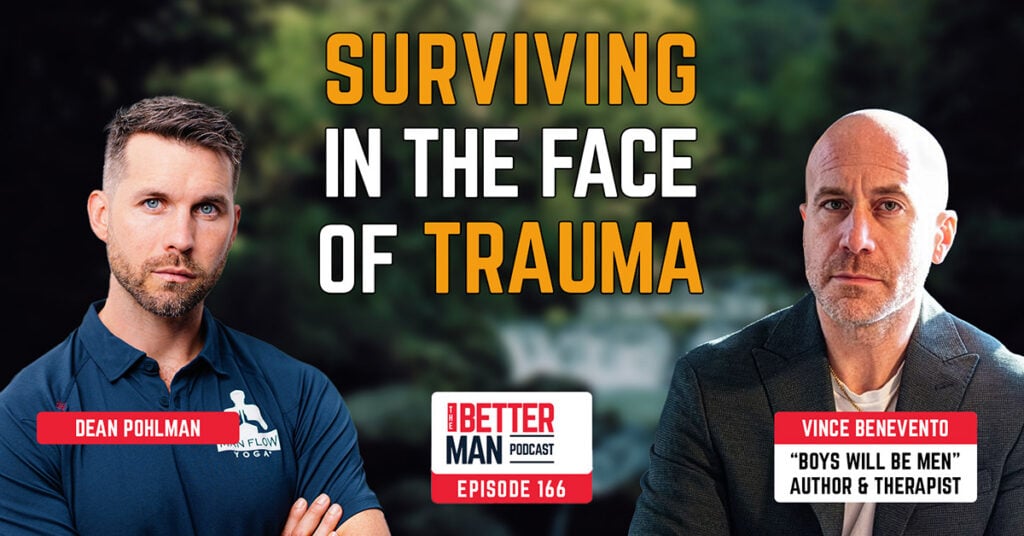
Surviving in the Face of Trauma | Vince Benevento (Boys Will Be Men author & therapist) | Better Man Podcast Ep. 166
Therapist Vince Benevento discusses his son’s 135-day battle for survival and how that trauma redefined his approach to mental health. He…
Remembering Who You Are | Mark Divine (Retired Navy SEAL Commander) | Better Man Podcast Ep. 165
Retired Navy SEAL Mark Divine joins the show to discuss how meditation and mindfulness bridge the gap between societal conditioning and…
How an Athletic Mindset Extends Your Physical Longevity Even If You’re Not an Athlete | Greg Herceg (The Volleyball Strength Coach) | Better Man Podcast Ep. 164
Unlock physical longevity by adopting an athletic mindset, regardless of your sports background. Greg Herceg joins the show to share how…
Building A Life That Matters | Brian Dubow (Hit of Happiness) | Better Man Podcast Ep. 163
Brian Dubow joins the show to share his journey from empty success to authentic joy. After a quarter-life crisis revealed his…
How To Navigate Coming Out Late In Life | David Cotton | Better Man Podcast Ep. 162
David Cotton’s story proves it is never too late to come out. After a career as an Air Force Brigadier General…
The “Core 4” Weight Loss Starter Kit (The Simplest Way To Lose Weight) | Brooks Coleman, Certified Nutrition Coach | Better Man Podcast Ep. 161
Stop the weight loss overwhelm. Join Certified Nutrition Coach Brooks Coleman to learn the “Core 4” strategy—a simple, reliable antidote to…