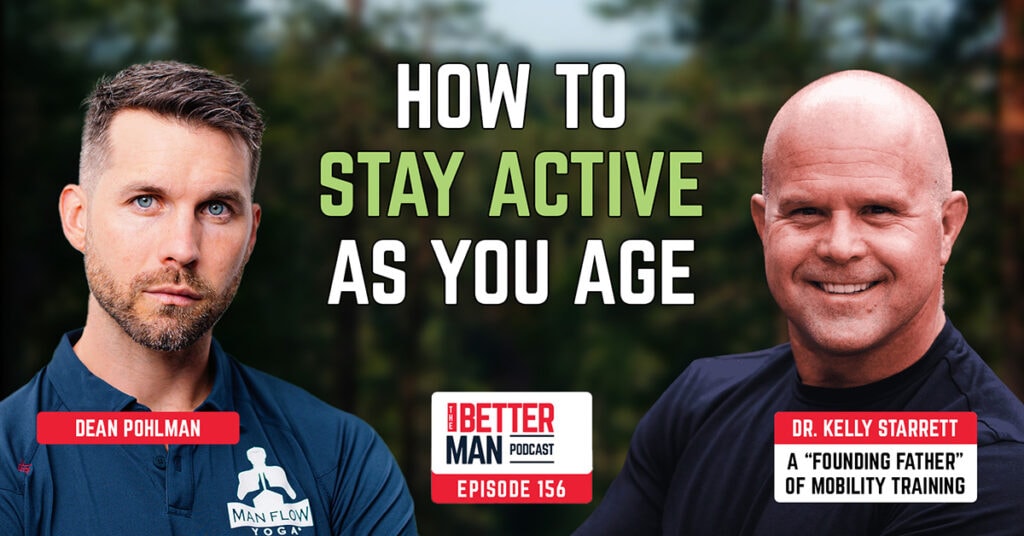
Today’s episode features a legend in the mobility space, one of the “founding fathers’ of mobility training himself, Dr. Kelly Starrett.
Besides being a renowned mobility expert, Kelly’s also the founder of The Ready State.
In this episode, Dr. Starrett shares practical strategies for adapting workouts, prioritizing mobility, nutrition, sleep, and recovery, and building a resilient, adventure-ready body.
We also cover the evolution of fitness, the pitfalls of outdated routines, and the importance of foundational habits over trendy hacks, offering actionable advice for lifelong health and functional movement.
If you want to keep your mobility as you age (so you can do all of your favorite activities and hobbies), listen now.
The Better Man Podcast is an exploration of our health and well-being outside of our physical fitness, exploring and redefining what it means to be better as a man; being the best version of ourselves we can be, while adopting a more comprehensive understanding of our total health and wellness. I hope it inspires you to be better!



Use the RSS link to find the Better Man Podcast on other apps: http://feeds.libsyn.com/404744/rss
Episode 156 Highlights
- How to adapt your workouts as your body changes: Learn specific modifications for joint health, muscle maintenance, and injury prevention tailored to each decade of life (3:15)
- Step-by-step mobility, warm-up, and recovery routines proven to reduce injury risk if you’re over 35 (6:30)
- The essential “NSM” trio: Here’s exactly how much sleep, what types of foods, and which daily movements are most effective for boosting long-term health (10:00)
- The weird reason we’re not getting healthier even as fitness knowledge peaks (and how to create a wellness blueprint that actually makes you healthier in your real life) (16:54)
- The “8’s Plus Weights” method for totally simplifying your fitness without sacrificing your results (and, in most cases, actually improving your results) (21:18)
- Why you need to eat more protein, not less protein, as you get older (23:55)
- Simple ways that don’t take any more “time” from your regular life to walk at least 8,000 steps per day (this is the “magic number” of steps per day because it drops your all-cause mortality risk by 51%) (25:49)
- How to set more specific and meaningful fitness goals that actually translate into daily function and resilience (26:20)
- How to break through fitness plateaus and bounce back from injuries or motivation slumps (33:10)
- Why recovery looks different after 40 (and how to maximize your gains even with an aging body) (37:25)
Resources mentioned on this episode:
- Get the “Bible” of mobility books, Becoming a Supple Leopard: The Ultimate Guide to Resolving Pain, Preventing Injury, and Optimizing Athletic Performance by Dr. Kelly Starrett on Amazon here: https://www.amazon.com/Becoming-Supple-Leopard-2nd-Performance/dp/1628600837
More ways to connect with Kelly:
- Visit Dr. Kelly Starrett’s website here: https://readystate.com/
- Find him on social media below:
- Buy my book, Yoga for Athletes, which features a great foreword from Dr. Kelly Starrett on Amazon here: https://www.amazon.com/gp/product/0744034892
- Man Flow Yoga: Haven’t signed up yet? Start your 7-day free trial and see how yoga can eliminate aches and pains better than other types of exercise here: https://shrtlnk.co/kP8M7
Dean Pohlman: Hey guys, it is Dean. Welcome to the Betterment Podcast. Today’s episode is an interview with Doctor Kelly. Star at T is a legend in the mobility world. He was one of the original mobility experts. He is a three times New York Times bestseller and Sunday Times bestseller. He has the brand The Ready State, formerly mobility ward, and he is one of the best guys that we can talk with about mobility.
Dean Pohlman: Period. Today’s topic we’re going to be exploring how to stay active as you age. So how to stay active and get to decide what you do with your body as you get older. The biggest gaps of most training programs. Why you need to be training at higher speeds, not just slow movements. Getting in the basics of nutrition, sleep and other lifestyle essentials so that your workouts give you more bang for your buck and why you should have a vision and a purpose for your fitness.
Dean Pohlman: This was an incredible episode, doctor Kelly star it is. He is an expert. He is a legend. Guys, listen to him implement what you can, get inspired and enjoy this episode. I hope it inspires you to be a better man. Hey guys, it’s Dean. Welcome to the betterment podcast. I have the man, the myth, the legend. Doctor Kelly Starrett back to talk about aging and fitness, because that’s just a great topic.
Dean Pohlman: And yeah, we’re going to do that. So Kelly, thanks for thanks for being here.
Dr. Kelly Starrett: Always a pleasure to discuss all things nerd with you. All things help with you, family with you. I even brought my, my cow water polo jersey out. My my my homemade, piece of flair, my piece of cheer. I thought I would connect.
Dean Pohlman: Yeah. So make sure that you watch the video version on YouTube and also in the members area so you can see, for sure. So you can see this. So, so, you know, we talked about this for you started the recording, but I think a really cool topic to hear because we just have, you know, most of the guys in our community are guys who are they’re in their 40s, they’re in their 50s, their 60s, the early 70s.
Dean Pohlman: A lot of them haven’t worked out for a long time. And they’re coming back into this now and they’re trying their workouts again the same way they would have when they were consistent, you know, maybe ten, 20 years ago. And things are different. Things are harder. There’s different, you know, there’s different considerations. They can’t go as hard. They have to, you know, pay more attention to flexibility to recovery.
Dean Pohlman: And, you know, I think it’s one thing to talk about the general experiences as a whole, but people also love to hear about individual experiences and what better person to hear it from than the supple leopard himself. So I don’t know where this conversation begins, but maybe if you can remember differences in how you approach fitness as you were in your 30s and moving into your 40s, let’s let’s start with that, that era.
Dr. Kelly Starrett: I love this conversation. It’s something Julia and I talk about a lot. I’m 52, almost 52. Julia’s 52. I want to set the framework for everyone that I, I’ve always had a body that could go really hard pretty instantaneously. Didn’t do a lot of warm up I liked. I paddled on the US Cuban kayak team, was a professional athlete.
Dr. Kelly Starrett: I paddle on a national whitewater team. You can literally. There’s a time of my 20s, you cut my hand off, and it would grow back the next day and we’d go again, you know, you know, would be out till four in the morning after a world Cup, you know, final and then be up for hard, you know, courses at 730 in the morning the next day after sleeping in a parking lot.
Dr. Kelly Starrett: So I remember this, this ability to slow down, manage chaos and just go, go and go. I will tell you that I’ve never been able to handle the volume that my friends could buy. It can handle. So that’s one thing I started to notice early in my career that I had to just be mindful and start to take care of myself a little bit differently than my friends, because if we went super hard in the paint, they could get an extra day in and I could not be as fresh and poppy.
Dr. Kelly Starrett: So starting to be aware and again, my 20s was was pretty fun. There was a time in my life where and I Powell two men racing canoe. So as a whitewater canoe, you see the gates hanging over the Olympics. And there was a time where there was two men in a canoe together. And I used to mock my best friend and Bowman because he had to stretch and mobilize.
Dr. Kelly Starrett: We’re going to call it stretching because it was the 90s. It the stretch to get in the boat. So he didn’t cramp and he could just fit in the boat. And I would just mercilessly heckle him because I was like, I was like pre stretch. In fact, in high school I would say, coach, I’m pre stretch. Like, what are you talking about?
Dr. Kelly Starrett: I don’t need to warm up like let’s go. And it was we started to notice and again think 90s that we should warm up before we did intense training sessions. And I’ll tell you, that seems obvious now. But at the time it really wasn’t obvious. And so we started spending a lot more time, you know, running around the parking lot.
Dr. Kelly Starrett: We started spending a lot of time doing some arm circles, our paddle up, we would paddle and try to power to the top of the course from the bottom of the course, which would take about 20 minutes. So by the time we got to the top of the course where we were going to start working out, if workouts started at 430, we were in the boat at four and had a half hour of a treatment, a feeling of touch up getting hot and we were sweating, ready to go for 30.
Dr. Kelly Starrett: So that started to happen towards the end of my career. Now fast forward to the 50s and here’s what I’ve noticed. Remember, I do you and I on the 21st, the 21st CrossFit in the world. We owned a gym for, you know, an open gym for 17 years where we coach every age, every Olympian, every national team, every professional team came in.
Dr. Kelly Starrett: And at the end now where I can see where the biggest changes are is that I cannot skimp on the margins. And I think one of the things that we see a lot as Julie and I have a strength conditioning lifestyle program for people in their 40s, 50s and 60s, is people want to, hey, I need to get back in shape.
Dr. Kelly Starrett: So you go back to where you were. Maybe you’re most successful in shape and you adopt that program because that worked for you. And we actually see the same thing in Olympic track and field. We see it the same thing in, other Olympic sports is that when people stop having success doing what’s working, they’ll default to a time with drills and things where they were having success.
Dr. Kelly Starrett: And that’s a that’s a fallacy because it’s a completely different body, completely different context. And what you find your body. So if you’re suddenly in your 40s and 50s, you know, late 30s even might have a job, you might have a household that you’re taking care of, right? You certainly have a patina of injury. Trauma potentially. Right.
Dr. Kelly Starrett: You just booted out skiing, you crash on your mountain bike, whatever. And you have a tissue system that maybe you’ve been neglecting. And so what we’re seeing is that people default back and immediately any sort of hot spot flares, it’s had any extension sensitivity. And, you know for the do it. And I have been, you know, programing mobility and talking about recovery and positional restoration and tissue health.
Dr. Kelly Starrett: You know, from when we started this thing really, you know, we started teaching a course in 2009. In 2010, we get a book deal in 2013 becoming a couple that comes out. So we’ve been doing this for a hot minute in terms of helping people feel better in their bodies so they can express normative range of motion. What we found was a lot of people did not have and I’ll talk about range.
Dr. Kelly Starrett: Motion first did not have access to their native ranges. They maybe never had access because it didn’t have to to kind of play soccer. Then they got stiff and adapted to their usually intellectual lifestyle. We get a desk job, we’re not moving as much or certainly not playing spike ball and pickleball. We’re not cutting. We’re not, you know, enjoying trying new sports.
Dr. Kelly Starrett: And suddenly what you see is, oh, there’s a real case for something like physical practice that exposes you to just these native positions. Inter metaphor yoga. Right, where you’re saying, hey, yoga doesn’t need to be your entire identity, but let’s make sure that in a really systematic way, we’re touching these positions. So your brain says it’s safe to be here, and your tissues have had some exposure and isometric control there, and also helpful to be able to twist and flex and rotate.
Dr. Kelly Starrett: And so what we see is that typically the average person, if they don’t engage in a very formal strength conditioning program, they get on the peloton, they do some bicep curls. That’s not a strict conditioning program. They’re not doing something that looks like Pilates or man flow yoga. What ends up happening is that they’re usually using, if they’re all the movements that you could express with your body, is a vocabulary.
Dr. Kelly Starrett: Most people are using about three words I sit, I stand, I walk around, I lay down, I sit, I stand, I walk around me, I bring my hands to my face. That’s it. I have to reach across and grab the seatbelt. We used to turn to have to look over our shoulders. Now have a backup camera. So even that’s going away.
Dr. Kelly Starrett: So right, so suddenly what’s happening is our movement sort of demands have gotten really truncated, and we’re really just leaning into 3 or 4 words. So now when I go into strength conditioning and let me define that for you, monitoring the conditioning is very thorough. It’s saying, here are the book and the key shapes that every human being needs to be in.
Dr. Kelly Starrett: And and if you jump into any collegiate strength training program, you go back to those those days, you’re going to see that strict press, strict bench, back squat, front squat, deadlift, lunge, pull up right push up row. Those things touch all the shapes that human beings need to be in. Snatch. And so what we end up seeing is that our modern strengthening initiative practices, which are very good and thorough, really do ask us to have access to our native ranges.
Dr. Kelly Starrett: The problem is you give up on touching those things back in Vietnam because it didn’t matter and your body didn’t hurt, so nothing hurt. So now you’re jumping into a program that’s asking you to have good tissue health, to be fed, to be slapped so you can adapt, to be able to access those positions. And so suddenly you got hot spots show up, shoulder starts, ache, back hurts, knees hurt, and you’re like, I don’t know what’s going on.
Dr. Kelly Starrett: Meanwhile, you’re smashing yourselves because we know that that works and there’s always work for you. And then you sit all day long. So we start to see this accumulation of adaptation errors. You’re not sleeping for eight hours. You don’t eat enough fruits and vegetables. You don’t get enough micronutrients and fiber. You’re definitely not eating enough protein, right? You don’t walk during the day and just decongest your body.
Dr. Kelly Starrett: Plus, you’re basically going back to your bros. Let’s because that got you jacked in college and now things are hurting and now you don’t even know what to do. So that’s sort of what we’re a template of what we’re seeing. And where my body has changed is that I don’t mess around with sleep. I have to sleep if I’m going to recover.
Dr. Kelly Starrett: My ability to manage these higher intensities is gone down even more, right? I have to warm up more. There’s a lot more. Zone two, zone three conditioning in my programing. You know, my nutrition has to be on point. I really I don’t really try not to drink alcohol. You know, I think every once in a while there’s an amazing margarita in my life.
Dr. Kelly Starrett: But honestly, that’s a celebration because it messes up my sleep so much. Right? And if I’m going to spend any calories on alcohol, I’d rather spend that on ice cream. Right? So I think in those terms a little bit.
Dean Pohlman: Ehm, I almost forgot how much you like ice cream.
Dr. Kelly Starrett: I like ice cream and you know, I, you know, fortunately I just, you know, had, you and I went in for our Dexa scan even ten years since I had a Dexa scan. And so when I was 41, I had that scan. 51. My bone density is exactly the same, like lean muscle mass, exactly the same.
Dr. Kelly Starrett: But, you know, like my fat is exactly this. I’m exactly the same person I was when I was 41, which I think is funniest, right? So that I’m doing okay. But what I’ve tell you is that I’ve had to become a lot more rigid in terms of non-negotiables, as I’ve gotten older. And then as we get into this conversation, we can talk a little bit more about the things I think would really serve you.
Dr. Kelly Starrett: If you want to get into some strength, condition. Cool.
Dean Pohlman: Yeah, I, I’m glad you brought up all those things, because those are all the things that it seems like, guys, you know, they struggle with when they’re there, they’re getting older, you know, they especially the, the guys who are used to really intense workouts, like, I have a lot of guys and we have a lot of guys in our community who are used to doing weights all the time.
Dean Pohlman: And if it’s not an intense workout where they’re, you know, dripping sweat and panting, they’re like, this is a dumb workout. I don’t even do it. And so that’s one of the things that I, you know, I try to share with people is like, yeah, dude, you need to just go on some walks, you need to go on some walks, you need to do some lighter yoga sessions.
Dean Pohlman: It doesn’t have to be like a super intense power yoga session. The warm ups like that’s absolutely a non-negotiable. I mean, even even for me, I’m 30, 35, I’m 35. And like, for me, the warm ups are like, I it’s just it’s a non-negotiable number one because like, I know I’m going to hurt so much the next day, but also because you’re just going to have so much of a better workout, like you’re going to have like, you know, to use your language, you’re going to, you’re going to learn not to use your language, but I’m going to paraphrase it.
Dean Pohlman: But getting into those deeper range of emotions and being able to build some familiarity there, so kind of reestablishing these necessary levels of, of range of motion that you need to be able to do these basic exercises that we’ve been doing for years. The front squat, the back squat, you know, whenever I press all of these things.
Dean Pohlman: So, yeah, I think that’s all, those are all awesome, awesome tips.
Dr. Kelly Starrett: I mean, you what’s expand the definition of train so. Well, oftentimes what we I think we tend to adapt or adopt is this idea that training has to happen in one hour increments, right. Or longer. And if I can’t do that, it’s up. Right. And training is the thing. And let’s call it entertainment, let’s call it like hobby I love training, my wife loves training.
Dr. Kelly Starrett: We are into training. We have no problem. But we did forget that the original point of training was not to win the AB competition on Instagram, right? That you you don’t win fitness. That’s not how it works. And I think we used to like look, you know, I shredded down for my wedding boom boom. And then like now I’m Jabba the Hutt again.
Dr. Kelly Starrett: But I won, right? I’m a world champion of my own body 13 years ago. So what are we training for? That’s the number one. I can tell you that in my 50s, I’m training to have a body that’s built for adventure. Right. And simultaneously, I want to be less gross for my wife. Those are the two things that are like big drivers.
Dr. Kelly Starrett: Like, I don’t want my wife to leave me because I get gross. And she, you know, has, you know, lats and abs and she’s a three time world champion. So I’m always trying to keep up with her. But built for adventure means that I’m also looking at tissue health. And if my knees hurt or I rupture my Achilles or my back hurts and I can’t ride my bike, I can’t paddle, I can’t ski, I can’t hike, I can’t do the things.
Dr. Kelly Starrett: You know, I did a four day gnarly helicopter ski trip this year. Very fortunate lifetime, you know, bucket list. But man, it was like 20 plus thousand feet of vert every day. Post hauling. It was gnarly. And I’m the oldest guy on the trip. So what I’m trying to do is get my body always in a state where I can be like, yeah, let’s go throw the ball, let’s go play what’s you know, sure, I’ll jump in.
Dr. Kelly Starrett: Yeah, we’re going to do this crazy adventure. I want to prepare. And that notion that we were training has gotten lost in the last two decades. So let me describe something that I think will help. First wave fitness is late 90s, early 2000s. And it’s not power bars. Probably before your time, right? Early heart rate monitors. And maybe, maybe you’ve came into a strength conditioning program that was out of college, very sophisticated.
Dr. Kelly Starrett: Or your track and field athlete. You were exposed to Olympic lifting, but no one overhead squat in the late 90s that didn’t exist. No one Olympic lifter snatch the late 90s or 2000 that didn’t exist. You couldn’t buy a kettlebell in San Francisco in 2005. Just so we’re clear, you could not buy a kettlebell in a city of San Francisco to thousand five.
Dr. Kelly Starrett: We had to drive down to Santa Cruz to buy kettlebells, kettlebell training did not exist unless you discovered this book. That was weird and you got it on the internet. Amazon doesn’t exist, so the world is very dark and not very sophisticated. Then all of a sudden we hit this ramp where YouTube is kicking off. We’re starting to see blogs.
Dr. Kelly Starrett: People are talking about fitness, CrossFit. All of these things are striking. Now you can literally listen to Peter Tier for three hours, right? You got the tubes. You you know, you’re laying in a red bed. You’re wondering which mitochondrial supplement is right for you. You’re in the backward shoes. You’re you know, you’re trying to follow your, you know, blast your abs and and what we see is that just peak fitness has happened and it hasn’t necessarily made us healthier, except now we have access to all of the information and we have.
Dr. Kelly Starrett: It’s easy for me to follow you and be like, okay, this is working. Like I can follow some experts in the field. Now Julie and I are describing this is we’re into third wave and third wave is really about integration. It’s about iteration and really making sure that we’re what’s essential is essential and that we’re not majoring in the minors.
Dr. Kelly Starrett: So if you’re cold plunging and you’re signing, you’re in your red bed and you’re biohacking, but you’re not doing those essentials, you’re not walking your cardiorespiratory system sucks. When we take a scan of your body, we look at your blood, we look at your Dexa. The truth is in the details. And you basically have this report card you can get anytime you want, right.
Dr. Kelly Starrett: That looks at, you know, how well you move and how old is your strength. What are your what are your move? What are your vital signs. And what we found is that the people who are very sort of interested in now realizing that fitness is about having a body that’s really not just looking good, have sort of tripped and fell and they’ve done, you know, it’s not work for them.
Dr. Kelly Starrett: Let me give you an example. We have a good friend, very smart, played college soccer, good athlete. He very, very fit on his peloton. Right. He is like a high level investment banker. He runs mergers and acquisitions for a gigantic company that everyone’s heard up. He falls skiing at the end of the day, a little innocuous fall to tears.
Dr. Kelly Starrett: His ACL tear, his MCL right also tibial plateau fracture, boom boom boom. So it turns out that he had been sold this bill of goods. Well, I was an athlete. That’s my day. I’m very fit on this peloton. So I’m meeting all my demands and then I’m going to go ski. And what we see is that his lifestyle training didn’t prepare his tissues.
Dr. Kelly Starrett: Gym prepares, nervous system, then prepare his, you know, his bones to handle what’s happening. And that’s a good example of what a lot of us are feeling. And it may not be a catastrophe, but now my shoulder hurts all the time, and now I can’t bench and I can’t throw, and I’m worried about my elbow hurting. I went and played pickleball and now something hurts.
Dr. Kelly Starrett: And if you get injured playing pickleball, let me be super clear everyone, your training sucks. And I don’t mean that in like a mean way. I mean, like, wow, we really failed you as an industry to prepare you to go play a game with a plastic racket and a wiffle ball. But what we see now is that truth is in the pudding, that we’re testing our bodies in these environments.
Dr. Kelly Starrett: And we need to ask, how well did I do if we go on a three day ski vacation? You can. Everyone can do one day of killing it. What is the second day look like? What’s the third day look like? How how jazzed are you to jumping in and not being wrecked for a week, where on the weekends you smash into one day and then literally spend the rest of the week trying to get your act back together.
Dr. Kelly Starrett: And that’s where we need to start to shift some of our thinking about the training we’re doing and the kinds of retraining we’re doing, and further expanding the definition of training. So we’re going to put what you and I call base camp to one side, which are physical practices that are agnostic about exercise. And this is important because we’re trying to create a body that’s ready to go when when I have opportunity.
Dr. Kelly Starrett: And that means you need to lay in bed. These are the eights. We call it eight plus weights. I need you to lay in bed for eight hours without looking at your phone. Non-negotiable. And you don’t have to sleep eight hours because your sleep sucks. And you’ve been using melatonin and red wine and THC and anything that you can do to sleep, you’re on the magnesium.
Dr. Kelly Starrett: You’re like you’re biohacking your way about sleep. Except you’re not training. You’re on your phone. All the sleep problems that we talk about. But in the very least, I want you to realize that resting is the next best thing to sleep. So if you’re super stressed, right, that’s okay. Get into bed. Don’t your phone for eight hours. It’s off to the side.
Dr. Kelly Starrett: You’re gonna set an alarm. You’re even allowed to look at what time it is. And if you wake up and you’re like, fuck, I’m awake. I just want you to lay there and be like, okay, I’m resting. It’s cool. We’ve got to retrain your sleep. Number two, Juliet and I are huge fans of someone, the nutrition superstar that we know.
Dr. Kelly Starrett: Name assistant Kowski. Just this thing called the 800 gram challenge. And her website, I think it’s called Three Pillars. And the goal is to just eat 800g of fruits and vegetables. That’s like four medium size apples every day. 80% of us are not eating enough fruit. 90% of us are not eating any vegetables. So what we’re seeing is that we’re arguing on the internet about organic fruit diet.
Dr. Kelly Starrett: Should I get these strawberries? You’re not even eating the strawberries. So let’s start eating the fruits and vegetables that you’re not eating, that you’re buying all this stuff a Whole Foods and throwing it away. At the end of the week, I want you to get a scale. And the reason I’m obsessed with this is that you’re not getting enough micronutrients, and you’re definitely not getting enough fiber.
Dr. Kelly Starrett: You’re blowing those things, and I can’t even talk about what’s going on with your process, with your body, with your tissue health. If you don’t have any micronutrients onboard, you know, vitamins and minerals. So 800g, right. There’s a familiar. Yeah, there’s eight. Right. Sleep lab at eight hours, eat 800g, get a food scale. Quit dicking around. And if you don’t like kale, cool.
Dr. Kelly Starrett: You don’t do kale. You get grapefruits and cherries and peaches. And don’t come at me about the sugar. A pound of melon is 230 calories, right? One Starbucks cookie, 350 calories. Eat a pound of melon and tell me what’s up. You’re like, oh, I’m so full from all this melon. I’m so inflamed from the melon. Shut up like quit.
Dr. Kelly Starrett: Make up the banana. Get the apple, get the orange right. Just hit those basics. I need you to eat at least point eight grams of protein. And as you get older, I need that protein number to go up, probably closer to 1.2. So my I’m I’m like is it two.
Dean Pohlman: Is it point. Is it point eight grams of protein per lean muscle mass or per your body weight.
Dr. Kelly Starrett: Her body weight and I would say argue ideal body weight. But already we’ve just sidetracked the conversation. Well, I don’t know what my lean muscle masses are. I’m, you know, like, what do you want to weigh? Are you eating that many grams of protein? Yes or no one? Is there a punk, guarantee or you’re not? You’re skipping breakfast as it was easy and your biohacking your way.
Dr. Kelly Starrett: I mean, while you miss a huge protein to go and your protein signaling comes down as you get older and you, you just need more protein. It takes more protein to have the same effect. You have one hamburger patty when you’re a kid and it works. Now you need like three, right? So the other thing that I’m trying to do here, by making you eat all this protein, like my favorite hack on the internet is walk 10,000 steps, eat 200g protein at it.
Dr. Kelly Starrett: And literally I’m like, watch what your body does. And I guarantee you you can’t do those things seven days in a row. You won’t because it’s hard and it takes consistency. 10,000 steps, 200g of protein. I guarantee you. What’s cool about hitting these protein numbers and 800g of fruit and veg is that it’s so much food that you’re going to be stuffed all the time.
Dr. Kelly Starrett: Remember when I met you and you’re like, yeah, all I did was eat lean proteins and fruits and vegetables for a year, and I got shredded. You’re like, yeah, it works every single time. I mean, welcome to Dean’s shred body. Eat fruits and vegetables and protein for a year and watch what happens. So we get calorie control in there.
Dr. Kelly Starrett: But also remember what? I’m obsessed with your tissue health. So now I’m going to have the healthiest tissues with the most available substrates around. Before you go looking at peptides, make sure you’re controlled here right then I think it’s 10,000 steps. I think 8000 steps is a super reasonable number where you get 51% of the of the benefits of, of, all cause mortality dropping, all cause morbidity drop by 10,000 steps.
Dr. Kelly Starrett: It goes up to 65, but 8000 steps, even a busy working human can sneak in eight steps. Gotta go for a little walk after lunch. Park your car away. Maybe you walk with your family in the evening. Super easy to hit that 8000. So what we’re starting to see suddenly is, hey, I need you to sleep. I need you to go outside.
Dr. Kelly Starrett: We program in our program. We want you to go outside and play a sport on the weekends. We need two 40 minute bouts of sport. That sport can be not the gym. I need you to go throw a frisbee, play spike ball, play pickleball, ride a bike, go do an actual sport where you feel athletic because it’s not just about that.
Dr. Kelly Starrett: It’s about community. It’s about sunshine. Play pickup basketball. It’s about being in weird shapes and decelerating and doing all the things that made us athletic and springy. And so we’re seeing that no one’s playing sports anymore. So I need you to go outside and play a sport a couple times a week. That’s what the weekend is for. Train your ass off during the week.
Dr. Kelly Starrett: During the weekend, play sprite. What we’re seeing is, for example, the research is the average American was going outside. Listen to this 20 minutes a week. That’s how much time you’re getting outside and that’s not that’s hard data. That’s straight up hard data from Nature Quartz or Nature Dose. What’s track is an app that you can get to tracks how much time you’re spending outside.
Dr. Kelly Starrett: We are shooting. We’re trying to get people outside for, you know, 150 minutes a week and your daily walks are about getting sunshine and fresh air and seeing trees. We just had a, an expert on our podcast who talks about his his whole research is for health and environment interaction. And if you’re super stressed out as a CEO killing yourself, you go for a 90 minute walk.
Dr. Kelly Starrett: You’re not allowed to listen to your podcast. Even nature will completely change your brain. One weekend in the wilderness, reset your brain for like three weeks. 90 minute walk will fundamentally change and get you out of that stress pattern. So we just we need to start thinking and calendaring. What am I doing this stuff right. So now guess what?
Dr. Kelly Starrett: We haven’t even talked about training. You’re doing those things. We think you should sit on the ground in the evenings for 20 to 30 minutes, ten minute man flow yoga routine, ten minute mobility. If you want. But suddenly what’s happened is we have built a physical practice where you are controlling for calories, taking care of your tissues. You’re working on a range of motion.
Dr. Kelly Starrett: You’re decongest in your body. You’re creating enough non exercise activity. We’re going to fall asleep. You’re interacting with your community. You’re off the tech. You’re going to sleep better and feel better. Then when it’s time to go cook, the frying pan is super hot so that we can go smash ourselves in the gym. Or we can really take advantage of what’s going on.
Dr. Kelly Starrett: And now training becomes a reason for getting stronger, working on positions right, adding skills. Not just, hey, I smashed myself because if I smash myself for three hours a week, the rest of the the week doesn’t matter. Does that make sense? I want to separate these out. Here’s my lifestyle. Non-negotiable base camp. Don’t lie to me about this.
Dr. Kelly Starrett: I can’t work with you or even understand what’s happening unless you’re doing these things. And then and by the way, it’s a system. So if you don’t nail each one, it’s okay because you got, you know, you got clothes on all of them. Then over here we can have a real conversation about your strength, conditioning. Awesome. Okay, so and that’s what I’ve been doing for the last ten years okay.
Dean Pohlman: So so the thing that stuck out to me was the the difference between the second wave and kind of the third way is fitness. So there’s there’s so much information, but nobody knows which information they’re supposed to use and apply to to their situations. So it becomes like, yeah, I could, you know, you could be part of four different programs, but you have no idea what you should be doing for for your fitness goals.
Dean Pohlman: Or like, I like the idea of just asking the question like, hey, what what are you training for? What’s important to you, and having alignment with what your vision is? And then, okay, well, what else? What all goes into this, which is, you know, I think, I think that’s significant and it sounds like most people just are.
Dean Pohlman: Okay, I’m doing this and I’m going to do now I’m going to go do sauna and I’m going to go, you know, now I’m going to go do this and I’m you’re not walking.
Dr. Kelly Starrett: You’re like, I’m just because I’m busy. And you if the only goal. And so I don’t have a, you know, I, I really am a for me and my wife, it works for us to have something on the about the calendar or training for that can be a mountain bike. That could be a ski season. That could be a four day fantasy helicopter trip in Canada, where I decide to drop 10 pounds lean heavy into my legs.
Dr. Kelly Starrett: Right? My cardio is all time so that I can keep up day after day. I’m skiing my overhead press went down with them. A power plane went down a little bit because I’m training for this thing right? But if you don’t have a thing to train for, we’re training for range of motion and tissue health. And I think if it was just about having big muscles, we just give everyone cocaine and steroids and be like, let’s do it right.
Dr. Kelly Starrett: It would work. It works every time. It’s not. It’s not enough just to have huge, big chunky thighs. I need you to have thighs. And by the way, thick time saved lives. I need you to have thighs and a butt that allows you to cut, sprint, get up and down off the ground, not smoke your little back every time you go in to extension.
Dr. Kelly Starrett: Not worry about your knees jumping down from the tailgate. And that’s the problem with sort of what our obsession with just naked physiology before by for you know, you know, what’s the skinny model of VO2 max? I’m like, what do you do with that VO2 max? Right. You’re just on the peloton. You never actually run, you know, hike.
Dr. Kelly Starrett: You know, you don’t do anything with that. So we’ve taken fitness and we’ve reduced it down to these recursive pills. Right. I do more pull ups so I can do more pull ups. It’s just about like hoarding strength so that someday I’m can spend it. Wrong approach. We can use those techniques to train our bodies, have health and fitness and healthy tissues so that we can go kick ass.
Dr. Kelly Starrett: I can still do the splits. I can still do a backflip. I can still paddle, I can still ski and still ride. I can still jump my bike, I can I want you to have a body that you’re like, good to go. You know, you see a trampoline. I’m not worried about it. I don’t need to warm up and that’s that is really what we’re trying to do.
Dr. Kelly Starrett: You create a readiness in these tissues that allow us to go be able to play hard and have a body that can handle the hits. So I have huge cuts all over my arm and my knee, because on Sunday, my dropper posts on my mountain bike, the the dropper lever, was rotating a little bit. I tighten it down, but it was like a bad episode of Final Destination, right?
Dr. Kelly Starrett: Where literally I’m like, I’m pushing it to drop my post, and then I reach over and I pull it back and I tighten it down. Meanwhile, we’re riding. I’m going fast. The end of the ride. I reach over to push it back instead of reaching under to pull it, and that puts me in a position where I have zero control over my bike.
Dr. Kelly Starrett: And right then, one great big turn going high speed. I go over the handlebars, take the handlebars to the chest. I’m going fucking fast. Grind my head into the ground. Bloody knees, bloody elbows. I get up, I’m like, wow, my friends are like, oh my God, you’re dead. Are those your teeth? Holy shit. My wife rolls. I’m like, oh guys dead.
Dr. Kelly Starrett: And I popped up and I was like, oh, that sucks. I have some scratches. Next day training again. And I’m not saying that my training prevented that. What I’m saying is that I was durable enough to take that hit because that hits are coming, the falls are coming, the disease is coming. And what I want us to do is have this body that we know is built on the practices that I go into the NFL with, I go into the Premier Rugby or Premier Soccer or university sports programs.
Dr. Kelly Starrett: I say here is the foundation and then it’s I only get one day a week training. I still have this foundation because my tissues are hot, I’m sleeping, my hormones are great. And then if I can get five days a weekend, super cool. But I have access to my positions, nothing hurts and I can take the hit that is really what we’re going for.
Dr. Kelly Starrett: And then again, we can have another conversation about what I think you should be doing is strength conditioning. But in the first time now we have a body that you have something you can focus on that doesn’t feel like I didn’t make it to the gym today because my family is busy. I got 17 school activities and five little league things and I’m a deadline, so the whole thing is thrown away and this is what we’re doing.
Dr. Kelly Starrett: We’re expanding the definition of training to include all these things.
Dean Pohlman: Okay, cool. So one thing that you were talking about was the sports twice a week. It is 40 minute sport and I play the cross in college, I played men’s lacrosse pretty much up until the pandemic, and then all the leagues kind of got shut down and I never got big. I never got back into it after that.
Dean Pohlman: So I must have been like maybe 30 or 31 was the last time I played lacrosse. And you can probably relate to this, but well, no, you can’t relate to this because you still, like, go out there and crush your body and do all the things. But I’m just terrified of, you know, playing the cross and like, and getting injured because I have had a lot of injuries in the past.
Dean Pohlman: I’ve had, you know, I have ankle sprains, I had knee, I oh yeah, you know, NCL tear like I’ve had all the things I’m like, it’s actually why I know a lot about the bodies because I’ve had to fix my body so often I’m like, oh, I know how to fix that. I know what that feels like.
Dr. Kelly Starrett: That’s right, that’s right. Yeah.
Dean Pohlman: So how do you get your body ready for something like that? Is there like, what’s the foundation? What are what are some universal foundations of physical fitness training? Like everyone asks me, like, you know, should I be doing cardio twice a week? Should I be doing strength training three times a week? How do I said yoga and like, what’s what are.
Dean Pohlman: So what are the things that people, the universal, you know, kind of foundation of training.
Dr. Kelly Starrett: Number one, one of the best ways you can inoculate yourself is to have access to your range of motion. So if people are doing legitimately, doing 10 to 20 minutes of mental yoga every day, your practice is pretty good, then you’re going to need, every once in a while, a voodoo band or a ball to just something that step or hurt.
Dr. Kelly Starrett: But you’re touching positions and are in isometric shapes that are crucial, that are required. Imagine you and I are going to engage in a sport and that sport is eating lunch, right? But my elbows don’t bend past 90 degrees and I have to do all this weird contortion of my neck and my hands to get my hands on my face and you’re like, bro, what are you doing?
Dr. Kelly Starrett: We’re playing lunch. And I’m like, it’s fine. Nothing hurts. And you’re like, look at how you’re eating your elbows don’t bend. And I’d be like, it’s fine, right? I don’t need them, but I don’t need to bend them in day to day life. I use long forks. Right. It’s super cool. Eight long foods. Like, what are you talking about?
Dr. Kelly Starrett: You’d be like, you’re fucking crazy. That’s how I view you running right now. You don’t even have the range of motion to sprint. You can’t put your arms over your head. So let’s go ahead and do that at high speed. And I force at in these crazy situations, I’m sure it’ll work out fine. It always works out. But no, it does it.
Dr. Kelly Starrett: So one of the things you can be doing to inoculate yourself so that you’re safe, first and foremost is to say, let’s make sure that we’re touching these shapes and positions. Let’s give our access to range of motion, and let’s give our brains movement choices and solutions so that we don’t. Here’s an example. There’s a direct correlation between how effective your glutes work, how effective your hamstrings work, on how stiff your answer your line is, and how stiff you’re quads.
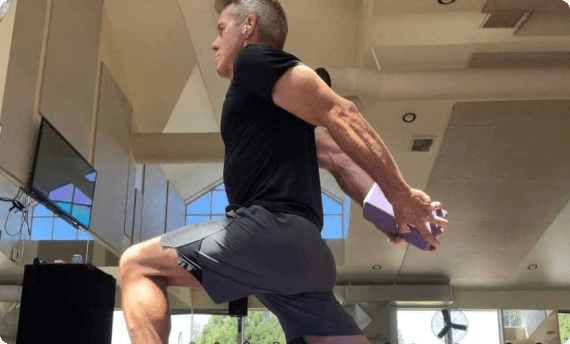
Dr. Kelly Starrett: We have something we invented a million years ago called the Couch Stretch. Right knee goes up on the corner, right? And what I see is that a lot of people can’t even get into a high kneel position. They can’t get their knee up with the knee and the core of the wall. You’re kind of in a basic, exaggerated one spread form.
Dr. Kelly Starrett: They can’t even do that. And when they certainly can’t breathe in that position, and then I’m like, okay, torso upright and open and a back, can you even squeeze your butt? Can’t even get into that shape. That is a low level bullshit test that’s so low level. The real couch stretches, the front foot is up on a bench, and you can squeeze your butt and put your arms over your head and breathe.
Dr. Kelly Starrett: But what’s happening is you’ve gotten stiff. Restricted brain doesn’t give you permission to access these shapes. Tissues aren’t sliding, gliding, whatever. Hip capsule stiff doesn’t matter. All the things. And so now, suddenly when you can’t, your knee needs to go behind your butt running, lunging, sprinting, your glutes don’t work very well. Oh, we just tested that. You can’t even squeeze your butt when I put these tissues under load.
Dr. Kelly Starrett: So now your hamstrings are like, shit, we have to do the hip extension and we have to flex the lower leg. Want to know why? One of the reasons you tear your hamstrings. That’s one of the reasons why your hamstrings are always saw. Your hips are so stiff that your butt can’t even do its job. So if we now say, okay, let’s go sprint, what’s going to happen?
Dr. Kelly Starrett: Your hamstrings are working super hard, your pelvis is getting yanked over into an anterior tilt. That’s a recipe for achy, low back and more importantly, shit outcomes. Shit performance. You’re going to be slow. You’re not going to have movement choice. So one of the things we can do is just make sure that we’re keeping an eye on. And again in the evening, first thing in the morning when you have some agency.
Dr. Kelly Starrett: What I’m not saying you to do is not train. What I’m saying is, hey, let’s put these little practices at the beginning of the day or the end of the day, and then let’s if we get a chance to go the gym, let’s protect the shit out of that time so we can actually do the fun stuff, the training stuff, the play stuff.
Dr. Kelly Starrett: But then we’re going to do this tissue health restoration, positional competency drill stuff on either end. I mean, you know me, I know you. If everyone did sun salutation in the morning, what would happen to the population? Ten minutes. Sun citation. I’m too busy. Or really, you get up at 645 and I get up at 635. Take a hot shower, ten minutes of sun salutation.
Dr. Kelly Starrett: Your mind would be blown at how transformational that is. Over the course of two weeks, one week, three days. You know, what ends up happening is you’re like, oh, I feel a little bit loose. I feel like I can get into my thing faster. I need less warmup. So what number one is, I want to protect you by making sure you have access to your range of motion.
Dr. Kelly Starrett: That means you’re not going to trip. You’re not going to pull something. Number two, when was the last time you actually sprinted? I look at your programing, you’re going to the gym, you’re doing tonal, you’re doing your bro split. You’re five by five a follow this guy. You haven’t sprinted. You do your cardio. You’re zone to what does the last time you moved your body at speed.
Dr. Kelly Starrett: So one of the things that I program for every adult, every week, we sprint at least one time a week. And that might mean, by the way, I don’t think you’re ready to sprint on the field yet. You’re going to tear something, you’ll rip your bones off your you know, you’re going to rip your Achilles. But I need you to even touch this energy system.
Dr. Kelly Starrett: So I’m gonna introduce you to the rowing machine, to the concept, to bike right, to an assault bike. And I need you to go so hard in the paint. Once you’re warmed up for 8 to 15 seconds, find out what your peak outages. Then I want you to just chill for two minutes at least. 30s. But you’re going to need a minute or so to come back from that 90s two minutes.
Dr. Kelly Starrett: And when you feel recovered, go again. And when you feel recovered, go again. And chances are you’re going to do six of those because you haven’t touched this. And what’s going to see at six is that your wattage starts to fall off. What do you think is going to happen when you can’t maintain that intensity while we’re playing lacrosse, while we’re sprinting, while we’re running up the ski and the bumps in the trees.
Dr. Kelly Starrett: And so I need you to be able to handle this high intensity, low metabolic load, core respiratory demand, low in some kind of domain where you’re protected. So the first order of magnitude is, hey, let’s make sure that we’re touching this energy system in a safe way. The second thing I need you to do is to inoculate yourself, is I need you to go out, start throwing that ball around, pull out your stick, go through the ball.
Dr. Kelly Starrett: Go through the ball with a friend. Go throw the ball against the wall. Go throw for a half hour and you’re going to see that. You’re going to have to catch, move, twist, load right. And you’re going to have to chase the ball and you’re going to pick the ball up when you miss and you’re going to start to have this exposure to the root language that you used to do all the time.
Dr. Kelly Starrett: But we need to come back with that. We can then go and say, hey, let’s go find a hill. Let’s go be very, very warm. Before you run that hill. We do some of those intervals on that hill. And again, the hill is just a mechanism by which I’m going to control your range of motion. That’s all it.
Dr. Kelly Starrett: It’s you’re just not going to be able to run as fast as big a range of motion on the hill. So it’s a way of protecting meat heads from being me. That’s and I’m staring at the number one meat head in in the room. Me your number two. Although depending on the day you could be number one. So one of the things that I want you to do is I want you to walk 800.
Dr. Kelly Starrett: This is from an elite track and field coach. Walk 800m as fast as you can walk, and you’re going to feel your butt on your calves. It’s not going to take that long, but I need you to walk 800 as fast as you get, not allowed to run. And then level two is a every hundred meters. I want you to skip for 100m or skip for 50m, and then walk for 100m.
Dr. Kelly Starrett: Skip 50, skip 100, walk 100 and skipping. It’s going to load that rear leg in extension. It’s gonna load your calves. Well you’re going to see like wow, I can’t even skip very much. So how if I can’t even skip, which is a position that requires me to have the route language to sprint if I’m not comfortable there and I’m having to adapt my tissues, then what’s sprinting going to look like?
Dr. Kelly Starrett: So now we’re starting to do sprint analogs. We’re starting to warm up our tissues a little bit, walk in more. We’re starting to play. We’re doing the sport. Then I want you to start running that hill. But we’re not going to do it from a dead start. We’re going to start to run, and then we’re going to accelerate a little bit.
Dr. Kelly Starrett: And the second power comes down. Is this what we’re training for is power, not cardio? Let me do. If I say we run 100 hills, everyone’s going to 100 hills. We’re going to suck. It’s going to be slow. But I’m interested in this power aspect and the loading of the tissues. Your tissues aren’t tissues until they can handle speed and speed load.
Dr. Kelly Starrett: Let me be very clear about that. One of the problems that we’ve all sort of traps, we’ve all fallen into is that we’re like, hey, I’m doing my stiff legged good mornings with the single leg. What happened while I’m like, well, that was slow as shit. And no wonder when you went fast, your tissues can handle it. Remember that acceleration vector, right?
Dr. Kelly Starrett: Mass times acceleration. The acceleration squared. So the forces right is are huge when we start adding impulse speed velocity. Right. That’s the killer. On the body we can do anything slow. And one of our, my favorite coaches, Franz Bosch, you got me fired up. Franz Bosch says there’s more variation in waltzing than there is in sprinting, which means low loads and low speeds.
Dr. Kelly Starrett: It doesn’t matter as much. Your tissues can buffer it. You can round your back when you do that. Many, many where. But I’ll tell you it high loads, high speeds. Whoop! We start to see that the humans all start to function the same way. Look the same way your femurs longer, make torsos longer, whatever. But the principles remain the same, and we start to see that there’s a lot less variation.
Dr. Kelly Starrett: And that’s why also that we also say your tissues aren’t ready to go until we can do it fast. And this is why you’re not. If I look at your strength training at some point, I need you to get off the deadlift bar and on to the kettlebell. Why the high speed negative loads on the hamstrings and the hips are so much more.
Dr. Kelly Starrett: And knock like they will knock you for safety against hamstring strains. Much more than that deadlift because that you’re not doing a good eccentric and you certainly eccentric isn’t fast. So that kettlebell for me is one of the ways that I keep your back and and hips and hamstrings super healthy because what I really trying to do there, it’s not argue about which exercise is better.
Dr. Kelly Starrett: It’s like, hey, everything you do is slow. So what do you think was going to happen? When do you move fast? And what do you mean? You tore your biceps hitting a wiffle ball on the the pickleball court. I hear that all the time. Like, dude, what were you doing? Everyone on this call, I need you to go get a rope, and you just start doing that.
Dr. Kelly Starrett: David. Wack rope float. Rope flow is my favorite way to warm up, and it’s one of the easiest ways to add speed training of your torso. Side bending flexion. Again, here’s my twist on yoga. Done slowly. You can’t can’t forward fold at high speed. You just can’t. It’s not. It’s not what it was intended for. Practice. It’s a restorative practice.
Dr. Kelly Starrett: Isometrics like they read so you could.
Dean Pohlman: Jump up a staircase and forward fold very, very quickly.
Dr. Kelly Starrett: So the idea here is I’m looking for ways where I can have multiple bang for the buck. I jump rope every single day, but I jump out with a length of rope. You can get a half inch piece of rope on Amazon, a three quarter inch piece of rope. You don’t have to buy some special rope. There are so many great protocols and examples of rope flow and low.
Dr. Kelly Starrett: You don’t have to do rope flow like it’s your identity so you can go to Burning Man. So you stop doing sport. We just blow up the rope and park like pharmacy. Do that. I’m going to kill you. But this thing where I swing a heavy rope around, man, it asks me to side, then ask me a four flex.
Dr. Kelly Starrett: Ask me to extend. Ask me to rotate all the shapes that I’m doing in my movement. Practice right? My mobility, my yoga. But now I’m adding with speed and with the shoulders. Arms straight, arms bent. I’m getting thousands of rotations. I’m getting tons of weird movement patterns and directions. And what you’ll see is you’re like, Holy shit, now my tissues are starting to be exposed to this speed.
Dr. Kelly Starrett: I can do something than that for five minutes now my bench feels better, my snatch feels better, and I’m starting to expose myself to shapes and positions that are required for sport. And now we’re starting to build the tools that start to look like how do I protect myself so that I can go have a body built for adventure?
Dr. Kelly Starrett: Right. And what what if I use them in your programing when I’m going to, all I’m going to look for is deficits where you’re not rotating or you’re not flexing. Extending. Where is the speed? How come you didn’t touch this shape? You have it lunge or done? A rear foot elevates what squat in 100 days. So no wonder you suck at these things, right?
Dr. Kelly Starrett: So. And it’s not your fault. You know, it’s difficult for us to sort of imagine what a modern strike munition program looks like. And I had the same conversation with our elite heavyweight Olympic lifters who don’t spend any time in hip extension and their knees hurt. So we have to put them in hip extension and then it’s like.
Dean Pohlman: So, so what I’m hearing is people need to be less afraid of intensity of high intensity, but also that they have to are moving fast, moving fast with intensity. But they have to also appropriately scale up. Right. You. So you talked about walking fast instead of sprinting fast. It also sounds like people are doing way too much just during training, just like, you know, going to the gym, doing five by five or like without you guys sprints, without getting outside and moving.
Dr. Kelly Starrett: That’s right. I need you to go spend those fitness credits. Right? I love squat, you know, but I’d rather you spent the next, you know, if you just Olympic lifted with a sandbag, I think you’re going to have a better outcome. And again, you know, if the goal is just to have big quads, we know how to do that.
Dr. Kelly Starrett: And we’ll just do blood flow restriction and leg slit. And then we’ve solved all your problems, right? You have huge quads. You look at naked. You. What’s that? I forget the actor, but he’s swimming recently. He played in twisters and he was in Top Gun. And anyway, now his chariot and these apparently are super nice guy and super shredded, but he’s out there swimming like a girl, and he’s like, I’m fat.
Dr. Kelly Starrett: I’m not very fat. He’s. And she’s like, dude, you’re hot, girl. Fit. You know how many carnies I can party out, right? And what I don’t want you to be is hot girl fat. I don’t want you to be hog or fat. I want you to be. And I think you can be all of these things. But notice where I started was in calorie control, micronutrient density, which is how we’re going to change your body composition.
Dr. Kelly Starrett: That’s how we change body composition. This training I want to be about outcome, not esthetics. And that’s where we’ve lost our minds. I’m squatting so that I can be powerful and have a butt that works and do all these things. I’m not squatting so that I look better naked. Does that make sense? If you want to look better naked, you’re gonna eat 200g of protein and walk 10,000 steps a day.
Dr. Kelly Starrett: That’s going to change your life. That’s going to change your body composition. Over here, we’re training to have a body that is legit well into your 60s and 70s. And look, I have friends like Laird Hamilton, who is 61, and that mofo is so badass fit can do with everything. Try to keep up with that 61 year old.
Dr. Kelly Starrett: You cannot. And the reason is that he works on his positions. He has a huge aerobic set. He’s strong. He works in the range as he can control. And he and then he goes out and plays and plays in place. So we don’t have that flexibility, but we don’t need that kind of life flexibility that he has this professional big wave surfer.
Dr. Kelly Starrett: We can take those lessons and say, hey, let’s do that and drop that into the schedule of a very busy person. Who’s old okay. Right now. No. When I’m 52 in September I’m probably coming up near the peak of my powers, the, you know I’m on a, you know, a lifestyle board of Stanford. I get to work with the best teams that are like right.
Dr. Kelly Starrett: Like I’m finally good at my job. Finally, you know, I finally have enough experience to be worth a shit. And now I have the least amount of time. So how am I going to manage that? And that’s all of us on this call. We’re we’re killing ourselves to provide for our families, provide for ourselves, take care of our our elderly parents, all those things.
Dr. Kelly Starrett: And I think we can do these other things. We just have to be a lot more disciplined and then get a pad in those base camp things. Those things just run in the background and they run the background for months and months and months and months. And then what you’ll see is that’s enough. Plus some sense. It’s some smart, striking conditioning.
Dr. Kelly Starrett: You’re going to be flying.
Dean Pohlman: But in terms of so in terms of prioritizing things, base camp, it sounds like the base camp has to be first. So that is that where energy should be directed to. If you’re struggling with these things or.
Dr. Kelly Starrett: Both things simultaneously, you can train. But what I’m saying is you’re working real life, you and I, I’m doing base camp. You’re doing base camp. I’m not your base camp. We both eat an apple. You are getting 100% of the benefit of the apple. I’m getting a bite benefit of the apple. We both eat the apple. That’s what’s happening in your training, right?
Dr. Kelly Starrett: So you’re doing all of these things. Your body will adapt really well. I’m not doing any of those things. My body does not adapt to the same stimulus. So there’s a thing that we work on and talk about in professional sports. We call it session cost. And the idea is, there used to be an idea that you could outwork the competition.
Dr. Kelly Starrett: Obviously at work, competition, the grind. Right. And I’ll just get in there and up grind them. You can up grind anybody more. Everyone’s working their limits like you know, what do you think Stanford is out grinding Cal out brand USC right. It’s Michigan I’m grinding Ohio State. It was bullshit. It’s not happening. Everyone’s working very hard, but I handle my business.
Dr. Kelly Starrett: I pay less of a cost on my nervous system, on my tissue’s, on my readiness, and I can adapt better to the same volume of training. So that means over time, I start to make much better gains because my adaptation to the strength, conditioning to the lifestyle, the stress is much better and I have more tolerance when something goes wrong because you’re going to get a cold, you’re going to get sick.
Dr. Kelly Starrett: You know, I got the sickest I’ve ever been this year, and I lost some weight and I was like, oh my God. Like, what happens if I don’t have weight to lose, you know? So what I’m trying to say is the things I’m describing isn’t about playing defense. It’s about playing offense. And offenses means I have a body that is ready to go.
Dr. Kelly Starrett: I adapt to the training really well. And then when something comes my way where I just can’t work out this week, it’s not a last week because I’m doing all of these things are a physical practice. And then when it’s time to train again, I can jump right back in.
Dean Pohlman: Cool. All right. So that makes sense. So the base camp makes the base camp is also makes the workouts that you do more efficient. If you’re not doing the base camp you’re only getting so much out of the workouts.
Dr. Kelly Starrett: That’s right. And you know and remember evidence base, this is all based on clinical data, all based on, you know, scientific evidence. And you know what we know is if you are having a blood panel and you’re pre-diabetic, this is how we solve it. If your bone density is not where you want, this is how we solve. If you know, I’ll give you an example.
Dr. Kelly Starrett: And lucky, I own a gym. I’m a physio obsessed with this stuff. This is how I’m not in jail and addicted to drugs and in a life of crime because I exercise right? I love this though. I crashed on my skis in 2013 2014 going real fast. And just booted up. I was on some detuned slalom skis.
Dr. Kelly Starrett: I was going real fast, doing some stupid racing stranger and the ski court and I felt a little bad pinch in my knee. I was a fool. I sprained my knee. That’s why I stood up. My wife came down. She’s like, oh, you’re covered in snow. Did you? Crash is like, yeah, I just crashed. But I think I spent money I need to ski out, so I ski down.
Dr. Kelly Starrett: When you stay swollen for about a month, I manage to do everything I could. I drained it, right. I went and finally got a picture. And I had two gigantic compression fractures in the surfaces of my knee. My femur and my tibia basically had impacted so hard. Put my steamer into my tibia and I had what are called kissing bone lesions.
Dr. Kelly Starrett: And those bone lesions were swelling and pissy and I just went right through the surfaces, didn’t fracture my tibial plateau, didn’t tear my ACL. But I have so much energy. But I crushed these two surfaces. Now I managed it for a real long time, and finally I had to get my knee replace about five years ago. And when I went in there and they did it, they had use three saw blades to cut my femur.
Dr. Kelly Starrett: They would the first saw blade became dull and started burning the bone so they didn’t know what to do. There’s a resin in there. So yeah. And the the senior attending was like, oh, get another saw blade. Again. The saw blade became dull on my bone. Third saw blade finally got through. And I’m not even a mutant. I’m not special.
Dr. Kelly Starrett: I just had been real good at getting micronutrients, doing some dynamic movement for a long time, and my body had adapted. And my point is, I had a crash and an accident. It’s my fault. But I had a minimize the trauma. I didn’t just throw my knee. That could have destroyed many. I mean, I skid down and then when I had the surgery, I still had my range of motion.
Dr. Kelly Starrett: I had my muscle mass. I didn’t lose any of that because again, the injury is coming. And so we’re going to have bodies that we love and we can do things with our bodies that we care about. It’s not yoga for the rest of our lives. It wrapped in bubble tape eating, you know, vegetables and brown rice. It’s I do the things that allow me to keep my body ready to go so I can crush it and bounce back.
Dr. Kelly Starrett: And that’s really what this story is about, trying to be able to do that for as long as we want.
Dean Pohlman: Okay, cool. Well, I have I can’t I can’t add anything to make that any better. And, I think that’s a great stop. Yes. Boy.
Dr. Kelly Starrett: It’s super important. And, if you’re here missing the theme, you’re already doing a ton because you’re got a best practice. You’re touching shapes and you’re moving. You’re thinking about recovery and restoration, all the things that are always thrown off. And now we don’t have to throw any of that away. We modify it by just stacking one more behavior, stacking one more behavior.
Dr. Kelly Starrett: And pretty soon what we see is this is really manageable amount of input into my body. I can do this sustainably for decades. And that is the game. The long game is again.
Dean Pohlman: Yeah. And that’s what I think. That’s what you hear about most in our community is people. Yes. Like looking great is would be awesome if that’s what happens. But people just want to be able to have the agency to choose what they do and don’t do. And even more than that, you know, looking at the people in their life who don’t have that ability and who don’t even have the ability to live independently, they’re like, they look at that.
Dean Pohlman: They’re like, I don’t want that to be me. So I’m going to start doing this fitness thing because I don’t want that to happen tonight.
Dr. Kelly Starrett: I sit on the ground for 20 or 30 minutes, are watching TV. We just wrapped up. Andor is the greatest television show in the history of the world, not on the scoreboard. We don’t have to be. Watch season one. Watch row one. You’re watching one to watch. I don’t even have a reason to live anymore because indoors over.
Dr. Kelly Starrett: But to watch an Andor on the ground is where I work on all my hip stuff. You know, I’m getting all of this time in long set in 90, 90, kneeling and squatting and in the background, I’m working on my positions and shapes, which makes it a lot easier for me to do what do the things I want to do for my body and look.
Dr. Kelly Starrett: The one thing you don’t have to change is, you know, you really don’t have to sacrifice your tissue health. You can really work hard on that. But your range of motion, which is part of that conversation of tissue health, you can hold on to your range of motion your whole life.
Dean Pohlman: Yeah. Those 99 seconds I love hanging out in 99 is on the ground. It just works well for me.
Dr. Kelly Starrett: So I guess what. Don’t do that shit at the gym. That’s not a gym activity. That’s, I’m at home. Play with my kid. Activity. Do you mean at the gym? I want to be banging weights and swing cowbells and doing rad shit. You know, I’m still on the. I’m back on my quest to power clean. 225 every 30s for 20 minutes.
Dr. Kelly Starrett: Right. That’s that’s what I’m chasing right now is capacity, not 99. Who’s in the gym? That’s, you know, again what and what you 99. Yeah.
Dean Pohlman: All right. Cool. Well, just in the interest of keeping this the new time confines of this season, I’m going to call it here. I’m sure you go all day. I love listening to you. It’s super helpful. I got a lot of a lot of stuff out of this. Like one thing, for example, like kettlebells being good for explosive fitness.
Dean Pohlman: I hadn’t thought of that. I hadn’t thought of that is like, oh, yeah, that makes sense. But like just subbing kettlebells for barbell training or dumbbell training.
Dr. Kelly Starrett: Oh, so that’s it’s an easy fix are the effects. And and you’re like, it’s not heavy enough. Just catch a 100 pound kettlebell. Find out. Let me know how it goes okay.
Dean Pohlman: Yeah. You know, make sure you have health insurance.
Dr. Kelly Starrett: If you if possible, you can. We’re going to we’re going up to a friend’s ranch up in the mountains this weekend. And, we’re you’re right. Mountain bikes battle, but I’m bringing kettlebells. You know, I mean, because I’m like, I’m going to get 20 minutes of training in there because I it’s the weekend when I’m on vacation.
Dr. Kelly Starrett: It means I get to do two sports a day. That’s what it means. I get to do a sport and train for sport. I mean, that’s, you know, I pack it in.
Dean Pohlman: Yeah. Love it. Awesome. Well, thank you for coming on, sharing your your wisdom, your experience, your knowledge. It’s, I think you’re still the most popular episode we’ve had on the on the show.
Dr. Kelly Starrett: Oh, man. Well, Dean, you know, you’re thinking about flipping they don’t recognize because we weren’t so comfortable with you in this group just how important your work is and how you just deal. Sanskrit is a really important practice for us and made it so valuable. And I know it’s. I know your tenets more than just yoga.
Dr. Kelly Starrett: It’s like saying I’m just mobility. It just like, what is that? You know what I mean? But I just want to just reiterate that if you’re in this community doing things work, you’re so far ahead of everyone.
Dean Pohlman: Thank you. That means a lot. I appreciate it. Well, I hope we can chat more. Guys, if you enjoyed this.
Dr. Kelly Starrett: Episode on the, the old, lacrosse court, you’re going to hear, I’m going to fuck you up, man.
Dean Pohlman: I’m I think I’ll I’m pretty fast, man. I think I think I could you outrun that.
Dr. Kelly Starrett: I was just kidding. I never I that that’s why they had to give the defenders a long stick. Can’t catch. Yes.
Dean Pohlman: True. I tried sprinting last week and I didn’t fall apart, so that was exciting. I hadn’t sprinted in years, so a lot. So I’m doing.
Dr. Kelly Starrett: Sometime. Go go to a local track and field. Even take your shoes off beyond the surf on the turf. Just some like acceleration. So in the sprint, I’m Johnny a little bit between the 40 yard dash lines. I’m going to accelerate and then I’m just going to jog and then walk, then turn around and just start to jog and accelerate and all that sprinting that sprint training for the all.
Dean Pohlman: Okay. All right I’m in down. I’m inspired I’m doing it this weekend. All right. Thanks again I’ll put all your links in everything. Thank you so much for being here. Becoming a supple leopard is just a Bible of a mobility book. Everyone should have it. And I also have to mention yoga for athletes, which was has a great forward from Doctor Kelly.
Dean Pohlman: Star in it. And, you should get that too. All right, guys, I hope this inspires you to, say it one more time. Sorry.
Dr. Kelly Starrett: Jet yoga for athletes.
Dean Pohlman: Thank you. All right, guys, I hope this inspires you to. If you have a better man, I’ll see you guys in the next episode. All right, guys, thank you so much for listening. I hope you enjoyed that. If you want to learn more about Doctor Kelly, star at, his books, The Ready State, anything that he does, you could just Google him and a ton of stuff will come up.
Dean Pohlman: But we’re also going to put his links in the show notes here, so definitely check that out. If you’re enjoying this podcast, I encourage you to leave a review if you have already left a review. Thank you so much. If you’re part of the mantle yoga community here listening in, I hope you guys enjoyed this. I hope this pairs well with, you know what?
Dean Pohlman: You’re already getting out of the Mantle Yoga app and members area, and if you’re not already there, I encourage you to sign up and try a free seven day trial. You can learn more at man for.
Dr. Kelly Starrett: Yoga.com/join.
Dean Pohlman: Links in the show notes. If you’re not quite ready to do that, I do have a free seven day program called the seven Day Beginner’s Yoga for man Challenge. Don’t let the word challenge scare you. It’s just a word for a seven day program. You can learn more about that at Mental yoga.com/7dc. Guys, thanks so much for listening again doctor Kelly star.
Dean Pohlman: It is amazing. I hope you enjoyed this interview. I hope it inspires you to be a better man. I will see you on the next episode.
[END]
Want to improve your sexual wellness, get stronger erections, and last longer in bed? Then join the FREE 7-Day Sexual Wellness Challenge here: https://shrtlnk.co/uA27H
Want to unlock more flexibility and strength, reduce your risk of injury, and feel your absolute best over the next 7 days? Then join the FREE 7-Day Beginner’s Yoga for Men Challenge here: https://ManFlowYoga.com/7dc.
Tired of doing a form of yoga that causes more injuries than it helps prevent? The cold, hard truth is men need yoga specifically designed for them. Well, here’s some good news: You can start your 7-day free trial to Man Flow Yoga by visiting https://ManFlowYoga.com/join.
Like what you’re hearing? Sign up for the mailing list:
Rate & Review
If you enjoyed today’s episode of The Better Man Podcast, hit the subscribe button on Apple, Spotify, or wherever you listen, so future episodes are automatically downloaded directly to your device.
You can also help by providing an honest rating & review over on Apple Podcasts. Reviews go a long way in helping us build awareness so that we can impact even more people. THANK YOU!
More Podcast Content
The Story of Jim’s Death & Rebirth | Jim A. | Better Man Podcast Ep. 168
After retiring from a high-stress career, Jim A. nearly died following a back injury and an accidental Ibuprofen overdose. His health…

Are Humans Herbivores By Design? | Dr. Douglas Graham (Creator of the 80-10-10 Diet) | Better Man Podcast Ep. 167
Dr. Douglas Graham explains why he believes humans are “herbivores by design” through his 80-10-10 Diet. By prioritizing raw fruits and…
Surviving in the Face of Trauma | Vince Benevento (Boys Will Be Men author & therapist) | Better Man Podcast Ep. 166
Therapist Vince Benevento discusses his son’s 135-day battle for survival and how that trauma redefined his approach to mental health. He…
Remembering Who You Are | Mark Divine (Retired Navy SEAL Commander) | Better Man Podcast Ep. 165
Retired Navy SEAL Mark Divine joins the show to discuss how meditation and mindfulness bridge the gap between societal conditioning and…
How an Athletic Mindset Extends Your Physical Longevity Even If You’re Not an Athlete | Greg Herceg (The Volleyball Strength Coach) | Better Man Podcast Ep. 164
Unlock physical longevity by adopting an athletic mindset, regardless of your sports background. Greg Herceg joins the show to share how…
Building A Life That Matters | Brian Dubow (Hit of Happiness) | Better Man Podcast Ep. 163
Brian Dubow joins the show to share his journey from empty success to authentic joy. After a quarter-life crisis revealed his…