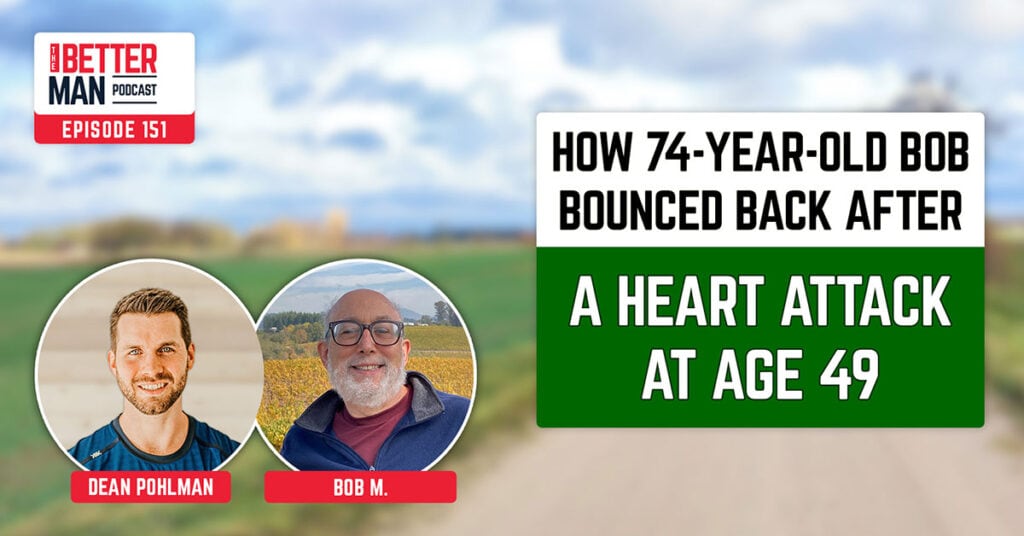
Some men are blessed with superior genetics. And other men are at the mercy of their less-than-stellar genetic code.
Today’s guest, Man Flow Yoga Member Bob, falls into the latter group with cardiovascular health. His entire family has had some cardiac event that altered the course of their life.
Bob’s cardiac event struck when he was 49. While he was out for a run, he started feeling alarming warning signs that made him rush to the ER. Turns out, he had a heart attack.
But you know what?
It’s been a quarter of a century since his heart attack – and despite being dealt an unlucky genetic hand, Bob has not let it stop him. In fact, he’s used it to up his fitness game… and he’s in stellar shape in his mid-70s.
Whether you were also dealt an unlucky genetic hand, you feel the winds of Father Time starting to catch up, or you just need a dose of inspiration from a 74-year-old who’s less stiff and achy today than he was five years ago, this episode has you covered.
Here’s what Bob shares on this episode:
- Bob’s secret to consistency that’s helped him stay consistent for decades
- How to outsmart your unique genetic traps with diet and exercise
- Why switching from running to yoga significantly improved Bob’s body composition
Listen now!
The Better Man Podcast is an exploration of our health and well-being outside of our physical fitness, exploring and redefining what it means to be better as a man; being the best version of ourselves we can be, while adopting a more comprehensive understanding of our total health and wellness. I hope it inspires you to be better!



Use the RSS link to find the Better Man Podcast on other apps: http://feeds.libsyn.com/404744/rss
Episode 151 Highlights
- How genetics and stress caused Bob to have a heart attack at only 49 years old – despite consistently jogging for 20 years (and how he upped his fitness game in the 26 years since suffering his heart attack) (2:38)
- A few of the symptoms Bob experienced during his heart attack that may help you recognize the warning signs if it happens to you (3:18)
- How to satisfy your sweet tooth in only 100 calories (11:41)
- Why your body composition can radically change even if you’re in your 70s and even if your weight stays relatively stable (17:02)
- The obvious, yet overlooked best way to prevent sarcopenia from setting in as you grow older (20:34)
- How Bob balances yoga, strength training, and regular walks into his weekly fitness regimen (22:34)
- The “extra 10 to 20 percent” secret of having an engaged community attached to your workout routines (27:01)
Dean Pohlman: Hey, guys, it’s Dean. Welcome to the Batman podcast. Today’s interview is a member interview. And we have Bob here. Bob is 75 years old, so he’s representing, a significant but maybe not recognized part of our community. And in this episode, we’re going to talk about heart health. Bob had a heart attack at the age of 49 and how that impacted his approach to health and wellness.
Dean Pohlman: We also talk about how he transitioned from running to yoga in his 60s, and how that actually improved his body composition. We talk about his struggles with flexibilities and how you can reframe your progress with flexibility to have a hopefully, a more encouraging view and one that actually helps with your overall health and wellness. And then this is just a great conversation, to highlight kind of the importance of community and how that’s been helpful in Bob’s own journey and how he’s helped inspire others and how he’s been inspired by others.
Dean Pohlman: It’s just simple community engagement. So guys, I hope you enjoy this interview. I enjoyed this conversation. Got a lot out of it. And I think you will too, I hope inspires you to be a better man. Hey guys, a scene. Welcome to the Batman podcast. Today’s episode is a member interview today. I’ve got Bob here and we’re going to talk about his health shown over the last few years.
Dean Pohlman: Bob. Thanks for being here.
Bob M.: Thank you. Dean.
Dean Pohlman: Yes. And we we talked about this before we started, but Bob’s a bit nervous, but that’s okay. He’s going to do great.
Bob M.: Right? Yes.
Dean Pohlman: Sure. Okay. Well, and so, Bob, I met at the, the most recent wellness weekend we did, which is in DC. And Bob, I think initially said, like, yeah, I’d love to talk, but I don’t know if people really want to hear my story because, you think you’re older than most of the guys who are doing manual yoga, but I just so I.
Bob M.: Know I’m older.
Dean Pohlman: You you’re older. However, you are so in a common demographic within our community. So you’re 70, 74.
Bob M.: 74.
Dean Pohlman: 74. And we do have a lot of guys in their 70s who are doing men for yoga and who are being successful with it. Like you. So I wanted to have your story just to show. Hey, you know, there are guys in their 70s, there’s mostly guys in their 40s, 56 seconds. Yes, there’s guys in their 30s, too, who are getting smart and, you know, actually taking care of themselves before things get worse, which is great.
Dean Pohlman: But yeah, we’ve got guys in their 70s, too. So I’d love it if we could just kind of start off with what was your oh shit moment with your fitness. When did you realize, okay, I’ve got to make a change here. If things aren’t going the way that I want them to.
Bob M.: Well, I was 49, and I had a heart attack. And so that was kind of an oh shit moment. And I actually had the heart attack when I was out for a run. Oh, that that it just happened to be that I have, you know, an unusual family history when it comes to cardiac issues. But, you know, I had been running at the time for, oh, probably over 20 years.
Bob M.: And, I had been in for a physical a couple of weeks before work, and the the doctor told me she didn’t like the way the EKG looked. And so I was out for this run in on on the way back from the run, I started feeling terrible. I actually started feeling a little bit, jaw pain, and, I, I decided it was time.
Bob M.: Time to go to the emergency room. So we did that, and. Yeah. And it turns out that I had a heart attack. I had a stent put in, and, and so that was my, my wake up moment that, that, you know, there were issues here. They they are two issues necessarily, because of the way I’ve lived my life.
Bob M.: I think there are more issues because of genetics. Yeah. But it it it did signal to me that I had to up my game. Yeah. And then I think some of it also was stress. Yeah. And, stress I think is part of just about everybody’s life at some level. And, you know, like I said, there’s there’s family history at this point.
Bob M.: Everybody in my family of origin had had some kind of cardiac issues. So, you know, it it’s not something that I’m blaming myself for a bad lifestyle for, but it was something that, that that kept me, wanting to make even more of an effort at staying in shape and, you know, not ballooning up in weight, that kind of thing.
Dean Pohlman: So what happened? So immediately following the the heart attack, what were.
Bob M.: Well I, I ended up continuing to, to run for several years and it didn’t stop me from having subsequent cardiac events, so I, I had a couple more, but fortunately I’ve got a good internal warning system, and, that is that that, I mean, once I was on the treadmill and I wasn’t able to go as fast as I usually did, and so, I went to the doctor a couple of days later, and then a week later, I ended up having, a cardiac bypass operation.
Bob M.: Oh. So. But I was lucky because I was in pretty good shape at that point. And so even though I, I, I had that happen, you know, the artery had a blockage in it. But I basically recovered within in a month. And for a while, food was the enemy. What can I say? That that I couldn’t think of what else to do because I’d been doing it all, and, then, a few years later, I was finding that, my, my body was not reacting as well to running as it, it it had been.
Bob M.: And so I needed to find some new activities.
Bob M.: So I, I, I got into biking and then I visited with a friend and a friend, took me to a yoga class, and, I, I thought to myself, well, this is an area that I haven’t really examined at all. And I was let’s see, it was probably about ten years ago. So, so I was about 64 at the time.
Bob M.: And, when I got home, I, I did take a couple of lessons from a local yoga teacher. And then I found you on YouTube. And, I’d kind of say that after that. The rest is history. It didn’t take me very long after that until I. I decided to become a member. That that that the way you approach to spoke to me.
Bob M.: Yeah. That that I was I was able to do most of it. I’ve, I’ve got the world’s Titus hips, shoulders and hamstrings. And, you know, I will say that that they have improved somewhat, as, as a consequence, man, to me, you know, okay. So and that’s kind of it in, in a nutshell, you probably got a little more medical history than you wanted.
Bob M.:
Dean Pohlman: No. I mean, this is, this is important. All right? This is this is looking at health. I’m not. I’m not just looking for, like. Well, approximately how much did you bend your knees in order to touch your fingers to the ground, like, I don’t I don’t care. It’s more so looking at like, what is the overall health picture and how did you know?
Dean Pohlman: How did things fit into that. So so I’m kind of curious for you, how did you you know, what were the, so you mentioned that food was the enemy here in terms of what you could do about your heart health? Was was that what was most helpful, making some of those changes? Was it just staying off of the heart or cardio or like what?
Dean Pohlman: What are the.
Bob M.: Changes? I, I think to heart harder cardio. Cardio was more about the fact that the cartilage in my ankle was going, and I couldn’t run, run as much without pain. So that’s that. And that’s the one thing that that I really found that the yoga has had, has helped with. And I had had ankle surgery in 2022.
Bob M.: So, you know, I, I’ve had a lot going on, just to, the yoga has actually helped the ankle mobility quite a bit. And, you know, I it it was something that I noticed when, when, when I was at the, the September meeting is, is, is when we were doing those, those lunges with, with the knee past past the toes.
Bob M.: I can actually do that now. Now. So I, I, I felt that was a real win. So I think that I’ve, I’ve just been been I’ve been learning a lot. And, you know, over time, I can ease into a lot of these positions better. Yeah. As, as as far as the health thing, you know, you look for reasons, but sometimes it’s just the genes.
Bob M.: And I’m pretty much convinced that that’s that’s that’s what it was. You know, when my entire family of origin has had cardiac issues of one kind or another, it’s. Yeah, it’s definitely there. And, I’m a scientist by training. And, and so there’s really nothing in the science that convinces me of anything much different.
Dean Pohlman: Sure. So, yeah, I think totally makes sense that genetics are the reason why you have more cardiac issues and other people. Are there did you just kind of say, okay, that’s that’s what it is, and it’s always going to be, you know, more challenging for me and, you know, but are there are there other things that you said, okay, well, it is more challenging for me and I have these genetics, but I’m still going to do these things differently because of this.
Dean Pohlman: Or I think I’m trying to understand, you know, are there certain measures that others that other people might not need to take for heart health?
Bob M.: Certainly. You know, I, I, I do try and eat a decent diet. I, I certainly have have for years. I can’t even remember the last time I had, a sugary carbonated beverage.
Bob M.: That that I kind of switch to, to either seltzer or water back in, in the 1980s. So, you know, a long time ago, and, you know, basically tried to eat healthy. I do have a little bit of a sweet tooth that I, I, I indulge to a limited degree that, I, I, I buy these 100 calorie dark chocolate bars to just satisfy my urge.
Bob M.: Yeah. And I find that one of those will will, we’ll do it, but I, I basically try and hold Whole foods most of the time. I, I do like to cook and, and and that kind of helps. I like fresh fruits, vegetables and, you know, so much about nutrition. It’s always a moving target that, that, that the things that they advise about nutrition over the years have evolved.
Bob M.: Yeah. And I, I think, you know, it’s a learning process and, and there again, genetics kind of fits into it because we’re all different. And doing studies on, humans is actually very, very challenging because we’re all, all a little bit different and our metabolism so different. So, you know, I, I, I try and eat and live, lead a sensible life.
Bob M.: And, you know, the one thing about my family, despite this thread of of, heart disease that that has traveled through the family is that nobody’s died young from it. That that, just about every body in my family has lived into their 80s. And so, you know, I, I figure I’ve got at least another good ten years, and, and my goal is, is to get 15 good years out and, and, and I think that both yoga and some strength training is helping me get there.
Dean Pohlman: Yeah. So you’ve been doing yoga for about it’s never yoga for about ten years now. Is that right? Yep. For about ten years okay. You were there now. Really stuck with.
Bob M.: Me for a long time.
Dean Pohlman: Yeah. Yeah. You’re probably you probably know my voice very well at this point. So what was and you moved to kind of that as your main workout, but before it was running and that was due to just ankle pain. So what, you switched over to that? What were some of the differences that you noticed in your, your kind of your day to day fitness?
Bob M.: I think as much as anything that I, I noticed that I was getting fewer backaches. That that I was less stiff in the shoulders and, and above all, I think my posture had had improved significantly. I got a bit of scoliosis. So, so I guess that’s another piece of my my my health journey, so to speak.
Bob M.: And, the, the, watching you and and and doing the workouts actually made me a lot more aware of, of my posture and, how I was standing or, or sitting.
Dean Pohlman: That makes sense. So body composition wise, did you notice, has your body composition changed for the better or for the worse? In the last, you know.
Bob M.: It’s definitely changed. It changed for the better.
Bob M.: I’m, I’m definitely.
Bob M.: Stronger. So, I’m, I, I would say that, you know, I got a little bit less of a a tummy than I had ten years ago. And and my legs have gotten extremely strong.
Bob M.: So, you know, I, you know, particularly my, my, my thighs have, have gotten very strong, so I yeah, I’ve, I’ve, I’ve noticed a lot of difference. I, I, I’ve never really given myself the, the,
Bob M.: Permission to put on a lot of weight. The, I, I’ve always been rather weight conscious so I, I’ve always tried to keep things to a reasonable point, but certainly, you know, as I’ve grown older, I have put on weight. When I graduated high school, I was taller than I am now, and, weighed about 50 pounds less.
Bob M.: That I was quite, quite skinny at the time. By the time I got into college, I was probably about 30 pounds heavier, and I’m probably again about another 25 pounds heavier now. But I think a lot more of that is muscle.
Dean Pohlman: Cool. Were you surprised that you lost weight after you started doing running and doing yoga?
Bob M.: I wasn’t surprised. I was kind of surprised that I was able to keep the weight off when I stopped running and started doing yoga. That, that because, you know, I thought, start running. I was burning a lot of calories. And I kind of replaced some of that with going for brisk walks. And then sometimes go get on the bike.
Bob M.: So, but, but my weight has been extremely stable, but I think it’s, it’s, it’s also redistributed.
Bob M.: Okay. So I think more of it is muscle and less of it is fat.
Dean Pohlman: Okay. Cool. So when you first have you ever struggled with being consistent with exercise or have you always been able to do your workouts kind of consistently?
Bob M.: There are times that I’ve struggled, but that’s also mostly been due to, family things coming up. I’m sure as the parent of two young children, you, you would have some of your own struggles that way. Well, when, when when we had kids, we had one child, and then six years later, we had twins. And when the when the twins came around, I was sleep deprived, and I hardly had time to breathe, so that was probably the biggest struggle that I had.
Bob M.: But, you know, it was temporary.
Bob M.: But I, I will say that I’m kind of a motivated person, and I and, and I do try and be consistent.
Dean Pohlman: Do you know what your motivation comes from?
Bob M.: I think I just want to be a better version of myself. And I think it’s it’s a strong motivation. And since I semi-retired, it’s a lot easier that that that’s that’s one advantage of age, which I can’t think of too many.
Dean Pohlman: Yeah. Yeah. I mean, I’ve talked with a lot of people who are retired who are somehow busier now than they were when they, you know, when they were employed and had a family. But, yeah, you know, you can choose what to do at that time a little bit more. So, well, also.
Bob M.: I, I laugh and say that I, I, I often wonder how I had time for work.
Dean Pohlman: Yeah. Yeah. It makes sense. So when you. So we had you so you had the heart episode, you were running to yoga when you started doing yoga, were you doing strength training at the time. Have you always but have you always lifted weights.
Bob M.: No, no, I have to that that’s actually more recent. And that’s actually something that, joining the engage 2.0.
Bob M.: Alerted me. Yeah. That kind of alerted me to the, the that importance and, and the, the, more that I’ve read and, heard experts talk to the the more important that is for, for us golden agers, that, you know, keeping sarcopenia from setting in is, is really, a big thing. And one thing that I will say is that being of the vintage that I am, I’ve seen so many of my contemporaries start to falter in about my age.
Bob M.: And so I, I’m, I’m actually pretty pleased at the, the ability that I have have to keep up with, with things. And one of the things that I noticed at the September activity is that I, I was actually able to keep up with everybody.
Dean Pohlman: Yeah. Well, that’s a testament to you continuing to, to improve yourself over, over many decades. So you started doing strength training last year about, how’s that been going for you?
Bob M.: I think it’s been going pretty well. The you know, I’m I’m, I’m making progress, and, I, I think one of the things that, I’m continuing to work on is just try to trying to get a little bit more flexible that I, I, certainly like a little bit more flexibility in the hips if I can get there.
Bob M.: But, overall, the strength training, it is making me feel stronger. There are things that, that, that do seem to be coming harder as I age, but, I’m, I’m taking them one, taking them one one at a time and, you know, continuing to work at it.
Dean Pohlman: Yeah. So how do you, you know, a question that I get all the time people is how do I how do I do all these things that, you know, you recommend that I do? I have to walk, I have to you do I have to do, you know, strength training, how do I where do all the things. And so what’s your kind of average weekly workout routine look like?
Dean Pohlman: Not the one that you strive to have, but what’s like the usual workout routine look like.
Bob M.: At this point I’m trying to do yoga 3 or 4 times a week. Sometimes a little bit more. And, there’s a couple of, of your, your episodes on, things to do before strength training. Yeah. And I’ll often do those right before I do my strength training.
Dean Pohlman: Yeah.
Bob M.: I just to get the body good and warmed up I, I, I see that one thing that becomes more and more important as you get older is, is doing that warm up activity. And, you know, I, I, I, I try and get into the gym to do strength training three times a week. I’m not going to make myself crazy.
Dean Pohlman: Yeah. I think three times a week is great.
Bob M.: And, and and then I get, get out for maybe 3 or 4, three mile walks during, during the week, sometimes during the weekend. So, a moderate amount of exercise, but but a decent amount.
Dean Pohlman: Yeah. And, it sounds like a great schedule. So you mentioned struggles with flexibility, and I wanted to bring that up because I think a lot of people, have an idea that in order to improve or in order to notice the results of flexibility, they have to notice, okay, now I’m going deeper into this position than I was before.
Dean Pohlman: And what I try to steer toward, steer people towards instead is, yes, I know that you want to be more flexible, but how do you feel in your day to day life? Are there are there things that you have difficulty doing, or do you have you know, stiffness that you really I mean, I think stiffness is kind of a given as you get older, unfortunately.
Dean Pohlman: But are there things that you struggle to do because of a lack of luck, because of a lack of flexibility?
Bob M.: At this point, no. I’d say 5 or 6 years ago. Yes. That is that it actually has is eased up in, in, in, in, in a lot of ways that, you know, I, I can actually do a decent squat, with my heels on the floor.
Dean Pohlman: That’s that’s significant.
Bob M.: So, you know, certain things actually have improved. And I can actually see the improvement over the years. But, you know, I’ve, I’ve kind of, for lack of a better word, I’ve been consistent. Yeah. And, and I think that that that does make a difference, and I, I, I will say that I love the challenges.
Bob M.: That, that that’s a perfect way to rope me in at this point.
Dean Pohlman: Okay. Yeah. So the challenges are with you. So if you’re listening, you don’t know what challenges are. So challenges are when we do kind of community led programs. So we say, okay, you know, three Mondays from now, it’s usually the first Monday, every three months. So like we’re doing one right now and October. And we say, okay, we’re all going to follow along for this program together.
Dean Pohlman: So every day you know that you’re doing the same program, the same workout that everyone else in the manual, you yogini who’s following that program is also doing. So it’s, it does add a lot of motivation, adds a lot of fun to it. You get to see people sharing on Facebook and sharing in our community section of the app, posting photos like, hey, I did the workout today.
Dean Pohlman: And so it helps, really helps with inspiring you and keeping you kind of hooked in. Like you mentioned.
Bob M.: So I, I, I do think that that’s a good way to stay engaged, for lack of a better word. And I, I will say the fact that you’ve got such an active online community of, of people who also, you know, as are kind of inspiring, and people of all different ages, shapes and sizes. Yeah. That, that, you know, I, I’ve, I’ve really been inspired by a lot of them.
Bob M.: And, I, I do think that that has helped me stay engaged in that and wanting to do the best I can.
Dean Pohlman: Yeah. So by inspiring, you mean it helps you, you know, show up and do your workouts, but also push yourself more in the workouts? Or what do you mean by inspiring?
Bob M.: Exactly. Well, you know, seeing seeing some of these people of various shapes and sizes works so hard. Had it, and really push themselves, makes me feel like, well, I can put an extra 10%, an extra 20% in and and and and maybe I can get there too.
Dean Pohlman: Yeah. Okay. Great. That was going to be one of my other questions. Is external support systems. How have they helped you in your fitness journey? Has your family always been supportive of your your health habits? You feel like you have good support there?
Bob M.: Well, you know, given the fact, my family almost lost me at one time. I, I, I do think they’ve, they’ve tended to be supportive because I think they’d rather have life with me than without.
Dean Pohlman: What a compliment. Yeah, yeah, sure. Dad, you can stick around. We’d love to have you here. Yeah. Okay. Cool. Do you feel like. Do you feel like you’ve ever had to say, hey, like, I need this time to work out? Or have you had, was that ever a conversation that you had to have to make sure that you had that time?
Dean Pohlman: Or was that always kind of, like, accepted or.
Bob M.: Certainly there were things that I had to rearrange in my life in, in order to keep that going. So, you know, there are are a couple of outside activities that at one point I, I did that I stopped doing because the, the health oriented things were more important to me. And yeah, point in time and, and also I, I needed the extra time to support my kids.
Bob M.: Yeah. Which is more is a more important.
Bob M.: One of the more important things to me and twins was chill, challenging.
Dean Pohlman: Yeah. Yeah. I have friends who have twins and they refer to us as singletons. I don’t know if they if you did that. Yeah. I’m not. They you did that when you were, when you had twins. But that’s the new word. That’s what people with twins call people with a single child. Singletons.
Bob M.: Well, well, well, since we had a singleton first, I don’t think that was as much of an issue for, for us. And I guess the other thing was that we had all already gotten one child to six years old at the time the twins were born. And so, while while the first two years with twins were very challenging, there were a lot of the things first time parents go through that we didn’t have to go through.
Bob M.: When the twins cake.
Dean Pohlman: Yeah, true. So you mentioned, you know, your goal now is to get another good 15 years is that is that your next. Is that the next mountain you want to climb with your fitness or what’s kind of what’s what’s your what’s the big thing that you’re working toward now or you would like to work on in the near future?
Bob M.: I, I do think it’s the overall goal of that. 15 years is the big, I, I would like to see, you know, I, I’m not aiming for any kind of perfection, you know, nobody’s perfect. Nothing is perfect. But, I, I’d like to continue getting a little bit stronger. Maybe, put on a little bit more muscle and lose a little bit more faith.
Bob M.: But then doesn’t every guy want to do that?
Dean Pohlman: I like yeah. Most of the guys I talk to, there’s,
Bob M.: The.
Bob M.: The part that I think that’s kind of, a universal thing, but, you know, I’m, I’m also not unhappy with shape. I mean right now.
Dean Pohlman: Cool. Well, I’m ready for your rapid fire questions if you are.
Bob M.: Okay.
Dean Pohlman: Okay. All right. So what’s the one habit, belief or mindset that has helped you the most with your overall health and wellness?
Bob M.: I think the part that would be just pushed myself to do a little bit of something every day.
Dean Pohlman: Okay. Love that. What’s one thing that you do for your health that is often overlooked or undervalued by others?
Bob M.: I think taking some time to reflect.
Dean Pohlman: Yeah. Yep. It’s a good one. And what is the most stressful part of your day to day life?
Bob M.: Sleep. Sleep that. Yes, that as you get older, sleep becomes, more challenging. So. Yeah. I, I really miss the days where, where, I would work all day and, and deal with the kids in the evening and go to bed and get my 7 or 8 hours in without interruption, and then wake up in the morning refreshed.
Bob M.: And, you know, as you get older, the parts don’t work as well. She ends up having to get up for various reasons in the middle of the night and sometimes getting back to sleep. Is it? It’s a little challenging, depending on, when it is I, I aim for seven hours, but most of the time it’s more like six.
Dean Pohlman: What is your best piece of advice for men who want to be healthier.
Bob M.: Best piece of advice is probably eat well eat wisely and get enough exercise.
Dean Pohlman: Well, Bob, thank you for representing, the 70s crew in this interview. I appreciate you coming on. And sharing your story.
Bob M.: Well, thank you for having me, team.
Dean Pohlman: Yeah. And I appreciate you coming to the event as well. And being active in our community, it really means a lot, to me. And, means a lot to the guys in the community to to see your posts and see that you’re doing the workouts because, like you mentioned, like, if, you know, if none of the guys like you were sharing things, then it would be not a very inspiring community.
Dean Pohlman: So, I’m glad that you’re active. And one of those guys who shares things.
Bob M.: Well, thank you. And I’ve really appreciated the opportunity to to talk to you today.
Dean Pohlman: Yeah. This is great. All right guys I hope you enjoyed this interview. Bob. Thanks again. And I’ll see you guys on the next episode. I hope this inspires you to be a better man. All right, guys, I hope you enjoyed that interview again. This was Bob, and you’ll find him on the mantle yoga community, either in the Facebook group that we have or as well in the Mantle Yoga community section of our members area and app.
Dean Pohlman: So if you are enjoying this podcast, I want to encourage you to check out some of the other member interviews we’ve done. You can hear stories from other guys, and share their own health and wellness journeys and how mental yoga, but how other stuff has also fit into that. So, if you’re enjoying the podcast, I want to encourage you to leave a review.
Dean Pohlman: You can do that on Apple Podcast, on Spotify, wherever you listen. And if you want to try out the community for yourself, go to man for yoga.com/7, DC the number seven and then the letters DC. And you can try a free seven day challenge. So thank you. If you’re already part of the mental yoga community, I appreciate you guys being here.
Dean Pohlman: I hope these are helpful. I hope these are encouraging up there. Inspiring. If you want to tell me your story, send me a message, email me at Help at Mental yoga.com or send me a message on social media. And I’d love to interview as well. So all right guys, thanks for being here. Hope you enjoyed this episode.
Dean Pohlman: Hope this inspires you to be a better man. I’ll see you on the next one.
[END]
Want to improve your sexual wellness, get stronger erections, and last longer in bed? Then join the FREE 7-Day Sexual Wellness Challenge here: https://shrtlnk.co/uA27H
Want to unlock more flexibility and strength, reduce your risk of injury, and feel your absolute best over the next 7 days? Then join the FREE 7-Day Beginner’s Yoga for Men Challenge here: https://ManFlowYoga.com/7dc.
Tired of doing a form of yoga that causes more injuries than it helps prevent? The cold, hard truth is men need yoga specifically designed for them. Well, here’s some good news: You can start your 7-day free trial to Man Flow Yoga by visiting https://ManFlowYoga.com/join.
Like what you’re hearing? Sign up for the mailing list:

Rate & Review
If you enjoyed today’s episode of The Better Man Podcast, hit the subscribe button on Apple, Spotify, or wherever you listen, so future episodes are automatically downloaded directly to your device.
You can also help by providing an honest rating & review over on Apple Podcasts. Reviews go a long way in helping us build awareness so that we can impact even more people. THANK YOU!
More Podcast Content
Dark Motivation Works … But It Causes a Mid-Life Crisis (Try this instead) | Connor Beaton from ManTalks | Better Man Podcast Ep. 191
Do you ever feel like you’re just wandering through life without a purpose, or stuck in the middle of a frustrating…
Fitness After 40: How To Start When You’ve Never Exercised (The Man Flow Yoga Catalyst Effect) | Bobby B. | Better Man Podcast Ep. 190
Turning 40 was Bobby’s wake-up call. After a lifetime of skipping workouts, a doctor’s visit revealed warning signs in his blood…
Gut Health Goes Way Deeper Than Weight Loss | Ben Brown (Founder of Body Systems Coaching and Head Nutrition & Fitness Coach) | Better Man Podcast Ep. 189
Gut health impacts far more than weight loss—it directly governs your energy, immunity, and mental well-being. If you grew up in…
Moving From Your Survival Path to Your Soul Path | Caleb Campbell (Former NFL player & West Point graduate) | Better Man Podcast Ep. 188
If you’re an endlessly striving achiever, you know the path forward lacks clarity. Former NFL linebacker Caleb Campbell used his feelings…

The Ethics & Use Cases of AI | Ted Phaëton | Better Man Podcast Ep. 187
The topic of AI is unavoidable. Ted Phaeton, productivity coach and host of the Modern Man Podcast, joins the show to…
My Personal Experience with Anxiety | Dean Pohlman | Better Man Podcast Ep. 186
After an accidental mushroom trip triggered a panic attack, I realized I’d actually been living with low-grade anxiety my whole life….