Without your awareness, knowledge, or consent. And you only notice how deeply entrenched your conditioning when shit hits the fan.
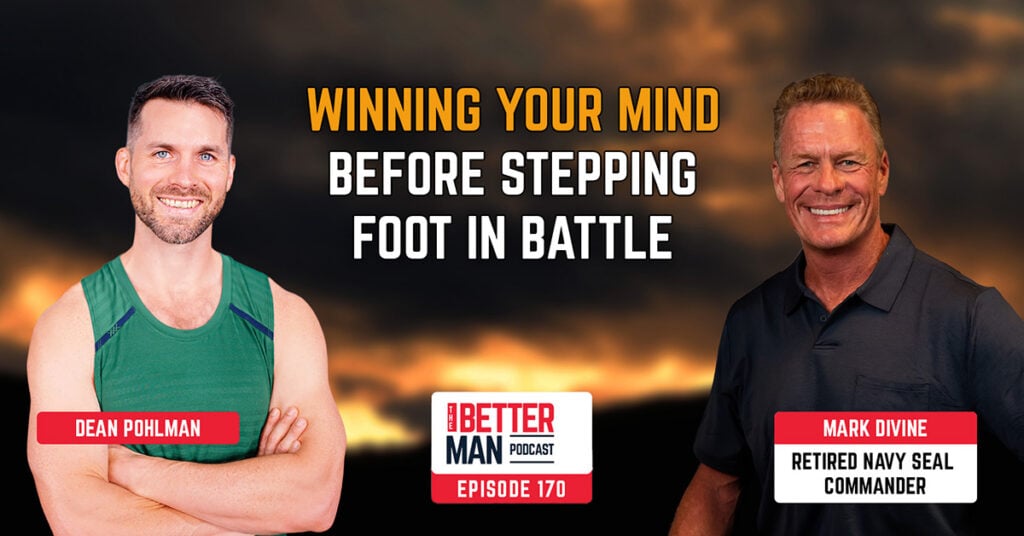
Mark Divine (retired Navy SEAL Commander, best-selling author, and CEO of SEALFIT and Unbeatable Mind) returns to the Better Man podcast for a beautiful example of showing courageous vulnerability in today’s show.
Because despite writing five books on mental and emotional health…
Despite being a retired Navy SEAL Commander and successfully founding multiple companies…
And despite having perhaps the most intense morning routine you’ll ever hear about…
… shit still hit the fan for Mark, which reminds us that perfection isn’t possible and to never get complacent.
Mark’s one of my favorite guests. And you’ll see why when you listen to this show.
Here’s what Mark and I discuss:
- Mark’s exact 4-hour long morning routine (and the “shit hit the fan” story behind why Mark makes it so intense)
- How to start a mental strength practice and use it to improve your emotional intelligence and resilience
- How to bounce back after going through major setbacks without losing yourself
Listen now!
The Better Man Podcast is an exploration of our health and well-being outside of our physical fitness, exploring and redefining what it means to be better as a man; being the best version of ourselves we can be, while adopting a more comprehensive understanding of our total health and wellness. I hope it inspires you to be better!



Use the RSS link to find the Better Man Podcast on other apps: http://feeds.libsyn.com/404744/rss
Episode 170 Highlights
- Why Zen monks break a sweat when they meditate – and easy-to-follow steps for beginners to train your mind to concentrate (2:58)
- The “barbell curls for your brain” mindset shift that makes you look forward to meditation (even if you suck at it) (5:25)
- How to train your mind like a Navy SEAL (and why you must rewire your brain or someone else will) (15:27)
- Why training your mind to become “One Mind” allows you to perceive more than others think possible, to create with almost unlimited potential, and to stay young for as long as you need (19:21)
- A simple practicing mistake almost all men make when trying to learn something new (23:28)
- How gamifying your goals hijacks your mind and practically forces you to achieve them (24:52)
- How to tap into a river of consciousness dating back thousands of years and “borrow” its energy by repeating ancient mantras (33:40)
- Why the best way to “rewrite” memories of your past is to create memories of your future (44:20)
- An extreme real life example of the imminent danger posed to and others by letting your emotions drive your actions (52:03)
- Why doing the work Mark describes in this episode, work that can change your life in ways you can’t even imagine right now, won’t make you perfect (1:00:51)
Dean Pohlman: Hey guys, it’s Dean, and welcome to the Better Man Podcast. Welcome back to a repeat interview. We’ve got Mark Divine back for a follow up interview. And this one I, I really push him to get personal, and I think he does an amazing job. Without fear. This is an amazing example of courageous vulnerability. We talk about, his exact morning routine, which I think is really cool.
Dean Pohlman: You get to just see the amount of intention and the, the exact practices and the, the spiritual elements that go into his morning routine, which are unlike anything I’ve ever heard, honestly. And then we also go through some of the more trying times of his life. And, you know, you get to hear from this guy who is this bestselling author, who is this, you know, commander of the Navy Seals, who is incredibly successful and still had setbacks, still had, you know, still had breakdowns, even after all of that.
Dean Pohlman: And I think it’s just, it’s just a great conversation. There’s so much to gain from this. I know that I got a ton out of this. I think that if you have half a brain, you’ll be able to get something out of this as well. And, I really hope you enjoyed this interview. I did.
Dean Pohlman: And, thanks again to Mark for being part of this. And, I hope this inspires you to be a better man. Hey, guys, it’s Dean. Welcome back to the Better Man podcast. I’ve got Mark Divine here for our follow up interview. And, coming off a great first interview, but, Mark, thanks for being here again.
Mark Divine: Yeah. My pleasure. Dean. Enjoyed our conversation.
Dean Pohlman: It was great. Yeah. It was. I mean, honestly, one of the one of the one of the better conversations I’ve had on this podcast. So I really I really appreciate it. And I came away with that being, feeling re-inspired to do a lot of things that we talked about that I haven’t done as much of it, and namely meditation, because I used to meditate a lot more and I kind of turned more to kind of more to journaling and to a gratitude practice and to, kind of a, shifting a lot.
Dean Pohlman: I’ve had a lot of, you know, anxiety over the last few months that I’ve had to work through. So kind of shifting from the ruminating to let me pay attention to the sensations in my body. And so being reminded of meditation and specifically the way that you talk about it in the sense of concentration. Right. So inhale exhale count.
Dean Pohlman: And so I have done that multiple times per day over the last however many weeks ago we had this conversation. And I do feel more mentally at peace now as a result of that. So thanks very much, for that. And, you know, I think for, for a lot of guys who, who meditate, you know, you’re familiar with the, you know, the typical experience of trying to meditate, trying to focus on your breathing and then having thoughts or images or fragments of ideas pop up in your mind.
Dean Pohlman: And in our interview, you mentioned the goal is to get to ten without, you know, having a thought. And I’m curious for you, does that mean that nothing pops into your mind during those ten breaths? Or is it you notice flashes of things or fragments of ideas and then you just don’t follow them?
Mark Divine: So it’s a good question. So with concentration training, which, develops focused attention, and I mentioned our call that that really is, a prerequisite for different types of meditation practice, such as monitoring or mindfulness. And we can get into why that is. So, you have something in your mind. So your thought is inhale hold exhale hold.
Mark Divine: If, if you’re doing box breathing or inhale exhale count one. That’s your thought. And you hold your attention on that thought. So yep. You’re practicing attention control. Now in the early stages of the practice and maybe, maybe forever for a lot of people, you’ll be doing that and you might get to 2 or 3 rounds without any other thoughts.
Mark Divine: And then you’ll notice that, you know, there are other thoughts. And so at that point, you just redirect your mind back to the object of concentration, which is your breathing.
Mark Divine: And you pour more effort into it. So this is an efforting practice, right? I mean, Zen monks who are really deeply steeped in the practice and can hold their attention for, you know, 30, 40 minutes at a time or longer. You know, they’re breaking a sweat like this is a workout for them because their mind is being is being directly, energetically and with willpower being focused on that one thing instead of giving attention to the other thoughts.
Mark Divine: And so what that does over time is naturally it strengthens. It strengthens your ability to hold your attention on that breathing pattern to the exclusion of all else. So it literally blocks out, blocks your awareness of other thoughts and other, imagery or sensations, even. So what’s what’s powerful about this is it strengthen really strengthens your mind.
Mark Divine: It’s like doing barbell curls for your brain. This strengthens your ability to to have that focused attention, to really penetrate anything is any subject deeply?
Dean Pohlman: We’ll just consider that part. That’s part of the part of the practice.
Mark Divine: My friends are practicing their their attention control over their. Yes. So it’ll deepen your powers of concentration and, allow you to hold your attention and also, it’ll help you notice when you’re distracted much quicker and give you the willpower to just, you know, snap out of that distraction. This is enormously valuable in this world that we live in right now, which is just full of nonstop distraction and an attempt to take control of your attention right through social media and advertising and whatnot.
Mark Divine: Having said that, you know, not everyone is going to develop that type of concentration power, right, of the Zen monk. So the practice will still have enormous benefits, even if all, you know, even if you you never get to ten without any other, acknowledgment or recognition of any other thoughts. I mean, it’s enormously beneficial just to be able to get to 3 or 4 or like I said, I consider it a, advanced practice.
Mark Divine: If you can get to five or more cards, right, or five or more rounds of box breathing and with holding discretely holding your attention on the box pattern without thinking of anything else. So there’s enormous benefits that come from it. You know, without having to strive for perfection. In other.
Dean Pohlman: Words. Yeah. And I, I think I noticed those benefits just within days of restarting the practice. I think I used to do a lot more meditation and I don’t know what happened. Maybe it got too hard. Maybe life got I don’t I don’t, I don’t remember, you know, there could just be too many maybe rumination became too and just made it too difficult that I didn’t want to try to do it.
Dean Pohlman: But, you know, after focusing so much of the different healing practices and different, different, you know, types of, self work, like journaling or like, you know, body scans after having so much, so much of what I’ve been doing, being let me pay attention to what’s going on in my body versus let me direct the attention itself.
Dean Pohlman: I was like, maybe this will be something nice to compliment all of that other work I’m doing. And so, yeah, for me, it was it was just a really nice experience to and then also to realize, because you had said it took you six months to be able to count to ten and like, crap, do I have six months?
Dean Pohlman: I mean, I’ve got, you know, for years, I guess I had like, right, all right, I’ve got six months, but also I want to take that long. So I was kind of pleasantly surprised when I realized that I could get to that point of, oh, I’m not having any thoughts right now. Right. My body, you know, kind of like riding a bike, remembered how to do it, right?
Dean Pohlman: So, so.
Mark Divine: I’d like to address.
Dean Pohlman: That was encouraging.
Mark Divine: You know, you mentioned a number of different practices, so we should all have a suite of practices and, be very clear about why we’re doing the practices, what the benefit is and how to practice them. Right. So you’re doing it correctly. So you mentioned journaling. So journaling is a really nice practice of, contemplation. Or it can be a practice of, just like a stream of consciousness where you’re getting stuff out of your conscious mind, which opens up space for stuff, the bubble up from your subconscious, and then it comes out through your pen without you necessarily knowing or thinking it through is just coming up.
Mark Divine: So in a sense, it’s a great complement to your emotional development as well as, reflective metacognitive, kind of realignment and reframing. Right. So or repositioning to do things differently. So like a personal debrief. Right. You can reflect upon how things went over the week or how it went in today. So we, we, recommend that nonverbal mind as an evening ritual.
Mark Divine: Right? You do your box breathing and then you, you go back in the beginning of the day and you visualize yourself going through it. And you journal. Highs, lows. What went well? What didn’t go well? What did you learn? What are you going to do different. So like a little debrief of your day. So all of those benefits come from journaling.
Mark Divine: And there is also a a calming effect. Right. So you’re getting a biophysical kind of reaction to that. That’s going to, you know, have benefit over time for health and, balance and whatnot. But it’s not mental training. Right. And I would put that more on the emotional, category or, you know, even in planning and I’m trying to do, you know, improve on conditions of your life.
Mark Divine: And then you mentioned the body scan. So body scan is very nice because it’s a, it’s a, it’s a master relaxation techniques and a form of embodiment where you get to experience that the body and mind actually are two separate things. They are one thing because as you put your mind throughout your body, you experience the body in a different places, locations, organs, and and so it teaches you that the mind isn’t just the brain, right?
Mark Divine: Otherwise you wouldn’t, you know, you would be able to think about your calf, but you wouldn’t necessarily be able to feel as if you were in your calf because you’d be in your head. And so and so is the body scan is really powerful because it’s a way of embodying the experience of whole mind. And it’s extremely relaxing, right?
Mark Divine: Because you, you know, different types of body scans. But one is, you know, like where you, you flex and release every muscle as you go through, you know, the body from, let’s say, your toes up to your top of your head, which is a nice one. And we’re just to experience and release any tension that, in my experience or just to experience as if you are your calf or an as if you are your thigh.
Mark Divine: Right, you know, put your mind right there.
Mark Divine: So so that’s why you would do a body scan and some really nice way to kind of ease into a meditation, right? Even if you’re doing a seated meditation because, it gets your mind off of the outward focused, task oriented, you know, content attached egoic mind and places your mind back into the body. And then from there, once you’re done with the body scan, it’s easier to turn the light around to turn your attention inward instead of habits outward.
Mark Divine: Right. So body scan happens to be a very, very effective, second stage of a meditation practice. The first stage being to set up your posture right, the breath, your intention, and then go into a body scan and then you begin the practice.
Mark Divine: So the and then there’s others, right. Some people use apps. Right. And so like guided meditation or guided visualization, those are interesting too, because they first of all, you don’t have to you have someone to follow, right? So there’s a guide. That’s what they call a guided. But I would put those really in the bucket of, attentional training because you’re actively doing something with your mind.
Mark Divine: So you’re training by holding your attention. And it’s pretty easy, especially if it’s a, if it’s a beautiful scenery that that’s been, you know, guided or you’re doing some steps like, like, you know, walking down the stairs and, and entering, you know, a beautiful, beautiful area like, you know, natural area that might be someplace you’ve been to in your childhood or that you love.
Mark Divine: And so what you’re doing is you’re activating your visual capacity, right? So you’re training visualization, which has enormous benefits because, not everyone. Right? I think there’s like 25% of people who can’t visualize it all. And then there’s another like 25 or 40, 40% of people who have real difficulty holding on to imagery when they visualize this because they just haven’t practice.
Mark Divine: And then there’s a small percentage of people like 20 or 35% who can actually, like hyper visualize to the point where it’s very real to them. So by following a guided visualization, your training, your ability to use your visualization, which has like when it comes to development, it’s extremely important, right? Visualization is is when it comes to like, taking yourself to higher states and stages of awareness, manifestation or getting clarity around the, the future version of yourself, that emergent quality that you want to become imagery and visualization is absolutely essential.
Mark Divine: So guided visualizations, even auditory where it’s not necessarily a visualization but, it’s sparkly. Some imagery are really useful in that regard. But the practice itself is one of kind of controlled attention, similar to Zen. But it’s not going to be as effective as Zen strictly for developing concentration and, and attention control. And so.
Dean Pohlman: It’s a good is, is a good leading into the like.
Mark Divine: Puppetry. Yeah. Like I think guided apps are like training wheels. There’s real beginner tools, right. Just to get you to stop doing that. Nothing. Or doing the total distracting thing or failing with mindfulness. Right. Or, you know, because your mind, you just can’t. You used to agitated and to anxious and you can’t sit still. So guided visualization gives your mind something to do.
Mark Divine: And so if you need to you’re having trouble starting, then you know, it’s good to start with guided visualization and and stay with that for a month or 2 or 3. But then just like a, you know, just like an aura ring, you’re going to want to let it go eventually or to become a crutch. You know what I mean?
Mark Divine: Like, I don’t do any wearables because, you know, I got tired of being a slave to the wearable, right? The wearable device, you know, quantified type is good to set a baseline, but ultimately you want to learn to listen to your own body and to know your own, your own set points and, and when you need to adjust things anyway.
Mark Divine: So all of these things we’ve talked about so far are really nice tools. But I wouldn’t, I wouldn’t necessarily say, except for the training wheels of guided visualization that you’ve really started the process of training your mind. So this is where, you know, rubber meets the road. It’s nice to do meditation for health benefits. And, it’ll make you feel better and it’ll calm you down and reduce anxiety and all that stuff.
Mark Divine: It’s really nice. Right? So. So that’s where most people think meditation lies, right? Like, oh, I do my yoga. I do a little meditation after class. And it’s part of my performance ritual. Right. But they’re missing the forest for the trees, right. So what, what we really are doing with meditation is completely rewiring how our brain works, and thus the subjective experience of how our mind is experienced.
Mark Divine: And as we talked about last time, it it needs rewiring because we’ve been trained since we were born. But we didn’t we weren’t consciously aware of it, and we weren’t taught to take it disciplined and, direct control over the training of our mind to include the content that we allow in how we manage, organize, remember that content, what will you allow ourselves to remember how we remember it?
Mark Divine: And then also, the ability to open up to contextual awareness and to create this, trait, the skill of simultaneous mind, which is the ability to have radical focus on, on a task while not losing, but maintaining and even expanding your situational awareness so you don’t miss the forest for the trees. So mental training in my world became like one of the most important things.
Mark Divine: Because like I said, if you’re not training your mind, someone else will and the results will speak for itself. And wherever the mind leaves, the body will follow. So, you know, the idea of training your body without training your mind is actually kind of silly. Because you’re you’re leaving most of the potential on the table. And furthermore, if you want to tap into your full potential as a human being, you can’t do so with the limited, construct of how our mind has been trained, especially in the Western world, which, you know, allows us to really tap into just a small percentage of our mental power.
Mark Divine: So training the mind, I think, is probably the most important thing that we do as adults, right? When we have agency is to be able to recognize that, that the mind is the most important thing. The mind generates this physical reality and creates our our capacity to perceive and to make meaning. And, and yet it needs to be trained to basically reintegrate, to, to experience life from a whole mind perspective, an integrated whole mind perspective which has vast power and potential.
Mark Divine: Right. And to perceive a lot more than than people believe can be perceived, can create with almost unlimited potential. And and also can direct the body to stay yo for as long as you need it or want it. That’s how powerful the mind is. So. But you don’t have any of those skills unless you train it.
Dean Pohlman: Yeah, yeah. Just kind of reflecting on what you’ve said and, you know, going through those list of complimentary practices, I can see how, you know, a lot of those things that I mentioned initially, like the body scan, or maybe what I do isn’t even a body scan. What I, what I’ve, what I do a lot of is I tend to, I sit with kind of the intention of just listening to the body, and I listen to I don’t do a scan where I go through and I tense different parts of the muscles.
Dean Pohlman: But, you know, I notice where am I feeling tense. Yeah. Or and I’ll think to oh wow. My my chest is tight. And then I’m like, why is my chest tight? And then I think, it’s tied to oh, it’s tied to this situation. It’s tied to this stressful situation from the day. And so I’m able to, you know, just kind of pick and choose different.
Dean Pohlman: Right. It’s not that I’m picking it. It’s just whatever is the most intense and unresolved from that day just pops up in my body. And instead of, you know, the, the temptation there is to ruminate on a solution, right? If you think you know, and this is what I, you know, and up until I was 22, this worked, right.
Dean Pohlman: Or I could just well, I’ve can come up with a solution. So let me come up with a solution. And then, you know, life gets more complicated and you can’t create solutions for all of the different problems that you have. And you have to just practice. Okay, maybe I can just sit with that feeling until it goes away.
Dean Pohlman: Right? Until the intensity of it goes away and the problem is still there. But now you’ve removed the kind of the emotional baggage that makes it harder to deal with. And so, you know, using practices like that, journaling sometimes, you know, sometimes I am ruminating on a topic that needs to be, sometimes it needs emotional research, and sometimes it needs a logistical, hey, let’s well, if you’re worried about money, you know, let me actually look at the let’s look at the books.
Dean Pohlman: Right. Let’s look at what’s coming in. Let’s look at what our expenses are. And we actually have to have do the logical check. Right then training the mind. I mean, I’ve just noticed in this in the last couple of weeks allows you to notice when you start that rumination pattern and you just you’re just more aware of it and you jump in, you’re like, hey, shut it down.
Dean Pohlman: Let’s focus on let’s focus on the thing. And so, you know, I’ve found little opportunities in my own life where it could be just a couple minutes between, you know, a couple minutes between, let’s say I’ve got a 2:00 appointment. It’s 155. Okay. Let me take three minutes. Let me face a blank wall. And just in a in and out or red light therapy.
Dean Pohlman: You know, this is a great opportunity. This is a great time for me to just sit and breathe. And so any time now that I find myself sitting, with the intention of some sort of reflection or meditation, I usually default into inhale, exhale one and. All right, you know, I’ll kind of I’ll kind of hold myself accountable to, you know, if I, if I lose focus, then I go back to, okay, that didn’t count.
Dean Pohlman: No, no. Right, right. We’ll count that as go back to two or we’ll go back to three or whatever it is. So,
Mark Divine: Yeah, you’re bringing up a really good point. Most people think practice is just something you do, you know, on your bench or your bed or your chair in the morning or, once a day. And maybe, if you’re lucky, you you carve out time to do it twice a day. But ultimately you’re you’re moving. You get the most benefit when you take the practice off the mat, off the bench, you know, out of the out of your practice space and you bring it with you wherever you are.
Mark Divine: Your practice is with you. And so initially that is done. We call them spot drills. It’s exactly what you just described. You know, I encourage my tribe members to like, not block their schedule hour to hour to hour. Right. But like book it for 45 minutes or 50. So, you know, at the most. And then you’ve got ten minutes and they’re ten minutes.
Mark Divine: Now you got time to use a restroom, and to do a spot trail in the spot show. Could be, you know, ten rounds of, of box breathing or or that Zen, you know, tactical breathing that you described, or take a walk out in nature and just mindfully walk and enjoy the nature in the sunshine or, you know, practice gratitude by, you know, going out and telling someone that grateful here to them and or maybe a little contemplation if you just finished a period of deep work or a conversation, just like go back and debrief it.
Mark Divine: And what was the most salient point? What did I learn, you know, and how did that meeting go? Right. So all these things are you’re, building muscle, you’re building, the different skills and you’re putting in rep time. And so I encourage people to like every minute that you do is one rep roughly. So if you get 100 reps in a day, you’re doing well.
Mark Divine: Right? So let’s say you had a 20 minute box breathing, contemplation, meditation, visualization practice in the morning, 20 minutes in the afternoon or evening. There’s 40 reps. And then, even your physical training, right. Whether you’re doing, yoga, Pilates, even a CrossFit workout, it gets a little bit harder. The more intense it gets in, the more people around.
Mark Divine: But you can turn that into a mindful movement practice. Right. Which is the way we, Todd seals it back in the day. Is like, you pay very close attention to every rep, the quality of the movement, your breath, the alignment and even situational awareness to make sure that you’re safe and those around you are safe and everyone’s doing it accurately.
Mark Divine: And, you develop the kind of, movement, fidelity, virtuosity, that then carries over, especially as a seal into your life. So if you’re in a firefight, you know, you’re you’re moving with grace, even though you’re in the most intense situation that human could possibly be in. So that would be reps, right? If you if you actually like, dedicate your workout and the whole thing is like that, like, like I described, that might be 45 reps.
Mark Divine: But if you only get like ten minutes of it that you’re honest with, then you give yourself ten reps. Yeah. And then if you did five of these spot drills during the day, right. You know, each one was three minutes. That’s another 15 reps. So you can see how like you can gamify it with a goal of getting 100 reps a day.
Mark Divine: And now you’re like, okay, I can’t just practice during my morning or evening practice period because it’s just not enough time. It’s great to do it consistent. Doing that consistently every day will bring you great benefits, but you’re going to really supercharge your development if you take your training off your mat and you bring it with you wherever you are, and you just get these reps in because it compounds, right, it’s like you just compound really quickly and then you have accelerating effect.
Dean Pohlman: Yeah. I’m reading the, you know, I’m reading the book you recommended, on zazen. Okay. And, and,
Mark Divine: Zen mind beginner mode.
Dean Pohlman: Yes. And I’m reminded how confusing Buddhism is to people who are not. Now, who are not, you know, fully integrated into the practice. And, yeah, it’s one of the concepts that I can’t comprehend is zazen is not just, you know, something that you do once a day. It is a way of life. Right? The same way you can practice at all times.
Mark Divine: And ultimately you don’t need to do spot drills. It just is it becomes who you are, that present moment, mindful awareness, witnessing right of what’s going on, and then the ability to curate your experience by deciding what thoughts, you know, to keep my thoughts to get rid of, you know, it’s like pruning the garden is is a real time thing.
Mark Divine: And then to be radically present and non-judgmental and, you know, have that open and loving kindness in relationship is a right. That’s a practice.
Dean Pohlman: Yeah.
Mark Divine: So all the benefits or outcomes that Buddhism talks about are really the fruits of a, of a practice. And taking that practice off the mat and, and embedding it into your life such that it’s moment to moment to moment. Yeah.
Dean Pohlman: So I want to bring up kind of, you know, my morning yoga practice, which I don’t always do. I don’t pretend that I do yoga. You know, I think a lot of people think that I do yoga like three hours a day. And that’s just, you know, I don’t, sometimes I do get morning yoga in. Sometimes it’s in the evening, sometimes it’s not at all.
Dean Pohlman: And, but if I do a morning yoga session, sometimes I’ll wake up feeling, you know, my thoughts will be racing. Maybe ruminating on something, maybe just, you know, going from one thing to the next. But I find that if I can do a even like a 20 minute yoga session, I feel like a 20 minute. And that’s the same.
Dean Pohlman: That’s the same as your morning practice is a 20 minute. And I find that, you know, initially you get started and there’s a lot of a lot of thoughts happening. Right? There’s a lot of different things coming in. There’s a lot of different, you know, there’s more distractions happening. And then kind of as I progress, I remember to focus.
Dean Pohlman: Right. And, and, and the, the those, those, those unwanted thoughts or those extra, you know, those extra thoughts start to decrease in number as the practice goes on. And pretty much right by the time I get to the end now, I’m much more, much more focused on, you know, it could be just inhale, exhale. It could be focusing on nothing.
Dean Pohlman: And then just being hyper vigilant of thoughts coming in and kind of saying, okay, you know. Yeah. Acknowledged. You know, later. And I wanted to ask you about the, you know, what does that 20 minute practice that you and I’m sure it’s outlined in, where do you outline outline the specifics of that practice and which which of the programs you developed?
Mark Divine: I that’s a really good question.
Mark Divine: I, I ask that everyone create their own custom morning ritual because one size doesn’t fit all and everyone’s at a different, you know, trajectory and starting point and even, developmental, not path, but necessarily, but progress or speed depending upon their ripeness. Right. And that’s largely a karmic thing, but also a life condition thing. There’s a reason that I took to meditation when I was 21 and, and I didn’t quit.
Mark Divine: And I found a huge benefit with it. Right. Because I was karmically ripe for it. Right. I think the yogis tradition says it takes a thousand lifetimes to find yoga. And the Buddha said, once you have enlightenment, it’s inevitable. But it it could take thousands of lifetimes to even hear of or be interested in the idea of enlightenment.
Mark Divine: So I’m pretty certain that I was a Yogi in my past life, right? Either near life or whatever. Not that that is sequential, right? I think I’ve had future lives. I’ve had visions of myself in outer space in some epic battle. Like, I don’t know if that was past or future, but it’s pretty well. Hell yeah, I don’t.
Mark Divine: I don’t think I won either.
Mark Divine: I didn’t write, I know, so so my ritual I know you’re talking about specifically my meditation 20 minute meditation ritual, but it’s it’s all kind of baked into, how I wake up and, and the sacredness which I hold the whole morning space because I, I block, yeah. I usually wake up around 535, 530, and I don’t take any meetings unless it’s really important until 10 a.m..
Mark Divine: And that’s really to protect that morning, the morning space. It’s just so precious for development and for being in nature and, you know, winning in your mind before you step foot into the day. Right? So the very first thing that happens is I regain conscious awareness from the sleep cycle, and I immediately begin practicing while I’m laying in bed.
Mark Divine: And I call it first thoughts, first words. So usually, you know, I wake up, I’m like, oh yeah, here I have another day, right? And I, and I’ll be remembering a dream or something like that. Now, if it’s an interesting dream that I feel like had some importance or some message that I will try to remember and, you know, gleam at the what the message is or the lesson if there’s any.
Mark Divine: But oftentimes, you know, it’s, it’s slipped away or it’s just not that important or I don’t, I don’t remember a dream. And so I’ll activate the first thoughts, first words. And so I begin with my mantra. And this is to avoid the default mode network from activating. And to start thought okay, what is my day look like?
Mark Divine: I wonder if I got any emails or I wonder or thinking about what I was thinking about yesterday, right? So I block all that and mantra practice is a form of attention control, right? But also, because a mantra has positive energy to it. And and if it’s a, if it’s a classic mantra like, oh money, pardon me, or the Marsha Bayer, then it’s got thousands of years of energy.
Mark Divine: So you’re like, tapping into, an energetic stream or river, right? That’s just been grooved into consciousness. And so it hold your attention and and it has a lot of positive energy benefits to it. So that begins my practice right there. But I don’t consider that like structurally part of the structured box breathing, you know, meditation. But it’s really important, to set the ground, you know, it’s like weeding the garden.
Mark Divine: Right? So you just get up and if you just weeded the garden every day, you’d have a beautiful garden. But if you read it, you know, once in a while it’s going to be harder then, so I’ll do that for, you know, like 10 or 15 minutes while I’m just kind of like, reorienting and that kind of evolves into gratitude.
Mark Divine: I’m grateful. Right, to be alive. I, you know, didn’t have to happen that way. Right? Every day is a blessing. You know, that’s easier for me as a warrior, right? Because I had many opportunities where it could have easily gone the other way. And I didn’t wake up the next day because of, you know, some sort of accident, parachute accident or dive accident or whatever, a shooting accident or combat.
Mark Divine: And I’ve got a lot of friends, right, who didn’t wake up the next day. So I find it very empowering to start your day with gratitude first for being alive, for having this precious opportunity, this day, this next day, to to, to grow, to evolve, to share experiences, to love your loved ones and that kind of thing.
Mark Divine: At some point I’ll get up and use the restroom and I’ll drink a, a tall glass of fresh water. And that’s, also gratitude. But it’s also just pure physiology because you dehydrate a lot. And in the evening, as you know, when you exhale, you’re dehydrating yourself. And since your brain, your entire body is, is a brain, but specifically, the brain is like a battery.
Mark Divine: If you’re dehydrated, then it’s like your battery is needs water, you know, I mean, it’s it’s it’s not going to function effectively. Right? The electrochemical signals are going to be really, primed unless you’re rehydrate. So rehydration is really important. Then I’ll come back and I’ll assume my sit position. But I do it in bed with and I’ve got a really firm mattress and I’ll sit and sit with a pillow behind me.
Mark Divine: So I’m, I’m in a, you know, yoga lotus posture in my bed. And so I sit space and it’s blurry because I live in a small house right on the ocean. And, and see is California. I don’t have a dedicated room for yoga and meditation in my house. So our bedroom is it. But, you know, I’m looking out at the ocean.
Mark Divine: It’s pretty darn nice.
Dean Pohlman: Yeah.
Mark Divine: Studio. Right. And then I’ll go into, contemplation and journaling. Very similar to what we talked about earlier. Right. We’re allowed a journal, stream of consciousness, a little bit more gratitude again to remember. Right. Okay. Yeah, yeah, yeah. It’s really important to remember things, to be grateful for. You know, that’s saying if if you love what you have, you have everything you need.
Mark Divine: That’s that’s what I’m trying to approach with my gratitude. And there’s a specific reason, because I grew up as I mentioned, I think in our first discussion in a pretty toxic family environment, not a lot of alcoholism, a lot of a lot of lack thinking, you know, a lot of negative thinking and I was taught that, you know.
Mark Divine: That, anyways, I learned, I should say I’m probably wasn’t taught, but I learned to look for what was wrong instead of for what was right. And I had to really work on that. But it’s sometimes it still kind of seeps into me because I was baked in that for 18 years. So this journaling gratitude practice really helps me look for what’s right.
Mark Divine: And that’s I think that’s an incredibly valuable tool for a lot of people.
Mark Divine: Okay. So all of that maybe is taken me 45 minutes to an hour and I’m not rushing it. Right. I even have a cup of coffee. Like I sent my wife Sandy and I do this practice together. So and we alternate one morning I’ll go get the coffee and the next morning she’ll get the coffee. I never drink much of it.
Mark Divine: It’s just the ritual act of having. Yeah I drink about a maybe a quarter of a cup and, then that’s enough. But it’s just the act of having it, and there’s a little bit of the caffeine stimulation, you know, helps the brain wake up.
Mark Divine: Okay, so then I’ll go into the 20 minute practice I call the box breathing continuum. Right. And so in the seated posture, this is the formal practice I begin the process of box breathing. And that’s, you know, the controlled nostril, deep diaphragmatic inhale to a five count holding the breath for five count, exhaling five count and holding the breath for five.
Mark Divine: Count. And, I just I do it with attention and concentration in mind. So it’s just it’s just like the Zen practice is set up. Inhale exhale. Count one I got inhale hold exhale hold. Right. There’s one round. And I’m holding my attention on that discreetly. And I’m watching it right really closely with my inner eyes. And I’m experiencing every nuance of that.
Mark Divine: The energy prana coming in I experience the differences between the inhale and the exhale, as well as the inhale hold versus the exhale hold. Each one of them has a very different quality to it. And I’m also noticing if my mind kind of like wanders off, which at this point doesn’t happen very often but occasionally it will.
Mark Divine: And I’ll bring it back. Right. And I’ll bring gently bring it back. So I’m training arousal control attention control concentration and noticing.
Mark Divine: I’ll do that for like ten minutes and then I’ll shift to just witnessing. Sometimes I continue with the box pattern. Sometimes I drop the holds and just go back into that five, count in, five count out kind of Zen practice, and I shift my entire center of sense of self to witness. And in witness there’s no mark, right?
Mark Divine: The idea of Mark is just an idea. I can see Mark is just a bundle of memories and experiences and perceptions and beliefs. And I can say with impunity, that’s not who I am. I am 100% witness at that point. It takes me a while to get there. Right. So this is why concentration training is is really a prerequisite to this idea of witnessing where, you know, you got to strengthen your mind and get it really focused to allow it to become humble enough to get the fuck out of the way.
Mark Divine: Right. And when when it does get out of the way, it doesn’t feel like it’s lost anything and then feel like you’re giving up anything because it understands that the entire personality and ego is strong as you think it is. And even though it used to be concretize or reified into an identity, that was the main thing. You strengthen it up to realize that it’s okay to not be the main thing, to be seen as what you really are.
Mark Divine: I was just a bunch of ideas, beliefs, memory based habits and to be okay with it because what you really are is so much more. And and the experience of witnessing is evidence of that, because the experience of witnessing is tapping into the totality of all that. Yeah, all of you are, which is universal mind and all and, you know, all of life force non-personal.
Mark Divine: This is what Buddha meant by emptiness of self. He meant empty of that little less ego identity. So I sit and rest in that for the rest of the practice. And now from that really nice place of just real, you know, open, open awareness, witnessing, noticing non-dual awareness, at the end of the practice, I allow the image of my future self to emerge, and I imagine it’s coming out of my heart.
Mark Divine: Right. And I and I imagine that because the heart right has been said to be like the seat of the soul. And it’s the soul that is like the thread, like the, the pearl that threads between lifetimes. So they say, the theory goes, and, and so it has some, you know, some karmic memory of past and future.
Mark Divine: And so if you want to get a clear sense of your future self and what that looks like, who that looks like, that allow it to emerge from the heart, in order to do that, you need to be very open, very present, and you have to practice this, this open, open, you know, witnessing kind of practice.
Mark Divine: And what happens is this soft image appears. It’s not the same as visualization, which is you’re constructing an image in your head for imagination. Is this soft image that kind of like reveals to you, you might not you might hear it, feel it, see it, but ultimately you can create an image of it. So I love that image.
Mark Divine: And that’s, that’s I call that the future self. And I and I work on that image by adding, texture to it. Color is sensations in a context.
Mark Divine: Ironically, that future self is always younger looking than than. I am at the stage in my game and vibrant and bathed in light. You know, I’ll be like seeing a picture of like you would expect, like to see a picture of a saint or something like that in the distance. And then saying is, I’m a saint, but I’m saying that’s what the future self looks like.
Mark Divine: It’s radiating youthful vitality, perfect health, surrounded by light. Anyways, I am completely aligned in my purpose and calling. So what I’m doing there, and this is another core practice of unbeatable mind, is to create a memory of your future, to replace the memories of your past, and to more you practice this emergent future self, the more it becomes the dominant image in memory.
Mark Divine: When you know you start to go tap into, or when you know when the crisis hits and and all the oh shit, you know, all the coulda, shoulda, woulda has come and you start to remember how you know how how much you screwed up last time or right all the the way your childhood was or whatever. Those kind of our dominant memories, all those past space things.
Mark Divine: Well, they tend to be limiting for many people is certainly were for me. So what I’m doing with the future self imagery is I’m not I’m not deliberately not feeding those past space memories anymore. And so it’s giving them less and less power, right? Because I’m not paying attention to them. Whenever they do come up, I turn my back on them and so they don’t really bother me anymore.
Mark Divine: Right? It’s not like I’m not aware of that shit that happened. It did, but it just simply has no hold over me anymore because I don’t pay attention to it. And I’ve got a very strong future self image, which immediately activates when I go to, you know, tap into my memory banks because I practice it every single day.
Mark Divine: So you create a memory of a future event that is ultimately becomes your destiny. Right? Wow. So that’s all my morning, practice there and then a after that, I’ll make a smoothie, and my wife and I go down to our. We’ve got a second home down in this newness where we that’s where I am right now, where we have he ran up the top three bedrooms and we keep the bottom, and I’ve got my trading, you know, pull up rig and equipment, my sauna.
Mark Divine: I’ve got a pool, I’ve got my hyperbaric chamber. I’ve got my his studio. Yeah. All the goodies. It’s like you’re a little, you know, set up there, but yeah, most of it’s outside.
Dean Pohlman: You probably a windows.
Mark Divine: Yeah a window. No windows and, Yeah. So then then, I take my wife through about a 20 to 30 minute yoga sequence, so I usually get that in at least six days a week, if not seven. I prioritize that over fitness. Right. So so my yoga asana practice, comes first and then will I go out to the rig and we’ll do a 20 to 30 minute, functional, high intensity functional workout.
Mark Divine: And then, I’ll take a sauna and then I’ll jump in the pool. And the pool during the winter is like a cold place during the summer, not so much, but so. So that’s pretty much that. And then I’ll take the dogs for a walk, grab a cup of coffee, another cup of coffee, which I drink another quarter of, and maybe, something for, you know, grab a sandwich, be sure for lunch.
Mark Divine: That’s my morning routine.
Dean Pohlman: Wow, that sounds amazing.
Mark Divine: Yeah, I love it.
Dean Pohlman: Yeah.
Mark Divine: So another meditation session later. Afternoon. And my recapitulation that I described earlier. And then also go up the deck and I’ll do some, qigong and drills. Right now my drills are focused on recovering my shoulder, which I had a serious injury with last year. Welcome.
Dean Pohlman: So one question I was thinking of, and a lot of what I focus on is, you know, overall mental and emotional wellness. And the thought that came up was when you are, when you have trained your mind so much that you can instantly kind of say, you know, no to a thought, right? You can so you can see it coming up and just kind of disregard it.
Dean Pohlman: Does that make it so that you are less likely to deal with those things? I mean, I’m assuming that you have, you know, emotions and and trauma like everybody else. And if your mind is so trained that you’re able to just push it aside, are you less likely to deal with it or what are your what are your thoughts on that too?
Mark Divine: The answer is, people are doing that all the time. They’re avoiding dealing with stuff. That’s not what I’m talking about. I’m talking about the art of the it. Catching the snake at the head instead of the tail. Right. So for most people, a thought comes up that activates a memory bank, you know, starts a trail of. Yeah, you’re right down the rabbit hole, right?
Mark Divine: The thought triggers another sort of emotion, which triggers an image, which triggers a thought. And now you’re off to the races, and you’re supposed to be doing your meditation, and you’re. And you’re chasing this story. Down this, you know, gopher hole, and you don’t catch it until you’re 2 or 3 minutes into it and you’re like, Chase, I’ve been frickin thinking for three minutes.
Mark Divine: So that’s one example that’s catching up the tail. Whereas, you know, if I’m sitting there doing my practice and some thought gets activated, I’m like, I catch it right at the head. And turn, you know, just throw it away and turn my attention away. Well that happens all throughout the day when I want to be focused on productive things.
Mark Divine: Right. So, so that’s part of the practice that I talked about earlier of taking your practice off the bench off the mat and taking it with you is catching the snake at the head. And so what I teach and then Bill, mine is what I call the wire and the worm process is you maintain that situational witnessing awareness even while you’re going about your day, even if you’re in a conversation or in a meeting, and as soon as or if and when you see or hear or not hear, but experience a thought or emotion that is going to get in the way of your attention and what you’re focused on, then you’re going to immediately
Mark Divine: witness it, and you’re going to intercept it. And now back to your point. If it’s something that needs attention right. Make a mental note of it and you’ll come back to it later. But now’s not the time. So you intercept it and then you redirect your mind. You literally say okay not that redirect to the focused camera to my camera.
Mark Divine: So put my attention back on this conversation or or put my attention back into this body, into this meeting, or put my attention back on writing or whatever it is you’re doing, and then you maintain your attention there with a really subtle monitoring practice where you’ve got to kind of activate your mantra. And the mantra creates like a, like a gravitational pull to keep your attention in that train, right in that train of focusing on what you need to and kind of positive and, and that that’s a really soft mantra.
Mark Divine: It’s not like a concentration mantra. It’s more like a term monitoring mantra, just like softly playing in the back of your head until until it goes away and you’re and you’re really back in the groove of your focus, attention. So now if you what I tend to teach is a lot of times those things that kind of interrupt your thought patterns are just random, right?
Mark Divine: Someone says something to remind you is something remind you that you got to go to the store or you know, you’ve got this or that or mine’s used by your son or your daughter, you know, if something was said yesterday and they’re really not important, so you just catch it at the head and turn away from it and continue on with the task of the day.
Mark Divine: But sometimes someone says something or does something or just their very presence really triggers you. And it’s usually because you’re transferring, you know, some emotional stuff out of them or you’re projecting some stuff onto them. And if that recurs right, or you’re getting feedback, it’s kind of like that where you get feedback and you feel it is really critical or and it triggers you.
Mark Divine: You got to catch that at the head, but you’re going to make a mental note of that and say, okay, this is a recurring pattern. There’s a theme here. I need to I need to take this and, and make it an object of my study. Like I bring it into my journaling and contemplation and then I’m going to use my, my memory to go back and, like, try to trace it to some sort of, you know, source, like the go to the source of the the water hit the water head, so to speak, go to the source.
Mark Divine: And so that becomes an emotional development practice, right. For the very specific need that you got to uncover whatever is, you know, getting in your way or blocking your further progress by constantly throwing this distraction in this trigger, in this emotional energy that you. And so we’re trauma work comes in. Right. So I guess to summarize you, you don’t want that stuff to get in the way of your everyday work because you know, how many people have, like, torched their reputations at work by going off the handle because of some emotional trauma they haven’t dealt with?
Mark Divine: Or, you know, I use an extreme example of, there’s a woman here in San Diego ten years ago driving to work. She was a nurse, right? Driving to work. And a motorcyclist was splitting lanes and kind of clipped her car a little bit. It’s probably didn’t do any damage whatsoever. In fact, the guy’s lucky he didn’t get injured, but it really triggered her, and she just couldn’t let it go.
Mark Divine: And she was pissed. And so she sped up and chased him down and obviously not on purpose, but freaking hit him. And he crashed and died. That’s an extreme example of not catching the snake at all. And, not having the capacity to deal with the emotional patterns to the point where it literally led to her, you know, destruction of her livelihood that she spent how many years in jail, I don’t know.
Mark Divine: So you’ve got to deal with that stuff, right? It’s extremely important. But at the same time, you got you got to drive the car and get to work, right? You don’t want to let these triggering events like, distract you or make you blow up in front of your boss or in front of your team, right? So it’s a form of emotional control, but not emotional suppression or repression.
Dean Pohlman: Yeah. It makes me think of we’ve got, we’ve got a mindfulness coach within our community. His name is Patrick. And one of the things that he says is not here, not now. And that’s something that I’ve found has been helpful if I find myself ruminating on things, has been just to kind of call out the thing that I’m okay, I’m anxious about this right now, or, and I will deal with it later, like tomorrow.
Dean Pohlman: You know, maybe it’ll be like a Wednesday and I’ll have a therapy session, let’s say, the following Monday, or I’ll have like, I’m going to be going on a hike on Saturday or something. I’ll say, not here, not right now. I’m going to be going on a hike on Saturday, and I will have time to be with this and right.
Dean Pohlman: And heal with it then.
Mark Divine: So that’s nice. I agree with that approach. And, you know, it’s helpful to sometimes just to jot it down or keep a keep a list of the things that you need to like readdress. Yeah. Either in therapy or in a longer session.
Dean Pohlman: You know, you talked about growing up with, you talked about growing up in a, you know, somewhat I don’t know if dysfunctional is the right word, but how going to. Well, we’ll, we’ll call it, you know, you talked a lot about how you’ve had how meditation has been part of, you know, strengthening your mind. And yeah, I’m curious, have you also gone through other have you ever gone have there been other healing, you know, parts of your parts of your journey?
Dean Pohlman: And what is some of the more intense, aspects of that looked like in your own life?
Mark Divine: Yeah. It’s interesting. Meditation is great for mind training. And it’s great to expose some of the emotional stuff that you want to work on, but meditation is not going to in and of itself, lead to emotional healing. Right. The original way it was taught, like, you know, when I did this, 500 hour yoga teacher training with a guy named Gary Carrasco.
Mark Divine: You’ve heard him. American yoga was one of the best in yoga.
Dean Pohlman: Yeah, yeah, yeah.
Mark Divine: So the yoga instructor, certified. And Gary was a good friend of mine. And, he said that, you know, true yoga included yoga therapy, like all of Ian, gar, Ian gar taught, I’m sorry. Krishnamurti taught Ian Gar his yoga for healing. You know, his spine. But so Ian goes is all just basically healing the physical body and of course, with the mind and movement.
Mark Divine: And Ashtanga yoga was also came from Krishnamurti and Krishnamurti taught how to be joyous, a strong, a yoga, so that he could teach young police officers. So it’s like military training. If you’ve ever done Ashtanga yoga, in that sense, it’s like it’s like bootcamp, man. It’s freaking hard. And they even stand feet together. Straight up. It’s bootcamp. And so it’s a very it’s a, it’s another application of yoga.
Mark Divine: And then yoga is, the yoga of yoga’s. And so it’s meant to be personal personalized yoga. So if someone comes to you with, scroll poses, you’re going to design a yoga, you know, asana sequences and yoga therapy and breathwork and, and visualization and sound to really address that issue. Kind of like Ian Gar was taught, if you’re an athlete and you want to use yoga for performance, then you would, you know, you’re going to design the yoga program to meet those particular needs.
Mark Divine: And it might be more aggressive, like Joyce Joyce’s was, and if you’re having emotional problems or challenges, then the yoga would be designed in a yoga therapeutic way for the asana to open you up and to release any areas where that emotional energy might be stored. Release the energy, and it would use imagery and mantra and, breathwork for emotional healing.
Mark Divine: And it would include, you know, what we would call therapeutic processes and maybe even our Vedic, you know,
Mark Divine: You know, interventions to really kind of because, you know, moving in and, and nutrition and sleep are like the first three things you need to do for, for handling someone who’s got depression and serious anxiety. Right? So you get the physiology right, then it’s easy to work with the psychology. But there’s very few people in the West who who really know how to bring all that together.
Mark Divine: The physical movement, the mindfulness, the meditation, the concentration, the ara, Vedic type of things. You know that Gestalt therapy, right? That’s a if you can find a really integrated practitioner can bring it all together. And that’s, that’s worth his weight as gold, that’s gem. At any rate. So I did find great emotional benefit from my yoga practice because I was taught from this guy, Gary, who taught us that yoga is meant to be personalized for whatever your particular challenges are, and that course will change over time.
Mark Divine: And so I’ve always had a very integrated practice. I never looked at yoga as just movement. You know, I think life is yoga. Yoga’s, you know, integration training. My entire, real mind program, the integration of the five demands physical, mental, emotional, intuitional and spiritual is yoga. It’s a it’s an American yoga. Having said that, all the yoga I’ve done and all the meditation I’ve done didn’t root out, you know, really deeply entrenched below consciousness patterns that led to, you know, some me doing some pretty dumb things.
Mark Divine: Right. You know, especially growing up in an alcoholic, codependent, abusive environment. Right. You know, the survival mechanisms that you take on are quite brilliant as a kid. And, and they become part of your matrix, right? Your mental emotional matrix. And they’re completely hidden from view. That’s why they’re called shadow. And you can work on them for, for 50 years and still have a doozy, you know, bomb go off in your 51st year that just got activated when the time was right or when the circumstances were right or whatever.
Mark Divine: Right. Yeah. I had I had a a series of events that put me into fight or flight that I was completely unaware of because I had such great practices. Right. And so it kind of crept up on me and that fight or flight, you know, I had someone die at one of our seal fight events that had nothing to do with us, but he had a heart attack.
Mark Divine: It was really traumatic at a core, 50 hour event. And then we had then we lost our training center. And that’s nice, because the city, people complained that we were making too much noise. We were being too healthy. In other words, we were like, you know, doing buddy carries down the street and, and, you know, people.
Dean Pohlman: How how dare you?
Mark Divine: Yeah, we’re offended that we are so healthy. So they complained and they said it was the noise. And we get kind of run out of our beautiful training center. So that was traumatic. And then Covid hit. And then I had, a head coach who was running a big part of my performance division, kind of leave and take all the clients and start his own thing.
Mark Divine: So I heard him one thing after another, one battle after another should get a they should get an Academy Award for that one. And that triggered me and, and and led to some like and one of the just run away from everythig just like a kid, you know, I just wanted to run away, get out from under the stress and anxiety of being in that family without really understanding what was going on that activated all that stuff.
Mark Divine: And so I was operating out of, you know, my like, eight year old self is weird. And I was 50 something years old and had all this practice. And, you know, I’d written five books by that time already and done so much work. Anyways, I tell a story only to it’s okay, it’s okay. Don’t think there’s no perfection.
Mark Divine: There’s no they’re there. Right. We do the work, to get as much clarity and charity and, progress as we can. But never don’t ever get complacent and think, oh, I’m done, I’m there. Right. And especially guys. Right. I’ve had clients who were like yeah okay. My, my therapist fired me because she says I’m, I’m good.
Mark Divine: Yeah. I don’t need her anymore. And I’m like betray flag. What, what basically what she’s saying is you just you’re in a fixed mindset and you’re you’re not willing to do the work, so she doesn’t want to work with you.
Mark Divine: There is no there, there. It’s a constant, never ending peeling of the onion to get get down to your very core. And I can guarantee unless you’re just ruthlessly honest and brutal with this work, like most people don’t get to the more than the first layer or two. Yeah.
Dean Pohlman: So. So when all of that came up, what did you mean, how do you deal with it?
Mark Divine: Back to therapy? Psychedelics. Some of it effective and some of it not like we talked about. Let’s, you know, we could go into that, but I don’t think we have time. No, but it wasn’t there. It was useful. Yeah, there was a couple experience I had that were very useful, and there were a couple that were just like, oh, my God, like, I don’t ever want to do this again.
Mark Divine: You know, this.
Dean Pohlman: Is.
Mark Divine: Awful. I did something called the Stella ganglia block, which is a injecting Novocain into the base of your ganglia cells, which is your sympathetic nervous system, and it resets your nervous system to reactive, you know, and allows you to reactivate the parasympathetic nervous system.
Dean Pohlman: I’ve heard of this.
Mark Divine: Yeah. That was a game changer.
Dean Pohlman: There’s a guy that I met in Austin who I think he was part of, part of Special Forces World,
Mark Divine: Was a Kirk. Personally.
Dean Pohlman: I don’t remember his. I don’t remember his name, but he it was the same concept of basically shutting down the sympathetic nervous system.
Mark Divine: Yeah, that’s the stellar ganglia block. Okay. Very effective if you’re stuck in hyper arousal. And a lot of people are stuck in hyper arousal, they don’t see it. So they compensate with, you know, hard core exercise and alcohol and anyway, so that was really effective. Those those three modalities eMDR, a lot of eMDR. Yeah. I did a session of ibogaine, which is the, it’s a really fast kicking.
Mark Divine: Psychedelic doesn’t have any pleasant qualities to it at all. But I had a good experience with it, and that was with some lot of veterans. And I think I should probably have said that. I didn’t realize that I had post-traumatic stress from my time in the Seals, but it’s they call it complex PTSD because what it did is it kind of like piled on top of the childhood trauma.
Mark Divine: And a magnet, it magnifies it. And I would say that’s true for a lot of vets who are somatic stress and serious issues is they had childhood, they had a lot of trauma. And then all that combat trauma layers on top of it like exposes it and it magnifies it. And that’s what happened to me.
Mark Divine: But I had I had such strong foundation of practice that I was kind of it didn’t really show itself until that series of shocks hit my system and then it revealed like, oh wow. Yeah, right. And all the TBI that you’re exposed to traumatic brain injury, you’re supposed to as a Navy Seal. So I, I had to do a went overboard to try to like make sure that I didn’t end up with, you know, some sort of, you know, dementia in my later life.
Mark Divine: So I did like electric brain stimulation, the psychedelics, the ganglia, stellar block, lots of eMDR and and therapy do like that had an enormously positive effect. Right. And I also it doubled down on my my practice like the practice I described earlier, I started that duration and intensity, after this happened in 20 2100. So, not that I was practicing every day before that, but I didn’t I didn’t carve out for hours my morning every morning.
Dean Pohlman: Yeah.
Mark Divine: I decided after that that was is the most important thing is just, you know, when in your mind, before you step foot in the mental.
Dean Pohlman: Do you think that the things that these events brought up were were there and they were going to come at some come up at some point with the right stimulus?
Mark Divine: Or do you think.
Dean Pohlman: That.
Mark Divine: Sometimes they never come up and you go through life blissfully ignorant of that conditioning? But but oftentimes, even if you’re ignorant of it, it’s, it’s they’re showing up in subtle ways. Yeah. Right. So so do you think.
Dean Pohlman: It’s better that it came up and you were able to deal with it? Are you better now than you were before it happened?
Mark Divine: 100%. Definitely. Yeah. It’s always better to surface those things and to release that energy, because even if you’re not aware of it, right, it’s having a subtle effect on you. Right? Like it’s trapped energy. And so it’s in a shadow. So it’s not you’re not allowing as much light through your body mind system. Right. Because you’re blocking it.
Mark Divine: So whatever that stuff is, it’s a little, little, you know, it’s like little bits of blockages that are, preventing you from experiencing and expressing the full light of your beingness in the room so that, you know.
Mark Divine: The work I did really kind of open me up, made me much more aware and sensitive and and compassionate. You know, and, chipped away at my ego because, you know, I was like, oh, man. Yeah, I’m not as good as I thought I was. Yeah, I’ve been teaching this shit for years. I’m like, wow, this stuff is hard work, right?
Mark Divine: I, you know, and I reminded of Gary, who once said that, you know, meditation is, is just part of your developmental path, right? Because if you’re an asshole and you meditate for 20 or 30 years, you’re likely to be just more focused on.
Mark Divine: It’s, it’s a bumper sticker. John. Kevin Zen wrote a book or had a saying that, you know, after enlightenment, take out the trash. And so most people think he means, like, you know, chop wood, carry water, you know, before lightning, chop wood, carry water after lemon, chop wood, carry water. All right. I think he means is you still got to do the emotional work, even if you even if you’re awake and being it doesn’t suddenly turn you into a saint, you could still be an asshole.
Mark Divine: Or you can still, you know, have all this emotional trauma, right? And there’s plenty of examples of highly evolved saints and sages who, you know, we’re doing really creepy things because they didn’t do the emotional work. You know? Yeah. Well, I pretty much things, by the way.
Dean Pohlman: Thank you for the clarification. Yeah. You’re always wasn’t worried about you. But I appreciate you, sharing that with me. And sharing that with us. I think, I call that courageous vulnerability. So a fantastic example of that.
Mark Divine: Yeah. You’re welcome.
Dean Pohlman: All right, well, anything else that you want to mention? Because we’ve already gone over. I think it was worth it. But.
Mark Divine: Sure. Now, I, I enjoyed talking to you. I, I think this is important stuff. So that’s it, right? If you’re not practicing every day, you’re not practicing. And if you’re not training your mind, someone else is training it for you. I don’t know how I can say anything. You know, more to emphasize more how important it is for, multi-dimensional integrated practice, which is what you promote and what I promote.
Mark Divine: A develop the sensitivity or find a coach to personalize it to help you personalize it and pay attention for the emotional pat, repeat patterns and name them, get them out, park them on your journal like an object and just start going to town because you’re never going to grow beyond them, right? Like I said, you could just become a more focused asshole.
Mark Divine: Yeah. So all of this ultimately is leading us to the emotional development, which makes us more aware, openhearted, compassionate. And those are the skills that we need. You know, we don’t necessarily need people to be more, focused. Right? We got we actually have a lot of focus training for those, you know, if you get a a degree or an MBA or PhD, like that’s that’s focused training too.
Mark Divine: What we need is for people to be more open hearted and compassionate, aware and sensitive and, you know, to to move away from violence and, and, you know, division. And so that’s cultural level.
Dean Pohlman: Yeah. I can’t add anything to that. Beautifully said. Thank you again for for coming on, sharing your wisdom. Amazing. I love this conversation. I hope we get to do it again. But yeah, honestly, very. Thank you very much, Mark.
Mark Divine: My pleasure. Dean. Who we are.
Dean Pohlman: I, I did I did airborne, so I practiced saying, I can’t even remember. It was so long ago and I was only in it for three weeks, so, I will not say that because I feel like I haven’t earned the right to. But I appreciate you. All right, guys, thanks for listening into this conversation. Really beautiful conversation with Mark Divine.
Dean Pohlman: Former commander, Navy Seals, author of many books, including Unbeatable Mind, creative Sail fit. I hope this inspires you to be a better man. And I’ll see you guys on the next episode. All right, guys, thanks for listening again to this interview with Mark Divine. He’s got a lot of stuff that he’s created in the past. I’ll put it all in the show notes below.
Dean Pohlman: You know, his book Unbeatable Mind would be a great place to start. I just I actually have the book, and I bought it because I couldn’t find my copy. But it’s sitting on my desk, writing to it, waiting to be read. Creator of Seal Fit. There’s a few other programs that he has. But give him a search of some.
Dean Pohlman: Find tons of stuff by him. If you’re enjoying this podcast, I want to say thank you for being here. I hope you leave a review if you haven’t already. Help us to continue to grow the podcast to get in front of more viewers. If you’re already part of man for yoga, I want to say thank you for being part of the man for your community.
Dean Pohlman: And if you’re not already, you can always join with a free seven day trial at man for yoga dot coms. Join We also have a free seven day pain relief challenge if you want to give it a shot, see if you actually like the workouts. That’s free and that’ll pretty much get you results. Within three days. You’ll feel.
Dean Pohlman: You’ll feel the results. Usually people feel better after the first workout, which is pretty cool. So anyways, thank you guys again for being here. I hope this, this podcast is helping you in your life in some way, shape or form. Maybe it’s just entertaining. I know this is helping me in my own personal development, and I get to talk with these amazing guests, on a regular basis.
Dean Pohlman: People who I probably wouldn’t have conversations with otherwise. So, you know, selfishly, it’s great for me, and I hope you’re also benefiting from it. I hope this inspires you to be a better man. And I will see you guys on the next episode.
[END]

Guest Bio
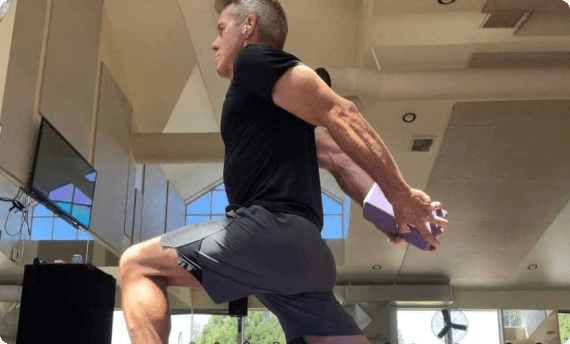
Dr. Mark Divine | PHD is a retired Navy SEAL Commander, New York Times Best-Selling Author, Founder / CEO of SEALFIT and Unbeatable Mind, founder of multiple million-dollar businesses, lifetime Martial Artist, Ashtanga Yoga teacher, and host of the Unbeatable Mind podcast (recently rated #1 health podcast and #30 overall on itunes).
The U.S. Navy selected him to create a nationwide leadership and mental-performance program for the SEALs, designed to help elite teams excel under extreme stress.
Resources mentioned in this episode:
- Find Mark’s programs, coaching, books, and podcast on his site here: https://markdivine.com/
Man Flow Yoga Events: We just announced new locations for 2026 in-person events. Find the full list of cities we’re coming to here: https://manflowyoga.com/man-flow-yoga-events/
Want to unlock more flexibility and strength, reduce your risk of injury, and feel your absolute best over the next 7 days? Then join the FREE 7-Day Beginner’s Yoga for Men Challenge here: https://ManFlowYoga.com/7dc.
Tired of doing a form of yoga that causes more injuries than it helps prevent? The cold, hard truth is men need yoga specifically designed for them. Well, here’s some good news: You can start your 7-day free trial to Man Flow Yoga by visiting https://ManFlowYoga.com/join.
Like what you’re hearing? Sign up for the mailing list:
Rate & Review
If you enjoyed today’s episode of The Better Man Podcast, hit the subscribe button on Apple, Spotify, or wherever you listen, so future episodes are automatically downloaded directly to your device.
You can also help by providing an honest rating & review over on Apple Podcasts. Reviews go a long way in helping us build awareness so that we can impact even more people. THANK YOU!
More Podcast Content
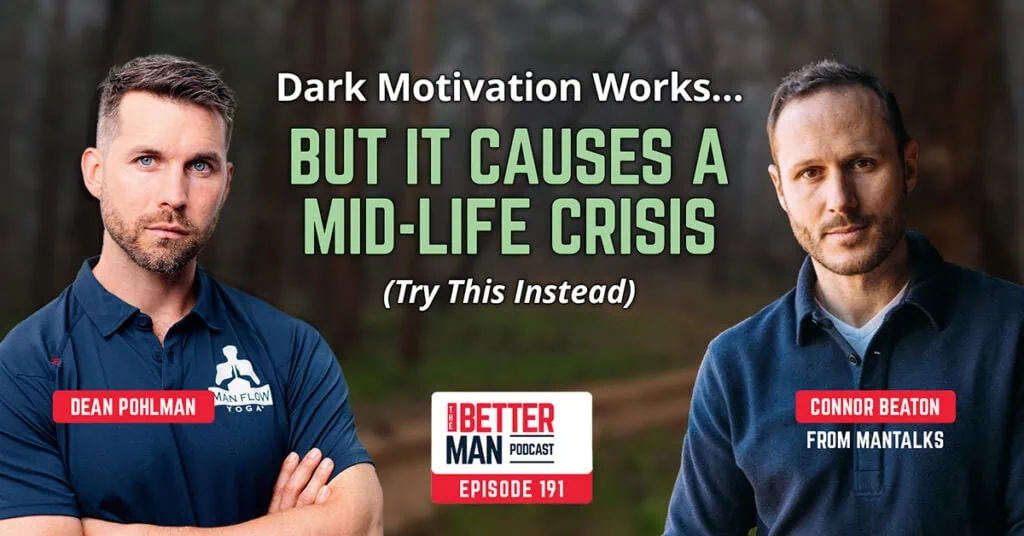
Dark Motivation Works … But It Causes a Mid-Life Crisis (Try this instead) | Connor Beaton from ManTalks | Better Man Podcast Ep. 191
Do you ever feel like you’re just wandering through life without a purpose, or stuck in the middle of a frustrating…
Fitness After 40: How To Start When You’ve Never Exercised (The Man Flow Yoga Catalyst Effect) | Bobby B. | Better Man Podcast Ep. 190
Turning 40 was Bobby’s wake-up call. After a lifetime of skipping workouts, a doctor’s visit revealed warning signs in his blood…

Gut Health Goes Way Deeper Than Weight Loss | Ben Brown (Founder of Body Systems Coaching and Head Nutrition & Fitness Coach) | Better Man Podcast Ep. 189
Gut health impacts far more than weight loss—it directly governs your energy, immunity, and mental well-being. If you grew up in…
Moving From Your Survival Path to Your Soul Path | Caleb Campbell (Former NFL player & West Point graduate) | Better Man Podcast Ep. 188
If you’re an endlessly striving achiever, you know the path forward lacks clarity. Former NFL linebacker Caleb Campbell used his feelings…

The Ethics & Use Cases of AI | Ted Phaëton | Better Man Podcast Ep. 187
The topic of AI is unavoidable. Ted Phaeton, productivity coach and host of the Modern Man Podcast, joins the show to…
My Personal Experience with Anxiety | Dean Pohlman | Better Man Podcast Ep. 186
After an accidental mushroom trip triggered a panic attack, I realized I’d actually been living with low-grade anxiety my whole life….