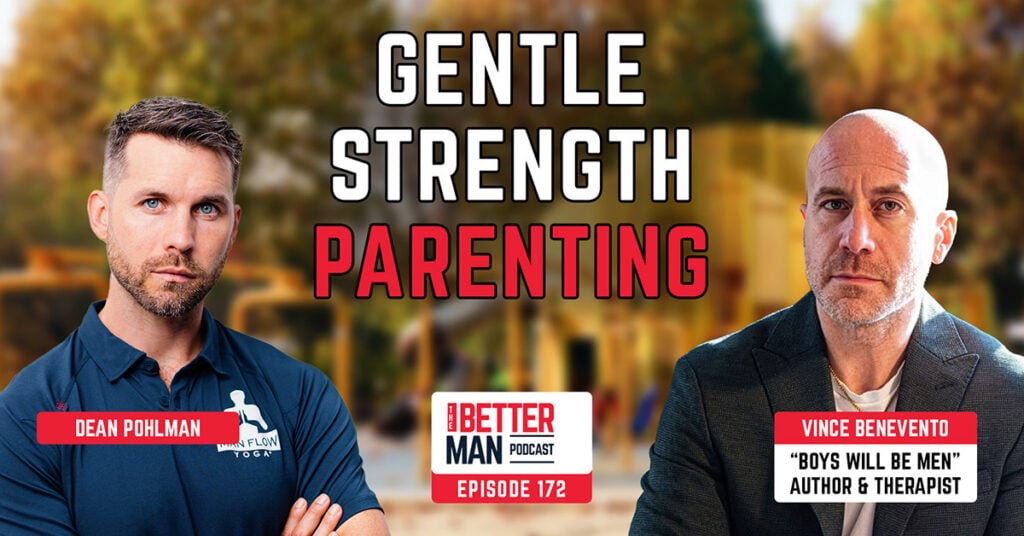
There are a lot of ways that fathers get in their own way of being a great parent. Sometimes it wears the mask of “self-improvement.” Sometimes it gamifies your presence. And sometimes, it’s a desire to overcorrect your parents’ mistakes.
In many ways, it’s much harder to be a father today than ever before too.
Gender roles are more fluid than they were in previous generations (but there’s still value in distinguishing gender roles). Fathers are forced to feel through their feelings when it comes more naturally to think through them. And balancing the climate of your home, the relationship with your partner, and your responsibilities at work can lead to burnout.
That’s why I was personally excited for today’s follow-up discussion with Boys Will Be Men author and therapist and fellow father, Vince Benevento.
Vince answers all my toughest questions around:
- The Gentle Strength method to become a stronger, and gentler, parent
- How to be better at accepting yourself as you are today instead of who you’ll become after hitting another milestone
- How to better divvy up the balance of traditional and modern gender roles to best benefit your entire home
The Better Man Podcast is an exploration of our health and well-being outside of our physical fitness, exploring and redefining what it means to be better as a man; being the best version of ourselves we can be, while adopting a more comprehensive understanding of our total health and wellness. I hope it inspires you to be better!



Use the RSS link to find the Better Man Podcast on other apps: http://feeds.libsyn.com/404744/rss
Episode 172 Highlights
- Why modern fathers have unique challenges previous generations didn’t have (and how to better balance your responsibilities without burning out) (4:28)
- How your tone, anxiety, and sense of urgency seeps into your climate at home even when it originates from work (6:38)
- The insidious “Destination Mindset Trap” that stifles your presence when parenting (7:15)
- Why men in particular are prone to gamifying being present (and why you might be blinded to how this interrupts presence) (9:25)
- The best thing you can do if you have too much free time that will show you why you’re more isolated than you acknowledge (11:43)
- The real reason workaholics struggle in relationships that precedes working long hours and doing fulfilling work (17:25)
- Why new parents have a tendency to overcorrect their parents’ mistakes (and why this overcorrection backfires) (27:47)
- Why the word “self-improvement” is a sneaky way you hold yourself back (40:44)
- 3 characteristics of “Gentle Strength” that make you a better parent in your children’s eyes (even after you’ve drifted apart from your kid) (42:00)
Dean Pohlman: Hey guys, it’s Dean and welcome to The Better Man podcast. Today I have a repeat guest. This is Vince Benevento. He is the author of boys Will Be Men. The founder of the Causeway Collaborative. He is a therapist who specializes in men. And in this conversation, we’re going to pick up on the conversation that we had previously. We’re gonna talk about some of my own specific questions, just things that are specific to my own life.
Dean Pohlman: Things like parenting, things like values shifting. As you become parents, we’re going to talk about this idea of gentle strength as a father and how we can be more comprehensive parent. We talk about fluidity of gender roles and how that’s evolved over time. But how we still also have to find some distinction between, men and women and fathers and mothers.
Dean Pohlman: And so this is just a great conversation. Pretty to the point. These are topics that I think every, every guy can relate to, especially if you’re a father. And, I hope this inspires you to be a better man. Hey, guys. It’s seen. Welcome back to the Better Man podcast. I’ve got a repeat guest here today. This is Vince Benevento, and we’re going to be continuing the conversation that we had last time.
Dean Pohlman: It kind of go in a bit more into Vince’s work. On on parenting, on growing up as a man on. Yeah. You know, looking at childhood wounds, all that, all that fun stuff. Sure. So, Vince, thanks for coming back.
Vince Benevento: It was so fun last time I had to do it again, so thank you, man. It’s good. It’s good to be here for sure.
Dean Pohlman: Yeah. So some of the, some of the potential topics we discussed are, honestly, these are all things that are very close to me that are part of my own, self-improvement. Now I’m calling self-acceptance journey. Some of them have to do with parenting and kind of just noticing, noticing the ways that I subconsciously parent just based on, you know, my own experience growing up and how was I parented.
Dean Pohlman: And values. This is something that comes up a lot, but, you know, just kind of this big transition of going from a very self-improvement, productivity, achievement focused guy to, you know, all of a sudden your hours outside of 9 to 4 p.m. are not for yourself. And now it’s, you know, very much focused on family. Yeah. And then I think as I’ve, you know, just in the therapy that I’ve done over the years and the, and just a lot of my own personal growth, healing and call it is this, this desire to have more, emotional support or kind of I’m just going to call it, like softer parenting.
Dean Pohlman: And you’re noticing, you know, that your dad’s doing a lot better than his dad and maybe his dad before that. But you’re still like, okay, we’re keep raising the bar. And what does that look like? So, yeah. And these are all things that you talk about, and, these are all concepts that you cover in your book.
Dean Pohlman: You’re featured on, the I love the podcast. I heard the art of what is the Art of manliness? Art of.
Vince Benevento: Manliness. Yeah, it’s a good it’s a good show, man. It really is. So.
Dean Pohlman: Yeah. Yeah, very well-known. But yeah, let’s go to start off with, with the, I think the values thing, I’m just going to jump to the values. Yeah. Let’s ask. So it’s a topic that always, you know, kind of comes up. It’s a lot of it’s there’s a lot of friction between my wife and I, my partner and I in that area, just because, you know, I think for her, the kind of the expectation was, okay, you wanted a family.
Dean Pohlman: So, you know, you want to be with us all the time, right? And I’m like, well, you know.
Vince Benevento: From from. Right.
Dean Pohlman: You know, so yeah. And it’s a big adjustment and it’s I don’t know how often people talk about it. I think it’s kind of just like something that a lot of guys just kind of keep to themselves. And you’re like, well, yeah, my wife’s not paying attention to me as much because she’s focused on the kids. And, and yeah, I don’t have as much time to focus on my work because I’m with the kids.
Dean Pohlman: But that’s just, you know, just kind of suck it up and do it, right. But it works to a certain extent. But,
Vince Benevento: Yeah. Yeah. I mean, I know I, I listen, I appreciate the, the opening of the conversation. I think it’s something that I have an opportunity to speak to a lot of guys about. And, you know, look, I think as I, I love the point that you raised, which was like, as men, we are so much better than our predecessors in this way and in these ways, you know, like, we’re much more family minded.
Vince Benevento: We’re much more egalitarian around domestic responsibilities, much more open and available to, you know, doing the things that, you know, guys didn’t do 50 years ago, you know, like my, you know, my, my, my wife’s father is like, very kind of prototypical masculine guy and, like, you know, very solid, solid individual, but, like, you know, on the record never changed.
Vince Benevento: A diaper like that was just not what happened. He, like, he was at work and like, you know, my mother in law was like, running the kids, running the household, doing the things. And those like, very sort of like specific gender roles were like, well known, well publicized and like, you know, just we’re we’re a part of what was happening in the culture of the household, you know.
Vince Benevento: So, you know, I remember, this was like a pretty infamous story within our family. But like, there was one time we were away with the kids where, you know, with her parents and the kids when the kids. You know, I don’t think my daughter was born. Yeah. My boys were like, one and two, you know? So, like, you know, one of my kids, you know, went to the bathroom and I had to get up a change him and I, like, grabbed him, grabbed a diaper bag and left.
Vince Benevento: And her father said to her, his daughter, like, hey, what do you let him do that for, right? Like, you know, from his own kind of archaic gendered, you know, prototypical masculine perspective. So like, and he’s like a wonderful, wonderful, thoughtful, incredible man. And like, even still, that was his knee jerk reaction to what he saw in real time, you know?
Vince Benevento: So I think, you know, I mean, you know, you raise a point, Dean, but like, I think as husbands, we try to be thoughtful and, you know, anticipate, meet and think about what our wives need and think about, you know, how we can serve our kids and, you know, try to manage our work and all those things. And yet, like, there’s a calculus there that is very difficult to sustain, you know, and and like, as a guy who has like devoted my life and my time to coaching other men, he always and like advising guys about how to do these things.
Vince Benevento: Well, I struggle myself a lot of the time to like, make sure the recipe is right, you know, and, and I think, you know, there are certainly seasons of my life where particularly when my demands at work are escalated, like I find that the, the tone and the tenor of, you know, how I’m implementing what I’m trying to do is certainly not in line with how I would hope it would be, you know, and I’m a little more snippy, or I’m a little more hurried or a little more anxious, and that stuff, even in an unspoken way, kind of seeps into, you know, the climate at home, you know?
Dean Pohlman: Yeah. Yeah. I mean, for me, that’s, you know, it’s very difficult for me to be present in those times when I am, you know, thinking about or or worried about work. It’s very difficult to have that extra patience or to be present and then, you know, it’s hard to remember, like, well, what is the point of work?
Dean Pohlman: Right? Well, the point of work is to make sure that I have, you know, that I have fulfillment through my work, but also so that I have enough money to be able to take care of my family and have a great and have a good family life. So, you know, I think, I think a couple years ago was the first time that I made this like, made a more integrated, realization that, oh, I’m just like, going around on a Merry-Go-Round instead of just getting off and being the parent I want to be.
Dean Pohlman: I’m like, once I do this, then I can, like, be present. And once I do this, then I can, like, right then I can, you know, be be thoughtful and kind. But I have to reach this level first. And. Yeah. Yeah.
Vince Benevento: So yeah, I think there’s often like, you know, milestone or destination driven mindset around like how to be a husband or how to be parent. Yeah, even how to be like a boss to like, I mean, I, you know, looking at April break, summer, Christmas, you know, the wedding that we’re going to in such and such a place, such and such a time next year like we have these, you know, checkpoints in our life that we orient ourselves around and, you know, kind of drive towards.
Vince Benevento: And I mean, I think one of the, you know, walkways that’s really been important for me is like, you know, the the weeks one after the other, like, are what matters, you know, like Tuesday dinner is what matters. You know, like taking my daughter for a date on the weekend. That’s what matters. You know, sitting with my wife on a couch like it’s not, you know, being with her in Cabo, you know, like, it’s been a while since that happened anyway.
Vince Benevento: But. But it’s not that which is. It’s not the destination or the checkpoint which really matters. It’s the time in preparation of that that should be celebrated and should be representative of, you know, living how I hope I can, you know. Yeah.
Dean Pohlman: Yeah. For me, I get into those moments and then like I realize like, oh, this is like the important stuff. But then my, but then my, my self-improvement, like, productivity, manager of just call manager comes in if you’re familiar with. If you know what I’m talking about. But the manager comes in, he’s like, yeah, be present for this.
Dean Pohlman: This is what’s going to help us reach the next level. I’m like, no, no, no, that’s not how it works. You have to enjoy like you have to enjoy these moments intrinsically. You can’t like, enjoy them because you think they’re going to help you with. Yeah. With your like.
Vince Benevento: You’re like, you’re gamifying being present, you know. You know.
Dean Pohlman: Yeah, yeah, yeah. So yeah, that’s that’s something that I, that I struggle with a lot is just some joy in the activity intrinsically. So but yeah, I mean, how do so how do guys, how do you guys that you’ve worked with and how do you coach people to kind of go from rewiring values like from this, from this, you know, kind of productivity focus to, oh, the thing, this is the thing.
Dean Pohlman: Right? And this and not just the, the logical recognition, but actually the emotional kind of fully integrated recognition of that and feeling it and, you know, feeling it emotionally, not just not just recognizing it because there two very different things.
Vince Benevento: Sure, 100%. Yeah. I mean, I think one of the things that’s really important, you know, to advise guys around doing is sharing time and space with other men. You know, I mean, like, I think what you’re doing on this podcast is like creating a better framework for men to be better men, you know, no pun intended. But I mean, I think it’s true.
Vince Benevento: Like, I think men are both a source of strength for one another and a metric of accountability for one another. You know, and I think, like the mirror that another guy can provide in terms of feedback exchange, in terms of relationship, in terms of, you know, making a suggestion in terms of like even sharing a perspective that can be helpful for one to internalize, like is something unique to a, you know, kind of peer driven, mentorship driven model, you know, for guys.
Vince Benevento: And, you know, I mean, I hear, I got into the practice a couple of years ago, you know, I wrote about it in, you know, the book how, you know, I took a pretty significant step back at work a few years ago. Right. And my wife and I were having trouble in our relationship, and I was a, you know, you know, prototypical kind of workaholic achievement guy, like, you know, was very, very gratified by my work and doing good work at work.
Vince Benevento: And, you know, there was obviously, you know, financial success that came alongside those long hours in those hard days. And so, like, it was very gratifying and easy for me to be at work. And it was harder for her to be home with the kids, doing all the kid things, plus her own big job, plus juggling all the things as well.
Vince Benevento: And so we were not in a good place. She was very unhappy with me and had a lot of good reasons to be. And so I took some, you know, I took a pretty significant step back from work. But I found that, like, I had a lot of space and time right to fill up. And I started having coffee with guys.
Vince Benevento: You know, I would just, like, meet a guy at the field or, you know, meet a guy, you know, in exchange or at church or whatever, and just, like, grab a cup of coffee and, and start, you know, developing a relationship and like, I think I, I developed the belief from there that I was actually much more isolated than I had given myself, you know, sort of that I acknowledged.
Vince Benevento: Right. Like, I hadn’t I hadn’t actively cultivated the process of trying to make friends, probably since college, honestly. And here I am, I’m like 36 or 30 or whatever I am and like, you know, like I have friends that are friends who are couples who are like, are my wife’s girlfriends and I’m friends with their husbands. But like, I don’t have like guys who have like sort the companionship of and have become friends with personally, you know.
Vince Benevento: Yeah. You know, I think in those in the development of those relationships over the last couple of years, like I’ve seen one like I need them and it’s good to hear stories from other guys about what’s going on in their lives and how they feel and think about things. Just to give me some perspective. Yeah. But also like I have guys who say to me, hey, man, like, you know, are you sure that’s something that you want to be doing?
Vince Benevento: And, you know, like, you might want to think about doing X or Y or Z or like, you know, here’s what I did in that situation in this actually worked pretty well. So like there’s, you know, there’s sort of accountability by extension, but also creative, you know, sort of solutions that are offered in relationship that, you know, are very difficult, if not impossible to get in a vacuum, you know.
Vince Benevento: Yeah.
Dean Pohlman: So I just want to reiterate a few things that you’re saying. So so first off is this, you know, men holding each other accountable. So not just hanging out, which is important, but also like having those checks with people that you trust, to be able to say, hey, like, like you said, are you sure you want to be doing that?
Dean Pohlman: And, I think that’s important, because I think that I think that, I mean, I know that I’m just I know that I’m very sensitive to criticism. And so a lot of the way that I’ve kind of structured my life has been to I know I’m just, I know I just from my own personal experience, I know that a lot of my life I’ve structured around kind of avoiding criticism or issues I’m I’m against.
Dean Pohlman: I think I’ve also created this narrative in my head that in order to be quote unquote, like a better man and to kind of look at the maybe the previous traditional masking on valid values is to, instead of seeking feedback and getting, like, constantly critiqued. It’s been to, okay, like, let’s just be okay with how I am and like, let me get like, let me get emotionally validated instead.
Dean Pohlman: And I’ve done that and I and I’ve, I’ve focused more on that. But at the I think there’s a balance of, well, get the emotional validation, get like the validation, get the support that you’re looking for, but then make the changes or do the work or get like the feedback. So I think, I think that’s an important, distinction.
Dean Pohlman: The second thing I wanted to mention is the the experience of being gratified at work is so easy. If you’re if work is going well, right. It’s so easy for you to say, hey, like, people at work love me. You know, I’ve got this community of people who love me. I’ve got people who like my work hours. I’ve got people who like my, you know, like the things the blogs and the emails that I’m writing.
Dean Pohlman: And then I come home and it’s why have you been at work all day? What are you doing? Why aren’t you helping with this? Like I need your help here. Like, well, cool. These people are being nice to me. And you’re not being nice to me. So why would I spend time here? Yeah, right. It’s like it’s. It’s an easy decision.
Dean Pohlman: And then I also wanted to bring up an experience that I had this this past weekend. I went to, I went to pick up, my wife for she didn’t change her shipping address on these razors that she’s had for, like, the last six years. Even has her maiden name on it. She’s had it since, like, I don’t know, probably 2019.
Dean Pohlman: Sure. And, so we stopped there and we were on good terms with our, with our previous home buyers there. Kind of like a few years behind us. Like, they, they have kids, but they’re 2 or 3 years younger than us. And, we stopped there. I saw him outside watering the lawn, so I so I drove by and I stopped and got out of the car, and we spent an hour just talking like the kids were in the back seat.
Dean Pohlman: That’s pretty cool zones. And we just had this hour long conversation and I was like, totally present. I was like, this is great. Yeah. And I got back in the car. I was like, oh, wow, that was really nice. Like, I need to do more of that. And so just, you know, having hanging out with other guys.
Dean Pohlman: Yeah. And you know, for you, I’m curious what you know or what prevented you from doing that. Yeah. Prevented you from reaching out and like, just hanging out with more guys.
Vince Benevento: Yeah, man. You know, I think, the same stuff that prevents most guys from doing it, you know, in my opinion, like the demands of life and specifically the demands of work, you know, like, I, I started my business at 29, I had, like, a, like, deep insecurity about feeling like I was, you know, less skilled and less experienced than a lot of other people who did my job at the time and, like, you know, wasn’t as good.
Vince Benevento: And so I overcompensated by working longer hours, working harder, you know, studying harder, reading more, trying to be better, etc. and like, really had this, like overcompensation with my performance where I tried to level the playing field and it really built, in me some obsessive tendencies, you know, and I’m, you know, I had sort of mentioned this prior, but like, I’m kind of an o holic of like all the things and like, always have been, you know, like and it was, you know, drinking and drugs and gambling and sex and like, whatever it is like, you know, even working out like, as I’ve gotten older and work like I’ve, I’ve just always been excessive
Vince Benevento: with respect to doing everything. And, you know, for better or for worse. And so like, I was like, just like you said, I mean, like getting gratified by the work and the expansion of the business and more referrals coming through and feel good about helping people. And it’s easy to feel good about helping people when you’re helping people.
Vince Benevento: And so, like, I was just doing that. Yeah, I was just doing that. And honestly, like anything for me in the in the throes of it, when it was my worst for sure, like anything that wasn’t that, I was like both bored and and frustrated by the fact that I wasn’t working and wasn’t you know, generating revenue and wasn’t helping another person and wasn’t accomplishing the task.
Vince Benevento: And so, like, there became this, like myopic focus on this achievement, success driven narrative at work. And like, I, I didn’t I didn’t make space for anything that wasn’t working at the time. And so, like, I wasn’t very fun to be around. I wasn’t very relaxed ever. You know, and other than, like, being good at my job, which I objectively was like, I didn’t probably have a lot of things that you could say about me at the time that were favorable, you know.
Dean Pohlman: Yeah, yeah, that makes me think of, my, my son recently started asking like, why doesn’t dad like, being with us? Like, oh, thanks, man. Yeah. And I think it’s, I mean, I know it’s because, well, first it shows like, oh, you’re like older now, aren’t you? He’s almost. Yeah. Is almost six and. Yeah. And so he’s able to like have these wonderful unfiltered thoughts come out.
Dean Pohlman: Yeah. And then, you know, I think, I think his mom is just so mom is just so different. Mom is like, so I think she just grew up with a different experience. I mean, she was her mom was just like, just incredibly supportive, incredibly emotionally supportive, like always there really didn’t take care of herself at all.
Dean Pohlman: Died early. She died at 59. Wow. And I think that’s because she was just so focused on her kids and didn’t have, you know, I mean, former smoker, two, and ultimately died from lung cancer. So, you know, clear link there. But also, you know, my suspicion is that she just gave so much of herself to her kids that she didn’t ultimately wasn’t, didn’t, like, take care of herself in the process.
Dean Pohlman: But but that’s what Marissa grew up with. And so she had this very positive, I think very positive experience of being a kid. And and my experience was, you know, mine was more on, you know, are you getting all or are you getting A’s or getting A’s and B’s, like, what’s your you know, what are the different things that you’re doing?
Dean Pohlman: I was very successful. The very success, you know, validated. Yeah. There wasn’t a lot of emotion. There wasn’t emotional support. There’s still not emotional support. Right. And and so so I think for me, you know, that brings up what we cannot tolerate in ourselves, we can’t tolerate in others. And so when I’m with my kids and I’m hearing, like, whining or I’m hearing I don’t, I don’t know, like that’s just some that’s, that’s sometimes I can tolerate it and sometimes I can.
Dean Pohlman: Sometimes I’m just like. And so Marissa is just so much more supportive, and in many ways than I am that my kids look at that and they’re like, why don’t you want to be here? I’m like, well, just because I’m not mom, does it mean I don’t want to be here? It just means I’m, you know, and I bring all that up.
Dean Pohlman: Because I forgot. Okay.
Vince Benevento: Well, let me, let me, let me let me just let me let me feed off that for a second because I think this is a real thing. And I’ve been experiencing this a lot in my house. So like, I think the jobs. So I mentioned before that, like, it’s important for dad to be anticipatory and partner well, and like pick up a lot of the duties of the household domestically and otherwise to like, be an equal contributor.
Vince Benevento: Right. And do a lot of the stuff that maybe dads didn’t do in generations past. And I still think it’s dad’s job to do certain things that aren’t fun, you know, like, I am the bad cop in my house. Everybody knows it, my wife knows it, my kids know it, everybody knows it. And so, like, if there’s a hard thing that needs to be said or a rule that needs to be enforced or discipline that needs to be rendered, that comes from that, you know, and so, like my kids, they know who to they go to mom when they want to ask for certain things.
Vince Benevento: And I think whatever, like it’s cute and it’s fine. But like, I mean ultimately like I am responsible for, you know, I mean, I think like the my wife and I say that like, you know, she’s responsible for, like, the air and the music of the household, and I’m responsible for the structure of the household, you know, like like if you’re building a house, the bones.
Vince Benevento: And she does, like, all the fine tuning, you know, I think, I mean, I think there’s something to that, like, I as dad cannot be primarily concerned with your enjoyment. Right. I have to be concerned with, like, raising you to be a person of substance, you know, ensuring that you are, you know, doing right by others. You know, having character, you know, being caring and thoughtful.
Vince Benevento: But, like, you know, if you aren’t happy because you can’t eat four pieces of cake in a bag of starbursts, like, then you’re not happy because you can’t have four pieces of cake in a bag of starbursts, you know? And yeah, we’ve seen this play out with my son where he’s been. He’s been sick. And like, you know, someone has to enforce the rules right there are clear rules around what he can and can’t do.
Vince Benevento: Someone has to enforce them. That person happens to be me. And so, like, it’s unsurprising that he’s more drawn to his mom in those instances because, like, I’m the guy giving him bad news 95% of the time, you know?
Dean Pohlman: Yeah, I see, I’ve, I am, I am a proponent of gender roles working both ways. Okay, cool. Because like, I’m like, hey, I’m going to be the I am that because I, I added this up, I think last week I was doing and but most most of my job at home, most of my, most of my time spent at home is just kind of running around picking things up.
Vince Benevento: Same.
Dean Pohlman: And Marissa, she likes me cooking, so like, she’ll like, make, you know, I’m used to making dinner, and I enjoy making dinner. One of my one of my, one of my new, one of my new hobbies, let’s say, is just like using a lens to language learning models, like Gemini or, you know, Claude or ChatGPT.
Dean Pohlman: Cool to come up with meal ideas like, I’ve got beans, I’ve got tomatoes, I’ve got this. What are some things I can make? And so, yeah, I’ve. Yeah. And so I’m, like, learning all these different ways to, to make food. And I’ve been, I’ve been, I’ve been cooking for, you know, a decade. I’ve been the main chef of the house for like, a, you know, decade now, however long we’re been together.
Dean Pohlman: Yeah. But it’s just one thing that, one other thing that I get to do to, you know, that’s that’s fun for me, but also has benefits for other people. But, and I do I, I mostly doing the laundry right now because Marissa, she started a physical therapy practice, look for physical therapy practice, and she’s, like, crushing it.
Dean Pohlman: I’m like, you’ve got the momentum. Like, if you need to go out and, you know, if you need to start your job at, you know, at 730, if that’s when you can fit your pace engine because you’re busy all day, like, go do it. I can go to school, whatever you know. But, anyways, point of me saying all that, this generals go both ways.
Dean Pohlman: If they were going to be fluid or generals, we’re going to go both ways. So I’m not going to be the only person that says no. Okay. So she says, hey, they’re not in this. They’re not listening to me. I’m like, go make them listen. Do you go tell them, you know, instead of me, like coming in and looking at the looking around the room being like, okay, the tablets have been on for 30 minutes.
Dean Pohlman: This is not okay, you know, I’ll go to her and say, okay. Yeah. Tell them turn. Tell us off. Well, you know, so I’m like, I’m not the only bad cop. Also, like, you know, I want to be love, too. So. So I make it go. I make it go both ways.
Vince Benevento: Yeah. And and I think that’s wise for sure. I think your way is right. And I think, you know, because even now, like, my presence is lesser, like, I find myself attending to those matters of substance as they unfold because I have been gone a lot of it. Usually it’s like in the evening when I’ve been gone most of the day and mom’s been chasing everybody around all day.
Vince Benevento: So like, I’ll step in and handle, like whatever needs to be addressed in that moment. So.
Dean Pohlman: Yeah. Yeah. So, so let’s go back. So let’s we kind of touched on this a little bit, but let’s go into this, this topic of kind of just parenting based on how you are parented. And sure, most of us just kind of subconsciously do what you know, we just do what our what our parents. And sometimes we’ll say something, we’ll be like, where does that even come from?
Dean Pohlman: Years like, that was something my dad said to me when I was, yeah, you know, we’re just like, you know, I think you need to go back to bed. I’m like, where did that come from? Like that? That’s something my mom said. My mom would say, you know what? I think you woke up on the wrong side of the bed.
Dean Pohlman: Don’t you go back upstairs and, like, try again. Or like my dad, my my dad. I have very vivid memories of my dad telling me to shape up. There it is. Why aren’t you happy? Just shape up. My. I know I want to fake being happy, but, you know, that’s that’s just. That was my, So how do you start to, you know, what are some ways that we can start to look at some of those subconscious parenting behaviors that we have and start to be more you have more agency in how we decide how to parent.
Vince Benevento: Yeah. Yeah. I mean, I, I think, it’s very clear to see how my own psychology, with respect to particularly my father, influenced how I showed up as a father. Right. And I think the biggest, you know, example, the most specific example is around work and time allocation with respect to work. My dad retired at 44 years old, you know, hazardous duty pension job was a probation officer.
Vince Benevento: And like these, you know, the pensions have gone away for a reason. But like, he was 44 and, like, retired with, like, you know, 70% of his earnings in perpetuity forever. And so like, and like.
Dean Pohlman: Kind of what’s this job? What does he do? Can I do that?
Vince Benevento: Yeah. No. Yeah. Yeah. It bankrupted the financial system in Connecticut. Okay. So but like, you know, kind of government high, you know, high risk, hazardous duty government, you know, funded, you know, pension planning and programs. Right? So in any case, you know, he had this job as sort of desk job and then retired and like kind of had a couple of jobs here.
Vince Benevento: And there thereafter. But like didn’t really work like a full time steady job from 44. And so I remember seeing that as a, you know, 18 to 25 year old guy and thinking to myself, like, hey, like I’m a full financial aid kid at school. And like, there’s certainly opportunity, like, I wonder why this isn’t something that he’s prioritizing.
Vince Benevento: And he just, you know, I think that he believed in like, balance and, you know, being present and like, honestly, just stuff that didn’t hit for me as a guy who had like very ambitious visions for like, what I wanted out of my life. And, you know, so I just like, I, I do what sometimes happens in these instances where, like, the pendulum swung completely in the opposite direction and like, you know, by the time I was 30, you know, 30, 35, I was working 80 hours a week, you know, and like, pretty in a pretty unhealthy way.
Vince Benevento: And I know it has, like, deep foundational roots in my father having a much more relaxed, laid back, kind of laissez faire demeanor with respect to work and feeling like, like he could have done more to support us financially now. But it’s interesting.
Dean Pohlman: Did you talk with him about that?
Vince Benevento: And so, so so yeah. So it’s really interesting. So like now, you know, ten years later, you know, as my kids have gotten older and as I’ve kind of reallocated and reprioritize things in my own life to try to develop something that’s more healthy and sustainable, I actually told my father that I think he had it more right than not right.
Vince Benevento: And like this over this, like overwhelming overcorrection that I had made was like, you know, my own desire to pour things, you know, into, like the, you know, places that they didn’t belong, you know, and, and that if I had to do it, in retrospect, I would prioritize things that he did, like leisure, like self-care, you know, like time in relationship with friends.
Vince Benevento: You know, my dad always did a good job of being around us as kids. And so, like, you know, I think his some of his tendencies, I certainly overcorrected to try to, you know, mitigate. When in fact, I think he had it, you know, more right than I gave him credit for it.
Dean Pohlman: Yeah. You know, I read one of my favorite books is called flow. It’s the Psychology of Optimal Experience by me. Hi. Cheeks sent me high, and it’s one of my favorite books. And in the book he actually goes through and talks about how people who grew up with different values, even if even if they’re always perfectly according to those values, they’re always going to have something that they’re lacking right from those strengths.
Dean Pohlman: Right. So like in your experience, it’s like, you know, hey, we weren’t you know, we were focused on your dad was focused on being present. Your dad is focused on more self-care. Your dad was, you know, he wasn’t as concerned with ambition or making more money. And, you know, you got tons of benefits out of that. But then, on the other hand, you had this void of, well, that’s what I want to fill.
Dean Pohlman: And then you overcorrect. And so it’s, it’s, you know, no matter what your parents do, you’re going to want to, you know, they can only do so much and you’re going to have like, you’re, you’re going to have this desire to, to fill the gaps. It also makes me think of, also makes me think of Buddhism, right, of the, the base of Buddhism, which is the king who wanted, didn’t want his son to see anything bad in the world.
Dean Pohlman: Yeah. And then so he sheltered him from the world. Yeah. And then he saw one, you know, he saw the real world. And then he decided to, you know, anyway, it’s a whole the whole thing. It’s like overcorrection. So despite best intentions there, are there going to be overcorrection in the opposite direction? Yeah.
Vince Benevento: Yeah for sure. I mean, I, I even think about, like, like how you think about hospitality as a parent. Right? So like, I grew up in a very private like, nuclear family driven framework. Right. Like my parents didn’t keep a lot of friends. You know, my dad would go to work and come home. They worked sort of opposite schedules.
Vince Benevento: So, like, my dad worked during the week. My mom was with us. My mom worked on the weekends. My dad was with us. And so, like, you know, we try to, like, have dinner as a family and like, you know, kind of kept a fairly subdued, quiet, low profile existence. And then I meet my wife and like, there’s 50 people for dinner on like, a Sunday.
Vince Benevento: Like Saturday, you know, like it’s just like this. You know, guests coming in and, you know, Easterners, you know, 60 people at Easter cheese and like, just guests and friends and big, boisterous, you know, whatever. And like, I like that as a better alternative. I think now as I’m 44, it was like getting hit with a bucket of cold water.
Vince Benevento: 20 years ago when we met, you know, so like the ways in which our upbringings, you know, impact us and also how they collide in relationship to figure out how you sort out preferences as a couple and a unit, I think is like a an interesting thing to consider in terms of how you make decisions about who you want to be as a family.
Vince Benevento: You know?
Dean Pohlman: Yeah, yeah, of course. I mean, and I think, my own experience with that was when you’re before you have kids, it’s, it’s your preferences don’t seem as significant. Yeah. And then you have kids and then you’re like, oh okay. Now we’re really like, now we actually care about our differences. And we’re figuring out I remember, you know, one of the biggest differences, for us, was real and Covid, when, you know, my wife, is very she’s and she’s I knew this already, but she has Purell, you know, everywhere.
Dean Pohlman: She’s Lysol wipes everywhere. She works in physical therapy. Yeah. Her even at the office where she used to work, her coworkers would get her Purell as, like, a gift that would that would go in her gifts. And so, you know, Covid happened. This is her nightmare. And, you know, so, like, we’re, you know, she’s, like, washing down, you know, everything that comes into the house.
Dean Pohlman: And, I remember my our friends came over, one weekend and they came over to, you know, just say hi. And, I didn’t think about it, but I gave my friend a hug, and she was so mad. Wow. She was like, what are you doing? And not in the moment, but afterwards. And then, you know, I had to, like, I had to what I had to I took off all the sofa cushions and wash them as, as penance for my, my grave mistake.
Vince Benevento: Wrong. You’re wrong.
Dean Pohlman: Yes. But, but, yeah, you know, figuring out those, figuring out those differences and values. And then, for me, the big struggle has the the big struggle. There has not just been in the differences that we have, but in having me having the courage, to be able to. And this is coming back to, you know, parenting, me having the courage to be able to say, well, this is what I believe.
Dean Pohlman: And this is what I want to do because of the fear of just abandonment that went from that came from, you know, disagreeing or not being approved of. And so, yeah, I was an I was initially really scared of just expressing those differences. And that led to a lot of resentment, a lot of built up resentment. For me and, and, toward my wife and, you know, eventually we, we started couples therapy, you know, a few months after that, I think I started pushing for it around the time our son, six months old, and.
Dean Pohlman: Yeah, after about a year of year of kind of like, softly pushing for it, we started it, but, but yeah, just the some of the, some of the experiences that and kind of personal growth that came up for me. Yeah. You know, looking at differences in values, but between, my wife and I.
Vince Benevento: Yeah. And I mean, it’s, it’s, it’s really good in the, in the conversations needed, you know, and I think some people, are having those conversations often together, you know, some people have struggles to initiate those conversations. But I think about, you know, my wife came back to me and, you know, recently, right? Said, she said that we should go back and talk to somebody.
Vince Benevento: We talked to you know, a couples therapist for a couple of years when we were having a hard time. But she recently came to me and she said, hey, like, we’re dealing with a lot of stuff because our son is sick. Like, you know, this situation when Leo is real difficult, like, we should probably go talk to somebody, you know?
Vince Benevento: And honestly, you know, despite the fact that I’m a therapist and this is my life’s work, and, you know, I typically view that with a great sense of, you know, both esteem and and support. I was like, I was, like, offended, you know, for, like, a quick for, like, a moment in my mind, like, I was, I was like, you know, we don’t need this and I don’t need this, and this is whatever.
Vince Benevento: And like that, I just try to gather myself for a second and just listen, like, you know, you’re right, you know, and and my, my point is those kinds of guided conversations and and discussions and, and, you know, that therapeutic exchange, it doesn’t have to have a beginning, a middle and an end. Right. And I think the best that my experience is that the way that those conversations are offered most effectively is like situationally specific and, and and as needed on an ongoing basis.
Vince Benevento: Right. Just because my wife and I were good seven years ago doesn’t mean we’re good forever. Right? And there’s there’s circumstances that require an objective lens and objectivity in order to solve effectively. And I think there need be openness to a reoccurring willingness to have that conversation over time.
Dean Pohlman: Yeah, I know that for me, if I if my wife and I haven’t had like a difficult conversation and let’s say a month. Yeah, I don’t know, let’s say anywhere from like two weeks to six weeks. Yeah, I know that. There’s, you know, there’s some build up. You can kind of feel it. You’re like, oh, it’s been good.
Dean Pohlman: We haven’t had any like these big serious conversations. Yeah. And those are usually the times where I’m like, I should we should probably have one of these, you know, and they’re never fun to do. The I, I’m always bad about it because, like, I have this deep, you know, I have this this, you know, this fear of abandonment comes in for me.
Dean Pohlman: So, like, my wife is very much able to say exactly what she wants to say, and she’s able to do this with her, with her sister, with her dad, with, like, she doesn’t have a problem. Like expressing herself to people close to her. But for me, I’m I’m very scared to do that. And so, you know, even after we had the conversation, we did everything out.
Dean Pohlman: But I’m like, I need more reassurance. I need more like, I need more from you. And she’s like, we’ve already said everything. It’s been an hour and a half. What more do you want? Like we just we just got to wrap it up. You know, we’re already. You’ve already said the same things and. Yeah. And you know, after a while, after doing this for years, I have realized, okay, like, things are going to be okay.
Dean Pohlman: I just need to leave this alone for we just need some time to ourselves right now. Like, we just need to process this and, like, be on our own. I don’t, you know, it’s not going to get better just by staying in the same on the same couch together, looking at our same this. Okay, though, like, I don’t know if you understand.
Dean Pohlman: I’m like, I’m waiting for it to click with her. Like, I’m just like, maybe if I say it another way, then she will fully accept what I’m saying and she will be like, oh, I love you so much. It. Which is not how it works, right? It’s right. So, so yeah. And then, you know, the last topic that we had in here that I kind of wanted to bring up is, is this, this kind of this, this, this, you know, in, in a lot of, a lot of self development, is is self-acceptance is acceptance, I think.
Dean Pohlman: And, you know, we know that a lot of men’s work is looking at your relationship with your father. And, you know, what did you get from and what did you not get from him? And, you know, as I look at that, there’s this, you know, part of you wants to avoid conflict by saying, well, look at how it was for his dad.
Dean Pohlman: I bet his dad you know, was not nearly as supportive as he was. And I know that’s true for my dad. You know, he doesn’t talk about it a lot, but like the stories that I do hear, it doesn’t sound like he was a very warm, fuzzy, supportive individual. And so but at the same time, you know, we’re also generation to generation.
Dean Pohlman: We kind of. I feel like this there’s this general softening, to there’s a general desire for softening, and for more emotional support from, from your fathers. And so, I’m just wondering how this topic comes up in your own work and some observations there for you. From you. Yeah.
Vince Benevento: Yeah. I wrote a chapter in my book called Gentle Strength. And it was about a guy who has me, a guy who has grown up, like, around the old men my whole life and has been an athlete my whole life and runs a business for men, you know, and, and, you know, men’s mental health, and you know, wrote a book about it and so on.
Vince Benevento: And my journey to learn how to father effectively, like a five year old daughter, and how to code switch and learn how to like speaker language with both a consistency and a softness that was required. You know, I think a lot of the, achievement driven aggressiveness and, you know, hard charging nature that has made me effective.
Vince Benevento: And, you know, some of the different arenas in my life is like completely counter to what you want to do and how you want to be to a father of a 5 or 6 year old girl who’s now, you know, 11. And that’s a different journey, by the way, to father, a five year old daughter and 11 year old daughter, too.
Vince Benevento: But I think the, you know, for me, it was about, being curious, you know, like being curious to learn about the things that excited her and ignited her, being patient when doing so, being consistent in my ability to hold her emotional response. You know, one of the challenges dealing with, you know, younger kids in general.
Vince Benevento: But I would say, you know, father to daughter especially is like, you know, emotions don’t typically make sense, you know, at that age. And so, like, you just trying to, you know, hold whatever comes your way and, you know, not be reactive to it, you know, and what I’ve found is, you know, with her especially like, it’s just being around, you know, there was when I was working a ton and, you know, kind of building the business.
Vince Benevento: Like she gravitated towards the relationship of other male figures, you know, her grandfathers, and, you know, uncles who were present and you know, who she was more familiar with their company. And so I had to kind of double tap and really work to bridge that time spent over the next couple of years to make inroads in my relationship with her.
Vince Benevento: And, you know, from my experience, it really didn’t matter what we were doing as long as these were things that were interest aligned for her and where I curiously sought to kind of know her experience and, where I was, you know, relatively consistent in terms of my, you know, emotional response to her emotional response. It was very enjoyable for her.
Vince Benevento: And she was willing to engage more readily and in more time, you know, so the relationship was just built over time through time allocation and, you know, slowly building trust with consistency.
Dean Pohlman: Yeah. You know, I mean, I originally brought the question in terms of, I guess selfishly, I was thinking of the of the question from, you know, my perspective of my, my five year old son. But it also that also brings up the idea of, you know, just recognizing that men and women are different, that boys and girls are different.
Dean Pohlman: You know, in the age of equality, I think we get this wrong. Yeah. I mean, I know that, you know, I and I grew up in this and this is, this is a this is a concept that I’m going to explore with another guy in the podcast. Later. I’ve got an interview with him later this week.
Dean Pohlman: Actually. It’s just talking about the differences between masculine and feminine. You know, I grew up in an environment where my mom, you know, out of necessity, had to be very chic. She had to be masculine. She just that’s just that’s just what happened to in her life. That’s what her experiences taught her, that she needed to be strong.
Dean Pohlman: Yeah. And so there wasn’t a lot of that femininity, from her. There wasn’t a lot of that emotional, you know, nurturing, feeling. And I, you know, and I and the message that I received from growing up was that men and women can do the exact same things, and women do not need men. And I think that comes from I think that comes from I think that idea comes from one women are made to not feel safe, and that usually comes from men.
Dean Pohlman: And so, you know, I have this, I have this, you know, for me, it’s this idea that, you know, women are afraid to be women when they have been dealt to me, when they have been felt to be made unsafe by men. Yeah. And men are afraid to be men because they’ve been taught that it is, you know, it is violent or it is wrong to be masculine just by kind of today’s society.
Dean Pohlman: And so, you know, part of the intention behind the Better Man podcast was creating this podcast to be a platform to have the conversation of, okay, well, let’s look at old traditional masculinity and ideas of what it means to be a man. And let’s look it like, let’s let’s find a let’s kind of found find a balance here.
Dean Pohlman: Let’s also let’s respect that there are differences between men and women, not, you know, complete generalizations but tendencies. Yeah. And then also, you know, examine existing at the same time. So yeah. Anyways. Yeah.
Vince Benevento: No. Yeah. I mean, listen, I mean the, the joke of my household by my kids, which, you know, is, you know, depending on who you ask, not so funny is like, you know, my, my boys, my boys tell me that I’m so much easier on their, you know, sister. And you know that I, you know, baby her and coddle her and and you know that I’m harder on them.
Vince Benevento: And like, I unapologetically tell them that they’re correct. Right. Like, I am harder on you than I am on your sister. My job is to make you a man of character. Right? Like my job is to make you someone of, you know, intention and character and a good man. My job is to not be easy on you, right?
Vince Benevento: Like, I, I believe my, approach, you know, a gendered approach where I treat my daughter as her father differently than I treat my boys is okay and appropriate. Now, lean into that. Right now, I think the sum total needs to be, you know, both code line two and one where, you know, there are jobs to be done on all sides by moms and dads, and they need to be done.
Vince Benevento: They need to get done, they need to get accomplished. And the division of labor is in the who does what. But I’m a completely unsupportive dad doing gender jobs as long as he feels they’re appropriate and mom doing gender jobs as long as they’re feeling appropriate and particularly in terms of the handle and approach to the kids, like I will always treat my sons differently than I treat my daughter, and I don’t have any issue with that.
Dean Pohlman: Yeah. And it’s it’s because even as you’re saying that all of my kind of like upbringing. Oh my, oh my upbringing is like a, you know there’s like alarm bells going off like oh this guy’s a, this guy’s a, this guy’s, you know, all of these things. All right. Yeah. So there’s like then like.
Vince Benevento: Yeah. I mean.
Dean Pohlman: Sure, there’s there’s all these things coming up like, oh, that’s wrong, like, equality and, yeah. And I’m like, well, that’s, you know, and so it’s trying to find the balance of like this. I think, you know, I think that I’ve just I just grew up with kind of this suspicion of like, oh, this is kind of this inherent suspicion of, of things masculine or things manly of my own.
Dean Pohlman: Yeah. And it’s kind of, you know, confronting that, being realistic and saying like, well, I do have like, I do have these, these suspicions toward, to, toward masculine things because of society, because of how I was raised. And it’s, it’s being honest about that. But then also having the conversation of, okay, well, what does this actually mean?
Dean Pohlman: And what do how do I behave, you know, how do I make decisions? How do I how do I behave toward this? Like where is the balance. Yeah.
Vince Benevento: And, and and there is a great balance. Right. And it’s over. It was sort of overstated and oversimplified in the way that I communicated it prior. But like, you know, and it’s important to me that my boys feel, you know, safe that they feel that I’m approachable, that they know that I’m presence, that we share dialog openly, that you know, that our relationship isn’t hierarchical, that we’re friends as well as father son, that you know that I teach them and instruct them certain things, like all of these nuanced components of our relationship are still within the fabric of, you know, my desire to instill certain character, logical principles in them.
Vince Benevento: And I believe that personally. And it’s just my opinion, like, I believe there’s something uniquely beautiful about a father bestowing a certain set of characteristics and values to his son and a, you know, father bestowing a certain set of characteristics and values to his daughter. And, you know, mom’s doing the same thing and playing the same role and, you know, single parents doing both.
Vince Benevento: Like, I think you use the assets that you have, right? Like, and and, you know, and everybody’s different and every family is different by extension. But I think, you know, for me, you know, I’ve developed a great relationship with my boys, partially because they are aware that my desire to be to be hard on them and hold them to account is because I believe they’re capable, and it’s a call to action that they rise, you know, like I’m I’m hard on them because I want them to be better men and I want them to be better individuals.
Vince Benevento: And and, you know, I’m pushing them to do that.
Dean Pohlman: Yeah. I was laughing because I was just thinking of I think I think my son asked me, why can I watch tablet more and more TV this week? And I’m like, yeah, because if I let you watch TV, you’re going to grow up and be unhappy.
Vince Benevento: Like, yes. And you’re just.
Dean Pohlman: Explaining it to him. Like, you know, I’m just like, I’m just answering your trip like I if you if I let you watch more TV, you’re going to grow up. You’re going to be unhappy. You’re going to be mad at me for not not being, you know, tougher on you and you. I’m telling a five year old, he’s not, you know, hearing any of this, but I’m like, yeah, I’m just going to keep it.
Dean Pohlman: I’m just going to be honest. And this is why, you.
Vince Benevento: Know, and I and and to your point, there will be some point in his life where he appreciates that candor.
Dean Pohlman: You know, maybe. Yeah. You know, we won’t know until he’s like 30 and he has his own kids. That’s right. That’s that’s all of that’s like that’s like, you know, that’s that’s what my wife and I have realized through parenting. It’s like, you know what? They’re not going to appreciate any of this until they have their own kids.
Dean Pohlman: It’s for sure the question. Oh, well, well, then, thanks again for coming back, having a conversation.
Vince Benevento: I appreciate this. This is awesome.
Dean Pohlman: Yeah, that was great. And you’re, Remind me your book.
Vince Benevento: Yeah. Boys will be men, so boys will be men. Eight lessons for the American Male, on Amazon. And the organization is Causeway Collaborative. Causeway collaborative.com.
Dean Pohlman: Cool. Cool, man. All right. Well thanks again for joining me guys. I hope you enjoyed this. Hope it inspires you to be a better man. I’ll see you on the next episode. Awesome. Thanks. You all right? I hope you guys enjoyed that episode once again. Anything that we covered in this, this conversation will be in the show notes.
Dean Pohlman: Check out his book. Vince. His book, boys Will Be Men, which I love. The title, by the way, because, it’s it’s so punny and it’s a great title. Anyways, check it out on Amazon. And, if you’re in the tri state area, you can check out his practice causeway Collaborative. So, if you’re enjoying this podcast, please leave a review.
Dean Pohlman: You can do that wherever you’re listening. We also have video versions of the podcast on the Better Man podcast. My YouTube channel, as well as in the mental yoga app and numbers area. If you’re curious about the community that we’ve created here, we do have a free seven day trial inside of that mental yoga.com/join. And if you want to make sure that you actually like what we do with the workouts, man for yoga.com/7 DC to try out a free seven day pain relief challenge.
Dean Pohlman: And then see if you’d actually, you know, like the workouts around the commune which the community is built. But, something that I really like about our community is that it’s not just fitness. Yes, it’s about improvement through fitness, but we also explore a lot of these topics that we discuss on the betterment podcast. So it is it is more comprehensive in that sense.
Dean Pohlman: It’s a really, really cool, supportive community that we’ve built. And, great way for you to practice a lot of the things that we talk about in the betterment podcast. So I hope you guys are enjoying this. Again, please leave a review if you haven’t checked out any links for anything that I mentioned in the show notes.
Dean Pohlman: And I’ll see you guys on the next episode.
[END]


Guest Bio
Vince Benevento is the Director and Founder of Causeway Collaborative, leading and providing direct service for all three specialized teams. A licensed professional counselor, he holds a BA in Psychology from Wesleyan University and an MA in School Counseling from Fairfield University.
Vince began his career as an in-home therapist for adolescents and families at the Wheeler Clinic in Plainville, Connecticut, a regional behavioral health services provider. From there, he entered the corporate world, where he worked as a professional recruiter and honed his career-counseling skills. With this valuable experience under his belt, Vince transitioned back to individual and community-based counseling as an employment specialist for the Kennedy Center, one of Connecticut’s largest and most highly regarded community organizations. At the Kennedy Center, Vince worked to find meaningful jobs for unemployed adults with psychiatric diagnoses and criminal histories. He joined Freudigman & Billings in 2010 as an educational therapist and completed a year-long internship in the Weston High School guidance department, where he initiated and co-led weekly support groups for at-risk-students. In 2012, Vince brought his skills and experiences together to start Causeway Collaborative.
Vince’s work experience, whether in the corporate world or in counseling, is united by a single purpose: to help students, young professionals, and those who are struggling to plan for the future and to realize their potential.
Vince recently published the book, Boys Will Be Men: 8 Lessons for the Lost American Male too.
Resources mentioned in this episode:
- Buy Vince’s book, Boys Will Be Men: 8 Lessons for the Lost American Male on Amazon here: https://www.amazon.com/Boys-Will-Be-Men-American/dp/1959170317
- Follow Vince on Instagram: @vince_benevento_LPC
- Visit Vince’s company, Causeway Collaborative, here: http://www.causewaycollaborative.com/
- Or, check out Vince’s personal website (for speaking and coaching) here:https://www.sharperformen.com/
Man Flow Yoga Events: We just announced new locations for 2026 in-person events. Find the full list of cities we’re coming to here: https://manflowyoga.com/man-flow-yoga-events/
Want to unlock more flexibility and strength, reduce your risk of injury, and feel your absolute best over the next 7 days? Then join the FREE 7-Day Beginner’s Yoga for Men Challenge here: https://ManFlowYoga.com/7dc.
Tired of doing a form of yoga that causes more injuries than it helps prevent? The cold, hard truth is men need yoga specifically designed for them. Well, here’s some good news: You can start your 7-day free trial to Man Flow Yoga by visiting https://ManFlowYoga.com/join.
Like what you’re hearing? Sign up for the mailing list:
Rate & Review
If you enjoyed today’s episode of The Better Man Podcast, hit the subscribe button on Apple, Spotify, or wherever you listen, so future episodes are automatically downloaded directly to your device.
You can also help by providing an honest rating & review over on Apple Podcasts. Reviews go a long way in helping us build awareness so that we can impact even more people. THANK YOU!
More Podcast Content
Take Off Your Mask & Remember Yourself! | Be The Better You Retreat Recap with Coach Patrick | Better Man Podcast Ep. 192
At the latest Be The Better You Retreat we focused on a powerful idea: remembering yourself. Today we explore how the…
Dark Motivation Works … But It Causes a Mid-Life Crisis (Try this instead) | Connor Beaton from ManTalks | Better Man Podcast Ep. 191
Do you ever feel like you’re just wandering through life without a purpose, or stuck in the middle of a frustrating…
Fitness After 40: How To Start When You’ve Never Exercised (The Man Flow Yoga Catalyst Effect) | Bobby B. | Better Man Podcast Ep. 190
Turning 40 was Bobby’s wake-up call. After a lifetime of skipping workouts, a doctor’s visit revealed warning signs in his blood…
Gut Health Goes Way Deeper Than Weight Loss | Ben Brown (Founder of Body Systems Coaching and Head Nutrition & Fitness Coach) | Better Man Podcast Ep. 189
Gut health impacts far more than weight loss—it directly governs your energy, immunity, and mental well-being. If you grew up in…
Moving From Your Survival Path to Your Soul Path | Caleb Campbell (Former NFL player & West Point graduate) | Better Man Podcast Ep. 188
If you’re an endlessly striving achiever, you know the path forward lacks clarity. Former NFL linebacker Caleb Campbell used his feelings…

The Ethics & Use Cases of AI | Ted Phaëton | Better Man Podcast Ep. 187
The topic of AI is unavoidable. Ted Phaeton, productivity coach and host of the Modern Man Podcast, joins the show to…