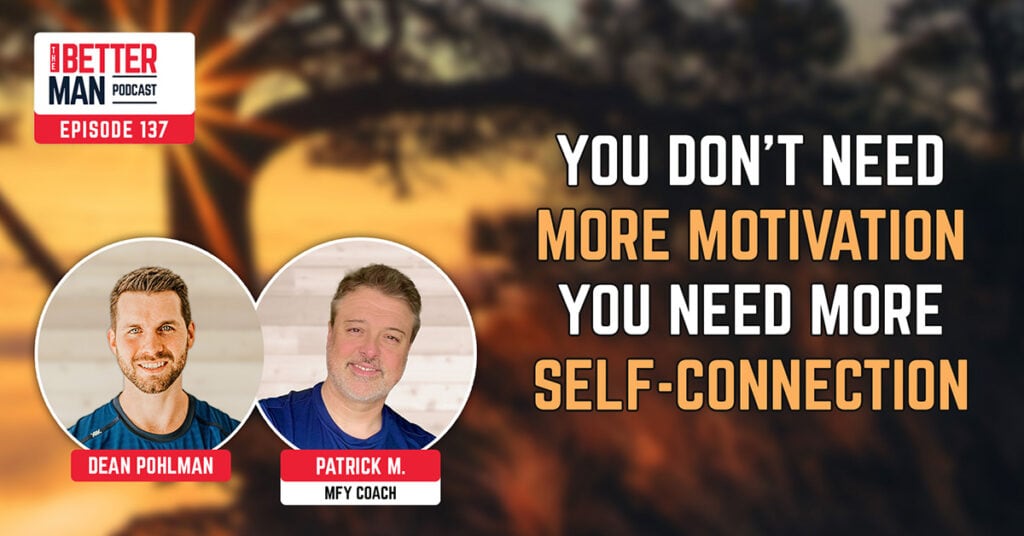
External motivation is a tricky and fickle thing that can make you consistent one week, only to feel defeated and deflated the next 3 weeks.
Why?
Because external motivation is a short-term band-aid that’s not only unsustainable over time, but actually makes it harder to be consistent with any goal you’re trying to achieve.
There’s a better source to fuel your energy in pursuit of your goals: Yourself.
Problem is, we’ve never been more disconnected from our true selves than ever before thanks in large part to social media. But something magical happens when you reconnect with yourself:
Your brain joins your team instead of constantly criticizing you.
This journey of self-connection isn’t always puppies and rainbows… but it’s possible. And today’s guest, MFY Coach Patrick, LCPC (who has 25+ years of experience as a mental health professional) understands this better than anyone, especially as it relates to your consistency with fitness.
Patrick battled depression, anxiety, and low self-esteem first hand, which led him to become a mental health specialist in the first place. And as the Motivation & Consistency Coach at Man Flow Yoga, he has a sixth sense for helping you understand how you hold yourself back on an emotional level.
He also understands how to talk to your “inner world” in a way that reconnects you to yourself, and allows you to be consistent without relying on motivation.
Here’s what Coach Patrick shares in this episode:
- How to give yourself permission to stop beating yourself up
- The “Monster in the Basement” trap of negative self-talk that flies under most guys’ radars
- How to be kinder with yourself even when you’re not in a good place
Listen now!
The Better Man Podcast is an exploration of our health and well-being outside of our physical fitness, exploring and redefining what it means to be better as a man; being the best version of ourselves we can be, while adopting a more comprehensive understanding of our total health and wellness. I hope it inspires you to be better!



Use the RSS link to find the Better Man Podcast on other apps: http://feeds.libsyn.com/404744/rss
Episode 137 Highlights
- Why advice that only tells you what to do falls flat (even if it’s good advice, it doesn’t empower you like Coach Patrick’s “Empowerment Therapy” coaching style) (4:46)
- The weird way celebrating your wins, even if they’re small, prevents you from falling into the trap of self-sabotage (5:54)
- How motivational YouTube videos can actually make you feel defeated and deflated (and the trick to stop relying on motivation completely without sacrificing your fitness goals) (10:12)
- 2 reasons why more men are unhappy today than we’ve ever been (13:02)
- Do you feel disconnected from yourself? Here are 3 techniques that help you tune out the noise and understand yourself on a deeper level (17:09)
- How to actually convince your brain to join your team instead of being your biggest critic (21:37)
- How to point out your flaws and faults and failures in a kind way (31:01)
- Why focusing your intrusive thoughts, anxieties, and insecurities to a specific body part can help you “digest” the emotion without spiraling (47:48)
- The counterintuitive reason trying to ignore negative thoughts, emotions, and stories give them more power of you (49:41)

Resources mentioned on this episode:
- 1-on-1 Coaching with MFY Coach Patrick: If you’re struggling with motivation and consistency, negative self-talk and self-sabotage, or another mental health problem, Coach Patrick has 1-on-1 coaching spots open. You can learn more about being coached by Patrick and sign up for 1-on-1 coaching here: https://manflowyoga.com/man-flow-yoga-one-on-one-coaching/
- Group Coaching with MFY Coach Patrick: Or, if you prefer a group setting where you’re surrounded by other like-minded men who are struggling through similar problems as you, Coach Patrick also does group coaching. You can learn more about group coaching and sign up for group coaching with Coach Patrick here: https://manflowyoga.com/mfy-12-week/
Dean Pohlman: Hey guys, it’s Dean. Welcome back to the Better Man podcast. Today’s episode is with Coach Patrick. He is the motivation and consistency coach for man for yoga and we brought on Patrick back in 2024 in spring. Because this is such a big issue that we hear about with our community. It’s finding the motivation to be consistent with your workouts.
Dean Pohlman: And what we get into in this episode is understanding the root causes where motivation falls off. So most people don’t just need more motivation, they actually need to better understand themselves so they can understand what’s getting in the way of their motivation. And that’s what we’re going to talk about in this episode. We’re going to talk about some of the exercises and some of the treatment methods that Patrick uses with his own, clients as an LCC.
Dean Pohlman: We’re also going to be talking about how you can celebrate yourself. What does that actually look like in practice? We’re going to talk about some of the threats that we face to our mental well-being in modern society. And you’re hopefully going to come away with this with a greater sense of how to start understanding yourself better so you can reach your goals more.
Dean Pohlman: How can you figure out what’s getting in the way of you reaching your goals? So, I encourage you to listen to the whole thing. Hopefully you find some nuggets in here that are helpful to your own health and wellness journey, both in the context of fitness and living a healthy lifestyle, but also in terms of mental wellness.
Dean Pohlman: So, yeah, I hope you guys enjoyed this episode. And, here we go. Hey guys, it’s Dean. Welcome to the Betterment Podcast. Today I have Coach Patrick who is our motivation and consistency coach. At least that’s the title that I came up with when we started looking for these coaches. But he does a lot more than that.
Dean Pohlman: And so I’m excited to, talk with Patrick today and help you understand and, what he knows and how he can help. So, Patrick, thanks for being here.
Patrick M.: I think thanks for having me. And I like the title. I’m sticking with it. So MC kind of has a nice ring, but I’m going to go for it.
Dean Pohlman: All right? That’s true. MC is, definitely a thing. So, you know, I interviewed a lot of I interviewed a lot of potential candidates for this position. And the one thing that really struck me about you was that you had a very different approach to coaching. That was that compared to the other coaches or potential coaches that I spoke with and a lot of other coaches.
Dean Pohlman: And I think a lot of the tendency with coaching in general seems to be giving advice. It’s it’s it’s, you know, it’s listening to people’s struggles, people’s challenges, but then, you know, giving them solutions and what your approach seems to be and which seems way more effective to me, seems to be helping people to understand how they can help themselves or coming up with solutions on their own.
Dean Pohlman: And basically, I think I called it empowerment. Therapy is the word that I came up with before we started this call. And so I’d love it if you could start with, you know, what’s your background in, I always forget the acronym LLC.
Patrick M.: LCP.
Dean Pohlman: Yeah. Is that.
Patrick M.: I. It’s LCP, but, you know, it’s different every state. So just I like LA. See, that sounds kind of cool. So we can go with that. They’re just initials. At the end of the day it just means I’m a lawyer or something.
Dean Pohlman: Los Angeles police commissioner, LAPD. Anyway, so yeah, I’d love it if you could talk about your background and kind of your, your education in that field and how you got started with that.
Patrick M.: Yeah. Thanks. So I’ve been in the mental health field, actually practicing, for over 25 years now. I, you know, growing up in, like, a small community, not really fitting in. I never really quite had a good grasp on my mental health. And I’ve struggled with anxiety and depression. And through my own therapy, and kind of finding my own way, I realized that that was what I wanted to do with my life.
Patrick M.: So I went and I went to school, graduated and went to college. Graduate school. And then just began working in different areas. This year as, different places where I could feel like I was making a difference. Now I’m in private practice where, I kind of work with my own clients and whoever contacts me.
Patrick M.: And it’s it’s been an amazing journey. And to go back to something you said earlier, I do think that it’s great to get advice that tells us what to do. And while I’m not against doing that, I understand when people maybe need a little bit more concrete evidence. I think that’s wonderful. But I think that the best thing we can do for each other is remind ourselves how empowered we can be, how powerful we can be, and that I can’t be an expert on you because I haven’t walked in your shoes and I haven’t lived your life.
Patrick M.: So to give you my advice, to give you my goals, to give you my approach, that’s cool. And if you need a Band-Aid to get you to a better place to make those choices and decisions on your own, I’m totally down with it. But ultimately, you can’t walk my path. I can’t walk your path. My goals can’t be your goals because I don’t know what makes you tick.
Patrick M.: So to me, my approach has always been, hey, let me, let me walk beside you until you can, you know, walk ahead of me. I don’t want anyone ever feeling like I’m the magic or the therapist. The magic path of this. I want them to always remember that they’re the ones making the difference. They’re the ones putting in the work.
Patrick M.: And at the end of the day, that’s why I want them celebrating themselves so hard. And through my, you know, all the progress I make, things like that. It’s always like to celebrate yourself, to celebrate yourself, to celebrate yourself. Because I just think that’s the most important thing we forget to do. We look outwardly, we try to figure out what we’re not doing right, which is great problem solving, but we don’t do the counterbalance, which is acknowledging when we do.
Patrick M.: I’ve seen you put up and I’m so thankful for your approach. I’ve seen, hey, show up for two, short for five. Do what you can, rest longer, modify that. Permission is so important because people feel like if they can’t do it perfect, then they’re not going to do it at all. And that that is just such self-sabotage. But when you are giving yourself permission to just show up and that’s a success, man.
Patrick M.: The motivation, the consistency, the success rate just goes through the roof. So yeah, at the end of the day, I want everyone to ultimately not need to hear from me because I can’t offer anything you don’t already know. I just want you to teach you how to listen to yourself.
Dean Pohlman: Yeah. You know, that reminds me of the worst therapist I’ve ever had. If you. I think it was a couple of years ago. I was looking for a new therapist, and it was the only time that I’ve been in a therapy session where she spoke more than I did. And that was all he did. He was, like, giving me, like, his life advice.
Dean Pohlman: And I’m, you know, sitting in the chair, looking at him, patiently listening and just kind of thinking like, I think you and I have different goals in life. Like, I don’t want your life advice, you know, like I want, I want, I want someone who’s going to help me understand, practicing my feelings. That’s like that. That’s where I fell in, like the most benefit.
Dean Pohlman: But anyways, like, so that’s, like, the exact opposite of what I’ve found helpful is, like, just someone giving you advice based on, you know, like you were saying, you don’t know what their goals are, you don’t know what their story is or their background. So like for you to try and, you know, step in and just give them advice based on that.
Dean Pohlman: Like, I like the analogy of a Band-Aid. That kind of makes sense. But like for a long term solution, yeah, that’s, that’s helpful. So the motivation and consistency, you know, I think one thing that I saw this great post yesterday that said, starting a new habit doesn’t take new energy. It requires figuring out what’s holding you back.
Dean Pohlman: And, I think when we’re thinking about motivation and consistency, that’s where that’s where people are struggling the most. You know, they come in it with the idea that, oh, you know, I’m trying to be more consistent with my yoga practice, and I just need someone who can give me some motivation, help me stay motivated. And rather than, you know, playing a YouTube video for you that’s going to motivate you to do your workout in the moment, which is fine if that’s what it takes.
Dean Pohlman: It’s instead figuring out, hey, you’re carrying around this big backpack of all these feelings that you’ve never processed or like you’ve got all this self-sabotage going on that you don’t even know about. So, like, you know, yeah, you maybe could bring your big backpack of stuff with you and, and show up to your yoga mat and do 15 minutes a day, three days a week.
Dean Pohlman: Or you could do a little bit of work to figure out how to take the backpack off and then realize, oh, this is this is a lot easier. So I’m wondering if you could speak to, speak to kind of, of that concept of, of how you’ve been helping people within the man for yoga community with the, the motivation and the consistency piece.
Patrick M.: Well, first of all, that that, that meme that you saw, that that’s very perfectly said. And the concept of bringing a big backpack to our mat or our space wherever we’re at, is just it’s dead on. You can put on a video to motivate you in the short term, but it’s kind of like a Kleenex on a fire.
Patrick M.: It’s like poof. And when that video’s over, if you don’t understand what got you to turn it on, if you don’t understand what made you turn it off, then that motivation, the external versus internal, that external motivation is so fleeting and it’s gone. And then you feel defeated and deflated and it kind of becomes harder. But when you’ve figured out what’s bringing you to the mat or what’s making you hit play or what’s making you hit stop, what’s making you succeed, what’s making you fail?
Patrick M.: Now you’ve got a log on the fire. That nice, slow burning energy that’s going into real sustain itself. Right. So bringing things to the mat, we think about like, well, what’s going to be what’s going to empower me, what’s going to empower me. But I also like to take the approach of what’s going to power you. Right? So if you have this like belief system that you are a failure or you can’t do something and you bring that to the mat, the first pose that you can’t do that you don’t realize that’s what you’re bringing to the mat, right?
Patrick M.: That first pose you do that isn’t quote unquote perfect. Now you’re like, see, I know it’s a failure. I know I couldn’t do it. Why would I bother to hit play again? I want you to bring your backpack if you have to. And I want you to understand we all have struggles, but, man, sit with it, listen to it, confront it gently and be like, no, I’m not a failure.
Patrick M.: That’s the celebration piece. I’m awesome because I showed up and I’m awesome that I showed up with this huge backpack. And look what I can do with all the stuff that I’m carrying. I don’t want people to deny what’s keeping them from something, or pushing them towards something. It’s just all about being mindful and being aware so we can talk to ourselves in a kind and constructive way.
Patrick M.: We all have those moments where we fall out of a pose and we get frustrated with ourselves. We all have those moments where we think about doing the workout and I’m like, well, yesterday thought, so why would I? Why would I bother feeling that way again? And we focus on that part that we didn’t feel good about instead of going, but how did I feel after?
Patrick M.: How did I feel when I felt myself improving? How did I feel when I posted about it and people complimented me? Right now I know I’m talking about some external motivation here, but there’s nothing wrong with external motivation. It just can’t be your only fuel source. I probably, much to your dismay, talk about food more than I should.
Patrick M.: And so to me, internal motivation is the whole cupcake and external motivation is the sprinkles. Sprinkles are awesome. Sprinkles are great, man. It just it just puts that cupcake over the top. But it’s not the cupcake. External motivation can’t be the everything. That can’t be the thing you’re excited about. It can be the thing that compliments what you already know is great, but it can’t be the sauce.
Patrick M.: And that’s what I try to get people to kind of flip from. And we live in a world where, we’re constantly trained to look at other people and their progress and what they’re doing and what they’ve done. And so we go, well, that’s what I should do, and we’re going down someone else’s trajectory, and we can’t figure out why we’re never happy once because you’re you’re doing stuff that doesn’t actually make you happy.
Patrick M.: Maybe you’re not. Just maybe not that maybe you’re really over here, but we’re so disconnected from what actually makes us happy or ashamed of what actually makes us happy. That we don’t we don’t pursue it. And then we wonder why we’re lacking motivation. You know, do anything to make yourself happy. And I’m making yourself smile. You’re not the entity going, God, today was a great day.
Patrick M.: It was like, well, I did more of the same, same crap again. And so I guess I’ll just wake up and do like it. Just it why? Why would anybody want, it that way. So you got to take that moment to take that inventory. Am I am I truly do what makes me happy? Are my following someone else’s blueprint?
Patrick M.: Because I think that’s going to give me the happiness I see them have. So it’s not what what we bring that motivates us, or what we find that motivates us. Sometimes you’ve got to drop that backpack and realize all the things that are sabotaging us, that keep us from showing up again. And to be clear, I can’t. I can’t tell you what that is.
Patrick M.: I will sit with you. I will help you go to the backpack. I will help you point things out. And if you’re having troubles, oh my gosh, of course, of course people can assess. There’s nothing wrong with that, but they can’t do the work otherwise. Again, now I’m externally motivating you to be helpful. Yes. And that’s not any good.
Patrick M.: So I gotta help you identify as something on your own, and then you’re going to know what to do with it. I can’t tell you what each thing in your life signifies, people. And this is not a knock on dream analysis at all. People love dream analysis, but sometimes we take it literally. I dreamt about a tree.
Patrick M.: Let me Google. What do you mean by a tree? Means, well, cool. Maybe. Maybe it means that. That maybe you have a memory about a tree with your family or your dog when you were a child. And so for you, a tree means something very different. If you start trying to figure out what your dream meant because, this is what the vast majority of people say a tree means you could be going down the wrong path, but if you like.
Patrick M.: Oh, I dreamt about a tree. When? How do I feel about trees? Like what? What memories I have about trees. You get to know yourself better and how you’re interacting with your environment, how you are assimilating information. Because we all assimilate information differently, we remember things differently. So yeah, any of those times you can come to the mat with a backpack without a backpack, just know what each of those mean and be okay with it.
Patrick M.: Don’t be hard on yourself. Bring the backpack, but do yourself a favor. Set it down right beside the mat and give yourself just a few minutes unburdened to see what that feels like.
Dean Pohlman: So as we’re talking about this, and even as we first started talking about this, I think the issue is in that I think the biggest issue is people don’t realize, God, we’re going to be using this backpack analogy all episode. I don’t realize this is my fault. But people don’t realize they have the backpack and like, people don’t realize they have the backpack.
Dean Pohlman: It also sounds like people are trying to figure out, based on what you were just saying, that people are trying to figure out their path by following other people’s paths. And so it sounds like there’s this profound disconnect of that people have with themselves. And so what is the process for like, like because, you know, you’re saying, you were talking about this kind of failure mindset, right?
Dean Pohlman: But I don’t know how many people actually admit, like, oh yeah, that’s me. I have to feel your mindset, right? Like, I would assume that most people say like, oh, no, that’s not me, right? Like, oh, so the people who have these limiting self beliefs or these limiting mindsets, they don’t even know that they have them. They don’t recognize them.
Dean Pohlman: And so what’s the process for starting to look at yourself like, how do you start to do that?
Patrick M.: Well, I love journaling, I love meditation, I love the mindfulness work that we put up in here. And all those are important because it starts to maybe tune out the noise. I like doing exercises with people both in private practice or like in group coaching or individual coaching, where we sit there and we say, okay, write down, catch yourself throughout the day, the thoughts you tell yourself, and I need you to then down and figure out whose voice is that.
Patrick M.: And it’s, it’s it’s overwhelming the people when they write it out, they’re like, that is something I’ve never actually said in life. Like, why is that? I thought I had, but, you know, it’s so automatic. Like the backpack, we’re so used to carrying things our brains like to, like, make work light. Right? So we just get used to things, even if we shouldn’t.
Patrick M.: We used to get used to them or we assimilate it. We’re like, well, this is this is our life now. And we just go. The same things go with like negative thoughts, negative voices, things we’ve heard from other people or things we’ve created based on what we think other people think of us. So we write it out and you go, oh my gosh, I, I’ve never said these words in my life or I would never say these words to someone else.
Patrick M.: That’s the most common one. I would never say these words to someone else. Where do they come from? And you can spend your time figuring out who said it to you, and sometimes it really comes to you. Whatever. That’s not important. What’s important is, well, would you say this out loud to someone else? Does it sound like you?
Patrick M.: Cool. Then rewrite it. If it’s not, rewrite it. It gets a little trickier. When we have believed something so long that we actually think it is our voice. Because we’ve made it our voice, we’ve adopted it. So sometimes you write it. You don’t know where it comes from. Yeah, that does sound like something I’d say. You can’t figure out that it’s not someone else’s voice or that it’s negative.
Patrick M.: You acknowledge. Okay. And it is something I’d say. I’m like, all right, you think it’s helping you? How would you make the sentence more helpful? Right. You just take the sentence and make it more helpful. So rather you can flat out say, well, it doesn’t sound like me. I need to correct it or let it go, or you have to go a little bit deeper and say, yeah, okay.
Patrick M.: And that does sound like something. I say, okay, cool. What do you want to do with that? Right. How do you make it more helpful for you? How do you make it feel helpful? Sometimes it’s like you said, like that growth mindset or, you know, the kind of concrete mindset. Do your thoughts, do your statement, do they empower you?
Patrick M.: Do they do power you? Do they give you a direction to go or is it a done end? I like that comment yet you’ll see me posts about it incessantly. I can’t do that yet. Yet I don’t know how to do that yet. Like, you know, people get very annoyed when they’re talking to me quite often because I’m like, not yet.
Patrick M.: So but, you know, it is very helpful.
Dean Pohlman: It’s just a constant stream of passive positivity. And, at some point, I remember one time we were having a meeting and I was super stressed, and you’re like, Dean, breathe. And I looked at you. I said, fuck, you just.
Dean Pohlman: I was like, yeah.
Patrick M.: And I said.
I.
Patrick M.: Better.
Dean Pohlman: That was. Yeah.
Patrick M.: Like, I love when people swear at me because that means I’m like, okay, yeah, I hit a nerve. You feel better now? Once you get it out? You ready to move? You’re cool. Oh, yeah.
Yeah.
Dean Pohlman: So this this exercise that you’re talking about. So I want to recap it just so people are quick. Yeah. Yeah. So it’s. And how often do people do this. Like they just keep a notebook by their desk and they do this for a week and then they and then at night do they go through and like look at the thoughts and like analyze them, or should they spend the first week just writing the thoughts down and maybe the second week they go back and they start to, you know, to look at them in more detail and say, whose voice is this?
Dean Pohlman: And or ask themselves, so this, does this help me or does this not help me? Should I rewrite this?
Patrick M.: Yeah. So to go back to kind of what we covered before, it should be done in a way that makes them happy for some people. They need the notebook and you need to write it down, and they need to make it very scientific. And I’m down with it, and I need to do it for a week. Fine.
Patrick M.: If that feels overwhelming, catch it in the moment and just think about it and go, what was that about? And then maybe at the end of your day, you write down the ones that really stuck out to you. There’s not any one approach. It’s just I want you to become more, become more mindful. And when we tell our brains we want to recognize something, it’s it’s wonderful how we suddenly start recognizing it everywhere.
Patrick M.: Right? So if you tell yourself, man, thinking about these thoughts are important now, suddenly you start catching all these like automatic thoughts that you had, you really had throughout the day. You can write them down in your phone. You can put them in a coloring book. I don’t actually care. You have to find the patterns going to work for you.
Patrick M.: Some people, you get these signs.
Dean Pohlman: Up the place. Patrick’s not giving you the plan because you’re empowered enough to come up with the plan.
Patrick M.: No, my plans are always a choose your own adventure book like turn to page 75 or 42. It’s up to you, and then we’ll go from there, whatever the consequences are. And by the way, consequences are good. People hear the word consequences and they clench. Consequences don’t have to mean punishment. Everything is a consequence. You’re about to take a drink.
Patrick M.: Your consequences. You’re going to feel less thirsty. That’s not a bad thing. So we also have to kind of get rid of this idea of like, oh, there’s consequences and oh, confrontation and all these negative words that keep us from getting healthier. We’ve made them taboo and we don’t need to. Everything’s safe. You’re safe now. There are people.
Patrick M.: I want to put this disclaimer in there. If you realize you are in a danger environment, a dangerous situation, you proceed in a way that is going to be safe and healthy for you. Right? And I do think having the support of a therapist is a great way to go. Not everybody has access to it, so I want them to always do things in a way that’s going to be safe for that and not overwhelming.
Patrick M.: A journal is awesome. I think people, I don’t want to write my thoughts down because someone might read them. So journal about it and then tear the journal up and you don’t have to keep it right. So the there’s a kind of a weird connection that’s made, like when we are writing and thinking, it just somehow solidifies and makes more sense.
Patrick M.: There’s just something about the click ability in our brain. We want to keep it. It’s after you get it out, it’s done its job. So in a way, if you’re the person who likes to go back and review, go back and review, but there’s not a magic to it that you have to. You have to see the spell the right way or it won’t work.
Patrick M.: And it’s choose your own adventure.
Dean Pohlman: Okay, cool. So what are the some of the things that come up when people go through this process or maybe not even just going through this specific process, but what are some of the things that you find people have put in their way? I mean, we’re talking about this from this perspective of motivation and consistency. But, you know, I’m assuming that the same things that get in the way for motivation and consistency are the same things that get in the way and lots of other areas of your life.
Dean Pohlman: So what are some of the things that you find within our community specifically? Just so we know that people are similar? If you’re here, you’re probably similar to a lot of other guys here. So we’re some of the the things that tend to come up.
Patrick M.: Well, I think the biggest thing and we talked about this, in, in Austin and at one of the live events, for all my nerds out there, it’s kind of like Dungeons and Dragons. You’ve created this character sheet about yourself that you don’t even realize over time you’ve created. And there are so many. What keeps coming up is people have such belief systems about themselves that they don’t even know they’re telling themselves until you get them to say it out loud.
Patrick M.: You know, and, you know, if you get the brave soul that volunteers like, you’re always correcting or getting done, you know, they’ll start saying things out loud and then I’ll be like, well, why is that true? Is that true? That doesn’t sound like you. That’s not the person I’m seeing. And I think the biggest thing is the character that we’ve created in the head of ourselves.
Patrick M.: And especially when you’re talking about any kind of fitness routine where yoga or just any kind of movement, people have such backpacks about it, about what they can, what they can’t, what they’re afraid of. You know, if I don’t have a six pack, I should not post my picture. No one wants to see me unless I look like this.
Patrick M.: I’m not flexible, and I’ve never heard that one. I’m not flexible, so I can’t do yoga. Well, you know, I was never good at sports, so I’m just not good at sports. All these, we just create these snapshots of who we are based on or data. And we are always growing. We are always evolving. Most of the time we realize that was never true.
Patrick M.: It’s a circumstantial belief system, but that’s beside the point. Bottom line, even if it was true at one point, it doesn’t have to be true in the future. And it doesn’t even mean it’s still true now. It’s probably something you outgrew or changed or don’t even know that you passed through. But we still have that belief system of that old snapshot of ourselves.
Patrick M.: So getting people to update who they are in this moment and seeing what they’re capable of and giving themselves like, do to me. And so yoga community online, I just I can never say enough about how impressed I am with the things people share and put out there, and they are instantly surrounded with, oh my God, me too, me too, me too.
Patrick M.: We don’t have to be isolated, even though we believe that we need to be. And so those are like the common things that come up the need for a face or a mask to be put on to present a certain way, or these old archaic belief systems that we have of ourselves that that aren’t true and maybe never were.
Patrick M.: And so we got to rewrite who we are, but be willing to sit down, put ourselves out there, see ourselves through other people’s eyes, maybe start updating our information. I think that’s the biggest one.
Dean Pohlman: Yeah, I think these are all good ways to. I think we’ve given you guys like, you know, listeners, I think we’ve given you guys some, some steps here to start examining this stuff on your own. But, you know, working with someone one on one is going to be kind of the fastest path and the most efficient path to getting deeper in this stuff.
Dean Pohlman: Right? It’s like, yeah, you could go start a yoga practice on your own and you could figure out along the way somehow, maybe without videos or without programs, but it’s just going to be a lot harder. So anyways, I say that because yes, you can do this on your own, but yes, you can also get help. And so one thing I did want to move into is kind of talking about, you talked about how can you sell, you talked about this concept of celebrating yourself.
Dean Pohlman: And that’s the opposite of what most of us do, which is belittling ourselves somehow. It’s like, oh, you failed us. You couldn’t do your workout today or, you’re so lazy. You didn’t do your, you know, you didn’t do that walk that you said that you would. And this is normal because humans have negativity bias, right? We’re we’re literally programed to look at the things that are wrong.
Dean Pohlman: And the best way to fight that tendency is to do the opposite, which is, you know, hey, I’m going to look at what’s going right instead. And, you know, I’m actually reading a book right now called The Antidote. I forgot, I think it’s an older book. I just grabbed it off my shelf and started reading it, but it’s kind of a it’s kind of about how it’s it’s it’s kind of knocking the, optimism movement, which I don’t, how relevant the optimism movement is anymore.
Dean Pohlman: But it’s, it’s so it’s it’s not about, you know, ignoring that. It’s it’s not about ignoring that you have negative thoughts. But with, you know, with this, this concept of I got lost.
But,
Dean Pohlman: I just I got lost. But the point is, so reading this book. So it’s not about the, it’s not about avoiding optimism. It’s it’s being more, I just totally got lost. We’re going to have to just read you so I don’t you, so I don’t fuck up that badly. Don’t know for sure.
Patrick M.: Here’s the fun part about it. I don’t know. I love what you’re saying, that you think you need to redo it. I think it’s just like this idea that, like, optimism. It’s kind of like when we say confrontation, right? We have, like, a certain idea of it. I don’t think optimism or being positive has to always be puppies and rainbows.
Patrick M.: I think celebrating ourselves, that that can also be acknowledging the parts that need to change. Loving something means you want the best for it. So if you know, pointing out something that’s not working, that’s a that’s an act of love, I don’t think we have to be all like, oh, I’m never going to think about the bad I that is never anything I would suggest for anyone.
Patrick M.: You know, if you love your car, you don’t ignore the rattle. You’re like, I love this car. Something’s wrong. Let me go take care of it. Acknowledging the stuff. It’s not working. Acknowledging the negative to me is some of the most celebratory things you can do. Because if you love something, you take care of it. You don’t put a blind eye to it, both in the negative field or the positive field.
Patrick M.: The approach, more that I look at is whatever you’re doing, just do it with kindness. You can point out your flaws, you can point out your faults, you can look for what’s not working. In fact, that’s what I encourage you to do. But you don’t say like you did earlier. Like, you know, you don’t say like what? Your fat ass.
Patrick M.: You say, hey, look, you know that this is healthy for you. You didn’t do it today. What’s up? Why is that? What what what what can we do better next time? You know, there we are. And negative bias. And I love that you brought that phrase up. You know, biologically, it does us better to remember the things that don’t work.
Patrick M.: That’s what keeps us safe, right? This stove’s hot. I won’t have to. I’ll have to remember that again. So we do try to hold on to that information and store it differently. So I’m asking people to just tap into their higher self and let intellect override instinct. And it works out just fine. I don’t want you to ignore the bad things, and I don’t want you to only puff yourself up, but I want you to be positive about whatever approach you’re taking.
Patrick M.: I want you to congratulate yourself. I want you to celebrate yourself, even if that means acknowledging, yeah, I didn’t do that the best or that didn’t work the best, or I can do better next time. That’s all part of growth, man. That’s all part of, like, embracing it. I think it’s perfect. And I kind of, you know, I love that you were thinking, and it kind of took you down this path.
Patrick M.: And sometimes those linear thoughts, when they take us astray, I think that takes us to like the coolest places. If you just let your mind wander and you don’t like, try to confine yourself so much. So I encourage people to daydream, daydream as often as I can, and let there but their minds run amok. When we were talking about like that negative thought or optimism and things, I do think another thing in the community that I see a lot is, you know, as we are trying new things, we are going to fail.
Patrick M.: That should be worn as a badge of honor. I failed or guess what that means you tried something new. That means you tried something. You weren’t a rat. That means you’re pretty brave. Good on you for failing. That is awesome. I’m glad that you nailed that move for the 800th time and I will celebrate you. But man, if someone fails, you must have tried something different.
Patrick M.: And isn’t that cool, right? As we’re getting older, we have to update that character sheet and realize our body responds differently to different things. And that’s okay. That doesn’t mean we’re any less of a person. That just means we’re we’re changing. We’re evolving. That’s okay too. We have to allow all of these factors into ourselves, and let us be constantly updating and celebrating because it’s an honor to get older.
Patrick M.: Not everybody gets there. So whether it’s an injury and people say the setback, oh, I gotta start all over again. You know, I always catch people and I’m like, with love. I say, unless there are people who have had to start over, whether it be a traumatic brain injury or a stroke, those folks do have to, in a sense, kind of relearn things over again.
Patrick M.: Unless you’ve had a traumatic event in your life and not starting all over again, you’re trapped, you’re picking yourself up, and maybe you’re recreating a little bit of the path that you were on, but you’re not starting over, so you got to knock it off with that. If I’m injured, if I’m this, if I’m not, then I’m starting all over and you have to see it as a part of the journey instead of constantly being reset to zero because it’s just not true.
Patrick M.: But also God, who? How many times can you pick yourself up if you believe that like everything that you worked for is gone after one mistake, right?
Dean Pohlman: Yeah. I mean honestly this, this kind of reminds me of and I’m not quite sure how to explain this, but it kind of reminds me of let’s say like in the last ten years maybe kind of the, the much wider acceptance of this, oh, woe to me kind of, mindset that is now. It’s acceptable now, right?
Dean Pohlman: It’s like it’s like I’m having a, you know, this is really tough for me. Like, oh, I’m just I’m going through so much right now. And I think that’s great on one hand, because now people are actually acknowledging things going on instead of gaslighting yourself. But I also see it as, do you have to get that upset over it?
Dean Pohlman: Like, are you going to you’re kind of you’re kind of staying stuck in this place because people are culture is allowing you to do it and people are supporting you and you’re getting attention that way. So like, at what point does it become counter productive? I don’t know, I didn’t really tee up for a question here, but as a therapist, I’m sure this is something that you have encountered.
Dean Pohlman: So I’m curious, like, yeah, what’s what’s your experience with this and what are your thoughts around that?
Patrick M.: Well, I’m certainly happy that people are much more willing to talk about, like your emotions and negativity in your life, but, yeah, like you said, with everything else, there has to be that counter balance. That has to be that great. You’ve acknowledged that. I’m so proud of you. What are you going to do with it when, you know, I think it’s okay to wallow and have a pity party, I do.
Patrick M.: I tell people all the time like, oh, throw a tantrum, throw yourself on the couch and kick the pillows for a few minutes. Like, have at it. Nothing feels better. The tantrum. And if you’ve not done it, pause this right now. Go throw yourself on the couch. Kick your feet, punch your hands in the pillow, and then get up and go about your day.
Patrick M.: That’s the counterbalance. What do you need? How do you how do you fix it? And I say that in a loving way, like if it’s not helping you fix it so you keep moving forward for every person that while the way in or that fit time is going to be different. But I think that constant wallowing does the same thing as constant chastising.
Patrick M.: Like they’re kind of like two extremes, right? And so you have to get that kind of internal compass where you’re saying, I’m allowing myself to have my full range of emotions being hard on myself, allowing myself to wallow. But I always come back to my center wherever that center is. And I understand that there are going to be days that are extreme and they’re going to be things that are mild.
Patrick M.: And I have to let myself ride the wave, but I always have to come back to my center. So developing that center personality, that center touching point where you’re, like, still productive and functioning and taking care of yourself and eating well and doing all these things, as a society, we like to just really swing from one extreme to another and, you know, pop culture quick fixes.
Patrick M.: I love, you know, God bless. I love people being on a journey, enrichment and education. But just like anything, anything else, if it’s not an offering, a counterbalance, it’s, it’s it’s kind of like a quick fix. And unfortunately, there’s just there’s not quick fixes, but there is longevity and there is, ways to maintain and do things in a healthy way.
Patrick M.: You’ve got to be able to express yourself. There are going to be times where you’ve got to also hold it together. Those are all okay to do. It’s not about that pendulum swing. You don’t always have to be in an extreme state. And if you find yourself always in an extreme state, I either have to be shut down or in the bar in a corner and we’ve all been there, not making fun of anyone.
Patrick M.: If you’re in an extreme agitated state, shut down or in the corner curled up. And that’s when you start saying, I need help because I can’t regulate my extremes. And there’s no shame in not being able to regulate it. You just need to learn so you can’t regulate your extremes. Say it with me yet. All right, you’ll get there.
Patrick M.: You’ll get there. It’s it’s fine. So. So there is always a healthy balance. Whatever we do, just make sure you’re making a counterbalance for a healthy tone. Balance. And. Yeah, be careful reading things on social media. You know, everybody likes to give you that quick fix, whether it’s these, these two moves or all you need to get in the best shape of your life, like, you know, or if you just eat this one food a day, you’ll never die.
Patrick M.: We all love to hear it. And it’s fun to be like, oh, what’s the simple answer? Yeah, just just put on that critical thinking cap. And like, that makes sense.
Dean Pohlman: Yeah. So and we talked about this but you know the social media thing. But what are some other threats to mental wellness that we should mental health. Wellness that we should kind of be on the lookout for.
Patrick M.: You know, I think that we are the most connected we’ve ever been and also the most isolated. So we have this potential to be over connected with everyone where we share every single thing, and that can be great. But we also share most of us. I try not to share and try to put the good, bad and ugly.
Patrick M.: I got a great fall kick from my yoga session earlier this morning that I can’t wait to post. But we curate this lifestyle that we want to share. Like, look at me and like, people go to like ten push ups or pull ups, whatever they like. Pose for a picture and they’re always holding it with this, like, weird flex.
Patrick M.: You’re like, well, I thought I was just be looking at your baby. What are you doing? Like, you know, it’s like a weird. So people curate this image and then we as connected as we are, step back and go. But I can’t look like that. My life doesn’t look like that. And so we sit in the shadows and watch everyone else live.
Patrick M.: So I think we’re either over connected or we’re always performing, or we’re so hidden in the shadows because we don’t feel like we can keep up or we’re not enough. And it just really messes with our self-esteem and our sense of belonging. And I want to say, for anyone listening, I want to see your photos. I want to see your best pose, and I want to see your fall.
Patrick M.: I want to see you at your highest weight, and I want you to see your lowest weight. Because what I want to see is you. I don’t want to see a pretense. I don’t want to see a perfection. No, I don’t care if you have the best curated outfit or if you went through and found like, you know, the sniff test clothes that you threw on because that’s what you had that day to do the workout.
Patrick M.: I want to see it all because that is real and that is who we all are. So just being careful once again, that extreme feeling like everything has to be on stage and so perfect that we can’t enjoy every moment because it’s not perfect enough. Oh my God, this picture. I’m going to go back to the baby because I have a friend that I yell all the time, about this.
Patrick M.: But like like with the picture, the baby. So cute is like, yeah, but look at my face. I’m like, oh my God. So you’re not going to share that photo because you don’t think you look your best? What are we doing to ourselves or why are we looking at everyone else and going, I’m not good enough to be a part of that.
Patrick M.: So I’ll just sit in the back and watch. Please join life, join us, share in the groups, share in the community. Do not be afraid. Nothing that you’re going to say is dumb. And let’s be very clear, I try to like comment all the time on step and there is probably a good 5050 where I post something. I’m like, does that sound stupid?
Patrick M.: Was that reply to that person stupid? And I have to catch myself and be like, you know what, just be proud of yourself for replying and commenting. Like, stop second guessing yourself. Of course someone wants to hear something nice about themselves. Knock it off. So get it out of our own heads and facing those insecurities. I think social media is just like, it’s just the perfect platform to make us feel terrible about ourselves one way or another.
Dean Pohlman: So what’s your personal process for? Like you mentioned that you have, you’re in your own head like, no, I wouldn’t say very often, but in, you know, in the situations, in enough situations very often where you have to tell yourself like, oh no, I should do that. So like, what is your internal process? And maybe people can take some inspiration from that for, for dealing with, you know, some of these, I don’t know what to call them intrusive thoughts, insecure.
Patrick M.: Because they’re anxious thoughts and insecurities. And I will say, I will say, I say to myself all the time, the thoughts are lying to you. How do you really feel about it? I struggle all the time. It is often that I’m in my head. Should I say that? Should I not say that? How did I come across,
Patrick M.: Is someone mad at me? Did they think what I said was stupid? Like I have to catch myself all the time and not let that stand in the way of just being myself? And some of that is, again, knowing yourself well enough, which I work two years in therapy to do, to feel like, you know, what? If I did make a misstep?
Patrick M.: If that did sound dumb. Oh, well, or if they didn’t take it the wrong way. Well, I hope they know me well enough that they’ll look over it, but I can’t do anything about people’s reaction. Like, sometimes it is a pep talk from yourself, and there are days where you’re more anxious than others. We all have anxiety.
Patrick M.: Like it doesn’t have to be like to a level of clinical anxiety. But anxiety is a natural occurring emotion. Understand how you’re thinking about things and reacting with things and just have that kind voices. Sits down and goes, hey, are you are you okay? Are we feeling anxious today? What’s what’s all this about? Take that step back. Let yourself do it.
Patrick M.: That’s what I do. I still, I mean, I had the psych myself out to talk to you, to take something I got. I’m taking a deep take a deep breath, do some meditation today. We all have our insecurities. We all are. Oh, people are gonna listen to me. They’re gonna think everything I say is stupid. And I’m probably going to end this call and have to go sit in the shower for a few minutes and just go.
Patrick M.: Everything you said was fine. You didn’t sound that ridiculous. Yeah, we all have them, but it’s like how kind of you’re going to be about it. And are you going to keep yourself from living? And that is where I’ve had to push myself the most. Like, you have to keep yourself moving forward because what’s the other option? And when you start feeling like the thoughts keep you from acting and living, then you’ve got to get help to work around them and think about them.
Patrick M.: And I do it through meditation, through journaling, through talking to my dog who is. She gives me a great feedback. She’s always like, you did great. So, you know, find that sounding board that’s going to be there for you. She’s very supportive. Everyone should have an.
Dean Pohlman: Item or.
Patrick M.: Cat.
Dean Pohlman: Yes. Can’t argue with that. Well, I can argue with the cat, but I’m. I’m allergic to cats, so I just, you know, I think they’re great. So for you, I think there are a lot that.
Patrick M.: Would not be so you can.
Dean Pohlman: Even with the dogs.
Patrick M.: Who would have reaction.
Dean Pohlman: Correct. Yeah. And even with the dogs I have to have like there has there’s a giant filter in each room of the house. It’s just, just running constantly. But. Well, I appreciate you. I appreciate you sharing your, you know, that you also go through, you know, all these thoughts that you’re helping people with. And, you know, I feel the same way, like when I finished filming or when I finished doing a podcast episode, you know, I get off and I feel all of those insecure thoughts.
Dean Pohlman: I’m like, oh, crap, did I, did I do well, is that stupid? Like, do I need to redo that? And, you know, it’s something that I’ve been doing this for 12 years now. You know, I started creating uploading videos in 2000 and maybe even 2011, 2012. And so I’ve, you know, been doing this very long time and it’s still I still get insecure about it.
Dean Pohlman: I still feel, you know, stressed when I’m, you know, uploading a YouTube video. I’m like, how is this video going to do or like sending out an email or like just sitting in my inbox and just looking at responses from people like, oh crap, this is going to be like a negative response. It’s going to be a positive response.
Dean Pohlman: And only recently have I been able to, shift the only recently have have I been able to respond to it differently. This is unrelated, but I developed this weird ability a couple weeks ago, which probably is like, you know, I would call it like, like a skill unlocked. That took ten years or however long it took me doing this other work that I’m doing.
Dean Pohlman: But now, instead of going down the rabbit hole and thinking, following my thoughts to the extreme, now I can look at something and I can look at a stress. I can look at something that’s stressful. So for me, there’s two things that are the most stressful. It’s number one is financial insecurity. So any sort of threat to that just will, you know, that will trigger me.
Dean Pohlman: And then the second thing is seen, you know, seeing social media comments or seeing like negative feedback from, from customers or members and that’s like and so now instead of like spending 30 minutes trying to reassure myself, you know, which kind of works, but like, it’s a huge time suck. Now I’m able to notice. Now I don’t know what this is, what other people do, but this is what I’ve been doing.
Dean Pohlman: That’s helpful. Now I notice, okay, where’s that showing up in my body? And then I describe it to myself. So instead of like going down the rabbit hole, or then trying to reassure myself or trying to talk myself out of the feeling, I just experience the feeling. I don’t explain it. I just notice where it is in my body and I kind of follow it around, you know?
Dean Pohlman: I’m like, oh, okay. There’s like my back. My head is tight. I feel tense in the back of my head. And there’s also something in my chest that’s kind of like moving down toward my stomach, and I just hang out with that for a few seconds. And it doesn’t make the, you know, it doesn’t make the thoughts go away entirely, but it reduces the intensity of them like it takes them from like an 8 or 9 down to like a 2 or 3 to the point where it’s like, oh yeah, I’m still like worried about that.
Dean Pohlman: But I’m not like, and now it’s not taking me out of the present like it was before. That was not really.
Patrick M.: I had no.
Dean Pohlman: But I but I felt like.
Patrick M.: No, it was absolutely really this I think it’s so wonderful that you are so vulnerable and open, because I bet I’m not the only one who looks at you and says like, oh, he’s been doing this and he’s the master. And he’s like, of course. Like he just he just wakes up and you know, turn it up. So anytime we hear that someone that we admire goes through what we go through, it.
Patrick M.: And don’t underestimate what that does. It’s it’s so brave and cool and helpful when people are just honest that they’re human like the rest of us. And so now I think that was dead on. And by the way, paying attention to how you feel in your body or in your mind, that is that is the best advice we can give people.
Patrick M.: Because if you remember when you were like a kid, I don’t know if you anybody else had like a scary basement and so you could take yourself out, right. Like there’s nothing in your basement, at least not for most of us. Maybe you had, you know, a clown killer down there, but most of us did it. But you could start like stepping up those steps a little bit fast on the fast.
Patrick M.: And before you know it, you completely psyched yourself out because you created this, this monster, and you gave in to it, and you fed it and you were running up the stairs. You couldn’t slam the door. And you you would have thought you just survived an attack. The same thing goes, and we start ignoring feelings. We give them power when we stop, when we start ignoring thoughts, we give them power.
Patrick M.: Because the only reason we would ignore something is we’re afraid of them, and we’re afraid of them because they’re bigger than us. They’re stronger than us. They’re whatever. But when you start to face and you go, what are you? It it can’t become that thing that’s bigger than life because you’re not allowing it. And I think that that, that exercise of following where it is in your body because our body stores things weirdly and has reactions differently, based on our own experiences.
Patrick M.: So I think by doing that, you’re doing this brilliant example of I am taking the power away from the fear. I’m taking the power away from the feeling. I’m not letting it get out of control. You’re still allowing yourself to have it. But now you’re experiencing it for what it is versus the monster. You made it because you ran from it.
Patrick M.: So that’s great for people to hear. Cool. Did you have scary basement stairs?
Dean Pohlman: I did, I did, but did I? I don’t think it was too bad. I know I don’t, I don’t it may be scary, but I don’t know if you’re not Midwestern. You don’t get that, you know? So, like, if you fear, you know, I, I live in Texas now, and there’s no basements here. It sucks. I’m like, let’s go.
Dean Pohlman: Hang on the basement. Like there is no basement. You know, it’s, Anyways, you’re.
Patrick M.: Right. That is, And I’m sorry for those of you who can’t relate, but I’m sure you’ve all freaked yourself out in a dark room somewhere. Somehow.
Dean Pohlman: Yes, exactly. All right, well, I do want to also mention, Patrick is. Well, I already said this. Patrick’s. Motivation and consistency, coach. But we’re also launching one on one coaching with Patrick, in the very near future, if not already. So be be on the lookout for that if you’re on our email list, or if you’re part of our community or in your Facebook group or in the community on the members area.
Dean Pohlman: So Patrick is going to be doing one on one coaching. Make himself available for one on one conversations. And then we’ve also got another round of 90 day group coaching coming up as well. So if you want to do it in a group setting, that’s also an option. So anyhow, Patrick, I want to thank you for coming on and also for all that you do for the community.
Dean Pohlman: Patrick’s spent uploading these really great motivations. Sorry. Meditations, seems like one a week for the last couple of months. And those have been really helpful. So thank you for doing that. And, thank you for all the, you know, conversations that you helped contribute to and the motivation.
Patrick M.: To when I can when I can. I’m just happy to be in the room. So thank you for creating the community. I can do it in.
Dean Pohlman: Yeah. All right, guys. Well, I’m sure we’ll have Patrick back. We’ll have another conversation. Or say hi to him in one of the community sections. If you remember, if you’re not, then, you know, become a member and interact with us. Cool group. So, yeah. Patrick, thanks again for coming.
Patrick M.: Thanks for having me.
Dean Pohlman: Yeah. All right, guys, well, I hope you enjoyed this episode. I hope it inspires you. And I’ll see you on the next one. All right, guys, I hope you enjoyed listening. Thank you for being part of, of the betterment podcast. Thank you for being part of the man for your community. If you are, if you enjoyed this one, I encourage you to leave a review.
Dean Pohlman: You can do that wherever you listen to the podcast, on Apple, on Spotify or whatever podcast platform you’re listening to this on right now. Keep in mind, we also have video versions of the podcast in the email for your app and members area, as well as on the Betterment Podcast YouTube channel. So check those out. If you’re thinking about getting involved with man for yoga, if you’re not quite sure where to start, we do have a free seven day program to get you started called the Beginner’s Yoga for men Challenge.
Dean Pohlman: You can learn more and sign up for that at man for yoga Dot coms seven DC I’m gonna put a link for that, in the description below in the show notes. And then, yeah, guys, we’ve got lots of great episodes coming out, so I hope you’ll subscribe, and follow and all that good stuff and, stay up to date.
Dean Pohlman: We put out new episodes every Friday. Now, updated that recently. And then if you’re not following me on social media, I’m on YouTube. Man, for yoga. I’ve also got, Instagram and Facebook and even TikTok because TikTok too. So, thanks so much for being here. I hope this episode was inspiring. I hope inspires you to be a better man, and I’ll see you on the next one.
[END]Want to improve your sexual wellness, get stronger erections, and last longer in bed? Then join the FREE 7-Day Sexual Wellness Challenge here: https://shrtlnk.co/uA27H
Want to unlock more flexibility and strength, reduce your risk of injury, and feel your absolute best over the next 7 days? Then join the FREE 7-Day Beginner’s Yoga for Men Challenge here: https://ManFlowYoga.com/7dc.
Tired of doing a form of yoga that causes more injuries than it helps prevent? The cold, hard truth is men need yoga specifically designed for them. Well, here’s some good news: You can start your 7-day free trial to Man Flow Yoga by visiting https://ManFlowYoga.com/join.
Like what you’re hearing? Sign up for the mailing list:
Rate & Review
If you enjoyed today’s episode of The Better Man Podcast, hit the subscribe button on Apple, Spotify, or wherever you listen, so future episodes are automatically downloaded directly to your device.
You can also help by providing an honest rating & review over on Apple Podcasts. Reviews go a long way in helping us build awareness so that we can impact even more people. THANK YOU!
More Podcast Content
Remembering Who You Are | Mark Divine (Retired Navy SEAL Commander) | Better Man Podcast Ep. 165
Retired Navy SEAL Mark Divine joins the show to discuss how meditation and mindfulness bridge the gap between societal conditioning and…
How an Athletic Mindset Extends Your Physical Longevity Even If You’re Not an Athlete | Greg Herceg (The Volleyball Strength Coach) | Better Man Podcast Ep. 164
Unlock physical longevity by adopting an athletic mindset, regardless of your sports background. Greg Herceg joins the show to share how…
Building A Life That Matters | Brian Dubow (Hit of Happiness) | Better Man Podcast Ep. 163
Brian Dubow joins the show to share his journey from empty success to authentic joy. After a quarter-life crisis revealed his…
How To Navigate Coming Out Late In Life | David Cotton | Better Man Podcast Ep. 162
David Cotton’s story proves it is never too late to come out. After a career as an Air Force Brigadier General…
The “Core 4” Weight Loss Starter Kit (The Simplest Way To Lose Weight) | Brooks Coleman, Certified Nutrition Coach | Better Man Podcast Ep. 161
Stop the weight loss overwhelm. Join Certified Nutrition Coach Brooks Coleman to learn the “Core 4” strategy—a simple, reliable antidote to…
How to Make Managing Diabetes Easier | Ben Tzeel, Diabetic Dietitian | Better Man Podcast Ep. 160
Ben Tzeel, founder of Your Diabetes Insider, shares his journey of living with Type 1 diabetes since age seven. As a…