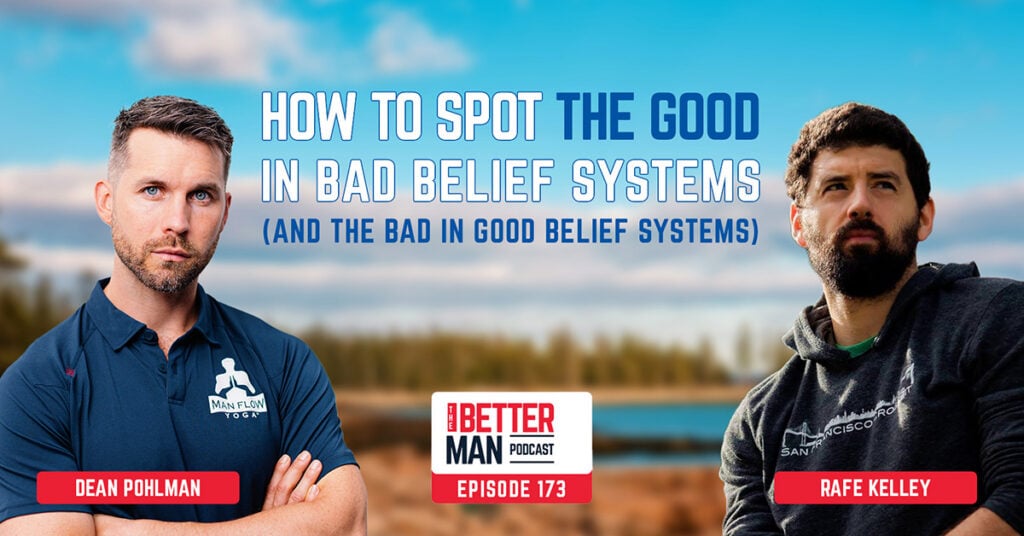
Our world has become too shackled into “black and white” thinking.
When something is considered “good,” the negative trade-offs are ignored and neglected. When something is considered “bad,” the good is disregarded and the baby gets tossed out with the bath water.
But the reality is that there’s a lot more gray areas than we think. This is particularly true with charged topics like the differences between male and female, between masculinity and femininity.
The truth rarely exists on the extremes. Both sides of an argument have positive and negative aspects to think deeply about. And absorbing an entire belief system while disregarding the “other side” can lead to real disconnection in your relationships and with yourself.
Today’s guest, Rafe Kelley (founder of Evolve Move Play), has lived out the consequences of falling into extreme camps. It caused a serious rupture in his marriage. But it’s also taught him a valuable lesson:
How to take the good from bad belief systems, separate the bad from good belief systems, and create your own Bespoke Belief System that’s unique to you and serves your highest self.
I encourage you to listen to this episode in its entirety. It is a heavily nuanced discussion of some of the hottest cultural topics and it may challenge some of your beliefs. You might feel yourself get pulled into the “cognitive miser” trap that Rafe mentions at the beginning of this episode.
But if you listen with an open mind, you’ll get as much from this episode as I did.
Here’s what Rafe and I discuss:
- The differences between men and women (and why losing our sexual polarity is harmful to everyone)
- How belief systems based on truth are surrounded by a foundation of falsehoods
- Why considering beliefs from people you disagree with instead of throwing out anything not in your “camp” is one of the best ways to protect your closest relationships
The Better Man Podcast is an exploration of our health and well-being outside of our physical fitness, exploring and redefining what it means to be better as a man; being the best version of ourselves we can be, while adopting a more comprehensive understanding of our total health and wellness. I hope it inspires you to be better!



Use the RSS link to find the Better Man Podcast on other apps: http://feeds.libsyn.com/404744/rss
Episode 173 Highlights
- The danger of falling into traps placed by “cognitive misers” that can mess up your entire belief system (and why a Bespoke Belief System shields you from this) (3:23)
- Why do vegans become carnivore people? And how this ideological trap applies to every social media hot button (6:28)
- The fundamental problem in society and how we can answer this delicate question responsibly (12:44)
- Why does sexuality create so much guilt, shame, and trauma? (And the bizarre role played by living in a society based on Christian values) (21:25)
- How we inherited a shame-based relationship with sexuality from the Middle Ages (and why it still exists today) (27:24)
- Why misunderstanding the role males and females play leads to frustration in relationship and could even lead to divorce (41:31)
- How ideological groups take a grain of truth then encode a false belief system around that seed (and how this wrecked Rafe’s marriage) (50:17)
- The overlooked negative trade-offs that naturally arise when we treat men and women as the same (and why respecting the differences means seeing differences as complimentary and not about superiority or inferiority) (59:42)
Dean Pohlman: Hey guys, it’s Dean. Welcome to the Betterment Podcast. Today’s episode is an interview with Rafe Kelly. And Rafe is the founder of Evolve Move Play, which is all about the belief that modern life has pulled us away from what truly matters. And they’re here to help you rediscover your natural potential through movement, play, and connection. And the real reason why I brought them on.
Dean Pohlman: Because this movement stuff is great. But I brought him on because I wanted to talk about some thoughts that I’ve been having, some internal discussions that I’ve been having when it comes to differences between men and women and kind of masculine and feminine polarity. And I brought Raffin because he’s been talking about this. He thinks about this. He makes posts that don’t always fit into a certain box.
Dean Pohlman: I think he’s doing a great job of, you know, expressing his own thoughts in a way that doesn’t conform to camp A or can’t be. You know, he’s really talking about what he thinks himself rather than just subscribing to a belief system. And that’s something that we get into this podcast. We talk about this idea of off the shelf versus tailored belief system.
Dean Pohlman: So creating your own system instead of just adapting, you know, a group of beliefs. We also talk about how there is a shame based relationship to sexuality and how even though not all of us identify as Christian, Western society is rooted in Christian values and how this still affects us today. And, you know, Rafe mentions some people who I wouldn’t consider role models, but I think something that we try to explore in this interview, and something that I encourage you guys to do, is to not just throw out an idea because it belongs to a certain camp.
Dean Pohlman: Kind of what we’re trying to do here in this conversation is consider different ideas from different people, even if we don’t necessarily agree with everything that they say. But trying to incorporate things that make sense and things that will help us without just throwing things out because, you know, they come from a certain place. And so anyways, I hope you enjoyed this conversation.
Dean Pohlman: It goes a bit longer than some of our other ones, and I think being able to listen to the whole interview instead of listening to snippets is important here. So I hope that you’re able to get something from this interview. I hope it inspires you to be a better man.
Dean Pohlman: Hey guys, it’s Dean. Welcome to the Betterment podcast. Today I’ve got Rafe Kelly here and we’re going to be talking about some stuff. So Rafe thanks for being here.
Rafe Kelley: Yeah thank you Dean.
Dean Pohlman: Yeah. And I invited you on the podcast because I kind of just follow your your Facebook post. Facebook, by the way, is still relevant to many of us. And so I actually like using Facebook because I get to follow a lot of people that I respect, and they kind of give life updates. A lot of them do a really good job curating conversations.
Dean Pohlman: So and I think if you’re a great example of that, just kind of following the things that you talk about, and it’s cool because you’re not just talking about one thing, you’re talking about tons of different things, and you’re not limiting them to one school of thought or one, you know, one’s information source or one influence. You’re really going into all these different areas.
Dean Pohlman: And I think you’re doing a great job of authentically, you know, presenting your personal views bereft and kind of removed from, you know, group or herd narratives, if that makes sense. Yeah.
Rafe Kelley: Yeah, I, I have this terminology I like to use of off the shelf versus bespoke worldviews.
Dean Pohlman: Okay.
Rafe Kelley: So imagine you can go buy a suit from, you know, off the shelf and it’s, you know, it fits you as well as it fits you. And it’s the same as any number of other guys have gotten all you can go to a tailor and have a suit made for you, and obviously a suit that’s made for you is going to be a lot more expensive and take a lot more time.
Rafe Kelley: And most people there’s something in kind of cognitive science literature called cognitive misers, right? We are cheap when it comes to cognition. We don’t want to have to think more than we’d like to. So what a lot of us do is we choose a narrative that is produced by maybe one of the political parties, or a scene of people online that are kind of driving in a specific direction, and we make that our true north.
Rafe Kelley: As far as truth, what I’ve discovered over time is that that’s probably just a bad way of kind of finding your way towards truth. And I think perhaps now, more than most periods of time, we live in a really corrupted landscape for truth seeking. There’s a lot of perverse incentive structures. There’s a lot of, you know, there’s a new a whole new technology in social media that has essentially created the potential for.
Rafe Kelley: Really deep ideological traps, if that makes sense. And and we haven’t really adapted to it yet. We haven’t figured out how to kind of manage the derangement that social media causes. Well, as of yet. And we can see this in like the political polling, right? If you look at, if you look at how liberal or progressive the average Democrat is or how conservative the average Republican is, we can see that they’re getting further apart.
Rafe Kelley: Men are becoming more conservative. Even before that, women were becoming more progressive liberal.
Rafe Kelley: And the degree of trust between the political tribes is at like, you know, at least 100 year low. So we have, you know, a massive problem of trust. We have sort of institutional decay. And so it becomes really dangerous in some sense, to just grab one of these off the shelf worldviews. And what I’ve watched a lot of people do is they’ll sort of buy into one off the shelf worldview.
Rafe Kelley: And when they start to see the holes in it, when it doesn’t function for them, they’ll just jump to the next off the shelf worldview. So I’ll give an analogy here that I think maybe we’ll take us out of the political realm and help people see this in a way that is a little less loaded. But how many people have you met who were vegans, who became carnivore diet people or vice versa?
Dean Pohlman: I don’t know, I don’t think I don’t know if I’ve met any. I mean, I don’t how. Yeah. How about you? Maybe I just don’t.
Rafe Kelley: Quite a few. I’ve met quite a few, actually. And and so you see this extreme perspective, right. No animal products. And then there’s a health problem and then they think okay, animal products are the answer. So therefore all the plant products are bad. Yeah. So they’re they’re bouncing back and forth between these extremes. We can see this with with with with fitness trends as well.
Rafe Kelley: Someone jumps from yoga to CrossFit and they become true believers in these things. That’s the analogy that kind of works for me. So what I try to do, and I did this as well, I was I would say I’ve described myself as kind of a bog standard progressive in 2008, and by 2010, I was essentially, you know, part of the beginning of the the alt right and the, the manosphere, you know, the manosphere long before Andrew Tate was, was a was a twinkle in the eye of the internet.
Rafe Kelley: And that was actually very damaging to my marriage. And so I’ve had to navigate myself out of that. And while I think there’s some truth in both those narratives, really in both the standard progressive narrative and in the alt right and ministerial narratives, those truths also come with a lot of a lot of I’m going to use the term bullshit.
Rafe Kelley: And I mean this in a in a very technical sense, like Harry Frankfurt wrote this famous essay on bullshit, which is about how someone will will not exactly lie to you in the sense that they want you to just believe something false, but they will present information, whether it’s whether you are expected to believe it or not, just so that it it it hijacks your salience landscape.
Rafe Kelley: Right? When you see beautiful women drinking Coors Light, you know, you don’t actually believe it, but somehow it starts to hijack you. And so so there’s both lying and and misinformation and a lot of manipulation of what information is shared in all these narratives. And so yeah, so I think I’m in both my work as a, as a movement teacher and in my personal sort of thinking, I’m trying to navigate towards the ability to.
Rafe Kelley: Look at individual problems with a lot of epistemic. That is true, seeking rigor and ethical rigor, and be willing to have uncomfortable opinions that put me at odds with people around me. When that’s where the evidence leads me. And even if that means that I end up very politically homeless, which is, of course, where I end up, because I think it’s just an inevitability when you when you when the nature of the political tribes is driven by the kind of dynamics that that we currently face.
Rafe Kelley: Does that make sense?
Dean Pohlman: Yeah, yeah it does. And you know what I was thinking about as you were talking about kind of this idea of the off the shelf, I’ll just call it belief system was the it’s the assumption that everyone has an off the shelf belief system. So even the people who are trying to be more conscious of creating their own belief system and, you know, not just taking, oh, well, you believe a so that means I also believe, you know, that means that you also believe B through Z, right?
Dean Pohlman: It’s being able to take certain beliefs and certain values and pick apart what you want and what you think is true. And then, you know, have your own thing. But just because we live in the world that we do now, there is the assumption of off the shelf belief system for everybody. So, you know, if even if you, you know, let’s say I’m in camp A and I say, you know what, I think this and then, you know, can’t be or the world looks at that and says like, well, that actually belongs in the camp B system.
Dean Pohlman: So now you’re part of can’t be. I’m like, no, no, no, I don’t, I’m not part of can’t be. I think I’m like somewhere in the middle here. But now I’m being thrown into camp B or like now I’m being thrown into camp A, and, you know, part of the struggle of having this, you know, this idea, this mission of the betterment podcast is how do I explore some of these concepts without just being thrown into a box, you know, like without just being, you know, assume that.
Dean Pohlman: Oh, well, he said that. So he’s this or like, oh, he had this guest on. So he agrees with everything that got that guest says. And it’s hard to explain to those people. You can’t explain to the people who make the assumption of off the shelf because they’re so ingrained in that, in that point of view, or that that how they view people that, you know, they’re just going to throw you in one category and the other.
Dean Pohlman: And so it makes having like a nuanced, complicated I don’t even know if complicated is the right word. It just makes unique groupings of viewpoints in a single person very hard to grasp. And it, you know, it makes it very difficult for us to look at influences and ideas from people who hold belief systems different from ourselves. And so, you know, there’s all these great, like nuggets and there’s all these great, like ideas that are in other areas.
Dean Pohlman: And we’re just disregarding, you know, we’re throwing out, you know, baby, with the bathwater in the situation because we’re just instantly suspicious of of everything there. And, you know, one thing that I wanted to kind of bring out specifically with you, there’s tons of topics that that we could talk about, but you and I kind of have a similar background in terms of growing up with this kind of suspicion of super masculine things.
Dean Pohlman: Right? This kind of I was that’s what I interpreted. But maybe, maybe you can talk about what I saw and you can you can talk about your background there.
Rafe Kelley: Yeah. We’ll see. Tell me what you saw and I’ll tell you.
Dean Pohlman: So I think what I saw was the idea of you growing up with strong women and in kind of a more liberal background and kind of the idea that men and women can do the same things that men and women who wouldn’t be differentiated. And, you know, the irony of this podcast is I came into that with kind of the I, I also have this background where, you know, my mom is a very strong woman.
Dean Pohlman: She had to be to adapt to her situation. And it was only in recent years that I started to look at, you know, her. I started to look outside the realm of her success and look at the other areas of her life. And I’m like, is she really happy? You know, like, is she really is she really behaving to according to her true self, or is she behaving more toward, you know what, you know her her wounds taught her to be in order to be strong, in order to be in order to protect herself.
Dean Pohlman: And, you know, I questioned like, is that the way that she was really meant to live, or is that just what, you know, shit happened and that’s how she adapted. And. Yeah, yeah.
Rafe Kelley: What I hear in that question is something like.
Rafe Kelley: What if it’s true that men and women are actually different, like, not just in their outer appearance or their sexualities, but actually in their temperaments and their drives, in their desires, and in some sense in what the optimal life for a man or a woman is. And if that’s true, how can we handle that responsibly? How could we respond to that in a way that, like, helps men and women live really well together and also leaves lots of space for the individuals to find what works for them?
Rafe Kelley: I think that for me, that’s one of the really fundamental problems that we face right now as a society is we really don’t have a good answer to that. And I think what we’re seeing is essentially feminism arose for, I think, very good reasons. And I think this is part of the conservative critique that gets gets it wrong.
Rafe Kelley: Is it really doesn’t it kind of sees the problems that feminism has bequeathed to us and then fails to grapple with why it arose, like, but the the way that I see it is feminism. It’s not alone. It’s part of a broader set of ideological movements, but it arose to essentially empower female agency. And there was a kind of assumption that for women to have agency, they had to essentially meet the male model or mold as much as possible.
Rafe Kelley: And so one way to do that was to try to deny difference as much as possible, because difference itself was the justification for the unequal treatment of men and women. And there’s a lot about about the nature of being a man or a woman that is unequal, that is beyond society’s grasp. Right? Like it is unequal that women have to bear the cost of pregnancy and birth and lactation.
Rafe Kelley: That’s just that’s an incredibly large cost that women bear in relation to sexuality and child, you know, and children coming into the world that it doesn’t have anything to do with societal contract constructs. Right. And.
Dean Pohlman: The, the, the experience of pregnancy and birth aside, then you’ve got every three hours for the next six, 12, 18 months, every three hours. You know, I’ve been crazy.
Rafe Kelley: I’ve been through it with my wife. And, you know, I always laugh when, when, when young men who are going to have a child with their wife will tell me that they’re going to do 50%, right, it’s going to be 5050, like it’s impossible. The child will not let it happen. The child demands the mother, and the father is an adjunct.
Rafe Kelley: Right? Well, once your child is in the world, you just have to think of yourself as sort of like your wife’s assistant when it comes to child rearing for the first couple of years.
Dean Pohlman: Yeah, yeah. You’re the best. You’re the best assistant you can be.
Rafe Kelley: That’s that’s you’re not going to be able to remove that burden fully generally. So at any event.
Rafe Kelley: I think there’s a model then that arises of, of a sort of egalitarian.
Rafe Kelley: Pleasure oriented, adult focused.
Rafe Kelley: Model of what a relationship should look like. Right? We get into relationships between men and women because it’s a source of companionship and pleasure, and we meet each other as equals. And, you know, if it’s not working for either party, then we can separate, right, and go our separate ways. And so really, what we’re seeking in each other is, is just companionship and pleasure.
Rafe Kelley: And, and then of course, it’s like, well, why why be married. Why, why do these things? Because it’s not a sufficient understanding of of how men and women serve each other, and how the pairing of a man and woman serves both a child and society. So now you have the rise of you know, I think it’s really interesting to see where appreciation of difference between men and women has arisen, because you have a like a very you have conservative aspects of that that have been going on really since the beginning.
Rafe Kelley: I’ve been saying, hey, no, women aren’t the same as men, and if you try to treat them the same as men, then you’re going to be missing really important things. This is a Mary Harrington who’s an author I really respect. She talks about this in her book called Feminism Against Progress, the idea that there was a feminism of liberty, which was essentially a feminism of trying to allow women to become as much like men as possible.
Rafe Kelley: But there was also a feminism of care, which was about trying to get society to recognize the value of what women traditionally did and help creating what they called the cult of domestic. So. So you see that kind of rising up in our culture and getting captured again by these really interesting right wing dynamics where it becomes an aspirational meme production, the trad wife meme.
Rafe Kelley: Right. And lots of young women see that and think, oh, that, that looks nice. I want to have children. I don’t want to be stuck in a corporate gig. You know, these women who who look beautiful, who have beautiful clothes, who make beautiful food and beautiful houses with beautiful children, and you don’t realize that they’ve got like, you know, ten assistants who are filming them all the time.
Rafe Kelley: And it’s a production and they’re they’re making a business out of it. Right? Yeah. And it becomes politicized. So there’s the trad wife, mean. But the other one that’s really interesting to me has been within sexuality, right? As people are trying to heal the wounds of sexuality that we face as a society. There’s been a lot of discovery of the the power of polarity that it’s not in some sense a meeting of perfectly identical equals that creates sexual tension and energy.
Rafe Kelley: It’s this polarity. So you see a lot of stuff coming out of conscious sexuality around polarity. And that that’s an interesting space. So where I.
Dean Pohlman: Go back and just just for people listening and maybe for myself to can you clarify what you mean by sexuality problems or what were you saying, what was the term you used?
Rafe Kelley: So people. Right. I think there’s that sexuality has always been an area of intense potential for conflict and trauma and pain because it is deeply unequal and it is extremely motivating, and it can go wrong in lots of really important ways. And societies have had very different ways of dealing with that. One way was to just allow the most powerful people to control the scene and just view it as their right to do so.
Rafe Kelley: If we look at Roman and Greek sexuality, essentially the idea was just that elite citizen males had the right to do whatever they wanted to whomever was below them in the social hierarchy. Christianity came along and said, no, we’re not going to do that right. We’re going to treat sexuality as specific to marriage and the man and the woman as having an equivalent claim to each other.
Rafe Kelley: Both are one body and eventually, and it took a long time. But this idea was intrinsic to Christianity. For from the beginning there was a claim on male chastity which didn’t exist before. Chastity in the Roman and Greek world was something that was only concerned by women. But eventually there’s this idea that men to should be chased, that men to should not have sex outside of marriage, and that I think that was actually very virtuous in a certain way, because it took us out of a world in which it was considered perfectly normal to, say, sexually exploit a slave child.
Rafe Kelley: So people don’t appreciate how radical Christian sexuality was and how much it was in some sense a positive moral revolution. But the downside of that moral revolution was that to create this very constrained model of sexuality also meant leveraging a lot of shame and guilt for people who weren’t able to live within the the model.
Rafe Kelley: And, you know, I just read a very interesting book that I would recommend to people called The Origins of Sex The Story of the First Sexual Revolution by a man named Farmers Devil Willow. And in it, he basically tracks how the Protestant Reformation and the idea of freedom of consciousness in regards to religion set the grounds for an idea of freedom of consciousness in regards to the expression of sexuality.
Rafe Kelley: And so it became less and less sort of philosophically tolerable for for people to police other people’s sexuality in the way that had happened in the Catholic model of the Middle Ages.
Rafe Kelley: So.
Rafe Kelley: I got a little lost there in the in.
Dean Pohlman: I was loving it. Yeah, that was great. I did sidetrack you though.
Rafe Kelley: Okay. So okay, so, so.
Dean Pohlman: So we’re talking about how those we were talking about how currently how how there’s a sexuality I guess tension or something. Something wrong.
Rafe Kelley: One of the so Christianity tells us essentially both the sexuality to the degree that it should exist, should exist only in marriage. And this is this is an interesting thing because it, it, it it constrains particularly male sexuality from a lot of expressions that are really pathological. And that’s probably a good thing. And it supports the development of really stable family structures.
Rafe Kelley: Right? When when a man can’t go and seek sex, sex outside of his marriage, then he’s going to be more focused on his spouse, right? Sustaining and main and maintaining that relationship. And then those two individuals can then give themselves to their children more fully. Now that’s that’s an aspirational reality. And you’ll hear this kind of talk a lot from conservative thinkers like Jordan Peterson and Ben Shapiro.
Rafe Kelley: People like that. And there’s there’s truth to that story, but it’s also a very incomplete story, because, you know, the reality is that many elite males continue to have a lot of sexual freedom that other people didn’t. And this continue to be a problem. And so throughout the Middle Ages, there was this idea that that sexual constraint was was virtuous, right?
Rafe Kelley: Chastity was virtuous. And this is a world in which sexual right from the beginning, Christianity also has a ambivalent relationship to sexuality in general, because Christianity is essentially in some sense about overcoming the body and being and being saved, such that you can live as a spiritual being in the kingdom of heaven that happens after death, that that idea then, like Christ, is asked in the Gospels, if a woman has had seven husbands, who is her husband in the kingdom of heaven, and he says she won’t have a husband because we will not be creatures of the flesh of sakis, we will be creatures of I believe it’s there’s two different terms pneuma and
Rafe Kelley: sukha. Suke is the kind of of I believe, if I remember correctly, Suki or psyche from the term we get. Psychology describes the type of spirit that you have when you are alive, whereas pneuma describes the soul that exists that is, that is immortal. We will become creatures of pneuma when we enter the kingdom of heaven. So because we are creatures of pneuma, we will not unite in the flesh and we will not be married.
Rafe Kelley: And so therefore, there’s an idea very early within Christianity that to live the most perfect life is actually to give up on sexuality and give up on the body completely. Right. And Paul lives this right. Who’s the most influential figure in the development of of Christianity? And he says that it is best to live completely celibate. But if you can’t and he doesn’t think most people can, at least you should just be monogamous.
Rafe Kelley: And so there’s this sense all the way through the Middle Ages that sexuality itself is suspect. And there’s this idea then, that women are the less spiritual side of of the sex binary. They are more earthly, they are less elevated, and therefore they are more lustful. And men see women as this source of temptation, of taking them away from their their religious practice and toward sexuality.
Rafe Kelley: One of the really interesting things that comes out of reading The Origins of Sex is that once literacy spreads far enough that many women start being able to write about their experiences, they then want to claim the high ground of chastity. They want to say no, we are the more chase sex because they’re living in this very sex negative psychological world, and they’re dealing with the reality that men continue to prey on.
Rafe Kelley: Women continue to promise to marry them and engage in sexuality and then abandon them. And they see this in their social circles. So they’re saying, no, no, no, it’s not women who are the source of lust in society. It’s men. And this is a huge theme of like a lot of early novels that are written in the 17th, 18th century.
Rafe Kelley: So we inherit this very shame based relationship to sexuality. So part of the sexual revolution of the 1960s. And then feminism is saying, no, no, no. Not only are men and women equal, but sex is good and we shouldn’t be ashamed of it, but in that we cast out all of our traditional wisdom about, oh, a marriage is not just for the two people in it.
Rafe Kelley: It’s also for the community. It’s also for the children who come through it. And then we have the children of divorce, right? Then we have all of that chaos that comes through. And I think that we’re we are really still in this place of dealing with the repercussions of, you know, the birth control pill of the ideological revolution, of the sexual revolution and of trying to, to to move past maybe a shame based model of sexual constraint to something that that can guide us towards, like a virtuous sexual life without creating so much psychological damage.
Rafe Kelley: Because I think a lot of people are really deeply damaged by how much they feel shamed of sexuality. And that was part of the sort of ideological system that Christianity bequeathed dust, which did a lot of positive things, but also had a lot of trade offs. And that’s just the reality of of all these systems, I think, is that they have trade offs.
Rafe Kelley: So I have a lot to say about this kind of stuff, I don’t know.
Dean Pohlman: Yeah. So, so, so what I was getting as you’re going through that is like, yes, this it sounds like, you know, if everybody conformed to this one way of thinking about sex, then yes, things would be easier. But at the same time, people are different. And the obvious downside is, well, not everyone fits that model. Not everyone wants to be in.
Dean Pohlman: Not everyone wants to be in a monogamous relationship. Not every not every man wants to be with a woman. Not every, you know. So there’s there’s so many people that don’t fit into that mold. And I guess what I’m sitting with is like this tension of conservatives saying, hey, if we all do this, it’ll be a lot easier with the other people saying, well, I don’t want to do that, so don’t make me do it.
Dean Pohlman: And yeah, so that’s that’s kind of what I’m I mean, that’s the summary of what I was thinking about as, but like also like you just bring up this idea of like, you know, 19 centuries of and whether or not you, you know, whether or not you identify as Christian or maybe you grew up in, you know, going up to church and now you don’t go to church, maybe you have no, you know, maybe you have no history or your family has no, no history of Christianity at all.
Dean Pohlman: But the fact is that, you know, we derive our values from just as a Western society, you derived your values from Christian ideals. So, you know, I think no one escapes this shame based relationship to sexuality that you’re talking about. Everyone has, you know, every everyone grows up with this, you know, thinking of their sexuality in a way that’s, you know, you know, something to be something to be constrained.
Dean Pohlman: It’s something to be something to feel bad about, potentially. It’s there’s there’s one way to do it. So we all have this sense of shame when it comes to sexuality, regardless of whether or not, you know, you identify with a certain religion.
Rafe Kelley: And I think it’s important to point out that that constraints around sexuality and sort of like how those are built on the trade offs of them are not a unique problem to, to to Christianity. Right? You know, a lot of Westerners turn to Buddhism or Vedanta as sort of escapes from Christianity, that is Hinduism. But those systems have their own histories of of deep sex negativity.
Rafe Kelley: Right? A lot of the the Buddhist tradition in particular, again, it has a similar idea of wanting to escape the body and therefore recognizing that sex is an extraordinarily tempting thing to make us want to experience the body. So the Buddhist tradition outside of Tantra, which is not really a sexually oriented as, as as people think it is, but tantra is part of tradition that’s really reclaiming the body as central to the person.
Rafe Kelley: But a lot of the British tradition is, is antibody and therefore anti-sex, and it also develops a lot of the same sort of structural problems that that has. Right? You have a celibate priesthood celebrate monastic orders that end up with problems with abusing children. Right. You you know, we see this like, here’s a this is maybe I find this very interesting.
Rafe Kelley: And I think it kind of dovetails, perhaps with our conversation that you’re interested in about, like the construction of masculinity and how do we understand how to become men such that it fulfills our nature as men, but does so in a, in a socially virtuous way and puts us in right relationship to women. Like, that’s a that’s a difficult question for men.
Rafe Kelley: Well, here’s a really interesting observation, a little bit disturbing, but an interesting observation. So.
Rafe Kelley: In many small scale warrior societies, you will see a tradition of pederasty, which is a tradition where male sexuality is redirected away from women towards adolescent boys. People find this really hard when you’re going back and reading the Greeks, right? Like Greek civilization, Greek philosophy, Greek science, all of that is so foundational to our culture. But if you go back and read, you know, the symposium where Socrates is talking about love, initially, the whole conversation about the problems of Eros is about the intensity of falling in love with young boys.
Rafe Kelley: Right. And how the beauty of a young boy can, can, can impact a an older man.
Rafe Kelley: That’s not just the Greeks, right? The samurai also had a tradition of pederasty, I believe. Actually, I’m going to say that with a caveat. I’m not sure actually as much about the samurai, but the other group that I am really familiar with is Papuans in Papua New Guinea. There’s a lot of tribes that have these traditions. There’s tribes to believe that for a man to be, for a boy to grow into a man, he has to ingest enough semen.
Rafe Kelley: That masculinity is an essence that pass from older men to younger men. Now, this is deeply uncomfortable conversation, but I bring it up for a reason, because what I think happens is that the bond, the inherent potential for the bond between men and women is so powerful that it can very easily disrupt the formation of male coalitions. And everyone who’s been through, like, their teen years probably remembers this experience of like, you had this bond of of male friends and you’re all really hanging out together all the time, and it’s great.
Rafe Kelley: And then a girl comes along and starts dating one of your friends, and then he’s just not available to you anymore. He disappears. Right. And so there’s a way in which that female pair bonding potential disrupts the male coalition, small scale societies where there’s a lot of warfare, where they’re constantly having to fight, want men to be bonded.
Rafe Kelley: There’s an incentive for men to be bonded as closely to each other as possible. So in these Papuan societies, what you see is that they have men’s houses where the men sleep in one house, in the women sleep in a separate house. They have very misogynistic social norms. They’re brutal in relationship to women. They view women as less is morally less.
Rafe Kelley: And you’re sort of your.
Rafe Kelley: You’re going to be derided by your male Pearce. If you’re too devoted to the woman in your life and you see the same dynamics in like, American gangs, right. Bros before hos. Right. Like think about the messages that come through gangster rap. This is a I believe that this is a structural problem of like, how do you you need men to be more devoted to each other than to women if they’re under constant threats of violence.
Rafe Kelley: But what attracts men to women, of course, is the sex drive. And once there is a sexual connection, there’s this deep potential for intimacy and love and connection and shared work and shared family. Interestingly, there’s research that shows that as warfare decreases in those Papuan societies, men increasingly opt out of the men’s house. They just stop sleeping in the men’s house, they start sleeping in their wives houses, and the relationships between men and women become more peaceful, more loving.
Rafe Kelley: Because for a man to to mistreat a woman, in some sense he has to to dehumanize her. And it’s a lot easier the less time you spend with somebody. But when you have shared work and shared projects, we we see the humanity of the other person much more. And it’s harder to to extinguish that empathy.
Rafe Kelley: So that’s a small scale society’s adaption to social pressure, which comes through the level of warfare as it goes up. And then you end up with this constraint around sexuality. We want men to redirect our sexuality towards other men, towards young men.
Rafe Kelley: To keep their coalition strong. So this type of problem exists across many different societies and we’re always trying to solve it. We you know, I think one of the fundamental problems we really don’t understand now is how much shared work is actually one of the predominant things that drives pair bonding after the infatuation period. And that’s why marriages are so unstable in American society, because the corporate world means that you’re going to end up in different, different work, whereas the traditional marriage is not a single family.
Rafe Kelley: The man earns all the money and the woman stays at home. That that existed for like 30 years at the beginning of the century, right? The last century. For most of human history, the the traditional marriage is a corporate marriage where men and women do shared work. A man goes out and shears the sheep, that then a woman weaves the wool that he takes to market.
Rafe Kelley: They are mutually interdependent, and that independency is actually as much what creates the marriage as the initial sexual attraction. So very often people’s cheat with the people that they end up working with, because essentially they’re acting out marriage with their secretary more than their acting up marriage with the woman who lives in their house. Okay. And so we don’t understand the trade off that we’ve made, and then we don’t have a model for how we solve that.
Rafe Kelley: What what do you need to do when your wife works in a different place than you, and you work with a woman to manage yourself such that you don’t become more emotionally connected to the woman you work with than the woman who’s already had your children.
Rafe Kelley: Okay, so that’s the type of trade off that I think about with these things. Yeah.
Dean Pohlman: So how do we bring this back to the initial topic of conversation, which is kind of discussing, you know what, I don’t know, I guess, loosely speaking, how do how are women, women and how are men men and in society.
Rafe Kelley: So I think maybe I’m pointing to, to to a few different ideas here. One is.
Rafe Kelley: We have to develop a more sophisticated model. Right. There’s a there’s a failure mode. Let me, let me, let me personalize it for a second. So I was raised by feminist, by a feminist mother with feminist friends and by men who were part of the counterculture, not necessarily feminists, but they were. They had rejected the traditional values of their Christian upbringing, and the result was that the men that I grew up around were very personally irresponsible and frequently sexually corrupt in ways that made it really hard for me to want to grow up and be like those men.
Rafe Kelley: Whereas the women that I grew up around, all the people I could really trust for the most part in my upbringing were women. So it’s hard to then construct a masculinity for yourself that that works. And then I grew up going, you know, then to a very progressive college and sort of being surrounded and just embedded in the waters of feminism, let’s say.
Rafe Kelley: And so I had this egalitarian model. I didn’t have a model that respected the difference of women and understood the difference of women. So then I ended up in a relationship with with my wife, and I kind of expect her to behave like me, right? Like I’m interested in initiating sex every day. She’s not maybe not interested in initiating it at all.
Rafe Kelley: As it turns out, her very rarely. And that feels unfair. Like, I don’t understand that because I don’t understand that that women’s sexuality is actually different from men. That doesn’t mean that women can’t initiate or won’t initiate, but they tend to be more receptive and more looking for a signal that it’s time from a man.
Rafe Kelley: I expect.
Dean Pohlman: I actually, I just want to share a personal experience here. Like I thought about, you know, my my, my daughter right now. Have you seen sandlot, the movie Sam?
Rafe Kelley: Yeah.
Dean Pohlman: I love the sand. Okay. So you know the scene where squints fakes drowning in the pool and he kisses Wendy Peppercorn. So my daughter, I have no idea why she watches this scene on repeat. Like, she just she she just rewinds and she watches it over and over again, and and, you know, mom says so. You know, my wife Marissa, her mom says, you know, that’s bad to, you know, does she you know, he tricks her into kissing her.
Dean Pohlman: That’s bad. And obviously, yes. Like, don’t don’t trick don’t don’t trick women into kissing you. But at the same time, I asked her like, you know, I didn’t ask you to kiss you the first time that I kissed you. What would you have thought if I had asked you if I could kiss you instead of just going for it?
Dean Pohlman: And. And she said, I don’t, I don’t know. And then I said, okay, look, let me. So this is what it would actually look like. I would, I would have said instead of just kissing you, I would have looked at you and said, hey, do I have my permission? Do have you do I have your permission to kiss you?
Dean Pohlman: You would have thought I was a psycho. So, you know, that’s.
Rafe Kelley: What young men are being taught to do now, right? That’s the affirmative consent model. And so, so there’s there is an ambivalence for women about male sexual aggression, right? Because it’s very attractive. And if you look at like, women’s erotic literature, it’s very much about aggressive male sexuality. And yet it’s also dangerous, right? Women want a man to, to to be sexually aggressive who they are already shown that they’re attracted to.
Rafe Kelley: They don’t want to deal with the sexual aggression of men that they’re not attracted to. And that’s a very difficult line to, to, to manage.
Dean Pohlman: Yes. Obviously that is not something that yes, that is that is a major consideration.
Rafe Kelley: And but what’s interesting, you know, I’ve seen this point made and I think it’s very interesting, which is that really men are supposed to think that they’re initiating. Right. And women are supposed to initiate. And this is a funny, funny thing, but but a woman initiates by indicating interest, and the man is supposed to have the social competency to recognize the interest and then to take action on it.
Dean Pohlman: Okay. That that resonates, right?
Rafe Kelley: That that is the default model. Right? So young women used to know and used to be taught and sort of like pick up in their social sphere that if you want a man to approach you, you have to make yourself approachable. So I have a 13 year old daughter right now. She’s very beautiful and she is really upset that young men are not approaching her.
Rafe Kelley: And I said, well, okay. Are you? How do you behave towards young man? She’s like, oh, you know, I’m mean. Basically I was like, okay, so you’re tall and strong and really beautiful and you consistently put off an energy of aggression. And men don’t intimidate, boys don’t approach you scared 13 year old half developed boys don’t approach you, right?
Dean Pohlman: Yeah. Probably shorter than her.
Rafe Kelley: Yeah, yeah. So maybe, maybe, maybe there’s actually a dance. There’s a dance of of indicating that you’re open and that that part has been forgotten because we don’t have these, these scripts anymore around male and female behavior. And so we’re trying to construct a new ones like the affirmative consent model is, is a is saying, hey, if something wasn’t working about the model that we had, how about this?
Rafe Kelley: Right. And it’s I think it’s rooted in fundamentally mistaken priors about human nature, but it is an attempt to like, give people a way to negotiate these things so that so that it’s not just like alcohol and you fall into bed with somebody and then you’re greeted in the morning. So in any event, but, you know, your daughter’s fascination with that, it reflects something inherent about the way that female sexuality tends to play out, which is that it’s more receptive.
Rafe Kelley: So I felt frustrated by my wife. And then I also didn’t recognize that I wasn’t setting her up to receive my bids. Well, right. Nobody had taught me this is what a woman needs to be ready to receive that bitter. This is her indicators that she’s ready to receive that bit. And that’s something the most young men don’t get right now, because we have no theory of difference.
Dean Pohlman: Yes. And this, this kind of circles back to this idea of polarity in sexuality. And, you know, when we are reducing the roles that create polarity, then we have this weird sexual situation.
Rafe Kelley: Yeah. There’s a.
Rafe Kelley: You know, there’s that idea of, of when a woman is in her young, it’s hard for her to go into her yin or her feminine. So as women play a more masculine role in society, it’s harder for them to access that. I’m not. I guess my focus is less on that element and more on like men don’t understand because we assume sameness.
Rafe Kelley: We don’t actually understand what’s different about women and how to then bring that out of them, or how to read their signals. And women don’t understand that about men because we have an assumption of sameness that’s unjustified. And so the traditional fist model, or the red pill or all that are all just trying to say at some level they’re offering us the truth that there is difference.
Rafe Kelley: But then they they’re bundling it with things that are maybe untrue or even dangerous. So I was in this egalitarian model with my wife and essentially this, you know, freedom of association. It’s like, yeah, we’re together and we’re married. And but if something better comes along, right, like, we all have the freedom to do that because there’s no you know, God’s not judging me.
Rafe Kelley: There’s no God. Right? And, you know, I don’t have any I don’t have any duty to society because I’m an individual. I didn’t have anything to truly bind that connection of marriage until.
Rafe Kelley: I wouldn’t say that I could describe myself fully as a Christian at this place. But I did have a Christian conversion, which was extremely transformative for me, and that completely changed my relationship to marriage. It really helped teach me what true devotion was. But I before I got there, I started to read. I was very interested in evolutionary psychology.
Rafe Kelley: So evolution psychology, you know, talks about men and women being different. And it’s picked up as a discourse online by people who are interested in how to seduce women by the red pill, by conservatives who want to push back on some of what’s been changing through progressives. And they’re, they’re, they’re hold on institutions. And and so if you accept difference in some sense you tend to enter these discourses that are maybe right wing biased or, or even male biased or pick up artistry biased.
Rafe Kelley: And I think I’m not saying that right wing this is better than left wing this or vice versa in general. But what I experienced was that the red pill elicited a frame of mind from me that was very. Shallow in its relationship to how I perceive my wife controlling and manipulative. And initially it did result in what I experienced as a better sex life.
Rafe Kelley: But over time it eroded the foundation of our relationship really dramatically. And when my wife broke up with me and 2000, 20, 23 and then again in 2024, that was the long break. A big part of that was her really processing the trauma of that transformation in me. And even though I had moved away from those narratives, they had never really been fully healed from her.
Dean Pohlman: Right.
Rafe Kelley: And I hadn’t and I also hadn’t fully healed either the sexual trauma that drove my own attraction to them were all of the ways in which I imbibed some of these ideologies that were really destructive in relationship to my partnership. So then essentially to, to as I move through that period of separation and I’m trying to win my wife back, I had been sort of very curious about Christianity and really deeply imbibing Jordan Peterson’s ideas on Christianity.
Rafe Kelley: John Keys, Jordan Hall, Jonathan Pageau and I had been going I had actually started attending an Orthodox church, but I was very inconsistent, and I was more looking at it from a cultural perspective. But while I was in the in that place of like deep pain, I had an experience of Christ coming into me and showing me that I was loved by a spiritual force, and that it was my role to be willing to be a sacrifice for my family, and to to bear the pain so that I could redeem these things and these things that had not been taught to me and that that that worked.
Rafe Kelley: And it was it was beautiful. And I was able to reclaim my marriage with my wife, and I was able to enter it, you know, in a way that was much more spiritually full and true than what it preceded it. But the interesting thing was that it created a lot of conflict with my daughter because, as it turned out, as I was becoming a Christian, she was discovering that she was bisexual and she was not very happy about me becoming a Christian and exploring and thinking about some of these things.
Rafe Kelley: And, you know, I was in Christianity, there’s this really this there is an idea of male headship in marriage and male leadership. And that actually was really helpful in a certain way, because the egalitarian model sort of puts an equality of, of, of responsibility on both partners in a marriage. The Christian model, if you adopt it correctly, I think, tells the man that he’s the leader.
Rafe Kelley: So he’s responsible, right? And for me, at least in that moment, taking on that responsibility, saying like the quality of my marriage is more my, my responsibility than anybody else’s was really a powerful place to be operating from.
Dean Pohlman: So where I kind of where I kind of hear that and start to get kind of, you know, suspicious. And I think where a lot of other people get suspicious is, okay, I’m the male, so I’m in charge. And I think the, the, the incorrect. There’s two ways of thinking about that. You can think about that as like I’m the male so I’m in charge.
Dean Pohlman: So do what I say. And then the other way is I, do you trust that I have our best interests at heart? Do you trust me to lead? Do you give me your like, do I have your, you know, consent to lead, right? It’s it’s it’s like it’s. Do you trust and will you let me lead versus like, fuck you, I’m leading.
Dean Pohlman: Do what I want. Which is what I think we’re this, you know, I think that’s where the, you know, let’s just let’s just call it, like, the right wing narrative, like whatever it is, which that’s where that narrative shows up and people are like, well, that’s not right. And it isn’t. But on the other hand, like the, you know, creating safety for the feminine, that’s that’s where that anyways, that’s, that’s, that’s a, that’s kind of where the shift for me, in my way of thinking has been.
Dean Pohlman: It’s been started out as men and women are equal. And then it moved and then like, I don’t never went to like the extreme of, oh, I’m in charge. You have to do what I say. But it did shift to I think it more shifted to in some way. I am meant to lead, and I need to create a feeling of safety for my partner so that she feels safe enough to let me lead, as opposed to the hey, nope, I’m in charge.
Dean Pohlman: We’re just going to do what I say, so listen up and like, no, don’t do that. You’re going to do what I say.
Rafe Kelley: Yeah. So the the the the the negative trade off of the model is that there’s, there’s essentially nobody who bears primary responsibility. Right. And so it’s easy for things to disintegrate the negative trade off of the of the Christian model is that, that it’s very easy to mistake leadership for dictatorship. So on the night that my wife sort of broke up with me, we sat for a long time.
Rafe Kelley: We talked for like 14 hours. And there was this point where she said that she was really tired of having to be strong, and I was like, oh, that’s that’s I want to be strong for you, right? Like, I want to be that. And I told her that I wanted to be like a good dance lead right where I was.
Rafe Kelley: I was leading where the steps were going, but I was always sensitive to what she wants. Right. The leader in a dance, in a traditional partner dance, the lead role is not to dictate what happens, but to create the constraints in which the follower can express themselves. I think this is a this is a model of how a male and female relationship can play out.
Rafe Kelley: That captures some of the dynamics pretty well and can be really beautiful. I’m still working this these ideas through in my own life, and with my wife and I, I’ve moved from that really strong kind of orientation towards male leadership back towards more of an egalitarian, more feminist influenced model. In my own way of thinking, I kind of find myself watching our dynamic a lot and saying like, well, what is actually happening here?
Rafe Kelley: And then is it working right? Is it is she happier? Right? Am I happier? And so I one thing you know, you’ll hear a lot of discussion sort of in the manosphere about how like women can’t tolerate motion and like all your vulnerabilities should be shared with other men. And that’s not been my experience at all with my wife.
Rafe Kelley: Like, right. The more that I could share my vulnerability with her, the deeper our connection was.
Dean Pohlman: Well, it’s more that men can’t handle women’s response to their sharing their emotions. It’s. Yeah.
Rafe Kelley: Well, I mean, I think there are women who really struggle, I think with experiencing it, for sure.
Dean Pohlman: I think it’s a man’s I was I think it’s a man’s role to be able to create a safe container so that the partner can express yourself or himself, and he can be in that container and, hey, you can rage, you can yell, you can do whatever you want. And I’m just going to sit here and take it all in, and I can be calm for you, and I can.
Dean Pohlman: I can be the rock. You can be the ship or like you can. I’ll be the you know, you can be the sea. And I’ll be the whatever the analogy is. Right?
Rafe Kelley: Yeah. The kite and the anchor. So, you know, the way that I tend to perceive my marriage is that my mood tends to be much more stable than my wife’s, and she.
Rafe Kelley: She has more she has more need for emotional containment than I do. And so I play that role of of holding her while she expresses emotion. And the better that I do in that, the more open and loving and like everything that I want from her, flows really easily from her when she gets that need met. But also she does play that role for me, right?
Rafe Kelley: At times, right? Like I’m processing my stuff and when when when needed, when I’m going through stuff. She also sits with me, right? Like I did a a mushroom journey recently and my wife sat with me for, for through it. And I went through a lot of deep stuff. Right. And she was a really great anchor. And, you know, there were times when I was talking to her about stuff that had to do with me and her that, you know, it would be easy for her to have a reaction to.
Rafe Kelley: But she had great emotional containment and strength. And so I think there is a there is a there’s a like on average we know that, you know, the, the psychological research anyways has fairly consistently shown that men have lower sensitivity to negative emotion than women. And and so man inherently has a capacity maybe to, to buffer to be a buffer for his wife’s emotionality in a really valuable way.
Rafe Kelley: And I want to I want to dig into this because I think it’s I think it’s a fascinating topic. I know we’re kind of running low on time here, but I think this is such an important one to get right because.
Rafe Kelley: The word we use neuroticism in psychological research, sensitivity and negative emotion is called neuroticism. But when you talk to a lot of women about like, oh, women are higher neuroticism, they’ll get really upset with you because calling women neurotic has traditionally been a way to dismiss their perspective. And I saw this really beautiful.
Rafe Kelley: Essay. I wish I could remember who the author was, but they were pointing out that you can kind of think of a woman as the more sensitive, emotional instrument. A woman is going to detect problems emotionally faster than a man. That doesn’t mean the problems aren’t real. But just like you, like you could think of it like like the nervous system, the parasympathetic fighter.
Rafe Kelley: Yeah. Rest and digest and the sympathetic fight or flight. So in some sense the man is like maybe the parasympathetic. He holds the emotional containment and the woman is the one who’s saying, hey, there’s more there. And it’s the balancing between the two that allows Alice status and the optimal operation of the human being in the same way a man and a woman, because they have these differences of temperament, are better able to address the needs of their children.
Rafe Kelley: The woman is going to say, hey, we need to pay attention to what’s happening here. That child might be hurt. That child might be scared. The men’s going to say, okay, but we can call, right? We can do it with a little bit more calm. And so when the when, when the woman doesn’t have the grounding of the male energy, then she can get into hypochondria and over controlling, and the child doesn’t get the opportunity to go out and explore.
Rafe Kelley: But when the man’s not when the male energy is dominant, then the child doesn’t get the nutrients that it needs, doesn’t get the attention, and it’s more likely to have issues.
Dean Pohlman: Or that ear infection turns into something worse.
Rafe Kelley: Exactly. And so it’s the balance between these two things. It’s so powerful. So I think about this from an ecological perspective to I’m a big think big believer in ecological psychology. That’s like fundamental to my movement work. So a woman has a higher sensitivity and negative emotion. Part of that is simply that the world is inherently more threatening to a woman than to a man.
Rafe Kelley: Right? I am more calm in the face of things than my wife. I’m six foot two and weigh 220 pounds. She’s five two ways, 140 pounds, right? Like I can deadlift 400 pounds. She can deadlift 230 pounds like I, I like my body can can literally be damaged, can be struck and not take the same damage as hers.
Rafe Kelley: The world is inherently safer in some sense for me. And then, of course, we started with the observation that sexuality itself is inherently far more dangerous for women than men. So this, this biasing of negative emotion is actually, in some sense, just the ecology of experiencing life in a smaller, less physically, more physically fragile body. And that’s sexually fragile in a way that men are.
Rafe Kelley: So the if we can deeply understand and respect that, that, that, that those differences exist and that they’re not a case of inferior or superiority, but a case of complementarity that I believe is the grounds by which we can then start to create like a really virtuous, positive system of understanding how men and women can deeply interrelate, can express what makes their their nature’s uniquely useful and valuable, and then put them together.
Dean Pohlman: Yeah. I think yeah, I think that you really you really pulled it together at the end there with that, that that sentence, with that statement. I think that that made a lot of sense to me, as did a lot of this. And I think the background helped. I think a lot of this was really, you know, the historical background really brought it together to.
Dean Pohlman: And I just want to say, because I know I have a I have a disproportionately large gay audience, that I think some of these concepts also apply to same sex relationships. I think, you know, you can probably notice that there’s tends to be one more masculine, more feminine partner. But anyways, I’m just saying that so you guys don’t feel unenclosed because I know that happens a lot, but hopefully you could hopefully you can hopefully everyone could listen to this conversation and, you know, get something out of it.
Dean Pohlman: But yeah, well what else. Including thoughts here.
Rafe Kelley: Concluding thoughts. Yeah I really enjoyed just getting the chance to to chew the fat on this stuff with you. And I think that I think that conversations like this with people who sort of been trying to navigate their way through these different camps and find truth and live virtuously in partnership and figure out that maybe what we were handed down was imperfect, but we have to have to try to recover.
Rafe Kelley: The good out of it is really true.
Rafe Kelley: Tom Holland and Jordan Peterson both make this point that we.
Dean Pohlman: Tom Holland’s Spider-Man. Tom Holland, no.
Rafe Kelley: Tom Holland, author of Dominion and the Rest is History, the most popular history podcast on the internet. Okay. He wrote a book called Dominion, which is about how so much of what we attribute to city enlightenment is really built off of Christianity, and how much it’s really hard for us to think outside of Christianity. And Jordan Peterson made this point as well.
Rafe Kelley: He’s talked about the idea of like, we have to go recover the bones of our father from the the underworld. And Christianity is is our cultural father in some way. What I would invite people to consider is that a lot of the neo traditionalist, New Right critique of feminism is kind of like the New Atheist critique of Christianity, where people don’t realize how much they have imbibed the the valuable sort of lessons of feminism.
Rafe Kelley: They don’t realize how much they’re operating within a feminist frame. And so therefore they because they’ve already accepted the good parts, they can only see all the negatives that are coming out of feminist theory and ideology. That’s been my experience anyways, and I’ve probably consider myself an anti as much of a consider myself an anti theist in the past, and I just want to invite people to look back at that longer history of female emancipation and why it arose, and how much it was actually necessary in a proper corrective to a world that was deeply unfair.
Rafe Kelley: And then and then come back to this question of, of male and female difference and understand. Okay. What have we learned from that, that we have to carry forward, just like we have to look at Christianity and say, there is a lot of virtue to how Christianity revolutionized, say, the sexual world and moral world, even if we can’t necessarily live within any of the sort of legacy Christianity’s that we have on offer, for many of us, we have to we can’t reject it as just absurd.
Rafe Kelley: And I want to invite people to who maybe are more towards the anti-feminist camp, to consider that this is also part of our our ideological heritage that arose for very real reasons and is worth wrestling grappling with very deeply.
Dean Pohlman: Yeah. I mean, and for me, I, you know, just very quick history. I grew up going to church, I grew up, I went to Presbyterian Church. I not a rule follower. So eventually I just I had a bad experience. I just didn’t I don’t know, I just I the whatever reason, you know, I didn’t I didn’t keep going to church after my parents stopped making me.
Dean Pohlman: And so while I don’t I while I do not identify as a Christian, I still read, you know, I’ve in the last couple of years, I’ve started picking up different literature from Christian authors because, you know, while I don’t subscribe to the entire belief system, I know that there are, you know, I know that there are kind of like I mentioned earlier, there are nuggets of information.
Dean Pohlman: There are nuggets of wisdom that I know that I can glean from them. And if I, you know, if I just take the perspective of I’m not I’m not a Christian, so I’m just not going to pay attention to anything that anybody is a Christian says. Then I’m missing out on so much. And I think that’s, you know, that’s that’s kind of been a theme of this whole conversation has been we need to be able to look at ideas from other belief systems and figure out for ourselves, like, does this work with me?
Dean Pohlman: Is this helpful? Instead of saying, oh, that’s in can’t be, I’m in camp A, I’m not going to listen to any of that.
Rafe Kelley: Yeah, yeah, there’s there’s real revolutionary perspectives and insights that have evolved in these different traditions that someone who wants to build a really virtuous, bespoke worldview needs to grapple with. I think so, yeah, hopefully that invitation is a good place to to finish the conversation.
Dean Pohlman: Yeah. And I hope you can come back and we can talk more about kind of your upbringing and some of how that that affected, you know, all the stuff that we’re talking about. But it was cool, I appreciate it. It was good conversation. So thank you, Rafe, for being here.
Rafe Kelley: Appreciate being here.
Dean Pohlman: All right guys, I hope this inspired you to be a better man. And I will see you guys on the next episode.
Dean Pohlman: All right guys, hope you enjoyed that interview with Rafe. You can check out Rafe at evolve.
Dean Pohlman: Evolve move play. He’s also on Instagram. He has a YouTube channel, so check him out there. And if you enjoyed this interview or if you didn’t enjoy this interview, I don’t know. Hopefully you enjoyed this podcast as a whole. You can you can subscribe for future episodes. Leave a review wherever you’re listening to this podcast. You haven’t done that yet.
Dean Pohlman: I invite you to do so. We also have video versions of the podcast on the Betterment Podcast MFI YouTube channel, and there’s also video versions in the manifold app and members area. If you’re already a member, we do have a free seven day trial join, but if you just kind of want to get a sense for yourself of the workouts behind this community and see if you actually like them, check out manfully.
Dean Pohlman: To try a free 70 challenge. All right guys, I hope you enjoyed the interview. And even if you didn’t, I hope you enjoyed the podcast as a whole. I hope you got something out of this, and I’ll look forward to seeing you guys on the next one. Hope it inspires you to be a better man. As always.
[END]


Guest Bio
Rafe Kelley, founder of Evolve Move Play, pioneers a unique movement philosophy, merging parkour with martial arts and a deep connection to nature, fostering a holistic wisdom practice. With over two decades of teaching experience, he offers transformative retreats, workshops, and online courses worldwide. His work emphasizes the synergy between body, psyche, and environment, inviting exploration of personal potential and the sacred in movement.
Resources mentioned in this episode:
- Rediscover your true nature through movement, play, and connection on Rafe’s website here: https://www.evolvemoveplay.com/
- Join Rafe’s free online forum at: https://coaching.evolvemoveplay.com
- Follow Rafe on social media below:
- YouTube: https://www.youtube.com/rafekelley
- Instagram: https://www.instagram.com/evolve.move.play/
Man Flow Yoga Events: We just announced new locations for 2026 in-person events. Find the full list of cities we’re coming to here: https://manflowyoga.com/man-flow-yoga-events/
Want to unlock more flexibility and strength, reduce your risk of injury, and feel your absolute best over the next 7 days? Then join the FREE 7-Day Beginner’s Yoga for Men Challenge here: https://ManFlowYoga.com/7dc.
Tired of doing a form of yoga that causes more injuries than it helps prevent? The cold, hard truth is men need yoga specifically designed for them. Well, here’s some good news: You can start your 7-day free trial to Man Flow Yoga by visiting https://ManFlowYoga.com/join.
Like what you’re hearing? Sign up for the mailing list:
Rate & Review
If you enjoyed today’s episode of The Better Man Podcast, hit the subscribe button on Apple, Spotify, or wherever you listen, so future episodes are automatically downloaded directly to your device.
You can also help by providing an honest rating & review over on Apple Podcasts. Reviews go a long way in helping us build awareness so that we can impact even more people. THANK YOU!
More Podcast Content
Dark Motivation Works … But It Causes a Mid-Life Crisis (Try this instead) | Connor Beaton from ManTalks | Better Man Podcast Ep. 191
Do you ever feel like you’re just wandering through life without a purpose, or stuck in the middle of a frustrating…
Fitness After 40: How To Start When You’ve Never Exercised (The Man Flow Yoga Catalyst Effect) | Bobby B. | Better Man Podcast Ep. 190
Turning 40 was Bobby’s wake-up call. After a lifetime of skipping workouts, a doctor’s visit revealed warning signs in his blood…
Gut Health Goes Way Deeper Than Weight Loss | Ben Brown (Founder of Body Systems Coaching and Head Nutrition & Fitness Coach) | Better Man Podcast Ep. 189
Gut health impacts far more than weight loss—it directly governs your energy, immunity, and mental well-being. If you grew up in…
Moving From Your Survival Path to Your Soul Path | Caleb Campbell (Former NFL player & West Point graduate) | Better Man Podcast Ep. 188
If you’re an endlessly striving achiever, you know the path forward lacks clarity. Former NFL linebacker Caleb Campbell used his feelings…

The Ethics & Use Cases of AI | Ted Phaëton | Better Man Podcast Ep. 187
The topic of AI is unavoidable. Ted Phaeton, productivity coach and host of the Modern Man Podcast, joins the show to…
My Personal Experience with Anxiety | Dean Pohlman | Better Man Podcast Ep. 186
After an accidental mushroom trip triggered a panic attack, I realized I’d actually been living with low-grade anxiety my whole life….