Your swing problem probably isn’t your swing. It’s your body.
You’ve taken lessons, watched the YouTube breakdowns, maybe even bought new clubs — and your swing still feels tight, inconsistent, and restricted. That’s usually not a technique problem. It’s a mobility problem. Tight hips limit rotation, a stiff mid-back shortens your backswing, and a weak core costs you power and consistency. When those areas don’t move well, your lower back compensates, and that’s where the post-round soreness comes from.
The fix isn’t more range time — it’s targeted mobility and strength work for what the swing actually demands: hip rotation, thoracic mobility, core stability, and balance. This article covers the specific exercises, why they work, and how to fit them into 15 minutes a day. If you’re still weighing whether yoga helps golfers at all, our Is Yoga Good for Golf? guide breaks that down first.
Why Golf Is So Demanding on Your Body
Golf doesn’t look like a physically demanding sport, but the swing is a coordinated chain of movements that places real demands on your joints and connective tissue. You’re generating force from the ground, transferring it through your hips and spine, and delivering it through the club — dozens of times per round, always in the same direction.
That asymmetry is part of what makes golf so hard on the body. The dominant side gets overworked. The non-dominant side gets under-trained. And every joint in the kinetic chain has to handle force in a way that no other daily activity prepares it for.
Research shows that flexibility and mobility training improve movement efficiency and athletic output, and Harvard Health notes that yoga supports balance, coordination, and core strength — the exact qualities a rotational sport like golf demands. Mobility work isn’t about flexibility for its own sake. It’s about giving your body the range and control it needs to actually execute the swing you’re trying to make.
The 4 Physical Limitations That Hurt Your Golf Game Most
Most swing issues come down to four movement limitations. Understanding which ones apply to you tells you exactly where to focus your mobility work.
1. Tight Hips Limiting Rotation
Your hips are the engine of your swing — they generate the rotational force the rest of your body delivers. When the hip flexors are tight (which they are for most guys who sit at a desk), your hips can’t rotate fully. Your body compensates for the missing rotation elsewhere, usually by overloading the lower back. The result is less swing speed, less consistency, and the kind of back tightness that builds up over an 18-hole round.
2. Poor Thoracic Spine Mobility
Your thoracic spine — the mid and upper back — should provide most of your rotational range on the backswing. When it’s stiff, your backswing shortens, your shoulder turn limits out early, and your lumbar spine ends up rotating in ways it wasn’t designed to. That’s the mechanical reason so many golfers feel back pain after a round: the wrong vertebrae are doing the rotation.
3. Weak Core Reducing Control
Core strength in the golf context isn’t about six-pack abs. It’s about the deep stabilizers that keep your spine steady as force is transferred through rotation. Without that stability, you lose the consistency that makes a repeatable swing possible — the contact gets sloppy, the path varies, and balance suffers under speed.
4. Lower Back Compensation
This is where the other three converge. Tight hips, a stiff mid-back plus a weak core equals a lower back doing work it was never built to do. Your body still wants to create rotation, so it borrows from the lumbar spine — over and over, round after round. That’s how recreational back pain becomes chronic back pain if you don’t address the underlying movement issues.
The Best Stretches for Golfers: A 15-Minute Routine
These five exercises target the mobility and stability gaps that hurt your swing the most. No equipment needed. Takes about 15 minutes. Do them in order, move with control, and breathe through your nose.
1. Low Lunge with Rotation (1 minute each side)
- Step your right foot forward and lower your back knee.
- Squeeze the glute of your back leg to stabilize your hips.
- Place your left hand on the floor and rotate your right arm toward the ceiling.
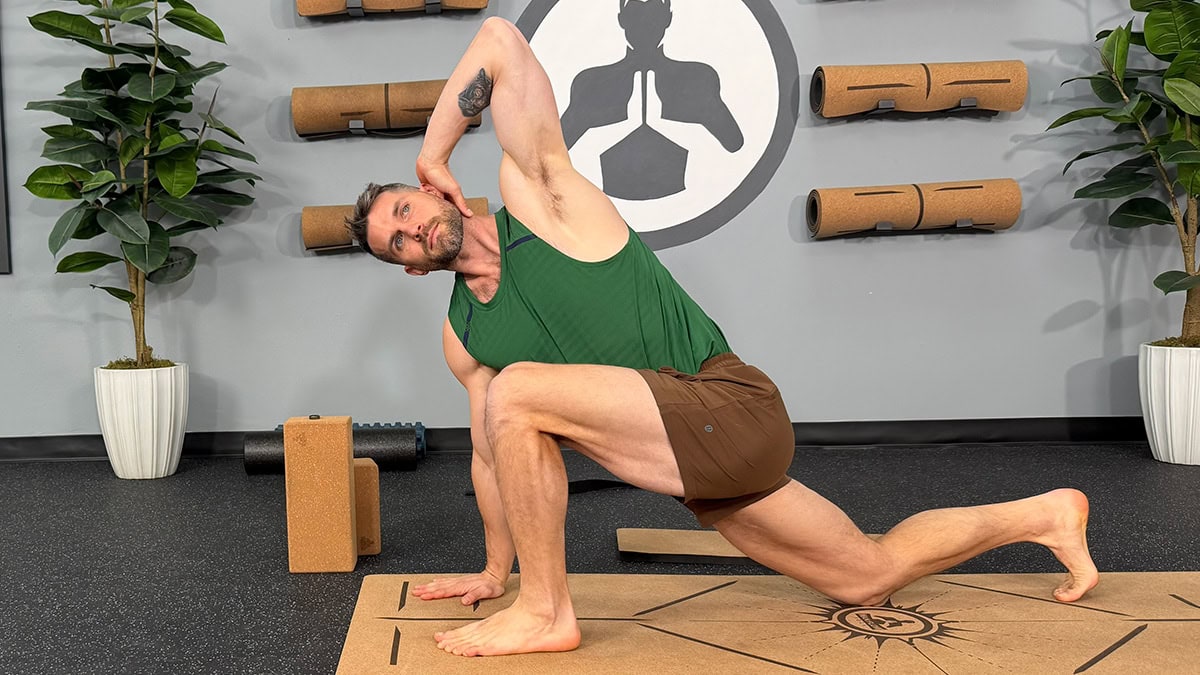
This is the most golf-specific movement in the routine because it combines hip flexor opening with thoracic rotation in the same shape — the exact combination your swing requires. The glute squeeze is what makes it work: locking your hips down forces the rotation to come from your mid-back instead of your lumbar spine, which is what you’re trying to train.
Tip: Squeeze the back glute before you rotate, not after. If you rotate first and then try to engage your glutes, the rotation has already shifted into your lower back. Switch sides and repeat.
2. Standing Side Bend (30–45 seconds each side)
- Stand tall with feet hip-width apart.
- Reach one arm overhead and lean sideways.
- Keep both feet planted and legs straight.
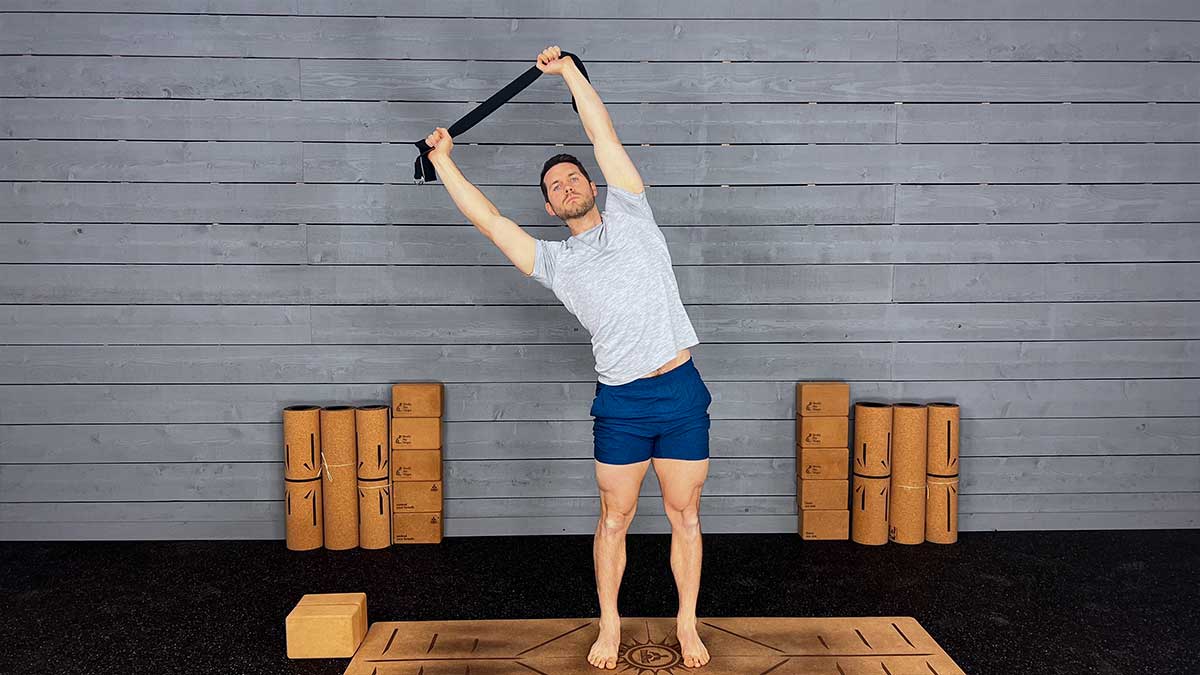
Golf creates significant left-right asymmetry from repeating the same rotational pattern thousands of times. This movement counters that by opening the lats, obliques, and outer hip on each side. The goal is to get as long as possible before you lean — think pushing up through the top hand first, then leaning into the side body second.
Tip: If you can’t breathe comfortably in the stretch, back off. You’ve gone past the working range and into a range your body can’t use.
Want to follow along with the full routine?

3. Reclined Spinal Twist (1 minute each side)
- Lie on your back and pull one knee toward your chest.
- Let it fall gently across your body, keeping both shoulders on the ground.
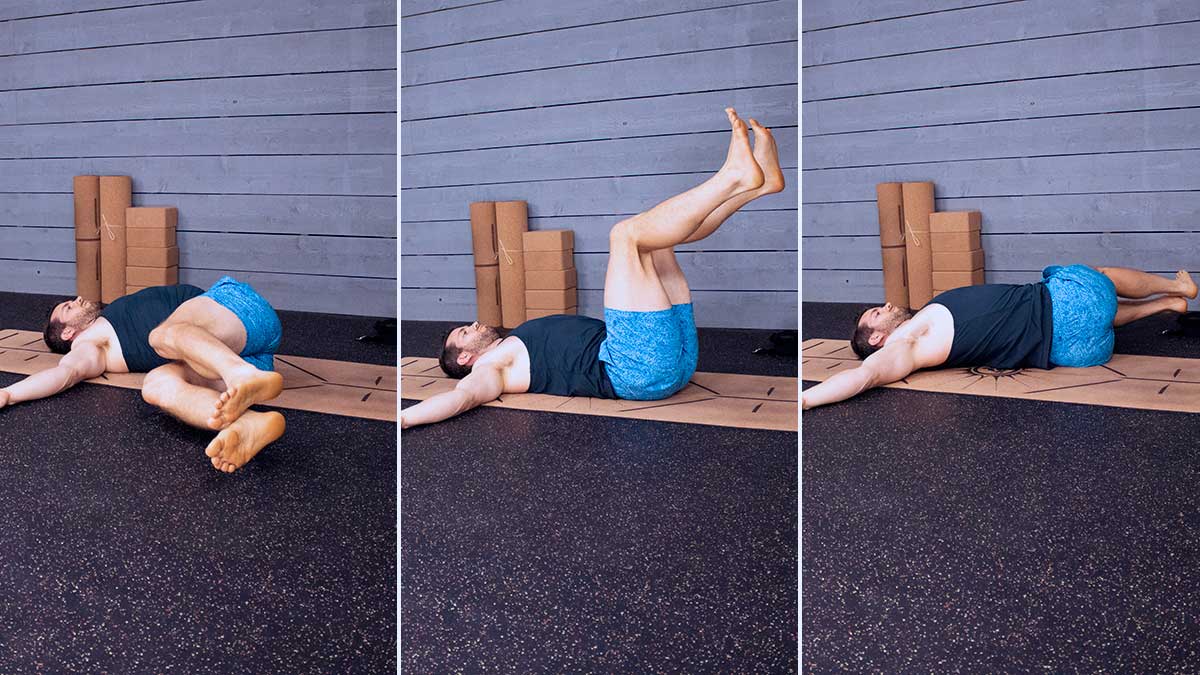
This is one of the highest-value rotational exercises in the routine because it’s passive—gravity does the work, making it easier to relax into the rotation rather than muscling through it. It also decompresses the lumbar spine, which is exactly what your back needs after holding tension all day. Don’t force the knee toward the floor. Let it drop where it drops and breathe.
4. Bird Dog (1 minute each side)
- Start on all fours.
- Reach one arm forward and extend the opposite leg back.
- Keep your hips level — don’t let them rotate.
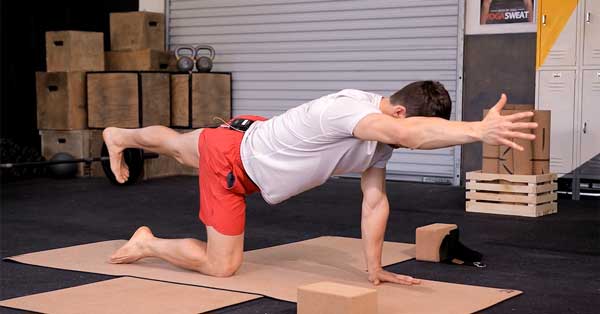
This builds anti-rotation core strength, which stabilizes your spine as force transfers through your body during the swing. Most golfers train rotation but not the ability to resist it, and that gap is where consistency problems live. If you feel shaky, that’s a good sign your stabilizers need work. Focus on keeping your hips square and still, not on lifting higher.
5. Cobra (30–45 seconds)
- Lie on your stomach with your hands near your chest.
- Lift your chest an inch or two off the ground using your back muscles.
- Keep your gaze at the floor and your elbows close to your ribs.
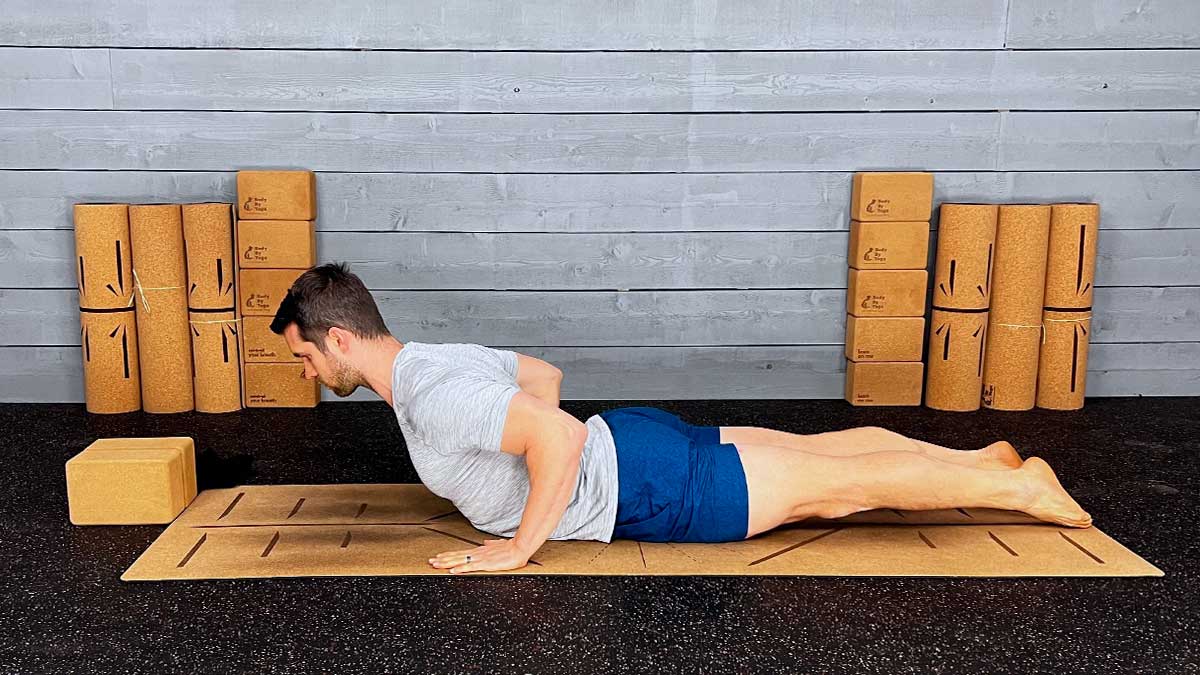
Most guys spend the entire day in spinal flexion — hunched at a desk, then driving, then on the couch. That position weakens the muscles along the spine that help you maintain posture through 18 holes. Cobra strengthens those muscles in a low-stress way. A shorter height is usually better. If you can’t breathe comfortably at the top, you’ve gone too high.
How Often Should Golfers Do These Exercises?
Three times per week is the minimum to see real change. Daily is better, especially if you sit a lot or play multiple rounds per week. The routine takes 15 minutes, which means you can do it before a round, after as a recovery, or on off-days to keep your body loose.
One session won’t undo years of stiffness, but a few weeks of consistent work usually does. Better rotation, more power, less tightness after a round, and a clearly different feel during the swing — that’s what shows up when you train your body the way you’d train any other part of your game.
For Senior and Recreational Golfers
If you’re over 50, dealing with stiff joints, or coming back to golf after time off, everything in this routine still works. You just stay within your current range and prioritize control over intensity. The Low Lunge with Rotation and Reclined Spinal Twist deliver the most for senior golfers because they target hip mobility and thoracic rotation — the two biggest age-related limitations — without high impact or aggressive stretching.
The best mobility routine for any age is the one you’ll actually do consistently. You don’t need extreme workouts. You need a sustainable movement that keeps your body able to play golf for years to come.
Want to Build on This?
This routine is a solid starting point, but if you want lasting mobility gains that translate to measurable improvements on the course, consistency with a structured program is what makes the difference.
That’s what we do at Man Flow Yoga — strength-based mobility training built for men, with clear instruction and workouts that progress over time. If you’re new, our Yoga for Men Beginner’s Guide is a good place to start.
👉 Explore Man Flow Yoga programs here.
Frequently Asked Questions
Related Reading
Want to keep improving? These will help:
- Is Yoga Good for Golf? The Complete Guide
- Muscle Recovery Yoga for Knee Pain
- Yoga for Men: The Complete Beginner’s Guide
- Watch: Yoga for Golfers (YouTube)
Hope this helps. 💪
About Dean Pohlman, Founder & CEO of Man Flow Yoga, Author of Yoga Fitness for Men, Expert on Yoga Fitness for Men.
Dean Pohlman is making yoga more accessible to fitness-minded men. A former collegiate lacrosse player, Dean discovered yoga while recovering from injuries and quickly realized its potential to boost strength, mobility, and overall performance.
Since launching Man Flow Yoga in 2013, Dean Pohlman has built a global community that speaks for itself:
- 195,000+ customers
- 42+ million YouTube views
- 200,000+ followers across Instagram, Facebook, and TikTok
Dean’s book Yoga Fitness for Men has sold over 50,000 copies, while his Body by Yoga DVD series has surpassed 120,000 units sold, earning him consistent #1 rankings on Amazon and thousands of five-star reviews. He’s also been featured in Men’s Health, Muscle & Fitness, GQ Magazine, Fox Tampa Bay, The Chicago Sun, and on influential podcasts like The Ready State and Ben Greenfield Fitness.
With a focus on real results, community, and technique-focused instruction, Dean Pohlman continues to change the conversation around yoga. He’s not just teaching poses—he’s helping people build stronger, more capable bodies for life.