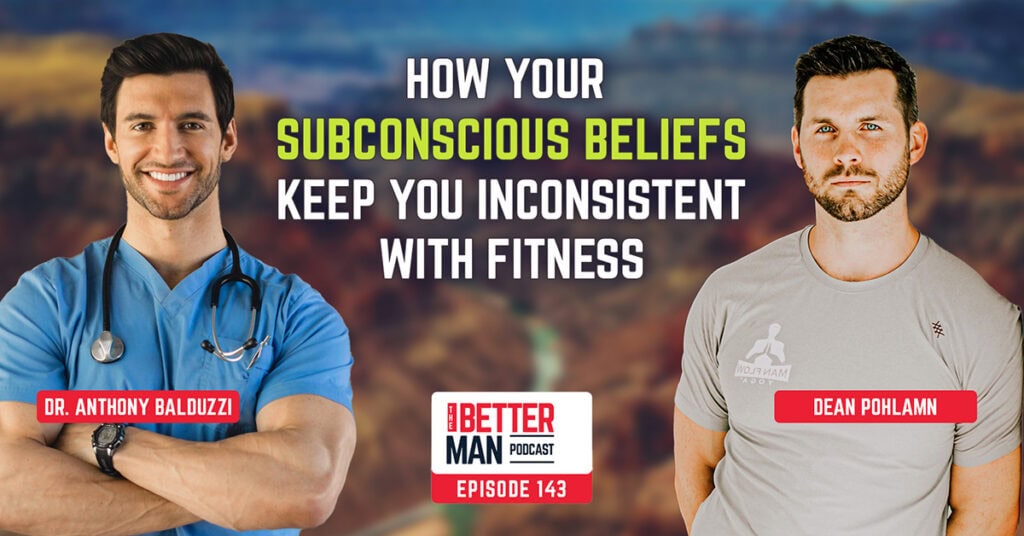
Your mindset can either be your biggest supporter or your biggest detractor of your fitness journey. But sometimes simple mindset shifts don’t work because there’s a deeper, subconscious belief that wrecks your consistency before you even start.
Like, for example, imagine you were always picked last in gym class growing up. This creates a subconscious belief that you’re in danger, emotionally, when you exercise.
It doesn’t matter how much willpower or motivation you have. It’s impossible to become more consistent without addressing this deeper, emotional belief.
That’s why I’m excited to invite Dr. Anthony Balduzzi, founder of Fit Father Project and Fit Mother Project, back onto the podcast. Dr. A’s coached over 60,000 families through the emotional traps that keep them inconsistent.
In addition to sharing a few strategies to address the heavier, subconscious stuff, we also share some of our favorite practical tips to make being consistent easier.
Dr. A and I also reveal:
- How to address the deeper emotional stuff that’s holding you back
- Tactical tips for becoming more consistent that you can use for your workout today
- Hidden traps you fall into that make you inconsistent
Listen now!
The Better Man Podcast is an exploration of our health and well-being outside of our physical fitness, exploring and redefining what it means to be better as a man; being the best version of ourselves we can be, while adopting a more comprehensive understanding of our total health and wellness. I hope it inspires you to be better!



Use the RSS link to find the Better Man Podcast on other apps: http://feeds.libsyn.com/404744/rss
Episode 143 Highlights
- 3 insidious ways your subconscious beliefs sabotage your fitness regimen (4:48)
- How having too much flexibility in your workout regimen backfires and makes it easier to skip exercise (8:43)
- A few ways to design your visual environment to make it easier to exercise consistently (it might sound weird or too simplistic, but it works) (13:30)
- The “Press Play” habit building secret that stops your inner voice from undermining your next workout (15:51)
- Why your subconscious mind might not like exercise (and how to address these underlying consistency saboteurs) (17:40)
- The scientific explanation behind why late-night exercise can actually worsen your health (19:49)
- How to neurologically condition your life to become easier as you age instead of harder (24:35)
- This mindset shift can make every workout you do a healing experience (30:46)
- How to use shame-based motivation to start a new fitness habit (and why you must switch motivation sources once your started) (37:39)
- Why doom scrolling on social media during work will make your workout later in the day harder (and sometimes, impossible) (42:33)

Guest Bio
Dr. Anthony Balduzzi is a health and weight loss expert and the founder of Fit Father Project and Fit Mother Project – leading health & weight loss programs for busy men and women over 40. Dr. Balduzzi holds dual degrees in Nutrition & Neuroscience from the University of Pennsylvania, a Doctorate in Naturopathic Medicine, and is a former national champion bodybuilder. Dr. Balduzzi is most proud of the fact that he’s helped over 60,000 families in over 100 countries lose weight and get healthy through his Fit Father and Fit Mother Programs.
Resources mentioned on this episode:
- Follow Fit Father Project on social media:
- Website: https://www.fitfatherproject.com/
- YouTube: https://www.youtube.com/c/fitfatherproject
- Facebook: https://www.facebook.com/fitfatherproject/
- Instagram: https://www.instagram.com/fitfatherproject
- X: https://twitter.com/fitfatherproj
- LinkedIn: https://www.linkedin.com/company/fit-father-project TikTok:https://www.tiktok.com/@fitfatherprojectofficial
Dean Pohlman: Hey guys, it’s Dean and welcome to The Better Man Podcast. Today’s episode is an interview with Doctor Anthony Bell doozy from the Fat Father Project. Anthony is a good friend of mine. He’s also an expert in the health and wellness field, specifically in weight loss for men and women with his fit father mother branch in this conversation today, we are going to talk about how you think about your fitness and why it’s holding you back.
Dean Pohlman:So we’re going to go through a combination of both tactics and deep work in this tactics to help you make your fitness happened that day, as well as deeper work to help you unpack subconscious beliefs and self-sabotage. Holding you back. We’re going to talk about how to ease into your workouts or scale back in order to stay consistent and help you make a long term process.
Dean Pohlman:We’re also going to discuss why busy work and other dopamine hits make get in the way of your exercise, and how to change that. We’re also going to talk about how you can use your environment and planning ahead to make your workouts easier, and require less motivation. And lastly, we’re going to talk about why coming up with rules and guidelines for yourself is a lot more effective than having flexibility.
Dean Pohlman:This is a really good conversation. Anthony is again, he’s a good friend of mine. We talk about this stuff all the time. I like that we go kind of deeper into this, beyond the logistics of fitness and really into the mindset and changing the way that you think about your health and wellness. Because if we can get from a place of I have two to I get to, that unlocks the doors for you living a healthier life.
Dean Pohlman:So guys, I hope you enjoyed this episode. I hope it inspires you to be a better man. And I’ll see you on the other side. Hey guys, it’s Dean. Welcome to the Batman podcast. I’ve got my good friend, Doctor Anthony Bell Doozy here from the Fit Father Project back, and we’re going to talk about how you think about your health and your wellness and why it’s probably holding you back.
Dean Pohlman:So doctor A, the Dos Meister, the dos here. Welcome back. I don’t call him any of those things. Welcome back.
Dr. Anthony Balduzzi: Thanks. I do like having the last name ball doozy. It does get the doozy kind of things. Microsoft Word auto corrects it to bulldozer and which is pretty awesome. I mean, I kind of missed out on being Doctor Bulldozer.
Dean Pohlman:Well, like, you.
Dr. Anthony Balduzzi: Had a better trajectory.
Dean Pohlman:You could probably, like, become an actor or like a, some sort of personality with Anthony Bulldozer.
Dr. Anthony Balduzzi: For sure.
Dean Pohlman:Yeah.
Dr. Anthony Balduzzi: I’d have to take, like, a ton of steroids, though. It’s in 2025. I need to be humongous, like, get rock size and do some things. Anyways, we got off track, bro.
Dean Pohlman:We got we have an off track since we started this call 20 minutes ago. Let’s be serious. Okay. But we are going to get back on track. And so something that I think sets us apart from, maybe traditional health and wellness is that we, we really think a lot about how we think about things. Right? It’s not just the logistics of, okay, you should eat this much protein and you should work out this many minutes per day.
Dean Pohlman:But we also think about how do we think about our fitness or what are the, what are the feelings that we have when we start a workout? Or what are the feelings that we have that night when we choose the pint of ice cream instead of the stretching session while we’re watching TV? And I think these are things that are really important, that should be discussed.
Dean Pohlman:And I think more people in general just need to do more reflection. But I think if you can put some effort, some thought into these areas, you’re going to be a lot more successful, with your health and fitness. And the reason why I bring this up is because I worked I started doing one on one training with people about a year and a half ago.
Dean Pohlman:And there’s I noticed with a lot of these guys that they spend a lot of their time kind of leading up to the point where they start their workout. Right. So it’s 5:00, they get home, they’re going to do their workout at some point in the evening, and they spend like three for some of them even like six hours, like 6 p.m. until midnight, just dreading their workout.
Dean Pohlman:And then they finally do their workout. But I’m looking at it like, well, man, you spent five hours with this negative thinking about your workouts. What do you think that’s doing for you? You know? And so that’s where I look at things kind of outside the box. And I think, wow, like what would happen if we could change the way you think about your fitness and make it something that is that you look forward to rather than something that you dread.
Dean Pohlman:So I’ll just hand that over to you and you can say what you want.
Dr. Anthony Balduzzi: Cool. I think let’s just think describe that situation of the person who gets home at five, has the plan to workout at five 3545 before dinner, but doesn’t do it until 11:00.
Dean Pohlman:
Dr. Anthony Balduzzi: They have resistance in some form or fashion to doing the workout like they associate it with some degree of pain. It’s not fun or they’d hop into it. So it’s a painful experience for them. This could be a number of reasons and we can tease these out in a little bit. It could be partly that exercise is hard and challenging.
Dr. Anthony Balduzzi: They don’t feel competent, so they kind of feel stupid. And maybe that’s like an old wound. It could be that their body literally hurts and it’s not pleasurable to do these things. And it could be like if they have like a lot of baggage of just associations around like exercise taking too much time and other limiting beliefs that all get stacked into resistance so they don’t do it.
Dr. Anthony Balduzzi: And then as hours go on, the pressure builds up. The guilt and the shame that they said they were going to do it, but they don’t do it builds up to such a point that now it actually becomes more painful at 11:00 not to work out than it does to finally get it in, because they know they have a call with you the next day, and they do not want to have the experience of saying, dude, I pay you a lot of money.
Dr. Anthony Balduzzi: And I didn’t do my exercise. So it’s like finally enough pain built up that it’s actually more painful than not exercise. And then they go do it. So it’s nice to really understand that we’re operating on these pain and pleasure kind of levers. And it has to do with our neural circuitry. And there’s many aspects we can do.
Dr. Anthony Balduzzi: We can work on changing the environment to make it more conducive to make it easier for us to enter into these things that are hard. Looking at some of those beliefs that underpin this. But it’s important to just understand, like we are primal creatures, we are moving towards pleasure, we’re moving away from pain. And it’s not like these things are objective aspects, like every part of our life is not objectively painful.
Dr. Anthony Balduzzi: It’s subjectively painful, which means there’s a relationship to things. So if we change the relationship two things we change the ease which changes the ease that we can be consistent and engage with these things. So a little bit of like a neuroscience nervous system frame of that. But that’s basically what I see happening in that point in time.
Dean Pohlman:Yeah. And something else that comes up in that time for those people is the, the dopamine rush, the allure of a dopamine rush from other productivity tasks. So that was a really wordy way to say, putting around and getting other things done that will make you feel good about yourself, but aren’t your work out right. So that’s things that that everyone has to do.
Dean Pohlman:They’re legitimate things that people have to do. Right? Maybe it’s like, oh yeah, I’m just going to spend a few minutes cleaning up the counter here, or I have some, you know, I have some mail that I have to take care of. Or maybe it’s like, you know, whatever it is. But there are these things that need to get done.
Dean Pohlman:But given the choice between do I do the thing that’s going to give me a dopamine rush and is easy or do I do the thing that is harder and gives me a dopamine rush? It’s very easy to justify, well, these are things that need to get done. So I’m going to go do these other things instead. And then at the end of the day, you look back at your evening and you’re like, oh, I didn’t work out today, but I did all these other things that I had to do.
Dean Pohlman:And so it’s it’s this, you know, it’s this desire just to get a dopamine rush, which is normal. Right? Like all humans have this desire to, like, literally what happens when you get home, is just imagine yourself getting home and what your brain does is it scans the environment for what are things that I can do that will make me feel good.
Dean Pohlman:Right. And so some of that is, oh, I could do this task and that will make me feel good. Or it could be I’m going to eat this thing because that’s going to make me feel good. So you’re constantly searching for things that are going to make you feel good. And it’s all of those choices. That’s the other part of this is like, there’s so many things that you could do, right?
Dean Pohlman:And there’s so many, so many options that you negotiate with yourself. You’re like, oh, I’ll do my workout at 6:00 instead of 545 because I still have time to do a workout. Then 6:00 comes. Well, I’ll just do a 15 minute routine at 615 instead of my 30 minute workout that I plan. And then at 615 you’re like, oh, maybe I can just do a ten minute workout.
Dean Pohlman:And so you constantly negotiate with yourself. You’re giving yourself too many choices. And when you give yourself that freedom, it makes me think of the, you know, the very popular book, the Jocko Willing book. Freedom is discipline or discipline is freedom. And when you give yourself too many choices, you end up with how you end up with decision paralysis, right?
Dean Pohlman:Nothing happens because there’s too many options. And so, for these guys, it’s trying to create exercise, an exercise habit that happens at a specific time every day or in a specific order when you get home, so that when it comes time to do it, you recognize, oh, it’s time to do it. I’m not going to try and make these different decisions.
Dean Pohlman:I’m not going to give myself the option. And then you, you know, you get yourself to do the same.
Dr. Anthony Balduzzi: There is a lot of really good stuff that you shared that I want to just maybe emphasize a few highlights and we can expand on the territory. We’re getting to a good spot.
Dean Pohlman:Yeah.
Dr. Anthony Balduzzi: That whole dopamine thing is like so true. And it’s interesting how like I’m a guy who has like mastery in my physical health and fitness, but I can totally relate in my work life to having like really deep work that you need to do, like design an important piece of writing or a pay a web page or work on a program or something.
Dr. Anthony Balduzzi: But I’ll do like the small email tasks and then and then it takes till late at night where I want to finish it, that day where I get it done. So I can so relate. And I think this is why a lot of the productivity gurus have the phrase of like, eat the frog in the sense of like the thing you don’t want to do, like do it first and do it immediately.
Dr. Anthony Balduzzi: Easier said than done for sure. But if you can find a way to like make eat the Frog like your mantra, which means like essentialism, like what is the one most important thing that I could get done today? That if everything else didn’t get done? Because quite frankly, all those small things like dropping off the mail, writing that check, cleaning the house like is not typically essential day of.
Dr. Anthony Balduzzi: But the big things are. So if we get that back to essentialism, I think that is a good aspect. And then I want to get into maybe like how we can really set up good routines, like the Anatomy of Habits, that idea that every habit has a cue or a trigger, which is something you see. So I think people who are struggling to get home and exercise often don’t have a good cue.
Dr. Anthony Balduzzi: They don’t have a strong enough cue to go ahead and do this. And then the routine is often not well defined, you know, but if you’re doing man flow or fit father workouts, you know exactly what to do. And you can just follow along. And then the reward you get after the fact is often not well established and created.
Dr. Anthony Balduzzi: So what I’m thinking is like exercise is almost best done when you’re not having a full stomach, right? It’s almost it’s it’s almost based on an empty stomach. So if you have this kind of scenario where you have dinner at, let’s just say 630 like that could be stacked in, right? You know, again, easier said than done. But like that could be a very tangible reward.
Dr. Anthony Balduzzi: What is your cue that you can establish to get directly into that? And then one other thing before I hand it back to you is I think, David Goggins has like, a lot of great content on this, on this topic, and he basically says, like, this is a guy who does all these really extreme physical pursuits and, like, lives his life on like super disciplined and sane mode all the time.
Dr. Anthony Balduzzi: And he still has that weak voice that says, oh, you don’t need to work out, you don’t need to do this. And what he does is he says, like, okay, like more or less, I hear you, but I’m still just going to instead of like that.
Dean Pohlman:Half marathon, I’m just going to.
Dr. Anthony Balduzzi: Go run a mile. So for your workout, for example, like, okay, you know, maybe I don’t feel like working out right now, maybe got a lot of things to do. I’m just going to go do warrior two pose for two minutes, or I’m just going to go sit in the yoga squat, or do 20 squats and 20 pushups and assess how I feel like once you’re in motion, the whole chemistry and it makes it so much easier to get into motion.
Dr. Anthony Balduzzi: So it’s like, what if the only thing we actually needed to solve was engaging into like the initial momentum of it? And what if we didn’t make this such a monumental thing? Like, what if you’re like, okay, maybe I’m not fully committed to the workout. I understand I feel this resistance, but like, I would feel pretty dang good if I did 50 pushups and 50 squats and it took me five minutes.
Dr. Anthony Balduzzi: If I just got that done, I’ll feel like I did something really good. And then it turns out a lot of the time when you go ahead and do that, you’re going to feel motivated to finish the next ten, 20 minutes. And the other thing I’ll say is this is a little more like tactical is okay, so we have a Q, we can establish this very visually.
Dr. Anthony Balduzzi: So you drive the car home, you open the garage. Like is your workout gear sitting right there. Do you have the workout printed in laying on the ground? What to do is your laptop where you play manual workouts like sitting right there for you? Like how do we create strong visual? Cue the routine. You can have a flex routine where you have the full 45 minute or 1 hour workout, and you also have the ten minute version, and these are already predefined.
Dr. Anthony Balduzzi: So you can deploy either one of those. And then the reward afterwards has to be salient. It has to be good. It could be really tasty. Protein shake piece of fruit dinner, something fun like I don’t know. But establishing that I know there’s a lot that I shared there, but there’s some there’s some good ideas in that.
Dean Pohlman:Yeah. And like so going back to cues and behavior science. Right. This is I love this I read I reread Atomic Habits and Tiny Habits every year. It’s like my it’s my go to resource on how to build habits. And I always get something. It’s actually it’s kind of like reading Harry Potter. I’ve read it so many times that I’m like, I know every sentence.
Dean Pohlman:And I’m like, okay, I remember this. And when I find a new sentence, I’m like, oh, I didn’t recognize that before, but I’m so familiar with it. But I love the concepts that are covered in those books and and something that’s really important. I’ll draw from two examples from that. The first thing is a very specific cue.
Dean Pohlman:So like super specific. It’s not enough to say after I get home, I will do my workout. Because what happens when you get home? What is that? What are the actual actions that happen when you get home? Well, you get home.
Dr. Anthony Balduzzi: You step out. Yeah. Go ahead.
Dean Pohlman:Exactly right. So it has to be specific. Like after I set my keys down and change out of my work clothes and leave my bedroom and enter the living room, I will walk to where I do my workout and start my workout. Right. It has to be very, very specific and I think people don’t understand that. You know, giving yourself I will do a workout in the evening, like there’s too much ambiguity there.
Dean Pohlman:You should be able to hand over a written explanation of the exercise habits to someone else in such detail that they will be able to do it the exact way that you do it. That’s what’s cool. That’s what it needs to be. It’s gotta be super specific. And then the other thing, this is a this is a concept that is brought up in atomic habits and it is specific to exercise.
Dean Pohlman:There’s a famous dancer. I forgot what her name is. She’s a dance instructor. She lives in New York City, and she works out every day. And she’s I’m I’m I’m assuming that she’s in her 60s or 70s or something at this point. And she doesn’t think about her exercise habit as the entire hour and a half that it takes.
Dean Pohlman:Whatever, whatever it is, her only job is to get in the taxi and get to the gym. Yeah, right. So if you can think about the only thing that you need to do is get to your exercise area and press play on the workout or open up the workout on your phone, or open up like you know, or have like a printed copy of the workout.
Dean Pohlman:Yeah, that’s the habit. All you need to do is start the workout and it doesn’t matter. And it doesn’t matter how you feel as you start. And I’m not saying that because I’m not saying that because I think you should say, you know, after your feelings, do something hard, nobody cares. Like, I don’t think that’s the right mentality to have, but I think it is important to say, okay, how am I feeling?
Dean Pohlman:Okay, I’m not motivated. Okay, cool. Like I’m not motivated. Why would that be? Well, exercise is hard, right? It takes energy. So I’m not motivated. I worked out yesterday. I’m sorry I didn’t sleep all today. Cool. So those are all things to take into account and recognize and acknowledge, right? Don’t gaslight yourself. But then you can also acknowledge all of those things and say, okay, cool.
Dean Pohlman:That’s right. This is what I’m feeling. And I am also going to do my workout because that’s important for me.
Dr. Anthony Balduzzi: So let me chime in on this for a second. I think like respecting our feelings for sure. At the same time, like what we’re experiencing is the conscious thought. Like, I don’t feel motivated to exercise or I just don’t feel like it. Today is based on much deeper subconscious feelings, traumas, relationships that we justify in the conscious mind with some kind of more rational reason.
Dr. Anthony Balduzzi: Like there could be a reason that you don’t feel motivated to work out. It’s because you actually don’t feel good about yourself, that you feel unsafe, that you feel just totally overwhelmed, and then you just have some reason that you’re justifying the logical mind. And if we just think of ourselves as our logical mind, we kind of forget that we have this deep subconscious of of feelings and relationships and stuff that’s just not under the surface, then we just become, you know, I think it’s the Carl Jung quote if you don’t make the unconscious conscious, it will direct your life and you will call it fate.
Dr. Anthony Balduzzi: And so it’s really important just to recognize that motivation is not something that you just have. It’s something that can be created as you unwind these patterns and you move into energy and activation. And I love what you said. And the same thing that I said, it’s like, just get into motion. Like, what if you make that your relationship to your exercise practice, the whole thing is just getting in and getting it done.
Dr. Anthony Balduzzi: And I want to do one more very practical thing like tie it to food intake. At the end of the day, we want to eat a nice meal like most of us do. Unless you’re intentionally fasting for a practice like we want to have a nice meal, and that feels like a way that the human system relaxes. We we sit down, we enjoy food that tastes good.
Dr. Anthony Balduzzi: Oftentimes the people that we love. Like if you start to create like a habit stack where you move your body in some fashion before you have that meal, something gets done there that also is going to give you a little more leverage. And if you need to understand a little more of the science, like it is not optimal to put food into your system, especially a heavier dinner meal, and then go demand after the fact with even within 1 or 2 hours that your body and your muscles go exercise, that you divert all that blood that wants to be in a GI tract to the muscles.
Dr. Anthony Balduzzi: We’re also learning now that late night exercise, way too late, can seriously disrupt your sleep. It raises core temperature. It can increase sympathetic nervous system tone when we want to be cool and more relaxed. And there’s going to be a lot more people that are going to be saying, hey, like, be wary of late night exercise. So another reason to maybe do it earlier in the day.
Dr. Anthony Balduzzi: So what I’m when I’m sharing is both the habit stacking concept, but also when you connect to some intellectual understandings of physiology and why other things are optimal, then you’re just getting more stools on this leg of belief that this is an optimal time. This is when I should do this. Oh, and my only goal is to get into action.
Dr. Anthony Balduzzi: It’s not to like, think I have to do the whole thing. It’s like climbing the mountain. Your goal is to start the climb, not like to necessarily. I need to be at the summit right now.
Dean Pohlman:Yeah, yeah. So I read this. Have you read, The Subtle Art of Not Giving a Fuck by.
Dr. Anthony Balduzzi: I’ve seen the cover in every airport, but no I haven’t.
Dean Pohlman:Yeah. It’s it’s it’s, there’s, it’s it’s a really good book. And there’s one concept in there that I always recall, like, probably the most important concept that I covered in that book. And it flips the paradigm that motivation leads to action. And instead it teaches us that action leads to motivation. It’s getting things in motion that leads to motivation.
Dean Pohlman:You might be able to sit around and wait for it. Motivation to strike. You know, I’ve seen a lot. I know a lot of. I have a friend of mine who’s pretty fit, and he says whenever I do a workout, I just watch this four minute video on YouTube and it gets me jacked every time. And that might be what you need.
Dean Pohlman:But, you know, action. If we if we understand that action leads to motivation, then that means that we need to take action in order to feel the desire to do something more. It’s not the other way around. And that’s such a big shift. So, practically speaking, you know, I’ve done a lot of content on this, but kind of like easing into the routine.
Dean Pohlman:So okay, maybe starting off your exercise routine, maybe it’s, you know, maybe it’s pressing play on the yoga workout. Maybe it’s okay. I’ve got heavy squats today. Maybe that feels like too much right now. Well, what can you do to ease into that? So like for me in the morning, I’ve recently probably done the last year or gotten into an exercise habit of doing yoga in the morning, and it’s absolutely crucial for me.
Dean Pohlman:It helps me with my back. It helps me with my feet, with my ankles. And the only way that I was able to start that was I just got down on the ground after waking up, you know, still feeling kind of groggy, still feeling tired, not not really being a morning exercise person. I’ve always worked out in the evening, and I just laid down on the ground, like where I would do yoga and then I’d bring my legs over to one side, and then I bring my legs over to the other side, and then I’d say, okay, core exercise, here we go.
Dean Pohlman:And just go straight into some dead bugs. And it was it felt really intense at first, but after doing that for a few days, I think it only took three days. Honestly, my body started to make a change. It actually started to look forward to the workouts. And so, you, you will make those changes, but you just need to do the thing and ease into it.
Dean Pohlman:So another way you could go for a walk first, right? You might not feel up to doing, a yoga session or a weightlifting session, but can you put your shoes on and go for a walk around the block? Right. So easing into things I think is a really good way, to scale up the necessary motivation that you need to be able to do, to do workouts.
Dr. Anthony Balduzzi: Yeah. And like, let’s talk about like, if, if what we’re running is like, if we were to code our thoughts as like a software program and the more specific we made the parameters for like the program to run successfully like workout must require peak motivation plus 45 minute man flow follow along session at you know, 515 to 545 before dinner.
Dr. Anthony Balduzzi: Like those are very specific parameters for things to run successfully. And if any of those variables are off, like no, no bueno. But if you were to simplify that down to the core, that’s like like I do some movement before dinner and like that is the core that the amount of flexibility that happens, like even if I don’t feel like it, maybe that’s the program.
Dr. Anthony Balduzzi: I do some movement before dinner, even if I don’t feel like it. Damn, that could be so many things. It could be a walk. It could be a bounce on a rebounder trampoline. It could be the set of push ups. It could be, you know, actually the full workout in the exact parameters that you originally planned it. But like that is a flexible program that actually builds positive momentum.
Dr. Anthony Balduzzi: And leads me to my next point, which is, I guess, a little more of a identity you can maybe call it like moralistic or maybe even like on your spiritual path is we have this concept that on each of us there’s like a devil on one shoulder and an angel on the other, that we have the part of us that is guiding us towards our greatest expression.
Dr. Anthony Balduzzi: And then we have the temptation, part of us that is looking for those short term pleasures, knowing that there’s some long term pain. And this is this is like a theme that is echoed in all of these different cultures and traditions. Like one of the famous ones in many people know is in the Cherokee tradition, the Cherokee Native Americans.
Dr. Anthony Balduzzi: They have the idea that there’s two wolves inside of us, and there’s the wolf that’s the good wolf that wants to protect and lead. And then there’s the bad wolf that wants to destroy and dominate. And basically, the chief when telling the story to is is grandson or granddaughter says, hey, like, the thing is, I recognize I have both these things in me and what I also know is that the wolf that I feed is the wolf that gets stronger.
Dr. Anthony Balduzzi: So when you really internalize that concept, that every time that you get home, you have a chance to give a piece of meat to one of those two wolves, and it’s actually going to set up what becomes easier in the next day and the next day. And so your choice isn’t just no longer like a momentary thing, you’re actually creating a neurological conditioning for what becomes easier, what becomes harder in the future.
Dr. Anthony Balduzzi: And we all we obviously want to make things easier and more consistent for ourselves in the future. So framing it out of the the just today environment, and we recognize that this whole process of what we’re doing encountering resistance is really neurologic wiring. And the choices we have end up having a little more weight. And so I’m saying even if you took a five minute walk and you did a little bit of stretching and like a plank for one minute, you fed the good wolf.
Dr. Anthony Balduzzi: If you didn’t, if you miss this or you don’t do anything, you actually fed the the bad wolf, if you will. That makes it harder the next day. So I think these are important concepts as well. And where I bring in what I consider to be my spirituality is like, I want to, as much as I can, express my greatest capacity and not be a slave to the things that are tempting me and kind of keeping me stuck in patterns that I know don’t serve my fullest expression.
Dr. Anthony Balduzzi: And so I make that. I take that mindset, and I put that on all aspects of my life into my work life, into my workouts. And then it becomes a game of my like, personal expansion and evolution that transcends any particular content. It’s the broader context of honestly feeding the good wolf in whatever way that shows up in a specific domain.
Dean Pohlman:Yeah. That’s it’s a good way to think about it. I think I want to kind of go back to what we were talking about, before with kind of those, those, those deeper thoughts in the subconscious. You were kind of talking about it from a Carl Jung, perspective. But I want to go back to those, because I think a lot of this logically sounds really good to a lot of people.
Dean Pohlman:Right? I think a lot of people will hear this and they’ll say, oh, yeah, that makes sense. If I just ease into some of these habits, or if I do this instead of that, then I’m putting the momentum in the right way. I think what I found within, you know, within the mental yoga community, and I’m I’m sure you’ve seen this within the Fit Father Project Brotherhood, but there are a lot of people who are just they’re stuck and like, you can you can talk about this stuff all you want to, but they’re still just kind of stuck.
Dean Pohlman:And in order for people to work through that feeling of being stuck, it does require some level of therapy. You might not call it therapy, maybe you call it coaching, but it requires you to actually look at those deeper subconscious feelings and those deeper beliefs and understand, okay, why is it so hard for me to work out? And it could be that, you know, I hear this story all the time.
Dean Pohlman:Mental yoga. Maybe you were that last kid picked in gym class, right? So maybe maybe you don’t want to work out because holy crap. Like, think of how terrible that makes you feel, right? So exercise might make you feel really poorly. Yeah, right. So it could be that, it could be that you’ve just never been successful with fitness.
Dean Pohlman:And so any time you think about a workout, you associate that with failure. So there are there’s deeper things at work here than just why can’t I do my workout? And if that has been you and if it’s not a time issue, or maybe even if it is a time issue, maybe you’re labeling at a time issue and it’s not really a time issue.
Dean Pohlman:Then I would highly recommend that you find someone that you can talk to about this, that you can actually examine these things in deeper, you know, in a deeper way. And it’s, it’s for these guys, it might not be enough to say, okay, I’m just going to sign up, I’m going to follow the program, and I’m going to do it because you might have, you know, I look at these kind of like these deeper subconscious feelings and beliefs.
Dean Pohlman:I look at these things as weights that are holding you down. It’s like, yeah, you could go do a workout program dragging 60 pounds on your back through all of it, but holy crap, that’s going to be so much harder than if you were to figure out, wow, what are these things that are making it harder for me?
Dean Pohlman:What are these things that are holding me back? And it really does take doing that deeper work that a lot of men don’t want to do that maybe they’re embarrassed to do or like me, I felt like I just didn’t need it. I was like, I’m so strong and I’m so tough and I’m so great that I don’t need to do any of that stuff, and I’ll still do it better.
Dean Pohlman:And, you know, eventually I hit a wall. I’m like, oh, wow. I feel really tired all the time, and I don’t want to do stuff because I had all this weight that I was just holding around. Anyways, the point of this all being that, you know, this stuff all gets easier if you can actually get to the root of what’s making it difficult.
Dr. Anthony Balduzzi: Yes, and I’m always a fan of these conversations, kind of. When I was talking about a computer program of like getting out of this specific, very conditioned aspect and broadening the picture of what we’re doing here. Like, what if what we’re doing here, showing up with our bodies, wanting to improve, how they look and how they move and how they feel?
Dr. Anthony Balduzzi: What if we’re doing is healing becoming more whole, becoming healthier? Like if we zoom out and recognize this is the whole process, then like, wow, you are in the dojo. Your resistance is a gift showing you where there’s parts of yourself deeply that want to be addressed, want to be seen so that you can just feel good, you can feel whole.
Dr. Anthony Balduzzi: And the cool thing, as someone who’s also done like a lot of deep work and also showed like learned how my contractions of like losing my dad at a young age created like a false sense of pain motivation that brought me into exercise and led to a whole bunch of different problems with these things are really great to have therapy and talk.
Dr. Anthony Balduzzi: Ultimately, what we’re trying to do is just shine a light on them. Like, even if you’re listening to this conversation right now and you have a sense of what might be one of your subconscious patterns from your past, oftentimes earlier in childhood, just recognizing it, admitting it, which is like kind of shining light on it. And then in that case, because you see it, it’s there.
Dr. Anthony Balduzzi: You can accept it in time by just feeling. And this is a part of your self. This is a part of your experience that actually is the whole healing process. It’s the things that we repress that we deny, that we put in small boxes in the corner and don’t want to look at that, then get expressed in all these different ways, but aren’t actually the deep thing.
Dr. Anthony Balduzzi: All those things want to do is be seen and felt like you felt powerless. You felt ashamed. You felt outcast. Like, damn, welcome to being human. We all had some version of that that. But then we contracted a personality around so we just need to see and feel these things. So that’s why I think the journaling processes are very good meditation therapy, all these stuff is really powerful.
Dr. Anthony Balduzzi: And then just zoom out and remember, like what you’re doing here as you’re practicing, getting yourself into an exercise routine might be this deeper stuff of like healing resistance patterns due to old trauma. And like I think that’s a big point of of why we’re here as humans is to like to look at that stuff and to to bring wholeness to it so that, you know, we can be our best version so we don’t pass that trauma on to future generations and that we actually feel happy inside.
Dr. Anthony Balduzzi: You know, I’d much rather be like a happy, unhealthy, like a quadriplegic, super happy, joyful person who’s super connected to life and understanding. I’d rather be that person than the person who looks great on the exterior, but is like absolutely in immense pain on the inside. Yeah, right. And if that’s true, then we really want joy, not just the abs in the ability to do like the splits.
Dr. Anthony Balduzzi: Right. So there’s something there.
Dean Pohlman:Yeah. I think if I ever reach that point, that would be cool. But I’m not there yet. I honestly, if you present me with the option, you’re like, Dean, you can be poor, but be in great shape and have terrible relationships and like, I think I would I think I would still like, I don’t know, I think I haven’t gotten to that point yet.
Dean Pohlman:And I don’t know why I say that in this context because I, because I, you know, because we we’re used to having these conversations.
Dr. Anthony Balduzzi: Yeah. That’s perfect.
Dean Pohlman:Yeah. I think just being honest. But, part of the healing process. Yeah. I totally agree with that.
Dr. Anthony Balduzzi: Can we talk a little bit about environment real fast? Because I know we’ve gotten like into the depths and the depths are important. Like we’re not talking about like the tip of the iceberg. It’s like what we think the problem is. I would love to talk a little about like, environment, like two things. And then you can take us wherever you want in the closing of this.
Dean Pohlman:Let’s do that. I want to say one thing about, about the therapy, just because, like, I think, I really agree with you what you’re saying about, just bringing light to it because you can’t actually over analyze it. You can’t actually go too deep into it. You know, this is something that I’ve only recently realized, but I had an experience, prolonged experience, where I was focused on the issue so much that the real solution was to not focus on it.
Dean Pohlman:And I had been so used to like, well, I just need to focus on it harder and then I’ll solve it. And so having an experience where the solution was to move away from it and not scratch it, that was a really new thing for me. But I think that’s also, something to consider in the healing process and in the solution process is that the solution might be to just leave the thing alone.
Dr. Anthony Balduzzi: Well, I mean, I think this is a this is an interesting orientation. I’m not trying to take this too deep into like the really spiritual, mystical space as men with like a lot of masculine doing energy, we almost always like look at problems and like we want to do or do something to fix them and like channel our will to exert it and fix it.
Dr. Anthony Balduzzi: And a lot of these things just need to be felt, which is like, you guess you could say is a little more of an open, non doing feminine. You could potentially label it in that way. But like, yeah, these are just parts of expression. We put labels on them. But I completely agree with you now in the environment because this is maybe kind of brings it back to very practical.
Dr. Anthony Balduzzi: I think the fact that your clients, the initial client that we talked about, who doesn’t get his workout done at 5 p.m. but may now be able to after this conversation, but gets it done at 11:00. Certainly not optimal, but still got it done is because they had an accountability backstop because there was something that they knew they need to show up on a call with you, or there was some kind of thing that they that was making it so painful that if they did nothing, they weren’t going to succeed.
Dr. Anthony Balduzzi: And so I do think creating accountability containers and structure like this is a really helpful tool. So having goals in enrolling other people in like the structure of those things, having a partner where you’re actually doing, plan check ins in like the posting that you’re going to do this like on the Man Flow Facebook group. Hey guys, I am struggling with this.
Dr. Anthony Balduzzi: Like for this next week, I am making the public commitment, that I’m going to post at 6:00, that I did some kind of movement and I’m asking for a few people who, like, see me and are willing to, like, actually follow up and like, should I do this? Like enrolling people in some kind of structure and container that allows you to have that aspect.
Dr. Anthony Balduzzi: That’s it can’t be overlooked. It’s very, very helpful. It doesn’t solve the deep subconscious stuff, but it’s a tactic. And we’re using both tactics and this deep art beneath it. In the combination of those seems to be effective.
Dean Pohlman:Yeah. Yeah. I think yeah. It’s a it’s like a, you know, you can’t spend you can’t spend your entire day working on the, the deeper solution. Sometimes you have to do the fix or the tactic that’s going to get you what you need that day and, you know, for, and that specific example, what I was looking at was, was, wow, we’re spending five hours in, like, this state of dreading your workout procrastination.
Dean Pohlman:And then it gets to this point where we move into more of a shame based motivation. Right? And and recognizing that, oh, wow, this is like this, right? It’s kind of like dirty fuel, right? Yeah. It’ll it’ll get it done. But at what cost to to you. Like if, if, if the.
Dr. Anthony Balduzzi: It doesn’t nourish you, it exhausts.
Dean Pohlman:Right, right. And if the, if your internal dialog is you fat piece of crap like go to your workout. And that’s what gets you to do your workout, like that’s not, you know, that’s, that’s not the place that you want to be. And, and kind of the trend that I’ve seen. And if you’ve listened to this podcast, it’s a trend that we’ve seen in our, in our, in our member interviews is that, that is something that people might need when they’re getting started, like maybe for the first month, it is kind of like the shame based motivation because that’s what we grew up with.
Dean Pohlman:That’s how we think about, I think that’s the cultural, you know, the cultural norm when it comes to thinking about exercise and healthy living is like, okay, I’m not going to be a fat piece of crap. So I’m going to do my workout and I’m going to eat this instead of that. But over time, you might realize that that doesn’t make you feel good, and that if you can shift to more of a gratitude based or more toward this, oh wow.
Dean Pohlman:Like, I feel good about myself for doing this, and I look forward to that feeling that I feel after I do a workout and just being in general, like shifting to more of a kindness mentality. Then then people start to have a lot more success. They don’t think about their workouts in a more negative way, and just a little tactic that that they can also use is just giving yourself permission to skip your workout that day.
Dean Pohlman:Like, rather than spending 5 hours or 3 hours or whatever it is dreading your workout. If you can just say, you know what? Today was a really busy day. I’m not going to stop working out entirely because it’s still important to me, but today it’s just not happening. If you can just give yourself that that grace and move on, and then not spend your entire evening feeling crappy about yourself like, wow, wouldn’t that be so much better than five hours of just making yourself feel like crap because you couldn’t do your workout?
Dean Pohlman:That day?
Dr. Anthony Balduzzi: I completely agree, and if you’re someone who’s in a rut of having that pattern of missing workouts, you do have time for a one minute plank, a three minutes of foam rolling your back and a set of 20 push ups. Like there is something you can do to feel like you checked a box and got into motion.
Dr. Anthony Balduzzi: When I don’t have time to work out, I ride my bike for five minutes. That’s it. It’s always fun, I always enjoy it. I never regret it. I almost always have time for that. So yeah, again, just the micro concept. A couple other things. When I was, when I was competitive bodybuilding around ten years ago, one thing I would do is always write out my workout the day ahead of time.
Dr. Anthony Balduzzi: So I went to bed knowing what I was going to do the next day. It was like that important to me. I knew the training, I knew the sets, reps, I knew the weights, and I was allowing to percolate in my in my subconscious and dream state. And like I had awareness that the next day I didn’t have that resistance of needing to like, figure out what the program was or what to do and to exert the mental energy amidst the chaos of doing all the different things.
Dr. Anthony Balduzzi: So what if you gave yourself that gift? Like, what if part of your blessing of the next day was being like, oh, this is the exact workout I’m doing here. If I’m streaming it, it’s open on the tab of the browser, or it’s printed out like that is a cue that is paving the path for success. Like that seems minor, but it’s actually quite major.
Dean Pohlman:Anything that you can do to reduce the energy required to do your workout ahead of time is worth doing. So like planning the workout in advance like you could get super, super in-depth with this. You could have the TV on in the living room with the app, loaded with your yoga mat laid out and your clothes like already there with a water bottle set up.
Dean Pohlman:You could even put like a flashing light on there that says like yoga. Like. So you walk in to your room and you’re like, okay, like it’s clear that I only have one thing to do right now, right? So like, I’m a huge fan of doing the work ahead of time or doing the things ahead of time so that you are basically you’re playing like it’s like you’re you’re guiding yourself down a path, right?
Dean Pohlman:You’re like, you’re putting fence. You’re putting a fence on where you need to go so that there’s only one way that you can go. You’re just making it so likely that you do the thing that you want to do. Which it could seem over the top, but yeah, I so I’m a big fan of what you’re talking about.
Dr. Anthony Balduzzi: And I have one final thought. In closing, we have the, the the unthinking or the missed thinking or the improper thinking that certain things exist in isolation, like how you’re showing up for your workouts or lack thereof is interconnected in affecting all your areas of your life. Like, because if it’s initiating some kind of stress or shame, that is certainly showing up in even subtle ways in how you engage in your relationships, how you engage in your work, and also your behaviors during the morning and afternoon and hours of the day.
Dr. Anthony Balduzzi: Like how much scrolling, how much procrastination, how much, how productive you are, whether you crushed your or not like is also impacting those conditions. When you get home of how easy that’s going to be, it is all interconnected. And so it’s like to also be aware, like when you’re in the middle of the day, you’re not really doing great.
Dr. Anthony Balduzzi: Maybe you’re just feeling a little distracted. Like that is going to make it more likely that your workout is going to be harder later today in the in the contrary is also true. Like you’re really on your game, you’re eating the right kinds of foods. It makes it easier that you’re going to work out. So feel and see that these are all interconnected things.
Dr. Anthony Balduzzi: And if you’re in the middle of the day and you’re depleting your dopamine with a bunch of BS, like, don’t be shocked later in the day when you don’t feel like you have the motivation and you start doing all the small things and ignoring the bigger thing. So we’re playing this whole game, and the goal is not to be perfect, but to recognize that it is all interconnected.
Dr. Anthony Balduzzi: To use the strategies that we laid out today to get you into initiating energy to get into motion, which will help you feel better. And then, I mean, I 100% know there was some really useful stuff in here. And I really appreciate your wisdom on this topic, both from like a reading and academic standpoint as well as from.
Dr. Anthony Balduzzi: I’ve coached so many men through this process. Like if someone listens to this and like takes it seriously and takes those 1 or 2 key ideas out of this and applies them like this has the potential to be a life changing conversation for someone. I feel very strongly in that.
Dean Pohlman:Yeah, same to you, man. I always, always appreciate you having, you know, joining and ping pong new ideas and going deeper. And my final thought is I talk about this all the time, but you can build a you can. It might not be the depth of the habit that you want right now. Right. Maybe the habit isn’t a 60 minute of extra 60 minutes of exercise every day, but if you start with something that turns consistent, you can always build upon that, right?
Dean Pohlman:So if your baseline of your fitness habit is I have five minutes in the morning where I stretch or where I go for a walk or do push ups against a wall. That’s something that you can build upon, right? So I’m always a big fan of promoting. Cool. You’re not you’re maybe you’re not, you know, doing as much as you want to yet, but you are doing something that establishes the base of a habit that can lead to something greater.
Dean Pohlman:So I think where we get into trouble a lot is thinking, oh, that’s not worth it. But if you look at it from the path of if you stead of looking at it well, is five minutes of it worth it? Well, again, you look at it instead from okay is building phase one and establishing that consistency because it can lead to phase ten.
Dean Pohlman:Now, is it worth it? And then it absolutely becomes worth your time, right? So if you look at it from this long term perspective, instead of is this going to get me a six pack abs, you know, within two weeks, then, I mean, and most people want to do this for life, right? We’re not we’re not just trying to start up a 30 minute, you know, 30 day workout program because we need we need something at the end of the month where most of us are doing this because we have a clear idea of what we want to do with our health.
Dean Pohlman:We we know that we want to be able to do what we want to do physically. As we get older, we know that we want to travel and do the things that we haven’t been able to do while we’re busy professionals. Maybe, you know, maybe you want to be around longer for your kids. Maybe you’ve seen people in your life who are not independent, and you’re like, I’m not going to end up like that person, right?
Dean Pohlman:So keep in mind the clarity. Remember that everything that you can do potentially leads to habits that can be built. And, listen to other people for more tips and advice and things.
Dr. Anthony Balduzzi: On that note, I’d love to say to like Dean, you and I are getting together at a conference that I’m throwing this August 2025, Labor Day weekend, and the conference is called sit, father, sit Mother Live. We’re bringing around 20 health experts, including Dean, to the event to basically work on this exact topic how to make health more sustainable, how to build bulletproof, consistent routines by addressing mindset.
Dr. Anthony Balduzzi: On day one with some incredible trainers, we have David Bayer, who’s one of the world’s foremost mindset and human performance experts coming in. Actually, Nanavati, who is in a world record setting Antarctica explorer. This guy pulled a 400 pound sled for 60 days, like for 14 hours a day. So he has some mental tricks on how to get through hard stuff.
Dr. Anthony Balduzzi: He’s going to be sharing some of those. Dean’s going to be guiding us through live workouts. We have breathwork. I’m going to be talking about hormones and longevity and peptides. We’re gonna have exposed core plunges in sauna. So if you want to drop in deep for a few days, there’s going to be some links in the show notes or wherever you listen to this, we have special deals for the Mancilla yoga community, and you can also ask Dean’s team for some links as well.
Dr. Anthony Balduzzi: We would love for you to join us. Whether you come for the full three days or drop in for 1 or 2 days. Yeah, come check us out. I mean, the power of getting in person and getting your cup filled is is massive. So just want to say. Yeah.
Dean Pohlman:And I’ve seen a lot of people at these events in the past who I just want to call to the people who might not feel like they fit in with the community and say, like, these are the kinds of things where we go to. And a lot of the people we talk with say like, I’ve never done something like this before.
Dean Pohlman:I’ve never taken time away from, you know, from my partner or from my family to actually go take care of myself and or maybe you think like, oh, you know what? I just I don’t really fit in with other guys. Like, I don’t really want to, you know, that’s that’s not where I hang out. And, you know, the reality is that people who attend these events, there’s a lot of people, there’s a lot of guys like that.
Dean Pohlman:And then they get there and they’re like, oh, wow, this is like, this is really cool. This is this is, you know, I can’t believe I was scared to come here. And so, and being able to meet other people who have similar goals, you know, being able to have that motivation form accountability partners, you know, these are things that you come away with with a lot of motivation.
Dean Pohlman:And, yeah, they’re they’re life changing experiences. So I’m going to be there doing yoga I think most days probably every yeah.
Dr. Anthony Balduzzi: Every day morning workouts, yoga and doing a lot of activations throughout the day. So yoga and Mandala is going to be woven into the entire event?
Dean Pohlman:Yes. So I’ll be there. We’ve actually got a few members who are going to come, run our booth for us so you can meet other other members there. And meet them, hang out and talk mantle yoga and how this office together. So yeah, check the link in the show notes if you guys are interested in attending, Phoenix August 29th through 31st.
Dr. Anthony Balduzzi: Labor Day weekend in Phoenix. It’ll be hot. You get to give Dean a hug. So many, so many wins.
Dean Pohlman:Yes. Hot hugs for everybody. Sweet. All right, man. All right.
Dr. Anthony Balduzzi: That’s where we end. That’s where bulldozers. We ended with hot hugs. And in the middle there was some stuff.
Dean Pohlman:There was some stuff man. As always thank you for coming on. I appreciate you, you know, sharing your your wisdom, your expertise. You know, it’s been cool seeing our communities interact. And, yeah, I was looking forward to more. So, thank you.
Dr. Anthony Balduzzi: Same brother. Thank you.
Dean Pohlman:Cool. All right, guys, I hope you enjoyed this episode. I hope it inspires you to be a better man. I’ll see you guys in the next one. All right, guys, I hope you enjoyed this interview. Check out the Shownotes for links, either for events or other things related to this interview. If you’re already part of the Mantle yoga community or maybe sit Farther project, I want to thank you for being part of those communities.
Dean Pohlman:I encourage you to be active in our Facebook group as well as in our app. If you’re not already part of the community, you can join with a free seven day trial at man for yoga.com/join. If you’re enjoying this podcast, if you haven’t already, please leave a review. You can do that on Apple Podcast, on Spotify, wherever you listen.
Dean Pohlman:You can also watch video versions in the mental yoga members area, an app either in the app or the website, as well as on the Betterment Podcast YouTube channel. If you need a bit of an easier start, I do have a free seven day Beginners Yoga for men program. You can sign up for that at Mandalay yoga.com/7 the number seven DC, and I’ll put the link for that in the show notes here.
Dean Pohlman:Guys I hope you enjoyed this interview. I hope it inspires you to be a better man. I’ll see you on the next one.
[END]
Want to improve your sexual wellness, get stronger erections, and last longer in bed? Then join the FREE 7-Day Sexual Wellness Challenge here: https://shrtlnk.co/uA27H
Want to unlock more flexibility and strength, reduce your risk of injury, and feel your absolute best over the next 7 days? Then join the FREE 7-Day Beginner’s Yoga for Men Challenge here: https://ManFlowYoga.com/7dc.
Tired of doing a form of yoga that causes more injuries than it helps prevent? The cold, hard truth is men need yoga specifically designed for them. Well, here’s some good news: You can start your 7-day free trial to Man Flow Yoga by visiting https://ManFlowYoga.com/join.
Like what you’re hearing? Sign up for the mailing list:
Rate & Review
If you enjoyed today’s episode of The Better Man Podcast, hit the subscribe button on Apple, Spotify, or wherever you listen, so future episodes are automatically downloaded directly to your device.
You can also help by providing an honest rating & review over on Apple Podcasts. Reviews go a long way in helping us build awareness so that we can impact even more people. THANK YOU!
More Podcast Content
Take Off Your Mask & Remember Yourself! | Be The Better You Retreat Recap with Coach Patrick | Better Man Podcast Ep. 192
At the latest Be The Better You Retreat we focused on a powerful idea: remembering yourself. Today we explore how the…
Dark Motivation Works … But It Causes a Mid-Life Crisis (Try this instead) | Connor Beaton from ManTalks | Better Man Podcast Ep. 191
Do you ever feel like you’re just wandering through life without a purpose, or stuck in the middle of a frustrating…
Fitness After 40: How To Start When You’ve Never Exercised (The Man Flow Yoga Catalyst Effect) | Bobby B. | Better Man Podcast Ep. 190
Turning 40 was Bobby’s wake-up call. After a lifetime of skipping workouts, a doctor’s visit revealed warning signs in his blood…
Gut Health Goes Way Deeper Than Weight Loss | Ben Brown (Founder of Body Systems Coaching and Head Nutrition & Fitness Coach) | Better Man Podcast Ep. 189
Gut health impacts far more than weight loss—it directly governs your energy, immunity, and mental well-being. If you grew up in…
Moving From Your Survival Path to Your Soul Path | Caleb Campbell (Former NFL player & West Point graduate) | Better Man Podcast Ep. 188
If you’re an endlessly striving achiever, you know the path forward lacks clarity. Former NFL linebacker Caleb Campbell used his feelings…

The Ethics & Use Cases of AI | Ted Phaëton | Better Man Podcast Ep. 187
The topic of AI is unavoidable. Ted Phaeton, productivity coach and host of the Modern Man Podcast, joins the show to…