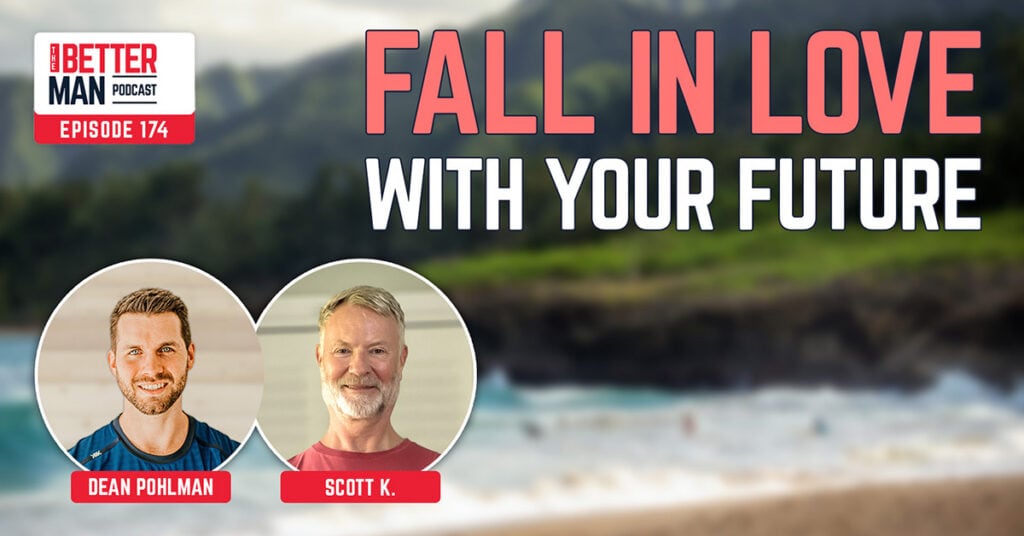
What if you could achieve all of your health goals without using any willpower, discipline, or external motivation?
It might sound too good to be true, but there’s a surprisingly simple way to do this: Falling in love with your future.
Something magical happens when you fall in love with your future: You start to appreciate the mistakes you made (or will make) on your health journey instead of beating yourself up over them.
Today’s guest, Scott, experienced this first-hand:
After retiring and moving to Hawai’i with his husband, the luxurious life caught up to his belly. One day, he looked in the mirror and hardly recognized himself because he gained so much weight.
Instead of beating himself up over it or worrying how he’ll find the discipline to be consistent enough to lose the weight, Scott remembered to fall in love with his future.
Since that moment he looked in the mirror, Scott’s done a complete 180. He started yoga and eating right. As his momentum grew, he started resistance training. And today, he’s continually tinkering and integrating healthier micro habits into his daily life.
Scott comes loaded with helpful tips and tricks, mindset shifts, and ways to approach your fitness and health from a new perspective.
Here’s what Scott and I discuss:
- The micro habits Scott built to lose weight in retirement
- How to eliminate the need for discipline and sacrifices when becoming healthier
- How to create your own philosophies that can hold you up when accountability, discipline, and motivation fail
The Better Man Podcast is an exploration of our health and well-being outside of our physical fitness, exploring and redefining what it means to be better as a man; being the best version of ourselves we can be, while adopting a more comprehensive understanding of our total health and wellness. I hope it inspires you to be better!



Use the RSS link to find the Better Man Podcast on other apps: http://feeds.libsyn.com/404744/rss
Episode 174 Highlights
- The spiritual mindset shift Scott went through after not recognizing himself in his mirror (and how this enabled him to be consistent without discipline) (3:11)
- The slow and insidious postural destruction that happens when you sit at a desk for work all day (3:34)
- Why the “Gravel Hill” technique can stop you from falling off the wagon completely when you feel discouraged or uncomfortable (6:16)
- How to recognize your growth when you’re miserable in the middle of the discomfort phase (8:16)
- Why falling in love with your future unlocks the ability to look forward to stumbling on your fitness journey (9:19)
- The counterintuitive reason to put yourself first in your relationship (it sounds weird, but Scott and his husband celebrate 30 years next year!) (16:58)
- Why off-the-mat Man Flow Yoga helps ingrain the postural benefits more deeply into your body (and how to easily start doing this) (28:53)
- How to start resistance training without stepping foot in the gym or even lifting weights (42:28)
- The most effective dieting strategy if you’re overweight and over 50 (48:51)
Dean Pohlman: Hey guys. It’s seen. Welcome to the betterment podcast. Today’s episode I interview Scott Kay. Scott lives in Hawaii. He used to live in San Diego, moved out there after retirement. And in this conversation we’re going to talk about Scott’s wellness journey. We start with him as a more active guy in his 20s and 30s, and then he prioritized work after that, moved to Hawaii after work, and then once some of that stress went away, he started gaining weight again, had a had a moment where he looked in the mirror and said, who am I?
Dean Pohlman: What is this? And then he got serious about his health again. So we talked about the micro habits that he started to build just to lose weight. Over time. We talk about some of the the philosophies that he’s adopted in life to help with these things. And I think what’s really cool about Scott’s conversation is that he doesn’t really think about any of these changes that he made as sacrifices or as requiring discipline.
Dean Pohlman: He just did them because he wanted to do them, because it was in alignment with who he wanted to be and what he wanted his future to look like. So I hope you guys appreciate this conversation. Scott was awesome and there’s definitely a lot that you can learn from this. I hope it inspires you to be a better man.
Dean Pohlman: And here we go. Hey guys, a scene. Welcome to the Better Man podcast. Today is a member interview. I’ve got Scott Nodal here today. And we’re going to talk about the progress that he’s made with his overall health journey. Scott, thanks for being here.
Scott K: Thanks, Gene. It’s an honor to be asked.
Dean Pohlman: Yeah. And the big reason why I wanted to ask you to be here. You know, I work with a decent a handful of people, not a ton of people, but I work probably with a handful of people on a on a one on one basis. And, you know, a lot of guys I meet with, you know, maybe it’s a week to week, maybe it’s biweekly.
Dean Pohlman: But a lot of guys I meet with and there’s a general progression. You know, most people most people improve in some ways. But with you, what I thought was really significant was the amount of discipline that you were able to have for yourself. So the ability of you to have kind of a plan or have an idea of what you wanted to do and then actually do it very, very consistently.
Dean Pohlman: You know, I was actually very surprised by how consistent you were able to be, and you could tell that we would do, you know, I would look at your technique week to week and I would or just over time and I would see how much you were improving. And it’s one thing, you know, to I don’t I don’t know what I’m saying.
Dean Pohlman: What I am saying is mobility improvement takes a lot of work. And you could see noticeable mobility improvements each week, which is really I mean, that’s significant. And so I wanted to talk with you about, you know, just get to talk with you and understand, you know, get to know the guy behind that discipline and kind of what other changes you made.
Dean Pohlman: And yeah, so that’s, that’s that’s my that’s my intro, my rambling intro for you.
Scott K: We’ll say scene. Yeah. Well maybe I just kind of start with where it started for me was coming from something inside that I knew that I had a kind of a spiritual philosophy, if you will, about what? The way I see the world, how I see things as being integrated and allied, or they should be, and what wasn’t aligned was the way that I felt in my body at the time.
Scott K: You know, over years working a desk job, sitting a lot.
Scott K: Just doing those kinds of things, having those long hours in front of the computer and the technique that they call it. I realized that things had degraded my my posture really degraded, my weight had increased, and it was just gradual, you know, a gradual, gradual graduated over time. And it was like little things over time, like one bite at a time per meal got me heavier and heavier and heavier, and everything was incremental and progressive.
Scott K: And I decided the awareness happened when I just looked in the mirror and looked at my sleep, looked at my digestion, looked at my mobility, looked at my body frame, and I thought, this is this doesn’t feel like I should feel. And I wanted that alignment to to happen. I wanted that connection back to my body because I used to feel really good at my body.
Scott K: I used to jog. I used to work out all the time. I used to, you know, look better. And not that vanities, the whole thing. But, you know, self-esteem is huge mental health and all of that. And I felt like things were not aligning for me. So where that that’s where it kind of started was the awareness going, oh yeah, something’s here that I’m not liking.
Dean Pohlman: Okay.
Scott K: And deciding to make a change, even if it’s not a big change. Little changes, little micro changes. And Rob got me into watching your videos and that’s kind of where it began. So I’ll pause for a minute in case you had any further follow ups or whatever.
Dean Pohlman: Yeah, no. So it sounds like you just noticed that you didn’t feel like yourself. And there was a there was a pretty significant desire to change.
Scott K: Yeah. And then my plan kind of began with a lot of your help because I was doing your videos. I was eating what I thought was right. I wasn’t working out or doing any resistance training and watching your videos. I made progression with to a degree. But what I realized that I needed more, I needed some better assistance, I needed more one on one.
Scott K: I needed someone to actually tell me what I was doing wrong and I was not. I didn’t follow one of the things that you tell people to do all the time on your videos, which is to record yourself or have an expert watch you and tell you. So I reached out to you for that expert advice, and we did a lot of corrections.
Scott K: And I was it a comfortable? Of course. Was it hard? Was it discouraging? Yeah. But you know, the way that I kind of look at all of this is kind of like everybody’s walked up a steep gravel hill probably in their life. And you just if you just stand there, nothing happens. If you walk up the hill, you’re probably going to slip on a stone or two and slip backwards a little bit, maybe, maybe even fall down.
Scott K: But you get up and keep going. And it was just the long view for me that helped me keep going and kind of lean into it and lean into the discomfort. And then it became growth. And that’s the best way I could describe it. And the growth itself kind of was. It was a really great feeling. I could feel it.
Dean Pohlman: Yeah, yeah. So like two things come to mind. The first is that, you know, the, the, the little tweaks that make significant difference are very hard to understand for someone who’s, you know, like a general I say general practitioner, but that’s not the term that I want here. As someone who’s not a professional, you know, fitness instructor, like the little tweaks that that that can be made to make big improvements.
Dean Pohlman: They don’t look like much on camera or in picture, but like to someone who knows, like those little tweaks and what, what you’re supposed to do, they actually make a huge difference. And so, you know, I could I could see the discomfort that you would go through when you made these little tweaks. But that’s, you know, that’s that’s that’s kind of what it takes.
Dean Pohlman: And so, you know, the question for me is you mentioned a lot of those tweaks being uncomfortable, but then being able to recognize growth. And you know for most people they get to the discomfort phase. But then they didn’t they don’t get to the growth phase. And so for you you know what. You know, what do you think was your mentality or what did you tell yourself or what did you do when you experience that discomfort but you hadn’t noticed the growth yet?
Scott K: Oh, well, that’s easy for me. It’s because I generally take a long view approach to most things I don’t. I mean, you have to focus on what’s in front of you so that you can focus on, you know, I don’t know, not getting bitten by a bug or whatever, just little things in life. But having the long view sets me up for being able to visualize where I want to be.
Scott K: And I’ve always had a really good ability to visually envision what something can be. I have one of these philosophies that I have that I made up or Rob and I made up together was called my husband is called Fall in Love with Your Future, and we should all do that because, you know, if you have that, that’s where the fire comes from.
Scott K: Is falling in love with your future, visualizing where you can be. I’ve always been able to kind of see that in my mind’s eye, and it’s going to be incremental steps. There will be little discomforts and disappointments and soreness and boredom along the way. And just keep that keep that progression because it’s like if you if we’ve all heard the an investor talk about maybe if you took your $5 of coffee that you spend every day and instead invest it.
Scott K: I’ve read somewhere that if you did that starting in your 20s, you’d have by retirement $1 million just of that money because of the dividends that pay off. It’s not just the initial investment, but it’s the dividends. And I kind of look at taking care of my body and my mind and my sleep and everything. The same way is that those dividends build up, accumulate gradually, not always perfect linear, but they do.
Scott K: The trend line goes up and up in the right direction.
Dean Pohlman: Yeah.
Scott K: And so, you know, then you take not just the long view but then you take like longer time. One thing that I noticed about my body and maybe other people are simple similar is that if I am doing really well with my weight management and my workouts and my weight is just plateaued and I realize, oh my gosh, it actually went up.
Scott K: I didn’t expect my weight to go up even though I’m doing the right thing. So maybe I skipped breakfast and did some intermittent fasting. What I realized is that it takes about three days for my body to kind of react to what I did three days ago, so I don’t know if that’s normal, but if I, you know, did something like had a bunch of cake and bad food, you know, I feel like the next day I feel like, oh, I got away with it.
Scott K: That thing happened. And then it starts. That shows up a little bit later. And if I do the opposite of that, if I do the intermittent fasting or eat one couple of bites less at a time or or skip a breakfast or something, if I do that for a week, then the trend line goes in the right direction for me.
Dean Pohlman: Okay, that’s good to know. So tell me more about this fall in love with my future philosophy. Is this something that you you’ve always had? Is this something that you you came up with, you know, a few years ago, or how did that come about?
Scott K: It came up. We came up with it about ten years ago. We were sort of getting quite of close to being able to see a retirement in the future. And we had been to Hawaii a couple of times. And we.
Dean Pohlman: Where did you live before that?
Scott K: We lived in San Diego, which is lovely. It’s a great place to live. We lived there for 30 years, you know, great careers, great city, love San Diego. It was getting really busy, really crowded, and it had some negatives. But we started thinking, gosh, you know, when we went on vacation, we’d come to Hawaii, we went to Kauai and went, oh my gosh, this, this feels right, but we’re not ready.
Scott K: So we just set our intention that, you know, we could fall in love with the the potential future of living among that kind of beauty. And we did that. We had that. All of our activities then from that point on became pay off the house, get ready for retirement, enjoy life, of course, as you go, but see that we could physically live someplace like that.
Scott K: And.
Scott K: In ten years it happened. So yeah, it took time. It took a long time, but we kept it was more of a feeling that a philosophy, really. It was just falling in love with what we could visualize as our future being. And so I realized, hey, you know, that could apply to other areas, to my integrated philosophy about life is it could apply to how I feel in my body, could apply to my relationships and how I treat them.
Scott K: You know, there’s hiccups along the way and everything and getting through those bumps. You know, meditation helps you figure out how to kind of get through all of those bumps. So I don’t know if that explains anything, but that was a philosophy that we like. And we it also is in alignment with.
Scott K: I know some people may not be in a spiritual place, but I’m not either, really. But one of my spiritual philosophies is beauty in nature. And once I recognized that, and it was aware of that as being where I was most comfortable and most happy, it aligned with my future that I could visualize yet. Hawaii.
Dean Pohlman: Okay, so the question I actually have is, do you and your your partner, you and Rob, do you guys have a do you both have the same desire to kind of think about life in that way, or is that you kind of, you know, is that you dragging him along? Is that him dragging you along? Or like, how does how does that work?
Dean Pohlman: Because usually in in relationships, one part, you know, they’re not they’re not the same. Right. Like, you know, I’m different from my wife. You’re different from your husband. Like, you know, that’s what brings us together. So, you know, how do you work together to to have, like, joint effort to creating a life philosophy, if that makes sense.
Scott K: Yeah. It does. I’ve never really thought about it too much because it happens organically. It’s we feed off each other because we have mutual trust. And so I think maybe I came up with the phrase fall in love with your future, but I’m not sure actually thinking back, because we work as a unit. And so.
Scott K: I don’t know the answer to your question. I think it just was both of us pretty much in alignment in these things. Do you feel like do you feel like you’re usually pushing these ideas forward, or does does he come to you and say, like, hey, I want to do this, or is it you coming to him and saying, like, hey, I want to do this.
Scott K: Do you want to do it with me? Or do you do it on your own? Or like maybe. Yeah, I’d say that probably me a little more about 60% of the time on things like that and him on other or practical things he’ll bring forward, you know, certain things to, to do in the house and whatever. But, you know, sort of the long term things I tend to come up with, I guess, a little bit more, just a little bit.
Scott K: But we always talk about it and, and then if we’re, if we’re not in agreement, we talk about what would work, you know, for the other person. So we we just make it navigate that together. I wouldn’t use the word compromise here. I just would use the word synergy, I guess. Yeah. Have you always been able to do that or did you have to figure out how to do that?
Scott K: I think we’ve always been able to do that starting early on 28 years, 29 years ago. We celebrate our 30th next year. So I think it was starting with common interests, just, you know, finding a partner with common interests and common philosophies about how to treat people and how to treat life and how to take care of ourselves.
Scott K: Because, you know, it sounds kind of weird to be in a relationship and say, to put yourself first, but you really if you don’t take care of yourself, who’s going to? And if you’re looking for someone else to fill a gap or to fix something that you don’t like about yourself, then it’s probably not the best. So now we’re getting into kind of another area, but I think that you have to be wholly and complete within yourself before you could come together.
Scott K: And then if you find the right person that has a lot of those existed qualities to then and there’s a desire to be together, then your decisions kind of just fall into place. A lot of times you discuss it, you have to discuss. You can’t just say, I want, I want to, I want to do a mediterranean cruise.
Scott K: The other person says, no, no, no, I want to do Alaska. Okay, well, both can be good, but you have to figure out why the other person wants it. And usually if there’s enough caring, you know, you come together somewhere in the middle just by default. Yeah. Cool. Yeah. That’s a that’s a question I ask because a lot of people have, you know, a lot of people are just more health oriented or they just care more about it.
Scott K: And so they run into issues with their partner when, you know, they say like, hey, I want to start eating healthier. And the other person is like, well, I don’t I don’t want to do that. Or like, hey, I think I’m going to start going to gym. And the response is, well, what do you how are you going to help with the kids?
Scott K: Or like, you know, they’re like, how are you going to do this if you’re going to the gym? And so, you know, and sometimes you have to just because sometimes, you know, you just have to do things. Sometimes you have to sacrifice. Sometimes you just have to say, okay, cool. That’s your decision. I’m going to go do it anyways.
Scott K: And it sounds like you guys have a, you know, fortunately, you guys are more on the same page and you’re able to kind of do those things with each other’s blessings. Yes. But now that you say it that way, I think I really get where you’re going with this. I am the one a little bit more in this arena of health and nutrition is such to be the more I’m going to do this, I would love to share this experience with you and you’re welcome to follow along.
Scott K: And. But when I open the pantry, I’m going to go for this shelf because I set up the shelf with all of my favorite seed mixtures and nuts and olive oil and whatever. And I’m going to ignore the delicious but bad for you potato chips. Yeah, and these supposedly healthy bars that really aren’t healthy I know. Right. You know, these little health bars with too much sugar and chocolate.
Scott K: Yeah. That was that was actually my next question, because I remember when we started working together, I would check in with you guys about nutrition and you’re like, oh, well, we still had cookies last night. And I’m like, okay, well, we talked about this. It sounds like, you know, what’s so what’s what’s been your solution to, I guess, cutting back on sweets or, you know, you probably don’t think about it in those words, but what has been your approach?
Scott K: What’s been what’s been helpful for you? Yeah, that it is kind of tough. But one of the things that fortunately or unfortunately for me is if I eat too much sugar, I get a headache. So I know that that’s going to happen if I if I overdo it. So, you know, I can see I can see that is going to be probable.
Scott K: And so occasionally I’ll indulge and then pay the price.
Scott K: I think the way that I got over that one is just really those incremental micro habits, which I, one of my micro habits is to eat a lot of more of those seeds and those mixtures and grains and such, and enjoying them and liking them. And once I do that and drink a bunch of water, you know, like chia seeds, you know, what they do in water.
Scott K: And then I’m full and I can just march around the yard, do gardening, whatever. And, you know, I think what happens is, as I do those things, you know, as Rob’s exposed to me, to watching me do that and feeling good about it, then he’ll integrate them to and he’s moving more in that direction as well. But I kind of just said, okay, I’m doing this and I’d love to share it with you, but I’m not going to, you know, eat a whole bunch of potato chips.
Scott K: I’ll eat a few. But it’s a slippery slope, you know, because I love that stuff, too. I have to be careful. Yeah. And, you know, I, you know, I’ve got, you know, full disclosure, I’ve got I’ve got all these, these great things that you sent me that we could discuss for your interview in front of me. And I’m looking at this list of drinking fresh water in the morning first thing, and having a little morning routine while you wait for your tea to steep, and doing whole grains and your bread, making those seeds.
Scott K: And, you know, whenever it comes to those kinds of things, these are all great ideas. But then the question becomes, and what really the struggle is like, okay, well, how do you get yourself to do these things right? Because I could tell myself, you know, if I could have my own dream morning. You know, I’d wake up at six, no matter what I’d go do I’d go do yoga.
Scott K: I’d go for a walk. I’d journal and meditate. All before. All before the kids got up at 1130 for school. That doesn’t start at 1130. It starts at 730. So you know, that doesn’t work out. But, you know, so how do you, you know, how do you have the self-discipline or like, what’s the mindset that allows you to to do those things consistently?
Scott K: Part of it’s just being retired. I’ll admit that I have more time now. I don’t have the schedule that I used to have, but what did you what did you do when you were working? I was in a baking career and it was called governance Program management, which is like a big question mark in most people’s minds. Like, what is that?
Scott K: It was kind of brisk, kind of compliance related and making sure we followed policies. And I did system administration. I did training program management. So I I’ve always been a curious person. I always need to learn. I always need to try something new and jump in sometimes in that way with different things. So even though it was baking, it had a lot of different aspects and it had a lot of people components to okay, all right.
Scott K: You can you can get back to what you were talking about. Sorry. Oh that’s okay. Yeah. So what I was working. Yeah. The scheduling was tough. But now I have a lot more freedom in that way. One of the things I do, we live in Hawaii, and it’s just remote here. And so it’s hard, harder and more expensive to just go to a nice store because we’re on the Big Island, the live near Hilo and it’s just shopping is not great.
Scott K: So Amazon Prime Water. Yeah, I was in I was in Hawaii 2020, I can’t remember. I was 2021 or 2022, but I remember I love Keila. It was like more it was just different than like, you know, it wasn’t like, yeah, it’s a very kind of like surfer vibe of funkiness and but it’s lovely. It’s got great qualities too.
Scott K: And one of the things is shopping is not so such an awesome experience. You find what you can. But I was on Prime as one of our favorite things because, you know, things come quickly. The shipping is paid for, which is huge. Yeah, and I love to shop. And so I would say, okay, I, I’ve been researching all these little seeds that I like or that I want to like.
Scott K: Which ones are most nutritious, nutritious. Which ones can I combine into like a little powerhouse snack or breakfast? And so I went shopping and went on the Amazon Prime and just started ordering all these different things. Even ordered bulgur wheat, the large red kind, the chunky kind of cracked wheat, so I could integrate it into my bread making, which you suggested.
Scott K: So thank you. That’s another little micro habit. So just the fun of shopping, the fun of, you know, making that happen for myself and ourselves and buying this stuff, mixing it up, trying different combinations of, okay, how am I going to eat this? I could just chew it, but that’s not a lot of fun mixing it with, you know, nonfat or not nonfat non sugar Greek yogurt, mixing it with olive oil, mixing it with a smashed up banana and making a breakfast out of that, and then drinking a ton of water after so that it kind of fills me up even more.
Scott K: So that’s kind of how I got started on that. And the other little micro habit that you mentioned was drinking water in the morning. I drink between 1624, sometimes 32oz of water right after I get up. Then I do the steeping routine. I’m looking over this way because I have a view of the ocean in my kitchen and I can.
Scott K: It’s really awesome. So I can put the tea in the glass and it needs to take three minutes. And I thought instead of just standing around or looking at a screen and scrolling and looking at junk on useless social media, most of it’s useless. I could do something. And so I, you know, integrated some leg abductions like the star pose and just did that for a minute on each side, and then did some calf raises and mountain pose fills up another minute.
Scott K: So right there I’ve got three minutes and suddenly I’ve got three minutes. I got a little boost to my energy. In the morning I feel better and then I’ve got my tea ready because at times going to go buy anyway. So why not just be useful? Yeah. Okay. So how do you get yourself to do that when you first start?
Scott K: Just do it. You know, there’s no magic. Not overthinking it, not overthinking it. Just just do it. Just say, okay, this is this is how I do things now, you know, kind of have that in the background of my head have. And your voice is kind of at the back of my head to, you know, three more beats breathing.
Scott K: Absolutely, absolutely. And also leaning into the discomfort just a little bit. But with that little, little routine, there it was. Just do it and make it enjoyable. Make it fun. Very make a variety to give it a little bit of creativity and try a different kind of leg abduction. Try a tree pose for a difference. Just keep it interesting and creative.
Scott K: Yeah, and have fun with it. You know, don’t make it just oh, I have to do this because I know I’m going to feel better at the end. That’s all. Coming back to that previous, after three minutes of doing that stuff, I know I’m going to feel like lighter, taller tingler and one if I can mention one more little micro habit that I don’t think we emphasize enough, is integrating all the poses that we learn.
Scott K: We get good posture muscles. We do a lot with our backs, you know, a down dog and other active poses. One thing that I wasn’t doing until I had to like become aware of it was use that. It’s not just when I’m doing the pose, integrate it throughout my day when I’m walking around the yard just doing routine stuff, cleaning up after the dogs or pulling weeds or whatever.
Scott K: Use those posture muscles. I have to remind myself 30 times a day to do it, and that’s okay. It’s kind of like meditating. Bring your attention back to this thing and that thing being okay. Short foot is supposed to be used in a lot of my standing yoga poses. I forget that sometimes. So I have to remind myself and also, you know, engaging the core, breathing all of those things.
Scott K: I constantly have to just keep it like a loop in my head. Yeah. So next question.
Dean Pohlman: And I’m kind of switching gears here, but it sounds like you had some. Did you do yoga prior to mantle yoga?
Scott K: Not routinely, but I did in an earlier version of myself back when I was I mentioned jogging and, you know, that’s.
Dean Pohlman: That’s what I want to go back to is what was your fitness routine before, you know, before mantle yoga, before resistance training and what were. What were your results with with jogging and whatever else you were doing?
Scott K: Yeah. Well, that was probably my 20s and early 30s. And the reason was really kind of embarrassing to admit, but it was just I wanted to be more dateable.
Dean Pohlman: Yeah.
Scott K: I. That’s the thing. That was the thing. I mean, that was sort of my mindset at the time, but I yeah, there was also the feeling better in my body and all that stuff and what that felt like was good. I had a gym nearby, lived in the middle of a busy part of San Diego, and I could walk to the gym and I could.
Scott K: It was social, it was fun. And so the jogging thing was I had a neighbor. So I being hanging around people who have the like minded activities was really important because if I was hanging around with, you know, people who had poor habits or a poor mindsets, I probably would have kind of taken on some of those qualities.
Scott K: And I, I always knew that I wanted to follow more positive stuff. So I had a neighbor. She got me into jogging a little bit. At first I wasn’t a jogger. I would ride the bike and she would jog, and then I would walk behind her. And then I started jogging and then I’m like, okay, this is building its momentum.
Scott K: It’s increasing. And so I was jogging. I was going to the gym. Most days I was doing yoga in the gym or stretching afterwards because I’ve always loved to stretch. I’ve always been kind of naturally flexible, but I do enjoy it too. But I learned a lot from you later about muscle engagement and stretching. I didn’t know these things.
Scott K: I just thought stretching was stretching and would just do it that way. Just, you know, untrained kind of. But that version of myself got the results that I wanted and I didn’t know it at the time. But I looked back on pictures of me after a marathon or a half marathon, rather, and I’m like, dang, I was. I looked good, but I didn’t know it at the time.
Scott K: I see it looking backwards, so I don’t know. Does that answer your question?
Dean Pohlman: Yeah. So I mean, so you were happy.
Scott K: With your, you know, you were happy with your physique for through your 20s, through your 30s. And how long did you keep that routine up of jogging of were you doing cycling too. And gym. Like how long did you keep that routine going through? Like which, decades of your life? Yeah, that lasted until I until I got married and really leaned into my work a lot more because my career at the time was was annoying, but not demanding, if that makes sense.
Scott K: So it’s a 9 to 5 job and it it didn’t require that much. I didn’t like it, but it was a way to pay the bills. And then I started leaning into my work. And like when you have a mortgage, you know, it kind of changes things and a relationship and responsibilities and all that. So then I started leading into my work more and was traveling, going to LA and, and San Francisco a lot for work.
Scott K: And then that kind of fell to the wayside. So I’d say to answer your question, maybe until my mid 30s and even even after marriage, we had a gym just down the street. But I guess life kind of got in the way and it just became too much to do all of it. Yeah. And I don’t know what to say to help people who have that situation now.
Scott K: It’s just it’s it is hard. Yeah. I mean, well, just we’re just going through the different phases of your life. I mean, this is really common. You know, you’re able to be able to be more active and you’re able to be more fit when you’re younger. Part of that is like it’s just genetically easier. So like you don’t, you know, you’re doing the right things and you’re like, wow, this is great.
Scott K: I’ve got results. I’m going to keep doing it. And, you know, things get harder just as you get older. You know, the things that you do when you’re in your 20s don’t work as well. When you’re in your 40s, you’re like, why am I not building muscle as quickly? Why do why do I have these shoulder, these knee pain that I didn’t used to have?
Scott K: Or why am I getting a belly? Like I’m doing all the same things that I was 20. Why? Why am I getting a belly now? So, you know, those are all just there’s different there’s different, you know, phases of fitness. And what you’re describing is very common for men in their, you know, in their especially, you know, in their late 30s, their 40s, their 50s.
Scott K: So for you, when did you, you know. Did you have a moment where you kind of like, looked at yourself in mirror and you’re like, what happened? Oh, yeah. Yeah, yeah. When was that? Well, probably around when I turned around 55. Okay. Because I was, I was long ago. That was five years ago. So. Yeah. Right. Okay. So so so pandemic five years ago you had your oh shit moment and had you, had you been consistent all with exercise between 35 and like 55.
Scott K: Very little. I mean I would walk okay. We would walk a lot. And that was about it. I, I would occasionally do some resistance training or a couple of push ups. But then pain got in the way. You know, my shoulder would do a weird thing or my knee would do a weird thing. And then it was a discomfort, discouragement.
Scott K: And I think it’s probably, again, pretty common. But no, I wasn’t really doing too much activity wise, but my my physique stayed okay because I wasn’t completely overindulging. But once we got here, the good life crept in and I started really gaining weight. So. Okay. Got it. Yeah. Is it less stressful living there versus being in San Diego?
Scott K: Hugely. Yeah. Okay. Massively. Okay. Yeah. I mean, San Diego is is a great city and there’s a lot to do and a lot of activities. But but it’s also kind of relative to what I was doing. And I was working and I was pretty stressed out a lot. Yeah, I had anxiety, you know, that was great. So stress kept you skinny.
Scott K: Great. Yeah. You know, and I’m a body reactor. Stress goes right to my stomach. And if I’m stressed out and all that, it’s just my appetite kind of goes away. So that’s not great. But. So yeah. No it’s common. I mean I started experiencing that in the last couple of years and I’m like, oh cool. This is so yeah.
Scott K: Yeah. It’s you know, it’s fine. Taught me that I needed to deal with stuff. So it worked out. You know, it’s fine, but, but so by point in asking you, this is now you move to Hawaii and you don’t have that stress, you’re able to eat more. And so, okay, so you’re gaining weight and then okay, so now what happens.
Scott K: Well, what part of what contributed to that was we met a completely new circle of friends. And they’re amazing people, all of them. And they love to get together and have big, elaborate meals. And it’s all about that and the social side of it. And that was fun. You know, food, fun, friends and family. So we really started just over indulging too many times and it caught up with us.
Scott K: And then I the moment was maybe two years ago. I just looked at myself and I said, what? Who is that? And what happened to my waist? It’s gone. It’s it’s doing things that it’s not supposed to do. Does it look right? Do you know how much weight you gained? Well, probably 15 pounds there in that. Okay. And it had been kind of increasing for a while.
Scott K: Back in when I was about 40, Rob and I went on a kind of extreme diet. If I could rewind for just a minute where we only ate. It was pretty much it was called Food combining. You’ve probably heard of this, where a meal can only have high quality whole grain carbs or meats and fats and vegetables. Okay, so in other words, you don’t combine your proteins and your carbs and you cut out sugar and caffeine completely.
Scott K: And why? Which was hell, because we lived in California. So why is like another food group? Yes. So we lost a bunch of weight. I mean, I lost 30 pounds back then doing it that way, but wow. Yeah, but then but you lost your soul in the process.
Scott K: Yeah. I mean I looked great, but it was, it was challenging, you know, because then you start to go to people’s houses and you could only eat certain things or eat a certain way. And they were confused about it all and they were like, yeah, yeah. Are you vegetarian? No. But, you know, it just got weird. So we kind of moved away from that and it just gradually came back.
Scott K: And then after retirement, I started really gaining with all of the social engagements. So yeah. Okay. So at that point you started doing mental yoga with Rob and what year? Yeah, I think it was 2023 or 4 okay. All right. So this is this is around the time and you’re like okay hey we got to get our we got to get it together kind of.
Scott K: Exactly, exactly.
Scott K: Yeah we did. And so we started doing it pretty regularly, doing it together and saying, oh I found this cool program, let’s do it. And so we would do yoga together. But Rob started having a couple of challenges with some of them, or he’d get an injury and couldn’t do it. And so then I started kind of coming up with my own routines.
Scott K: And I love your routines. They’re actually incredible because every time I do one of your routines, I think, oh, that was, you know, kind of moderate. And then the next day I’m like, ouch, something new hurts. You know, something in a good way, a new soreness and a muscle group. So we were doing stuff together and then I needed more.
Scott K: And I kind of had that, you know, that new visualization of my new future self. And I’m like, okay, what I see is not what I like, and what I feel in my body is not what I like. So let’s move. Let’s just kind of pivot a little bit and try something new. And so that’s when we started engaging with you.
Scott K: Yeah. Okay.
Dean Pohlman: So and then I think at my recommendation you also started you started resistance training. Eventually I feel like I feel like I know I’m trying to think back to when we first started. And I remember you still had the you know, that was the we discussed sweets a lot like that was the that was the thing that got in the way.
Dean Pohlman: We also, I don’t know how long it took for you guys to start resistance training. I don’t know when I had mentioned that as, but I guess I’m the two things I’ll just say because I don’t want to forget them. The first is, you know, what was kind of the progression from starting to work with me and then starting to make more, maybe more changes to the nutrition and implementing resistance training.
Dean Pohlman: And then what was the difference between getting results in your 60s versus or late 50s and early 60s versus, you know, when you were in your 20s? 30s what kind of differences did you notice in your in your fitness?
Scott K: Actually, not much for me because my joints still feel pretty good. But what’s started, I guess, was you as an example. I mean, you look great and I’ll never look like you, probably because I don’t lift heavy weights. But right away, after we started working with you, we realized I realized I needed to resistance training. And I like it, I enjoy it, and so I got the bands, started working with those and just kind of did a lot of high reps, and I saw results pretty fast.
Scott K: Rob unfortunately had a little injury with this back, and so you helped him with that. But the progression of it was your example. But also I was just going, okay, this works. Let’s keep going. And it’s fun. And this is how we do things now. That’s that’s also my, you know, one of my philosophies. And so it wasn’t discipline.
Scott K: It was just it’s you know Wednesday. So I, I my last workout was X. Now it’s today it’s it’s why. So it always with the I know I’m going to feel much better afterwards. Even if I start out feeling like crud I, I know that I’m going to feel better at the end of it, even if I don’t want to get sweaty, even if I don’t want to move my body in that direction, if I move it a little bit in that direction.
Scott K: And a lot of your advice is if you can’t dedicate or want to dedicate 30 minutes, you can do five minutes, you can do ten minutes, do something. And so yeah, just do something. Don’t just skip it all together because then that becomes the momentum in the wrong direction. Well I’m glad that you mentioned, you know, that you you started resistance training by doing bands.
Scott K: You know, I think a lot of people think like, oh, I don’t want to go lift weights. I don’t want to tell you why. It’s like you don’t have to go live heavy weights did your resistance training, you can use bands. And I think you guys just found something. You know, you mentioned your love for Amazon Prime. You guys found something on Amazon Prime that just was super compact.
Scott K: Like you didn’t have to drill any holes anywhere. You just got it and you started and it’s awesome because you didn’t even know it. Yeah. That to it’s take it with you transportable. But like I remember when you guys got started because I looked at some of what you were doing and I was like, not like that. But you guys got started anyways.
Scott K: You just did it. You just jumped in and did it, which was great that you just, you know. So I think if people can take something from there’s a lot that people can take from you, but you know, something else to take from you is like just you guys just got it and you just started. You weren’t sure if you were doing it correctly or not.
Scott K: You just started doing it. Well, you know, we’re all going to make mistakes. We’re all going to do something wrong the first time if it’s brand new. And I was a little shy about doing this podcast and I because I and the reason is I’m afraid I’m going to say something dumb and I probably have, but so what, you know, you move on.
Scott K: You, you know, you’re going to make there’s going to be mistakes. You just keep going. You keep going up that gravel hill, you know, and lean into it a little bit. Yeah. Yeah. No I mean I’m every time I get on camera, I’m scared that I’m going to say something dumb. And, you know, that fear persists. You know, I’m sure I’ve said the podcast especially because, you know, just sometimes I start talking, I don’t know what I’m going to say.
Scott K: And then I spend three minutes, I spend three minutes talking in circles and, oh, my God, that was kind of dumb. But, you know, I actually talk with a lot of people and they’re like, oh, I like how your communication is just, you know, you don’t plan it out. You just you just say what you’re you just say it.
Scott K: You’re not like trying to polish it. Yeah. So just be human. It’d be authentic. You know, it’s simple. Yeah. So I mean, that’s great. Well, the same. Yeah. The same. It’s great that you have that that that that mindset. And you took it into multiple areas. So you know, you mentioned that you started seeing results. How long did it take you to start noticing results from.
Scott K: Oh, immediately. Because I hadn’t used resistance training in so long that as soon as I did a few bicep curls or whatever, I was like, oh, I could feel it. I really could feel it in the triceps. I know that, you know, do more triceps than biceps because there’s more muscle mass there. There’s three instead of two. So focus there.
Scott K: And then the arm results were like within a couple of weeks. I mean, and you know, if you don’t see results the next day, you might feel it. You could feel the soreness. Well that’s progress. Yeah. You keep doing it. Do the cycle wash rinse, repeat keep keep the cycle going and and it will happen. So you know two weeks probably is when I started seeing it but I felt it earlier.
Scott K: Yeah okay. And then you know we also mentioned a lot of these different nutrition, you know, tweaks that we made. When did you start to sing the results of that. And also you know, how how long did it take for, you know, let’s say you lost 5 pounds. How long did it take to lose 5 pounds or 2 pounds or whatever it is, or even just noticing your waist looks slimmer pretty fast, because what I did is I did some intermittent fasting.
Scott K: And so, you know, the glycogen stores, the water, all of that kind of comes down quickly and you’re like, oh, super motivated now within a couple of days. But nutrition, digestion was vastly improved with more whole grains, more vegetables, which I love, and I grow them. So that’s that’s fun. Love that integrating, creating new foods to eat, you know, veggie wraps and stuff like that.
Scott K: So to answer your question at the time, yeah, it took maybe I would say a month and I started tracking. I didn’t have a fancy, you know, body scan or Hume like I do now, but I was tracking it. You got to track something. And so I did a real simple little mini spreadsheet of notes of my phone and tracked my weight and some couple of simple measurements and my mood.
Scott K: How do I feel? And I think that’s like mini journaling, but it’s another little micro habit that I would do every morning go, well, how did I sleep? How do I feel? Got a crummy headache. Slept terribly because I over ate last night. Okay. Remember that? Lesson learned? Move on. You know, and then the next time would be I slept.
Scott K: Awesome. What did I do? Right? So digestion is huge thing. And it’s. It was. That was pretty immediate. Yeah. Okay. Cool. And by the way, if you’re over 50 and you’re struggling with weight, intermittent fasting is one of the the first recommendations I’ll make. That’s something that comes up over and over again in our community, which has a ton of guys in their 50s and 60s and the guys that have seen significant weight loss and have been successful with it is that those are the guys who are utilizing intermittent fasting.
Scott K: So I do 18, six, you know, 18 hour after dinner. I wait until lunch time about 2 or 3 times a week. And I’ve done about a couple of months ago, I did a 72 hour fast, which was pretty hard, but yeah, it was pretty hard, but just drank a bunch of water and kept going, wow. And that was I lost like 5 pounds doing that, which who knows if it’s fatter water, but if the trend line went the right direction for me from that point forward.
Scott K: Okay, cool. So just just one that was from intermittent fasting in general. That was from one session, 1313 day fasting period. That was one three day fasting. Oh wow. Okay. So it’s had effects. It has had effects after I mean yeah, it was food. Of course there was less food in my system. There was less, probably less water, less like glycogen stores and all that.
Scott K: But I pretty much I went, okay, I’m going to keep that trend line going or keep it there. That’s my new baseline, you know, and I’ll keep moving in that direction. So then I would do intermittent fasting for the next week every couple of three days. And it wasn’t that hard. The intermittent that 72 hours was tough. But the intermittent fasting is a lot easier if I stay hydrated.
Scott K: Sometimes when I’m hungry, if I drink a big glass of water, I realize, oh, that was just thirst. That wasn’t hunger. And I’ll stay hydrated, you know, through those 18 hours after I get up in the morning and lunchtime, then tastes delicious because, you know, your appetite is all all there and you start to taste things a lot more.
Scott K: I could taste when there’s added sugar, when there’s, yeah, salt when there’s fake stuff. I taste the fake stuff now and I could taste processed foods and I don’t like it, I want it. Yeah. And just so people know, you wrote this in. So 20 months ago, you were 207 pounds. And what do you weight today? This morning I was 173, but I’ve been as low as 169.
Scott K: So yeah, that’s probably what, 35 or 6 pounds. 35 pounds. Wow. That’s pretty. That’s good. Anytime there’s like even 5 pounds weight loss is like really noticeable. So you know 35 pounds is huge. Thanks. You know and that’s my new baseline and I’ll thank you I’m going to keep going just just slow. And it’s probably going to be slower now but I’ll keep going.
Scott K: Yeah. Posted. Well let’s let’s do our rapid fire questions. Am I am I springing these on you. Yeah I did. Okay, perfect. Well, I can’t all be prepared to be organic sometimes. All right. What is the one habit, belief or mindset that’s helped you the most with your overall health and wellness? The long view? The long view. Yeah.
Scott K: Love it. What’s one thing that you do for your health that is often overlooked or undervalued by others? Water. Drinking water? Yep. Lots of water. What is the most stressful part of your day to day life?
Scott K: Oh, stupid stuff. Like if I if I order something and the directions are obviously someone used Google Translate and it just doesn’t make any sense. And I’m trying to assemble something and it just like, forget it. Screw that. I’m going to just figure it out. Damn it. Or I’ll find a just dump things like that. And that’s where my meditation needs to kick in, because I’m all this time apologizing to Rob, saying I shouldn’t have gotten upset over something so dumb, but little things.
Scott K: So thankfully it’s little things and not big stuff. Because big stuff. That’s. Yeah. That’s tough. Yeah. All right. And last question. What’s your best piece of advice for men who want to be healthier?
Scott K: Do it for yourself. Find what’s in you that that you want to be. You know, it’s be the Better man podcast. It’s, you know, and, you know, follow Dean of course. But start with start with why? Why are you doing this? Why do you be aware of that? You don’t feel good sometimes is if someone is a cigarette smoker and and loves that, but is coughing all the time, that’s a clue.
Scott K: Just being aware of how you feel and do it for yourself, nobody else, and take other people with you on the positive journey with you. All right. Do it for yourself and take off with you. Love it. All right. Well, Scott, that was a cool interview. So much good information. Thank you. Cool to get the whole picture of your life and the different phases that you went through and what’s helped you and what you’re continuing to do, and some of the philosophies that you have that, that make this all seem easier, which is cool.
Scott K: So great conversation. You had nothing to fear. You had nothing. Yeah, well, not with you. I mean, I trust you, so that’s great. Thank you Dean, really appreciate it. And I had fun today. Good. All right guys, I hope you enjoyed listening. Hope this inspires you to be a better man. And I’ll see you on the next episode.
Scott K: Aloha. Aloha. All right, guys, I hope you enjoyed that conversation with Scott. This is a great conversation for me, I loved it. I loved hearing about all all these little micro habits and all these different philosophies that Scott’s able to incorporate. And it also, I think, traces a lot of common histories, common kind of, you know, overall course of developments with with men as they throughout their life in terms of being active when they’re younger and then falling off the wagon and then getting back into it in their 50s and 60s.
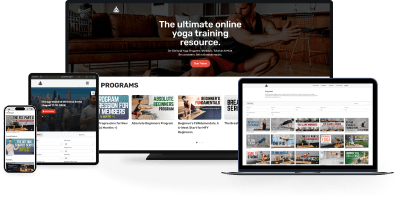
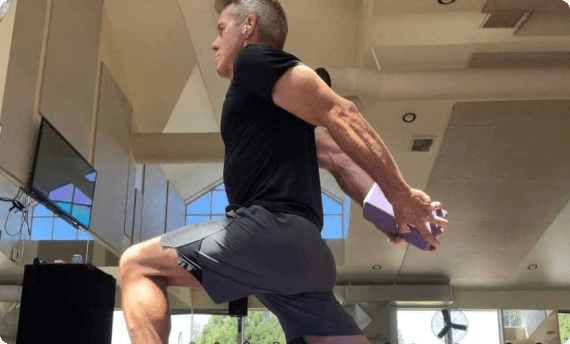
Scott K: So I hope some of this resonated with you. I hope it inspired you, and I hope it inspires you to be a better man. If you want to do some of the same workouts that that that Scott is doing, I’ve got the Manifold Yoga members area and apt. That’s where you can get started. You can go to manifold to get a free seven day trial.
Scott K: Check it out. See if you like it. We’ve also got a free seven day challenge. If you’re not quite ready for the free trial. There is no credit card for that. It’s just a series of seven workouts, and if you can do those workouts, you’ll probably notice the results in the first couple of workouts and you’ll know whether or not this is something you want to do consistently, so you can sign up for that challenge at.
Scott K: Sea. Hope you guys are enjoying the podcast! Please leave a review if you haven’t already, and I hope to see you guys on the next one.
[END]
Man Flow Yoga Events: We just announced new locations for 2026 in-person events. Find the full list of cities we’re coming to here: https://manflowyoga.com/man-flow-yoga-events/
Want to unlock more flexibility and strength, reduce your risk of injury, and feel your absolute best over the next 7 days? Then join the FREE 7-Day Beginner’s Yoga for Men Challenge here: https://ManFlowYoga.com/7dc.
Tired of doing a form of yoga that causes more injuries than it helps prevent? The cold, hard truth is men need yoga specifically designed for them. Well, here’s some good news: You can start your 7-day free trial to Man Flow Yoga by visiting https://ManFlowYoga.com/join.
Like what you’re hearing? Sign up for the mailing list:
Rate & Review
If you enjoyed today’s episode of The Better Man Podcast, hit the subscribe button on Apple, Spotify, or wherever you listen, so future episodes are automatically downloaded directly to your device.
You can also help by providing an honest rating & review over on Apple Podcasts. Reviews go a long way in helping us build awareness so that we can impact even more people. THANK YOU!
More Podcast Content
Take Off Your Mask & Remember Yourself! | Be The Better You Retreat Recap with Coach Patrick | Better Man Podcast Ep. 192
At the latest Be The Better You Retreat we focused on a powerful idea: remembering yourself. Today we explore how the…
Dark Motivation Works … But It Causes a Mid-Life Crisis (Try this instead) | Connor Beaton from ManTalks | Better Man Podcast Ep. 191
Do you ever feel like you’re just wandering through life without a purpose, or stuck in the middle of a frustrating…
Fitness After 40: How To Start When You’ve Never Exercised (The Man Flow Yoga Catalyst Effect) | Bobby B. | Better Man Podcast Ep. 190
Turning 40 was Bobby’s wake-up call. After a lifetime of skipping workouts, a doctor’s visit revealed warning signs in his blood…
Gut Health Goes Way Deeper Than Weight Loss | Ben Brown (Founder of Body Systems Coaching and Head Nutrition & Fitness Coach) | Better Man Podcast Ep. 189
Gut health impacts far more than weight loss—it directly governs your energy, immunity, and mental well-being. If you grew up in…
Moving From Your Survival Path to Your Soul Path | Caleb Campbell (Former NFL player & West Point graduate) | Better Man Podcast Ep. 188
If you’re an endlessly striving achiever, you know the path forward lacks clarity. Former NFL linebacker Caleb Campbell used his feelings…

The Ethics & Use Cases of AI | Ted Phaëton | Better Man Podcast Ep. 187
The topic of AI is unavoidable. Ted Phaeton, productivity coach and host of the Modern Man Podcast, joins the show to…