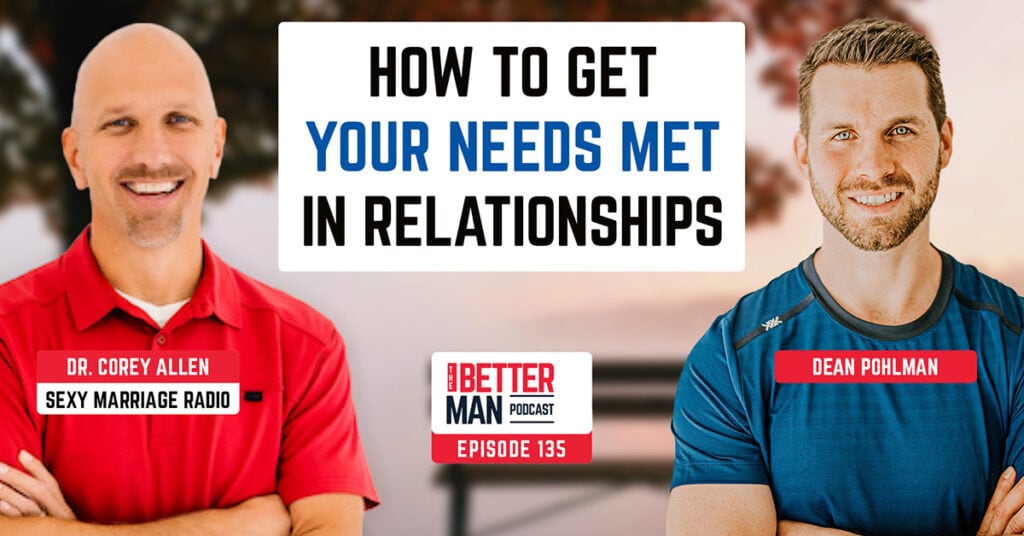
Tough conversations are one of the hardest things to navigate in relationships. Especially when everyone carries some kind of emotional baggage that’s waiting to erupt without notice.
For example, a conversation about your health and fitness could be interpreted as a threat by your partner. They’re thrown into flight-or-flight. You feel like your needs are being neglected. A fight takes place. And you’re both left wondering what happened.
If this pattern keeps happening, you’ll drift apart.
So, what can you do?
I invited Dr. Corey Allen, co-host of Sexy Marriage Radio, to share how you can break destructive patterns, how to be okay with discomfort during conflict, and why you might not always need your partner’s agreement to get your needs met.
Here’s what Dr. Corey Allen shares in this episode:
- How to have tough conversations with your spouse in a way that’s productive and brings you closer together
- Why avoiding conflict makes it bubble beneath the surface
- How to claim time for exercise and living a healthier lifestyle even when your partner isn’t 100% on board
Listen now!
The Better Man Podcast is an exploration of our health and well-being outside of our physical fitness, exploring and redefining what it means to be better as a man; being the best version of ourselves we can be, while adopting a more comprehensive understanding of our total health and wellness. I hope it inspires you to be better!



Use the RSS link to find the Better Man Podcast on other apps: http://feeds.libsyn.com/404744/rss
Episode 135 Highlights
- How to be able to open the door to uncomfortable, but important conversations with your spouse in a less messy way (9:23)
- Why you don’t always need your partner’s agreement when it comes to your fitness needs (17:23)
- How to reframe a conversation about your needs when your spouse doesn’t agree (and why this happens more often than you might think) (21:00)
- Why old wounds can be poked by new conversations with your spouse (and how to better navigate these troubled waters) (31:19)
- The “Completed Conversation” mistake men make during conflict with loved ones that undermines healthy communication (32:42)
- Do stories from your head (or your partner’s head) keep derailing conflict and causing intense outbursts? This book helps you talk about your emotions without the story attached (35:17)
- How being too solution-focused in conflict can backfire on your marriage and make you grow further apart (42:45)


Resources mentioned on this episode:
- Want more from Dr. Corey Allen? Listen to his show, Sexy Marriage Radio, wherever you listen to podcasts.
- Buy Nonviolent Communication: A Language of Life: Life-Changing Tools for Healthy Relationships by Marshall B. Rosenberg, PhD (the book mentioned in this episode) on Amazon here: https://a.co/d/da58pfF
Dean Pohlman: Hey guys, it’s Dean. Welcome to the Better podcast. Today’s episode is an interview with Doctor Corey Allen. He is the founder of Sexy Marriage podcast. We’re going to be talking about how do you have conversations to get your fitness needs met with your partner. So if you are struggling with making or helping your partner understand why you need time to work out or living a healthier lifestyle, we’re going to talk about how you can have these conversations in a way that is productive and helps bring you closer together, rather than drive a wedge between you, it’s going to help you get to a place where you can take the necessary steps that lead you to
Dean Pohlman: feeling more supportive of one another, and we do that by connecting. We’re also going to talk about how to do that when the discomfort comes up, which is the one big reason why many of us avoid having these conversations in the first place. I really like this straight to the point conversation. Hopefully there’s some good nuggets of information in here for you to use.
Dean Pohlman: And yeah, I hope this inspires you to be a better man. All right, Doctor Allen. Thanks. Come back. Have you been.
Dr. Corey Allen: Hey, this. This would be good. Let’s let’s, the the world of relationships, obviously, they’re incredibly easy, right? I mean, they’re everybody’s got it figured out. There’s no tension, no stress. We’re always on the same page. Wait, wait. No, I am mistaken. That is not actually at all close to being factual. So.
Dean Pohlman: Yeah, not at all. So I thought that this would be a cool conversation. To have around the, around the topic of, of wellness and getting your own wellness needs met and something that we hear a lot about within the mental yoga community is having to, you know, kind of fight for your time or your preferences or your, you know, your physical wellness needs to be met in, you know, the relationship dynamic with your partner or your spouse.
Dean Pohlman: So I thought having a conversation about how do we approach like, what are the specific talking points, what are the specific approaches that we can use? And let’s just start with kind of claiming time for your exercise. How do we go about talking to maybe a partner or a spouse who just isn’t, doesn’t understand our desire to exercise or our need to exercise in the context of maybe the family unit or in a partnership.
Dr. Corey Allen: Okay. So this is this will be a fun dialog because I think this is talking about the concepts of just what’s the pressures that take place in a committed relationship. And I think that’s the easiest way to frame it, is there’s a level of commitment and importance that this isn’t something I’m taking haphazardly or, you know, it’s it’s a short lived whatever.
Dr. Corey Allen: So there’s easier deal breakers, quote unquote. This is in my mindset in our conversation, Diem would be a conversation session that’s taking place with the pressures within a marriage or something that’s got some substance and history, longevity to it, because that’s a different beast, right? Because at that point you know each other a little more, most likely, there’s a little more familiarity, a little more understanding in some ways of what makes each of us tick, even if I don’t agree completely, because there is a lot of times, like you’re describing, of how I have, a higher level of desire for, for health and fitness than my spouse may.
Dr. Corey Allen: And so therefore it’s a more of a priority to me than it is to them. And so I think, well, first off, people understanding the fact that they don’t see it as the same priority for themselves as you do for yourselves doesn’t mean there’s anything wrong. Right. That, that’s, that’s a natural thing of a relationship. They want what they want, you want what you want.
Dr. Corey Allen: And so then it becomes how do you create a scenario and avenues that help you achieve more of that. Knowing there’s a cost to it on the relational dynamic. Because if you take time working out a whole lot, well every yes is a no to something also. Right. So then then it’s important to me to think of, okay, if this is a priority to me.
Dr. Corey Allen: But I also say this relationship is a priority to me. How am I demonstrating both, like when I’m with my my spouse or my girlfriend or significant other, who am I be? How am I demonstrating? They are of of priority to me too, because it’s not been about time as much as it is quality.
Dean Pohlman: Okay. So I’m hearing kind of two things I’m hearing. The first is that if you if wellness is important to you, if your workouts are important to you, then they have to be important enough that you’re willing to take maybe some of the the trade offs that come with that. You can put your you can kind of vote on your priority bucket and this can go in there.
Dean Pohlman: But it does take up time. It does take up energy. Yeah. And then the second thing that if you are going to be doing something that your partner might not necessarily agree with, with he or she might not agree with, or doesn’t value as much as you, then you have to make the effort in the relationship so that your partner feels valued so he or she doesn’t just see you saying, oh, you work out all the time and this is what you care about, but you’re also putting an effort into your relationship so that he she feels valued.
Dean Pohlman: And and they’re in the relationship. Is that kind of what I’m hearing?
Dr. Corey Allen: Yeah, I think there needs to be some harmony in this because we can claim. And the easiest example of this is I’m a father. And if I if I claim as one of my character aspect of me, if I want to see myself as a good father, yet my kids don’t know me, I can’t keep that claim. Right, because I’m never around or I’m too involved in other things, or so it’s an element of how do I make sure that because this is the thing that’s so interesting, is the world in which we have evolved with our society.
Dr. Corey Allen: It’s like we think there’s room and capability to do anything and everything that we would ever want when that’s just not true. It’s time is finite in a day. You know, attention is finite in a day. We don’t have unlimited. And so every choice I make has a cost to it and an impact from it. And so it’s just making sure that I hear two things in this time, that it’s making sure that I live according to what, values to me, that if if working out to me is an important thing, then I work out a way to fit that into my calendar.
Dr. Corey Allen: And if being with my family or my spouse is an important thing to me, I work out a way to fit that into my calendar. Okay. And what often happens then on the second side of this is I think we get caught in a scenario a lot of times in relationships where my, my spouse should want what I want, right?
Dr. Corey Allen: They wouldn’t. They want me to be better and healthier when they want that benefit of of my well-being and longevity and whatever in the physique and when they want that. And it’s like in reality could be, no, they don’t care about that because it doesn’t have as much value to them. Even though you are valuable. Okay.
Dean Pohlman: So how do you go? So how do you express that to them? So, like, I feel like a lot of the conversations that I have, people people don’t it’s not I mean, I guess part of it is they don’t see it the same way, but also how do you open up that dialog in a way to say like, hey, this is really important to me.
Dean Pohlman: And I want you to understand why it’s important to me.
Dr. Corey Allen: Yeah. And I think that’s one of the ways right there is I get a lot cleaner with what’s what is of importance to me. What is of value to me. Where do I get a lot of meaning and satisfaction in my life? So I need to be cleaner about that, or I’m just a lot more honest. But then it’s also recognizing that we may not see it the same way.
Dr. Corey Allen: And that doesn’t mean there’s something necessarily wrong, because I think most of us think that if if you’re like, if we if you and I were having a conversation and I was just trying to get you to understand my point of view, but yet there’s something there’s there’s nothing magical about you understanding my point of view, taking away our problem.
Dr. Corey Allen: Right. So if I’m trying to explain to my wife, look, I want to get up. I look like I just recently, in the last 2 or 3 weeks, took up running. First time ever of just trying to be a runner and not quite sure if I have a good choice on my part yet, but
Dean Pohlman: Yeah, just keep doing it is.
Dr. Corey Allen: It’s hard. I don’t necessarily enjoy it yet, but but the health, the benefits of coaching associated with it, I want to I want to pursue. And so me doing that means how do I fit this in to show it’s a priority. And if my wife is like, no, I don’t, I don’t. But I’m trying to explain it to her.
Dr. Corey Allen: She could get it as, oh, I get what you’re saying, but it doesn’t solve the problem of you don’t spend. That takes time away from me. That takes time away from us that, you know, so it’s just that element of that’s where we have to get drilled down into the deeper what’s underneath all of this? Yeah, we’re really navigating because if my wife feels valued and then chosen by me and I’m demonstrating that in a lot of other ways, it takes some of the pressure off of that one aspect of our relationship.
Dean Pohlman: Yeah. So so what that brought up for me when you said that. So and this is something I’ve noticed within my own relationship. But sometimes you’ll bring up a need. You’ll say like, hey, I really want to start doing more of this. And, you know, you go into the relationship, you go into the conversation thinking like, hey, this is what the topic is going to be about.
Dean Pohlman: And what is your partner do? He she comes in and says, well, I want to do more of this. You’re like, oh, that’s the topic right now. And so.
Dr. Corey Allen: But.
Dean Pohlman: The tendency there is then to say like, well, I’m just not going to bring up my needs because this is what happens. And I think recognizing that that initial response is, oh, we’re actually starting the conversation. And these are some, you know, kind of heightened these heightened emotions or like things that my spouse has been wanting to say for me for a while.
Dean Pohlman: And instead of seeing those as like, oh, we don’t have this conversation because this is uncomfortable, recognizing that that is how you open the door to have that conversation.
Dr. Corey Allen: Yeah, it’s it’s tolerating the discomfort, much like working out. It’s tolerating the discomfort because it’s going to produce something for you. And so when you recognize a spouse’s reaction to my request of a need or seeking of a need or a want or a desire or of something of importance, to me it’s not they are going to react based on how it impacts them, because that’s what happens in human relationships.
Dr. Corey Allen: Everything I choose has an impact. Some of it’s actually really positive, you know, like, hey, I’m going to pursue this career choice and it’s going to afford us more income and it’s going well. There’s a that’s a positive impact, but the negative impact could be it’s going to require more time. And and so it’s kind of navigating into what are the dynamics that we have to face that are the real meaning.
Dr. Corey Allen: Things under this is a quick detour. But maybe it helps kind of land our frame our conversation. So I’m married to a tax accountant and she’s been doing, direct tax work with, with individuals and businesses for 11 years now. And so right now in the middle of this recording is tax season. So she slams seven days a week every single hour of the day that she can be working.
Dr. Corey Allen: That’s what she wants to needs to be doing. In some instances. Well, now that our kids are older and our youngest is about to, graduate high school and has a lot more, freedom and boundaries, if you will, as far as the width and what he’s available to go do at this age, at 17, almost 80, she has much less mom guilt and her struggle of trying to spend the time working.
Dr. Corey Allen: And so I actually made the comment of, oh, so mom, guilt carries more weight than wife guilt does. And she and she says, yes, it does, because I’m not worried about emotionally scarring you because you should be a grown man. And and she’s not wrong.
Dean Pohlman: You already have your emotional scars that you’re not dealing with. You’re trying to minimize me.
Dr. Corey Allen: And and then I also added it, and I think I can articulate a little more of what I might be looking for with you. If there was something actually missing, like, hey, and tonight you and I, let’s go to dinner, let’s do something. Just you and I, and then I get it, get back to work. Because I also signed on to this choice.
Dr. Corey Allen: I knew going in, this is what we’re going to face together. It’s just going to impact us differently. And so then it becomes this scenario, which is just a great kind of platitude phrase, but it’s true of how do we maintain this, the conflicts that happen between us, how do we keep the problem, the problem, and not us become part of the problem?
Dr. Corey Allen: And so in this sense that you’re talking about the problem of I want to have better health, the problem of the time it’s going to take to do so, the time is going to the discipline is going to take. That’s the problem. I don’t need to make it about us. How do I keep it as this is something we’re trying to figure out to collaborate towards, not make it to where?
Dr. Corey Allen: No, but this is. And now all of a sudden it starts to become this personal round and round and round we go because they just don’t get what I’m saying. When in reality they probably understand. They just don’t agree completely.
Dean Pohlman: Okay, so so what if you’re, you know, you’re you’re bringing up this need and you’re trying to say like, hey, this is important to me. And it doesn’t just it just doesn’t seem to be landing. How can you how can you take some initiative here to maybe make your partner more open to, hearing your needs? What can you do in this, in this situation?
Dr. Corey Allen: Well, I don’t know if I don’t know if our reach extends that far, then I think it I think it extends as far as I can communicate where I’m coming from, what’s attached to it. But whether they understand or acknowledge and adjust or not, that’s actually a relationship dynamic that just happens. That’s that’s a component, that happens.
Dr. Corey Allen: And a lot of times it’s there’s other things under it, if you think about it, that it’s like it’s it’s a fear of, I’m going to you’re going to never be around or it’s a fear of what happens if this or what happens if that. And one of the things I’ve seen in couples that have been early in a health journey and like one of them, like, starts to get serious about it and like they’ve both, let’s say they’re out of shape and out of way overweight.
Dr. Corey Allen: And one of them is like, you know what? Enough of this. I’m going to I’m going to get healthy. I’m going to start eating right. And they start just changing their life. Well, a lot of times the spouse can be, oh, I see the value in that. Well, because we all know 100% of us know living a healthier lifestyle is just better.
Dr. Corey Allen: Every I think everyone objectively knows that, but nobody does. It. You know, in large part it’s like, wait, there’s still hard it’s hard to get disciplined at that level. And so if he starts for our sake of our conversation, if he starts that down that path, she can be like, oh yeah, great. But then as he starts getting better, feeling better, looking better, and now all of a sudden other people are noticing him, maybe even other women.
Dr. Corey Allen: Well, she’s she can internally start to feel threatened. What if he leaves me behind. What in. And that’s a natural systemic dynamic that most of the time then that system is working to try to get it back to what it once was. And that’s where she and I don’t know if this is always conscious, but it’s this element of in this scenario she could get into, like she starts having his favorite ice cream available and the favorite movies they used to watch together.
Dr. Corey Allen: I, I’d really want to do this because she wants to go back to what it was, because if he continues down that path, she has to really look at herself in the relationship dynamic and a lot of us don’t necessarily want to do that because it’s easier to take on my spouse and get them to do what I or not do what I don’t want them to do than me really look at what’s my role in all this, what’s what’s going on with me.
Dean Pohlman: Okay.
Dr. Corey Allen: I just went real theoretical there for a bit. So I might have derailed our conversation someday. But, but it’s part of a dynamic that I think is important because when you’re wanting something that you deem is really, really good, I will get pushback sometimes because my spouse and partner may not see it as the same thing I do, and I don’t want anybody to get all defeated feeling because they don’t agree, when in reality it’s not the agreement, it’s not important.
Dr. Corey Allen: It’s how is there room for both of you? That’s the goal. Then.
Dean Pohlman: Yeah I guess like you know if I were thinking about this and how I would like okay how would I, I guess my thought goes to I am going to okay. Well if I’m not you know if, if, if you don’t want to think about my health this way then I go through, you know, which which my wife recognizes is a very transparent, you know, strategy at this point.
Dean Pohlman: But I, I go to her, I look at something that she wants to do more of, and I’m like, hey, how about you do more of this? And she’s like, well, you’re only saying that because you want to do more of this. I’m like, that’s true. But also.
Dr. Corey Allen: Right.
Dean Pohlman: How about we do, right? How about I help you do more of this thing that you want to do? And I guess I don’t, right. I mean, is that is that helpful or is that, is that.
Dr. Corey Allen: Well, I think I think that’s a natural way we’re trying to navigate some things that it’s like, I’ll just give in a little more here and help be supportive here and hoping that it comes back to me with what I’m looking for to. And I think when it’s more out and in the open, that’s a healthier route. It’s when we do it overtly, that’s when it becomes destructive.
Dr. Corey Allen: Because again, most of us but most of us can see through the patterns in the maps, in the moves that our spouses make of like, okay, it’s like a kid walks up to you, hey, dad. Well, you look so good. You know, you’re like, okay, what do you want? Because that’s not they never approach you that way, right?
Dr. Corey Allen: Yeah. But when they’ve got something on their mind that they’re looking for, they’re looking for subtle ways to, to get what they’re looking for. And one. And so I think just within a system, the best thing you can do is just try to keep it as open out in the open as possible of just honesty. Because even that point right there of weight, this is of importance to me.
Dr. Corey Allen: And I know I’m also accompanying that with there are actions that go in line with that to show. It is important to me because sometimes we short circuit this thing by I’m shiny shiny guy and I’ll get this new idea of like, oh, I want to start that and I’ll map out this whole big plan, and then I’ll let her know my whole big plan.
Dr. Corey Allen: And then I don’t follow through with any of that plan after the first week. And so it’s like, yeah, I was attached to the new and the novel and the what it could be is not the actual work to getting it done. So if I’m living and demonstrating my health is a value to me, workout times are important to me.
Dr. Corey Allen: What I eat is important to me, and I show that. Then I’m just being more honest with it and I live accordingly. That’s a cleaner pressure in the marriage when they come home with, you know, Big Macs one day and it’s like, I really appreciate the gesture, but I’m going to pass on that one. I’m going to eat this instead, but enjoy yours.
Dr. Corey Allen: And and it’s just kind of recognizing that attention rather than I don’t it’s not like I don’t have necessarily good, good support or any support at all. It’s just not in line yet.
Dean Pohlman: Okay. So what are what are what, what’s your advice for guys for you know let’s say we’ve gone through step one and we said hey this is important to me I want to do more of this. It would be nice to have your support. Let’s say they don’t offer their support. Let’s say your partner is just not fully on board.
Dean Pohlman: So how do you. What’s the, I guess how do you what’s some advice you have for you doing the things that are important to you, even if your spouse might not necessarily be.
Dr. Corey Allen: So let’s let’s let’s change the let’s change the vernacular of this because, hey, I want to start a workout program. Right. Let’s let’s just use this as an example. I want to start I’m going to throw this out there. I’m not at all in thinking of this, but I’m going to I’m going to start like if I go to my wife, say, I’m going to start training for an Ironman in a year from now, which from a guy that runs a mile right now, that’s a big that’s a big.
Dean Pohlman: Next year plan.
Dr. Corey Allen: That’s that’s a big target if I was to actually do this, but to do this is going to be dedicating a lot of time morning and evening, particularly as it starts ramping up further and further into it. Right. So rather than the vernacular I want to change is rather I’m looking for rather than I’m looking for your support with this.
Dr. Corey Allen: It would be better if I came at it with a hey, I’ve got an idea of I want to see if I can accomplish an Ironman in a year or so from now. And I realize how this kind of path and training is going to impact you. And here’s kind of what I think it might be. And how will it impact you and us?
Dr. Corey Allen: What am I missing in this? And then how can I be in line to make sure we are in line together with this and see?
Dean Pohlman: Okay, so you’re asking for hey, what do you what do you think your needs are going to be as I work on this and this goal?
Dr. Corey Allen: Yeah. Because well, I think it’s because it’s recognizing when I frame it on impact of everything I do and shoes impacts those around me. And so when I frame it on that now I’m actually addressing what I am helping create with this choice, rather than why are you not on the same page with my choices? Because the choice is mine and mine alone, and I can think I can do it in a vacuum, but I can’t because it’s all going to impact people.
Dr. Corey Allen: But I have found a lot of value in just trying to be a mindful, much more mindful of, okay, I need to go travel to this. I got aging parents and so I’m going to have to head up and next couple days likely to help deal with some stuff going on with one of my parents. And so it’s like, okay, babe, within the next 3 or 4 days, I’m probably hadn’t, hadn’t, a couple states away.
Dr. Corey Allen: What’s the impact that’s going to create? Because I want to make sure if there’s something I can do to limit that and mitigate it, I’m going to do it. And and she’s at the point now you do what you need to do. I get I get it and we’ll figure it out. But it’s still just I think what I’m more open about, I realize I’m causing a difference in our normal.
Dr. Corey Allen: I should not don’t do that blindly. And then I can at least then whatever the discomfort we have, at least it’s more in the open to figure out how to navigate together better.
Dean Pohlman: Okay, so instead of saying, oh, hey, I forgot to tell you, but tomorrow I’m going to be leaving for three days.
Dr. Corey Allen: Is that right? Cool. Yeah.
Dean Pohlman: Dinner. And just trying to. Yeah. Trying to trying to do that. That method.
Dr. Corey Allen: Well, when we’re talking about like. Well, what your focus is dealing with the idea of just, betterment of of humans, betterment of men, then you know, that stuff that that’s an intentionality. If if I’m really following through with the programs you’ve got and doing them on a regular basis, there’s an intentionality there. So it’s not a shock that way.
Dr. Corey Allen: This could likely produce this that will have an impact on my family. So how am I being proactive about that before it hits? Oh yeah. Hey, by the way, you know, remember, I’ve been running a lot. That Iron Man is in next week and it’s in Columbia, so I’m getting what what are you talking about? You know, and it’s just like, okay, that’s that’s really bad relationship management on my part if that’s the way I went with it rather than, hey, that’s kind of what I’m expecting.
Dr. Corey Allen: You know, exploring and I realize is going to cause a time commitment. And I’m really aware and want to be mindful of what what this may do for you and for us.
Dean Pohlman: Yeah. So cool. So along kind of along these lines, topic I’m thinking about is, you know, we’ve been talking about living a healthier lifestyle and making changes. And how do you, I guess how do you go about I mean, maybe there’s something that we haven’t said yet about this, but how do we go about doing that with the support, of your partner or your spouse?
Dean Pohlman: Is there? Because, you know, we talked about how change is threatening to people, which isn’t normal. It’s it can be any change. Change for the better. It’s changed for the worse. Like, just change in general. That less predictability makes people feel insecure. So how do you how do you do that in a way where you’re, you know, you get your your spouse, your partner on board?
Dr. Corey Allen: Yeah. Well, I think again, it’s it’s recognizing getting a spouse quote unquote on board that’s too vague of a description. What does that actually mean. Right. Of. Because I think then we we turn that into are they in 100% agreement with what I, my, my goal is when if they’re just not.
Dean Pohlman: Gone against me.
Dr. Corey Allen: Right. Yeah. What are you worried their allies or enemies here and. Well it’s it’s looking at it as okay I’ve, I need to be solidified in what I’m choosing and what I want and and be mindful of all that’s surrounding that. And then my spouse needs to do the same on what is it that they want? What do they care about?
Dr. Corey Allen: What’s a value to them? Then we can at least see kind of how far apart we may be from each other, but then also it’s looking at it as okay, so when you’re talking about I need your support, well tactically speaking, what does that actually mean. Because it’s more than just a vague idea. It’s I need your support.
Dr. Corey Allen: Meaning I would like to carve out times three nights a week to be able to be at the gym and if that, if that’s an impracticality. Let’s see if there’s a way we can figure this out. Or I would like to, you know, because sometimes if you think about it, we have ways to find room for things in our schedule.
Dr. Corey Allen: If I just get a little more creative of I can get up a little bit earlier and hit a gym. And that’s minimal impact on family. You know, if I go and run and I’m home before anybody’s up, that is no impact on my family. The impact could be because I go to bed a little bit earlier.
Dr. Corey Allen: But what actually aligns in my household is my wife would love to go to bed earlier. And so the fact that I might be heading back by 9 or 930 most nights, that actually is a good encouragement for her to do the same. And so it’s just there’s a ways that you can get creative and find, paths that allow for both of you better.
Dr. Corey Allen: But it’s just that idea of, I hear, I hear the idea for my spouse, my wife, she’s not on board. She just doesn’t support, like, well, the entirety. She doesn’t support you at all. She’s not at all in favor of this. Or is it just the she’s actually looking out for the limited time you have or the the fact the resources it’s going to take or another meaning associated with this choice or some other pattern that you’re blind to and you’re not even aware, but she’s seeing and and it’s just kind of slowing it down and looking at what’s underneath it all because that’s what’s being uncovered.
Dean Pohlman: So having the conversation to really get them to tell you what they’re feeling about it and understanding. So and I think that’s and that’s also where the other, you know the other I don’t complaints is the word that comes to mind. But the other truths could come out. The things that your partner hasn’t said yet.
Dean Pohlman: So you making a request and in order for your partner to feel, you know, willing to give their requests, maybe there are things that they need to have met for.
Dr. Corey Allen: Yeah, it may be. And some of it is also they might just need the pressure that is going to be the pressure. The system has been avoiding by focusing on other things and, and creating dramas or conflict, you know, complaints and and fights and conflict on other things to keep from having to actually look at is what I say really what I mean is what I say, what really is of value to me, because this is where I mean, I don’t know if this happens in your marriage, but it happens in mine.
Dr. Corey Allen: Dean, where we have had a history of different things where it’s like, oh yeah, no, I like that. I think that’s a good idea. But there’s no real deeper inherent. I want I have the discipline and the desire to really follow through with that. I see it in theory and I understand it in theory. Like my wife is a healthier eater as far as a desire than I.
Dr. Corey Allen: Well, now we’ve switched. I’m the one that’s the healthier eater than she because it’s just easier, particularly when she’s stressed and rushed and busy. It’s just easier to not eat as healthy. But she still has the desire. And so then that’s the conflict that’s going on within us. But if I keep it about her or she keeps it about me, she don’t have to deal with herself.
Dr. Corey Allen: And so when you look at it with, I’m trying to live life in a way that I think is of value and a priority to me and to us. Well, that’s going to expose some things. And then I have to start really looking at myself. And I don’t know if I want to see some of these things in myself.
Dr. Corey Allen: I spent like you mentioned earlier, I’ve had baggage my whole life. I’ve been running from, why would I want to have to deal with it now?
Dean Pohlman: So it sounds like some of these conversations can just bring up things and you need to be you need to be aware that that is, is going to happen. And how do you how do you as these things come up, how do you how do you handle it. Because I think a reason why a lot of guys and I’m kind of just thinking about my own example here, my own, you know, life.
Dean Pohlman: But, you know, I avoid bringing things up that are potential triggers because I don’t want to deal with them because it’s painful, because it’s it’s challenging. And so, you know, as we bring these things up, like in the moment as it’s happening, how do you sit with that discomfort long enough to be able to have the conversation or to hear your.
Dr. Corey Allen: Well, so a couple things come to mind. Well, yeah, yoga is a great example. Take a break and do yoga real quick and then you can come back to it. But one of the first things that to come up is to realize a conversation doesn’t have to be completed in one sitting, that sometimes conversations can be one of the world’s longest tennis matches in the sense that I’ve served.
Dr. Corey Allen: And I’m waiting for that volley to be that serve to be returned. I don’t know yet. And so my wife and I have a couple of those instances where she’s brought up something. I’m like, I don’t know about that yet. Let me get back to you. I mean, that’s a more civil way of actually vocalizing what’s going on in my head.
Dr. Corey Allen: But it and then it’s just like, I got to wrestle with that and figure out, now how do I bring that back up? And then we get a little bit further and and so that’s one way to realize it’s okay to take breaks if I start getting really uncomfortable or if our pattern starts continuing the same pattern it always has.
Dr. Corey Allen: So I’d say, wait, you know what? We don’t get anywhere this way. I’d like to take a break and let’s come back to this and a little bit. And if you take a break or if you can do this better in real time, it works as well of as soon as I start feeling myself getting, my discomfort meter going up, how do I just ask myself some better questions of my own awareness in the moment of, okay, what’s what’s going on with me?
Dr. Corey Allen: What is it about her not being supportive or excited about this? For me, that really is bothering me, because sometimes that’s attached to some totally unrealistic thing, like I. I thought if I called my wife in the middle, if this is true for me, I thought if I called my wife in the middle of tax season in the middle of the day and she answers the phone even when I know I’m interrupting her day, I thought she would answer with, oh, I’m so glad you called.
Dr. Corey Allen: I have been thinking about you all day. Can’t wait until this is over and I get to come home and see you in a reality I get what do you need? I’m really busy. You know what it’s like, but it’s an incongruence that’s going on in me. Not so much her. And so the more I can be aware of what’s being exposed in me, then what I bring back next is, is more cleaner to the dynamic that we’re really wrestling with.
Dr. Corey Allen: Because again, we may not solve it. The goal to me becomes, how is there room for both of our experiences and both of our desires as much as possible than both of our wishes and hopes as much as possible?
Dean Pohlman: Yeah. I’m reading I’m reading nonviolent. Nonviolent. Oh yeah. Nonviolent. What’s coming.
Dr. Corey Allen: Yeah. Yeah. Rosenberg.
Dean Pohlman: Yeah, yeah, yeah. And going through some of those examples. And also, I love the examples that he chooses in that book because it’s just people who are just god awful at communication. It’s like it’s like textbook on, like, here’s how not to handle a conversation. Yeah. But, you know, it brings up the, you know, there need to there needs to be expression of the needs involved, from a personal perspective, rather than from attacking, an attacking perspective, I think.
Dean Pohlman: Right. I really also like the, I didn’t realize this, and it might not be I might not be able to explain it in, you know, a podcast interview very well, but it’s using, passive verbs to tell a story about what’s happening rather than, expressing an actual emotion. So saying things like, I feel betrayed or I feel forgotten or I feel overlooked, those aren’t emotions.
Dean Pohlman: Those are all stories that you’re telling yourself. We did a we had a retreat. We’ve we’ve done retreats in the past. And, there was one guy who was saying, like, I feel forgotten, I feel betrayed. And the, you know, the guest speaker looked at him, and you just said, like, that’s the story. He’s like, no, it’s not.
Dean Pohlman: And there wasn’t like that. There wasn’t the understanding that like, no, this is you telling yourself a story. This isn’t the emotion you’re feeling. So get right to the oh, I feel hurt or I feel scared or I feel, disrespected is a yeah, disrespected. Disrespected would be a an emotion or that a is that.
Dr. Corey Allen: I think some of that probably is more tuned towards the story side of things. But it there’s an element of there and there that it fits I think with a feeling component. Okay. That but again that’s, that’s, that’s some of the power of that book. That was one of my textbooks in school. So it’s one that, we had we had to go through it pretty deeply.
Dr. Corey Allen: Some of his work, but it’s, it’s the understanding that we, we, we make sense of stuff in our head, but that is not really what’s going on. And when I can do the work to get deeper on. Okay, what I’m afraid of is now all of a sudden we’re talking about something real or real or. And the dynamic of the fear that’s being elicited from this is akin to what I saw happen with my parents or what, you know.
Dr. Corey Allen: And so it’s just this now I can start putting those pieces together, and then it becomes who’s there to accommodate or address my fears, because I believe if I was to actually say, hey, you know what, honey? You taking this job working a lot of hours and then you want to tack on exercise routines on top of it, and then you want to tack on this on top of it.
Dr. Corey Allen: And, you know, I feel like what that’s going to do is it’s going to recreate my latchkey childhood all over again. And I can say that which can which is probably good. But here’s what I think it’s important is I personally and professionally don’t believe then because I said it, it’s my job or I’m sorry, it’s my wife’s job to address those fears.
Dean Pohlman: That’s what I was just going to bring up.
Dr. Corey Allen: I love that you’re my job. It’s my job to address my fear of yeah. Okay, so if this is the case, what do I need to do? Well, that might mean I need to get out and come have dinner with you some, which I do. That might mean I need to go work out with you something, which I do.
Dr. Corey Allen: I need to, you know, and so it’s just that’s me then leaning into my life better, which creates something that’s more inviting rather than I think a lot of times we do these needs based conversations or these feelings based conversations, as I’ve told you what I feel and now that means you should accommodate and address them for me when no, they shouldn’t.
Dr. Corey Allen: Not completely that they need to be aware, possibly of realizing. I realize I’m flying right into the face of what you told me as a fear. But here’s, here’s what I’m wrestling with. And then you just kind of navigate through it.
Dean Pohlman: Yeah. And this is just something from my own experience. But you know, I’m curious what’s the, what’s your take on this? But I found that a lot of the, the conversations that I’ve had, not just with my, spouse, with my wife, but also with, members of my family. Sometimes there’s not sometimes it’s not important whether or not actually, very rarely is it important that a solution is reached.
Dean Pohlman: It’s sometimes the solution is just having the emotion or the feeling heard and understood, and I think for a, you know, for a really long time, I thought if someone brought up a problem, I was like, shit, we have to solve this, like right now. Okay. Thank you for sharing your emotion. Let’s like, work together to fix it, right?
Dean Pohlman: Right. That’s, you know, like, right now, for example, I’m, we just launched, totally updated version of the mantle yoga app in the members area. And, you know, we started getting, you know, we probably, I would say 80 to 90% positive feedback, but we’ve got people who are also they’re confused or, you know, they’re frustrated. And so those people, you know, they’ll they’ll write long emails or they’ll, they’ll make post and say, like, I don’t really like this.
Dean Pohlman: I don’t like this, I don’t like this, and I like this. And I’m like, okay, well, rather than me like going through and like, you know, responding to each one of your points and trying to convince you while you’re while you’re wrong. And by the way, that we designed it is really a good way. I’ve come into this now with this mentality of, hey, like, you know, this was your living room and you came home and all your stuff is rearranged and you just don’t like the way that it is.
Dean Pohlman: And hey, that sucks. And and that.
Dr. Corey Allen: Changes. Change is frustrating. Yeah, change. Change is frustrating. Change is hard. I get it. And I’m asking a lot of you here. I get it, you know, and it’s just there’s an element of a comedy of of acknowledging that dynamic is actually then a closer relationship, when we do that. Because now.
Dean Pohlman: Because you’re connected. I am the emotions.
Dr. Corey Allen: Absolutely. And and so is being able to sit with these things and sit with this incongruence or this conflict that can happen and not lose my head because of it. Just like, okay, I get it. I understand, or I hear clearly how frustrating this is. I don’t even know if I offer a solution yet. We’ll see what needs to come of that, because some of it might just be that was all I needed.
Dr. Corey Allen: I just needed to be heard.
Dean Pohlman: Yeah, I drive my wife crazy because I we don’t do this as much anymore. We’ve we’ve gotten, we’ve, we’ve gotten a significantly closer for the last few months. Someday I’ll talk about, the story, was just my teaser, but, right, like how that happened. But, you know, before I think we would have, I guess it hasn’t happened in a while, but, you know, sometimes she would be like, all right, like, if you want to have a conversation, I can tell you want to have a conversation about this.
Dean Pohlman: It’s going to take an hour and 20 minutes because I just kind of sit there saying the same thing over and over again, hoping that there’s a resolution that is going to be reached reach, like, I think in my head for some reason, like, oh, if I just say it a little bit differently, it’s going to click and we’re going to like right back on the same.
Dean Pohlman: Yeah, they’ll get it and then.
Dr. Corey Allen: They’ll understand.
Dean Pohlman: I should. Yeah. Yeah. And reality, what I probably should be doing is just say and then like cool I think that’s everything. Is there anything else that you want to share okay cool. Let’s like take some time to process. Is that. Is that the right I don’t know. Is that the what should I be doing.
Dr. Corey Allen: No that’s this, this is, this is the hypothetical example. I use that just because I think it helps, draw out a deeper concept of what’s at play in married life and the exposures therein of, of ourselves, and then also helps, shine better light on the fact that that that phrase, we just don’t understand each other.
Dr. Corey Allen: Right. So, the hypothetical I use is, let’s say, my wife, because this is not her experience, but let’s say she had a horrific upbringing of sexual trauma. Right? It was just like some of the stuff I would see in my in my office from clients, like, let’s say it was that that awful for her at times.
Dr. Corey Allen: And so she does a lot of work in her teenage years, let’s say, and even in college years. And then we meet, we fall in love, we get married. And she’s she’s done a lot of healing. But then as, as we’ve gone longer, we we’re together almost 32 years now. And there’s various things that happen in our lives just guaranteed that’ll trigger old things because there’s just.
Dr. Corey Allen: You have a kid that when they hit a certain age, like how here it is. You know what brought that was because our daughter just turned eight and that was when oh, you know, now also. But it brings all the feelings and all the trauma and all that stuff back different. But it’s still back. So let’s say we’ve we’ve been going for a while now with, with a marriage where we’ve been the sexual and connected and, but now all of a sudden she gets to this point even with a good therapist, she’s like, you know, what?
Dr. Corey Allen: If she comes home and goes, you know what, honey? I just can’t deal with this trauma anymore. And because of that, I don’t foresee having sex anymore in our marriage. I would like to think that myself, as a professional in the field that does a lot of sex and trauma work, would understand how she would come to that conclusion.
Dr. Corey Allen: I can understand logically. I can see that. I can understand that that does not change the problem that is created between us, though, with that decision. Right. It’s like I understand completely why you’re making this call. But hold on a second. You’re making a call that really changes our marriage and we’re not solving that thing in one fell swoop.
Dr. Corey Allen: That’s going to be exactly what you described. Okay. Well I don’t know what to do with this for a little bit because I’m not just going to bail. That’s not like 32 years. No I’m not I would not just bail. Yeah. I don’t know what I would end up doing eventually, but it’s like I know for sure it’s not going to just be all right.
Dr. Corey Allen: Well, I’m going to start packing. It’s, And that wouldn’t be that or. Oh, okay. Well, I guess that’s just what it is now. No, it would be okay. Well, we’ll keep talking. We’ll figure we’ll we’ll figure a way out of this thing. We’ll figure a way through this. It’s okay. And that’s me doing some soul work. Her doing some soul work, which is the best thing we can do in any issue we face.
Dr. Corey Allen: Now, granted, this is high up the severity scale in the hypothetical we’re talking about, but it still works out in every scenario that it’s like, I don’t know, a solution to this one yet, and that sometimes that’s a perfectly valid answer.
Dean Pohlman: Okay. Well, cool. That’s good to know. I like that you don’t have to solve everything immediately. Yeah.
Dr. Corey Allen: But let me ask you a question right back at you here. Dean, do we ever really solve some of these things? Either.
Dean Pohlman: We, create temporary resolutions.
Dr. Corey Allen: Okay. Okay. Well, temporary is the operative word here. That for the time being, yes. But then, as things go, one or both of us change. Yeah. And so then it becomes this whole, I thought we solve this like. Yeah, we did back then, but it’s kind of back here again in a slightly different form.
Dean Pohlman: Yeah. I guess what I’ve recognized in my own relationship and, you know, I don’t know if you can speak to this or not, but I guess what I recognize is that as we’ve gotten to more of the the deeper issues of our relationship, like, me being truly vulnerable, being truly vulnerable with her, not like, not like Instagram vulnerable, but like actually vulnerable, to the point that she’s like, oh, I feel like you’re actually connected with me now.
Dean Pohlman: I feel like she used to say, like, you sound like a robot when you’re expressing, you know, we would we would have cut sessions, couples, couples therapy, and and she would say, like, you sound like a robot when you’re explaining yourself. I’m like, that’s me. That is me attempting to, like, explain myself. And and now I think she feels like, oh, you’re actually this is actually you being, you know, honest.
Dean Pohlman: And I’m like, oh, cool. And I’ve noticed like that a lot of our other things that have popped up, you know, like things like, hey, potential resistance to me doing trips to visit my family, and bringing everybody or, you know, doing things on the weekends or me, you know, potentially having some, you know, work things or I travel like, all of those things that used to create resistance before.
Dean Pohlman: Don’t create as much resistance now, as much friction. Because she feels that I’m actually that I’m like being vulnerable and being honest. Right. So a lot of those issues just aren’t there right now, because maybe the underlying the foundation of that. Yeah. Like is fixed.
Dr. Corey Allen: There’s well, there’s a deeper knowing and being known, which means some of the impact of some of the outer the the higher up surface things, you know, not that they’re not important, but the impact of those are less because I can cultivate that being known without physical proximity at times, too, like I can have times where I’m gone and the phone calls with my wife are really profound and helpful and meaningful.
Dr. Corey Allen: Because it’s not just how the day go. It’s you. Okay. No, I’m not, and here’s what’s going on. Here’s what I’m wrestling with here. And now let’s say. And then she’s really good at, that’s got to be scary. I hate that I get it, you know? And it’s just kind of just creating room for it. And because I think that’s quintessential human relationships is room for the good and the bad without either one of them, either one of us having to muscle it out because I’m uncomfortable, because that’s the hardest thing there is to do in a relationship is sit with somebody else’s discomfort and just give it room without making it about
Dr. Corey Allen: me and my discomfort.
Dean Pohlman: Yeah, yeah, I like that. Not making it about you. Yeah, I’ve definitely noticed, improvements when I was able to stop making it about me and. Okay, cool. This isn’t my fault. I’m just going to here. I mean, maybe it is, but I’m just gonna. I’m going to hear it like it’s not even inside of me.
Dr. Corey Allen: Even if it is. What? What they’re going through matters, and and it’s important. And then we can get into how we got there.
Dean Pohlman: Yeah. Well cool. I appreciate you jumping on the podcast today and having some pointed conversations about how to, how to get your needs met with your heart. Yeah, that was cool. So, where can people learn more about you.
Dr. Corey Allen: So my world, online is sexy marriage radio. The actual physical address in the URL is small FM. But if you just google Sexy Mary’s radio, you’ll find me. That’s, So I do coaching. Counseling. If you’re in the state. Texas is under the counseling umbrella. Coaching everywhere else. I have a podcast that’s been going for 13 years now, almost 14 and, well, now 13.5.
Dr. Corey Allen: And we, every week, episodes on just helping married couples enhance their connection, enhance their depth of connection and intimacy, their sex lives, their collaboration, everything. That’s kind of we just want people to thrive in married life. And so my wife is my co-host and we have people on like yourself that come on as well to round out conversations and just but yeah, smart FM’s the easiest way to find me.
Dean Pohlman: Cool. Awesome. Well, Doctor Allen, I want to say thanks again for, your time. And, yeah, I appreciate your expertise. I think this is some really good information.
Dr. Corey Allen: Thanks. Yeah, thanks very much for the invite. This has been fun.
Dean Pohlman: Yeah. All right, guys, I hope you enjoyed this episode. I hope it inspires you to be a better man. We’ll see you on the next episode. All right, guys, I hope you enjoyed that episode. Check out the show notes for more info on Doctor Corey Allen on Sexy Marriage. Also, I want to say if you haven’t left a review for the betterment podcast, please do that.
Dean Pohlman: It’s super helpful. You can do that anywhere you listen to the podcast on Apple, Podcast on Spotify, on his Google podcast too, or thing. It’s also on YouTube if you want to watch a video version of the podcast. Yeah, thanks for being part of mental yoga once again. I hope this inspires you to be a better man. I’ll see you on the next episode.
Dean Pohlman: If you haven’t started with man for yoga yet, try a free seven day challenge our Beginner’s yoga for men challenge. Sign up for that at man for yoga.com/7dc okay guys, see you on the next one.
[END]
Want to improve your sexual wellness, get stronger erections, and last longer in bed? Then join the FREE 7-Day Sexual Wellness Challenge here: https://shrtlnk.co/uA27H
Want to unlock more flexibility and strength, reduce your risk of injury, and feel your absolute best over the next 7 days? Then join the FREE 7-Day Beginner’s Yoga for Men Challenge here: https://ManFlowYoga.com/7dc.
Tired of doing a form of yoga that causes more injuries than it helps prevent? The cold, hard truth is men need yoga specifically designed for them. Well, here’s some good news: You can start your 7-day free trial to Man Flow Yoga by visiting https://ManFlowYoga.com/join.
Like what you’re hearing? Sign up for the mailing list:
Rate & Review
If you enjoyed today’s episode of The Better Man Podcast, hit the subscribe button on Apple, Spotify, or wherever you listen, so future episodes are automatically downloaded directly to your device.
You can also help by providing an honest rating & review over on Apple Podcasts. Reviews go a long way in helping us build awareness so that we can impact even more people. THANK YOU!
More Podcast Content
Dark Motivation Works … But It Causes a Mid-Life Crisis (Try this instead) | Connor Beaton from ManTalks | Better Man Podcast Ep. 191
Do you ever feel like you’re just wandering through life without a purpose, or stuck in the middle of a frustrating…
Fitness After 40: How To Start When You’ve Never Exercised (The Man Flow Yoga Catalyst Effect) | Bobby B. | Better Man Podcast Ep. 190
Turning 40 was Bobby’s wake-up call. After a lifetime of skipping workouts, a doctor’s visit revealed warning signs in his blood…
Gut Health Goes Way Deeper Than Weight Loss | Ben Brown (Founder of Body Systems Coaching and Head Nutrition & Fitness Coach) | Better Man Podcast Ep. 189
Gut health impacts far more than weight loss—it directly governs your energy, immunity, and mental well-being. If you grew up in…
Moving From Your Survival Path to Your Soul Path | Caleb Campbell (Former NFL player & West Point graduate) | Better Man Podcast Ep. 188
If you’re an endlessly striving achiever, you know the path forward lacks clarity. Former NFL linebacker Caleb Campbell used his feelings…

The Ethics & Use Cases of AI | Ted Phaëton | Better Man Podcast Ep. 187
The topic of AI is unavoidable. Ted Phaeton, productivity coach and host of the Modern Man Podcast, joins the show to…
My Personal Experience with Anxiety | Dean Pohlman | Better Man Podcast Ep. 186
After an accidental mushroom trip triggered a panic attack, I realized I’d actually been living with low-grade anxiety my whole life….