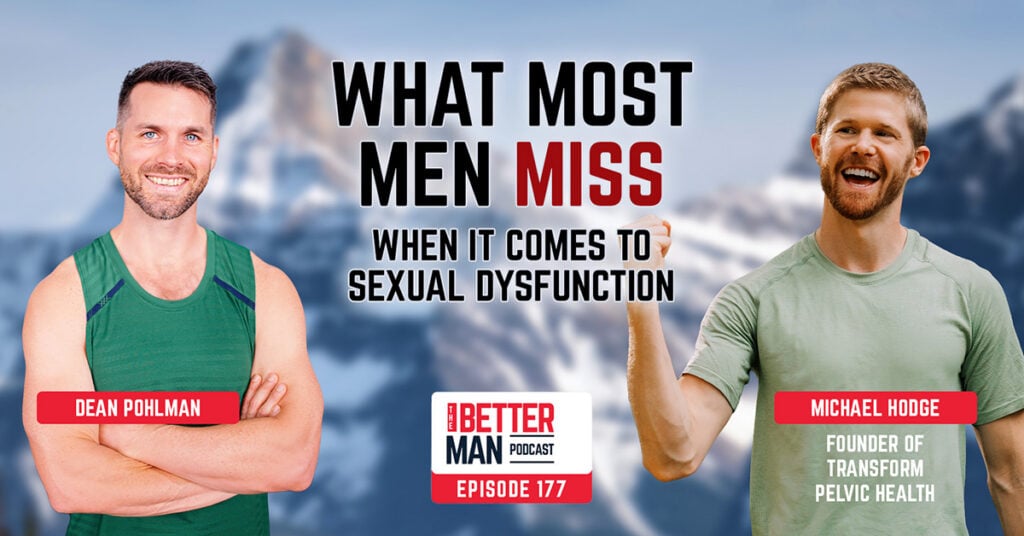
There is nothing more deeply humiliating or shameful, to men, than suffering from any kind of sexual dysfunction.
You feel like less of a man. You lose your natural sense of masculinity. And it allows your shame to consume your mind and trick you into thinking you’ll be laughed at if you bring it up to other men.
But something magical happens when you can talk about it openly:
It loosens the pressure vault and lets the tension in your nervous system relax. Why? Because your sexual wellness isn’t just about doing more kegels. In fact, that misses the point entirely.
Perhaps nobody knows this better than today’s guest, Michael Hodge.
Michael lived through 5 years of severe pelvic pain, urinary, and sexual issues, which culminated in his wife telling him that she doesn’t want to have sex with him anymore.
Since then, he’s merged his own healing experience with somatic nervous system practices which saved his sex life (and possibly his marriage). Beyond that, he’s helped thousands of men transform their sexual and pelvic health issues too.
Today’s episode will transform how you think about – and approach – your own sexual wellness. You’ll see why it’s a necessary ingredient to your overall holistic health. And you’ll leave with weird techniques that can make a significant difference to your connection and sense of pleasure (versus pressure) when it’s time to “get busy.”
Here’s what Michael and I discuss:
- Why your sexual health means so much more than your penis or pelvic floor
- How bringing more sexual energy into your platonic relationships improves your sexual relationship with your partner
- Why the best way to improve your sexual health is by playing more in your day-to-day life
The Better Man Podcast is an exploration of our health and well-being outside of our physical fitness, exploring and redefining what it means to be better as a man; being the best version of ourselves we can be, while adopting a more comprehensive understanding of our total health and wellness. I hope it inspires you to be better!



Use the RSS link to find the Better Man Podcast on other apps: http://feeds.libsyn.com/404744/rss
Episode 177 Highlights
- Why putting too much emphasis on exercises to address underlying sexual dysfunction can sometimes miss the forest for the trees (1:53)
- How Michael’s been through the complete ringer of pelvic floor and sexual health dysfunction – and what helped him to recover “down there” (6:43)
- A strange connection between “nice guy complex” and sexual dysfunction (10:08)
- Why type T personality types usually finish the quickest in bed (and how addressing your nervous system can help you last longer) (11:03)
- How somatic techniques can be wildly effective if you’re prone to bottling up your emotions (this made Michael cry the most primal cry of his life) (14:04)
- The scientific reason why purely mechanical approaches to ED and other types of sexual dysfunction leave you hanging (17:56)
- Do you feel “trapped in your body” when making love? Here’s why this is a common feeling (22:06)
- How to instantly quell any feelings of guilt or shame when you’re getting busy (and why this nervous system technique will help you last longer and enjoy sex more) (25:45)
- Are you scared that your partner will leave you because of your bedroom performance? Michael’s wife said that to him once (and here’s how he fixed it for good) (26:21)
- How to significantly increase how long you last by doing something that will make you recoil … but it WORKS! (43:01)
Dean Pohlman: And he learned a ton in his own experiences. And so through this episode, we’re going to talk about how your sexual health is not just related to your penis, it’s not just your pelvic floor. So much more of it is based on your overall health and wellness and your nervous system. And so we get into a lot of different areas.
Dean Pohlman: We talk about the importance of play. We talk about how sexual energy is creative energy. We talk about how even having more platonic relationships in your life is going to improve your sexual relationship with your partner. So I love this conversation. This is a really good one. If you are at all interested in improving your sexual wellness, this is a must for you to listen to.
Dean Pohlman: But I think what’s really reflective is you’re just going to learn how important your overall health is when it comes to its influence on your sexual health. So I hope you guys enjoyed this episode. I really liked it and I hope it helps inspire you to be a better man. Hey guys, it’s Dean. Welcome to the Better Man podcast.
Dean Pohlman: Today’s episode I’ve got Michael Hodges here from Transform Pelvic Health, and we’re going to be talking about what most men miss when it comes to sexual dysfunction. So, Michael, you reached out to me, by the way. Hello. Thank you for being here. Yeah, definitely.
Michael Hodge: Dean I’m looking forward to it. I think you provide a lot of super helpful information for the pelvic floor ed, premature ejaculation. And sometimes men can get hyper focused on fixing it through the exercises and be missing another component. So I just wanted to come out here and share some of that side of it.
Dean Pohlman: Yeah. And I’m glad that I get an expert on here because, you know, I get a lot of comments on we have we have some videos on YouTube that do really well for erectile dysfunction. And I get people asking super specific questions on there that I’m like, dude, I don’t know. I can’t answer that. Like I have no idea.
Dean Pohlman: Some people are like I have when I have, you know, when I ejaculate, it’s kind of like a clearer substance. I’m like, no, that’s that’s no, go see a professional like this is a YouTube video. I guess I am an expert in the sense that I know a lot more than most people, but like being able to diagnose based on.
Dean Pohlman: Yeah, that’s that’s that’s too much. So anyways, I’m glad that you’re here to to talk about this.
Michael Hodge: Yeah. And yeah. And I’m also I’m not a urologist. So by all means there are specialists that focus on the anatomy and physiology. But I have partnered with Pelvic Floor physical therapist to co-create programs. And I do have an advisor on my team who’s a urologist and another pelvic floor PT so we have some good clinical background, but I look at it more from the nervous system medicine side of it and my own personal experience.
Michael Hodge: I mean, I’ve gone through a lot of this myself too.
Dean Pohlman: Yeah. And I want to get into your personal experience. And I also want to mention that my wife started her own pelvic floor physical therapy practice about a year ago, and she had been an ortho. She had she had been an orthopedic focused physical therapist for ten years, or, you know, her entire career. And then after going through childbirth multiple times and especially after the C-section.
Dean Pohlman: And obviously this is for women, this isn’t for men. But after going through that experience and realizing how little, just like the basic things he wasn’t taught to like as as a woman about to give birth, just the things that they don’t know. Just like basic things that all women should know when it comes to giving birth. And also, you know, all women go through the recovery of birth after they’ve after they’ve had a child.
Dean Pohlman: And there are just basic things that women should be doing and basic treatment that that is just like almost thought of as, oh, that be one. They just don’t know about it. But they also I don’t they’re like, oh, I’ll just I’ll be fine. I’ll just I’ll just get by with incontinence for 18 months instead of going to a physical.
Dean Pohlman: There’s like it’s just wild that some of these things are not treated as regularly as they should be.
Michael Hodge: Yeah. They’re hidden. They’re in the gutter. They’re the parts of our bodies that we are afraid to talk about. Men especially actually are much more afraid to say they have anything going on down there. It completely rips apart through masculinity. They they don’t want to look as less than. There’s a lot of guilt and shame around it. Women’s sexual health.
Michael Hodge: Women’s pelvic health is quite far forward compared to men’s, I would say, due to kind of the taboo and the shame that men have around it.
Dean Pohlman: Yeah, I found that, you know, we we didn’t really I found that as soon as I started talking about some of these issues, like people really started coming out and saying, oh, this is me. You know, we’ve also got a lot of older guys in our community. So people who have had, you know, if they’ve had prostate cancer, if they’ve had and they’re, you know, they’re coming back from that and saying like, oh yeah, like it’s I don’t have function there anymore.
Dean Pohlman: But unless someone’s actually talking about it, they don’t know. And I agree with you that it’s something that’s just kind of not talked about and experience privately in shame. But people, you know, if they knew and they were able to have that shared experience, they’d number one, they’d feel better about themselves. Number two, they’d be able to go get the treatment they needed.
Michael Hodge: Yeah, yeah, it’s a part of your body. Whether your elbow is her, your penis, you know, whatever. It’s all we’re all human beings. We all go through things. We love one another. We help each other get better. You don’t have to be ashamed of it, you know?
Dean Pohlman: Yeah. So how did this. How did this become an area of focus for you?
Michael Hodge: Yeah. I never would have thought that I would be doing this kind of work. At the time, I was a martial arts instructor. I taught martial arts for many years. Always been interested in the mind, body, spirit, connection. All of that for sure. But when I was 22, I started having pelvic floor pain, perennial pain, urinary issues, and it got pretty bad though it wasn’t just kind of at the beginning, it was kind of in the background.
Michael Hodge: It felt weird when I was ejaculating, you know, discomfort when I was sitting down. Discomfort when I was working out. Went to three different urologist. They were just like, it doesn’t look like there’s anything wrong with you. So I’m going to give you antibiotics, which is almost always what happens like this is probably prostatitis. And nothing cleared out.
Michael Hodge: It wasn’t it wasn’t actually a bacterial infection. So it just progressed and progressed and progressed. It got so severe that the only really relief I would get would be lying on my back. I would like put my legs up, I would get in bed. It would get worse and worse throughout the day. So the mornings were sometimes not too bad.
Michael Hodge: I’ll be able to do some work, etc. but it was pretty hellish honestly. So it went on for five years. And pelvic floor issues, urinary issues, dysfunction, spasming you do? Not necessarily during that period. I did have that happen at another time. But premature ejaculation also was an issue for sure, because there’s already so much tension and dysfunction down there.
Michael Hodge: So when I was having sex, it was very weird. It didn’t feel right. I could not control that ejaculatory reflex. However, another aspect of the women trusted in pre is even after getting better for my pelvic pain and pelvic floor dysfunction, I was living life again, I was exercising, I was having sex, I was, you know, going, being able to go by my day to day pretty well.
Michael Hodge: But I was ejaculating quite a bit faster than I used to prior to ever having pelvic floor issues.
Dean Pohlman: What is like fast like what’s like.
Michael Hodge: For most people it would be less than one minute, but it could. It’s very subjective. So someone could be like, it’s less than two minutes or 3 or 4 because I used to ask ten minutes. And it’s a subjective, personal situation. I think in the research it’s classified as less than one minute.
Dean Pohlman: Okay.
Michael Hodge: But for me, I was pretty frustrated by that because I was like, okay, at least I’m able to live my life now. But I also want to have like connected sex with my wife and actually enjoy this. Yeah. And so that really led me on more of a path of like understanding that side of it too. And so that became part of my work as well.
Michael Hodge: And then EDI wasn’t even a thing for me until I was working on a program for Ed and Pre Jack, and it happened for like 2 or 3 months. I was like, what the hell is this?
Dean Pohlman: So you’ve had you’ve been at both ends of the, the, the, the, the sexual dysfunction spectrum or pelvic floor.
Michael Hodge: Yeah. I’ve had pre Jack was more of a challenge out of out of the two. But I even had gone through ed some. It’s kind of crazy. I’ve gone through almost every symptom that my clients can potentially go through. I didn’t have hard flaccid, which is a specific condition that I have a lot of clients with. I don’t want to have all of the potential conditions.
Dean Pohlman: But.
Michael Hodge: For whatever reason that’s happened.
Dean Pohlman: So yeah, I’m reading the book right now, and I just thought of this because it just came up. I’m reading a book right now called No More Mr. Nice Guy. And don’t don’t make your assumption based on the title. It’s, it’s it’s more a reflection of the state of, of men’s mental and emotional well-being. And there is a section on there is a section on sexual health, and it talks about how he’s never met someone who has this kind of nice guy complex who doesn’t also have sexual dysfunction, usually as premature ejaculation.
Dean Pohlman: And so it was interesting to me to read it there and just, you know, get I guess just get further further clarification or further, you know, support for the evidence that supports this idea of premature ejaculation. You know, being it’s it’s a mental, you know, it’s a mental wellness situation.
Michael Hodge: That’s a perfect way for me to segue into this conversation, because I talk about the type T personality, which stands for tension. So most of my clients honestly would probably be classified under type T. Type T holds things on the inside. They are very responsible. They are sometimes perfectionist. They’re quite organized. They fear confrontation. They don’t. They’re not the best at expressing themselves, making sounds, getting angry, moving it through.
Michael Hodge: So it’s holding things on the inside, being overly conscientious. It’s a nice guy thing you’re talking about. And it’s like, why would that translate into pre-check? Here’s the or other honestly pelvic health conditions as well. Not just predict, but it definitely translates well there. Because if we look at premature ejaculation, it’s like a geyser. Think of Old Faithful, you know, from Yellowstone.
Michael Hodge: And there’s this buildup of pressure in the system. And the more pressure that is already there, when there is sexual arousal, you’re already closer. You’re already closer to coming, because the sympathetic nervous system is that which activates for ejaculation the literary reflex to happen. So if you’re walking around on eggshells, if you’re holding it on the inside out of survivalism, honestly, but it’s been a conditioned response.
Michael Hodge: It’s a personality tendency that you’ve developed honestly to survive, to get by, to get love, to be approved by whoever in your childhood. It’s not necessarily the authentic state for many men necessarily, it’s just that they’ve learned that. And so expression like in our program, we actually we make sounds, we’re doing breaths, we’re moving our hips. You’re doing things that are more primal, more human, not just being in your head.
Michael Hodge: And so this moves things through and actually can kind of break down some of that tension.
Dean Pohlman: Okay. Wow. Yeah I mean I mean I’m just I’m going back to the book I was I’m rereading right now, but like it’s like that’s like checking all the boxes for this Mr. Nice Guy personality type. So you call it the type T personality. And I’m also looking this and I’m also looking at this and thinking like, oh wow.
Dean Pohlman: Like this. Kind of like this fits the boxes. This checks the boxes for me as well. Like this. You know, at least historically, I’ve been you know, I’ve been on this self-improvement journey for a while now, and I’d like to think that these are a lot of things that I’m working on or like, have at least improved in.
Dean Pohlman: But these are things that, you know, if you go back to how I formed as a child and behaviors that I adapted to, like you mentioned, just to survive, to fit in, to get loved, like, yeah, like these are all check, check, check, check.
Michael Hodge: So yeah. Me too, me too. It’s for me the emotional expression piece. It being safe to be emotional. It being safe to not have all my shit together all the time. Because that’s been my M.O.. I’m very reliable, dependable, responsible. I can set goals. I can complete them. Great. However, my body stores tension and incomplete emotions because I’m a human.
Michael Hodge: And so this is a factor. For example, in my own body, I’ve had this lower body abdominal tension thing that I’ve been working with for a bit, and I went to this kind of circling shadow work retreat thing a few weeks ago, and it was an amazing experience. But when it was my turn to go, the facilitator was having me breathes down into my belly, breathes down into my belly.
Michael Hodge: He was like filled out and like there are no thoughts, no emotions popping up. There’s a protector, there’s something guarding it. It’s like, no, it’s not. It’s not safe to feel that. It’s not safe to break down and cry or whatever. But I could sense that that needed to happen. And so the cell had people hold me on the ground.
Michael Hodge: My legs were being stretched out, my arms were being stretched out, hand on the throat, hand on the stomach, nowhere to go. You know where to go. He’s like, just keep lying there, taking it like you’ve always done your entire life. Keep choking it down because you know how to choke it down. Literally the body, it’ll start choking it down.
Michael Hodge: You’ll start swallowing what your body is trying to do. There’s an unconscious reaction to stop yourself from feeling the emotion. So it tightens the stomach. It tightens the jaw. And so there’s just working semantically to kind of break some of that up. I kept breathing, kept breathing. At first I got mad that I couldn’t even get sad.
Dean Pohlman: So yeah.
Michael Hodge: I was like pulling on all these people as hard as I could, yelling as hard as I could, so much anger and energy and I never get angry. So this was good, just like filled out. And then after a while, I tapped into this place that there was like no thought at all. And I felt it just started happening.
Michael Hodge: I cried the biggest cry have ever had in my entire life. It was so visceral. It was so primal. It was so. It was like beyond thought or even sadness or grief. The body literally has just held on to so much for so many years without actually expressing it. And so it’s kind of what we’re talking about. The more we do things like this, the more we open up to emotion and expression and what’s actually here, the body can just drop back into safety and fill the pleasure that’s there, you know, sexually.
Dean Pohlman: Wow. Yeah. I mean, I’m I’m getting anxious just hearing you talk about it like that. Sounds like it would be a super powerful experience.
Michael Hodge: I recommend it. Yeah, it was great.
Dean Pohlman: Yeah. I’ve. Yeah, I’ve. Yeah, I’ve never struggled with anxiety. I’ve never had really mental or emotional wellness issues other than the fact that I’m, you know, completely other than the fact that I was just, you know, completely a non emotional and just totally bottled up. But I had everything in control and then I and then like, the dam broke in a couple almost a couple of years, maybe a little over a year and a half ago.
Dean Pohlman: And then ever since then I’ve had to like, okay, this is what anxiety feels like. And so I’ve had to deal with a lot of that. But yeah, like these, those kinds of experiences that you’re talking about, those are like the those are the really powerful, transformative experiences that, you know, I’ve come to like, crave. I haven’t done as many of those or really any of those that I want to, but those are the kinds of things that I’m like, okay, that’s where that’s where the treasure is.
Dean Pohlman: I have a friend who says, like the the, the most valuable treasure lies in the deepest cave or like deepest, darkest caves. And anyways, that’s.
Michael Hodge: A really good one. I love that line. And and if people are wondering how is this relates to sexual health and all this and that, I mean, it’s highly related. And again, this is I especially help what I call the quote unquote hard cases. The people who are like, yeah, I’ve been doing Dean’s, you know, pelvic floor yoga every day.
Michael Hodge: I’ve been because I have some routines on YouTube as well. And they’re like, I’ve been doing all your stuff every single day. I do one of those routines and I’m doing the reverse Carroll’s, you know, ten times a day, and I’m doing Kegels ten times a day, and they’re like, really trying to follow that perfect Reddit post that they saw one time.
Michael Hodge: And they’re like, if I do that, I know I can fix it. And they’re looking at it in a very quantitative way. Like, if I just do this every day for the next three months, I know my premature ejaculation should go away.
Dean Pohlman: Yeah.
Michael Hodge: I wish it was that simple. But we’re not robots. It’s not mechanistic purely so. Although the musculoskeletal aspect does matter, it truly does. Like in our program we do that. We do pelvic floor exercises, we do coordination, we do the stretching and the relaxation and everything. We do solo sexual practices to repatriate how you actually engage with sex.
Michael Hodge: But this nervous system component, your baseline nervous system state, like I said, if your cup is already 80% full and then you go, you know, you start to have sex like it’s going to overflow really fast. So if we can have a more default, relaxed, parasympathetic and sympathetic kind of place, that’s where we want to be. Yeah, yeah.
Dean Pohlman: Got it. That’s pretty cool. I mean, I love that you’re coming at it from this perspective of, you know, I love that you’re coming at it from this from this perspective. Because, yeah, I mean that’s.
Dean Pohlman: That’s what it needs to be.
Michael Hodge: Yeah. Sorry. My my brain, my brain just died a little. My brain just died a little bit there, but I. Yeah. So I wanted to come back to your personal experience with premature Jack if you’re comfortable sharing it. So like going back to like when you you mentioned could not control. I wrote this down. You mentioned could not control ejaculatory reflex.
Michael Hodge: And, you know, all I have to go on is my own experience with sex. You know, I’m not you know, most mostly I don’t have. And as a society, we probably don’t like, you know, go around the dinner table sharing. Oh. What’s your experience like that would that would be weird. But maybe with your friends in a non I guess we talk about I guess when I was younger.
Michael Hodge: Right. We talk about sex and was like, oh yeah, I hooked up with, you know, but like it wasn’t, it wasn’t like, oh yeah. Like and I was like I was going. But then like I lost control, like, so I’m, you know, bringing it anyways, point being like, I haven’t had this conversation transparent very honestly now. Right. Versus whenever you’re like 17 you’re posturing.
Michael Hodge: Right. You don’t want to look bad. So. Right. Yeah. So what was that like. What is could not control ejaculatory reflex. What does that mean for you. Yeah. So what was happening is no issues getting an erection, no issues. You know, with that penetrating pretty soon after penetration. This. Yeah. First of all, there was a two different phases.
Michael Hodge: One phase is when I had really bad, like really high pelvic floor tension and pelvic pain. So there’s already like weirdness. It didn’t feel as normal or good anyway. Okay. There’s that. And so there’s already so much down there that didn’t feel as normal, that getting closer to ejaculation. It’s like there was a disconnect. It’s like things weren’t fully linked as the way I would describe it.
Michael Hodge: Okay, now let’s go to like post the pelvic pain and pelvic tension where my body was feeling more normal. Okay. But I was still, you know, feeling this point of no return way faster. And so yes, a lot of sensation in the lower belly and the penis. Right, the right before like point of no return kind of sensation.
Michael Hodge: It comes on so fast and even pulling out, I mean, they’ll slow it down a little bit, but they come up, they come on is just way faster than it was prior like years back for me. So it was extremely frustrating. And this is what most people would describe. They feel like they’re trapped in their bodies. Like I have clients who ejaculate before they even penetrate.
Michael Hodge: I have some people less than 30s, some less than a minute, you know, varying times whenever they start the program that we do. But ultimately, you don’t necessarily have conscious control anyway over ejaculation. It’s not like I can consciously choose to raise my right hand. You can’t consciously choose. I’m going to Jack right now or I’m not going to for three hours.
Michael Hodge: It is a it’s under autonomic control of the, the nervous system actually. But so yeah. Yeah it’s a sensation where it’s happening that arousal is there. It goes to the point of no return so fast. And then that exact reflex of the tightening of the pelvic floor muscles, the brain and the nervous system, the brain down the spinal column, basically initiating the emission phase.
Michael Hodge: And it just happens. Yeah.
Dean Pohlman: Yeah, I guess I’m, you know, I’m thinking to, Well, I’m just thinking of I don’t even know if I have anything to compare that to. I don’t know if I’ve ever not had premature ejaculation in that sense, because I’ve never I’ve never been able to like, you know, like, oh, yeah. Like we’re like, I don’t know, ten minutes in here or something, I think, I guess just speaking to personal experience, if I’m having sex often, then it doesn’t.
Dean Pohlman: It’s like, you know, it’s not as it doesn’t happen as quickly, like there’s less buildup because it’s happened recently. But I think to what I was thinking of when you were talking about that was the you know, I’ve read a lot of books where they talk about prolonging, you know, like having I don’t know if it’s tantric, tantric or whatever it would be, but, you know, having very prolonged lovemaking sessions where it’s like you’re going for hours and you’re not ejaculate.
Dean Pohlman: And I’m like, there’s no way. There’s just no way. Like, how does how does one build to that or like that? Just that just isn’t even on like, my reality radar, I guess.
Michael Hodge: Yeah. I mean, there are so many different sexual experiences that are possible and many that I’ve had in my life that are now way different than that period of time. That period of time sucked so much. The repatriating of that has to do with regulating your nervous system state, yes, on a day to day basis, but also even just in the moment.
Michael Hodge: So like if you’re going in, you’re like penetrating your wife and you’re like, this is seemingly a safe relationship. We’ve had sex a lot of times, but within, I don’t know, ten, 15 seconds. You’re already feeling that sensation. Come on to where you feel like you have to ejaculate.
Dean Pohlman: I just thought that that meant I was very fertile and, like, this is good. I’m doing what I was supposed to do. This is what biology wanted.
Michael Hodge: Some people have also looked at it that way. Yeah.
Michael Hodge: Yeah. Like, yeah, there’s that. The thing is, it’s all subjective. It’s a I want people to I want people to enjoy their sexual connection basically with their partners. So that’s the whole goal of this work. Not feeling trapped in your body. So but yeah, regulating your nervous system. And you know, we’ll probably get into this a little bit more in another episode.
Michael Hodge: But we’re basically calming. We’re making a change in the moment so you can even pull out, take a deep belly breath, drop the diaphragm, drop the pelvic floor muscles. Not only is it helping at the level of the muscles, but you’re shifting more into like parasympathetic. Because the thing is, you’re really revved up. There’s the sympathetic nervous system because of the arousal.
Michael Hodge: The more you’re in that sympathetic overdrive, the closer you are to coming. So if we can interject that with a kind of nervous system shift, that’s something we can do. And then you can reprocess even the thoughts, because there are often a lot of thoughts and emotions like feeling shitty, feeling shame, like, God, this is suck so much.
Michael Hodge: Like like for example, I mean, my wife didn’t even want to have sex with me anymore. She actually told me that she was like, it’s not even worth having sex with you anymore. And that was one of the hardest things. I mean, I had ever heard probably.
Dean Pohlman: Yeah.
Michael Hodge: I mean, and I, and I understood where she was coming from, but I also like deeply wanted to change it and wanted her to be a part of that change in some way versus me, just like being thrown to the corner like, hey, you just need to go figure that out. Like, I’ll just use it, you know, I’ll just use like a vibrator for, for like a while when you finally figure this out.
Michael Hodge: Can you come back and have sex with me?
Dean Pohlman: Yeah. So I’m I’m just. I’m going to paint my my picture for you. And you can see if this tracks with some of your other clients. I’m for a while, I for the period. For a period after I had kids for the first time, I didn’t. You kind of just lose your sense of what do you do for fun, right?
Dean Pohlman: You just kind of slowly lose that sense as an adult. And then also just me being myself, being like a very success oriented person, being very dedicated to to work, to my career, to my fitness, to my personal development, to all of that. And, you know, all my other free time really going to taking care of my kids and being there for family things, but not really having this sense of fun and not really just not really finding a lot of enjoyment in other areas of life.
Dean Pohlman: Sex was the one thing. Like, there was definitely a point in my life where I was like, no, sex is the only thing that I do for fun. And so it created a ton of pressure around sex also obviously created a ton of pressure around my wife or for my wife because even though I wasn’t, you know, specifically saying to her, like, this is the only thing good in my life.
Dean Pohlman: Actually, I take that back. I think at some points I did tell her, like, look, this is the only thing I have to look forward to. This is the best part of my life. So, you know. Ideally, this happens a few times per week and but yeah, you know, I just, you know, I remember that time being it wasn’t I guess it wasn’t really love making in that sense.
Dean Pohlman: It was just like, I need this to happen. And there was so much buildup in so much anticipation that, yeah, like, you don’t go into that and have like a long, controlled, very like down regulated love making session. I went into that and things happened very quickly. You know, I did my best to like, okay, like I’m going to try and draw this out, but there was no ability to like there was I had very limited control on like in regards to how long or not I could make that.
Dean Pohlman: And you know, I actually this this happened this was relatively recently. I think my wife actually was a little concerned because it lasted longer than usual. She’s like, what’s going on? Like, are you what are you doing? And I’m like, you know, most, most women I don’t think would be complaining about this. But like, the only thing that I could think of was, you’re right.
Dean Pohlman: It has been a few days. This usually would be a situation where it does last. You know, a does not last very long, but it didn’t happen like, you know, immediately, like it often does. And immediately, you know, let’s let’s say like less than a minute, like we’re saying here. And the only answer that I had to that was, you know, maybe my nervous system is just doing better overall right now than it was previously.
Dean Pohlman: Like, you know, maybe I’m not experiencing a lot of anxiety right now, and I feel good about letting emotions kind of move through me instead of holding on to them. And I’m expressing myself and I’m getting my needs met in other ways. I’m not only looking forward to sex and life. So.
Dean Pohlman: Yeah, I thought that was and I was also, I’m glad that we have this conversation on this podcast to be able to bring it up, cause I don’t know how many people I can just bring this up to in a conversation and say, like, I was having sex. And my wife got really mad at me because it lasted longer than it usually does well.
Michael Hodge: But that was a great story, and it’s actually happening in your life and everything. And it made me think of this metaphor whenever imagine you’re in the desert, it’s really hot. I mean, you’re just sweating and someone offers you ice cream, you’re gonna eat a fast. So what happens is, like you said, your body is intelligent. It has needs.
Michael Hodge: It has these like neurochemical, endorphin, kinds of hormonal needs and whenever that’s the main way you can get it, it’s going to happen faster that you’d be definitely like running uphill to not make it happen as fast. So like you’re saying, you’re more regulated. You’re getting needs met in different ways. Maybe you have other kinds of intimacy and affection, male bonding even, I don’t know, like different kinds of play, sex can now also be more playful.
Michael Hodge: And it’s there’s not as much pressure built up around it. So as a perfect explanation of how the ejaculatory reflex can change, it’s a spectrum that can really change over time depending on situations. Yeah.
Dean Pohlman: Wow. Okay, cool. Yeah. I’ve you know, I’ve also, you know, looked at how.
Dean Pohlman: We’ve we’ve had conversations. We had we started couples counseling maybe a year after duckling was born. That was my first son. And that would have been 2020. And I think we did it for her. We did it on and off for a few years. We stopped a couple of years ago because I feel we just got to a place where we could have the conversations ourselves, and we felt like we were more open.
Dean Pohlman: But the yeah, we kind of realized through those conversations that for, for, for us at least, sex had become like a what this book that I mentioned to you earlier, it was kind of just like a covert contract, just kind of like an unwritten agreement between us there, an unwritten. Well, I don’t know if she knew it, but I knew it in my head.
Dean Pohlman: It was, hey, I’d be a good husband and I get sex. And so even though I did not explicitly say that to her, you know, she’s a woman, she’s intuitive. She picks up on these things even if I don’t say it. So unconsciously. There was this understanding of that. And so for her, like, she didn’t really look forward to sex.
Dean Pohlman: But on the other hand, I’m like, this is all I want, and there’s nothing else fun in my life. So point being, like, it puts a lot of pressure on her too. And so I, you know, I realized over the last, you know, probably relatively recent, I’d say over the last few months, like being able to be more selfish and get my needs met in other ways.
Dean Pohlman: Not not the not the strip club that’s a mile away from house, but just other needs, other things in life that bring me fulfillment and bring me connection. It puts less pressure on her and it puts less pressure on the ejaculation to be what I need. It’s because I have other things now. So yeah. Anyways.
Michael Hodge: No.
Dean Pohlman: You don’t.
Michael Hodge: Make sense. Have you found anything recently that you enjoy doing? Kind of to for fun? That’s not success driven. I’m working.
Dean Pohlman: On it. Have the.
Michael Hodge: Same.
Dean Pohlman: I did I actually last week. I’m really proud of myself for this. I messaged maybe about a month ago. I started messaging a bunch of the dads from a bunch of dads that I knew with kids and a bunch of dads from my son’s Montessori school and asked him, hey, like, I think I’m going to set up an informal men’s group.
Dean Pohlman: And everyone said yes! And I got them together last week, so got them together on Friday. And we all went to, you know, went to a restaurant and we hung out. We just talked for an hour and a half. Oh, this is awesome. And I think that was like one thing that I’ve, I’ve wanted to do for a long time, but I just haven’t.
Dean Pohlman: And I think this is a this is a topic. This is a theme that comes up a lot in the different relationships that I’ve heard about from within our mantle yoga community, but a lot of guys are just scared of scared of asking their partner for time to go do other things. And so I think for me and for, for my wife, it just got to a point where she realized, you know what?
Dean Pohlman: You’re just not fun to be around at all. I don’t even care if you’re here. Just go do what you need to do. And so instead of me having to, like, pull teeth to say, like, can I please leave for two hours on a Saturday, I know that you’ll be watching the kids, but can I please leave it turned into you just need to get out.
Dean Pohlman: Period. And so I hope that that’s not what every. I hope that that’s not like what the situation is. And and to be fair to myself, like that was a situation in which like, I was super overwhelmed and I was talking about like where my mental state was and just not in a good place at all. And she was like, yeah, like, I can’t be everything.
Dean Pohlman: Like, I can’t be around this all the time. Like, you need to go do what you need to do. If you need to go do like more retreats or like more events or like go do it like I’d rather you be go taking care of yourself then like being the way that you are now around us all the time.
Dean Pohlman: So anyways, all that to answer your question, meeting up with other men has been helpful. I also want to one day by a video game console and start playing video games again. That’s on my that’s like my Mount Everest right now is like, can I have.
Michael Hodge: To do that too? I want to do.
Dean Pohlman: But can I have the self-control to do that and not like just become a gamer? I don’t know.
Michael Hodge: See, it’s funny because I love video games. When I was in high school and I stopped playing them, would you play like 18? Because like, I’m an entrepreneur like that. My business is more important than anything else than I’d have been doing that for many years. But recently I was like, that’d be fun to play Halo again. I loved playing Halo.
Michael Hodge: Is that what she played? Yeah.
Dean Pohlman: Okay. Yeah yeah, yeah. And then. Okay. X-Box. Yeah. I had a two and I played a what did I play with like God of War. I was like one of the last big games that I play. But I also played real time strategy games. So I played like age mythology on my computer up until I was like 18.
Dean Pohlman: And that was a ton of fun. Yeah.
Michael Hodge: So yeah, I played a couple of games like that too, and then I’d be like, oh, look at all the time I wasted though, right?
Dean Pohlman: Yeah.
Michael Hodge: The yeah, yeah.
Dean Pohlman: The success manager part of you was like, what are we doing? Let’s. You can’t have fun. You’ve got to create things to be. You’ve got to create things. Otherwise everyone’s going to leave you. Yeah. And yeah, yeah.
Michael Hodge: But I finally let myself start doing something just for art, for the purpose of just Joy, which is making electronic music. So producing electronic music. A couple of years ago, I started getting into learning the, the piano, the whole thing because, like, I love EDM and I’m like, I want to make amazing songs that like represent the sounds of my soul.
Michael Hodge: And it was. But I was this, this thing, this part of me was co-opting it so fast. It was like, this is how we’re going to like release on Spotify, and we’re going to get on the label by next year. And like, my concerts are going to be unlike any other concerts that’s ever been out there. And this is the way that will happen.
Michael Hodge: And then I was getting all this pressure is dressed in like headaches every time I would go to the computer because it wasn’t play. I mean, I wanted it to be play, but I also wanted it to be like world class. But yeah, it’s been a learning for me to, like, I just want to have fun.
Dean Pohlman: Yeah. It’s hard to find the intrinsic joy of what we’re doing. That reminds me of like the men’s group that I talked about last week, like I was there to be a participant, but I kept on noticing myself slipping into the role of like, men’s wellness community leader instead of just being a participant. And I was like, you know, looking at the clock, I was like, making sure that people didn’t talk too long.
Dean Pohlman: I’m like, hey, you didn’t talk yet. What do you think about this? And so, you know, very quickly I shifted into, you know, I shifted out of participant into like, you know, moderator role, which is not the point of it. The point of it is to the the intrinsic benefit of connection with other men. It’s not meant to be like this is a way for me to my skills of being a community facilitator.
Dean Pohlman: So yeah, I sympathize with the, you know, the product, the productive manager. Do you call it a manager? What would you call it?
Michael Hodge: Yeah, the manager mind. I mean, something like that. Yeah. Totally understand and like to bring this back even to our whole, like sexual health conversation. Sexual energy is a playful, creative energy. So when you’re playing for you’re not everything isn’t so serious. And you actually prioritize having fun again and joy and even a kind of intimacy with men as an example, you know, if you’re heterosexual.
Michael Hodge: But so you’re like, experiencing this kind of intimacy and connection even with the same sex, which is also beneficial. So you’re not like bringing all like sexuality is just when I’m with my partner and like for this and that. Like it’s a playful connective energy with all of life. It’s like a polyamory with life, even if you’re monogamous with your wife.
Dean Pohlman: Okay. That’s cool. That’s a cool way thinking about it. And I just want to say to your wife or your husband, a lot of gay. We have a lot of gay men in our community. So that’s thinking about it from the I like that. That’s that’s a really cool way.
Michael Hodge: Of saying. And I said, why? Because it rhymed with life. So. Oh, I was being poetic. But it’s absolutely for everyone.
Dean Pohlman: Yeah, I was, I was you were saying earlier I resisted making the joke because it was kind of serious, but you were talking about how your wife didn’t want to have sex with you, and you said, and I can see where she’s coming from. And I wanted to say, well, she wasn’t coming. That was the issue.
Michael Hodge: That’s so you should have done it. It would have been. I was it was an emotionally raw moment, even as I said it to you, though. So it was good.
Dean Pohlman: I saw that and I, I try not to always be funny, because I really like when men are able to get into these emotional states or like, were they able to be vulnerable and raw. And we very often use humor as a way to get out of it. And so I try not to try to be conscious of like, okay, not the best time to make a dope.
Dean Pohlman: Gee, not not not a good joke. Time being. Yeah, yeah. And that’s something that I like at the at events that I host. We just did an event in Boston last month and I don’t know, this month. And there was a yeah. Like I would walk around and look at the different conversations groups are having. And I’m generally like trying to perform and like being funny.
Dean Pohlman: And so sometimes I would come into a group and I’d like, I’d use humor. And they were talking about like something really serious about, oh, sorry, didn’t mean to make a joke there.
Michael Hodge: Yeah, exactly. No, I love that you bring that up because men usually just joke about sexuality because they’re trying to hide from how they actually feel about it and what’s going on. So, yeah.
Dean Pohlman: So do.
Michael Hodge: You like, for like, 20 minutes after the emotional unveiling?
Dean Pohlman: Exactly. Yeah. So like, what are the like how can, like how would you have a, like a conversation about sex with other men, like how did you do you, did you do that. Do you do that or do you do this like with with clients like, do you have friends that you have that you talk about sex with or like, what does.
Michael Hodge: I do personally now? But I mean, it’s very different than when I was younger and like going through these issues. One thing I say about premature ejaculation is if you’re able to make a video and say, like, yeah, I’m dealing with this thing right now where I’m ejaculating faster than I’d like to. I know I can change it, but that’s what’s happening right now.
Michael Hodge: If you’re able to make that video and post it publicly on the internet, your issues with pre jack or about to go way down. So there’s a kind of fear, a resistance, a shame around it that is like a cloud following you. And so the fact that I don’t have that now about any of the sexual stuff is quite liberating.
Michael Hodge: And I think it sometimes takes people by surprise. Oh my gosh, like, I was talking to a guy at dinner a few nights ago. We had just met and he was like, oh wow, I didn’t know you did that work. And like, I’m actually dealing with this Eddie thing right now. And he’s just like, so hush hush about it.
Michael Hodge: Like, he feels so bad about every single sentence that he says. Like he doesn’t want anyone to hear him. I’m like, it’s literally okay. Like you’re just a human being. Like, I have things that happen to and like, here’s how you can change that. So I’m just very it is what it is like. It’s a part of. It’s a beautiful part of life.
Michael Hodge: If I can help you with whatever is it finances? Is it moving your house? Is it your penis? I think that I’m aware there are certain levels of like with children, and there’s certain kinds of censorship that makes sense until someone has a more mature understanding of life, let’s say. Yeah, but as adults, I don’t see a reason to keep it hidden underneath the rug.
Dean Pohlman: Yeah. And, spoiler alert we’re doing follow up episodes for this. So we’re going to talk more about premature ejaculation and erectile dysfunction. So we’re going to group the first one as coming too quickly. The second one is inability to get an erection. But I do want to ask you about like you mentioned, I was really intrigued by this, this shadow work retreat that you went to.
Dean Pohlman: Like what are some of the what are some other like really powerful experiences that you’ve had? Yeah.
Michael Hodge: Gosh. Good question. So when I started getting into meditation like more consistently, I really liked Doctor Joe Dispenza meditations. For a while I was doing a lot of his meditations. Yeah.
Dean Pohlman: So guided meditations.
Michael Hodge: Yeah. Guided meditations. Doctor Joe Dispenza, he’s kind of like the guy who brought together science and spirituality. He really explains what’s really what’s happening. You know, how spontaneous remissions happen, what takes place in your consciousness. The brainwave states everything when you are meditating. Basically, I’m just saying that I started to have more space with less thoughts and more of an experience of like energy and consciousness through that.
Michael Hodge: That was just like a part of being able to see thoughts and not believe them as much and not just be my thoughts is the way I describe it. So that was pretty helpful. I didn’t think I was like, I don’t really need to do psychedelics or plant medicine. You know, I do my own meditations, but I could tell there’s a bit of a fear around ayahuasca, and it kind of like, I don’t really know.
Michael Hodge: I don’t really want to give over my conscious control. I don’t know what’s going to happen. And so anytime I feel a fear, if there’s like there’s like a fear around something, but also like an intuition to like go there and open up more like, I know I have to do it even if it’s scary. So yeah, but yeah, doing ayahuasca was definitely.
Dean Pohlman: Oh, you did ayahuasca okay.
Michael Hodge: Very, very much a submission. Right. Submitted the ego because.
Dean Pohlman: Was that your first plant medicine experience. Yeah. Oh okay. So you just like, jumped in the deep end.
Michael Hodge: I went from nothing, like never doing drugs, being clean my whole life. Like, I don’t even know what it’s like to be, you know, smoking weed or something to go extreme. Like, honestly, if you can do, like, psilocybin first you’re smoke weed or like, I would probably do those things first. I was crazy and.
Dean Pohlman: Yeah.
Michael Hodge: But in a good way too. So it completely like, yeah, it was like this thing you think you are this ego that’s so important to you. You know, it broke things apart. So it was very helpful. You could say I’ve done other plant medicines to. But yeah, also like this thing I just went to three weeks ago was so awesome.
Michael Hodge: I mean, no plant medicine. It was just people in a circle. I can’t I’m not going to get into it so much, but it’s a kind of circling technique that they do in a prison system. So they started doing this to help prisoners who have really deep trauma. And the recidivism rate, the amount of people who go back to prison after being a part of this kind of thing is extremely low.
Michael Hodge: It’s one of the most potent therapies ever done in the prison system in the US. And why is that? Because these somatic memories, these incomplete emotions and traumas that get stored in the fascia inside the body, that turn into chronic health conditions and addictions and depression and anxiety and all of that, they get viscerally felt. I mean, there’s nowhere to run.
Michael Hodge: It’s right there. The grief of your sister dying ten years ago, or, you know, just holding the burden of never having fun or whatever. Like everyone has something different, basically. And and I saw every single person in the circle have some sort of tremendous somatic release. Wow. It would also different. One person, like we laid her down on a bed of pillows.
Michael Hodge: She just lost a friend who had died. And like, we were just repatriating love because she’s always giving to others, but not very good at receiving. So everyone had a hand on her and we were all, like, massaging her and loving her. And she she’s not used to that, you know. So like, she had to repatriate that it’s okay to be loved for, for nothing.
Michael Hodge: So like every person had a different kind of experience. But by all means, that was a pretty big one for me.
Dean Pohlman: Wow.
Michael Hodge: That was really great.
Dean Pohlman: Yeah. And, yeah, I’m just impressed that you did. And the ayahuasca for you, like, you came back okay. Yeah.
Michael Hodge: Oh, yeah. I mean.
Dean Pohlman: Yeah, I mean, I, I asked because I had a, I did an act. I don’t, I don’t know if I talked about this, I basically did an accidental psilocybin dose. I thought I was taking a micro dose and I was not. And it turned on to like a full on trip for me. And I did not handle it well.
Dean Pohlman: That’s what led to me having anxiety like I just did. I didn’t have proper like guardrails in place. I didn’t have a guide I didn’t have. I just did it in all the wrong ways. And to be fair to myself, I didn’t think I was doing like a full dose, so I didn’t think that it would happen. But yeah, for me, it just it, it happened in all the wrong ways.
Dean Pohlman: And eventually, you know, looking at back like a year and a half later like, yeah, it like opened a bunch of doors and forced me to deal with a bunch of stuff and learn about, learn a lot more about myself. But like, I’m not as mentally stable as I used to be. It’s forced me to, to heal, you know?
Dean Pohlman: Essentially.
Michael Hodge: Yeah.
Dean Pohlman: But it’s not in a not in a easy way.
Michael Hodge: It can be. Yes. Destabilizing. But yeah, the set and setting, who you’re around. Gosh, the way that that happened for you would be super rough for sure.
Dean Pohlman: Yeah.
Michael Hodge: Yeah. Because I knew I was walking into something. I didn’t know exactly what it would be like. It was way like crazier than I realized. Like, I thought I’d have some kind of, like, conscious control or no, that was not happening for me. But nonetheless, it was breaking apart the ego and my connection and belief in who I am.
Michael Hodge: And this kind of identification with conditioned patterns that I could see through. I’m like, oh, this is conditioning. This isn’t necessarily like my authenticity. Yeah. So it makes you heal and change and release. Yes. But there is less of a belief in thoughts that appear now. So like repetitive thoughts from the past, it would have reactivated that conditioning can appear right.
Michael Hodge: But I don’t necessarily believe it or let’s say give it as much energy anymore. And the way I probably like this is just who I am.
Dean Pohlman: And probably doesn’t feel as intense. You probably have to like you think about it and you’re like, oh, okay. And then you move on. It’s not like something like you ruminate on anymore. Yeah, and.
Michael Hodge: I don’t even think about it. I don’t know how it appears. I don’t think I have choosing those thoughts to appear. So.
Dean Pohlman: Yeah. And bringing it back to the topic of this, this, this episode, you know, I think most guys say that they want to have a better sex life and it’s you’re not going to get a better sex life by doing more Kegels necessarily. Right? It’s going to come from improving overall holistic wellness, like what we’re talking about here, like being able to be in a creative state where you are able to experience play and joy, and having a down, down, regulated nervous system where you are not constantly in fight or flight, where you’re not stressed about work or stressed about, you know, whether or not people like you or, you know, stress about whether or
Dean Pohlman: not you’re pleasing your partner. So like and I think. Ironically, were this like, I think that what’s ironic about this is the way to have better sex is to make the rest of your life better so that you don’t care as much about having better sex, I guess. Would that be?
Michael Hodge: Yeah. And it’s moving from pressure to pleasure, presence and connection. So it’s like, that’s what it’s about. We’re connecting. This is pleasurable. Maybe it lasts a long time. Like for I’m not a stickler about it. There are people who, you know, work as teachers and guides and they’re like, oh, you know, I need to have multiple nonobjective orgasms, and I’m not going to jack it for like nine months.
Michael Hodge: And I’m I’m just like, I want to connect so deeply with my partner that like, the love is felt and every single part of me like it’s the love and body and maybe it’s a ten minute thing. Maybe it’s two minutes, maybe it’s 30. It changes all the time. If we’re disconnected in the heart, that hurts a lot more to me than anything else.
Michael Hodge: So for me, it’s all about love, not lust.
Dean Pohlman: Yeah. Okay. All right. Well, this has been an awesome conversation. I’m going to go ahead and get into our rapid fire questions, because I know we have more opportunities to talk later and we will. This has been a this has been awesome. What do you think is one habit, belief or mindset that has helped you the most in terms of overall happiness?
Michael Hodge: Not believing every thought that appears? I’d have to go back to that because the thoughts will appear to run like right now it’s sunny outside. It’s a beautiful day, but the thought could appear like that, I don’t know, there’s not enough money in my bank account because we’re behind and like, I need to work more and like I need to go and, like, change our strategy for the business or whatever.
Michael Hodge: So there could be like a thought that appears again, and then you go down that rabbit hole and if you can throws off the beauty of this moment.
Dean Pohlman: Yeah. Yep. All right. What’s one thing that you do for your health that you believe is overlooked or undervalued by others?
Michael Hodge: It would be playful things like dancing. Yeah. Dancing. Dancing. Alone at home, going to ecstatic Gans. I didn’t used to dance ever until I was 29 because I felt self-conscious about it. I was afraid of it, and of life was more like exercise and, you know, stretching and blah, blah, blah. But I would say something like, yeah, dancing.
Dean Pohlman: Yeah, okay. That’s a new one. Love it. What’s the most important activity you regularly do for your overall stress management?
Michael Hodge: Interesting. Probably just going on walks outside in nature. I love being in nature, so.
Dean Pohlman: Yeah. And where do you live?
Michael Hodge: I live in Arizona and Texas. So both places. Yeah.
Dean Pohlman: Okay. All right. What’s the most stressful part of your day to day life?
Michael Hodge: The most trustful part. Interesting question. I think it would be whenever I am putting pressure on myself to get a lot of things done in one day. So it’s more of like if I overload my own schedule and think, I have to get all of those things done, that would be that. That would create so much stress.
Dean Pohlman: Yeah. Okay. What do you think is the biggest challenge facing men and their wellbeing right now? Last question.
Michael Hodge: Being disconnected from their emotional state. Like what’s actually going on, what’s stirring underneath and feeling safe enough to express that in a way that doesn’t have to mean violence. It doesn’t have to mean losing everyone that’s around you. It doesn’t have to mean the loss of your work or your career. So it’s like deep, vulnerable emotional expression is quite devoid.
Michael Hodge: And most of our male circles right now.
Dean Pohlman: Yeah. Okay. Solid answers Michael. Where can people learn more about you?
Michael Hodge: Yeah. Transform pelvic health. Transform public health or social media at Transform pelvic Health. Great way to connect. I’d love to help anyone I can.
Dean Pohlman: Okay, awesome. And just for everyone listening, we’re going to do follow up episodes because sexual wellness for men is a huge topic. So we’re definitely going to talk about premature ejaculation. And we’ll also do one on a rectal dysfunction. So be on the lookout for those. Michael this was like I knew that this would be a good conversation, but I don’t think I knew it would be as good as it was.
Dean Pohlman: So a lot of gratitude for you for joining me and like having this amazing conversation. Thank you.
Michael Hodge: That’s what he said.
Dean Pohlman: Thank you.
Dean Pohlman: Oh, you ruined it.
Dean Pohlman: All right, well, guys, I hope this inspired you to be a better man. I hope it inspires you to look at your sexual wellness in a different way. And I will see you guys on the next episode. All right, guys, I hope you enjoyed that conversation. I’m I again, I really like that conversation. And I even told Michael at the end I’m like, dude, this is an awesome conversation, so I hope you enjoy it as well.
Dean Pohlman: If you want to go check out Michael and what he does with Transform Pelvic Health, he has a YouTube channel. He also has a lot of does a lot of one on one work. So check him out. Links for all of that in the show notes below. Also subscribe to the podcast if you haven’t already, because we are going to be doing a follow up episodes for this.
Dean Pohlman: So we’re going to be doing one for premature ejaculation, one for a reptile dysfunction as well. If you’re enjoying the podcast, leave a review wherever you watch. We also have video versions of the podcast available on the Veteran Podcast YouTube channel, as well as in the app and members area. If you’re looking to join a wellness focused community of men, that is more than just yoga that gets into all areas of your health and wellness.
Dean Pohlman: The Mantle Yoga community is amazing. For this, you can get a free seven day trial, check it out at yoga. And I’ve also got a free 70 challenge. If you’re not quite ready to do a trial yet, then that’ll give you seven 15 minute workouts to help you learn how fitness centric yoga for men can improve your life.
Dean Pohlman: So.
Dean Pohlman: For that guys, I hope you enjoyed this episode. I hope you’re enjoying the veteran podcast. I hope it inspires you to be a better man. I will see you on the next episode.
[END]

Guest Bio
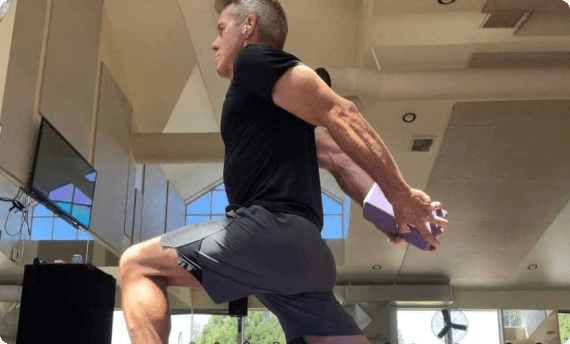
Michael Hodge lived through 5 years of severe pelvic pain, urinary, and sexual issues. By merging his own healing experience with nervous system practices, he is helping thousands of men to transform their pelvic health. He also really likes dark chocolate and produces euphoric dance music.
Resources mentioned in this episode:
- Transform Men’s Pelvic Health Website: https://www.transformpelvichealth.com/
- Miachel’s Vigor Sexual Strength Program (for ED and PE): https://bit.ly/vigorstrongsex
- (Use code MANFLOW to save 15% on Michael’s Vigor program.)
- Overcome Pelvic + Urinary Issues Program: https://bit.ly/overcomepelvicpain
- Follow Transform Men’s Pelvic Health on social media:
- Youtube: https://www.youtube.com/@TransformPelvicHealth
- Instagram: @transformpelvichealth
- Tik Tok: @transformpelvichealth
Man Flow Yoga Events: We just announced new locations for 2026 in-person events. Find the full list of cities we’re coming to here: https://manflowyoga.com/man-flow-yoga-events/
Want to unlock more flexibility and strength, reduce your risk of injury, and feel your absolute best over the next 7 days? Then join the FREE 7-Day Beginner’s Yoga for Men Challenge here: https://ManFlowYoga.com/7dc.
Tired of doing a form of yoga that causes more injuries than it helps prevent? The cold, hard truth is men need yoga specifically designed for them. Well, here’s some good news: You can start your 7-day free trial to Man Flow Yoga by visiting https://ManFlowYoga.com/join.
Like what you’re hearing? Sign up for the mailing list:
Rate & Review
If you enjoyed today’s episode of The Better Man Podcast, hit the subscribe button on Apple, Spotify, or wherever you listen, so future episodes are automatically downloaded directly to your device.
You can also help by providing an honest rating & review over on Apple Podcasts. Reviews go a long way in helping us build awareness so that we can impact even more people. THANK YOU!
More Podcast Content
Take Off Your Mask & Remember Yourself! | Be The Better You Retreat Recap with Coach Patrick | Better Man Podcast Ep. 192
At the latest Be The Better You Retreat we focused on a powerful idea: remembering yourself. Today we explore how the…
Dark Motivation Works … But It Causes a Mid-Life Crisis (Try this instead) | Connor Beaton from ManTalks | Better Man Podcast Ep. 191
Do you ever feel like you’re just wandering through life without a purpose, or stuck in the middle of a frustrating…
Fitness After 40: How To Start When You’ve Never Exercised (The Man Flow Yoga Catalyst Effect) | Bobby B. | Better Man Podcast Ep. 190
Turning 40 was Bobby’s wake-up call. After a lifetime of skipping workouts, a doctor’s visit revealed warning signs in his blood…

Gut Health Goes Way Deeper Than Weight Loss | Ben Brown (Founder of Body Systems Coaching and Head Nutrition & Fitness Coach) | Better Man Podcast Ep. 189
Gut health impacts far more than weight loss—it directly governs your energy, immunity, and mental well-being. If you grew up in…
Moving From Your Survival Path to Your Soul Path | Caleb Campbell (Former NFL player & West Point graduate) | Better Man Podcast Ep. 188
If you’re an endlessly striving achiever, you know the path forward lacks clarity. Former NFL linebacker Caleb Campbell used his feelings…

The Ethics & Use Cases of AI | Ted Phaëton | Better Man Podcast Ep. 187
The topic of AI is unavoidable. Ted Phaeton, productivity coach and host of the Modern Man Podcast, joins the show to…