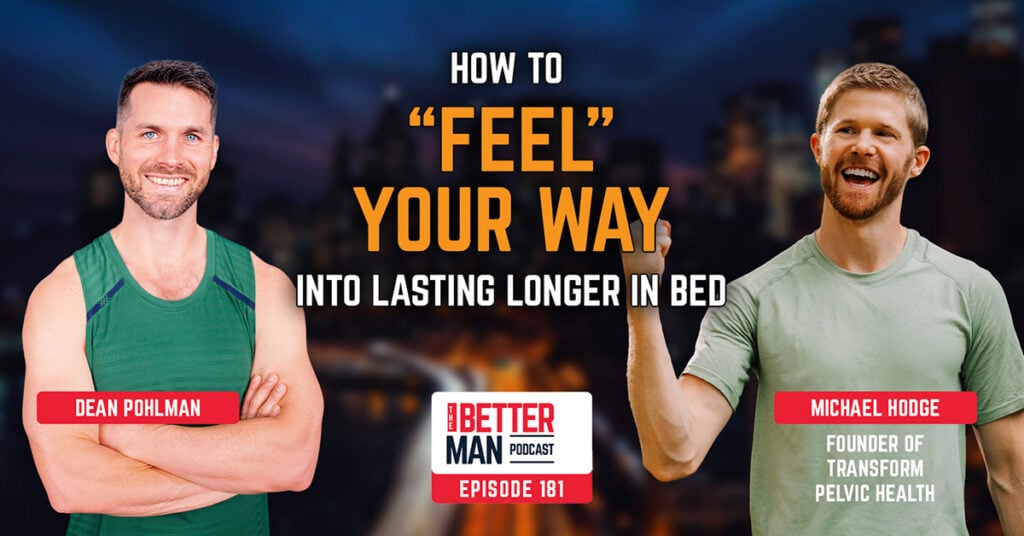
Michael’s worked with over 1,500 men over the last 7 years helping them to conquer every type of sexual dysfunction they’re going through.
One such way sexual dysfunction manifests is with an inability to last longer than 60 seconds during sex. Or premature ejaculation for short.
The problem Michael’s stumbled upon, both through his own struggles and with coaching 1,500+ men through it, is that kegels are not enough. Sometimes they can actually make you finish quicker. But the reality is, if kegels solved this problem reliably for men, no man would suffer from finishing too soon.
The real root of the problem is deeper and scarier:
Your nervous system.
Modern life is set up in a way that sets everyone at a higher baseline level of the sympathetic nervous system (also known as the fight-flight-freeze response). This naturally lowers how long you last in bed. And then there are other problems like porn, sexual shame, emotional dysregulation, lack of emotional expression, overthinking, and the list goes on.
In other words:
If you struggle with premature ejaculation, you likely think it’s a purely physical condition. But Michael’s work over the last 7 years shows us that treating it as a purely physical condition sets you up for failure.
That’s the bad news.
The good news?
Michael’s helped thousands of men like you and he shares some of his top tips in this episode.
Here’s what Michael and I discuss:
- Why premature ejaculation isn’t only a physical issue
- How your mind hijacks your nervous system and makes you finish faster
- Why feeling your way into lasting longer is a more effective strategy (and Michael’s favorite tools that make this easier)
The Better Man Podcast is an exploration of our health and well-being outside of our physical fitness, exploring and redefining what it means to be better as a man; being the best version of ourselves we can be, while adopting a more comprehensive understanding of our total health and wellness. I hope it inspires you to be better!



Use the RSS link to find the Better Man Podcast on other apps: http://feeds.libsyn.com/404744/rss
Episode 181 Highlights
- How treating premature ejaculation like a purely physical condition can tighten its grip on your sex life (1:15)
- Why kegels can actually make you finish sooner (1:53)
- The strange way modern life itself can make you climax faster (and the holistic solution to last longer) (2:46)
- The “Pelvic Repatterning Method” Michael Hodge first used on himself, then 1,500 of his students, to reverse their sexual dysfunction (7:50)
- How to naturally take the pressure off of sex by engaging the 5 senses (and some of Michael’s favorite activities to accomplish this) (19:12)
- Why Michael’s 8-week “Vigor” program, currently 15% off to the MFY Community – the coupon’s in the show notes, can help you last far longer in bed in two short months (and maybe even faster!) (20:22)
- The biggest mistake men make when they’re trying to regulate their nervous system (25:19)
- How your intelligence holds you back from healing your emotional gunk that’s causing your nervous system to go haywire (27:38)
Dean Pohlman: Hey guys, it’s Dean and welcome to the Better Man Podcast. Today’s episode is an interview with Michael Hodge from Transform Pelvic Health. And in this episode, we’re going to be talking specifically about premature ejaculation. So what is premature ejaculation? We’ll also talk about what actually causes premature ejaculation. I think most people think about it as a primarily physical condition.
Dean Pohlman: In reality, premature ejaculation is mostly a symptom of overall health. And so we talk about how Michael helps people with his program, with transformed pelvic health, and how he gets you to look at all of the potential causes of premature ejaculation, and how it actually helps you to improve your life as a whole as a result. So this was a really cool episode, and if you’re suffering from premature ejaculation or if you don’t know what it is and you might just want to improve your own sexual experience, I think this is an amazing conversation and I would highly recommend you give it a listen.
Dean Pohlman: So give it a shot and I hope this inspires you to be a better man.
Dean Pohlman: Hey guys it’s Dean. Welcome to the Better Man Podcast. I’ve got Michael Hodge back from Transform Pelvic Health and we’re going to be talking about premature ejaculation. So Michael thank you for joining me.
Michael Hodge: Yeah. Good to be back. Dean. We’re going to get into what’s causing this and what you can do about it. But we want to look at the nervous system and really things that people sometimes miss. A lot of people who follow your podcast probably try your yoga routines and they’re very useful, and they do a lot of other sexual training techniques, yet they’re still dealing with premature ejaculation.
Michael Hodge: So this is going to be really useful for people who seemingly have tried it all. And it’s still happening.
Dean Pohlman: Yeah, I’m excited. And I was excited to have this first conversation with you because it kind of explained sexual wellness from a different perspective. I think a lot of us look at that as a, as a physical issue, right, where it’s something to be solved with exercise. I know that based on the comments that I see on a lot of my videos, people, you know, say, oh, I need to do more Kegels or I need to do more.
Dean Pohlman: Actually, it’s usually just Kegels. People just think that they need to do more Kegels, even if that’s what’s making it worse. But I really like your explanation and kind of your approach to looking at this as a holistic wellness issue and premature ejaculation or other sexual dysfunction being a symptom of overall health deficiencies, rather than that being the issue itself?
Michael Hodge: Yeah, that’s what I found. I mean, I’ve worked with over 1500 men in our programs for the last seven years, and we collect a lot of data. You know, we see what people have already done, what hasn’t worked, etc. if you think about premature ejaculation, it’s kind of like a car that’s already going really fast, like 70mph with a very sensitive accelerator.
Michael Hodge: So whenever you just tap the gas, I mean, you start coming. So if you’re already going really fast when you start sex, you’re going to ejaculate a lot faster. This is essentially the sympathetic nervous system state, which is that fight flight freeze kind of survival response. A lot of people are living their lives with this as more their baseline.
Michael Hodge: And what happens is that you’re already in a place where you’re closer to the ejaculatory reflex. That’s what people don’t usually understand.
Dean Pohlman: Okay. Got it. So if you’re stressed all the time and you’re in good physical condition, you don’t have an issue where you have difficulty getting an erection, then you’re likely to have premature ejaculation.
Michael Hodge: It’s possible. It’s not necessarily as simple as saying that, but it is one way in which you can have dysfunction. You could have other kinds of dysfunction. But yes, the sympathetic nervous system is what’s controlling the ejaculatory reflex. And so we do want to take care of the pelvic floor. And we want to do reverse K and maybe sometimes Kegels.
Michael Hodge: And you know, a lots of other things. They can be useful. But what I noticed, just for example, people with premature ejaculation because I used to deal with it and I know what this is like. They go pretty fast and they’re they’re often going to the next. They’re moving, they’re thinking, they’re planning. They have difficulty just really slowing down and settling into whatever’s actually here right now.
Michael Hodge: This could be a kind of personality tendency that was developed over a long period of time. And it could also be trained. You know, there’s training that happens with neurophysiological from masturbation and watching porn. That absolutely does affect the ejaculatory reflex. So those are factors, you know, we think about pelvic floor tension. And if you’re tense in your pelvic floor are you going to ejaculate more quickly.
Michael Hodge: Often that is the case. There’s already tension so there’s less flexibility and less coordination. But again why are you tense in the pelvic floor? The pelvic floor is just holding tension as a guarding and a bracing mechanism. It’s a kind of protection and a lock down to threats that are perceived. Those threats may be about money. They may be about relationships.
Michael Hodge: They may not be about, you know, someone holding a gun to your head.
Dean Pohlman: Yeah. So just any sort of tension, especially, I mean, stress, especially just the day to day stresses that affect us the most. Like you mentioned, money, relationships. You know, I can just think of just going off my own experience. Yeah, definitely worrying about finances, worrying about success of the business, worrying about, you know, ideas around failure and, and and trying to avoid a sense of failure, trying not to let people down around, around me.
Dean Pohlman: So that means being stressed about relationships, especially if you’re, you know, just in, in my position, thinking of some of the young dads out there, you know, you usually wouldn’t think about sexual dysfunction for people who are in their late 20s and early 30s. But, you know, just thinking about the stress of life in that situation, having young kids and being in that phase with your partner where you’re navigating parenting and probably, you know, worried about, oh, is this going to make her happy?
Dean Pohlman: Is this going to help her? And and then realizing there isn’t anything that you can do that’s going to make her happy and taking on that stress? So yeah, that makes a that makes a lot of sense. So what are some of the things that you start looking at first when someone comes to you and they have issues with premature ejaculation.
Michael Hodge: Yeah. And just to touch on what you said, one quick thing. In our last conversation, you had talked about how that was happening some in your life regarding the stress. And but part of it was the ejaculation, the pleasure that orgasm was a way to get a release and a relief. And there’s this chemical concoction that your body then produces.
Michael Hodge: And so whenever the body has a way to get out of stress and feel good, even if it’s for 15 seconds, that avenue, that pathway is going to be traveled down as quickly as possible. You can’t really control it. So what I mean by that is the ejaculatory reflex is under control of the autonomic nervous system. You can control arousal to a degree, yes, but when it happens it happens like I can control raising my hand.
Michael Hodge: You can’t necessarily just say I’m going to ejaculate or not. It’s not under that kind of conscious control, but things we want to look at our.
Michael Hodge: Overall tension in the pelvic floor. We want to look at stress patterns. We want to look at how you react and respond when you do ejaculate. So like I’ll just kind of give you briefly the path that I use to changing this. We do something called pelvic reporting. Pelvic re patterning is basically retraining the brain and the pelvic floor muscles and the genitals through nervous system safety versus like nervous system overdrive.
Michael Hodge: And so we do it in this kind of three step thing. Step one is regulate your nervous system. So we could think about this even in the moment. Like when you have a high level of arousal and you feel like you’re getting close to the point of no return, how do you regulate your nervous? Well, you’re you’re getting into that sympathetic breath is going faster.
Michael Hodge: It’s shorter. It’s getting ready for that ejaculatory release. So you can reverse it by going deep breath, slow it down, you know, relax. And a couple of deep breaths, even one deep breath is already going to start reversing that. So that’s what we could call regulating your nervous system and then reprocessing how you respond to symptoms. So meaning you’re about to ejaculate or even if you did ejaculate sooner that you would like to.
Michael Hodge: Often people immediately go to self-hatred, self-criticism, feeling self-conscious, right. Because you want to change it. And so there’s a self-flagellation that happens that actually doesn’t help you get over it, though. What does help is what we call nonresistance or non-reactive. So what happens is that you’re starting to like, okay, this happened and I’m going to be with the sensations.
Michael Hodge: I’m going to be with the emotions of of shame, frustration, instead of running from them and trying to fix them by taking an SSRI, or like getting on Reddit again and reading more posts tonight about how to fix this. So that’s actually step two. That starts to help retrain the neural circuitry by not getting into that like fear reactivity, response.
Michael Hodge: The last thing we would say is how you engage with sex. So it’s basically regulate reprocess, repatriate repatriating is doing it in a different way. So if you’ve been approaching sex through the lens of performance, through the lens of I’ve got to be really good at this or my partner is going to break up with me, I’ve got to be really good at this, or everyone’s going to make fun of me, all that kind of thing.
Michael Hodge: And you’re like, you know what? I’m just going to talk to my partner. I’m going to talk to this person. Like, this is something that’s going on in my body. I actually really want to deeply experience pleasure with you in connection and just work with this. That takes a lot of guts, honestly. It takes a lot of vulnerability.
Michael Hodge: But now you’re like, I want to move from performance and pressure to presence, pleasure and connection. And so that’s actually what you start doing with partnered sex and also with masturbation. And so when you do this we call it pelvic. Ultimately you’re starting to retrain, rewire the neural circuitry of that of the response. You’re creating more relaxation in the pelvic floor.
Michael Hodge: And you’re really changing your relationship with sex. And we find that over time the ejaculatory endurance goes up.
Dean Pohlman: Yeah. Okay. Cool. And I suspect that this is a pattern that works with a lot of things just as I’m listening through it. Right. This is a this is a format that you could literally take and put into anything else. So start with something that’s stressful. Okay. Let’s let’s start by taking a few deep breaths and trying to regulate the nervous system.
Dean Pohlman: And then instead of trying to solve the problem right, let’s focus on the sensations in the body. Let’s focus on the feelings as if that were the solution, just being really present with them. And then three thinking about how you can reframe it. So what are some of the do you have like a system of questions or like an interview that you kind of interview style that you give people to look at how they think about sex and then think about how they want to start thinking about it or what are you what do you recommend for for that step three process?
Michael Hodge: Yeah, it’s a good question. And briefly, also what you just said, pelvic patterning or this approach. Yeah, you can use it for anything. It’s actually what we use for all the conditions that men have, whether it’s pelvic pain, overactive bladder, premature ejaculation, bowel issues, Ed it all works the same way because you’re shifting the nervous system state away from the survival state, and then you’re reprocessing the automatic emotional response.
Michael Hodge: The automatic emotional response keeps you stuck in the loop. And then you repack by reengaging in life in a different way. So what you’re asking is like, how does someone know that there may be engaging with sex in the wrong way? Let’s take a look at a few things. Let’s take a look at masturbation, and let’s look at when you masturbate.
Michael Hodge: The question is really just how were you feeling emotionally right before you did it? It’s pretty much that simple.
Dean Pohlman: So I have a question, and I don’t know if this applies to anybody else listening. I assume that it must apply to other people listening because I probably, like most teenagers, grew up. My sex was masturbation, right? Like we didn’t have a lot of nobody was talking about sex except in like, a bragging way, like, oh, I got a hand job last week, you know, whatever.
Dean Pohlman: But, you know, so most of my sexual activity up until I actually started having sex was masturbation. And I’m curious, like, since that was how I started sexual activity, how much of that carries over into how I think about and like just how I like my, my, my pelvic patterning or however we want to think about this.
Dean Pohlman: How does that carry over into my actual sexual behavior, even though I’m not masturbating anymore? I’m having sex now. But how much does masturbation determine what sex is for me?
Michael Hodge: Yeah. So yeah, many people who are listening probably were raised in a similar environment where sexuality has been very repressed in our culture and seen negatively and shamefully. But then it’s touted as some kind of like heroic thing in certain situations. So it’s very confusing for like young boys as they’re growing up. And if you think about it, though, your relationship with sex is your relationship with sex.
Michael Hodge: So even when you’re touching yourself, it’s pleasure. It is arousal. You’re fantasizing, probably thinking about a person. Maybe you’re watching a video like it’s your connection with that, just like when you’re having sex with another person. And so if you think about someone who is able to talk about sexual desires or even like what it’s like to have sex, and it’s a little bit more open, at least culturally, there’s less repression, there’s more freedom, and there’s less shame.
Michael Hodge: So my assumption is that’s going to translate to more liberation once you have partnered sex as well. I mean, we’d have to study that, but that would be my assumption. Now, if you are primarily engaging through sex with yourself, but while watching pornography as an example, pornography is not a realistic representation of an actual raw physical sexual act.
Michael Hodge: Like perfect shots, perfect bodies, obviously like men, sometimes with bodies that don’t always represent every Mel penis size and all these kinds of things. So you can create a lot of connection to sex that isn’t necessarily realistic. And you can also create an addiction. And so now you’re getting a release from that as quickly as you can as often as you want.
Michael Hodge: Because it’s a drug. It’s like a legal drug for you as a teenage boy or something like that. So yes, it’s it’s patterning, the ejaculatory reflex. It’s patterning the way you respond to the opposite or the opposite sex patterning, the way you respond to someone that you’re sexually aroused by, it’s very influential is basically what I’m trying to say.
Michael Hodge: So but we can start to reverse it and repatriate it. It’s not that you’re stuck. Even if you’re like, man, I feel like masturbated three times a day. I’ve been watching porn for 15 years. I mean, I have a lot of clients like that, but they’re just so fed up with coming in less than a minute. They’re fed up with a pelvic tension.
Michael Hodge: They’re fed up with, you know, their relationship situation. And it comes to that level of suffering. Right. To finally change. They’re ready to change.
Dean Pohlman: Yeah. Okay. Yeah. That’s yeah, I guess my, my relationship with masturbation mostly. Well, no. Entirely stopped when I got, I guess, serious with my relationship. I think it’s very interesting to me the different boundaries that different partners have with each other regarding masturbation and porn. Like you’ll have some people who are like, oh, yeah, totally fine to watch porn, and then you’ll have some people who are like, no, you absolutely do not watch porn if you’re in like a relationship.
Dean Pohlman: So I don’t know if I have anything to say more about that other than people have different.
Michael Hodge: Everyone’s a different I mean, I, I think if you use it in a way that enhances your connection with your partner, that seems fine to me. If you’re using it as a way to make up for the connection you’re not getting from your partner, that means you’re avoiding some gap in your relationship, some blockage that’s just going to fester and boil over into like a relationship explosion at some point.
Dean Pohlman: Yeah. So what are some of the other things that you want to look at know? Because I think we talked about this last week and the conversation that you and I had. But sex is kind of, you know, if you do have premature ejaculation, one of the reasons why that is would be because it’s one of the few things that you look forward to.
Dean Pohlman: So you put so much pressure on this thing that gets you what you want, that there’s there’s too much pressure on it. And so it happens so quickly. But there’s, you know, there’s other if you can find more fulfillment in other areas of life, or you can find things that make you happy or make you fulfilled or whatever it is in other areas of life, you kind of reduce that pressure around sex being the one thing that you need, or the ejaculation being that one thing that you need.
Dean Pohlman: So what are some other areas that you, you know, that we start to look into?
Michael Hodge: Yeah, that’s exactly right. So let’s look at that. And then I’ll also go into some tools that you can use to actually do the pelvic repatriating. But what you’re pointing out matters because sexual energy is a creative life force. You’re literally able to make a baby, you’re able to make another person. And so this life force wants to move through you and be expressed, but it can be expressed through playing sports, through making art, through connecting platonically with people, through affection.
Michael Hodge: You know, I had a mentor recently say the only time we touch one another in our culture is if we’re fucking or we’re fighting. And it’s so sad, right? So affection and intimacy that shows up in different ways is also feeling that void of that kind of loneliness and that affection gap, that void that we feel. Dancing, singing music is very sensual.
Michael Hodge: Cooking, gardening, things that get you into the sensorium of the five senses is extremely helpful. Versus like, I only work at a computer ten hours a day and I go to the gym and that’s it. Like it’s so imbalanced. Really. Humans are meant to be tactile and connective in societal, so that’s really important. What I also wanted to get into is like people are wondering, how do I actually do all of this?
Michael Hodge: Michael, you’re like, okay, to regulate the reprocess, repatriating it makes sense. So we have a program called vigor. And I’m not saying this to sell it to you. I’m just saying it. So you know what tools we use. We built an eight week program that basically does the pelvic repackaging, but through different kinds of tools that you do on a daily basis.
Michael Hodge: One of them is a mobility routine. So, Dean, you’re a master at this. And this is like one component, though. We actually built specific routines that use pelvic floor physical therapy and yoga and sexual training techniques to not just strengthen the pelvic floor, but to create flexibility. Right. The strongest muscle is a flexible muscle because you have more capacity, you have a greater spectrum.
Michael Hodge: So each routine actually opens up the pelvic floor and it restrengthened in each routine. And it includes breathwork, a pelvic floor coordination, things like that. So those kinds of mobility practices, such as the ones you have on your YouTube channel, in your program and your members course on all of that are very useful. So I’m not saying that they’re not.
Michael Hodge: It is one component that can help a lot. Yeah. Do you want to add anything about your perspective on kind of the mobility side even?
Dean Pohlman: Yeah. I mean, so pelvic floor works with the muscles connected to the pelvic floor. So, you know, when you’re looking at flexibility to release tension in the pelvic floor, you know, you’re looking at the groin muscles, you’re looking at the glutes, you’re looking at the the adductors. You’re looking at all of these muscles that are kind of close to the pelvic floor.
Dean Pohlman: And then when you’re thinking about strengthening the pelvic floor, you’re mainly looking at transverse abdominis. You’re looking at your your core muscles essentially. And so and that’s and I’ve got some of those videos like you mentioned. And that’s kind of what we go into in those. And I like that. And I think that’s what I’ve done with the videos that I’ve created the past two is they’re they’re focused on a combination of both strength and flexibility.
Dean Pohlman: And, well, while some people probably don’t need as much strength, maybe they don’t need any more strength, right? Maybe those are the people who are experiencing premature ejaculation. They probably need more of the the stretching, the more of the relaxation, the breathing. But then for people who are on the other spectrum, which is not for this episode, but people on the other spectrum where they don’t have the strength to get an erection, that’s where you need to focus more on the strength aspect of it.
Michael Hodge: Yeah, definitely. Yeah. So the mobility side can help. Something else we have in our program, we call them solo sexual practices. And so this is changing the way that you masturbate as you do the vigor program. So versus like okay I’m just going to like jack off to porn all the time or whatever. I’m going to not do that and I’m going to do this solo sexual practice.
Michael Hodge: We actually have a guided practice takes you through breathwork. It takes you through some pelvic floor and anal contractions and releases. It takes you through the big draw, which is like a pelvic floor squeeze, bringing the energy up the spine. It has you do some different things as you’re actually touching yourself. So you’re touching yourself, your legs, your your, your taint, your penis.
Michael Hodge: Like whatever. You’re changing it up. You’re trying to not always think, okay, I always just move my hand up and down in the same position. That’s how I am. So we’re actually opening up the space for someone to reconnect with their sexuality with sounds. Also, sound is included. Sound, breath, movement, moving the hips, touching different parts of your body.
Michael Hodge: And you’re getting really good at the awareness of the arousal. So like when you get to a level seven, you stop touching yourself and you back down. So you actually get to start training yourself through these solo sexual practices. And we have four different ones. They kind of progress throughout the program.
Dean Pohlman: Yeah. Interesting. So you have guided masturbation.
Michael Hodge: Yeah. Yeah. They’re guided masturbation because the way people have been masturbating hasn’t been working. So we want to change that. We even have a couple of things you can do with your partner. Right. We have some sex shift techniques. We have a partner breathwork practice that leads into sexual intercourse. We have the three, two, one big draw, which is like our main technique for when you’re getting close to ejaculating with your partner.
Michael Hodge: So you can practice that and use it. So we start to introduce these things to work with your partner. If you happen to have a partner, you know you can do them. And then daily nervous system regulation. So again we’re doing things like meditations, breathwork, emotional expression, nervous system regulation is regulation. It’s not always just relaxation and chilling out.
Michael Hodge: It can be expression. It can be yelling. It can be shaking, it can be moving. It can be getting out of the freeze response. So we have different kinds of practices to help you with that regulation. So those are tools that we have built into our program that basically help you do the pelvic repack. I’m a big like tool guy.
Michael Hodge: I want someone to show me exactly what to do versus me. Like, okay, I understand the method. Let me go figure out that’s that’s essentially why we created a program that’s easy to do.
Dean Pohlman: Yeah. Yeah. Cool. So and I would imagine that, you know, if someone hasn’t done these kinds of activities before, you know, if they’re actually down regulating, if they’re meditating, if they’re doing breathwork, there’s probably going to be a lot of stuff that there might not be a lot of stuff, but that does create the space where things that they have not dealt with will actually start to come up.
Michael Hodge: Right.
Dean Pohlman: Yeah. What’s been the experience with people like how many weeks into the program? When they do, they start having, you know, realizations or they start, you know, having experiences where they’re thinking about stuff that they haven’t thought about it in a while.
Michael Hodge: Yeah. I mean, usually two, three, four weeks in by halfway for sure.
Dean Pohlman: Yeah.
Michael Hodge: Like the rebuilding and the releasing of the root causes, I call it the root causes, the things that are actually dysregulated, the nervous system in the first place, they start to reveal themselves on their own, like you’re saying when you create space for it. Because now there’s an awareness to you have ears to here, right? And you have eyes to see versus eyes that we’re just looking at a mechanical fix.
Michael Hodge: Were just taking a pill. And yeah, things will start to appear. Crying will happen. Journaling will happen. We do some deep breath work journeys. People will be like, what the hell was that? I didn’t even know that I could do that. Like what? This was hallucinatory. This was like psychedelic, even if they’ve never done psychedelics. So we integrate some of that stuff in there to kind of give them a big bang and show them, like, you’re not just the thoughts that are constantly thinking, right?
Michael Hodge: Like you really are more than this. And you can if you tap into what’s going on beneath the surface, your body, your body wants to be in balance, in harmony, like it naturally is always going towards homeostasis. So we just deeply avoid the emotional stuff, I would say, and the fear and the unprocessed things. And we often get into our heads thinking we can solve it intellectually, but it really needs to be felt.
Michael Hodge: Yeah. More than thought about.
Dean Pohlman: Yeah, that’s cool. And that’s that’s where I think that’s so different from, you know, typical approaches to sexual health. Right? I think it’s very normal to look up Kegels or look up, you know, even if you’re a bit more educated on sexual wellness, to look up relaxation exercises, but to actually go into the, you know, the, the therapy side of it.
Dean Pohlman: Yeah, that’s, that’s that’s really cool. That’s like a and that’s, you know, I had a, I was on a podcast a couple weeks ago where I was interviewed by a guy and he was asking me like, oh, what are some of the things that, you know, people who do Mantle Yoga go through? And I’m like, well, a lot of them start to realize that they’re not being them true self, their true selves.
Dean Pohlman: So they start to realize that they’re, you know, putting on an act or they’re, you know, they’ve got to mask up or they feel disconnected from what they do on a day to day basis and who they would like to be and what they would like to be doing. And it sounds like this is something that happens as people are going through the the vigor program as well.
Michael Hodge: Yeah, for sure. I think they go hand in hand. It’s slowing you down. It’s changing your patterns. You’re looking at life differently and that’s really transformative. And, you know, there are a lot of other sexual approaches like you mentioned. If they worked, I wouldn’t do all of these other things. I would shut this all down. It’s not needed.
Michael Hodge: Like if you could do Kaggle every day and then you go from a one minute ejaculation to ten minutes or whatever, like, great, that’s it. Move on, live your life. I’ll just go make music and, you know, eat dark chocolate. I don’t care like, but these I have really I have people with like lifelong premature ejaculation. So they’ve had projects since the first time they had sex.
Michael Hodge: They literally never in many cases had like an actual fulfilling, satisfying sexual experience in their life. So I’ve had a lot of very challenging cases come to me. I’ve lived through things myself, and I basically I’ve found that the need to go to the first domino that’s tipping over is required. And not only does it help change this physiologically, but yeah, you become more of your authentic self.
Michael Hodge: The rest of your life is really better, not just which is, I think, the gift.
Dean Pohlman: Yeah. And that’s what I wanted to ask you is like, what are the other things that, you know, because this ultimately is not just a program about sex. This is this is a program about, you know, addressing the nervous system and understanding the root causes and understanding that, you know, sexual dysfunction or, you know, not having the sex life that you want is mostly a symptom of the other things.
Dean Pohlman: So what are the other, you know, improvements that people noticed in their lives when they start, once they start to do all this stuff?
Michael Hodge: Yeah, I mean, they become more free everywhere else, and the more free you become everywhere else, the more you free become sexually. So it just goes back and forth. They affect one another. I mean, in your relationships, there’s more vulnerability, there’s more openness, there’s more real nice. You might even have to, like, let go of certain relationships. You might end up changing because you’re like, this isn’t even who I am.
Michael Hodge: And I can see that this was adding to that stress because I was trying to keep up with appearances. You know, you’ll feel more free. Typically, relationships improve, they become more clear. Your work often will become more filled with passion or like there’s more vitality and vibrancy again, because you’re just not hiding from anything. You’re actually noticing it.
Michael Hodge: And the less self-conscious you become, you’re like, I’m making sounds now. I’m, you know, I was I did not make a lot of sounds when I had sex when I was younger and or just in general. I was very quiet. I was very quiet. And you become more expressive. You just become more you everywhere because you don’t care.
Michael Hodge: You basically don’t give any fucks anymore for like a better way to say it. But what you don’t, you actually, it’s because you love yourself so much.
Dean Pohlman: Wow.
Michael Hodge: Yeah.
Dean Pohlman: Okay. Yeah. That sounds.
Michael Hodge: I can’t make the. That’s not the grandiose promise of the vigor program, but that’s kind of the overarching other things improve typically. Right. When you do this like root cause process.
Dean Pohlman: Yeah. No that’s that’s a that sounds that sounds amazing. I had another question which I, I can’t recall at the moment. What are the other benefits? But,
Dean Pohlman: This is, this is what happens when you have too much caffeine. You bring your brain goes slower rather than faster.
Michael Hodge: That’s okay. Yeah. We can we can start wrapping this one up because I know we’re going to have we’ll have another episode in which we’re going to talk about Ed, which will be really nice. Yeah.
Dean Pohlman: Yeah, I’m trying to think because I can always edit this part out.
Dean Pohlman: So lifelong mature ejaculation people.
Dean Pohlman: Yeah, I cannot remember.
Dean Pohlman: Well got it right down stuff faster next time. Okay. How do we want to wrap this up?
Michael Hodge: We can wrap up. I was, I was also going to give a coupon code for the audience if you would like, if I can, I don’t know.
Dean Pohlman: Yeah, sure. Yeah. Cool. Do we have a do you have an affiliate program set up, by the way?
Michael Hodge: I can set one up. I, I don’t have one I use right now, but I could.
Dean Pohlman: Yeah. Okay. Yes. Cool. I mean, yeah, in the meantime, if you just use the coupon code and track it back, that works too.
Michael Hodge: Okay, we can.
Dean Pohlman: Do that. Okay. So. All right, we just finished talking about the other benefits.
Dean Pohlman: I mean, yeah, these are those are all benefits that I’d love to see more of in my own life. I mean, those are a lot of things that I’ve, that I’ve gotten in a lot of the work that I’ve done, you know, on myself, some of the things that are like therapy, some it’s journaling, some of its breathwork, you can also be scary.
Dean Pohlman: You know, when you start to be vulnerable with yourself for, you know, maybe the first time or maybe you’re going to another level, you can feel ungrounded. So do you have that? Does that happen as well? I’m just curious.
Michael Hodge: Yeah, it does happen with some people. With some people it’s like, oh, this is so awesome. I’m flying higher. And with some people it’s like, what did what happened? Like, why is my life a little harder? Why are things yeah kind of falling apart around me right now. And and so that’s because change is really afoot, right? When you’re actually willing to see the root causes and start to work with them, often changes can take place, and that’ll scare you.
Michael Hodge: You’ll start to, like, question aspects of you, your past, the people around you. It’s not going to like, make you dissociative or anything crazy like that. I’m just trying to make a point that, yes, it’s a transformational process versus just a symptom fixing kind of process. And it’s one that can that’s why it can have such large overarching positive effects.
Michael Hodge: But yeah, you’re kind of shaking things up and having a coach like we give you coaching support as you go through it. Having someone you can talk to that’s a mentor is really helpful.
Dean Pohlman: Yeah. And I mean, that’s just part of I mean that’s just part of the self-improvement process in general. That’s that’s the work. You know, sometimes it feels like, okay, I’ve let something go and now things are easier, but it’s also oh, okay. This is something that I didn’t deal with a long time ago, and it’s just been getting stronger while I’ve ignored it.
Dean Pohlman: And now it’s. And now it’s a lot. And in the moment and maybe for a few hours, maybe a couple of days, maybe. However, however long it takes, it’s going to be difficult. And that’s just that’s just part of it’s it’s not specific to this. That’s just what, you know, self-improvement and self-discovery and the work or whatever you want to call it.
Dean Pohlman: That’s just that’s just how it is. The I guess the alternative is, you know, don’t deal with it ever, and just carry your, you know, 60 pound backpack around with you wherever you go. Yeah, that’s hard. But you do it if you want.
Michael Hodge: Yeah. That’s the bullshit backpack basically.
Dean Pohlman: Yeah. The bullshit backpack.
Michael Hodge: Yeah.
Dean Pohlman: I mean.
Michael Hodge: You can carry the rest of your life if you want to suffer that deeply, or you can start to realize that you can let it go. So.
Dean Pohlman: Yeah. Yeah. But, yeah. So and you were going to tell so for people listening and who are interested in the vigor program, you were going to mention a, a special deal for the mantle yoga community.
Michael Hodge: If you want to do the Vigor program, we have a 15% off coupon just for you guys. So it’s man flow, just all uppercase one word man flow. And that’ll give you that discount. I’d love to help you with this if I can. I also have free resources on my YouTube channel. You can follow us on Instagram, TikTok, places like that.
Michael Hodge: And yeah, just want to help you get better if I can.
Dean Pohlman: Yeah. Awesome. Cool. We’ll have a we’ll have the link for all of that in the show notes. And if you want to go back and check out the first interview that we did with Michael, that one was a bit a bit more about you and your experience. And you know why you’re in this work. And then we’ll have another one as well, where we get into the other side of sexual dysfunction, which we’ll call erectile recalling this erectile dysfunction.
Michael Hodge: The other one will be about Ed.
Dean Pohlman: Yeah okay. Cool. All right guys. Well Michael thank you.
Michael Hodge: Thank you. Dean.
Dean Pohlman: Yeah. Guys listening in. I hope this inspires you to be a better man. And I’ll see you on the next episode.
Dean Pohlman: Okay.
Speaker 4 All right, guys, thanks for joining me for that episode.
Dean Pohlman: Anything that we mentioned in this conversation is going to be in the show notes. So if you’re interested in the vigor program, again, use that code. Mantlo for 15% off link below. Michael also has a bunch of free resources on his YouTube channel for Transform Pelvic Health. And then if you want to check out some of the other interviews that we’ve done, we’ve got another one coming out on on the rectal dysfunction.
Dean Pohlman: And then we also have the original interview where we get to know Michael a bit more. So check that out as well. If you’re enjoying the podcast, please leave a review wherever you listen. There’s also video versions of the podcast and the Mantle Yoga app at members area, as well as and the Betterment Podcast YouTube channel. If you want to get started with Man Flow Yoga and join our community, we have a free seven day trial.
Dean Pohlman: Go to Manifold Yoga to check that out. All right guys, that’s what I’ve got for you today. I hope this has been helpful. I hope it inspires you to be a better man. And I will see you on the next episode.
[END]

Guest Bio
Michael Hodge lived through 5 years of severe pelvic pain, urinary, and sexual issues. By merging his own healing experience with nervous system practices, he is helping thousands of men to transform their pelvic health. He also really likes dark chocolate and produces euphoric dance music.
Resources mentioned in this episode:
- Transform Men’s Pelvic Health Website: https://www.transformpelvichealth.com/
- Miachel’s Vigor Sexual Strength Program (for ED and PE): https://bit.ly/vigorstrongsex
- (Use code MANFLOW to save 15% on Michael’s Vigor program.)
- Overcome Pelvic + Urinary Issues Program: https://bit.ly/overcomepelvicpain
- Follow Transform Men’s Pelvic Health on social media:
- Youtube: https://www.youtube.com/@TransformPelvicHealth
- Instagram: @transformpelvichealth
- Tik Tok: @transformpelvichealth
Man Flow Yoga Events: We just announced new locations for 2026 in-person events. Find the full list of cities we’re coming to here: https://manflowyoga.com/man-flow-yoga-events/
Want to unlock more flexibility and strength, reduce your risk of injury, and feel your absolute best over the next 7 days? Then join the FREE 7-Day Beginner’s Yoga for Men Challenge here: https://ManFlowYoga.com/7dc.
Tired of doing a form of yoga that causes more injuries than it helps prevent? The cold, hard truth is men need yoga specifically designed for them. Well, here’s some good news: You can start your 7-day free trial to Man Flow Yoga by visiting https://ManFlowYoga.com/join.
Like what you’re hearing? Sign up for the mailing list:
Rate & Review
If you enjoyed today’s episode of The Better Man Podcast, hit the subscribe button on Apple, Spotify, or wherever you listen, so future episodes are automatically downloaded directly to your device.
You can also help by providing an honest rating & review over on Apple Podcasts. Reviews go a long way in helping us build awareness so that we can impact even more people. THANK YOU!
More Podcast Content
Take Off Your Mask & Remember Yourself! | Be The Better You Retreat Recap with Coach Patrick | Better Man Podcast Ep. 192
At the latest Be The Better You Retreat we focused on a powerful idea: remembering yourself. Today we explore how the…
Dark Motivation Works … But It Causes a Mid-Life Crisis (Try this instead) | Connor Beaton from ManTalks | Better Man Podcast Ep. 191
Do you ever feel like you’re just wandering through life without a purpose, or stuck in the middle of a frustrating…
Fitness After 40: How To Start When You’ve Never Exercised (The Man Flow Yoga Catalyst Effect) | Bobby B. | Better Man Podcast Ep. 190
Turning 40 was Bobby’s wake-up call. After a lifetime of skipping workouts, a doctor’s visit revealed warning signs in his blood…

Gut Health Goes Way Deeper Than Weight Loss | Ben Brown (Founder of Body Systems Coaching and Head Nutrition & Fitness Coach) | Better Man Podcast Ep. 189
Gut health impacts far more than weight loss—it directly governs your energy, immunity, and mental well-being. If you grew up in…
Moving From Your Survival Path to Your Soul Path | Caleb Campbell (Former NFL player & West Point graduate) | Better Man Podcast Ep. 188
If you’re an endlessly striving achiever, you know the path forward lacks clarity. Former NFL linebacker Caleb Campbell used his feelings…

The Ethics & Use Cases of AI | Ted Phaëton | Better Man Podcast Ep. 187
The topic of AI is unavoidable. Ted Phaeton, productivity coach and host of the Modern Man Podcast, joins the show to…