I ended up in the ER last week after my wife and mom had to threaten me with an ambulance because they thought I was having a stroke.
(I didn’t have a stroke, but I am dealing with, and on medication for, a case of stress-induced Bell’s Palsy.)
This surprise visit to the ER was a wake-up call for me on several fronts:
Not only did I need to be threatened with an ambulance to go to the ER (I didn’t think I was tough or anything… I just thought I’d be fine), but I was also surprised by just how many difficult emotions came up for me while getting an MRI and learning about my Bell’s Palsy.
Anyway, I promised myself I wouldn’t make a podcast about this if it felt like work. But I think it can help you – whether you’re going through something similar, battling your own kind of health problem, or just dealing with the harsh realization that you can’t have full control over your future.
Here’s what I share in this episode:
- Why being in “great” physical health doesn’t grant you full control over your health
- The most important things I learned about myself and my emotions from this surprise ER visit
- Why the cost of your health is a lot less than whatever the doctor’s visit or ER trip will cost you
The Better Man Podcast is an exploration of our health and well-being outside of our physical fitness, exploring and redefining what it means to be better as a man; being the best version of ourselves we can be, while adopting a more comprehensive understanding of our total health and wellness. I hope it inspires you to be better!



Use the RSS link to find the Better Man Podcast on other apps: http://feeds.libsyn.com/404744/rss
Episode 180 Highlights
- How my brain thought I was just fatigued when my eye started twitching and my face started looking asymmetrical (my wife and mom had to threaten me with an ambulance!) (1:07)
- Why I was surprised to go through such a wide range of emotions when I was getting an MRI (I mistakenly thought mindfulness would help me counteract the shocking sense of panic) (5:44)
- Did you know 5 out of 10 people who get an MRI have to hit the “tap out” button? Here’s how I managed to get through it… (7:06)
- How I learned the hard way that I need to take my stress management more seriously (8:31)
- The most important lesson I learned from my surprise ER trip where I thought I was having a stroke (it’s just Bell’s Palsy, I didn’t have a stroke, and I’m doing okay) (11:29)
- A weird way a scene from The Pitt (a very dramatic and intense show depicting what an ER room in Pittsburgh is like) made me feel better about my medical bills (14:30)
So last night I got home from the E.R. at about a little after midnight. And this is a solo podcast in which I will be telling that story. Not because I need support or not. I need reassurance that I’m okay, but because I am. I am a creator, and this is my way of making sense from things. And also, I think that you might benefit from some of the reflections that I have that I have here.
So and ultimately nothing, by the way, ultimately there is there’s nothing significantly wrong. There’s nothing long term. There’s no serious, you know, conditions. But it definitely got me thinking about things and thinking about how I can make some changes. So the story started a couple of days ago when I woke up, and I stayed up late the night before I was working on, I was actually working on a formal complaint to the Better Business Bureau for a for a company called Mr. Sparky, who had, I believe, wronged me.
And so I didn’t sleep that much that night. And the following day I woke up and I noticed, like my I was kind of being a little weird and was being a little twitchy. And I was like, oh, that’s happened before. It’s usually just a sign of fatigue. And I actually I googled it and I did some searches on it.
And yeah, okay, this is a possible side effect of just being fatigued. And Marissa asked me about it. I’m like, no, that’s fine. It’s just fatigue. And and it persisted until the, you know, yesterday. And it was still happening in the morning. And then Marissa and I went out to lunch and we actually took a photo of, of of she took a photo of me trying to smile and something was off.
And if you look at the video now and I’m looking at the camera right now, if you’re watching a video version, you’ll see like there’s something visibly different from one side of my face to the other. And so we came home and she was like, I’m kind of worried about your eye. And I’m like, no, I’m just tired.
I’m going to go take a nap. So I went and I took a nap, and I woke up and Marissa was opened the door and she’s like, I think you really need to go in. There’s something wrong with you. And and I wish, I kind of wish that I had been, you know, the, the good example of men’s health proponent that I, that I like to be and said, okay, this is serious, we need to go in.
But I honestly just didn’t think that anything was wrong. I thought that, you know, I’m just tired. This is your eye twitches when you’re tired. And I just thought like, okay, like there’s there’s nothing wrong. I don’t need to go in. And then my mom and then my, my wife, my mom on the phone and she said, Dean, if you don’t go to the air right now, I’m going to call you an ambulance.
And I said, fine. And so then we went to. So anyways, I got in my car because I was totally functional. I was, you know, my my eyes blinking a bit more than usual, but I was functional. So I get in the car, drive there and my and the reason why they insisted that I go is like, you might be having a stroke, you need to go.
I’m like, I’m 36. I’m in really good health. There’s no way I’m having a stroke. Right. And so I called them on the way there and like, hey, I, my name is Dean. I’m, I think I’m having a stroke. So I just wanted to let you know that I’m on my way and they’re like, okay, cool. When you get here, check in, we’ll get you in and shout out to seek medical.
By the way, they did a great job. I think they’re very prompt and got me in quickly. And you know, the doctor was was waiting there for me actually when as soon as I got in he was there and said, hey, what’s going on? And he looked at my face and he was like, okay, yeah. Something’s going on with your I.
I’m not seeing, you know, the droop in your face that would be suggestive of a of a of a stroke. But there’s definitely something happening with your eye. Your face does look different. You know, it’s not it’s not symmetrical. There’s some asymmetrical differences here. And so this is the funny part. They wanted to do an EKG on me which required them putting different adhesives on my stomach, chest and arms.
And so I had to they had to shave some of my chest. So I’ve got this beautiful little patch of patch of nothing, two patches on my chest now. And so they did an EKG, they did a, they did a CT scan, they did an X-ray and nothing. And this probably took a couple of hours to do all these tests.
And, and so nothing came back that was suggestive of a stroke. But they did see an abnormality. And they said there was some white matter that they saw on the CT scan. And so just to make sure to put their mind at ease, they wanted to do an MRI. And and so I got my dad on the phone.
My dad’s a doctor. And so, you know, I’m not a very good patient advocate for myself. I usually have a conversation with my parents or my mom or my my wife later on, you know, after I go to the doctor and they’re like, well, what do they say about this? I’m like, I don’t know. I didn’t ask that.
They’re like, well, what did they say about this? Like, I don’t know. So I’ve learned that I need to have somebody on the phone with me or with me. So I actually the questions that you know, are anyways, so they helped me out, I guess. And so they’re on the phone with my dad and I’m like, do I do I need the MRI?
And he’s like, and he responded in all caps and text. Yes. And the the attending doctor there also said like, yeah, this is not really a recommendation. This is not really a you can do this for peace of mind. This is, this is what I’m recommending. And so I said okay fine. Doing the MRI. And I had to wait a bit for the MRI.
There was only one machine. But fortunately when you are at risk of having a stroke, they take it seriously and they sometimes bump you up in the line. So I only had to wait maybe like an hour and a half or kind of probably two hours to get the MRI done. And they warned me that it would be, you know, it’s claustrophobic that, you know, and so they asked me a bunch of screaming screening questions.
I was like, I’ll be fine, right? I’m like, I’m good at mindfulness and breathing and whatnot. And so I get get it. I get in and get set up there grabbing a blanket on me. They’re putting my head in. They’re putting the little, you know, Jason hockey mask over my face, bent me from moving. And I get in and after a few breaths, I’m like, okay, this is way harder than I thought it would be.
And I went through a wide range of emotions while I was in there. I at one point I wanted I felt like I was going to cry. Had, you know, another moment I was like, oh, there’s like there’s panic is this panic is what’s happening. There’s this. There’s also, you know, there’s a very loud noises going on as you’re in there.
And initially I was going in and thinking like, I’ll just lay down and be chill and relax and you can’t relax there while there’s like banging noises. And so it actually reminded me of the scene from the the The Waco movie on Netflix a few years ago where they’re conducting psychological, where the FBI is conducting psychological warfare on the people in the compound.
They’re just blaring music and noise. And not that I was being, you know, not that I was being deliberately tortured, but that’s kind of what it felt like. And so I remember at some point, you know, pretty quickly into the experience, I was like, okay, I’m going to I’m just going to really focus on my breathing. I’m just going to breathe.
I’m going to breathe in for exhale four, and I’m just going to count breaths. And I did that and it it helped a lot. I was also kind of going back and forth to like, do I pay attention to emotions? Do I not pay attention to my emotions? Like, how do I handle, how have I handled anxiety in the past and how it’s apply here and so and so?
Anyways, I did the breathing and I got up to like 40 breaths. And then I got up to 60 breaths and then and then a hundred breaths. And then when I got to 105 breaths I said, okay, let me do the math here and figure out how many breaths I’ve taken and how many seconds that is. And I figured that I’d been in there for about 15 minutes.
It was going to be a 20 minute thing. And so I said, okay, I’ve got like a few more breaths to do. I’ll just count 20 breaths and I’ll be done. And then I think within five breaths I was finished and I got out. But man, that was a challenging experience. And I asked her afterwards, like, how many people have to, you know, kind of tap out because they give you a little thing that you can squeeze.
And she said that five out of ten people have to just quit. I’m like, wow, I’m not surprised. I’m also proud of myself for making it through that, and maybe a testament to my to my mindfulness practice, I don’t know. So anyways, I get back up, it’s probably 915, 930 by this point, and then at around 11, I think they come in and they say, hey, like, here are the results.
Nothing showing. And so yeah, no, no stroke. Good news. And they are treating this as a as a Bell’s palsy. So it is a related to herpes simplex. And my conclusion there was that it was brought on by stress which.
I don’t know if it was a wake up call. I’ve had plenty of wakeup calls. You know, I’ve had plenty of experiences to suggest that I’m doing, trying to do too much. And, you know, I even thought about like, should I even do a podcast or like, make anything about this if it feels like work. But it doesn’t.
It feels like part of me making sense of it. So that’s why I wanted to do it. But it just kind of brought up like, well, clearly my body is telling me something that, hey, like, yeah, you’re trying to make changes and you’re trying to be less stressed, but you need to make more and you need to be more serious about it.
And so it’s just it’s just getting me to think about what am I going to do to manage my stress, reduce my stress, not just manage my stress, but to like, you know, reduce the stressors overall. And when I was in the MRI machine, you know, I started to think about what I could do in that situation to provide some relief for myself.
And I started thinking about all the other things that are going on in life and all the different things that I’m trying, all the different balls that I’m keeping up in the air. And not to say that other people aren’t also trying to keep balls up in the air, but, you know, just looking at my own life and thinking about, you know, I’ve got I’ve got the Better Man podcast.
I have the man full yoga members area, I’ve got the YouTube channel, I’ve got social media, I’ve got all the behind the scenes business. I’ve got, you know, managing a team, got all of our customers. You know, sometimes I get 200 emails in a single day to go through, and I try to respond to those myself. I’ve got, you know, and that’s just that’s just one thing.
I’ve got my family. I’ve got a three year old, a six year old. I’m not just worrying about being present with them, but also being worried about how they’re developing as humans. I have my wife, you know, I’m worried about her and her. You know, she’s busy with her job and worried about her taking care of herself. I have our relationship to also worry about, like, what am I doing to make sure that our relationship stays nurtured?
What’s my long term, you know, plans, like just all these all these things and I just, I don’t know, I think I it was just a sign to it was just kind of a sign or an idea to me that just said, you can’t control all this. Nothing is nothing is actually in your control. It’s all an illusion.
And there’s no possible way that you can create enough certainty in all of these areas, that you can move forward with the certainty that things are going to be okay. And, you know, earlier this week, I had a podcast with Caleb Campbell. I really appreciated the conversation that he had, and he talked about this concept of truly being held, like letting life hold you and fully submitting into that and just letting go, letting limp, and just feeling that support of being held.
And, you know, I have resisted and I still resist, you know, this idea. Not because I don’t want something to be taken care of for me, but I just doubt, like how, how, how can all these things continue to go on? How can all these things continue to be okay if I’m not actively spending time and energy on fixing them or making sure they go, okay?
And I don’t think I ever will be able to, you know, feel like everything is going okay. I think that’s part of the part of the journey, is recognizing that point when you’re like, okay, I can’t control everything here, I submit, right? I okay, like I can’t do it all. Nothing, no amount of work that I do will create the level of certainty that I want.
I have it’s being okay with the uncertainty, recognizing that’s just part of it. But you know, the immediate pushback to that is, well, who’s going to make sure that I can pay my mortgage? Who’s going to make sure that I can pay for my kids daycare and health insurance and all these other things that are very expensive, you know, who’s going to make sure that all of these things get done?
Who’s going to make sure that, you know, like social media posts like get done and like that we’re doing all the things that we need to do for mental yoga and for the Better Man podcast and the YouTube channel and, and all the things, again, behind the scenes, who’s going to make sure all those things are getting done?
And this isn’t like a you know, I’m not saying this as a way. I want you to tell me, you know, about Jesus. This isn’t like a this isn’t a call for help. This is more so me just coming to terms with this idea that I can’t control everything and trying to figure out how do I implement that into my life, what does that look like in practice?
Yeah. So that’s what I’m sitting with. You know, I think the other thing to mention is, despite me being a proponent of men’s health, you know, I had that same experience that I think most guys do when something medically wrong is happening. They’re like, I don’t need to go see the doctor. And I don’t think it was out of a desire to be like, tough.
I think it was just out there was I literally didn’t think I needed to. I also didn’t think like, is this worth the time? Like, how much does it cost to go to the E.R.? Like, what’s my health insurance going to cover? There was like a financial stress component to it as well, which it makes me think of this episode from The Pit.
I’m a really, you know, very dramatic, intense show about an air in Pittsburgh. And it talks about there was this one guy in season two, this guy who was working multiple jobs and, you know, multiple jobs, really struggling financially and had this, you know, had this condition, had this, had this, you know, he was working with the hospital’s finance coordinator, this finances assistance person to figure out how can we make this work.
And realizing how expensive it was, he decided that he just he left. He just got out of the hospital and he left, and he didn’t get the treatment he needed. And he ended back, ended up getting he ended back up in the hospital in the E.R. a few hours later because he had fallen off a roof, and now he was in a much more serious situation.
He had to have emergency brain surgery. The medical bills that he had before were nothing compared to the medical bills that he had now, and he would have to fight for his life. And even a year from now, from that point, he might not even be basically functional. And I think that was a good.
I think that was a good way of telling a story and showing, you know, whatever you think the cost of.
Whatever you think the cost of your health is, it’s not. It’s it’s a lot less than it’s a lot less than whatever the doctor’s visit is going to charge you.
And at some point I also through that, you know, I wondered like, well.
Sorry.
This feels like I’m trying to make a dramatic and I’m not, but that’s how it feels. I also thought about like.
As I was driving to the hospital, there was this idea in my head that, you know.
People don’t really care about me aside from what I can produce, which is something that I kind of joke about a lot. But, you know, seeing the emotion that I have, talking about it, talking about it now, I can feel you that it’s it’s not just a joke. It’s.
It’s more deeply ingrained. And there’s also this a weird part of me that wants to see, you know, like, what would happen if I was, you know, actually ill, sick, like, would people then value me or, like, what would happen? You know, there’s like, this weird. Makes me think of like, this woman who faked her own funeral just to see what her friends reactions are.
And that’s something that I’m proud of, that part that desires attention there. But like, that is a reality. And I thought about like, well, what my you know, what of my kids think? Like, do they know that did do my wife, my partner, did she tell them that I’m in the hospital right now? Are they are they worried about me?
And so, yeah, it just brought up a lot of brought up a lot of stuff for me. And it just kind of encourages me, you know, because, again, I believe that this happened because of stress. I think this is a direct result of stress. And there was a, you know, at some point, my we were having a text message said with my parents and my wife, just so I didn’t have to, like, text multiple people to say what was going on.
And I think there was a there was a, you know, the realization, oh, this is, you know. Did you have a cold sore recently? And this could be a result of the cold sore because it’s the same it’s the same virus. And I said, yeah, I did like a few weeks ago. So so this is caused by stress.
So all I need to do is reduce my stress. And I said it like, you know, I just I typed it so there was just text, you know, there was no like a mojito with it. But my dad picked up on it right away and he sent like a crying, laughing emoji. Because I am always stressed, I always put stress on myself or maybe say instead of differently.
Historically, I have placed a lot of stress on myself. I don’t necessarily have to do it in the future. But that was the joke. The joke was, oh, I just have to reduce stress. Like it’s so simple. But you know, this is my body saying, no, you really do need to relieve stress. And so I’m just kind of continuing to go down this path of how do I reduce stress in my life?
How do I do less? Do I really have the privilege of doing less? Like I look at other people in life? And I was telling this to my dad this morning, but I look at other people in life who have much harder conditions than I do. They have, you know, they don’t have the same level of freedom or income with their job.
And I’m like, do I deserve to take a break? Like, why do those people not get to take a break? Why do I deserve to take a break, though? What makes me special? And so there’s this sense of like, I don’t deserve to take this break. I don’t deserve to give myself less of a load. That’s the resistance to it.
At least that’s the resistance to taking to taking, you know, to doing less. So I don’t know. I don’t know what the answer is. I mean, the answer is probably clear. The answer is do less. The answer is be less stress. But there’s a lot of resistance to that internally.
I’m going to work on it. You know, I know that I have a responsibility to my family, to this community that I’ve created, that I need to take care of myself as well. And I think I’ve been doing a better job of that. But, you know, and I think the other part of it, I was also and this is the last thing I’ll say, but, you know, being in the E.R., most of the people there are in the same level of health that I am.
Most of the people there, you know, they’re at the point now. They’re in there. You know, a lot of guys were in their 70s. 80s there are people that are, you know, there were people who had falls. One guy just woke up and he stretched the wrong way and he felt his rib pop. And so he thought that he, you know, needed to go to the hospital.
Another guy, older, older guy, probably in his mid 80s. He had broken his arm in multiple places and his shoulder and his mom was his his wife was there, not wife, sorry. His daughter was there with him trying to convince him, hey, like we need to get you into a home. We need to get you because you’re not going to be able to wash dishes, you’re not going to take a shower.
You’re not going to do all these things that you need to do. You can’t. And you also have to stop saying, no, you can’t go take care of the neighbor’s cat. You can’t go get their mail. And just seeing all of that and thinking like, wow, there’s so many, you know, despite what any of these people did leading up to where they are now.
They are.
They have things they have they have health conditions going on on preventable. It’s unprintable. And it just reinforces the idea of like, we are not in control no matter what we. No matter what we do, we are not in control. And so it’s this idea of can you give over? Can you get over that? Give, give, give, give, get into this idea that I’m not in control, that something else is in control.
If you want to believe in something else, and can that be the control that you see? Can that be the reassurance? Rather you seek rather than trying to control the external circumstances? Anyways, I’ll leave you with that. To ponder, to ponder life. But I wanted to share that not because I wanted to make more work for myself, but because I felt like this would be not only beneficial for me, but hopefully also beneficial for you as well.
And I thank you for being part of this community. However you are, whether you’re a listener, a member of Mantle Yoga, whatever it is, I appreciate you being here and and helping to make sense of life with me. I am on medications now, so my, you know, hopefully my eyes go back to normal soon. Took me awhile to realize that.
Oh my, my left eye is blinking a lot. And then I realized, yeah, you left eye is breaking because you’re right. Eye is not blinking and it’s trying to make the right eye blink, but it’s not doing it. It’s like, oh, okay, that makes sense. So yeah, Bell’s palsy fun stuff. But thank you for being here. And I won’t give you anything other than the thank you for being here, but I hope this I don’t know, I hope this does something for you.
If at least if nothing else, maybe some entertainment and I will see you guys on the next episode. I hope this inspires you to be a better man.
[END]
Man Flow Yoga Events: We just announced new locations for 2026 in-person events. Find the full list of cities we’re coming to here: https://manflowyoga.com/man-flow-yoga-events/
Want to unlock more flexibility and strength, reduce your risk of injury, and feel your absolute best over the next 7 days? Then join the FREE 7-Day Beginner’s Yoga for Men Challenge here: https://ManFlowYoga.com/7dc.
Like what you’re hearing? Sign up for the mailing list:

Rate & Review
If you enjoyed today’s episode of The Better Man Podcast, hit the subscribe button on Apple, Spotify, or wherever you listen, so future episodes are automatically downloaded directly to your device.
You can also help by providing an honest rating & review over on Apple Podcasts. Reviews go a long way in helping us build awareness so that we can impact even more people. THANK YOU!
More Podcast Content
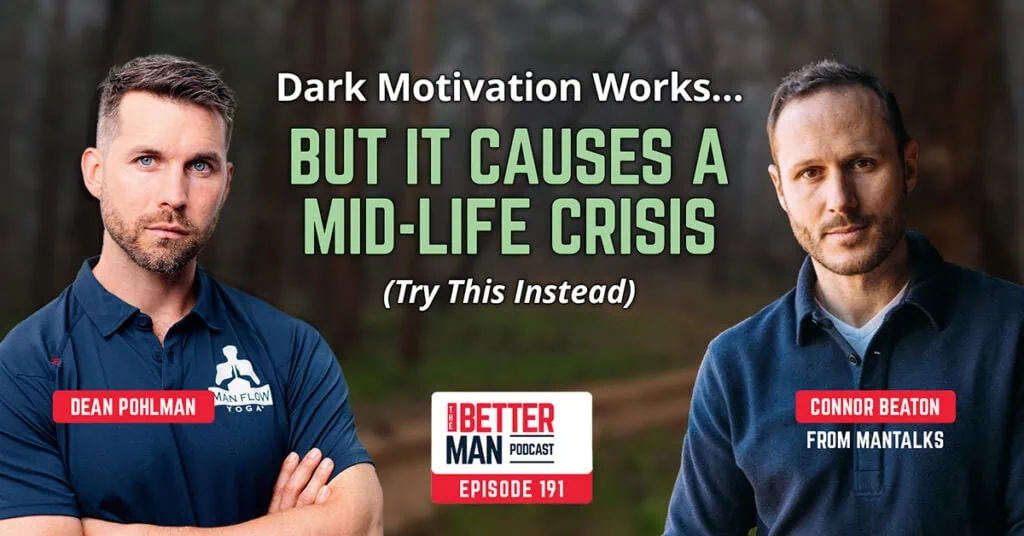
Dark Motivation Works … But It Causes a Mid-Life Crisis (Try this instead) | Connor Beaton from ManTalks | Better Man Podcast Ep. 191
Do you ever feel like you’re just wandering through life without a purpose, or stuck in the middle of a frustrating…
Fitness After 40: How To Start When You’ve Never Exercised (The Man Flow Yoga Catalyst Effect) | Bobby B. | Better Man Podcast Ep. 190
Turning 40 was Bobby’s wake-up call. After a lifetime of skipping workouts, a doctor’s visit revealed warning signs in his blood…
Gut Health Goes Way Deeper Than Weight Loss | Ben Brown (Founder of Body Systems Coaching and Head Nutrition & Fitness Coach) | Better Man Podcast Ep. 189
Gut health impacts far more than weight loss—it directly governs your energy, immunity, and mental well-being. If you grew up in…
Moving From Your Survival Path to Your Soul Path | Caleb Campbell (Former NFL player & West Point graduate) | Better Man Podcast Ep. 188
If you’re an endlessly striving achiever, you know the path forward lacks clarity. Former NFL linebacker Caleb Campbell used his feelings…

The Ethics & Use Cases of AI | Ted Phaëton | Better Man Podcast Ep. 187
The topic of AI is unavoidable. Ted Phaeton, productivity coach and host of the Modern Man Podcast, joins the show to…
My Personal Experience with Anxiety | Dean Pohlman | Better Man Podcast Ep. 186
After an accidental mushroom trip triggered a panic attack, I realized I’d actually been living with low-grade anxiety my whole life….