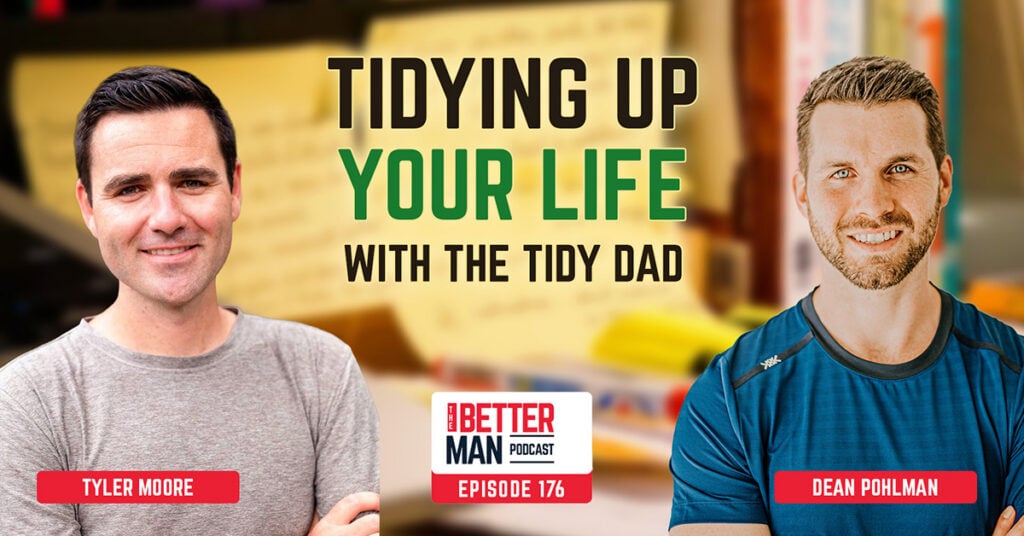
If you’re a dad, especially if you have younger kids, then you know how quickly your home can go from clean and organized to a chaotic disaster.
Whether you realize it or not, this physical clutter takes a toll on you – emotionally, mentally, and spiritually (even if you have a high tolerance for clutter, which is something I was not born with).
With Father’s Day around the corner, and as a dad of two young kids myself, I invited the PERFECT guest for today’s Father’s Day themed show:
Tyler Moore aka The Tidy Dad!
Tyler is a public school teacher, best-selling author of Tidy Up Your Life: Rethinking How to Organize, Declutter, and Make Space for What Matters Most, and perhaps most impressive, is that he’s a father of three living in a 700 square foot apartment in New York City.
Squeezing five people (including three children) into a 700 square foot apartment is not easy. He doesn’t have the luxury of excess physical space that many of us do.
And yet, his apartment stays cleaner, more organized, and more efficient than the vast majority of living spaces. Mine included.
And you know what?
After Tyler created a system to keep his 700 square foot apartment clean, organized, and useful … he realized how crucial his “tidying up” methods are when applied to other, more important areas of life like his relationships, his career, and his overall life.
This is a fantastic episode even if you’re not a dad, even if you live in a spacious home, and even if your living space isn’t cluttered.
Here’s what Tyler and I discuss:
- How to declutter your life according to a dad of three living in a 700 square foot apartment in New York City
- The vicious way keeping up with the joneses fills your house with useless stuff
- How physical decluttering and organization applies to more important areas of your life too
The Better Man Podcast is an exploration of our health and well-being outside of our physical fitness, exploring and redefining what it means to be better as a man; being the best version of ourselves we can be, while adopting a more comprehensive understanding of our total health and wellness. I hope it inspires you to be better!



Use the RSS link to find the Better Man Podcast on other apps: http://feeds.libsyn.com/404744/rss
Episode 176 Highlights
- How 30-day experiments can give you a completely new experience of life (without boxing you into a certain identity) (1:58)
- Why The Tidy Dad spends his mornings with Man Flow Yoga (3:13)
- The absolute worst way to start your morning (and you probably do it too) (8:34)
- A silly question to ask about your clothes that will give you instant clarity over whether it can be safely donated or kept (14:11)
- The strange way certain color clothing gives you a boost of confidence (18:16)
- How thinking of the rooms in your house as zones can tidy up a cluttered space almost overnight (and why it might address your hidden dissatisfaction) (24:56)
- An ingenious “toy” idea for your kids that will be consumed in quick order (41:00)
- How to jump off the train that leads to an endless accumulation of stuff (and the sneaky cause of it) (42:41)
- Why the simple act of naming stuff around your house means you can tidy it (54:42)
- The suffocating “Internalization” trap that men, and particularly fathers, fall into and the simple, yet identity-shattering way out (56:43)
Dean Pohlman: Hey guys it’s Dean. Welcome to the Betterment Podcast. Today’s episode is an interview with Tyler Moore, aka The Tidy Dad. Tyler is a father of three, a New York City public school teacher, and he is the author of the national bestseller Tidy Up Your Life. To most, he’s known as Tidy Dad, and this was a really cool interview because Tyler is doing a lot of the things that I’m trying to do in my own life, and a lot of the things that I think we’re trying to do.
Dean Pohlman: If you’re listening to this podcast and trying to learn from it, and he comes at this from the lens of tidying up initially from from a physical space, just living in a 700 square foot apartment in New York City. He has to be tidy. But it’s really cool to hear about how that physical decluttering and organization there has radiated out into other aspects of his life.
Dean Pohlman: And so we talk about, you know, things like what is enough and when do you know it’s enough? We talk about how he’s been able to raise a family that focuses on experiences instead of stuff, because they just don’t focus on stuff as much. We also talk about some some cool things, like some 30 day experiments and how he’s done that.
Dean Pohlman: We talk about color analysis, which is new for me. But anyways, there’s a lot of stuff in there that I think is helpful if you are trying to be more introspective about making decisions to improve quality of life and just help with decluttering life, not just physically, but mentally, emotionally, spiritually as well. So I hope you guys enjoy this interview and check the show notes for any links at the end.
Dean Pohlman: Hey guys, it’s Dean. Welcome to the Betterment Podcast. Today I have Tyler Moore with me here. He is the tidy dad. And we’re going to be talking about tidiness and stuff. So yeah thanks for joining me.
Tyler Moore: Thanks for having me.
Dean Pohlman: So I met Tyler. He reached out to me on or. No you I think you tagged us. I think you tagged us in the story on Instagram. And you had been doing our workouts for or one of the manifold yoga workouts for a few weeks now, and you had just. And you just finished a marathon, right?
Tyler Moore: I did, I finished a marathon, and I’ve actually every month I take on sort of a new experiment. I have this idea of 30 day experiments, and the idea is, is that you try something new and you experiment for 30 days and see, does this actually enhance my life? Is it something that I want to continue doing, or is it something that I want to sort of push to the side?
Tyler Moore: Because so often we have like the new year, new you resolution season, and that can feel so overwhelming for people. Yeah. And so actually it was the start of the new year. It was my January, experiment, which was what would it actually look like to have a daily sort of yoga or just mobility sort of practice? Because for the past year I’ve been working to overhaul my physical health.
Tyler Moore: I’ve lost 30 pounds. I do a ton of resistance training. I was training for a marathon. But as I shifted more of my workouts to the morning, I found that jumping straight into strength training was actually leaving me really fatigued and also really saw. And I was like, it’s probably because I’m not warming up my body properly. And so I actually talked to my dad and he is 66.
Tyler Moore: He has Parkinson’s. But he was like, why don’t you start watching this guy on YouTube? He was like, I really like his stuff. And so that is when I really started the practice. And so I thought, let me try this out while I’m brewing my coffee, it’s literally ten minutes in the morning. I was like, let me see, does this make a difference?
Tyler Moore: And after 30 days, if it does, keep it going and if it doesn’t, move on to something else, and all these months later, I still start my day every morning with one of your videos. That just helps warm up my body and actually like get it going, which is really important before you try to do anything, whether you’re whether you’re going into strength training or just your day, I feel like energizing yourself, waking yourself up, shifting from sleep to now.
Tyler Moore: I’m actually moving through life in my day. It’s so important.
Dean Pohlman: Yeah, yeah. And I’ll be honest, like, I don’t always do yoga every day, but I usually do at least something in the morning, you know? So I’d love to be able to say that. Oh, yeah. I start every day with a 45 minute yoga session and I just don’t, you know, so, you know, there’s I’ve got two young kids, I have a three year old and a five year old.
Dean Pohlman: I’ve got stuff to do at home before the day starts. Just, you know, just general household duties. And so my mornings, sometimes I get a sometimes it’s a walk, sometimes it’s like a mindfulness practice or a journaling session. But yeah, usually by like 930, 10:00 I’ll have done something, but it’s not yoga every day. But yeah, just getting moving instead of like getting on the computer.
Dean Pohlman: And that being the thing that’s that’s definitely, definitely a better way to start. But I love that you brought up this concept of 30 day experiments, because this is something that I like to talk about a lot with a lot of our members in the mantle yoga community, because so many of these guys are trying to build new routines.
Dean Pohlman: Some of these guys have never been successful with fitness before. And so, you know, they’re coming into this, coming into this program because they think it’s different. They believe it’s going to help them. And they and they come in it with kind of like a an all or nothing attitude and maybe more of like, I’m going to do this every day no matter what.
Dean Pohlman: And I always like to dial things back for them. And this is also this people who are also consistent with their fitness and who are disciplined also struggle with this sometimes because for whatever reason, they struggle with making, you know, this yoga into a routine. And so it’s the same advice that I give for for everybody. It comes back to I usually talk about it in 28 day terms, but 30 days, you know, right there it’s hey, let’s try this out for a few weeks.
Dean Pohlman: Let’s, you know, let’s be willing to modify the plan each week. Right. So let’s do a little assessment at the end of the week and say, okay. Like what got in the way. What was I. How was I able to be successful and be consistent with this? And what made me almost not do the work out and then just doing that for a month instead of this, oh, I’m just going to do this three times a week for the rest of my life.
Dean Pohlman: That that 30 day, that 28 day kind of period that, that makes that makes a lot more sense.
Tyler Moore: Well, because it feels so daunting, especially at the start of the new year, that we’re coming out of the holiday season, which is arguably one of the most intense periods of the calendar year. And then we’re suddenly supposed to shift into this like wellness, mindfulness, let me just overhaul my entire life. And there’s that date in January that it’s very short into the year.
Tyler Moore: I think that it’s like January 10th, 12th, something that they call it like National Quitters Day, because so often everyone is so gung ho, but then something happens and you get defeated. And so I’ve had to learn that even with like, my yoga and the mindfulness in the morning and just moving my body, that initially it took some time for me to make it where I didn’t have to, like, consciously think about what to do.
Tyler Moore: That even as I was watching your videos that as the month progressed, there was this really nice moment where in the quiet of the morning, because it’s typically about 445 in the morning when I’m doing it, it’s dark, I can smell the coffee brewing. I’m laying on the kitchen mat in our apartment because we have a very small space, and so everything has to work double.
Tyler Moore: So we have this really long, like eight foot kitchen mat and that’s where I do the workouts. But it was this huge moment where I could just lay with my eyes closed. And as we were progressing through each of the moves, there was this overwhelming feeling of calm. And I realized, even going back to what you were talking about with when you wake up, first thing there’s this desire to like, grab the tech.
Tyler Moore: What do you do? Do you check email? I found that forcing myself to start with some sort of yoga while the coffee was brewing. It kept that phone out of my hand, which then led me the next month. I was like, what would it look like, actually to give myself from 445 till about seven in the morning to be completely unplugged from news, social media, email?
Tyler Moore: And so I find that oftentimes when you allow yourself to experiment, there’s that curiosity and you start to wonder, well, what would it look like to try this? Or what would it look like to stack this new thing on that? I don’t think you have to completely overhaul everything, but it’s all about those layers that you start to gradually place on top of one another, and there really can be some cool change in growth.
Tyler Moore: But also, if something isn’t working for you, let it go and move on and try something new.
Dean Pohlman: Yeah, yeah, I think this is so what you’re talking about now, I think I think this is probably a great reflection of your overall philosophy, which is probably most well known because of what you do with with tidy. Dad and I kept on, you know, when I first I told you this earlier, but when I for some reason I saw Tidy Dad and in my mind I saw Tiny Dad.
Dean Pohlman: And so like for many instances I wrote like tiny dad out instead of Tidy Dad. And I don’t know why I did that, but anyways, so what is what is tidy dad?
Tyler Moore: Yeah, so you know, it started because my wife and I live in a small New York City apartment. We live in about 700ft². We have three daughters there now, 11, eight and six. And so in many ways, it’s been a pen name that allows me to share about what does it look like to set boundaries with our physical space, with our square footage, and how do we use creative strategies to make life work in this very small space?
Tyler Moore: That there’s something about a dad sharing the perspective of tidying and organizing and cleaning that just sort of stops people in their scroll. And it’s funny because sometimes people will refer to me as Tiny Dad, but it does make sense because I live in a very tiny space. Well, we also have a cottage in Pennsylvania where we spend our summers because I’m also a New York City public school teacher, in addition to writing and, you know, sharing online.
Tyler Moore: And so it really has been this exploration over the years of what does it look like to apply these tidying principles? How does it take? How do you take something like your socks and your underwear, figuring out how do you build out small capsule wardrobes? How do you contain all of the kids stuff that just seems to multiply and multiply and multiply?
Tyler Moore: But then how do you take those same skills and the level of questioning and being able to set boundaries? And how do you actually apply that to other, more substantial aspects of your life, like your career, how you want to spend your time, the relationship that you have with friends and family, whether or not you’re able to prioritize your health.
Tyler Moore: All of those things really do boil down to tidying decisions. And so, as Tidy dad, I enjoy sort of walking people through my personal journey while also inspiring them to figure out some way to tidy up whatever mess they’re experiencing.
Dean Pohlman: Yeah. Okay, cool. So that’s that’s a message that really resonates with me. So, you know, solely from the physical act of tidying up, like when I’m it’s this is kind of what I default to doing. If I’m not working, I’m like, I go to other forms of productivity, which is tidying up, which I recognize is kind of, you know, not the point I shouldn’t.
Dean Pohlman: I struggle with this compulsion to be productive all the time, which I’ve talked about a lot. It’s part of my mental wellness journey, I would say, is trying to be okay with what is, rather than feeling like I have to produce in order to feel good about myself. But one of the things that I enjoy doing is tidying up.
Dean Pohlman: And I remember this past Christmas, we the holidays, we got to actually stay home for the holidays and we didn’t go anywhere. My wife’s family came in for like two days, but that was it. And so we had like two weeks where it was just us and the kids and, you know, not much to do. So every day was just a different room.
Dean Pohlman: It was just a different cabinet. And it’s kind of funny because by the time we got to the end of my to do list, I didn’t. I don’t think I ever fully expected to be done with it. So I had like a minor existential crisis. I’m like, it’s done. What do I do now with my life? And, but yeah, I love I spend a ton of my time just tidying up, trying to trying to make things physically less decluttered.
Dean Pohlman: So I have a cleaner environment. I think the other goal is convenience. So it’s very much like, how do I position things in a way where, you know, I don’t have to spend much time getting to them. And then also just the feeling of when you have less stuff, it just feels better. Like knowing that the things that are in your physical surroundings have a purpose instead of, oh, that’s just something that I have in case I need it.
Dean Pohlman: I haven’t used it in two years, but maybe I’ll use it. It makes me think of the does it spark joy like I, I love, I love that concept because it was very it was a very simple way of does it spark joy? It’s like, well, no, it actually makes me feel bad that I’m not using it. Okay, well, thank it for what it’s done and then send it on its way.
Tyler Moore: And it does feel silly even to ask that question sometimes of clothing, but I, I bring up clothing because it’s something that’s so deeply personal to people. But oftentimes, especially as men, we don’t actually think about the individual items. We don’t really think about what’s the fit, what’s the fabric, how do I feel when I put it on?
Tyler Moore: What does this color sort of bring to mind? I just had my colors analyzed back in the fall. It was something I was always fascinated by, which is that idea of like, are you a I am a bright winter, but there’s like, are you a winter, spring, summer or fall within that? Are you bright? Are you cool? Are you warm?
Tyler Moore: And so.
Dean Pohlman: All.
Tyler Moore: Right, let’s.
Dean Pohlman: See, what’s this color test called? I have to look this up.
Tyler Moore: Yeah. So if you look up. So it’s the idea of its color analysis. There’s lots of different sort of iterations, but the seasonal plus the bright or dark, those are generally sort of the okay, the ways you describe it. And it’s interesting because it’s based on your hair color. It’s based on your eye color. People are often they can even look at like your veins, like they can look at your arms, even your hands, and they can tell you what season you are.
Tyler Moore: And so it sounds silly, but I had all of these pieces of fabric draped on me. And so I watched as the person was like, okay, how do you feel in this? What do you notice about your eyes? Were you notice about your hair color? So learning that I was a bright winter, it just gave me this whole new sort of way to assess my clothing and make decisions about what to keep versus what to move out.
Tyler Moore: So what.
Dean Pohlman: What colors does that mean for you?
Tyler Moore: So essentially you can wear any color, but what you really want to pay attention to is the shade. So for example, I, I have a very small closet. My closet is 14in wide and 6.5ft tall. So it is very narrow. It fits all of the stuff for temperamental New York City weather. So you’re thinking about work stuff, sweaters, dress shirts, I’m a teacher, weekend gear, all of that stuff.
Tyler Moore: And so I had primarily been wearing four colors navy, olive, this tan like camel color and Burgundy. And so I sat down in the chair and the woman who did it, I was like, okay, these are my four colors. Let’s see, have I chosen my colors correctly? And so she draped me and she was like, did you say that you’ve been wearing Olive?
Tyler Moore: And I was like, yes. And she’s like, you should never wear no olive. She. So she then draped me with Olive and she was like, look at what it does to your eyes and your skin completely sort of washing me out. But then she put Emerald on, which is that like brilliant green. And she was like, look at how your hair pop.
Tyler Moore: Look at looks at how your eyes pop. It was the same with Burgundy. She was like, Burgundy washes you out. But it’s funny because it’s actually the color red that you’re wearing right now. She’s like, look at that bright red. And what does it do? And so you start to learn. Even when I went back to my closet, I was like, oh my gosh, the things that I was wearing, they actually subconsciously fit into that bright winter palette.
Tyler Moore: But then there are other colors I’ve introduced, like white and black, that I’m able to have these more sharper contrasts. But again, I think that as men, we don’t often think of these things. We don’t often question why do we prefer the things that we do? Why do we like to wear the things that we do? Why is it comfortable?
Tyler Moore: Why is this something I gravitate towards? But I do feel like the more we’re attuned to the decisions that we make with inconsequential things, like at the end of the day, does it really matter what color shirt I wear? No, it doesn’t, but do I feel better when I’m in my like, bright winter palette? Absolutely. And does it then embolden me to make other decisions in my life and actually have a rationale for why I’ve made them?
Tyler Moore: Absolutely. And so I think there is something freeing about that process of even going back to what we’re mentioning of sparking joy. Like what actually underlying that is, do I know myself and why I’m choosing to keep what I am and why I’m choosing to move other things out?
Dean Pohlman: Yeah. So just in case you aren’t familiar with the does it spark joy? This is from Marie Kondo. Kondo yes.
Tyler Moore: Kondo spark Joy or Marie Kondo? It’s funny because there’s now Marie Kondo and then there’s me. So I crowd, there’s there’s like the one man and it’s me. So it has been exciting to sort of like offer this other.
Dean Pohlman: Yeah.
Tyler Moore: So because there’s so much greatness, there’s so many great things about her philosophies and what she, what she teaches.
Dean Pohlman: Yeah. So I know that there are I know we have a lot of we have a lot of our community is based in, in New York, in Manhattan or surrounding areas and, you know, in New York City. And, you know, I’m I’m curious, like, what are the and obviously, you’ve had to do this yourself just because of the reality of your square footage, but what are some things that men don’t really think of or couldn’t?
Dean Pohlman: It doesn’t even have to be men. But like, what are some things that people don’t think of when it comes to an organization and and how it can help with life?
Tyler Moore: I think one big thing is this idea of efficiency and systems that I think so often we think of organization being about control, or this like Uber fixation on our and our on our environment. And it is looking a certain way. I think that’s a big misconception. And especially when you think about men, I think that there’s often this huge misconception that men don’t see clutter and that men aren’t affected by clutter in the same way as women.
Tyler Moore: And I think that that is what it just is. It infuriates.
Dean Pohlman: My my wife is like the leave the thing on the counter and I was, I was and I’m the that belongs in something. It doesn’t go on the counter.
Tyler Moore: You’re speaking my exact same language. And with my wife, sometimes she likes the things left on the counter because it reminds her to do something. And so she’ll get frustrated that she was like, I was about to do something with that. And I was. She was like, where did you put it? And I’m like, well, I put it in the cabinet, which is where.
Dean Pohlman: I put it, where it goes. You know, we have this conversation about her hairbrush on a, on a, on a regular basis.
Tyler Moore: And I think that, you know, organization, we all have different preferences. I think there are people who like things behind closed doors that visually, you just need that clear space. Other people like organization systems where they’re able to see the items, whether it’s like having open shelving with baskets or bins. But I think so often we just don’t talk about these things and we don’t unpack them.
Tyler Moore: And oftentimes as men, you know, stereotypically, the home is the female space that the female women shoulder. This burden of organizationally knowing where everything is in the home and who do the kids go to? And that’s a big question, you know, even for my home, that it’s like if my kids are always going to my wife to ask her where something is like, things have broken down now, obviously.
Tyler Moore: Have the girls have gotten older, we’ve been able to share more of the responsibility with them. You having a five year old and a three year old, there are still lots of things that you want to have up and away behind closed doors that they cannot have access to, but as they get older. There are more and more things that you want to involve them in, because independence is so important and there’s power in knowing when I want something, do I know where to go to get it?
Tyler Moore: And then after I’ve used it, do I know where to put it back? So the next time that I want to find it, it’s actually there.
Dean Pohlman: Yeah. And I’m, I’m laughing at myself because I’ve had a just thinking back to like, you know, kind of the flip gender role in this situation of, of, of me being the person who knows where things are. But I also get blamed when things are not. When she doesn’t find things, she’s like, did you throw this out? She’s like, I can’t find it.
Dean Pohlman: Where did you did you throw it out? Even if she doesn’t say it, I can hear it in her voice. I’m like, you think that I moved your thing? And so this is this is like a, you know, I think 1 in 5 times she might be right, but four out of five times it’s. You lost it and you’re blaming me, right?
Tyler Moore: And you know, what has helped is we’ve had to think through what are the categories of items that we need to negotiate about and that we’re all responsible for, and what are those items that we are individually responsible for? And we can set up our own systems. And like my 14 inch wide closet, I love that closet because I do not share it with my wife.
Tyler Moore: She does not need to go into my closet to do anything that is my domain, 100% my toiletries. She does not need to get into my little tiny section. We have one bathroom so we each have a small section, but she doesn’t need to know where my stuff is and how I use it. My work bag. I’m completely responsible for that.
Tyler Moore: But when you think about something like the kitchen, the kitchen is a shared space. We all need to know where things are, where the gadgets are, who has put what away, what the systems are. And that’s when we’ve set up this idea of zoning. So in each of our rooms, I sort of shared the mental organizational load with my wife by thinking about what are actually the zones in this individual room and how are we using it.
Tyler Moore: We often think of blueprints when it comes to like building a home, or if you purchase a home like you get the blueprint and you see what is each room named? Bedroom one, bedroom two. This is the kitchen, the bathroom, whatever. But we use that similar approach to the rooms in our home and we actually like sketched out what are the cabinets?
Tyler Moore: What are the closets? Where do things go? What is the utility of this? Because when you think about a space like a kitchen, it really is designing it like a chef would. The goal in a kitchen is efficiency. Efficiency has to come before taste, flavor, anything else because I don’t care how good that meal tastes. If it if you’re in a restaurant and it takes you two hours from the time you sit down to get that dish in front of you to eat.
Tyler Moore: If it’s taken two hours, I don’t care what is served to me. You’re not going to be in that great of a mood. And so when you think about a kitchen, there’s often these and you can look up all these different diagrams, but they talk about the triangle that it’s like your kitchen should have a triangle where you have your prep zone, you have your cooking zone.
Tyler Moore: And then like you have your serving zone, those three need to be in close proximity to one another, layering that on in a kitchen. We also have our like dishwashing zone, which is you need to have like the sink, the drying rack, the soap. We have kids. There are also things that we want our kids to have access to that it’s like, can they actually reach their bowls, their cups, the silverware?
Tyler Moore: There are things that I don’t need to get for them. They can get for themselves, but they have to know where they are. And organizationally, the kids stuff needs to be in a zone where they can access it. And so that’s the really cool part I think about organization is thinking about efficiency. How can I make things where I don’t have to think all the time, but also where the stuff that I have and where it’s located actually supports my life, as opposed to like just getting in the way.
Dean Pohlman: Yeah. I think, you know, going back to what you were saying with with how your wife likes to leave things out sometimes because she was using them and then like also having them accessible but also organized. I think there’s a yeah, there’s definitely a balance of figuring out, you know, how much do we leave the thing out or do we put it away or like, how often does it get used?
Dean Pohlman: So is this just going to be something that’s permanently out. But but going back to just like a kind of like we talked about how you like to do 30 day experiments, if the goal is to make sure that it’s used and to make sure that the habit is built, then like, it totally makes sense to keep something out, you know, like, I know that if I’m like, for example, if I’m starting a new supplement or something like that, or if I’m trying to like, like a good example is I have I have a Collagen Pro, I have a collagen supplement that I like to add to coffee, or I have a it’s a colostrum.
Dean Pohlman: Actually, it’s a colostrum supplement that I like to add to my coffee. But you know, if it’s not out, I won’t remember to use it. So so for the first month that I had it, I kept it out so that I remember to use it. And then after kind of I got into the habit of doing it and I didn’t need the visual cue as much, then I can put it away.
Dean Pohlman: But yeah, having it as a visual cue is something that might not organize per se, but just for the sake of trying to build a new habit, then visual cue is is part of that.
Tyler Moore: And I think even to your point, that it’s like there are so many things that we want to do with our spaces, and sometimes there’s this dissatisfaction that comes from either square footage or if only our kitchen were bigger, or if only I had a bathroom with two sinks in this much larger cabinet. There are all of these sort of questions that we have in our mind, and there are so many ways in which we can become dissatisfied, which then causes us to want more and more and more in desire or the keeping up with the Joneses.
Tyler Moore: And oftentimes I just like to think about even going back to the supplement conversation, that it’s like, what in the kitchen is getting in the way of you having your supplements organized where you want to have them organized in the way that you want them organized. And oftentimes it’s excess stuff that just needs to be gone through. And oftentimes we just haven’t established a criteria of what to keep versus what to move out in.
Tyler Moore: The classic example in the kitchen is like the number of coffee mugs that people have that the reality is, is you are not hypothetically going to have like 35 people over to your house drinking coffee at the exact same time. First of all, none of us have coffee makers that large to even produce that bulk. And it’s like it’s one thing if the coffee mugs, because I know some people will collect them from travels.
Tyler Moore: And it’s one thing if like when you get that coffee mug, it sort of does spark joy or spark that memory. But also, if you don’t care about coffee mugs, then why do you have that many coffee? Like if you drink from the same coffee mug every day? Why do you need to have 17 of them? So I think for each of us, we should feel empowered to make decisions about what we want to have in our lives and what we don’t.
Tyler Moore: And we can’t upsize everything. You can’t have every single category of items to the nth degree. You have to make cuts somewhere. You have to edit. And so I think it’s just that questioning to yourself, why do I have what I have? Why do I have it stored where I have it stored? What could make my life a little bit easier?
Tyler Moore: Those are really powerful questions to constantly sort of be checking in with yourself about.
Dean Pohlman: Yeah. So how often do you do you have a set? You know, is it every month, every two months, every three months that you like to, you know, go through stuff for like once a year? Like, what’s the what are some of your formalized processes for getting to the excess?
Tyler Moore: The biggest thing that’s been what’s been most successful for us is this idea of a decluttering calendar. So we actually took 12 months out of the year, and we assigned certain categories to thing based on month. And so like for example, the month that we’re in right now, we just did an overhaul of our winter gear and sorting through our summer gear because we’re about to transition into like swim, triathlon season, park season.
Tyler Moore: And the idea is, is that we’re able to go through items at a time where other people might be looking for them, like my daughters they just went through. We had this big bin of like ball caps, and the girls were like, I don’t want to wear any of these hats. And I was like, great, let’s list them on our like, pre-loved group.
Tyler Moore: And they just went to another family with lots of little girls and they needed hats. The same with like sunglasses. The girls were like, this is my favorite pair. These don’t fit anymore. And it’s like, wonderful because people are actually looking for the stuff now. So when you can align the time of year with the stuff that you’re sorting through, I feel like that better.
Tyler Moore: Helps you steward the stuff to the right people because.
Dean Pohlman: So how do.
Tyler Moore: You kids like you’re always going through? Like right now you’re getting your kids summer wardrobes set. It’s likely that they’re not wearing the same summer clothes that they were last summer that they are now. You don’t wait until winter time to go through the summer stuff because nobody wants your winter. Nobody wants your summer stuff in the winter.
Tyler Moore: So that’s that’s been our sort of approach.
Dean Pohlman: Yeah, okay. Makes sense. So where do you what do you do with stuff you don’t want.
Tyler Moore: So we use our we have a wonderful by nothing group in our neighborhood in New York City. And there are tons of by nothing groups fall over the US even thinking about things like Facebook Marketplace, even thinking about donation centers, you know, you can give of things. I think that that’s important. And even to our kids that it’s this idea of new things come in.
Tyler Moore: Things that we have used go out like this is a natural sort of part of life because children, unlike adults, like we’re generally fixed in the size that we are. The things that we want to have are hobbies and interests, but that’s just not the same with kids. And I think that’s been a big distinction in my philosophy from Marie Condos is she talks a lot about how she would work with people and they sort of like tidied once and then they were done.
Tyler Moore: And that sounds great until you have a kid move into your house, because even comparing your three year old to your five year old, like their interests are so different birthday season, everybody wants to give them something. And it’s like, how do you move stuff out and make space for the new things to come in in a way that it isn’t just completely overwhelming or you feel like you’re constantly in this man, we just really need more square footage.
Tyler Moore: We really need to move. You know, we need to change X, Y, or Z about our lifestyle in order that we can have more space for more stuff to come in.
Dean Pohlman: Yeah, yeah. I remember reading a book about it was a book about organization, and it was the basic concept of kind of the concept of what we’re talking about. I think it was it was a minimalism book, and the guy was saying that, you know, we we thought that we were minimalists, but really we were just really good at organizing things.
Dean Pohlman: So they were just good at like fitting fitting things into to cabinets and you know, to I think back to you were talking about birthdays and I remember that Declan had one year, I think he was three when he just got so many presents that we ended up our we were kind of waiting on our, our second to be born.
Dean Pohlman: And so we had one room was empty. And so we, we just had probably 20 boxes like 20, you know, 20 toys just in that room, just like in a box just waiting to be opened. We we didn’t tell them about that. We didn’t tell them about those. But every week or so would just be like, here you go.
Dean Pohlman: Here’s another one. And it’s just just insane. Like, how many? And I think back to the pandemic and, you know, we were first time parents during that and we were bored. Good God, we were bored. And one of the things we could do was buy stuff on Amazon. So I feel like we got, you know, multiple toys. I mean, I know we got multiple toys every week.
Dean Pohlman: I don’t know if it was 2 or 10, but there were a lot of different things coming into our house, you know, over the course of however long that was. And, you know, by the end of it, you just look at all the random toys and things that you accumulate and you’re like, what is all this crap? And, you know, Marissa and I think back to when we were kids, and if you wanted to get a toy, right, if you wanted something new, you would have to go to target with your mom.
Dean Pohlman: You went to target once a month, right? You you know, I grew up in the suburbs. We didn’t have probably different living in the city, but, like, you know, we didn’t just have a big store that you could walk to. It was like a big event, like, yeah, I want to go. Yeah, yeah. Now it’s just like, my son’s like, why don’t you buy it on Amazon?
Dean Pohlman: I’m like, you know, when I was your age, we didn’t have this option, but it probably has created a much greater demand for learning how to get rid of stuff.
Tyler Moore: I think so, and even still, we’re disentangling ourselves from this feeling of I show love through the physical possessions that I give. And we have been at this. My oldest just turned 11, and it was just this Christmas, that one set of grandparents, they were finally like, what if we all just go to the water park together as their Christmas gift?
Tyler Moore: Do you think your girls would be okay with that? And I’m like, they 100% would be okay with that. Like send them a card, say that we can’t. Look, we’re looking forward to seeing you and we’re going to take you to the water park. And we all went and did it. Like experiences are so much greater than stuff.
Tyler Moore: But I also think that we have to model that ourselves for our kids, that they see the relationship that we have with stuff. And I would much rather give my girls experiences. We’ve traveled with them all around the world. It’s not because we’re just lapping in luxury, it’s because we’ve intentionally set boundaries around certain categories in our life in order to make space for what does matter.
Tyler Moore: And so I feel like even with the stuff that’s continually continuing to come in, it’s never too late to course correct. And just because you did it one way, one year where your kid had the huge blowout birthday and got like 50 presents, by the time grandparents, parents and all the friends are involved, that doesn’t mean that you have to do it again the next year and you can say, hey, you know what?
Tyler Moore: We’re going to have the homemade cake. You want to choose the meals that we’re going to eat, and we’re going to go do something like, where do you want to go? Where do you want to go? What do you want to do? And I think that there is just there’s joy and sort of unpacking that and exploring it even with your kids, that there is beauty in this world as opposed to beauty and just accumulating stuff for the sake of having more stuff.
Dean Pohlman: Yeah, yeah, I mean, I, I know that I, for one, send messages to the grandparents and I tell them like, don’t get anything big or like we had like a crazy. No, it was it last year there was one year where my wife’s sister got our kids so many presents that we were just ripping open, and it wasn’t like she was, you know, spending thousands of dollars on presents.
Dean Pohlman: She just rated TJ Max and got whatever she thought would be like, great or moderately interesting. And, you know, it was like 930. I hadn’t had coffee yet. I haven’t had breakfast yet. And we’re just like ripping open presents. I’m like, this isn’t fun. Never again. This is never happening again.
Tyler Moore: No. And we have a very small we call it our toy rotation closet. That has one strategy that’s helped us is, and I have shown every time the grandparents come to our apartment, I take them on a tour of that closet. And I’ve literally had to say anything that you send them. Something else has to leave. Like, just so you know, this is a like one in, one out.
Tyler Moore: We don’t have more space, we don’t have an attic, we don’t have a basement. We’re not interested in getting a larger apartment. This is it. And so that has sort of helped them. And even for one of their birthdays, my mom, because we just finished birthday season and she was like, do you think each girl would like their own bag of caramel cheddar popcorn?
Tyler Moore: And I was like, yes, mom, that is a wonderful present. They would absolutely love it. Grandparents have sent like boxes of cereal pop, you know, all of those things that we don’t buy on a regular basis that are just really fun for kids that are consumable, even Santa Claus, Santa Claus. We worked out an arrangement where Santa brings one present, and he always brings a box of cereal, and that’s it.
Tyler Moore: And our girls, you know, they’ve talked to friends and cousins who Santa somehow brings them a lot more. But our girls are content and happy. Like it it you can set boundaries around these things and I don’t know. So I just think there’s so much to unpack there with the culture that we have around stuff and accumulating more.
Tyler Moore: And I think that, I mean, I don’t see a model or an example of anyone right now in the world, even when we think of the billionaires approaching now trillionaire who say, you know what, I’m satisfied with all the stuff that I have. Everybody wants more and more and more. There’s always someone who has more than you do.
Tyler Moore: And so you have to get off that train of, let me just get as much as I can, because at some point something is going to give. Is it your mental health? Is it your physical health, your emotional health? Is it your family? Are you now working 80 hours a week in order to provide this lifestyle that you don’t even get to enjoy?
Tyler Moore: So I think that that is the real power of tidying up your life is how do you set these boundaries around the physical stuff in your in your home, so that you can then apply similar boundaries to the much more consequential things that actually have a huge impact on you and your family.
Dean Pohlman: How do you start setting boundaries on that?
Tyler Moore: So, you know, I learned pretty quickly with my career, for example, I think that it was applying. So my story was that I was a teacher. I moved into school admin at the same time that I was that we were up sizing our family, that oftentimes it’s when you’re increasing the number of children who live with you that you’re also increasing your job and your responsibilities.
Tyler Moore: And I had to sit down and I remember thinking, because I was getting ready to. I knew that I needed to go back to the classroom, that I did not enjoy the admin work. And I made a simple t chart that was like, what do I like doing at work? And what do I not like doing at work?
Tyler Moore: Which is the same thing that you could do again, going back to the dress shirts that you wear, what do you actually like and what are you actually not like? And when I started to look at my job responsibilities and I was like, I enjoy doing this, I don’t enjoy doing this. I enjoy doing this. I don’t do enjoy, I don’t enjoy this.
Tyler Moore: It gave me this clarity that also took this emotional weight off of myself because I was like, why am I doing a job that I actually don’t like doing when there’s this other job at the exact same place that I do enjoy? And so there’s nothing like asking for a demotion at the school where you work and where you have to once again go back to the teaching staff.
Tyler Moore: I was now teaching alongside teachers that I had actually supervised the year before. It’s a very humbling process, but I feel like there is so much clarity when you actually sit down and ask yourself the simplest question of what do I like versus what do I not like? It can be a very revealing process, and I think that oftentimes we just don’t stop and actually ask us those ask ourselves those questions.
Dean Pohlman: Yeah. Yeah. I mean, that’s a that’s something that I have to remind myself to do a lot of the time is I get so focused on what I’m doing, you know, in the day to day, like with with Mantle Yoga, for example, I get so caught up in like on my to do list that sometimes I, I forget, like, well, what is the point of all of this?
Dean Pohlman: Right. And so coming out of the weeds, so to speak, and being able to get high up above things and, and remember like, okay, well what’s the what’s the main thing, what are we doing this for. What do I like doing. What do I not like doing. And fortunately I’ve done that enough to the point that there are very few periods of time that I look at, you know, over the last few years and, and think, you know, I really wasn’t doing anything that I liked during that time.
Dean Pohlman: I’ve been pretty good about creating a systems for myself, where I get to do most of the things that I like doing, and minimal time, spending time, you know, on time that I don’t like. But I think also, you know, it’s easier for me to do that because my, you know, the just the career that I built for myself and the position that I built for myself does come with, you know, more time, luxury, like, yes, I’ve got a lot of responsibilities.
Dean Pohlman: There’s a lot of people who are depending on me. And, you know, there’s a there’s a lot of ups and downs and they’re sometimes unpredictable. But I also have the time to be able to, you know, I also have more time to be able to, you know, I’m just going to take off this afternoon or like today, for example, I just went for a hike.
Dean Pohlman: I went for a hike from like 930 until 12, and then I went to lunch with a friend. And most people can’t just wake up on Thursday morning and say, I’m not going to work today. For me, it fits into my overall work goals, but you know, that’s beside the point. So what I like about what you’re doing is you’re still living the public teacher life and doing this thing on top of it.
Dean Pohlman: You know, you’re not just saying, no, it’s easy. Just do what I do. You’re saying, no, seriously, I’m doing it too. And this is my schedule. So, you know, it’s it’s an inspiring example.
Tyler Moore: And I think that it gives a little bit of credibility because I’m constantly balancing work, kids, my marriage, while also wanting to have this semblance of self. At the end of the day that I want to feel like a human. And I think for me, because I get asked all the time, people are like, well, why don’t you just become full time tidy dad?
Tyler Moore: And I’m like, well, on paper I make more as tidy dad than I do as teacher. But at the same time, I love the day to day interactions with my students. I love the fact that all three of my daughters attend the same school where I go. I get to see them every single day in the hallways, even if they don’t necessarily want to see me.
Tyler Moore: I live six blocks from my school. I walk home for lunch every single day. I’m out at 220. I also have the summers off. I’ve been a teacher for 18 years, so there are things that have gotten easier over the years. There are systems that I’ve built. But, you know, even after my book came out was asking, well, what’s next?
Tyler Moore: What’s next? What’s next? And when are you going to write the next book? Have you already started it? What do you hope is going to happen? And I think that there is this freedom in being able to live in the season that you’re in, clearly knowing what stresses you out, what fuels you, what brings you excitement and joy?
Tyler Moore: Even after writing the book, you know, there was it took a lot. It took months for me to sort of come down from just the exhaustion of writing the proposal, writing the book, then doing the whole launch stage, all of the press, all of the publicity, that I had to really tap into myself. And it was like, what do I want in this next season?
Tyler Moore: And what I kept coming back to was, I want to just live life. I want to experience an afternoon where I can just take my daughters to the park and I can work out. I call it exercising. I like have my little resistance bands, and I’m doing my workouts and watching them play. There’s something very joyful about that.
Tyler Moore: Having the freedom in the summer. Time to say I’m off during the summer and I can. I’m in an adult swim league, like I have coaches that I work out with two times a week. I open water, swim with this group of triathlon friends that I’ve made. There is joy in that, while also knowing that I have my stable teaching job that provides a great pension and health insurance and a schedule that actually works for me.
Tyler Moore: And so I think that just because we see other people doing things, we can give ourselves permission to take a little bit different path and not say, oh, if only my life were like X, Y, or Z, you really have to sort of tune into yourself and ask yourself, what do you actually want?
Dean Pohlman: Yeah, well, I mean, I commend you for being able to do that. I think it’s really easy to I mean, I know just personally I know it’s hard for me to, you know, it’s it’s hard for me to answer the question honestly. Okay. Like what point is enough. Like, you know, just looking at like, how many YouTube subscribers, YouTube subscribers do I need to feel like, okay, I’m comfortable with where we are right now or how many, how many members, you know, do I feel like I need we need to have in our community to I’m like, okay, this is good.
Dean Pohlman: Like everything’s, everything’s, you know, going well. And as much as I’d like to say, well, it will be enough when everything is predictable month to month and we don’t have to, you know, we don’t have to worry about keeping the lights on. And but, you know, I don’t I don’t I don’t know because we might get to that level and then I’ll say, yeah, you know what?
Dean Pohlman: Let’s keep growing. And I don’t know, I don’t know. I like to think that I’ve done enough, you know, I’ve done enough reflection and personal work and all of that kind of stuff that I know what my enough is. But at the same time, I don’t know because I feel like I’m not enough. I’m not there yet.
Tyler Moore: So..
Tyler Moore: Yeah, but it could be, as you know, as saying in your schedule if you no longer had space in your schedule where you could just go for a hike if you wanted to, or go out to lunch with a friend like you could have done X, Y, or Z today from a productivity standpoint or from a revenue standpoint.
Tyler Moore: But you did make that decision. And so I do think that even asking yourself, why did I choose that hike over doing X, Y, or z business related task that could be revealing? And I think that that’s the continual process of checking in with ourselves is what actually is enough. And for me, I’m not willing to sacrifice the relationship with my wife, my relationship with self, my relationship with children in order to gain x, Y, or Z.
Tyler Moore: That could come from writing more, creating more videos online, pushing my podcast out more, pitching myself to all of these different news organizations that just would not be worth it. At the end of the day, if my children were like, yeah, my dad called himself Tidy Dad online and he tried to present himself as this really great dad, but we actually never saw him.
Tyler Moore: And he was he was stressed out. All, you know, there’s their trade offs. And so I really had to check in with myself. And it’s like a continual sort of question. But it also sounds like you’re doing some of that, which is good.
Dean Pohlman: Yeah. Yeah. It’s a it’s an unlearning process, you know, personally, and I’ve talked about this very opening on the podcast, I’ve just been someone who’s been driven to be productive. And a lot of my self-worth is I’m like, Luisa from Encanto. My my self-worth is dependent on how my self-worth is dependent on my output. And, you know, if I think about taking away all the things that I’ve built and, you know, all the all the, you know, relative success that I’ve had, then you know, who would, who would I be if I didn’t have my physical fitness, if I didn’t have the books that I’ve written or like all these, you know, this community that
Dean Pohlman: I’ve created or who would I be? And so, you know, I’m slowly but surely working on redefining what my self-worth is based on. But it’s a it’s a process. All right. I know we’re getting close to the end here. And you are the tidy dad, which means we have to stay relatively on schedule. So. Rapid fire questions. You ready?
Tyler Moore: Ready?
Dean Pohlman: All right. What do you think is the one habit, belief or mindset that’s helped you the most in terms of your overall happiness?
Tyler Moore: I think that if you name it, you really can learn to tidy it. That’s something that I really believe. It’s not just your clothing, but there are other things that you can do too.
Dean Pohlman: Okay, I love that I’m writing it down. I’m writing a lot of this down. This is my own personal growing and learning network as well as a podcast. What is one thing that you do for your health that you believe is under looked or overlooked or undervalued by others?
Tyler Moore: Actually getting my steps in. I get 10,000 steps easily in New York City, but like get out and actually walk. I feel like it’s so undervalued.
Dean Pohlman: Yep. Agreed. What’s the most important activity you regularly, regularly do for your overall stress management?
Tyler Moore: Pull ups? It sounds crazy, but I got this little pull up bar in our house, and I feel like there are times where I can just feel like I just need to work something out. So I do my pull ups and then my girls are still, like, hanging from the bar and they’re like, daddy, this is so hard.
Tyler Moore: But I’m like, someday you will do it too.
Dean Pohlman: So yeah. Nice. What’s the most stressful part of your day to day life?
Tyler Moore: Oh, the screaming children at school and managing my own internal sort of sense of calm. I have to be ready for whatever they throw at me. And so maintaining that calm, composed exterior can be really hard and stressful. Yeah.
Dean Pohlman: Yeah, I don’t I couldn’t do that. I’m out one day and I’d quit. What do you think is the biggest challenge facing men in their wellbeing right now?
Tyler Moore: Oh, I think actually admitting when they need help. I think that we internalize so many things, and we think that asking for help puts us in this vulnerable space or that we’re going to be judged. And I think asking for help in any given area is just so important and also freeing.
Dean Pohlman: Yeah. Agreed. Cool. All right. Where do people follow? Tidy. Not tiny. Tidy. Dad. Tyler.
Tyler Moore: Yeah. So on Instagram I’m tidy. Dad. I also have a Substack, so you can look for me there. Tidy dad. Also, it’s called the Tidy Times. And then my podcast is titled Tidy Tidbits. And so essentially if you Google tidy, you’ll find Marie Kondo and then you will find me. Okay.
Dean Pohlman: What’s the book called?
Tyler Moore: The book is called Tidy Up Your Life. And my mindfulness. This is silly, but my mindfulness activity. Because I am a girl. Dad, I’ve been bedazzled the cover. But it’s these little gems. So I’ve been 20 minutes a night. I said a little timer. We turn on music, we have quiet time, the girls are doing their thing, and I have been placing little gems on my book.
Tyler Moore: I’ve been getting much more efficient because it’s very hard, but. But dazzling. I can do that too.
Dean Pohlman: You know that. That brings up another question we’ll have to save it for. I usually like to do follow up interviews. If you’re if you’re open to doing another one is how do you maintain like your sense of masculinity when you are surrounded by.
Tyler Moore: It is really, really hard because I’m surrounded by girls at home, and then I’m one of two male classroom teachers in my school. I mean, I teach it in elementary school, so I do feel like it’s really, really hard to sort of carve out my own space. And so some of it has been fitness that I feel like sport has been really important for me.
Dean Pohlman: So those pull ups.
Tyler Moore: Those pull ups, like even just building community with other men around triathlons, because I have a huge triathlon community at our cottage in Pennsylvania. And so swimming, biking and running with them, setting goals. I ran a marathon, two and a half weeks ago, and it was just fun to be like on the group chats with them of like, what should I do for hydration?
Tyler Moore: What are your guys long runs that I feel like community around sport has been something that has just brought so much joy. That is totally separate from my girls, although they enjoy sport to. But it’s just something that’s totally for me and helps me set goals, but also have community and gives me something to talk about with other guys.
Tyler Moore: Because I feel like sometimes you don’t know what to talk about. It’s very surface level work.
Dean Pohlman: Yeah.
Tyler Moore: But I my triathlon friends, I don’t actually know what any of them do for work. Like we don’t talk about work, we talk about sport and what we’re doing from all. And I don’t know, there’s something really cool about that. Yeah.
Dean Pohlman: Cool.
Tyler Moore: All right.
Dean Pohlman: Well, thanks for talking. I appreciate the interview. This is great. I’m looking forward to joining you on on yours. Yeah. Next week I think.
Tyler Moore: Yes, yes.
Dean Pohlman: Yeah. So, guys, go follow Tyler the tidy dad, I’m also checking out your book, so I’d recommend it. It’s on Amazon and yeah guys I hope this inspires you to be a better man. Tyler, once again, thanks for your time.
Tyler Moore: Thanks for having me.
Dean Pohlman: All right, guys, I’ll see you on the next episode. All right guys, I hope you enjoyed this interview. Once again. This is Tyler Moore, the tidy dad. Check them out on Instagram. Check out his book. He’s got a Substack. There’s a whole website with lots of different stuff on there, including podcast, Amazon recipes, merch, apartment, cottage. Anyways, lots of stuff on there, so check it out if you want to learn more about Tyler and the Tidy dad.
Dean Pohlman: If you’re enjoying this podcast, I encourage you to leave a review if you haven’t already. Please do that. It’s super helpful. You can do that on Apple Podcast, on Spotify, wherever you’re listening. And if you are interested in joining the community behind the podcast, The Manifold Yoga Community, you can sign up for a free seven day trial any time at Manfield Yoga if you’re not quite ready.
Dean Pohlman: We do have a free seven day challenge, which is seven workouts, 15 minutes each, focused on helping with pain relief, helping you incorporate yoga into a routine, into your daily life, and pretty much gets instant results in terms of feeling better from start to finish, so give that a shot at.
Dean Pohlman: DC. Thanks for listening and I will see you on the next episode.
[END]


Guest Bio
Tyler Moore—known online as Tidy Dad—is a father of three daughters, a cleaning and organizing expert, and a full-time NYC public school teacher. He’s gone from scrubbing toilets to appearing on the Today Show and publishing his bestselling book, Tidy Up Your Life, which helps people make space for what matters most. For Tyler, the goal isn’t always a perfectly tidy home—it’s a home that’s easily tidied. You can find also find him on Instagram @tidydad and at thetidydad.com!
Resources mentioned in this episode:
- Get Tyler’s Book: Tidy Up Your Life: Rethinking How to Organize, Declutter, and Make Space for What Matters Most on Amazon here: https://amzn.to/4wgt5Kj
- Read The Tidy Times (Tyler’s Substack) and learn how to become more tidy in your day-to-day life: https://tidydad.substack.com/
- Listen to Tyler’s Podcast, Tidy Tidbits, available wherever you listen to podcasts.
- Follow Tyler on Instagram: @TidyDad (https://www.instagram.com/tidydad/)
- Check out The Tidy Dad website here: https://thetidydad.com/
Man Flow Yoga Events: We just announced new locations for 2026 in-person events. Find the full list of cities we’re coming to here: https://manflowyoga.com/man-flow-yoga-events/
Want to unlock more flexibility and strength, reduce your risk of injury, and feel your absolute best over the next 7 days? Then join the FREE 7-Day Beginner’s Yoga for Men Challenge here: https://ManFlowYoga.com/7dc.
Tired of doing a form of yoga that causes more injuries than it helps prevent? The cold, hard truth is men need yoga specifically designed for them. Well, here’s some good news: You can start your 7-day free trial to Man Flow Yoga by visiting https://ManFlowYoga.com/join.
Like what you’re hearing? Sign up for the mailing list:
Rate & Review
If you enjoyed today’s episode of The Better Man Podcast, hit the subscribe button on Apple, Spotify, or wherever you listen, so future episodes are automatically downloaded directly to your device.
You can also help by providing an honest rating & review over on Apple Podcasts. Reviews go a long way in helping us build awareness so that we can impact even more people. THANK YOU!
More Podcast Content
Take Off Your Mask & Remember Yourself! | Be The Better You Retreat Recap with Coach Patrick | Better Man Podcast Ep. 192
At the latest Be The Better You Retreat we focused on a powerful idea: remembering yourself. Today we explore how the…
Dark Motivation Works … But It Causes a Mid-Life Crisis (Try this instead) | Connor Beaton from ManTalks | Better Man Podcast Ep. 191
Do you ever feel like you’re just wandering through life without a purpose, or stuck in the middle of a frustrating…
Fitness After 40: How To Start When You’ve Never Exercised (The Man Flow Yoga Catalyst Effect) | Bobby B. | Better Man Podcast Ep. 190
Turning 40 was Bobby’s wake-up call. After a lifetime of skipping workouts, a doctor’s visit revealed warning signs in his blood…

Gut Health Goes Way Deeper Than Weight Loss | Ben Brown (Founder of Body Systems Coaching and Head Nutrition & Fitness Coach) | Better Man Podcast Ep. 189
Gut health impacts far more than weight loss—it directly governs your energy, immunity, and mental well-being. If you grew up in…
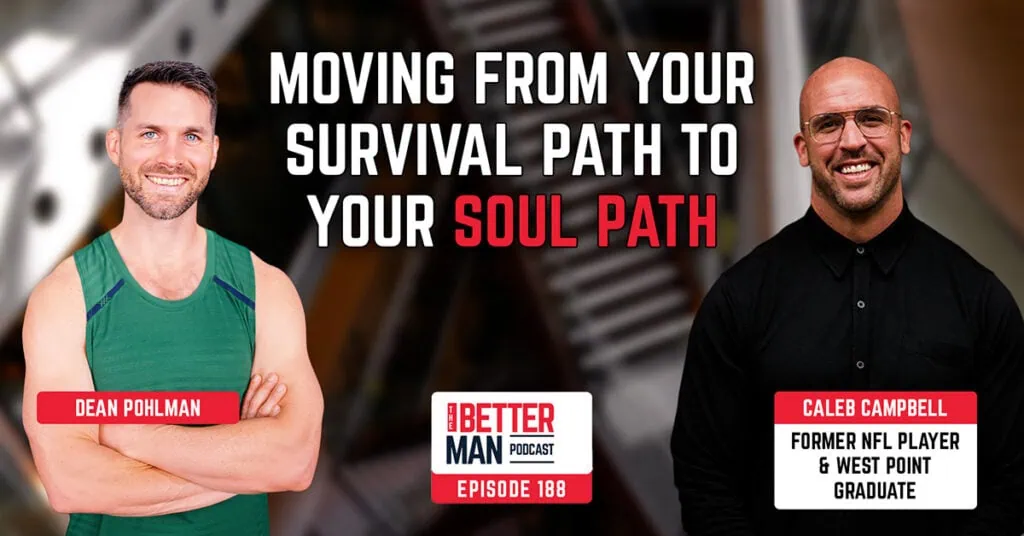
Moving From Your Survival Path to Your Soul Path | Caleb Campbell (Former NFL player & West Point graduate) | Better Man Podcast Ep. 188
If you’re an endlessly striving achiever, you know the path forward lacks clarity. Former NFL linebacker Caleb Campbell used his feelings…

The Ethics & Use Cases of AI | Ted Phaëton | Better Man Podcast Ep. 187
The topic of AI is unavoidable. Ted Phaeton, productivity coach and host of the Modern Man Podcast, joins the show to…