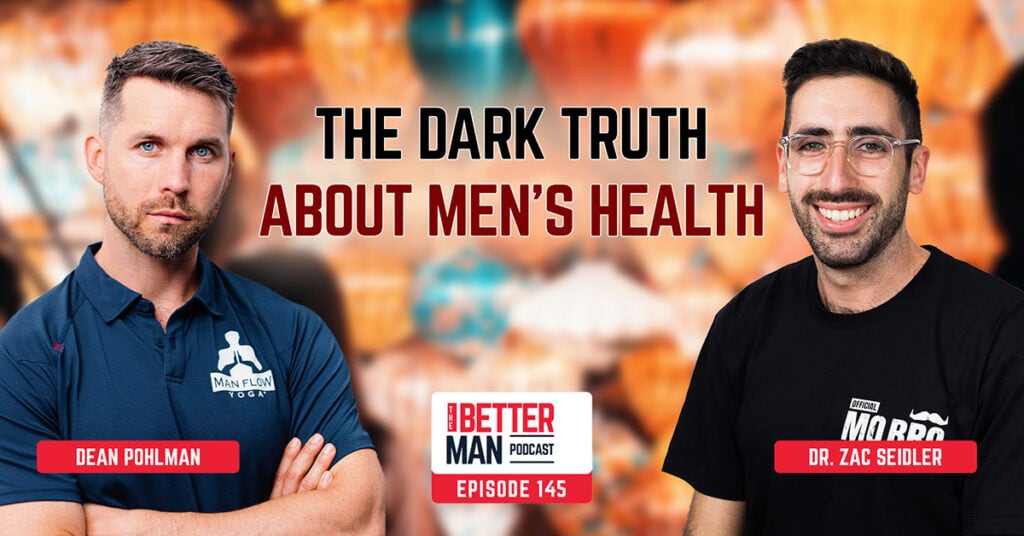
You have been sold a lie, and if you believe it, you’ll end up in a grave much sooner than you otherwise would’ve. It’s not your fault you fell for this lie. I have too. In fact, almost every man has fallen for it.
The lie?
That in order to be a “real man,” you have to tough everything out on your own. This lie has lethal consequences: it makes you feel unworthy of your own health, it forces you to avoid intimacy with other men, and it makes vulnerability impossible.
The result?
You fall into the deep abyss of loneliness… and don’t know how to get out.
That’s one of the reasons why men commit more than 75% of the suicides in America. And it’s why I invited Dr. Zac Seidler, Global Director of Men’s Health Research at Movember, onto today’s show.
One of the problems with men’s health is that disconnection and loneliness are discussed in a vague way. Well, Movember’s recent report, “The Real Face of Men’s Health” finally puts actual data to this vague description.
And the data trends are alarming: Isolation is the single biggest threat to your physical health. It will put you in a grave sooner.
The good news is, Dr. Zac shares a bunch of ways to stop living your life around this lie all men have been sold.
Here’s what Dr. Zac and I discuss in today’s show:
- What’s getting in the way of men having more meaningful connections – other than being physically healthy?
- The insidious, borderline lethal effects of silence (and why a fear of rejection and vulnerability cause it)
- How to change how you think about yourself to be happier, stronger, more vulnerable, and a better version of yourself
Listen now!
The Better Man Podcast is an exploration of our health and well-being outside of our physical fitness, exploring and redefining what it means to be better as a man; being the best version of ourselves we can be, while adopting a more comprehensive understanding of our total health and wellness. I hope it inspires you to be better!



Use the RSS link to find the Better Man Podcast on other apps: http://feeds.libsyn.com/404744/rss
Episode 145 Highlights
- Why the life expectancy gap between American men and women is actually going backwards for men (and how to prevent dying sooner than previous generations) (3:02)
- The 2 biggest reasons behind the alarming suicide rates among men of all ages (worst part? it has only a small connection to complex mental health history) (6:04)
- The potentially lethal consequences of “toughing it out” by delaying a doctor’s appointment and putting your family or career before yourself (11:04)
- Why your fear of boredom and silence will put you in your grave faster (and how pooping without your phone is the first step towards being comfortable with boredom and silence) (19:50)
- The Harvard Longitudinal Survey, the longest running study on human health and happiness, has discovered one metric that’s more important for living a long life than how much you exercise, your nutrition habits, and even whether or not you smoke (24:55)
- The 5 areas of holistic health (and why most men only do a couple and completely neglect the others) (27:05)
- How the silencing of your emotional needs leads you down a road of poor physical health (32:38)
- The “WMQ” secret for not only sustaining male friendships but thriving and connecting with other men on a deeper level and actually living longer (52:23)


Guest Bio
Dr. Zac Seidler is a clinical psychologist, researcher and leading men’s mental health expert. He currently holds dual roles as Global Director of Men’s Health Research at Movember and Associate Professor with Orygen at the University of Melbourne. Zac has dedicated his academic and professional career towards further understanding men’s mental health and masculinity. His ultimate goal is to help reduce the staggering rates of male suicide and domestic violence worldwide. Through his research, Zac has advocated for a change in the way we think about treating men’s distress. As part of his research, he has uniquely focused on creating mental health services that account for masculinity. This has evolved into a fully funded project, Men in Mind, the world’s first training program for mental health clinicians, to help them better understand and respond to men’s distress and suicidality.
Resources mentioned on this episode:
- Download Movember’s Report, The Real Face of Men’s Health here: https://us.movember.com/the-real-face-of-mens-health
- Follow Dr Zac Seider:
- Website: https://www.zacseidler.com/
- Instagram: https://www.instagram.com/zacseidler/
- Man Flow Yoga – Start your 7-day free trial here: https://shrtlnk.co/kP8M7
Dean Pohlman: Hey guys. It’s seen. Welcome to the Better Man podcast. Today’s episode is an interview with Doctor Zach Zigler. He is the global director of men’s health research at Movember, a psychologist himself. And in this episode, we are going to be discussing the findings of Movember upcoming October 2025 report entitled The Real Face of Men’s Health. In this episode, we discuss what’s getting in the way of men having more meaningful connections, more than being physically healthy.
Dean Pohlman: The one thing that you need to do if you want to live a longer, healthier life as a man. The issue of silence amongst men, and how men are so scared of rejection and vulnerability that they’re choosing to suffer loneliness and all of the negative health benefits that this entails i.e. living 20 to 30 years shorter than he should, and how men and how you can start to change the way that you think about yourself to be a happier, stronger, more vulnerable and in my opinion, a better man, a better version of yourself.
Dean Pohlman: This episode is exciting because we get to actually talk with an expert on men’s health, specifically on men’s emotional health, on mental health, which is really the big the big focus of this podcast is to talk about men’s health beyond the physical fitness. So we get into a lot of really compelling information, a lot of great actionable information and insights.
Dean Pohlman: And I know that if you’re interested in your health, this is one episode that you won’t want to miss. So guys, I hope you enjoyed this episode. Let’s get into it. All right, Zach, well, thanks for joining us today. And I understand you have some data for us on the the latest in men’s health.
Dr. Zac Seidler: I do data and who doesn’t love data? Data as you as you say in America we call it data down here and in Australia.
Dean Pohlman: That’s messed that up.
Dr. Zac Seidler: It’s, it’s really interesting, to consider, you know, what we do at Movember, in trying to shine a light on things that we thought were pretty obvious when it comes to men’s health, but especially in the States, no one has actually compiled a breakdown of what this looks like, for men across, you know, race and ethnicity, across age, demographics.
Dr. Zac Seidler: And so what we’re actually releasing, calling the real face of men’s Health is the first ever report, comprehensive report looking at what’s going on for men and boys, in the States, when it comes to their health and well-being. And, you know, the data is pretty staggering. I don’t think that you need to look at the numbers, to know on the ground that the men’s health is is in crisis.
Dr. Zac Seidler: If you look at the, you know, the dads in your life, if you look at, the young teenage boys who, we know struggling in school, struggling, you know, with mental health, social media stuff, pornography, like, you know, the issues abound. And when it comes down to it, you know, the life expectancy gap, which you between men and women, which you would think, you know, is actually getting smaller over time.
Dr. Zac Seidler: You think that that progress is being made consistently. We always believe that like, oh, I know health is getting better. Like we’re getting innovation by consistently talking about this stuff. We have more and more research. Surely we’re moving forward. And what we’re actually finding is that the state of American men is actually going backwards, in, in some ways and in some places.
Dr. Zac Seidler: And so we really need to shine a light on this stuff. And we’re lucky to have, you know, certain governors have come out and made really clear that this is just like, not okay. Gavin Newsom came out and Wes Moore has come out. And Spencer in Utah, there’s like a number of people who are going, okay, this is actually probably an issue that we need to start to tackle here.
Dr. Zac Seidler: And I think one of the main reasons for that is the pure economics of this, which is that when men die early from preventative causes, it costs billions of dollars. And you lose a father, a brother, a son, a worker, a community member. And I think that we’ve taken that for granted for far too long. So our report is really comprehensively trying to break down, you know, not only state by state, but by different ethnic groups, like what what is happening and how are actually going to go about it.
Dean Pohlman: So what are some of the big findings like, what are some of the big numbers or the big summaries that you’ve you found?
Dr. Zac Seidler: So when it comes to life expectancy, you know, we’ve got a really big gap of, you know, 6.8 years in Hispanic men between men and women. You know, overall it’s 5.4 years. Is the life expectancy gap in the states, between men and women, which is, you know, women are living past 80 on average and men are not breaking 75.
Dr. Zac Seidler: Now, in other parts of the world, 75 is considered like the beginning of where, you know, early, early death kind of comes on. If you die before 75, it’s considered we could have probably prevented it when your average American is not making it to 75, we have an issue. And so we’ve got really big, you know, gaps in the black community, in the, you know, even amongst white men, we’ve got a we’ve got a serious, you know, gap as well.
Dr. Zac Seidler: So we need to take this stuff, you know, very seriously around life expectancy. And there’s a lot of reasons why that’s happening. But I think that, you know, one of the main things that I continue to focus on as a psychologist is the suicide rate. And what’s seeing things moving in the wrong direction there as well.
Dr. Zac Seidler: We know that suicide is suicide. Death is largely a male phenomenon, like 75, 76% of all suicides in the States are amongst men. And something that’s that’s, you know, really interesting. Is that it? Everyone’s focusing on young men and how, you know, these these rates are actually increasing in, in young men in like the 15 to 25 year old age demographic, which is horrible, like losing a boy at that age is just, you know, really, really tragic.
Dr. Zac Seidler: But what we’re not focusing on is the fact that the numbers are really increasing in middle aged and older white men. It’s this notion of like disconnection and loneliness, which, you know, we keep talking about in vague terms. I think we’re missing a trick here when it comes to understanding how we’re going to address and respond to these men who do not feel like they have purpose and meaning, who do not feel like they are needed in society, who move through these transitions from, you know, teenager into, worker into father into a retiree.
Dr. Zac Seidler: And those transitions cause serious pain for them that they cannot seemingly regulate, that they can’t talk about, that they don’t have any friends to actually discuss it with. Or there’s not enough openness and vulnerability to do so. So there’s a massive call out there around, like, what are we doing here if we can’t safeguard these guys who actually don’t typically have a really complex mental health history, how are they slipping through the cracks?
Dr. Zac Seidler: You know, and I think we need to take that that really, really seriously. You know, we’ve we’ve got numbers galore in this document, and I’m hoping we can obviously link, for your audience here so that they can they can take a look through it. And I don’t want to bore them with some, but I think it’s really, really important.
Dr. Zac Seidler: To just consider why, it’s been so hard to gain traction when it comes to talking about mental health. I think, you know, you found yourself, I’m sure, Dane, that like, talking about, like, stress and talking about, you know, physical movement and exercise and nutrition, those types of topics seem to have, you know, been put in the okay bucket for lots of men and boys.
Dr. Zac Seidler: But when it comes to, you know, talking about going to the doctor when it comes to really understanding the burden, of our own health and well-being on our moms, on our wives, you know, when it comes to discussing, you know, heart health when it comes to talking about diabetes, like this stuff is just not commonplace amongst men.
Dr. Zac Seidler: And I think that that’s the reason, compared to women who have these conversations regularly, who have a relationship with their family physician, it it, you know, it hits the fan for us pretty early and we don’t know what to do.
Dean Pohlman: So do you think that it’s so it sounds like having conversations about living a healthy lifestyle is things that does are things that men are willing to have conversations about. So talking about working out, talking about different nutrition, I don’t know, talking about supplements, I guess, but is there I guess the question that I go to is there is there an assumption that or is there just like, the sense of I oh, it’s too hard.
Dean Pohlman: I’m going to give up if they aren’t able to do the things that they think that they need to do. Like if it’s if it’s too hard to exercise, or if they can’t, like, you know, maybe they were used to working out, lifting weights when they were younger and being able to run when they were younger, and now they try it again.
Dean Pohlman: We’re in their 40s and 50s and like, oh, it’s too hard. I give up or like, what’s the, what do you think is the I mean, I don’t know if there’s kind of a I guess what I’m, what I’m getting at is kind of this distinction between, like, here’s general health, what’s general, you know, fitness conversations in here.
Dean Pohlman: And then if it doesn’t work goes into these other conversations. And men are just they’re just not willing to have that conversation about like if if there are other issues or is that.
Dr. Zac Seidler: Yeah, I think that there is, you know, there’s so much desire for like that pain and game situation, this, this biohacking that’s rife on, on social media, like all of us, you know, are getting this content, whether it’s creatine or it’s supplements or it’s, you know, how we’re going to go about, you know, getting the most productivity out of our day.
Dr. Zac Seidler: That type of stuff is really resonating with lots of guys. And so I think we have a lot to learn when it comes to that. Because a language has been created, products have been created. There is safety in that discussion amongst men as well. It’s not shame inducing. It’s not seemingly vulnerable. The other side of the coin is like your traditional understanding of health and well-being.
Dr. Zac Seidler: And you know, the fact that guys going to see their doctor, like firstly, the time in which they go and see the doctor is often extremely delayed. Yeah. When symptoms have gotten worse, crisises hit and the limits of self reliance have come into play. And so they go, I can deal with this. This is fine. This isn’t an issue.
Dr. Zac Seidler: I don’t want to spend the money on myself. I don’t want to, you know, take time off work. Every excuse known to man come comes up and eventually they hit a wall and some of them go into R and some of them go, you know, into the morgue, to be honest with you. Like, this is this is a, it’s it’s it’s really this idea of like, I am, I think, not worthy of the type of care that I hope that my child has, that I hope that my wife has, or I don’t believe that it will help.
Dr. Zac Seidler: Or the really scary one to me as a psychologist is like, I don’t want to find out the amount of men who go, I don’t want to go for my physical, because I don’t want to know if something is happening. I don’t want to know if I’ve got cancer. I don’t want to know if I’ve got heart disease.
Dr. Zac Seidler: And my response to that always is like, we’re not on this earth, you know, for for knowledge, for growth, for development. Like, that’s what being a man means, you know, in this one day. That’s what that’s what manhood should be. And so I find it really interesting that that guys would rather bury their head in the sand sometimes.
Dr. Zac Seidler: And I think we’re starting to see a shift there because guys are realizing if I want to be a good employee, if I want to be a good husband, if I want to be a good father, I’m going to probably have to deal with my own shit. Like, that’s just how this works. If I’m going to succeed.
Dean Pohlman: Yeah. And it makes me think about how, you know, just the growing use of of smartphones and, you know, the ability to basically numb yourself to your emotions. Very easy. Right? You don’t ever have to deal with any challenging emotions if you don’t want to, because there are so many easy ways to distract yourself. So, you know, instead of dealing with this, you know, dealing with this real situation in front of you, which is your health, you can just turn on Netflix and you forget about it.
Dean Pohlman: And then you you go to work. And when you’re at work, all you’re thinking about is work. And then you come home and you’re rushing about, taking care of the kids or like, taking care of yourself, or you’re distracting yourself with TikTok. And so I don’t think men ever actually have the, you know, I think it’s very easy for men and women as well, but it’s very easy for men to just distract themselves from that reality and be able to avoid, you know, finding out whether or not they have something that’s wrong with them.
Dean Pohlman: That’s really easy.
Dr. Zac Seidler: It is. And I think that, we need to find a way to sell preventative health care, as, you know, something that is actually worthwhile and something that’s useful because I think that it’s this idea of like, oh, I’m okay now, and I’ll deal with it when it becomes a real problem. You know, the data is really clear on the fact that that delay, that period where prevention may have been possible.
Dr. Zac Seidler: Like, that’s if you jump on it, then I always say as a psychologist, it’s like, I don’t want to see you when you can’t get out of bed. And your your lowest, like, lots of people believe that. That’s when you go and see a therapist. And like that is the hardest time to make any change. I want to see you when you’re at your best and you can, like, come and pick up tools for me and you can utilize them in those moments, because otherwise I have to sit here and like coach you in the most simple things of like brushing your teeth and having a shower.
Dr. Zac Seidler: That’s not a good use of my time or yours either, you know?
Dean Pohlman: Yeah. So one thing that you said that that, made me think is this idea, that men don’t think they’re worthy of treatment. So talk to me a little bit more about that. What is the where is this? Is this Billy? Is this a new belief, or is this just like, this sounds different from, you know, the the John Wayne era of, I’m just going to tough it out and I’ll be okay.
Dr. Zac Seidler: Yeah. Dana, I think that something that’s really important here is that, I’m trying and our organization is trying to move away from. Yeah, the Superman era, I think in some ways, and trying to clarify that being a man is a much more complex, nuanced, diverse experience than what is being sold. And if you speak with enough men like we do, millions of guys across the world, we start to realize, that if you box them in, they will just give you the same answers over and over again.
Dr. Zac Seidler: And so that tough, stoic mentality is still going strong. There’s no doubt about that. Toughing it out is still a sentiment that many of us feel, is something that prevents help seeking fundamentally. But there is also this idea of being the protector and provider means that I am here for the service of others. I am here to look after others, and therefore I am undeserving of care myself.
Dr. Zac Seidler: And you know, I’m sure then you can reflect on like the, the, the beauty of like having friends who you’ve shared with and they’ve shared with you. And there’s this reciprocity and it makes you feel seen and loved and cared for. And therefore you get to this point where you go, oh, I actually maybe I deserve that warmth, I deserve that, you know, that someone leaning in and actually asking what’s going on?
Dr. Zac Seidler: Lots of guys who are extremely disconnected and who are just going through that day to day grind, are at odds with that feeling within themselves that maybe going and getting help is something you know, that is in line with their idea of manhood, is in line with their idea of of, you know, what type of dad they want to be, what they want to modeled.
Dr. Zac Seidler: And I think that that’s the issue comes from silence, to be honest. And like, that’s where we’re at right now, where if you do not have these conversations with others, if you’re just going through this internal narrative, you’re kind of going to trip yourself up. You’re going to continuously, like, delay. It takes others off. And and we know this in the in the data as well.
Dr. Zac Seidler: I find that all the time, especially with men who are in like suicidal crisis, they say that the role of the other, whether it’s a neighbor who comes and knocks on the door and just checks in, whether it’s their wife going, I’ve noticed something is different. We need to have community around us because you can’t trust yourself all the time with, you know, knowing what’s happening because you’re within your own brain.
Dr. Zac Seidler: You can only say so much. So I really do think that that idea of like, feeling worthy of care, feeling worthy of love, feeling worthy of, you know, the types of relationships that you that you want to have feeling worthy of a doctor who’s, who’s, you know, attending to your needs. Like it’s wild that we are in a place right now where health care has kind of become a privilege rather than a right.
Dr. Zac Seidler: And I think that we need to to shift away from that.
Dean Pohlman: Yeah. I mean, to what kind of got me thinking when you were talking was what are some of the obstacles to a culture that is more accepting of men talking more about their mental health or their health in general? What are the influences? What are some of the, you know, I don’t know, influences or ideas or organizations or whatever it is that are that are encouraging men to go in the opposite direction of what they need to be doing for, you know, to have just better health.
Dr. Zac Seidler: I think that, as you said before, I think technology has heaps of benefits, obviously. But most of the benefits that it’s selling to us at the moment are around productivity are around being going harder and faster. Actually gamifying our lives so that we continue to stay on these apps. Yeah. Which actually reduces offline connection time with others.
Dr. Zac Seidler: We’re also like, we’re so afraid of boredom. We’re so afraid of silence. And in those moments when we’re sitting on the toilet without a phone, that’s when you start to actually attune to maybe I’m feeling something, you know? I mean, it’s like that’s that’s the those are the moments in, in quiet times, like the fact that lots of men are spending most of the time on their phone when they’re having dinner with their family.
Dr. Zac Seidler: Like, that’s when you build that connection for your wife to go, how you doing? And you to actually consider, oh, that was a shit day. And actually that was a shit week.
Dean Pohlman: And yeah.
Dr. Zac Seidler: If you don’t stop and pause and consider and reflect with somebody else where those opportunities arise, we don’t grab them. That’s seriously problematic. And that’s why we’re actually getting this, this breakdown in and understanding of our own health and well-being, because it’s not being prioritized. It’s just not it’s not a voice that we are honing over time. And so when we think about, like the influences that, that are kind of pulling us away from our own health, I think that we should really, you know, consider what is making us healthier.
Dr. Zac Seidler: What are the things that actually make us feel better, that make us connect with others? And I think that, you know, employers especially have a real responsibility to, like, move beyond the, the cupcakes in the, in the, you know, they do these, like, morning teas. What are we going to talk about? We’re going to talk about mental health.
Dr. Zac Seidler: I’m gonna do a 15 minute morning tea and you’re going to come in, and then we’re going to say, some partners are going to come down and say, oh, it’s really important to talk about stress and make sure that you’re doing okay, and check in on everyone else, and then go back to your workplace and work until 2 a.m..
Dr. Zac Seidler: I’m going to slam you, you know, and it’s like culture of culture is the important thing here that I think everyone is like taking for granted, which is you can build culture if you if you create teams and you create, you know, a community that values this stuff. And that’s what we’re trying to do with my members.
Dr. Zac Seidler: You know, we’re building a community that that understands that this cannot be taken for granted. And we’re not doing it in a way that’s like reinforcing soft outcomes. It’s like fundamentally, you want to live longer, you want to live healthier, you want to make more money. All of these things are directly in line with you getting your shit together early with you, realizing what’s happening, slowing down, going and having that one doctor’s visit rather than spending ten days, you know, in a clinic like that.
Dr. Zac Seidler: There’s just simple math here that I think people are missing out on, that we really want to push.
Dean Pohlman: Yeah. I mean, for, you know, I’m going to kind of off topic maybe, but this is kind of what I was thinking as you were talking. But, you know, before I really got into health, and started doing what I do with mental yoga, I used to think that physical health and working out and eating well was like all you needed to have a healthy body.
Dean Pohlman: And it wasn’t until I started understanding the connection between mental and emotional well-being and your physical well-being and realizing that, oh, if you have if you you could work out every day for four hours and eat totally clean. But if you have terrible relationships and you have really poor emotional health, then you’re probably going to die sooner than somebody who eats terribly, doesn’t exercise, and has really great relationships and a sense of purpose.
Dean Pohlman: So are there anything what can you tell people about, you know, what can you speak? What can you speak to that like to the to the data of what does the data say about, you know, the risk of, let’s say, heart disease or, I don’t know, prostate cancer or like whatever it is between, you know, mental emotional health, relationships and physical health.
Dr. Zac Seidler: So this yeah, this is not a tangent. Then this is like core to the issue. And it’s something that we are trying to do. A lot of, you know, mental health the way it’s being conceived to date is like purely physical. Okay. So you look at the the research base and it’s like men’s health pre 2010 like psychological well-being wasn’t even really a part of it.
Dr. Zac Seidler: Like there was a bit of stuff on depression that me and my colleagues had written. That was a bit on, on male suicide because we were seeing trends there. But there was a huge focus on, yeah, heart disease, stroke, prostate and testicular cancer, which are things that we focused really heavily on. You know, it was it was the biological.
Dr. Zac Seidler: It was like, how are we going to do this, this, you know, physical renovation in order to to look after yourself. Now you’re seeing a massive pendulum swing. Now where, you know, the US surgeon general is going, okay. Actually, I think that the thing about, you know, the issue of our era is this loneliness and disconnection and everyone’s kind of tone talking about it in this really vague way.
Dr. Zac Seidler: But it means so much. And it’s it’s considered this really soft outcome. But it shouldn’t be. It’s like the most important thing. And a piece of data that I think continuously rattles me is, you know, the Harvard Longitudinal Survey, which you may have heard of, it’s it began a long time ago. These guys, some of them are still alive.
Dr. Zac Seidler: They’re in their 90s. They got them as as freshmen and they followed them, you know, for decades. And wanted to know what’s happening in their life. They can’t control for everything, but they’re they’re trying to look at their health and nutrition, their well-being, you know, all of these outcomes and what we find consistently is that the guys who are still alive now in their mid 90s, yeah, the ones who had quality friendships, it didn’t matter, as you say it did.
Dr. Zac Seidler: It actually didn’t even matter if they were smoking. Like that’s how full on this finding is. Like if some of these men smoked and others didn’t smoke and they didn’t have any friends, they’re dead already. Like, it’s that’s just the plain truth of it, which is that we are social beings fundamentally like, that’s what we’re here for. And men specifically.
Dr. Zac Seidler: This is a really clear outcome. Men and women have the same levels of loneliness. We know that. But women act to reduce that loneliness when they’re feeling that they go out, they pick up their phone. They don’t have this shame, this fear of connection. And lots of men just suppress this. They just push it down. But the need is just as strong.
Dr. Zac Seidler: And so what? What is really important is that loneliness is is a is a human experience. We’re all going to feel it. And that’s not the issue. It’s what you do with it. In the same way that if you have stress, you can drink it away, but it’s going to come back stronger, or you can meditate or you can run like there are so many options that I think lots of guys don’t see, and lots of those feel a lot harder for them.
Dr. Zac Seidler: But in my eyes, extended, painful loneliness feels like the worst outcome, so I’m not really sure why. Picking up the phone and calling a friend is is so painful. So I think that when we’re talking about mental health, I start to think of it holistically now, which is like it’s physical, mental, emotional, spiritual, social like. And I think of them as, as you know, like Marvel rings.
Dr. Zac Seidler: It’s like if, if you if you have one of them and you disregard another. You need to have balance here. You need to make sure that you’re focusing on all of these elements, and you’re just kind of titrating them so that they are in, in line with one another. Because if you disregard one of them, if you disregard your friends because you just want to do exercise on your own consistently, and then suddenly you don’t have anyone to talk to.
Dr. Zac Seidler: Like, I just I just think that that’s a really poor outcome. So we’re trying to see mental health as a really evolved and complex day to day practice that, you know, there’s so many guys out there who are like, ripped as hell, but they’re like misogynistic assholes, you know, who can’t sit down and talk with women and like, don’t respect them or what?
Dr. Zac Seidler: Like there’s so many examples of this stuff where you need to have balance, you need to have balance in your life, and you need to make sure that you are able to, consider holding all of these truths at the same time.
Dean Pohlman: What do you think is preventing men from acting on those feelings of loneliness? Like, what do you do? They have what do they think is going to happen? And I can, you know, I could speak for myself and.
Dr. Zac Seidler: I’d love to hear your thoughts.
Dean Pohlman: What is what is the well? What? Well, I mean, I I’d like to hear what the. Well, I’d like to hear what the data says. Like what? What would men say about. I mean, I think honestly, I think like, if I’m just thinking for myself, like, I think there’s, like, any sort of male companionship is seen as, as gay.
Dean Pohlman: So, like, men who don’t want to like, well, like, you know, like like I don’t I don’t want to seem like I’m gay, so I don’t want to, like, I don’t want to call my friend, or I don’t want to hang out with my friend, or I don’t want to, like, do have to close of a friendship. Like, this is, like, I went to London a year ago and we were shocked at how many guys were out just getting dinner with each other, like, you know, going out with their mates.
Dean Pohlman: Right? Like, that doesn’t happen here. You don’t see that here. Like, if you do, it’s like at a bar and they’re watching TV and they’re like, they’re totally absurd. They’re totally absorbed in the TV, right? They’re not actually like talking with each other. So, yeah, I mean, that’s just.
Dr. Zac Seidler: Like so, so many, so many thoughts then. Yeah.
Dean Pohlman: Yeah. Well, let’s share me, share your thoughts because I have, you know, I, I’m just one person with my own experience. I’m not the, I’m not the, the data collector guy.
Dr. Zac Seidler: Yeah. So, so, I think that we need to understand what the fear is, which, as you say, like there, there is a, there’s like an anti femininity, anti-homosexuality thing that’s going on there. There’s no doubt about that. Which is like if I am overly close and vulnerable with someone, then I’m going to be perceived as weak.
Dr. Zac Seidler: I’m going to be perceived as gay. I’m going to be perceived as, you know, needy, which is at odds with the type of manhood that I want to put out into the world. Little did I know that, the very act of distancing themselves from others is, you know, kind of the the fastest road to mental and emotional weakness, you know, struggling and and breakdown.
Dr. Zac Seidler: Really. You know, if you think about, like, picking up the phone and we look at this consistently amongst different groups of guys, like picking up the phone and calling someone and asking them to go out for dinner or whatever it might be like. The fear of rejection is really, really strong amongst many guys and that vulnerability that it takes to say, I actually want this, I want this from you.
Dr. Zac Seidler: I want this connection. Like that’s a that’s a fundamentally vulnerable thing to do, to put yourself out there and say, I want to hang out with you. The really the really strange thing here, though, Dane, is that everyone is clear on the fact that men are, like yearning for this. Like, look at I love you, man. The movie That thing blew up.
Dr. Zac Seidler: Guys consistently talk about it like stepbrothers. Like, you can list all of these movies where it’s men just hanging out in the same way that, like, we know we’ve done so much data with young guys and we ask them, why do you listen to Rogan? Yeah, what is it about? What is it about Joe Rogan? And they go, oh, it’s guys having a good time together.
Dr. Zac Seidler: Like there’s this, there’s this, there’s this yearning to hear men having fun, connecting, being in the same room together. And so when guys tell us, oh, I can’t reach out to him, I can’t possibly do that. I call bullshit consistently because I’m like, I know that that’s all that you want, but you have this massive wall of fear of saving gay, of, you know, this this idea that intimacy for some reason, is a no go for you and your friends.
Dr. Zac Seidler: And, you know, you go to Italy and oh, minute kissing each other on the cheek like there’s so much cultural diversity here that happens. But I’m really concerned at like the suppression of needs, this idea that like, this is something that all of us value and we’re moving through the world denying ourselves this thing, and all of us are doing it.
Dr. Zac Seidler: So it’s like if you’re in a locker room, everyone wants to say, should we grab a meal after this? And if you look around, no one, no one goes first. And it’s like, that’s the saddest state of manhood that I can see, which is like everyone is silencing their needs. And that’s when health outcomes start to, to worsen.
Dr. Zac Seidler: You know?
Dean Pohlman: Yeah, I mean, I guess I’m, I’m thinking back to, to college. I just I never really yeah. Like I remember I went out I, when I was there for the summer, for summer school, we would go out like all the time and then like one of my friends were a friend, so. Hey, let’s go, let’s let’s go to this bar beforehand.
Dean Pohlman: And I went with them, and I remember just hanging out with him at the bar and thinking like, how weird it was for me. Like, I, I’ve rarely like, I rarely went to hang out with just one guy at a bar. And I was like, this is weird for me. I’m not like, I’m not used to having like a one on one conversation with with another man like, this is this is like really different for me.
Dean Pohlman: So like, I, I don’t know, like and I’ve been involved in plenty of school, you know, organizations and I played sports all my life growing up. But I never really had, I never really had true intimacy with other men. It was always in like a group environment. And it was always there was always kind of we were I think we kind of just defaulted to, like cultural norms of male behavior.
Dean Pohlman: So it was, you know, it was is very much like, you know, giving each other shit like calling each other pussy, like, you know, it was like, or like talking about things that I thought guys wanted to talk about, like, oh, let’s talk about workout. Let’s talk about it. Yeah. Like success. Let’s talk about, girls meeting girls, you know?
Dean Pohlman: Yeah. It was like this. And so there was I, and I remember, like, I had a friend, who was in my car pool. He was one of my teammates on my carpool. And so I would, you know, we would go to practice, you know, however many times per week. But I remember he would have he would try to have conversations that were more than surface level conversations.
Dean Pohlman: And I got mad at him one day. I was like, dude, can we just talk about like, you talk about the weather? Can you just talk about, you know, something basic? Like, all of your questions are so deep, like it’s it’s annoying, you know, and like.
Dr. Zac Seidler: Imagine what all my friends think about me then.
Dean Pohlman: Yeah. Well, I mean, it’s different now. You know, I now I’m now I’ve gone the other direction and now I just like I just talk about whatever I feel like talking about, you know, I’m just like, this is what I want to talk about now. And if it’s like, you know, and if I give, I give people, you know, in my life a few opportunities.
Dean Pohlman: And usually they’re like, you know, the people that we know from school, like, that’s that’s who we tend to hang out a lot with when we get like, oh, this is this is Declan’s friend from school, so we’re going to have a playdate and we’ll talk with the parents. But if we hung out or if we hang out with them a few times and the conversations never go anywhere, I’m like, yeah, we’re we’re done with them.
Dean Pohlman: Like, I’m not. I’m not wasting my time with these conversations that don’t have any depth. I’m like, you just go, you want to connect and then it just doesn’t happen. I’m like, this is, this is dumb. This guy’s just trying to impress me with famous people that he indirectly knows. He’s like, oh, I’ve got a friend who met Kesha once, or like, I’ve got a friend to, you know, I’m like, this is this is a stupid conversation.
Dean Pohlman: I don’t want to have this, you know? Yeah.
Dr. Zac Seidler: It’s a mask. That’s, that’s that’s a mask thing. And that’s like the the thing that I get to do, I guess, as a therapist is like, everyone has a rich interior life. Some people just have way more boundaries that cut them off from that ability to access it. And so, like you as a, as a, you know, in your early 20s when you’re sitting there and you’re like, dude, like, stop asking these questions like, can we just talk about the weather?
Dr. Zac Seidler: Now? If you look back at that, you’re like, you want to have meaningful conversation. You wanted to, but you didn’t have the language. It felt uncomfortable. You know, he thought he was like pushing and prodding you like all of that stuff.
Dean Pohlman: I had totally different values, and I was actually just reflecting on this over the weekend and like why fatherhood has been like such a difficult transition for me. And it’s because my values before were all focused on they were success oriented. They were focused on success, they were focused on personal growth. They were focused on, you know, like physical fitness, looking a certain way in the mirror, like physical performance, you know, athletic performance.
Dean Pohlman: And so, and so that’s what I value. That’s like, I want to be better at I didn’t value intimacy. I did not value connection. I thought that if I focused on success and personal growth, that I would feel fulfilled and that I would be happy. And, you know, after years of doing that and feeling like I’m doing like, you know, I feel like I have reasonable I have like a reasonable level of success, you know, like, okay, I have a, you know, I’m pretty strong.
Dean Pohlman: I feel like I look pretty good. And you know, I feel like I’ve got a pretty good physique, but still, like, I was like, well, then why am I not happy yet? Like, what’s what’s going on here? And so, you know, there’s been a there’s been a very slow, gradual, painful shift of, of values over the last few years that, you know, I think I’m happier or moving toward happier.
Dean Pohlman: And not, you know, when say, I’m happy, happier. I’m pulling in from the. Yeah. I’m pulling, I’m pulling from the Oprah Winfrey, you know, Brooke’s, book. Yeah.
Dr. Zac Seidler: This.
Dean Pohlman: This nine post of happier instead of happy. But anyways. Yeah. So that’s that’s why those conversations, I didn’t want to have them because I was like, well, that’s not going to make me happy having these conversations. We need to talk about how we can be better for sure. We need to talk about how we can be more successful.
Dean Pohlman: And that’s it’ll make me happy.
Dr. Zac Seidler: And yeah, and that’s what you’d been sold. And that’s like the one dimensional attitude of what this should look like, what, you know, being a successful man in the 21st century is which is completely at all. It’s with like, you know, a century ago when we believe that it’s like, oh, our grandfathers were all just like doing this.
Dr. Zac Seidler: And it was straight down the line, like there was much more intimacy amongst friends, like my grandfather, the amount of male friends that he had, the connections that he had, the dances that they all went to like there was there was closeness and connection there. And we have this belief that, like, this is the only way to do it and it’s a lie.
Dr. Zac Seidler: And it’s, you know, there’s only so much I can rail against, like, oh, you become a father and then you work it out. But like, that’s, that’s pretty beautiful, that it’s like it takes bringing something else into the world as a mirror to shine up against you and go, oh, God, what have I been doing? The sad thing is, is that some people don’t come to that, you know, realization and and it hurts.
Dr. Zac Seidler: And it also hurts to have to do that in your mid 30s where you’re like, oh, what have I been doing for the past 15 years, 20 years, you know? So I like to think that we can get to the point where this success failure dichotomy, this attitude of like, what this really singular, one dimensional standard of manhood is, which is, yeah, purely based on your bank balance, your title at work, your size of your bicep, how much you can lift, whatever it might be like that that is always going to fall flat when it comes down to it.
Dr. Zac Seidler: And I think that people just realize that at a later point, and the longer it goes, the more powerless they feel to change it, you know? And that’s why you’re grappling with it in the same way that I am, you know, consistently, which is like, how are we going to expand our horizons, really, and move towards growth with a much broader, you know, spectrum of what growth looks like?
Dr. Zac Seidler: And yeah, that’s that’s what we’re trying to trying to do in my member is like, is clarify to you that, being a modern man can take shape in so many different ways and, like, sit down and think about that. Don’t shy away from that. Lean in, have those conversations with other men. Because as I said, everyone is trying to work this stuff out in silence.
Dr. Zac Seidler: And it’s not it’s not going to work.
Dean Pohlman: Yeah. And I’m kind of thinking now toward, you know, how do we start fixing this problem? Like, how do we start, you know, how do we start changing the way that we think about it? And one thing that came to mind is for me, all of my, you know, all of my some I guess I could call them failures, but all of my biggest failures or all of my significant life events or all my all the time that I’ve had the most pain or the most discomfort or the most like, or the biggest feeling of failure, those have all been for me, the biggest times, the most, the best opportunities for growth, you
Dean Pohlman: know, like, you know, and I think, you know, if you’re in, if you’re in this world at all, like if you’re in the self, you know, improvement world at all, I think most I think most people know that, like, I think most people understand that those times of tumult are opportunities for self-growth. They’re opportunities for you to kind of shed a previous belief about yourself that was holding you back, like, like for me, you know, like, I think I, you know, I, I’ve had ups and downs with, with man for yoga, you know, I’ve had I think like, you know, there’s been plenty of months where I’m like, oh my God, are we
Dean Pohlman: going to run out of money? You know, and being able to go through that and to experience like this feeling of failure and have to come up with a different way to think of valuing myself like, okay, well, if I’m if I’m not, like, as great as I thought I would be successfully, you know, with this on demand yoga business that I built, well, how can I think of myself?
Dean Pohlman: How can I continue to think of myself as valuable and, and so having to shift that to, oh, you know what? I’m I’m a great dad or like, I’m trying to be a better dad because I’m here a lot and I show up and I, you know, I make an effort or, you know, I’m really proud of the way the relationships that I’ve developed with my wife, because we’re very close to one another and we’ve had a lot of really difficult conversations.
Dean Pohlman: And we’ve gone through a lot together. And so I’m proud of that. So having, you know, having gone through different failures and having to.
Dean Pohlman: Really like having the blessing of, of these different failures and these different, you know, these challenges in my life that for me has been where I’ve been able to make these big strides in my own mental and emotional wellness. And so I’m seeing that as a way for guys to, like, be on the lookout for those, but also to kind of turn it over to you and say, where are the opportunities that guys can look for for making these changes?
Dr. Zac Seidler: I think that, as you said that day in like when you are faced with hardship, you have a number of options. You can you can double down and do the same thing over and over again. Yeah. Or you can take pause and say, what matters to me. And that’s what that’s what kind of happens when when your business is struggling and you take pause and you say, oh, if this thing falls over, who am I?
Dr. Zac Seidler: And if if you don’t have an answer like, that’s where the midlife crisis comes in, that’s where you go and you buy the Ferrari because you’re like, I’m trying to like, fill this hole, you know, rather than going, actually, I’m a multi-dimensional person. And without this, I’m also I know that I put the time into being a good dad.
Dr. Zac Seidler: I know that I put the time into being a good friend and husband, and I know that my, hobbies and like, spending a lot of time on the things that I love and value are going to, you know, pull me through, like that idea of being a singular version all the time and doing the same thing rigidly is not what being a successful human today kind of requires.
Dr. Zac Seidler: It’s not a it’s not a simple trajectory toward success. It’s consistently bumpy and it requires multiple inputs. And so taking that pause and going, where is my purpose? Where is my meaning? And how do I embrace, challenge and redefine myself consistently? Like at the core of Monday, manhood is flexibility. If you are using rigidity as your mode of operation, if you are doing the same thing, you know this idea of stoicism, for instance.
Dr. Zac Seidler: Love it. Yeah, it’s extremely important, like being stoic and, you know, understanding your bounds and knowing that you have the ability to, like, regulate your own emotions. Beautiful. There is a time and place to be stoic, and there is a time and place to be vulnerable and open. And I think that lots of people go, oh, I heard this thing on social media, and therefore that is my mantra, and that is all I do all the time.
Dr. Zac Seidler: And you’re not always in a fire, you know, it’s like we have to be willing to to reflect on what’s happening and adapt fundamentally and that’s what fatherhood brings. That’s what marriage brings. And we know that if you do the same thing when you’ve just, you know, started a relationship and you do the same thing you’ve done when you were single, like, it doesn’t work because you’re now in an interaction in the same way that, you know, friendship.
Dr. Zac Seidler: So I think that we need to we need to be really willing to have those moments of reflection, of going what matters to me? And how am I going to respond to this situation in a way that’s going to be in my best interests? And to grapple with the stuff that is painful and go, how am I going to how am I going to evolve here in a way that actually changes the outcome?
Dean Pohlman: Yeah. And makes me think about I used to, I think subconsciously I used to believe that the more masculine behavior I could have, the, the, the, the more the better it would be for me. Like the more value I would have as a man. And, and as and so I would like try to find I would try to like validate myself.
Dean Pohlman: I would try to like look for confirmation like this is still masculine, right. Like this is still a masculine thing. Right. And and and then, you know, realizing that, okay, like masculinity is you know, masculinity is important in some situations, but also it’s not like, you know, it’s not important in other situations, too. And I think even the idea of masculinity and femininity, it that creates the wrong dichotomy as well.
Dean Pohlman: Like I like I, I much more prefer like the, you know, the idea of the, the ship and the sea. Right. Because then that then it’s not there’s not man or woman attached to it. But like sometimes you’re the ship and sometimes you’re the sea and it’s in that way you’re like, oh, I don’t have to feel bad about being the sea right now.
Dean Pohlman: Or like, I don’t have to feel bad about being the ship right now. There’s no there’s like, nothing attached to it. Yeah. And you were talking about, you know, purpose, finding purpose, finding meaning. And so I’m wondering, you know, and I know we’re kind of running out of time, so I’m wondering if there’s, like, are there five things or there’s six things or like a little checklist of things that, you know, you guys should be, at least thinking about or taking action on, like, like, you know, once a week or once a month, like, you know, if we’re looking at these areas of you described physical, emotional, mental, spiritual, relational
Dean Pohlman: or social, like, what are those? What are the things that like, if you had a basic checklist, what are the things that, like, all guys should be doing?
Dr. Zac Seidler: Yeah, 100%. So I think that in the same way that it’s like you were forced to have those thoughts when you had a kid and, you know, your whole life is blown up. It’s great to do this stuff preemptively, to say, how am I going to to show up? What are the connections that really matter to me? What do I value in my self and in others?
Dr. Zac Seidler: Like when was the last time anyone asked that? It’s like, what do I value in myself? Like what matters? What do I have to offer? And if it’s purely about you as a worker, if it’s you as product that’s an issue like that has to be more. And so I think that that when it comes to that social relational stuff, that’s, that is so important to be like, what are people offering me and what do I offer others.
Dr. Zac Seidler: And like, what am I, superpowers? It’s something that, that I think is really important that we, you know, that we really understand. And again, that seems like a really soft question, and I don’t want to have to grapple with that. But if you’re answering that, like my ability to go to the gym every day is my superpower.
Dr. Zac Seidler: Yeah. Houston, we’ve got a problem so that there’s there’s some really fundamental, just like reflective things. This idea that, like, everyone needs to be in therapy is just bullshit. You know, I can put myself out of a job. But I do think that some of these questions, if you are brave enough to be honest with you, if you are courageous enough, you can ask them of yourself, and you just shouldn’t be afraid of what the answer is, because it’s probably the truth and.
Dr. Zac Seidler: That is the way in which we progress. Like that’s the way in which we move forward. And so in the same way that I said, you know, lots of people don’t want to know when they go to the doctor because they don’t want to find out. But like finding out means acting. Finding out means doing the thing. And evolving and improving.
Dr. Zac Seidler: And that’s what I think has been lost in translation here. So when it comes to, again, the physical and mental health side of things, I think that like really understanding where you’re at on a day to day basis and working out what your goals are like, it sounds really lofty, but like the idea that weight goals or that, you know, lifting goals or that, you know, like these can be much more simple, I think in some ways, which is like, I want to make sure that I and there’s a really beautiful, model around you, text mates once a week, you call them once a month and you see them once a quarter.
Dr. Zac Seidler: Like, if you’re not living up to that standard, you think back to college time. You’re seeing everyone every hour. And that’s what we actually want. Like that’s the beauty of connection. And now we’re at the point where it’s like, oh God, can I see my friends once a quarter? Like, I don’t know if I can make that up.
Dr. Zac Seidler: And that’s the saddest reality. Like, do it. Just make it happen, you know. And so I think that we need to when it comes to doing that, understanding of that holistic view of ourselves, we need to write down what the actions are that we really want to enable ourselves to do, and then work out what the fear is around enacting it, and then speak to someone about that and make action happen because, you know, you want to pick up your phone and call that friend, and you’re afraid of all of those feelings that we’ve discussed.
Dr. Zac Seidler: But loneliness is something you should fear far more. So overcome that discomfort because it’s going to lead to gold.
Dean Pohlman: Yeah. Love it. All right. Well, we’re going to do a follow up interview. So I’ve got you on the calendar. We’re going to another one. We’re going to get to know Zach, which I’m excited about. So, thank you for doing that. And thanks for sharing all of this information with us today. I mean, I’m sure there’s tons of things that people can take away from this, but I love that that lasting text week we call monthly C quarterly.
Dean Pohlman: I like because I like I like actionable.
Dr. Zac Seidler: Information.
Dean Pohlman: Too, because, yeah, thanks for coming and thanks for sharing all of that. I really appreciate it and we appreciate it.
Dr. Zac Seidler: Thanks, Dan. Great to be here.
Dean Pohlman: Yeah. All right guys. Well I hope you enjoyed this episode. I hope it inspires you to be a better man. And make sure to come back because Zach’s going to come back as well. See you guys in the next episode. All right guys, I hope you enjoyed that interview again. We’re going to have Doctor Zach coming back for another episode, so be sure to subscribe to the podcast if you haven’t already.
Dean Pohlman: And, be on the lookout for that next episode with him. If you are enjoying this podcast, I encourage you to leave a review. You can do that wherever you listen to the podcast on Apple, on Spotify, or whatever platform you’re using. You can also watch video versions of the podcast on the Betterment Podcast YouTube channel, and also in the man for yoga app and members area.
Dean Pohlman: Add free if you’re already part of our community, I want to say thank you so much for being here. I hope that this is helping you, with your health journey. And if you’re not already part of our community, you can get started with a free seven day trial at mental yoga.com/join. And if you’re not quite ready for that, we do have a free seven day Beginner’s Yoga for men challenge, which is, great for not just your physical health, but also for your mental and emotional health.
Dean Pohlman: So I hope you enjoyed this episode. Hope you got a lot out of it. And I look forward to guys to seeing you on the next episode. And as always, I hope this inspires you to be a better man.
[END]
Want to improve your sexual wellness, get stronger erections, and last longer in bed? Then join the FREE 7-Day Sexual Wellness Challenge here: https://shrtlnk.co/uA27H
Want to unlock more flexibility and strength, reduce your risk of injury, and feel your absolute best over the next 7 days? Then join the FREE 7-Day Beginner’s Yoga for Men Challenge here: https://ManFlowYoga.com/7dc.
Tired of doing a form of yoga that causes more injuries than it helps prevent? The cold, hard truth is men need yoga specifically designed for them. Well, here’s some good news: You can start your 7-day free trial to Man Flow Yoga by visiting https://ManFlowYoga.com/join.
Like what you’re hearing? Sign up for the mailing list:
Rate & Review
If you enjoyed today’s episode of The Better Man Podcast, hit the subscribe button on Apple, Spotify, or wherever you listen, so future episodes are automatically downloaded directly to your device.
You can also help by providing an honest rating & review over on Apple Podcasts. Reviews go a long way in helping us build awareness so that we can impact even more people. THANK YOU!
More Podcast Content
Dark Motivation Works … But It Causes a Mid-Life Crisis (Try this instead) | Connor Beaton from ManTalks | Better Man Podcast Ep. 191
Do you ever feel like you’re just wandering through life without a purpose, or stuck in the middle of a frustrating…
Fitness After 40: How To Start When You’ve Never Exercised (The Man Flow Yoga Catalyst Effect) | Bobby B. | Better Man Podcast Ep. 190
Turning 40 was Bobby’s wake-up call. After a lifetime of skipping workouts, a doctor’s visit revealed warning signs in his blood…
Gut Health Goes Way Deeper Than Weight Loss | Ben Brown (Founder of Body Systems Coaching and Head Nutrition & Fitness Coach) | Better Man Podcast Ep. 189
Gut health impacts far more than weight loss—it directly governs your energy, immunity, and mental well-being. If you grew up in…
Moving From Your Survival Path to Your Soul Path | Caleb Campbell (Former NFL player & West Point graduate) | Better Man Podcast Ep. 188
If you’re an endlessly striving achiever, you know the path forward lacks clarity. Former NFL linebacker Caleb Campbell used his feelings…

The Ethics & Use Cases of AI | Ted Phaëton | Better Man Podcast Ep. 187
The topic of AI is unavoidable. Ted Phaeton, productivity coach and host of the Modern Man Podcast, joins the show to…
My Personal Experience with Anxiety | Dean Pohlman | Better Man Podcast Ep. 186
After an accidental mushroom trip triggered a panic attack, I realized I’d actually been living with low-grade anxiety my whole life….