If you were born in the 80s, then you might be at a higher risk for gut dysfunction than the average person.
Today’s guest, Ben Brown (founder of Body Systems Coaching and Head Nutrition & Fitness Coach of 20+ years) learned this the hard way:
He was plagued by gut issues throughout his teens, but never realized the significance of gut issues until much later. As he went about undoing the damage he had accidentally done to his gut health, he started realizing that his energy came back online, his immunity strengthened, and his mood improved.
Today, Ben coaches men over 40 look at their body holistically to reach their weight loss, health, and fitness goals. And with over 20 years experience being a nutrition and fitness coach, he’s a wealth of knowledge when it comes to gut health, the implications your gut has on your overall health, and the steps you must take to reach any goal you have.
Here’s what Ben and I discuss:
- Why so many people overlook the importance of gut health (and some simple, low-friction ways to restore function to your gut)
- The role pain plays in creating lasting, internal motivation
- How building a new identity that’s aligned with your fitness goals keeps you accountable when discipline and motivation dip
Listen now!
The Better Man Podcast is an exploration of our health and well-being outside of our physical fitness, exploring and redefining what it means to be better as a man; being the best version of ourselves we can be, while adopting a more comprehensive understanding of our total health and wellness. I hope it inspires you to be better!



Use the RSS link to find the Better Man Podcast on other apps: http://feeds.libsyn.com/404744/rss
Episode 189 Highlights
- Why do digestive issues plague so many men (and why do they go completely overlooked for most of your life)? (3:40)
- How antacids made Ben’s digestive problems worse (5:30)
- The strange connection between being born in the 80s and GI distress (6:06)
- Why ignoring your gut problems can make you more susceptible to infections, take your mental health down a dark path, and create an unshakeable sense of fatigue that sleep can’t fix (10:39)
- How to improve your gut health, slowly but surely, over time without spending a small fortune on supplements and lab tests (13:30)
- What to do if you’re having fewer than two bowel movements per day to start to address any underlying gut dysfunction (17:54)
- Which kinds of processed foods are less bad for your gut? Ben shares some tips for making smarter and more informed tradeoffs here: (23:52)
- How social media traps you into a more dichotomous way of thinking that keeps you stuck on a yo-yo diet (28:12)
- Do you struggle with motivating yourself to get healthy? Here’s how one of Ben’s clients (who weighs 290 lbs) decided to make a lasting change (35:58)
- How to develop a stronger sense of self-kindness (52:36)
Dean Pohlman: Hey guys it’s Dean. Welcome to the Betterment Podcast Days episode is an interview with Ben Brown of Body Systems Coaching. Ben has been a coach for over 20 years. His focus is three pronged. He focuses on collecting data, behavior change, and the art of coaching. And this conversation started with the intention of it being about learning about kind of like what makes a good coach and what you should look for.
Dean Pohlman: And it pretty quickly went into gut health, which is a topic that I personally have not spent much time researching. So this is a really good introduction into gut health and some things to look out for to assess. Like is this something that you need to look at yourself? And then we really get into some of the coaching process and we talk about things like, how do you know when you’re ready to really make change the concept of identity transformation?
Dean Pohlman: And then this, this idea of being in touch with your pain, people who have not made the jump, people who have not made the commitment to start bettering their health are not in touch with their pain. And this is a concept that really intrigues me. So this is a great interview. Ben is an awesome guy, really well spoken.
Dean Pohlman: He has a good microphone, which is a good improvement from a lot of our conversations. So I hope you guys enjoyed this conversation. If you’re interested in lifestyle change at all. Check it out and I hope it inspires you to be a better man. Hey guys, it’s Dean. Welcome to the Bedroom podcast. I’ve got Ben Brown here today and we’re going to be talking about fitness.
Dean Pohlman: What’s up then. What up?
Ben Brown: Dean thanks for having me, man.
Dean Pohlman: Yeah. Thank you for coming. So I, I found about you through Anthony Ball doozy. Doctor doctor, doctor a from the fit father project. And I just thought you were cool guy. And then I, I think I looked you up, you know, saw what you did, and we had a conversation prior to this, and I was like, yeah, I think you’d be a great guest on the show.
Dean Pohlman: So, that’s the background story. So, so, yeah. Thanks for. Thanks for coming on and and chatting.
Ben Brown: Well, yeah. I’m honored. Thanks for having me.
Dean Pohlman: Yeah. And so you’ve been a coach for over 20 years now helping men with. Well, not just men, but men and women, I’m assuming, with with transformation, with health. And, you know, I’m always curious about the origin story of that. And so I’d love if you could, you know, take us back to when, you know, you were either passionate about fitness or, you know, struggling with your own fitness goals.
Dean Pohlman: And you know how you how you went from pain to purpose. Sure. As you say.
Ben Brown: Yeah, absolutely. I mean, I, you know, not to like, overly drama, dramatize the story. The reality is, you know, listen, I grew up in the 80s. So product of Arnold Schwarzenegger and Sly Stallone and Jean Claude Van Damme and what? You know what, boy, me, growing up in the 80s doesn’t want to be just shredded and and, you know, strong and and sort of be the superhero figure.
Ben Brown: And so that was always something that, I was interested in and enamored by is like, how do I get in the best and staying the best shape possible? And then, you know, you combine that with playing sports. And I was naturally pretty decent at to add some sports, you know, football’s American football specifically. I had a couple of injuries that accumulated in my high school years, like a torn ACL.
Ben Brown: And so I was pretty intrigued by the rehab process. But what what I really struggled with and kind of came to realize kind of much later on was I was really plagued by a lot of digestive issues in my teens, and I didn’t really realize the significance of it at the time. It just kind of what was right.
Ben Brown: Like, my mom had a bunch of gut issues, some extended family members had a bunch of gut issues. I would throw up all the time after meals, and we kind of joke like, oh, I ate too much, or it was too heavy of a meal. And so I didn’t kind of realized that that really wasn’t normal. But I did the obligatory things like go to the doctor and they gave me antacid medication.
Ben Brown: You know, this is like 15 or 16 years old. I’m on multiple antacid medications. I did the endoscopy where they put the, you know, the camera down your throat to see what’s going on with the stomach lining. And they’re like, you know, nothing to diagnose. It’s a little inflamed, but, you know, never any questioning around my nutrition behaviors.
Ben Brown: And, it became problematic enough that I really had to start to do my diligence of, like, understanding, starting to put the pieces together, like, okay, if I eat these things, it does this. If I eat these things, I feel much better and so on. And and that really compounded over the years. I ended up playing rugby for University of Arizona in undergrad and then came up to to Phoenix, where I am now, for graduate school for for my first master’s degree in exercise and wellness and continued to play high level men’s club rugby and along the way kind of started a personal training business.
Ben Brown: But I was still really exploring, like getting to the root of my own health issues of like what’s going on. I started to delve into functional medicine, learn from some of the best in the industry. And and this was way back. I mean, this was 2006, 2007, you know, so 20 years ago, I was I was running diagnostic testing and all came to realize, one is I had a nasty H.
Ben Brown: Pylori infection, which is a it’s a bacterial infection that houses itself in the lining of the stomach tissue that can create just a myriad of issues, including very low levels of stomach acid, which can contribute to the digestive issues, which, by the way, antacids were not helping with. In fact, it was making things worse, right, because it was further suppressing stomach acid.
Ben Brown: But, you know, also was that through a century, a lifetime at that point through 25 plus years of living, I had been exposed to multiple, multiple, multiple rounds of antibiotics starting as young as six months because my my parents being the, you know, the good parents of the 80s, that they were kind of the the logical solution to every ill was antibiotics.
Ben Brown: And so that really had done a number on, on my gut health, my intestinal lining contributed to tons of food sensitivities. And, and so my educational experience and process was really rooted in helping unravel that damage. And then realizing that I was really equipped with this, pretty unmatched skill set to apply to other individuals that had some level of of digestive distress, to say nothing of, you know, my involvement in just fitness and exercise and the tools that I developed, becoming a personal trainer and starting a business there.
Ben Brown: And that’s really been the evolution of my practice to date over the years. You know, to the extent that, you know, my business is called Body Systems because it’s really this holistic approach to understanding it’s right. Everything acts in in synergy. All the body systems act together to create this kind of holistic entity.
Dean Pohlman: Yeah. You know, it’s interesting because I, I think I grew up kind of straddling the maybe not even straddling, but I feel like I grew up kind of straddling the very, you know, medical approach to everything. Okay. If something’s not working, it’s medication to fix it. Right? It’s not looking at lifestyle. It’s not looking at, you know, maybe stress is causing this.
Dean Pohlman: It’s you know, and even when I think of, and then on the other end, you know, starting to look at things more holistically, I don’t even know if that really got popular until the 2020 tens. Honestly, I mean, so that’s when I, that’s when I started to kind of question a bit more about my health and go beyond like, you know, healthy food, exercise and sleep, and to like, well, what’s going on in your head?
Dean Pohlman: What are the emotions? What are the other things? And, you know, as you were talking about growing up in the 80s and having gut health issues, you know, even on a, you know, kind of on a, on a deeper, you know, visceral level, when I hear the word gut health, I’m kind of like, oh, like other stuff isn’t working, so.
Dean Pohlman: Or you’re not, like, doing the things that need to be done. And so like you’re looking at gut health is an excuse. It’s almost like a, you know like my, my, my mom. For a while she had this really annoying habit of saying she was gluten free. Yeah. And we all made fun of her for it, you know, not to her face, but like, kind of, you know, she would, she would say, like, is it gluten free?
Dean Pohlman: And we’d look at each other like, oh, she’s doing it again. But she only did that because she had a friend who had lost a lot of weight because she went gluten free. Yeah. And we’re kind of like mom, that doesn’t mean that, you know, you’re a gluten intolerance. That’s just like your friend’s experience. So, you know, I, I think gut health is a gut health is a potentially scary topic because, like, where do you start with it?
Dean Pohlman: And, you know, if you go into that, that, that conversation, the kinds of it goes to, like, I don’t want to get sold on probiotics or I don’t want to get sold into like, this other, you know, and so there’s a lot of I mean, even me personally, like, I don’t really understand gut health that much, because I’ve never had to, to learn about it.
Dean Pohlman: So, you know, so that’s kind of my, my overall view toward it and maybe some of my resistance to wanting to look into it more deeply. But I also think about, like, growing up in the 80s. What? And you answer the question for me, but like, kind of what was the gut health treatment at the time? It doesn’t sound like there, really.
Ben Brown: I don’t know I don’t know that there was outside of like take more Pepto-Bismol and Tums. I mean, I was eating the stuff like candy. And you make a great point, you know, around like, at least what I’m hearing from you is kind of this age old question of like, chicken or egg, you know, and it’s like, and and is there any relevance to, you know, a lot of people will use like the gut health standpoint to, to help drive like weight loss.
Ben Brown: It’s like, well, if you do this for gut health, then it’s going to contribute to weight loss. And I don’t think that that’s not really how things work. It’s this very multifactorial, you know, or needs to be a very multifactorial approach. I mean, the reality is like, listen, the gut is is literally integrated into our immune system and our brain health and our neurotransmitter production, and, you know, our digestion, absorption and assimilation of foods and therefore our energy production.
Ben Brown: And so, it would be irresponsible to suggest that it’s not, you know, very comprehensively involved in all of the above, again, to kind of this body systems approach, but to suggest that by taking a probiotic or by, you know, getting these, getting the stool analysis and addressing the parasites or the HP Laurie, that that’s going to be the ticket to, you know, get you to whatever the pervasive goal is, assuming the goal is something beyond just like feeling better or not having as much gastric distress or diarrhea or, you know, joint pain or something like that.
Ben Brown: So, you know, such as marketing, especially now, we have to kind of acknowledge that, again, is is we have to look at a lot of different components to, you know, the human body and how physiology actually works to the degree that, you know, that’s going to dictate what the roadmap looks like.
Dean Pohlman: Yeah. So, you know, the question that’s coming up for me is, you know, as someone who is not all that informed about gut health because I’ve, I’ve never had to be. And for people who are thinking, is this an aspect of my health that maybe I need to pay more attention to? Where do you even where do you even begin with?
Dean Pohlman: Because it kind of brings up the, you know, you can’t go into this. It would you could go into it blind, I’m assuming. But it would be a lot easier to have, you know, some specific guidance about where to begin and what’s important. And, you know, like, what are the right questions to ask? Versus just like typing in gut health and, you know, being immediately spammed by ads everywhere you go for general.
Dean Pohlman: Yes. Right.
Ben Brown: Well, you just said it now. So now we’re doing now we’re doomed.
Dean Pohlman: That’s okay. I won’t click on them. They’ll they’ll lose interest in me pretty quickly.
Ben Brown: You know, it kind of depends on the goals, right? But let’s just let’s just assume right. For the vast majority of us, the objective is to look better, to feel better, to have more energy. And a lot of the guys that I work with in our late 30s, 40s and beyond, you know, that becomes kind of the objective is, is, listen, I want to be leaner.
Ben Brown: I want to lose body fat. I would like to look good with my shirt off. I want my clothes to fit well. I want to feel confident in my skin. You know, I want to be wanted by my wife, and I want to be respected by my peers. And I want to have great energy and set a great example for my kids.
Ben Brown: I think those are, you know, kind of somewhat surface level, but appropriate kind of goals that I hear quite a lot, in which case, the very things that we’re going to do to address those goals are also the very things that are ultimately going to help with, improving gut health, if you will, because, you know, listen, at the end of the day, we need to be eating certain foods, eating a certain amount of nutrients, eating certain quality of foods, getting enough pre and probiotics which are coming from the foods that we consume, assuming we’re we’re consuming enough kind of nutrient diversity, meaning getting enough fiber from the foods.
Ben Brown: And that’s going to feed healthy gut bacteria. And so we end up creating this kind of symbiotic environment between the good and the bad bacteria in the gut. And that’s a lot of how our physiology responds, especially in our immune system health. It’s like we’re never going to only have good bacteria and we have immune defenses against bad bacteria.
Ben Brown: But it’s really the it’s the, again, the symbiotic relationship, the feeding back and forth between the two that kind of creates our homeostasis. And so again, if we zoom out we’re eating food. We need to eat a certain amount of food. If we want to lose weight, we need to create some semblance of a calorie deficit. And that’s going to be directly impacted by the quantity and the quality of the food.
Ben Brown: In other words, listen, we can agree that eating predominantly whole foods, what we typically call single ingredient foods and minimizing more processed, you know, refined types of foods and sugars and fats is probably going to be advantageous, right? So if we did nothing else. Well, that’s going to be advantageous. Then what else are we focused on? We’re focusing on movement that has a direct contribution to gut health and integrity.
Ben Brown: We’re focusing on stress management and sleep. That’s going to contribute to the integrity of our gut lining and our immune system health, and also how we handle the nutrients that we consume. And so I’m of the opinion and and by the way, I’m of the opinion and approach it this way, having done things in my opinion very wrong for a period of time, you know, on the back end of of treating myself, I was very dogmatic.
Ben Brown: I was the guy that was like, you need to be sugar for you need to be gluten free. You need to be, you know, dairy free, this, that and the other. You need to eliminate essentially everything, because that’s what I had to do to kind of build back.
Dean Pohlman: Yeah.
Ben Brown: And only to realize, well, it’s not going to be very effective if no one can stick with it. Yeah. And so I’ve spent the years really refining that process to the degree now. And I’m very malleable with it in terms of like, well, what can you reasonably commit to. And let’s not try and be overly drastic about getting all of these diagnostic labs run and then being on this extensive supplement protocol and eliminating all of these foods.
Ben Brown: Again, maybe that would help. But for a lot of the probably a lot of your listeners, certainly a lot of the men and women that I work with, it’s likely just terribly un realistic. Yeah. And so it’s not serving anyone.
Dean Pohlman: Yeah. So how can you tell if something is wrong with your gut health? Like what are some of the the signs to look out for?
Ben Brown: Well, I mean I think the obvious, it’s like if, if we’re, you know, if we have frequent diarrhea or frequent if we’re, you know, don’t have frequent enough bowel movements, I mean, we should be, you know, using the restroom or having, you know, 1 to 2 plus bowel movements a day. And I think people don’t really realize that you’re sort of your bowel movements are a direct representation of your gut health.
Ben Brown: And so this is funny. This conversation is not exactly going the direction that I anticipated, but and it’s awesome because I’m all for it.
Dean Pohlman: I rarely have plans.
Ben Brown: Yeah. No. It’s great. So there’s there’s actually shoot, I’m kind of blanking on the name right now. There’s, there’s a dedicated sort of like stool chart that you can look up. Okay. I’ll think of it at some point here in our conversation there’s a stool chart and essentially like gives images of different consistencies of, of stool. Yeah.
Ben Brown: That are kind of indicative of different things. Right.
Dean Pohlman: Well in the age of AI now you can just take a picture of your poop and you could ask.
Ben Brown: Well, look.
Dean Pohlman: At that. You can ask Gemini or ChatGPT or your thing of choice. You’re like, what’s wrong with my poop right now? And it will give you detailed say, like, well, it looks like there’s a lot of this, which suggests that you may have had some fatty foods recently and that you’re not processing.
Ben Brown: Emulsifying those fats looks like there’s some floating in the. Yeah. And so listen, we can tell quite a lot and apparently even more now with AI, which is cool, but also terribly potentially scary. So be careful how you’re leveraging it. Yes. But listen, I mean, that’s a direct representation. Our transit time or motility time, you know, the time it takes us to eat a meal to.
Ben Brown: But the time we see it on the other end. And, you know, not a lot is said or or taught about this, or even your doctors even ask you about this type of stuff. But if you’re not going to the bathroom consistently enough, well, that’s indicative of certain things. If you’re going to the bathroom too much. Well, that’s indicative of certain things.
Ben Brown: And so I think just being objective about your stool quality and quantity, obviously your symptoms like, listen, if you’re experiencing gastric distress or tons of gas or tons of bloating or acid indigestion, you know, around meals or between meals or upon waking or in the middle of the night, like that’s obviously something’s going on and it’s worth you kind of becoming your own best nutrition detective, as I often say, to figure out, you know what that is.
Dean Pohlman: Yeah. Okay. So let’s assume that some, you know, let’s assume that you’ve got some of these things. Maybe it’s maybe it’s frequent diarrhea, maybe it’s, you know, not having enough frequent bowel movements. What do we do now. What’s what’s what a first steps.
Ben Brown: Or I guess, you know, listen, the first logical thing is I alluded to, you know, previously it’s like, well, let’s assess our, our, our nutrition and lifestyle behaviors. Right. So are we over consuming caffeine? Are we taking any other drugs that could be contributing, whether it’s prescribed or otherwise? You know, maybe it’s over-the-counter medications. Maybe it’s just caffeine pills, maybe it’s focus, maybe it’s some sort of focus pill, right, that you’re trying to like optimize for focus.
Ben Brown: But maybe that’s giving you some gastric distress. We have to look at kind of sleep quality and quantity. But but I would say most importantly is just kind of looking at your existing diet like, listen, if you’re eating junk food, hyper processed, hyper palatable, overly refined foods like that’s not likely going to be digested and absorbed very well.
Ben Brown: And that could be contributing. And so the objective then is, well, how can I move to a more whole foods based diet? As I said, more single ingredient foods. And just think about, you know, think about that for a second. We’re talking about proteins or chicken, fish, steak, eggs, way protein, some dairy sources, you know, cheese, cottage cheese.
Ben Brown: Basically the less ingredients the better. And then obviously fruits and vegetables and whole grains, potato, rice. But the closer it is to, I think the way that you would find it in Mother Nature is generally a reasonable approach to getting a lot of nutrition, the quality of the foods that you want without a ton of calories, which is important for people that are looking to maintain, if not lose weight.
Dean Pohlman: Yeah, I remember when I first started looking at labels, you know, at first I was just it was kind of like reading a foreign language. I was like, oh, okay, this appears to be have fat in it or like, right. You know, but I didn’t know what it meant. And then the more and more, you know, I looked and I started to like, you know, just, just just be exposed to it and started to get curious about it.
Dean Pohlman: I started to look for certain things. I really like that you brought up looking for fewer ingredients. That’s one of the things that I look for, like, if my wife and I are at the grocery store and she’s like, hey, I want to try a new energy, not energy bar, but approaching bar. Yeah. I’ll be like, okay, well, let’s let’s look for the one that has the, you know, the fewest ingredients.
Dean Pohlman: Let’s look for the one that has the least added sugar. Right. You know, let’s look for a, you know, let’s look for the one that has, maybe more natural protein versus added way protein. So, you know, those are all like little things that you can, you can do and, and even like looking at snacks for kids, like I try to find if there’s all in it, I try to find something that has like olive oil, versus, you know, vegetable oil.
Ben Brown: Yeah, exactly.
Dean Pohlman: Yeah. So there’s like little things that you can, you can do to. And I had this really random question that I was thinking of as you were starting to talk about. And I’m like, is pastas is like tomato sauce. Like is Rao’s tomato sauce like, is that should I be making my pasta sauce from scratch or can like what what processed foods are like.
Dean Pohlman: Good to go. Yeah.
Ben Brown: You know, I mean listen so that that’s where it’s like there’s there’s obviously this spectrum, right, that we have to live on, whereby I, you know, it’s like it’s like trade, it’s trade offs, dude. Right. It’s trade offs to the degree that, you know, maybe Rios, which, by the way, I went to college with one of the, the grandson of the founding family.
Ben Brown: What’s.
Dean Pohlman: His life like?
Ben Brown: Apparently he doesn’t see too much of that coin, so.
Dean Pohlman: Oh, no.
Ben Brown: But either he’s doing just fine. Yeah. Anyway, so it’s like. Listen, Rios tastes amazing, but it it has. I’m pretty sure it has, like, more way more sugar in it than, you know, there’s another, like, Italian based, very simple ingredient pasta sauce from Costco that we get, that doesn’t really taste like much of anything. Like, it tastes like tomato sauce, you know, like, obviously much more natural.
Ben Brown: It’s nowhere near as delicious as Rios. And I’m like, dude, I like Ross. Like, I’m willing to sacrifice a little extra sugar, little more calories, you know, for the taste. And I think that’s listen, at the end of the day, and especially when we’re talking with, busy parents as an example, like this is where I think it’s important to figure out, like where the trade offs lie, what’s worth it, and where you can realistically live in terms of what fits for your family.
Ben Brown: Again, for your lifestyle, for your budget, all of those types of things, because it’s too easy to maybe listen to a podcast or, you know, see a social media clip and all of a sudden get fear MongoDB to think that you can never have any of that stuff, and it’s going to be the end of the world.
Ben Brown: And if you if you go down that route, man, it’s a slippery slope because before you know it, we can’t even breathe without potentially putting ourselves in a position to to die too early.
Dean Pohlman: Hey guys, it’s Dean interrupting my own podcast to mention a firm tech. If you’ve heard of Firm Tech, you’ve heard this episode before. This is basically an aura ring for your penis. It helps you measure the health of your penis. It helps you measure the strength of your erections, blood flow, how often you’re getting erections at night, which is great for sexual health as well as your overall health.
Dean Pohlman: If you’re interested in learning more, check out the link and the promo code that I have in the show. Notes. Yeah, you know, my my. My wife is on a kind of a health kick right now. And and I’m all for it because, like, we’re getting up we this week, we’ve gotten up early every day, like six, six, 15 ish usually hits the alarm once or twice, but we’re pretty much in the, you know, we’re exercising by like 630, which is, you know, it’s good for us.
Dean Pohlman: And, part of that is also she’s not been having desserts. So yesterday she’s like, this is the second night in a row I haven’t had dessert. Archie proud of me. And I’m like, I don’t care. You look amazing. You like you. You. And also like, what’s the plan here? Like, you’re just gonna never have dessert. It kind of goes back to this, like, what’s what’s the sustainable plan?
Dean Pohlman: Like, are you just never going to have dessert again? Or like, are you waiting until Friday to have it? Like, I’m glad that you I mean, I’m not I, I don’t care that you haven’t had dessert in two days. Yeah. But, like, if you if you care, great. But, like, what is the plan for this to be, like, sustainable versus like, you just like white knuckling it until like you get to Saturday and you’re like, okay, milkshakes are back.
Dean Pohlman: I need you to go to P Terry’s. P Terry’s is a local Austin like fast food place that makes delicious milkshakes. I need you to go to pee Terry’s and get me a chocolate milkshake. Like, okay, I’ll do it. You know, but it’s.
Ben Brown: You know, it it it lends itself to, to sort of this, what we call dichotomous thinking. Right? It’s this it’s this black or white thinking that a lot of people fall into, especially with the fear mongering on social media and with the dogmatic approach to you need to be carnivore, you need to only eat whole foods and toxic.
Ben Brown: Right. And it’s like and it’s understandable, right? Because you want especially when you have kids and it’s like, or you’re on a health kick, you’re like, you want to do the right things. And that’s knowable. But the problem is it’s also very again, it’s a slippery slope. And so with dichotomous thinking, that’s essentially when we only think about things as good or bad or black or white.
Ben Brown: I can eat this, but I can’t eat that. I can’t have I can’t have dessert. Right. And, you know, I can only eat these like, green check, check labeled foods that are organic and certified and blah, blah, blah. And again, it keeps people stuck, and yo yoing between sort of these realms and never actually learning how to live in the gray, never learning how to actually build autonomy, never learning how to create what we call unconditional permission to to actually enjoy the things that they want in reasonable and responsible amounts, acting as the adults that we actually are, who can make informed decisions around how to control our food choices and our
Ben Brown: calorie intake, and thereby actually learning how to set an appropriate example for our children so that they can grow up in a position where they also have autonomy and are empowered to make those types of decisions without feeling like they have to rely on. Right. This is good, this is bad. And by the way, the research is also very clear about people that approach dieting from a, a, a dichotomous mindset, from a black and white mindset in that they they tend to stay stuck in that perpetual cycle, meaning they’re the people that lose and gain the weight consistently and are likely to gain the most weight on the back end versus the people that can
Ben Brown: actually find. You know what that kind of living in the gray looks like for them. And so hopefully, you know, part of this conversation is really lending itself to like, the behaviors and the skills and the tools that allow someone to be able to do that.
Dean Pohlman: Yeah. So as you’re starting to create these kind of guidelines for yourself and like, and you do this with your clients all the time, I’m assuming like do you give them specific, like, hey, you can have this two times per week or like let’s decide on like a mutual let’s, let’s mutually decide on a number that feels like a whatever a cheat would be or like, how do you start to create those little, you know, not these black and white guidelines, but like, you know, these great guidelines for yourself.
Ben Brown: Yeah. So as I mentioned, I mean, having learned the hard way of of being very dogmatic about the things, realizing how much it repelled clients, how, you know, you get a very small percentage of people that are going to get great results, but the vast majority, you know, are not going to be able to adhere to those types of plans.
Ben Brown: And I learned that early on. And so over the years has just been iterating on, okay, well, how can we create a sort of systematic approach because everyone’s different physiologically, biochemically. Right. But we all need same kind of fundamental things. We need to eat a nutritionally diverse caloric managed diet. We need to move and be physically active and have some resistance training and manage our stress and sleep.
Ben Brown: Create great relationships. Right? These are fundamental across the globe. Across human existence. So the way that we approach it is through a process that we created called our pure science proven results, pure science proven results process. Dean. And and listen, there’s three components to that. It’s basically one is the science of data collection. Two is the psychology behavior change.
Ben Brown: And three is the art of coaching. Now I come from I mentioned, you know, my first master’s degree was in exercise and wellness. A few years later, I went back to school and got a master’s degree in clinical nutrition because I was just enamored with, you know, with nutrition, with supplementation with herbs and with just how impactful nutrition is on the body to say nothing of, you know, my experience with delving down the rabbit hole of gut health.
Ben Brown: But at the end of the day, we also need to leverage data to make informed decisions, right? Just like we would with our budgets and our finances and our business and our KPIs. It’s very much holds true with our nutrition and our exercise. And it would be irresponsible not to understand the the connection between. Right, just the laws of thermodynamics.
Ben Brown: It’s like if we create a caloric deficit, we’re going to lose weight. So how do we do that? Right? And so when we look at things with clients initially, we really do want to kind of assess and collect baseline data. It’s like, well how many calories are you consuming? What is your weight? What are your circumference measurements? You know, perhaps what’s going on with blood work if you’ve had labs run recently or we want to get labs run, you know, and then what are you doing from an exercise standpoint or a volume of exercise standpoint?
Ben Brown: And so we really can can leverage some objective metrics to understand, okay. Like first and foremost, what makes sense to help us manage our calories. And then we can kind of the low hanging fruit. Maybe it’s like you’re excessively consuming alcohol or you’re excessively consuming sweets or you don’t eat, you know, you’re of the opinion that intermittent fasting is the right modality for you.
Ben Brown: You don’t eat half the day, and then you overeat the second half of the day, and you can’t figure out, you know, why you’re not losing weight, in which case, maybe it’s not the right approach for you, but the data gives us the opportunity to, be unbiased about whatever the approach is and then ultimately figure out, okay, what aligns with your lifestyle, with your schedule, with your responsibilities, with your preexisting, you know, behaviors, your commitment level, your readiness for change, your social support system.
Ben Brown: So we do that around your nutrition, around your exercise. And then, as I mentioned, like the psychology of behavior change in the art of coaching are part of that as well. Because, Dean, you and I need to to communicate to the degree that we want to be as aggressive as we can, but we also want to make sure, as I mentioned, sort of this living in the gray, we need to do it in a way where you’re going to be able to adhere to despite, you know, the the stressors of life and the season that you’re in.
Ben Brown: Is it a super stressful season at work? Do you have young kids at home? Are you in the midst of a divorce? Like is are things crazy at work? Like all of that really matters.
Dean Pohlman: Yeah. So I’m I’m I’m curious. And I’ve seen this, you know, myself, I’ve got, you know, thousands of members. I get hundreds of emails a week sometimes. And, you know, one of the biggest things that tends to come up is this question of like, oh, motivation. Or, you know, I’m not feeling, you know, I’m just not I just don’t do my workouts.
Dean Pohlman: Like, I know I’m lazy and I don’t do it. And that’s, you know, and, you know, I’m curious, working really closely with people over 20 years, is there something that you’ve seen in people like is there a sign that they’re ready to make the change versus they’re just doing it because, like, I think it would make my life better.
Dean Pohlman: Like, what’s the difference between the people who sign up and like, commit to the change versus the people who sign up and just don’t go through with it?
Ben Brown: You know, it not to be cliche, but it’s it’s really is is acknowledging why they’re doing it in the first place. And it’s beyond, you know, it’s beyond the superficial. Like I want to look at at the beach. I mean, sure that that’s that might be important, but what’s deeper than that, right, is who are you with? What experiences are you making?
Ben Brown: I’ll give you an example. I had a conversation with a gentleman yesterday. Who? Who just enrolled in our coaching program, and he’s, 290 pounds. And the significance of the conversation. And he’s in a position where he just he literally cannot go another day. He’s not willing to sacrifice another day of his life being overweight, being uncomfortable, not liking what he sees in the mirror, but more importantly, is the impact it’s having on his relationships at home, the example that he’s setting for his daughter, and not being able to have and create the experiences that he wants and has been wanting to with his daughter.
Ben Brown: And what’s so powerful about this conversation for me, and hopefully for him, was we spoke three and a half years ago and he was not in a dissimilar situation, but he wasn’t nearly this far along. Sure, he was still overweight. His blood labs weren’t great. Now they’re awful. Now he’s on the precipice of some significant medication. And at the time, again, this was three and a half years ago.
Ben Brown: His daughter was, maybe 12 or 13. And he said at the time, you know, seemingly important wise, like, I want to be able to ride horses with my daughter. I want to be able to create these experiences. We go to the beach every summer, you know, I want to be able to run the beach with her. I want to be able to go trail hiking.
Ben Brown: And he didn’t commit and he didn’t sign up, and he used finances and an excuse. And perhaps the pain wasn’t great enough then, because here we are, three and a half years later, another three and a half years of missed opportunity and experiences with his daughter, whom now he only has two summers left with in the home.
Ben Brown: And I imagine for him and I listen, I have a 16 year old daughter of 16, 14 and an 11 year old boy. And so I imagine as a parent, for example, wanting nothing more than to have these types of experiences that you can create with your children while they’re still in the house, and the pain that might be associated with looking back and being reminded that one you missed out on all of these opportunities to spend time together, to exercise together, to create right new, new memories together, and to that all of the time that you were with them, you weren’t actually present because you were too concerned about how awful you feel,
Ben Brown: how awful you look, if other people are judging you. And so perhaps that’s a, a, a reasonable representation of, you know, the level of pain that I think someone needs to be in.
Dean Pohlman:
Ben Brown: To truly commit to making significant change. Now maybe it’s not that, maybe it’s not that significant for everyone. And maybe it legitimately is like we just need to find ways to help you enjoy the process. Right? It’s like you want to be active. You want to know how to eat healthier. You just don’t really know how.
Ben Brown: And therefore it’s figuring out the right cadence to be able to do that and just giving them a little bit of structure, a little bit of, autonomy. But at the end of the day, it still has to be something that, I think that.
Ben Brown: You know, they can’t imagine not creating for fear of, of living another day and in, you know, their old skin. Yeah.
Dean Pohlman: I’m, I’m this concept of not being in touch with their pain is something that, you know, I had a, I was part of a, a small mastermind of guys really similar to me, actually, guys in similar phases of life and and not necessarily same business, but like, fitness business. And I remember, you know, talking about this, you know, the motivation thing with one of my, one of the guys who was kind of administering the group and he said, well, he very matter of factly, he’s like, well, people who aren’t motivated aren’t in touch with their pain.
Dean Pohlman: And I was like, You know? And whenever I hear something like that and my initial reaction is, I don’t believe that, maybe there’s something to it. Do you usually means like, okay, this isn’t a new idea for me, but I’m open to it. I’d like to learn more about this and kind of, you know, spend some time noodling on this idea myself.
Dean Pohlman: And, you know, when you think about how easy it is to distract yourself from that pain on a daily basis. You know, and this is something I think about a lot, but like, you know, you’ve got all your streaming apps, you’ve got social media. I mean, you’ve got being productive, right? Is another one that’s the acceptable one. Right?
Dean Pohlman: But that’s another form of distraction. And so all these things that you can do that prevent you from actually experiencing that pain, that ultimately prevents you from feeling the pain enough to make the change. I know there was a there was a member interview I had on this podcast probably a year ago or so, and he summed it up really nicely.
Dean Pohlman: He said the convenience of my something paraphrasing here, but he said like the convenience of my poor choices was now out wide by the consequences of them. Yeah. And that was a you know, I think that was a I really liked the way that he, he said that. And so yeah, I think that those people who are not ready for the changes haven’t, you know, haven’t experienced the pain enough or, you know, it’s not this.
Dean Pohlman: I also like this concept you mentioned of like Season of Life because maybe it’s just like too busy of a season. Maybe it’s not the priority right now.
Ben Brown: I mean, listen, the reality is you’re not going to be motivated, right? All of the time. You don’t necessarily need to feel disciplined all of the time, but it’s just part of this identity transformation, of becoming someone who does the things that are in line with the lifestyle that you want to live. And I don’t know that there has to be anything beyond to, to profound or to necessarily deep.
Ben Brown: Listen, the pain really does matter. For the example that I set, the pain really does matter. And helping someone actually viscerally get in touch with because I don’t I think for a lot of people, like you said, they’re distracted from what it actually is and how significant. Like we say these things, we know it’s important, right? But it’s easy to be distracted from the significance of it.
Ben Brown: But if we’re being honest with ourselves and we have we give someone the platform and perhaps we ask the right questions to help them actually lean into and viscerally acknowledge the pain that they’re living in. Right. Well, that’s our job as a coach, is one to help them acknowledge that the significance of that pain, like, what is the purgatory that they’re living?
Ben Brown: And we all have a purgatory that we live in, right. But is it impactful enough, you know, negatively impactful enough that we’re willing to do what it takes and the level of discomfort that’s required to get out of it, right. Because as they say, it’s it’s uncomfortable either way, you know? Right. It’s hard either way. You choose your hard.
Ben Brown: So, you know, I think that there’s a lot of behavioral psychology. I think that but yeah. And so therefore just just from the motivational standpoint, it’s like, listen to you. You’re not going to be motivated every day, but but you do the things because, you know, it matters in the context of the life that you say you want to live.
Dean Pohlman: Yeah. Yeah. I like the, you know, like that you frame it as the identity transformation of being the guy who does these things that go into living a healthy lifestyle. And the motivation thing, I think that’s the you don’t have to feel like doing something to do it. I think I think that is a big misconception that, people who are not exercising regularly, you know, they look at people who go to the gym or, you know, they’re posting like, oh, I’m doing my yoga workouts every day.
Dean Pohlman: And they think like, oh, those people must just like, wake up and, you know, want to do it right away. And some of them do for sure. But like, you know, a lot of them don’t feel that way every day. I know I don’t like I’ve maintained a pretty consistent, you know, exercise routine of lifting 2 to 3 times per week for ever since I got back into lifting, probably, you know, 6 or 6 years ago now, but I probably only feel excited about one third of those workouts.
Dean Pohlman: For most of them, I’m just like, okay, it’s about 330 now. Kids are going to be home five or I need to go pick them up a little bit. So I need to head into the gym and it’s time for me to start, you know, doing whatever is on my workout calendar for today.
Ben Brown: I think people, don’t do justice, don’t don’t give enough credit to what’s possible when they actually commit to something and what motivation actually entails. Right? Listen, you’re motivated to go to the bar for happy hour. You’re motivated to stay up late and watch Netflix. You’re motivated to eat junk food, you know, past 10 p.m. but, you know, you still get up in the morning and you go to work and you do the obligatory things, and maybe you’re not happy about it, but you do it right.
Ben Brown: And so we can be motivated about a lot of different things. But what I think people don’t realize when you start to change or make that at identity shift, one that revolves around eating healthier foods, being more physically active, surrounding yourself with a tribe that also shares those same values is the pleasure that comes from reinforcing those behaviors to the degree that it’s like, yeah, maybe I don’t love getting up at 430 or 5 every morning, but I also wake up without an alarm.
Ben Brown: I enjoy my morning routine when it’s still quiet in the house. I look forward to that first cup of coffee and digging into my journal. I love getting out with the dog in the morning while it’s still cool here in Arizona and then hitting the gym. I love the fact that I have energy, you know, throughout the morning, and I’m not concerned about, you know, what’s going to happen tonight when I’m tempted to to drink alcohol again or, or snack late or stay up too late.
Ben Brown: And it’s sort of like, right. It’s like acknowledging how amazing things can look and feel in your life when you do start to change those behaviors, right? To the degree that, again, it doesn’t really revolve around motivation. It just revolves around I’m doing things that make me feel good, and I’m giving myself permission to reinforce those. And that’s very powerful.
Ben Brown: Yeah.
Dean Pohlman: And I think it can I don’t know I’m trying to I’m trying to like empathize with the people who haven’t like made the decision to jump in yet. And you know looking at guys like us who have you know you played college rugby I played college lacrosse. We’ve worked out, you know, our entire lives. It’s like, oh, yeah, easy for you to say.
Dean Pohlman: Yeah. At the same time, there are a ton of people that I’m sure you’ve worked with and a ton of people within our community that this hasn’t been, you know, this has been a relatively recent change for them. You know, these are guys who have gotten into their 40s 50s have not ever exercised consistently before. And and now they are.
Dean Pohlman: And, you know, partly because they’ve gotten in touch with their pain. I think a lot of it is also, they have started to lean into the identity shift of, oh, I’m a guy. I didn’t used to think of myself as someone who exercised in the morning, and now I find myself waking up, you know, three or 4 or 5 mornings a week to go to the gym early or to turn on my yoga workout.
Dean Pohlman: And there was you you mentioned the, the example of the guy who, you know, got got up and went, goes up and everybody, right, gets up and goes to work in the morning. And I, I had an interview with a guy, from the UK could barely understand him. He was a he was a cabbie. And he said, you know what?
Dean Pohlman: Well, I realized to myself that I, you know, I got up every day and I drove my cab, so, like, why can’t I do that with yoga? Or why can’t I do that with my workouts? Why can’t I do that with other things? And so, you know, I this is one thing that I try to get people to do is, you know, I’ve, I’ve had them like, hey, I want you to think about how you’re not successful with fitness, but I want you to then think about another area of your life where you do show up and you’d be consistent and like, what’s the, you know, what are some of those areas?
Dean Pohlman: And, you know, granted, losing your house and not being able to pay for things is very strong motivation. But, yeah. Anyway, that’s. That’s it.
Ben Brown: It’s like there was a point where you didn’t know what you were doing in your career. Maybe you hadn’t started a business yet, but you figured it out and you just took it one step at a time, and you built the skills and the tools to grow. You know, you did the same thing. I’ve done the same thing.
Ben Brown: It’s it’s the exact same process for whatever it is that we’re trying to create. People just need to give themselves permission to actually go through the process and not compare themselves to you or me, but acknowledge, hey, I’ve done a lot of really cool things in my life, right? And if I can do those from nothing, right? We’re not inherently born with skills for really anything.
Ben Brown: Then I can absolutely do this around my health and fitness. But, you know, as they say, how do you how do you eat an elephant? Right? It’s one bite at a time. And it’s like, dude, that’s the process. As as as challenging as it might be to accept, I know we want to snap our fingers and be there.
Ben Brown: But, you know, it’s it’s not going to happen. So, you know, what does that look like for you? Is it getting up at a certain time? Is it going to bed at a certain time? Is it just focusing on drinking enough water? Is it right. Going for a walk? Is it saying no? Is it cutting out alcohol?
Ben Brown: Whatever. You got to do something.
Dean Pohlman: Yeah. So I’ve got one more sub talk of the topic of this I want to cover before moving on to rapid fire questions, but how do you teach your clients to kind of be kind of themselves along the way, or to acknowledge that the thing is hard and do it, do it? Anyways? I think what’s really missing from one of the big reasons I started this whole, you know, mission with betterment podcast was to create a different example of men being better, instead of kind of one of my main tenants, I think is instead of gaslighting yourself and just like banging your head into a wall over and over again until the wall breaks.
Dean Pohlman: Like, what’s a better way of getting things done? Like, how do you how do you do something hard while also acknowledging that it’s hard? Like instead of like just trying to lift something and saying, oh, this isn’t heavy at all. I’ll lift it. It’s heavy. You try to lift it, you say, oh man, this is really heavy. This is going to be hard.
Dean Pohlman: I might not be able to do it. Okay, let’s try it. Right. It’s like just acknowledging, like the little you know, I think it’s a healthier mindset. So I’m just curious how do you, you know, and I’m assuming you use some utilize some form of this in coaching. You’ve been doing this for 20 years. So how do you kind of practice that.
Dean Pohlman: You know, that kindness. How do you struct people to to to have that that.
Ben Brown: Yeah yeah.
Dean Pohlman: Self kindness.
Ben Brown: Yeah. Well one is I think it’s important to try and remove emotion from the situation. And so what we, what we do is we create opportunities for reflection and education. And we do that through kind of a weekly check in process whereby, you know, we kind of treat it as game film. Right? Is what do you do after a game.
Ben Brown: You know, you you watch game film, right? You watch the video of like, okay, what did I do under these situations and circumstances? How did I perform? What did I do? Well, right. Let’s acknowledge what I did well right relative to to maybe previous weeks. What could I have done better? Okay, now that I’m aware of those, how can I take those lessons and apply those into future situations.
Ben Brown: And so it’s giving guys permission to one be be acknowledged and awarded for because we usually don’t give ourselves enough credit. Right. So when we move the emotion we say, well here’s what happened. Here’s why it happened. Here was the good, the bad and the ugly said, okay, one kudos, right, for the way you treated that situation. And by the way, what would you have done in years past?
Ben Brown: Oh yeah, totally would have bailed it. So that’s awesome right? Like you’re making progress there. So let’s acknowledge those things and then that’s reaffirming. Right. And then two it’s like okay we’re not here yet in terms of the food choices, the alcohol choices, the commitments that you said you, you know, you wanted or the the goals that you said you had, that you didn’t follow through with what was reasonable or or unreasonable about the goals that you had set.
Ben Brown: How would we do to things differently next time? And then we build the game plan for the next week, the next situation, the next trip, whatever it looks like. So becomes this ongoing iteration and feedforward cycle cycle where we’re continuing to learn and grow. And it doesn’t become this nebulous I’m just not good at. I just can’t eat out.
Ben Brown: I just can’t drink alcohol. I just can’t hang out with this peer group. Like, that’s not helpful. Said we need to teach people how to navigate real world situations. And and so that’s kind of a big part of the learning process.
Dean Pohlman: Yeah okay. Cool. All right. Rapid fire questions. You have not been prepared. You’ve not been briefed. Rapid fire questions. Here we go. What do you think is one habit, belief or mindset that has helped you the most in terms of your overall happiness?
Ben Brown: That’s a good question. My my grandfather used to always say everything in moderation, including moderation. And I think it’s just it’s absolutely more and okay just to have the efforts and enjoyment that comes from it in any way, shape or form occasionally.
Dean Pohlman: Okay. Love it. What’s one thing that you do for your health that is overlooked or undervalued by others?
Ben Brown: You know, I’ll say as of the last few years, blood work every six months, is, in my opinion, very important, especially in our 40s and beyond. Okay.
Dean Pohlman: All right. What’s the most stressful part of your day to day life?
Ben Brown: The just the role of being an entrepreneur. I’ll say a solo or a small business owner and the undulations that come with that. And so there’s you probably can resonate. But for anyone that has a small business just from highs to lows, you know, daily.
Dean Pohlman: Okay. Yeah. And what is the number one challenge facing men and their wellbeing right now?
Ben Brown: Man, I think, I think that there’s a lot of challenges facing men right now that culturally. But at the end of the day, I’m just going to keep it, I’m going to keep it PC, and I’m going to speak to just the environmental challenges that we’re facing in terms of, you know, the plastics, the phthalates, the xeno estrogens, the fact that our our as men, our environment is contributing to essentially feminizing us.
Ben Brown: And we need to be careful.
Dean Pohlman: Okay, cool. All right. And then anybody listening in, well, you’re still listening because you’re listening right now. But if any of this is resonated with you, if it aspires you to look more into coaching. This is what Ben does. So body systems, how do people learn more? Or is there something to get started?
Ben Brown: Yeah, man. So obviously you’ll have our website Body systems.com, and I’m sort of active on social trying to enjoy summer and not be too involved. But at at body systems coaching is my Instagram handle and I’m responsive to DMs there. I do have a podcast that’s somewhat in hibernation, but I’m working on next episodes, which, by the way, I’d love to have you on Dean.
Ben Brown: I’d love to be. It’s called the Smart Nutrition Made Simple show so you can get more information there. But we have resources on the website and I would love to, you know, if anyone wants to reach out. Has questions. I’d love to. I’d love to hear from you. Cool.
Dean Pohlman: Awesome. All right. Well, Ben, thank you for your time. Thank you for answering my questions about whether or not I can have pasta sauce from a jar. I’m just great, great. Great conversation.
Ben Brown: Thank you. Yeah, man, I enjoyed it. Thanks so much for the time and energy and and sharing the platform.
Dean Pohlman: You’re welcome. All right, guys, I hope this inspires you to be a better man. I will see you on the next episode. All right, guys, thank you for listening in. Everything about Ben and Body Systems is going to be in the description below. He is a one man show. So you know, send him a message. He’s got his email, his DMs and Instagram.
Dean Pohlman: Really great guy. I’m really glad that we had a genuine guy. If you are enjoying this interview, if you’re joining this podcast overall, please leave a review if you haven’t already. Really helps out. And if you want to learn more about what I do with Manuel Yoga and jump into our community and kind of be in an environment where all the conversations that we have here, you know, kind of shape how we interact with one another.
Dean Pohlman: Supportive, helpful environment. Go to manifold. Join. Learn more about a free seven day trial. I also have a free seven day challenge to get you started on the workouts. Com slash seven DC links for all of that in the description below. Guys, I hope you’re enjoying this. I hope it’s helping you. I hope it inspires you to be a better man.
Dean Pohlman: And I’ll see you on the next episode.
[END]

Resources mentioned in this episode:
- Ben Brown’s Body Systems Coaching: If you liked what Ben shared in today’s show, you can learn more about his Body Systems Coaching on his website here: https://bodysystems.com/
- Follow Ben on Instagram: @bodysystemscoaching. His DM’s are open if you have a question or need help!
- Check out Ben’s Podcast, The Smart Nutrition Made Simple Show: On Apple Podcasts here: https://podcasts.apple.com/us/podcast/the-smart-nutrition-made-simple-show-with-ben-brown/id1244912234 (or wherever else you listen to podcasts).
- FirmTech: An “Oura Ring” for your Johnson. Save 15% by using my link: https://myfirmtech.com/manflowyoga
Man Flow Yoga Events: We just announced new locations for 2026 in-person events. Find the full list of cities we’re coming to here: https://manflowyoga.com/man-flow-yoga-events/
Want to unlock more flexibility and strength, reduce your risk of injury, and feel your absolute best over the next 7 days? Then join the FREE 7-Day Beginner’s Yoga for Men Challenge here: https://ManFlowYoga.com/7dc.
Tired of doing a form of yoga that causes more injuries than it helps prevent? The cold, hard truth is men need yoga specifically designed for them. Well, here’s some good news: You can start your 7-day free trial to Man Flow Yoga by visiting https://ManFlowYoga.com/join.
Like what you’re hearing? Sign up for the mailing list:
Rate & Review
If you enjoyed today’s episode of The Better Man Podcast, hit the subscribe button on Apple, Spotify, or wherever you listen, so future episodes are automatically downloaded directly to your device.
You can also help by providing an honest rating & review over on Apple Podcasts. Reviews go a long way in helping us build awareness so that we can impact even more people. THANK YOU!
More Podcast Content
Dark Motivation Works … But It Causes a Mid-Life Crisis (Try this instead) | Connor Beaton from ManTalks | Better Man Podcast Ep. 191
Do you ever feel like you’re just wandering through life without a purpose, or stuck in the middle of a frustrating…
Fitness After 40: How To Start When You’ve Never Exercised (The Man Flow Yoga Catalyst Effect) | Bobby B. | Better Man Podcast Ep. 190
Turning 40 was Bobby’s wake-up call. After a lifetime of skipping workouts, a doctor’s visit revealed warning signs in his blood…
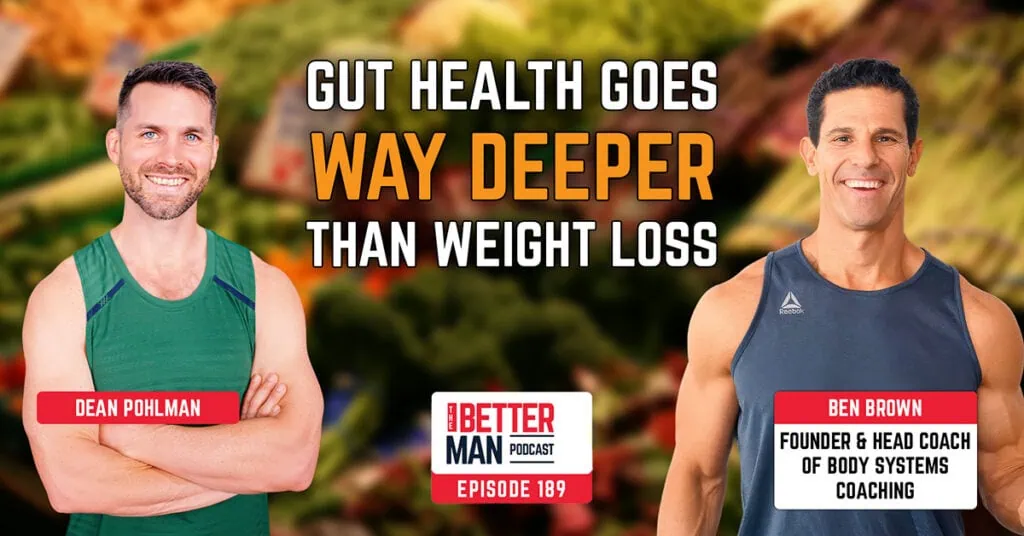
Gut Health Goes Way Deeper Than Weight Loss | Ben Brown (Founder of Body Systems Coaching and Head Nutrition & Fitness Coach) | Better Man Podcast Ep. 189
Gut health impacts far more than weight loss—it directly governs your energy, immunity, and mental well-being. If you grew up in…
Moving From Your Survival Path to Your Soul Path | Caleb Campbell (Former NFL player & West Point graduate) | Better Man Podcast Ep. 188
If you’re an endlessly striving achiever, you know the path forward lacks clarity. Former NFL linebacker Caleb Campbell used his feelings…

The Ethics & Use Cases of AI | Ted Phaëton | Better Man Podcast Ep. 187
The topic of AI is unavoidable. Ted Phaeton, productivity coach and host of the Modern Man Podcast, joins the show to…
My Personal Experience with Anxiety | Dean Pohlman | Better Man Podcast Ep. 186
After an accidental mushroom trip triggered a panic attack, I realized I’d actually been living with low-grade anxiety my whole life….