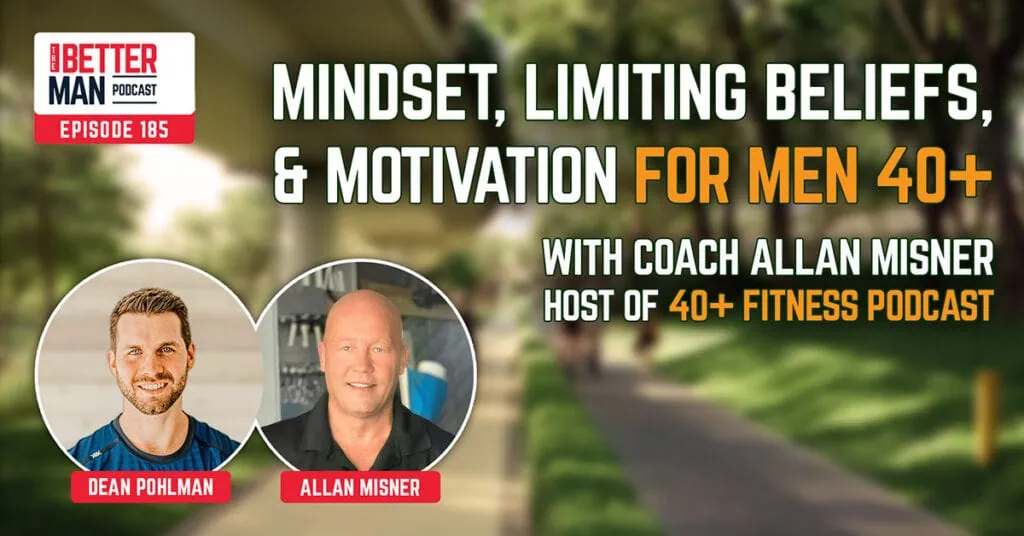
Today’s guest, Coach Allan Misner and host of the 40+ Fitness Podcast, almost drove himself to the ER when he was 39 after playing a half of a round of beach volleyball.
His story may even resemble yours:
He prioritized his career over his fitness, over his health, over his family, and over his relationships for years without even noticing.
That half round of volleyball was his wake-up call… but he was still battling a shoddy mindset which threw a wrench in his tires every time he tried to better himself. And so, he rode the fitness rollercoaster for another 8 years until his daughter said something to him that made him take his health and fitness seriously.
And then, at age 47, he did two things you weren’t “supposed” to be able to do: He lost 66 pounds of fat and gained 11 pounds of muscle at the same time. He also decided to start the 40+ Fitness Podcast because nothing of the sort existed at the time. (This was back in 2012-2013.)
Anyway, after getting his fitness in order, he decided to help other people over the age of 40 take back control of their health, fitness, and lifestyle.
And you know what?
He realized there were three key ingredients that determine your success regardless of your age or current fitness level: Your mindset, your limiting beliefs, and your motivation.
And so, today’s show takes a 40,000 foot view and gives you the strategy for getting fit after 40. We don’t talk about any tactics because, as you’ll hear, tactics can only work when they’re used in support of a successful strategy.
Here’s what Allan and I discuss:
- Why you must change your approach to fitness after 40 (and how to actually do it)
- How fixing your mindset and limiting beliefs will naturally motivate you more than beating yourself up ever could
- The most effective way to set fitness boundaries with your family and get them to join you in your mission
The Better Man Podcast is an exploration of our health and well-being outside of our physical fitness, exploring and redefining what it means to be better as a man; being the best version of ourselves we can be, while adopting a more comprehensive understanding of our total health and wellness. I hope it inspires you to be better!



Use the RSS link to find the Better Man Podcast on other apps: http://feeds.libsyn.com/404744/rss
Episode 185 Highlights
- How one game of beach volleyball made Allan think he needed to head straight to the ER at only 39 (and how he transformed his fitness in his late 40s) (8:21)
- Why one conversation Allan had with his daughter finally forced him to get his fitness in order after riding the “yo-yo rollercoaster” for 8 straight years (9:08)
- How one bad workout can “taint” your entire perception of exercise when you’re over 40 (even a bodyweight only workout like Allan explains at) (12:04)
- Here’s exactly what Allen did to lose 66 pounds of fat and tack on 11 pounds of muscle – at the same time! – at age 47 (and why he thinks Man Flow Yoga is better than his strategy was) (14:47)
- How to break through the barrier of self-hatred and shame (which can be motivating when you begin, but becomes lethal over time) and find a more positive source of motivation (21:41)
- Why the choices you make today will determine how involved you are in your kids’ or grandkids’ lives 30 years from now (29:12)
- A straightforward way to reframe your anxieties and actually enlist the people in your life to help you conquer them (33:10)
- How to set boundaries with your fitness and nutrition in a way that lets your family join the fight with you (39:04)
- The “Head Straight” secret to simplifying your fitness and aligning every aspect of your life (52:22)
- How to create an identity around your new fitness regimen (and why this allows you to stay consistent without even thinking about it) (59:08)
Dean Pohlman: Hey guys it’s Dean. Welcome to the Better Man Podcast. Today’s episode is an expert interview with Alan Meisner of the 40 Plus Fitness podcast. This is one of the longest running men’s fitness podcast. It’s a very popular podcast and this is a great conversation on fitness and aging. And it might actually be what you think because in this conversation, we’re going to talk more so about the mindset and the strategies required to be successful with weight loss rather than the tactics.
Dean Pohlman: When you go straight to, here’s what I’m going to do to lose weight, it usually doesn’t work out. And Alan is a prime example of that. So what’s interesting about this story is Alan started his weight loss journey back in 2012, when there was no information available for this, so he largely had to figure this out for himself.
Dean Pohlman: He decided to start a podcast to share with other people how he did it, and we talk about some of his strategies in this, his personal experience. And then we also give you some ideas on how you can do this in your own life. Also, by bringing the people into your life, in your life, into your fitness goals, rather than looking at them as the enemy or trying to work around them, but really actually being honest with them about your goals and what you want to do and making them be part of it.
Dean Pohlman: So there’s a lot of really good information in here. If you’ve been struggling with being successful with your fitness at all, or if you just want to make it easier. This is an awesome conversation and I’m looking to going on to Alan’s podcast as well, so check me out over there if you enjoy this one. All right guys, hope you enjoyed this interview.
Dean Pohlman: Hope you inspires you to be a better man and I’ll see you on the next one. Hey guys it is Dean. Welcome back to the Better Man podcast. Today I’ve got Alan here and we’re going to be talking about fit for task. And also just this overall idea of how to adapt your fitness as you get older. So Alan, thank you for joining me.
Allan Misner: Thank you for inviting me. I love this.
Dean Pohlman: Yeah. And you’re you are the host of a very popular podcast for fitness for men over 40.
Allan Misner: Yes, 40 plus fitness. Okay.
Dean Pohlman: And we met in the. We met in this ultimate health for men over 40 summit.
Allan Misner: Yeah. Funk Roberts.
Dean Pohlman: Yeah. So if you’re if you’re part of that or if you’re familiar with with that, then this is where I met Alan from. And Alan, you told me this, but you actually reached out to me. You looked for the whole list of people you found. And there were, I don’t know, like 80, 90 people on this. It was a huge list of people.
Dean Pohlman: And you chose, you know, handful of people that you liked. I was honored to be chosen among those people and reach out. And so we’ll be doing a podcast swap, as they call it, in the industry. So, you know, we’ve got Alan here to talk on the Better Man podcast about how to adapt your fitness as you get older.
Dean Pohlman: And then I’ll be on the fit 40 plus. Fit 40 plus. Did I say that right?
Allan Misner: 40 plus fitness.
Dean Pohlman: 40 plus fitness. I was so close. You should call it 44 fitness. Like the play on the page instead of the F. That would be really confusing.
Allan Misner: Here’s the interesting thing. When I was trying to get myself in shape, none of this existed.
Dean Pohlman: Yes.
Allan Misner: There were no podcasts, there were no books, there was no nothing. And so I was trying to find answers myself. And I’m like, okay, it’s got to be out there. It’s got to be out there. Yeah. I mean, and there was nothing. And then I figured a few things out and I can tell the story about how all that happened, but I figure everything out and I’m like, guess what?
Allan Misner: There’s still nobody talking about this. Yeah. And and it’s such a it’s such a huge demographic of people because all the boomers had just gone through this age, and now you had Gen about to hit this thing. And I’m like, there’s all these people that are coming into their 40s and they feel like they’ve lost their lives. They’ve lost who they were.
Dean Pohlman: And for you. What? When was this like? This was 15.
Allan Misner: For me. It was 2013, 2012, 2013 when I was figuring myself out. But I got through and I was talking to friends, and they’re asking me questions and like, you know, tell me what you did. Tell me how you did. I’m like, okay, I’m not just going to tell one person, I’m going to tell everyone who wants to listen.
Allan Misner: And so I started the podcast, and that’s why I could get 40 plus fitness, because there was nobody else. Yeah. And so that’s why there’s been 40 plus fitness. And now I am so happy to say there’s the summit. I mean that was all geared towards the second half of life. You know, you’ve got funk, you got you got so many people that are coming out now realizing we’ve got to talk about this because it’s not the same.
Allan Misner: You can’t be you can’t train and act like you did when you were in your 20s.
Dean Pohlman: No.
Allan Misner: When you’re older, you’ve got to start adapting. You’ve got to start changing. And I may have been the one that started that conversation, but I’m so happy that so many people are now coming into the mix and sharing information and making it available because like I said, back in 2013, 1415, it did not exist and it should have.
Allan Misner: So it doesn’t seem happy to say I was amongst the first to make that happen.
Dean Pohlman: Yeah. You know, I was just thinking of just the incredible changes in technology that we’ve had since then. You know, I was I told you this earlier, but, you know, you used to have to create a calendar invite for every single thing that you did. And today I took a screenshot of my son’s academic calendar, plugged it into Gemini, into Google AI, and said, create calendar invites for all of these.
Dean Pohlman: And then it spits it out. And, you know, that’s just like, I think that’s just very illustrative of where we were with trying to find information. And now how easy it is to find information. And, you know, as most of the guys that I work with are guys in their 40s, 50s, we really have a sweet spot of guys kind of in the 50s range.
Dean Pohlman: And a lot of these guys are just getting back into fitness for the first time in a while, or maybe ever, because this is the age when, you know, you might be able to get away with stuff in your 30s, your 40s, but when you’re 50s, that’s stuff really starts to catch up to you. And you know, you’re looking at your 60s like, okay, if I don’t turn stuff around, I might not actually be here for that many more years.
Dean Pohlman: And so it’s pretty scary. But, you know, there are things that you cannot do that you used to do. And so there’s all sorts of guidelines that, you know, I’ve I’ve come up with that. I mentioned to my guys that we’ve found as really important and, you know, injury prevention and being able to be consistent and and getting out in front of pain or dysfunction in the body that, you know, could sideline you or lead to, you know, a costly surgery.
Dean Pohlman: And so I’m I’m really curious, you know, for you what what kind of problems were you encountering when you were back in this period of 2012, 2013 when you were trying to figure out, how do I get back into this thing? And where were you at that point in terms of your overall fitness?
Allan Misner: Well, to answer that question, I got to go back about eight years before that. So when I was 39, I, I was I was doing great in my career. I had already basically made C-suite at 39. And so I’d made it my career. I made it, but every other aspect of my life was not good. My fitness was terrible, my health was terrible, relationships terrible.
Allan Misner: Everything else. Now, I decided that I should take a vacation because I hadn’t taken one in maybe five years. And so I took a vacation. I took a week off, I went down to a time share, and I just bought the timeshare. I, I just showed up and I said, where’s the sales office? And I’m like, what? I’m like, I walked right up to the sales office and I bought the time share.
Allan Misner: I hadn’t even walked the place yet. But what I knew about myself was that if I pod invested in a vacation that I that was paid for every year for a week, I would at least take a week off most years. So I did that knowing I needed this break. And then I went down and I saw that they had volleyball on the list of things that they do sand volleyball.
Allan Misner: And I was like, this is great. When I was younger, I played a little bit of semi-pro, made a little bit of money, won a lot of merchandise, you know, that kind of thing. It was fun and I thought, okay, I’m going to go out and play now. This was not the two man game I played back then.
Allan Misner: This was six on six. So it was a bump around move around little thing. But after one game I, I had to pull myself out and I was I was actually on the verge of thinking that I needed to go to the emergency room. So this is me, 39 years old, out of shape, cannot get through one game of volleyball.
Allan Misner: And so the next day I’m sitting on the beach and I’m like, you know excuse the language. You Bleep this out if you need to. But you fat bastard who the hell are you and what have you done with Alan. And so I was I was really upset about it. And I’m like okay, I’m going to fix this.
Allan Misner: I have to fix this. And for eight years I tried and failed. So when we talk about the roller coaster of making a little progress and then losing it all and then trying again and losing it all and all the stories and everything that come about from that. I had gone through eight years of this, and finally it was a conversation I had with my daughter that kind of broke the damn open.
Allan Misner: My daughter with the time was 20 years old, and she was a CrossFit level one CrossFit instructor, and we were on the phone and I was I was hungover. I was in the morning and in a hotel in Malaysia was hungover. I wasn’t feeling good. I was on the phone with my daughter and she says, daddy, would you watch me do this CrossFit competition?
Allan Misner: And that was like a kick in the gut because as a father, I had never thought of myself as a spectator in my daughter’s life. I had thought, always had thought I would be a participant.
Allan Misner: But after the call, I realized I wasn’t that person and there was no way I could have been a participant in a CrossFit competition. So she asked the right question. She just didn’t ask the question I wanted her to ask, which was, daddy, would you come do this CrossFit competition with me? And I had become the spectator and not the participant.
Allan Misner: That was the kick in the teeth. I needed to actually start doing something.
Dean Pohlman: Hey guys, it’s Dean interrupting my own podcast to talk about Magic Mind. Magic mind is a caffeine supplement that I’ve been using for the last few years. It’s something that I use as a alternative to coffee some days, and also something that I use maybe right before I do a podcast or from a video as a way to get a energy boost without the crash that usually accompanies caffeine.
Dean Pohlman: If you want to try it out. I put a link in the show notes below, but it’s a nice little supplement. It’s a drink two ounces that you can take just for a little boost of energy, a little more focused throughout your day. Give it a shot. Let me know what you think.
Allan Misner: Back then. So this is around 2012. I’m looking for answers and the books I can find out. Stretching for people over 50 and chair yoga. And I knew from from my experience that doing the stuff you do when you’re in your 20s doesn’t work and on. Case in point, one of the things I tried during that eight years, I was traveling a lot for work, so I thought I saw I came home, I was I was watching infomercials.
Allan Misner: I don’t know if they even still do infomercials anymore, but I was sitting there on a Sunday morning watching TV and there’s an infomercial and it was Shanti. Okay. You know who Shanti is? He was really fit. He’s a really exciting, dynamic personality, charisma, bouncing around happy. And they’re doing the workout. That was just bodyweight stuff. No equipment, just them and their body and the movement.
Allan Misner: And I thought, this is perfect. I can do this anywhere. I don’t need equipment. So I bought the DVD set and I got it and I ripped it to an iPad and cutting edge technology back then. Yes. And and so I’m like, okay, I got this on here. And I said, okay, before I go, I’m going on a trip Tuesday.
Allan Misner: Before I go, I’m going to do the benchmark workout on on Sunday. And so I sit down, I do this benchmark workout now. It’s really just a like a eight minute test thing. And I do the workout and I push myself because that’s what Shanti does. It gets in your head and he finds that little bit of ego.
Allan Misner: You’ve got to push you just a little bit further than you. You know, you would go and it happened to be a little bit more than I should have gone, because I woke up the next morning and could have swore people set up all night beating these baseball bats. I was so sore it hurt to reach out and grab my phone off the nightstand and call off sick for work.
Allan Misner: I couldn’t move, and so I called off, and when I got on the plane Tuesday, I was miserable and I flew and I was like, okay. And I never did a single one of those workouts. When I turned in that left and I turned in that that player, the non computer tablet three years later, I had never done a single workout that whole set because I had hurt myself so bad doing that one workout because I didn’t understand I wasn’t that guy.
Allan Misner: Yeah, that I was when I was younger, I was someone else, and I had quite figured that out, and my ego took me further than I needed to go. And so I learned that lesson. But the only answer I had at that point in time was just don’t do those things. But nobody was telling me what to do.
Allan Misner: So I decided to go ahead and get certified. So I went in for the Nasm certified personal trainer. From that I realized I probably need corrective exercise. So I got that certification. And then I looked at functional aging, and I did that certification. And then I looked at fitness nutrition. And so.
Dean Pohlman: What is what is corrective exercise.
Allan Misner: So within Nasm basically their model corrective exercise, when you notice that someone’s movement patterns just aren’t quite right. So for example easiest example is the overhead squat. If your hips and your and your and your particularly your calves are really, really tight, ankles really, really tight. When you try to do an overhead squat, your upper body is just going to face the floor.
Allan Misner: Okay. It’s a natural movement pattern. When there’s dysfunction in your hips or dysfunction in your calves okay. And so I would try to do an overhead squat. And I was facing the floor. It’s like okay I need to figure out what I can do correctly to address what’s going on here. Part of it was my hips. Most of it actually was my calves.
Allan Misner: And so learning how to basically get mobility back into my calves is what you actually do for a living.
Dean Pohlman: What was and what year was this when you were realizing.
Allan Misner: This would have been 2013?
Dean Pohlman: Okay. 2013 what were the mobility practices around like? Because yoga was that’s when I started yoga, like.
Allan Misner: So yoga. Yoga was there. But I’m going to be honest with you, that was that was a chick thing.
Dean Pohlman: Yeah. No it was I mean, that’s why I that’s the whole, you know, I mean, that’s when I started Mantle Yoga and that’s, you know, I was one of the first yoga for men dudes out there because, you know, it was not a man. It was not a manly thing to do.
Allan Misner: Exactly. And I actually took a yoga class probably around that time. And I was the only guy in there. I moved so poorly that it was just embarrassing, and the teacher was spending more time with me than anyone else in the room. And I’m like, okay, this is not the environment I want to be in right now. Yeah, yeah.
Allan Misner: But this was yeah. So this was a lot more focused about self myofascial release and active stretching and those types of things which for the base person gets you to a point. I think what you do is actually better. But in this in the grand scheme of things, at point in time, this was what I needed to be able to lift safely, begin to add muscle.
Allan Misner: And then of course, I was working the nutrition side and was able to start losing weight. So over the course of 11 months I lost 66 pounds of fat, put on 11 a muscle at the age of 47.
Dean Pohlman: Wow.
Dean Pohlman: That’s a lot.
Allan Misner: You’re not supposed to be able to do either of those things, and you’re especially not supposed to be able to do both at the same time. Yeah, well, what did you.
Dean Pohlman: What were you and what did you go down to?
Allan Misner: I was at I was when I walked into the, I walked into a nutritionist and I talked to her when I weighed myself. At that point, I was 255 pounds.
Dean Pohlman: Okay.
Allan Misner: Maybe 260. And then when I weighed myself again and got a Dexa at the end because I went back to her, I got another Dexa scan and I had at that point I was down to about 202. Okay.
Dean Pohlman: Got it. And how tall are you?
Allan Misner: I’m five foot 11, so technically I was still overweight, but but I basically was in about 19% body fat. So, you know, clinically not overweight but you know, BMI wise. Yes.
Dean Pohlman: Got it.
Allan Misner: You know, more a beefier guy. But I was lifting heavy. I wasn’t doing a lot of cardio work. It was mostly lifting. And then nutrition focused on protein.
Dean Pohlman: Yeah. So I want to go back to the I just have a question because I’m curious about. So when you were doing myofascial release and active stretching, what were the research? What were the resources for those? Were you like looking out of the book? Were there videos somewhere.
Allan Misner: Well within within corrective exercise, the certification itself, they teach they teach the methodology. Okay.
Dean Pohlman: Got it. Cool.
Allan Misner: Most people actually, you know, that’s kind of the funny thing coming out of it is like you watch people doing foam rolling and the the rolling. I’m like, I wish they really wish they wouldn’t call it rolling because you’re not supposed to roll the muscle. You’re only rolling to find the next spot that needs to be released. And it’s a process, and it’s a biomedical reason that it lets that does that.
Allan Misner: And it’s not the rolling that does it. It’s the pressure that does it. And so again, I learn the techniques and I was able to apply them myself, which was exactly what I needed. Because if you have poor form on a squat and you add load, you have the potential of hurting your lower back or worse. And so for me that’s that was the main movement patterns saying, okay, it hurts to squat when I add load and then realizing it will because your body is not in the right position to support that load.
Allan Misner: With the frame that you have, you got to get yourself in the right position. And you can’t do that with the muscle imbalances that I had.
Dean Pohlman: Yeah. Yeah. I mean that’s yeah, that’s kind of what I, I mean that fits with my methodology to, you know, like weight loss is going to come from nutrition and then strength training. Super important. But most people don’t have the necessary baseline of core strength, of flexibility to be able to do strength training. And so that’s where mobility practice comes in.
Allan Misner: Oh, absolutely. They hand in hand I mean, if you try to do one without the other you’re going to break yourself.
Dean Pohlman: Hey guys, it’s Dean interrupting my own podcast to mention firm tech. If you’ve heard of Firm Tech, you’ve heard this episode before. This is basically an aura ring for your penis. It helps you measure the health of your penis. It helps you measure the strength of your erections, blood flow, how often you’re getting erections at night, which is great for sexual health as well as your overall health.
Dean Pohlman: If you’re interested in learning more, check out the link and the promo code that I have in the show notes. The other thing I had in my note I wanted to go back to this is this, you know, this the you fat bastard, because that’s like that is that is what starts things I find, you know, I have a we have a motivation consistency coach.
Dean Pohlman: His name is Patrick and he does an awesome job of talking about how to have a, you know, a more effective approach to being kind to yourself to help with making progress with your fitness. But initially, it does take some self-hatred to, to, to spur you into action. And so, like everyone I talk with, like they all have, almost everyone I talk with just in general and also on this podcast interview, like they do have this moment where they look at themselves like, what happened?
Dean Pohlman: Who are you? You fat bastard, you know? And then they start to see some progress or they start to like, do some things, see some progress, and then, you know, eventually, over time, they make the switch. So, well, what if I was nice to myself instead? And then they really see progress. But like when, you know, when it first happens, there is this you fat bastard moment that.
Allan Misner: There was. But here’s here’s the interesting thing with me is that in and of itself was not enough. And so what I realized later was the difference with, with the thing with my daughter was that I now had tied that feeling to someone else of, I’m not, I’m not. I don’t respect myself. That’s one thing. But when my daughter doesn’t respect me, that’s an entirely different math.
Allan Misner: Okay, so my why was to earn her respect back. I don’t want my family to ever feel that I’m not capable of taking care of them, of being there, of participating. And so that was the kick in the teeth. Now, I’ve since learned a lot about mindset because I’ve coached hundreds of people. And what I know is I also had a very limited mindset of being a copilot, in that I put my work ahead of everything else.
Allan Misner: So my work and my daughter, they they were everything, and I wasn’t putting anything in for me. And so you kind of combine the idea that now I’m committed to task and I’m asking myself, why is this harder than any other really hard thing I’ve ever done? And coming to the realization that morning, no, this is not harder than being an Army Ranger.
Allan Misner: This is not. I mean, I wasn’t an Army Ranger, but I was in a unit trying to keep up with them. This is not harder than running an ultra marathon. This is not harder than passing the CPA exam the first time. This is not harder than any of those things. Why am I struggling? And that’s when it hit me.
Allan Misner: You’re not like that with this. I was so obsessed with those other things that it became the way I the way I lived my life. My whole life was centered around solving that thing, doing that thing. So when you have something in front of you that’s really, really hard, you have to pour more in than you maybe have, at least for a short period of time to break the barrier.
Allan Misner: And as soon as I started that, for lack of a better word, snowball and I started getting traction because I had changed my output to say, I’m not only going to focus on my career and my daughter, I’m going to pour into myself to I have to be one of the priorities to then. Now it was about getting traction, and once I had traction, it’s like, okay, now I just need to.
Allan Misner: And so that was kind of, for me, the evolution of my mindset as I went through the process to a point where I was about three months into this thing, and I called up my daughter and I said, hey, how would you like to do a Tough Mudder with me? Okay. Now the day I did that, there was no way I was going to do a Tough Mudder.
Allan Misner: It’s 13 miles in rough conditions and they throw in 25 obstacles just to mess with you. Yeah okay. So I was not in that kind of shape. And so it was almost kind of ridiculous to even be talking about it. But it was that for me at that point in time, that big, scary, audacious goal of, okay, now here’s here’s this.
Allan Misner: You think this is hard now it has a deadline. And so I did. That’s really what pushed me to to just basically become obsessed with with training and getting myself and knowing that injury was not available to me. I mean, I could not injure myself and still be successful because, again, the whole concept of being the participant, I did not want to just run this race with my daughter.
Allan Misner: I wanted to participate with her. So whatever her pace was, I had to keep up whatever she was going to do on that race. I was going to be there. And that’s the race I ran. And finishing that with her, holding her hand because we held hands at the end.
Allan Misner: Is one of the highlights of my life. I’ve got three moments with my daughter that I can tell you. I will remember the feeling of that moment for the rest of my life when she was first born, wrapping her fingers around my hand, my pinky, she literally grabbed my pinky. I could still feel that sensation today. And then doing this race and holding her hand as we went through the electric current thing, and then finished the race.
Allan Misner: And then the final one was walking her down the aisle, arm in arm, which I know that was about three years later if I hadn’t done the Tough Mudder.
Allan Misner: I probably wouldn’t have been available to walk her down the aisle.
Allan Misner: If I hadn’t made the changes I made when I was 47. I don’t know that I would have been there at 51, incapable of walking her down the aisle.
Allan Misner: That was not on that path before.
Dean Pohlman: Wow. How old was she? How old were you when? When she got married?
Allan Misner: I was 51.
Allan Misner: When it was 51. Something like that.
Dean Pohlman: Yeah. Go as fast. That’s what they all tell me. I’ve got a three and a six year old now and everyone says it goes by fast. Got me thinking. You were talking about those moments that you shared with your daughter. Got me thinking to my own, my own experience as a dad. And I was drifting off into like, oh, I should have done debtor in these situations.
Dean Pohlman: Well, but I think.
Allan Misner: About this, I don’t know how old are you?
Dean Pohlman: Dean 36.
Allan Misner: 36. Okay. Most kids these days are not getting married until they’re in their 30s. So add that to your age number 30 years.
Allan Misner: You’re going to be in your 60s.
Allan Misner: And you’re going to want to dance at their wedding.
Allan Misner: I have no doubt personally that you are. But how many men out there are in their 30s thinking, oh, I’m fine. You know, yeah, I got a dad bod and, you know, yeah, I’m not in the best of shape, you know? But how are you going to be double that age when your kids are getting married and then having their babies?
Allan Misner: Are you going to be crawling on the floor with their grab with your grandbabies? Or are you going to be a rocking chair parent that just watches them play from the rocking chair? These are choices that we make today.
Dean Pohlman: Yeah.
Allan Misner: Yeah, I’m a little passionate about this. Sorry.
Dean Pohlman: No, no, I mean.
Dean Pohlman: No need to apologize. I mean, yeah, I’m no people listening to this podcast know that this is not just meant to be an informational podcast. It’s more it’s meant to be, you know, a demonstration of here’s what men look like when they talk about things in a way that is emotional. It’s not just a it’s not just meant to be a, you know, a tactical guide.
Dean Pohlman: It’s meant to.
Allan Misner: I think it’s tactical too, if you.
Dean Pohlman: Yeah. No, it’s good. It’s good to be able to float back and forth between those. Yeah. But I you know, one thing that really stuck out to me as you were describing, you know, the changes when you were able to be successful was, you know, you looked at where you were successful in life, which is professional. And then you realized, oh, I don’t have the same level of I just don’t rank my, my own health, the same level of importance as these other areas.
Dean Pohlman: And so when you did make that shift, then that’s when you started noticing the improvements. Yeah.
Allan Misner: Because I went to my boss. I mean, you think and I said, okay, I told him, I said, look, I’m going to take my lunch from 2 to 3:00 and I’m going to be in the gym. So if you’re looking at me from 2 to 3, you know, from 2 to 3, I’m not going to be here. And he missed a couple times.
Allan Misner: He forget he’d call me like 2:00, five minutes till two. So one time he calls me, it’s like right after 2:00 and I just changed into my gym clothes. So here I am, bopping through the God pod C-suite, you know, wearing shorts and sneakers and a t shirt. And I walk into his office and he was like, what is this?
Allan Misner: I said, well, this is my lunch. I’m going to the gym. Remember? He said, yeah. And I said, what do you need? And he told me, I said, do you need it before 4:00? And he said, no. I said, okay, he’ll have it at 4:00.
Allan Misner: You know. And that was how important my workout hour was. Yeah. Because the idea of putting it off, because he needed something in the past, I would have just, okay, I can’t work out because he needs this report. And now it was okay. Will it be okay if I get that to you at 4:00?
Dean Pohlman: Yeah. I mean, it’s a good idea of a boundary versus a preference, you know?
Allan Misner: Exactly. That’s exactly what it is. If this was my boundary and I pushed it, if, you know, if he had said no, I need it. I need it now, then I would have probably gone down, change clothes and got it done, and then I would have put on my gym clothes and went back out. Yeah, right after that.
Allan Misner: But in this case he said no, is this fine? And so, you know, it was just the idea that I would stand in with that boundary and say, this is, this is where I’m at. Yeah. And because the interesting thing is this if you find yourself, I call it a copilot, you find yourself being a copilot. Typically, the people in your life care enough about you that if you just tell them what you need, they will help you get it done.
Allan Misner: So when I just turned my boss, I said, do you need this before then? Because this is where I’m going. His answer was okay because he understood this was important to me and your families that way. And your work is that way and life is that way. If you tell people what you need, but you still meet their expectations because you set them properly, it makes this a lot easier than we usually let it be.
Allan Misner: If we just think, oh well, everybody needs this now, you need this now. So it’s not that you’re fighting for it, it’s just you’re putting that place holder in there and saying, okay, how do we both get what we need?
Dean Pohlman: Yeah.
Allan Misner: You solve that problem and most people in your life are going to be reasonable. Most people in your life are going to actually help you get these things done.
Dean Pohlman: Hey guys, it’s Dean interrupting my own podcast to tell you about some upcoming Manolo Yoga events. We have wellness weekends that are happening in Phoenix, Seattle and Atlanta. If you’re interested in joining me there, meeting others within the Mantle Yoga community, this is an amazing weekend full of yoga improvement inspiration for your fitness and community connection. Link is in the show notes.
Dean Pohlman: Super early bird is going on now I am I’m kind of laughing to myself right now. I had a guy from our community send me an article on Father’s Day, and it was an article talking about what do men really want? Or what do fathers really want for Father’s Day? And, you know, talked about different things that they wanted, like, oh, I’d like a day out on the golf course, or it’s like, you know, a lot of a lot of the dads just wanted recognition for what they did.
Dean Pohlman: But the, the funny part, I think the funny part of the article and maybe, you know, something more telling of how men approach getting their own needs met is there weren’t any men who were willing to tell anybody what they actually wanted, because doing so is not seen as masculine. So, you know, you’re not going to get what you want unless you actually say what your needs are, you know?
Dean Pohlman: And I think that’s, you know, there’s a lot of I do a lot of, you know, work and research and, you know, my own personal study in the men’s wellness space. And there’s a book called No More Mr. Nice Guy that I’ve read a lot recently. And are you familiar with it?
Allan Misner: I haven’t read it, but I remember I know the premise. I’ve heard about it.
Dean Pohlman: Yeah. And so there’s this, there’s this, there’s this idea in the book of Unwritten Contracts. I don’t know if it’s a covert contracts, I think is what it says. And it’s basically this expectation that a man has with the people in his life that if he does the things that he’s supposed to do, that other people will do the things that he wants them to do, even if he doesn’t say what they are.
Dean Pohlman: And so I think it just highlights really well, like, you have to be willing to say what it is you want and to, you know, in your example, set those boundaries because your boss isn’t going to know them or your partner isn’t going to know them unless you tell them he’s not he’s not going to know that, oh, I go do in my workouts between 2 and 3, you know, and as someone who has a team and you know, who has had team members say like, oh, remember, I’m going to this, I’m like, no, I don’t remember because I have a thousand other things that I’m doing.
Dean Pohlman: But you did tell me that, and that’s fine. But, you know, people aren’t. You have to tell people what you want and then are uncomfortable to do that.
Allan Misner: And you don’t have to be like the premise of the book’s title. You don’t have to be mean about it. You don’t have to be obnoxious about it. You know, it’s not that they forgot on purpose.
Dean Pohlman: It’s just. Yeah, sorry.
Allan Misner: You’re not the most important person in their life at any point in time in their life. So they’re going to remember what they need to remember to do what they do. But occasionally, yes, they’re going to push your boundaries, and sometimes they’re going to push your boundaries because they want to just to see how far they can push you.
Allan Misner: And you have two little girls, and you’re going to live that a lot in the next ten years.
Dean Pohlman: Yeah, yeah, just just one girl. We got it right the first time. So a six year old son, three year old girl. I hope she doesn’t hear that. She won’t. Nobody. No, she’ll never know. My kids will never listen to this podcast.
Allan Misner: Yeah, they’ll push boundaries, I promise.
Dean Pohlman: Yeah. Yeah. No, I know they they they definitely do. She’s already doing it. I mean, she does it every she does it multiple times a day. We’re like, don’t touch that. And she just looks right at you and touches it. Yeah.
Allan Misner: What are you going to do.
Dean Pohlman: Yeah. She’s like, what are you going to do? If I touch it? It’s like, well, okay, I told you what would happen. She’s like, yeah, I didn’t think you’d actually do it. Yeah. So so what are some other examples of I really like this concept of setting boundaries with your fitness. Maybe because I’ve struggled with setting boundaries in my own life.
Dean Pohlman: You know, I, I don’t know if I have boundaries so much as I have preferences, and so I, I’d love it if you could talk more about how you set boundaries with your fitness.
Allan Misner: Okay, maybe a better story. I have a client that must be female, but I think I think this is something we can all relate to you. You want to change the way you live. You want to change the way you eat. You want to change your schedule to do the things that you need to do to get yourself and keep yourself in shape.
Allan Misner: That’s going to impact the other people in your life, whether you want it to or not. Okay, if they’re eating mac and cheese, most of the kids are eating mac and cheese most nights because that’s the only thing that one of them will eat, or chicken nuggets or whatever, whatever thing it is, you don’t want to be eating that, but that’s something that has to be prepared every night, which means there’s a second meal.
Allan Misner: And if you’re now changing the way you eat, well, you’re asking for maybe potentially what sounds like a third meal okay, to be cooked each, each and every night. It sounds a little overwhelming. So two ways to approach this. One is to have the family meeting and just say, what are your thoughts about us doing this and and cutting it back and saying, maybe your wife is willing to somewhat change the way she’s eating?
Allan Misner: I don’t know, maybe she won’t, but at least you’ve asked the question. You’ve posed the question and put it out there. This would be better for both of us if we all tried to eat a little bit more like this. Now, I know that you’re talking to a three year old probably not going to work, but for the adults.
Dean Pohlman: We’ve got their do here today to talk about your nutrition.
Allan Misner: To talk about your nutrition and you growing up to be a big girl. Yeah. No probably yeah. I’m not going to not going to float. But that’s one conversation. So I had one client and I was we were talking about what she was going to eat, how she was going to eat. And she’s like, I’m just not sure my family’s going to going to go for that.
Allan Misner: You know? I’m just not sure my husband’s going to be okay. I’ll with that. I’m not sure the kids are going to be okay with it. And I said, have the conversation, see where it goes, and then we’ll go from there. So she starts talking to her kids and one of her kids, her daughter was, I think, closer to ten.
Allan Misner: And she sent her and her daughter says, well, mom. Do you remember when we used to make the breakfast bowls?
Allan Misner: And she said, yeah. And those were generally they fit her plan. She’s like, how about we just make a bunch of those and put those in the freezer? Because we can warm those up ourselves. You don’t have to worry about it. And then everybody has a healthy breakfast. This is her ten year old, okay. That conversation, she’s like, suddenly her family was now in this fight with her.
Allan Misner: She felt supported. She felt that happening right there. Just from the suggestion that we make a change. And so the fears that she had, the limiting beliefs that she had, that this just isn’t possible turned out to be not only false, but like completely backwards. Her family was willing to make changes to help her to accommodate her. And so when you start thinking about boundaries, don’t think of it as black and white, because the answers you might get from the people you involve and you’re telling my actually surprise you.
Allan Misner: And if you just believe that they’re always going to go against you. Well, now you always go into it almost like there’s going to be some adversarial relationship in this conversation instead of going in. And they might just accept.
Dean Pohlman: Yeah.
Allan Misner: What you’re trying to do and help you get it done and be a part of it.
Dean Pohlman: So just having a, you know, a clear conversation like, hey, I would like to talk about this and I’d like you to participate with me. Is is one right way to do it? What are the what are the wrong ways to do it?
Allan Misner: The thing is the why why, why do I want to do this?
Dean Pohlman: And why are we doing it?
Allan Misner: You want to do it because of you. You know, you’re my wife. You’re my kids. I want to do this because I want to be here for you. And this is about my health. This is about our future. I want to be dancing with you at your wedding. I want to be there when you’re having grandkids. And I want to be playing with them.
Allan Misner: This this is not just we’re going to go through this like, terrible, you know, this little thing for a little while. This is a change I want to make that’s permanent. And it’s going to mean I’m healthier and live better and and stronger, have more energy. It’s for all of us. And so my why is you. And when someone knows your reason for doing something, there are 1000 fold more likely to help you do it.
Allan Misner: There’s a study that Robert Chaldean did. It’s published in his book influence. And he said they did a they did a study about letting people on to the the copy machine used to be a big thing, like people would be copying copies, like in a library or something of a school, and you’d go up and have to wait in line for everybody to do their copies of the books.
Allan Misner: And they said they set people up to ask if they could cut line, and if they just said, can I cut line? A lot of times the answer was, well, no, I got I’m making copies. You can just wait in line when they use the word, because the compliance rate for letting someone cut in front went way up, and when they had a valid reason for that to cause, it went up a little bit more.
Allan Misner: So just letting people know why you want what you want will increase the likelihood that they will accept it and say, yes.
Dean Pohlman: All right. Good to know.
Allan Misner: We’ll influence.
Dean Pohlman: Yeah.
Allan Misner: Thanks. So when you’re talking to people and you want to do something, let them know why. And they’re more likely to agree.
Dean Pohlman: Hey guys. Interviewing my podcast to talk about rapid release. This is a mobility tool that I have been obsessed with for the last few months. It’s something that I use when I’m watching TV. It’s my go to pain relief tool. If I have muscle tightness or soreness, that’s causing pain, and it has been an amazing complement to my overall fitness and my mobility practice.
Dean Pohlman: If you want to learn more, go to the link in the show notes below, and then use the Mantle Yoga Code there for pretty nice discount. And what are the wrong ways to go about doing this?
Allan Misner: Well, the wrong ways are to feel resentful, to think again that everybody’s against you, and to just completely rebel. And this includes rebelling against yourself. Okay, I don’t know how many times I’ve had clients tell me, look, I want to lose weight, but I want to have a beer every once in a while. Or one of the things my wife and I love to do on a Saturday night is go out by the sit in front of the fireplace and have a glass of wine, and I usually tell them I’m like, well, if you’re you’re a grown man and you want to have to class a wine with your wife, and it’s something that’s important
Allan Misner: to you and the relationship that you have, have the glass of wine. Because in the reality of life, we have all of it. We have the social relationships, we have the health, we have the fitness. And so like I’ll define on my podcast and you’re going to hear this when I interview you, is that I define wellness as being the healthiest, fittest and happiest you can be.
Allan Misner: And in the happiest part, that’s about social relationships. It’s about how we live our lives. So if you want to watch a ball game and have a beer with your buddy, or have a glass of wine with your wife, it’s a decision and you’re a grown person and you make the decision. So you don’t want to go to your wife and say, look, I’m trying to lose some weight.
Allan Misner: So no, I can’t have a glass of wine with you. You can’t. You don’t want to. If your buddy calls you up and says, hey, Dean, I’m going through this thing, I might be going through a divorce. I need to talk. Can we go have a couple beers and just talk? You’re not going to tell your friend. I’m sorry, but I don’t do beers now.
Allan Misner: And you’re not going to go there and order a club soda while you’re having the conversation. At least not initially, but. So you’re trying to make these changes, and you have to realize that you still have life, you still have friends, you still have things. And unless you’re willing to say, okay, I’m completely break everything in my life to fix this one thing, well, now you’ve created a different imbalance.
Allan Misner: So where I was all focused on career, if I had completely shifted over and say, now I’m focused only on health, well, I would have quit my job. And then I’d been in the gym six hours a week. And, you know, maybe I would have come a personal trainer or something, I don’t know. Yeah.
Dean Pohlman: Oh, well, what was your job, by the way?
Allan Misner: I worked in corporate. I was an internal auditor. The top internal order in the company. So basically the most hated person in the company every year running. And when one year I didn’t get the award, they decided to do a project they called enterprise risk management IRM. And they hired this guy to come in and do the program for them.
Allan Misner: And everybody hated him more than they hated me, because that’s a it’s a terrible project. And it’s it’s the questions and the whole thing. It’s just it’s just all terrible. I’m glad they didn’t ask me to do it. They asked him to do it. So for one year he took my title of most hated man in the company.
Allan Misner: Wow. But. So I didn’t have friends at work because I couldn’t have a conflict of interest, and nobody liked me because all they felt like my only job was just to show where they were doing things wrong. When I saw it as my opportunity is there to help them figure out how to fix it. But again, that, you know, that was the job.
Allan Misner: And so it’s extremely stressful. A lot of travel all over the world and just, you know, thankless work for, for years. And it paid well. And I got to see the world. But yeah. So it was it was not a pleasant job. It was not a pleasant place. Some of the people I actually would have liked if I had a relationship with them outside of work, but that was not in the cards because I had I had to appear independent and not just be independent.
Allan Misner: Yeah, so tough job. But when they laid me off, I went to my wife and I said, I don’t want to go back to that place with those people and do that thing. I’m going to make this online training work.
Dean Pohlman: When was that.
Allan Misner: 2017. Okay, cool.
Dean Pohlman: So you’ve been doing this since then? Yeah, yeah.
Allan Misner: And then after after about a year of it. My wife and I got to talking and we’re like, look, it’s so expensive to live here on Pensacola Beach with this house and and hurricanes every year. How about we look for another option. So we we sold everything and we moved to a Caribbean island off the coast of Panama that does not get hurricanes.
Allan Misner: It’s called Bocas del Toro. And we moved down here. I bought a gem. And then shortly after Covid, we bought a bed and breakfast. And so now we run the bed and breakfast and I do the coaching online.
Dean Pohlman: Cool.
Dean Pohlman: That sounds great.
Allan Misner: Kids. Everybody was like, well, I’m going to sell everything and move to the Caribbean. And that’s what we did.
Dean Pohlman: Yeah, yeah. I don’t know what my what is my now I’m thinking, what is my what is my dream. Where would I, where would I, what’s my what’s my Boca del Toro.
Dean Pohlman: So and who are the people that you typically work with?
Allan Misner: Well, typically people.
Dean Pohlman: Because I was asking you about this before. And you don’t have, like, you don’t have a similar, you know, structure to mine or it’s a numbers area and there’s, you know, thousands of people you, you prefer more higher impact one on one.
Allan Misner: I what I look at is I want transform, I want transformation at a level that I personally know. So I tend to build very personal relationships with my clients one on one. So it’s a very hands on, very involved. And so I really want to engage and help them make the change. And you know, as you can kind of tell from some of the things we’ve talked about, there’s a lot of mindset.
Allan Misner: There’s so much about behavior change that’s hard for people. And so helping take someone who’s really struggling with this is really gone through years of trial and error and failure and failure and just almost at that point of saying, I just and I had a woman say this on a call with me, I think I’m just destined to be an old fat woman.
Allan Misner: And I’m thinking to myself, how you know, someone who feels that way, someone who feels like they just can’t make it happen, they can’t trip that switch and find themselves on some other side where this gets easy because there is a switch it’s in. You don’t know what it is right now, but every one of us that’s out of shape, there’s a switch inside of you that just needs to be flipped.
Allan Misner: And as soon as you flip that switch, all of this becomes a lot easier. The it’s it’s a mindset thing. It’s a limiting belief thing. And it’s a motivation thing. And when you figure out that get your head straight, then your body follows, just like they say when you’re when you’re driving and you see like, like of cars been stopped on the side and there’s like a highway patrol, don’t look at the lights, don’t look at the car.
Allan Misner: Because where your eyes go is where you go. This is a very similar concept that when you get your head straight, all of this gets a little easier.
Dean Pohlman: What does that process of getting your head straight? I’m sorry. What is the process of getting your head straight look like?
Allan Misner: Well, the first is having a good why? Why do you want to do this? Because change is the hardest thing for a human. Literally, we were wired to stay the same. We’re we’re wired to make things easy. And so, you know, it’s not that we’re inherently lazy people, but we’re easy people. We want the easy button. And so we’re going to take the easy way out most times.
Allan Misner: And that’s the right answer for survival. It’s not the right answer when you’re in a convenience store.
Allan Misner: Easy isn’t always the best choice, but it’s it’s the choice we usually make because in real life, that’s what we would do. We walk in if, like in the past, you know, under gatherers, we walked out and we’re in a blueberry field. We’d come up on a blueberry field, thousands of berries. Well, we know the deer are going to eat those berries within a couple of weeks, so we’re just gorging ourselves every day.
Allan Misner: Well, now we got, you know, Burger King’s. Well, I’m a McDonald’s, Wendy’s, you name it. Five guys everywhere. Well, we can’t we can’t do the same thing. The math doesn’t work. Okay. So, you know, we’ve got to start with the principle of having a big why. Because change is hard when we have the why. Then then we have to start shifting to anything that would trip this up.
Allan Misner: And that’s what I’m saying. My work would trip me out. I don’t have time for this. I’m traveling all the time. How am I going to hire a coach? How can I do all this? And so I would try something that’s like the insanity workout or Shanti, and then I wouldn’t do it because it was too hard. And so I was, you know, I had to get my mindset where the okay, once I get that, I’m going to do it.
Allan Misner: And I broken it out and said, okay, now here I’m through. Now it’s like, where do I need well, I need traction. Okay, so let’s start tracking the number of workouts I do per month. And I’m going to do this many 13 as many people as I say to people, I’m like, if you’re doing two times a week, it’s nine.
Allan Misner: If they’re going three times a week, it’s 13. And so when you set the target, I’m going to do 13 workouts in a month. You’re saying basically I’m going to do three per week okay. And so I just say 13. That’s the number I’m trying to get to this month. And so I’d hit 13. I’m like, okay, great, I made that month.
Allan Misner: Let’s make the next one. Now it’s a streak. How many months in a row can I go at 13? And is it maybe time to bump that up to four workouts a week, which works out down to 17 workouts or 18 workouts? So it’s literally just saying, this is what I’m going to target, this is how I’m going to do it, and then setting it up.
Allan Misner: Once you have the traction, it’s like realizing, oh, maybe I need to be going somewhere. Maybe I need a big audacious goal. Now, for me, that was the path. That was the solve this puzzle that that domino falls. It’s easier now, solve this puzzle, that domino, you just keep going. So once I got the dominoes falling, I was moving forward, I felt good.
Allan Misner: It was easier to keep going. But it’s that beginning part. When you’re stuck in the muck and you’re not seeing progress, that the Y drives you out of that place. And the other side of what happens is in motivation is most of us start with the workout. Oh yeah, looks interesting. I guess I’ll go stool yoga, but we have no drive to one.
Allan Misner: It’s to want to do yoga. So we sign up, we sign up for the program, we sign up for the lessons or whatever we do, and then we don’t go, well, why did we not go? Because we didn’t have accountability. So within within motivation there’s intrinsic and extrinsic. Extrinsic is easy. I sign up for the class I joined, the group, I hire a coach.
Allan Misner: All those things. I’ve got someone on the outside now holding me to do the thing. Okay. And so initially having a coach and a solid Y can be enough to really get you in the game and get you moving. Okay. Once you get going now, the tactics and strategies begin to matter. How do I make this easy? How do I make the things I don’t want to do hard?
Allan Misner: If I’ve got food already prepared in my freezer and fridge, it’s easy to stay on track with my meal plan because if already got it organized, if I have my gym bag already packed and in my car tonight, I’m much more likely to make my workout tomorrow. So it’s those tactics and strategies you put in after just to make it easier.
Allan Misner: And then what really happens in the end? I don’t know when this happened for you, but sometimes when you started doing yoga initially uncomfortably, you began to as a Yogi, I guess is the term you guys use, right? At some point.
Dean Pohlman: I’m laughing because I’m. Yeah, yeah. No, I’m laughing because I sometimes actively reject the term Yogi because I don’t like to be, but like, yes, let’s for the sake of the argument. Yes. Like at some point, yes. I’m a guy who does yoga.
Allan Misner: You identify as the man who does yoga.
Dean Pohlman: Yeah, okay.
Allan Misner: That’s the difference. So imagine someone who decides I’m going to go out. I’m going to go walk for 30 minutes three times a week. And then now they start putting a little jog in there. And then after a while they’re like, you know, I think maybe I could do A5K and they sign up for A5K and they finish and they get the t shirt and the medal.
Allan Misner: And it’s like now they’re buying better shirts, they’re signing up for their next race. And eventually one morning they wake up and they they’re a runner. They identify as a runner. Well what a runner is. Do they run? So getting up in the morning and going for a run is not weird. It’s not odd and it’s not hard.
Allan Misner: In fact, what’s hard is if you enjoy yourself and can’t run.
Allan Misner: You feel bad. That’s like, I’m a runner who can’t run. And it’s all the feel, all the different. So if you’re a weightlifter that can’t lift, if you’re we. So we want that identity. But the identity comes after all that other stuff, starting with accountability, putting the tactics and strategies until your habits and your values align with the person who does that thing.
Allan Misner: So if you’re a man who loves yoga and does yoga, that’s what you’re going to do. It means you just get up in the morning. It’s like, okay, I got a morning routine. I’m going to do my morning routine. Boom. Done right? Yeah. And you don’t even think about it. It’s not like there’s a like like, oh, I just don’t feel.
Allan Misner: No there’s not, there’s no, I don’t feel like it. Yeah.
Dean Pohlman: You don’t have to feel like doing something to do it.
Allan Misner: Yeah, but but a lot of people will use the term dedication or the worst one I hate discipline was discipline means to punish and exercise. Working out should never feel like punishment, right? It should. It should feel like a reward. Like you’re giving your body what it needs so you can be the man you’re supposed to be. So you can be fit for task.
Dean Pohlman: Yeah, yeah, well, we’re coming up on time, but I do want to continue the conversation. You come back. Can you come back?
Allan Misner: Yeah.
Dean Pohlman: And we’ll we’ll keep going on these, you know, the getting started and and identity change. And then I also really want to get into and this is something that, you know, I have a lot of stuff to share on as well. But I’d love to talk about, you know, specific differences in how do you do fitness in your 40s 50s versus in your 20s?
Dean Pohlman: You know, things that are would have been nice to do in your 20s and are now like, oh no, you have to do this now. You know, all the all the things that you just have a there’s a smaller room.
Allan Misner: For you. Here’s the funny margin for every everything that I’ll talk about is something you still probably should have been doing when you were 20. Yeah. Your body just let you get away with not doing it right. Yeah. Now your body won’t let you get away with it. And then at some point, if you don’t do it, you can’t even do the thing you want to do, right?
Allan Misner: So that’s the transition is just how much will your body let you get away with? And unfortunately, as we get older, that’s less and less and less. And then at some point if you’re not doing those things, then you can’t do the thing.
Dean Pohlman: Yeah. All right. Cool. Well, Alan, thank you for joining me. And then where can people find the 40 plus podcast?
Allan Misner: Yeah. Anywhere that you listen to podcasts, just look for 40 plus fitness. Com plus fitness. My name Alan Meisner. I am the only Alan Meisner. Alan Misner that you will find in the entire world. There’s not another that’s alive. There was one at one point in time in my life. But he’s no longer. So you type Alan Meisner into any search bar.
Allan Misner: In any podcast listener, you’re going to find me. But 40 plus fitness. Orange blue logo, easy to find. Just guess I know you love them. You’re listening to this one.
Dean Pohlman: Yeah, now I remember I found I found you I mentioned this when we finally arranges, but I found you a few years ago and this is when I first like, oh, maybe I’ll reach out to some people on podcasts. And I wrote you a long email, but, you know, and then you mentioned, well, I get 100, you know, request a day.
Dean Pohlman: And I didn’t feel that bad.
Allan Misner: That Ben I got about 100. Now I get about 300, but.
Dean Pohlman: Oh wow. Okay. That sounds.
Allan Misner: Yeah. Well, it’s just, you know, there’s so many publicists out there that just blanket market people. And so I get all of these such and such as an entrepreneur doing. Oh, God. This, that. And I’m like, no, I’m not going to help them push their whatever course.
Dean Pohlman: Oh yeah. Yeah. No, I get that. I get the same emails. All right. Cool. Well Alan, I’m looking forward to having you back. And then if you depending on you’re listening to this interview, guys, go check me out on on Alan’s podcast.
Allan Misner: Yeah. We’re going to have a great conversation. I’m looking forward to that.
Dean Pohlman: Yeah, I’m looking forward to the questions. Don’t tell me them in advance. I want to be surprised. I’m going to have.
Allan Misner: I don’t tell questions, but I will give you areas, okay. Bullet points. All right.
Dean Pohlman: I kind of see them as pop quizzes and they test my. You like that? Yes.
Allan Misner: You were the guy who liked pop quizzes.
Dean Pohlman: If I knew what they’re talking about, which typically, you know, on a podcast interview. I know what I’m.
Allan Misner: Yeah, you.
Dean Pohlman: Know, you’re not going to ask me a, you know, a you’re not going to ask me about chemical engineering, so.
Allan Misner: Or the biology of a rabbit.
Dean Pohlman: Yes. Yeah, that would be that’d be challenging. All right, guys, I hope you enjoyed this episode. I hope it inspires you to be a better man. Alan, once again, thank you for joining me. Yeah, yeah. And we’ll see you guys on the next one. All right guys, hope you enjoyed that interview with Alan Meisner of the 40 plus Fitness podcast.
Dean Pohlman: If you enjoyed this interview, please leave a review wherever you listen to the podcast. We’ve also got video versions of the podcast and the Better Man podcast, Manolo Yoga YouTube channel, as well as in the Mantle Yoga app and members area. If you want to check out Alan’s podcast, I flipped the the link for that in the show notes below.
Dean Pohlman: If you want to get started with Man Flow Yoga and see what the community is about, you can always do that with a free seven day trial at Mandaluyong. We’ve also got a free seven day challenge to see if you actually like the workouts. This is my beginner’s yoga for men challenge. Check that out at Mansell Yoga seven the number seven DC.
Dean Pohlman: And that’s what I’ve got for you today guys. I hope this podcast is is adding value to your life. I hope it’s inspiring you to to to take control of your health and wellness, to ask yourself the right questions, to continue to grow as humans, as men. And I hope it inspires you to be a better man. I’ll see you on the next episode.
Dean Pohlman: Hey guys, it’s Dean interrupting my own podcast to talk about Magic Mind. Magic mind is a caffeine supplement that I’ve been using for the last few years. It’s something that I use as a alternative to coffee some days, and also something that I use maybe right before I do a podcast or from a video as a way to get a energy boost without the crash that usually accompanies caffeine.
Dean Pohlman: If you want to try it out. I put a link in the show notes below, but it’s a nice little supplement. It’s a drink two ounces that you can take just for a little boost of energy. A little more focus throughout your day. Give it a shot. Let me know what you think.
Dean Pohlman: Hey guys, it’s Dean interrupting my own podcast to talk about magic Mind. Magic mind is a caffeine supplement that I’ve been using for the last few years. It’s something that I use as a alternative to coffee some days, and also something that I use maybe right before I do a podcast or from a video as a way to get a energy boost without the crash that usually accompanies caffeine.
Dean Pohlman: If you want to try it out. I put a link in the show notes below, but it’s a nice little supplement. It’s a drink two ounces that you can take just for a little boost of energy. A little more focus throughout your day. Give it a shot. Let me know what you think.
Dean Pohlman: Hey guys, it’s Dean interrupting my own podcast to mention firm tech. If you’ve heard of Firm Tech, you’ve heard this episode before. This is basically an aura ring for your penis. It helps you measure the health of your penis. It helps you measure the strength of your erections, blood flow, how often you’re getting erections at night, which is great for sexual health as well as your overall health.
Dean Pohlman: If you’re interested in learning more, check out the link and the promo code that I have in the show. Notes.
Dean Pohlman: Hey guys, it’s Dean interrupting my own podcast to tell you about some upcoming Manolo Yoga events. We have wellness weekends that are happening in Phoenix, Seattle, and Atlanta. If you’re interested in joining me there, meeting others within the Mantle Yoga community, this is an amazing weekend full of yoga improvements, inspiration for your fitness, and community connection. Link is in the show notes.
Dean Pohlman: Super early bird is going on now.
Dean Pohlman: Hey guys, interviewing my podcast to talk about rapid release. This is a mobility tool that I have been obsessed with for the last few months. It’s something that I use when I’m watching TV. It’s my go to pain relief tool. If I have muscle tightness or soreness, that’s causing pain, and it has been an amazing complement to my overall fitness and my mobility practice.
Dean Pohlman: If you want to learn more, go to the link in the show notes below, and then use the Mantle Yoga Code there for a pretty nice discount.
[END]

Guest Bio
Allan Misner is a health and fitness coach who helps people in their 40s, 50s, and 60s get strong, healthy, and capable for the life they actually want to live. He is the host of the 40+ Fitness Podcast, one of the largest and longest-running health and fitness shows for people over 40, and the author of the award-winning book The Wellness Roadmap: A Straightforward Guide to Health and Fitness After 40. He and his wife live on a Caribbean island off the coast of Panama, where they run Lula’s Bed and Breakfast.
Connect with Allan below:
- Podcast: 40+ Fitness (available anywhere you listen to podcasts)
- Website and coaching: https://40plusfitness.com
- The Wellness Roadmap (book): https://amzn.to/3TZTHPv
- Email: [email protected]
Resources mentioned in this episode:
- Rapid Release: The mobility tool I’ve been obsessed with these past couple of months because I can use it while I watch TV to free myself from pain and tightness. Save 10% when you use my link here: https://manflowyoga.com/rapidrelease
- Magic Mind: Magic mind is my favorite caffeine supplement for when I need an extra boost of energy. Try it here: https://ManFlowYoga.com/MagicMind
- FirmTech: An “Oura Ring” for your Johnson. Save 15% by using my link: https://myfirmtech.com/manflowyoga
Man Flow Yoga Events: We just announced new locations for 2026 in-person events. Find the full list of cities we’re coming to here: https://manflowyoga.com/man-flow-yoga-events/
Want to unlock more flexibility and strength, reduce your risk of injury, and feel your absolute best over the next 7 days? Then join the FREE 7-Day Beginner’s Yoga for Men Challenge here: https://ManFlowYoga.com/7dc.
Tired of doing a form of yoga that causes more injuries than it helps prevent? The cold, hard truth is men need yoga specifically designed for them. Well, here’s some good news: You can start your 7-day free trial to Man Flow Yoga by visiting https://ManFlowYoga.com/join.
Like what you’re hearing? Sign up for the mailing list:
Rate & Review
If you enjoyed today’s episode of The Better Man Podcast, hit the subscribe button on Apple, Spotify, or wherever you listen, so future episodes are automatically downloaded directly to your device.
You can also help by providing an honest rating & review over on Apple Podcasts. Reviews go a long way in helping us build awareness so that we can impact even more people. THANK YOU!
More Podcast Content
Man Flow Muscle: Why Combining Yoga with Weight Lifting Improves Your Results When You’re 40+ | Funk Roberts| Better Man Podcast Ep. 193
Nothing is a better one-two punch for burning fat, building muscle, and building a pain-free and injury-free lifestyle if you’re over…
Take Off Your Mask & Remember Yourself! | Be The Better You Retreat Recap with Coach Patrick | Better Man Podcast Ep. 192
At the latest Be The Better You Retreat we focused on a powerful idea: remembering yourself. Today we explore how the…
Dark Motivation Works … But It Causes a Mid-Life Crisis (Try this instead) | Connor Beaton from ManTalks | Better Man Podcast Ep. 191
Do you ever feel like you’re just wandering through life without a purpose, or stuck in the middle of a frustrating…
Fitness After 40: How To Start When You’ve Never Exercised (The Man Flow Yoga Catalyst Effect) | Bobby B. | Better Man Podcast Ep. 190
Turning 40 was Bobby’s wake-up call. After a lifetime of skipping workouts, a doctor’s visit revealed warning signs in his blood…

Gut Health Goes Way Deeper Than Weight Loss | Ben Brown (Founder of Body Systems Coaching and Head Nutrition & Fitness Coach) | Better Man Podcast Ep. 189
Gut health impacts far more than weight loss—it directly governs your energy, immunity, and mental well-being. If you grew up in…
Moving From Your Survival Path to Your Soul Path | Caleb Campbell (Former NFL player & West Point graduate) | Better Man Podcast Ep. 188
If you’re an endlessly striving achiever, you know the path forward lacks clarity. Former NFL linebacker Caleb Campbell used his feelings…