If you’re an achiever or find that you’re endlessly striving for, well, something greater, then you know the path isn’t full of clarity.
It certainly wasn’t for today’s guest, Caleb Campbell. Caleb is a West Point graduate, former Army officer, and former NFL linebacker. But he was always followed by a sense of not being enough.
At first, he turned his sense of not being enough into fuel. This actually worked pretty well: He achieved his dream of making the NFL, becoming the second ever draft pick from West Point, and even being called “America’s Athlete” on ESPN after being the first player to serve and play concurrently.
But achieving his dreams didn’t fix the disconnection he felt internally. In fact, it made his emotions leak out in strange and counterproductive ways.
And so, he decided to leave the NFL and become a janitor in a mental health facility in Canada. During the five years he spent getting free therapy there, he made a seismic shift:
He moved from his survival path and instead started walking down his soul path. He argues this is something that every man secretly yearns for, but we don’t know how to interpret the signs, especially when the path isn’t clear.
If this resonates with you as much as it did for me, you’re in for an absolute treat in this episode as Caleb and I discuss:
- How to sync back into the “original knowing” that your body felt when you were still in the womb (and why this lights up your soul’s path)
- Why a mid-life crisis is an invitation to a mid-life reinvention
- What to do after realizing that what got you to the point you’re at today can’t get you to where you want to go (and how to embrace “unstriving” instead)
Listen now!
The Better Man Podcast is an exploration of our health and well-being outside of our physical fitness, exploring and redefining what it means to be better as a man; being the best version of ourselves we can be, while adopting a more comprehensive understanding of our total health and wellness. I hope it inspires you to be better!



Use the RSS link to find the Better Man Podcast on other apps: http://feeds.libsyn.com/404744/rss
Episode 188 Highlights
- How to participate with the ongoing energetic evolution of your life (and why your natural instinct to fight against it leads you astray) (2:50)
- The weird way being celebrated for your ability to perform or hold it all together slowly but surely sabotages your internal valves (this is what caused Caleb to have a mental breakdown at West Point) (15:33)
- Why compartmentalizing your anger and pain to use it as fuel works in the short-term (and how it leaks out as rage over the long-term) (16:47)
- A definition of anger that will forever change how you think about it and wield it in your life (21:37)
- How a story of not being enough haunts almost every action and behavior that follows (and rewriting the story unlocks control over emotional reactions and outbursts) (24:12)
- Why being the second NFL draft pick in the history of West Point and the first to serve and play concurrently only made Caleb feel more broken (28:25)
- How Caleb becoming a janitor in a mental health facility in Canada after leaving the NFL moved him from survival and into his soul’s path (31:31)
- What your sense of fatigue that no amount of sleep can fix is trying to tell you (46:43)
- Why all men are secretly longing for a deep belly “Grief Cry” (50:05)
- How to use nature to grieve the past selves of yourself that no longer exist (53:33)
Dean Pohlman: Hey guys it’s Dean. Welcome to the Better Man Podcast. I’m really excited to share this conversation with you today. I just wrapped up this interview with Caleb Campbell. He is a West Point graduate of former former Army Army officer and an NFL linebacker turned executive coach and keynote speaker, and his focus is on moving through different phases of life.
Dean Pohlman: He calls it moving from survival to soul path. In this conversation, we’re going to go through his own life as the example, we talk about how he was at the United States United States Military Academy, and then he went on to become a professional football player for the NFL. And then, in a dramatic change, he became a janitor at a mental health facility in Canada.
Dean Pohlman: While he got his own therapy there for free for five years. And it’s just a really fascinating conversation. Caleb is a really well spoken guy. I think there’s a lot of really great nuggets of things that you can get from this, and it’s not just information. It’s really a way for you to kind of hold up a mirror to yourself and ask yourself questions and learn to be able to trust that life has your back.
Dean Pohlman: Anyways, I’ll let you, Wissam, for myself, because my introductions never really do the whole thing justice, but I hope it inspires you to be a better man and I hope you enjoyed this episode. Hey guys, it’s Dean. Welcome to the Better Man podcast. Today I’ve got Caleb Campbell here to talk about his life and men’s health and all that stuff that you’re here for.
Dean Pohlman: So Caleb, thanks for being here today.
Caleb Campbell: Dean. Thanks for having me on the Better Man podcast.
Dean Pohlman: Yeah. And I’m excited for this one because you and I like to have intro calls with guests before, you know, I booked them on and start having, like, a first conversation. And, you and I had an awesome conversation when we spoke a few weeks ago. Like, I came out of that call feeling like a lot lighter, a lot better.
Dean Pohlman: Yeah, that was just one of many conversations that I had that week where I felt like I really got to talk with people who were kind of in the same, I don’t know, phase of life or kind of, you know, same kind of mindset, and find some relatable there and, you know, find some reassurance that I’m in the right, you know, path or right time or space or whatever it is.
Dean Pohlman: And then, yeah, end of that week feeling really good. Like mentally a lot better than I felt over the last few months. So you were you were part of that catalyst. And I’m still kind of writing that wave of like, you know, mentally stable, emotionally stable right now. So thank you for that now.
Caleb Campbell: Thanks for the conversation, man. I love hearing it. I can’t tell you how many times I’ve had, you know, simple conversations with other people, whether they were scheduled or not, that in the conversation they were able to put language to so much of my internal experience that I might not have had language for. And as a result, I could better understand not only myself, but better understand myself in the context of where I was in life.
Caleb Campbell: And with that just came greater clarity on what life was asking of me, which obviously allows you to, I think, participate with the ongoing energetic evolution of your life instead of fighting against it, which is a wildly different experience when it comes to your overall life experience.
Dean Pohlman: Yeah, yeah, I’ve heard people describe this show kind of as a as a mirror for them to hold up to themselves and ask questions about them, rather than just like listening to a conversation, gets them to think about how does that apply to me? And so it sounds like that’s kind of what you’re saying.
Caleb Campbell: Yeah, absolutely. We could all use a few mirrors in our lives.
Dean Pohlman: Yeah. So you’ve got a pretty, pretty interesting story. So you started out in the I guess let’s let’s take it back to your, your college football days and the you, the US, military. Yes. That’s us. May I was, I was I was going to say usm a and I was like it’s not the marine. And I was like, okay, cool.
Dean Pohlman: Because I, I had attended the lacrosse camp there like multiple summers. When I was, you know, I think I was like eighth grade. Ninth grade maybe. Okay. My dad’s roommate was the lieutenant colonel there while, while we attended these, while attending these camps. So I would go do that, and then I would go hang out with him and his family of six children.
Dean Pohlman: You know, on the in the days after that. So that’s my, that’s my, my, my West Point experience.
Caleb Campbell: Did you, did you stay in the barracks?
Dean Pohlman: Yeah, yeah, we stayed in and I was I think we discussed this. I was there probably when you were in New York.
Caleb Campbell: That’s right. Yeah. Yeah yeah, yeah. That’s right.
Dean Pohlman: So that’s like the. Whole world pleb week is like you’re, you know, that’s like the.
Caleb Campbell: Cadet.
Dean Pohlman: Training basic. Yeah. Exactly that, that version of boot camp. So yeah, I was playing lacrosse while you were doing basic training.
Caleb Campbell: So was it sweltering hot inside of the back room?
Dean Pohlman: Yeah. I remember one day, one night, they actually had everyone open the doors in the windows to, you know, facilitate airflow. Yeah. It’s hot. Yeah. Sorry.
Caleb Campbell: My, I think it was my sophomore year at West Point where it was just a ridiculously hot summer. You know, August, September. And I was looking through the cadet manual to see what the regulations said about air conditioning. And there was nothing except for a there was obviously nothing that was allowed for like a in window unit, like you can’t have the back of a, you know, air conditioning sticking out of the barracks window.
Caleb Campbell: And so at this time these like portable air conditioners that like you just stick a tube out the window. Yeah.
Dean Pohlman: Yeah.
Caleb Campbell: They were just becoming a little bit more, you know, popular. And so I was like well I don’t see anything saying no. And so therefore about two weeks I got away with just sticking a tube out the small little tube out the window and having a little portable AC in my room. And then people caught on when they would walk by my room and they feel like this draft of cold air, they’re like, where the hell is that.
Dean Pohlman: Coming from?
Caleb Campbell: I live, I lived a great life there for two weeks until they until they ripped it out of my, my window, and and I never saw it again.
Dean Pohlman: Did you fight back? Were you like, there’s nothing in the regulations.
Caleb Campbell: I tried, and then that’s when they just looked at me with a look where I knew I better shut the hell up, or I’m going to be in a lot more serious trouble.
Dean Pohlman: Yeah. Did you have to? What was the punishment? The punishment was like just walking.
Caleb Campbell: Walking hours? Yeah. Okay. So the way that they punished you at West Point really is like, they give you too much to do. You don’t have enough time as it is. And so whenever you, let’s say if you’re late to class, if you’re late to class, if they do, they call the class to attention. They take roll call and you’re not there.
Caleb Campbell: That’s automatically your first offense. You’ve got five hours and five.
Dean Pohlman: Hours.
Caleb Campbell: Five hours. And so that means that Saturday, instead of having maybe a little bit of free time that afternoon, you are showing up in a full uniform that has to be pristine, has to be like your belt, your shoes. Everything has to be polished. Everything has to be just like on par. And you go through an hour long inspection.
Caleb Campbell: And if you don’t pass inspection, they send you back to the room and you repeat the process the following week. And if you do pass, then you just walk in a goddamn square for 50 minutes and then you get a ten minute break. And then you do that for five hours and you just walk in a square and you sing cadences and you’re in full uniform, and your freshman, sophomore, and junior year, you have to carry your rifle, your parade rifle, and then your senior year, you carry your saber.
Caleb Campbell: And I think I walked well over probably 115 hours.
Dean Pohlman: Okay. So you were what were the different offenses that.
Caleb Campbell: Oh, my God, there’s so many different things. My freshman year, I decided that, you know, with a group of us, we were gonna sneak off campus. We sneak. We snuck off campus, got in trouble, got caught. Actually, you know, my my sophomore year, know, the end of my into my freshman year, I had a mental breakdown and I snapped back at an upper classmen, and it was a really dramatic experience.
Caleb Campbell: I just, you know, all of the rage that was in me and suppressed. It just came out sideways and I inflicted it on this upperclassmen. So that landed me in a brigade board where I was really close to being kicked out for that single offense. But, they saw it. They saw it as an opportunity to, you know, connect me to some resources and to start processing some of the the internal discomfort that I had buried.
Caleb Campbell: And that was clearly manifesting in some and some rage. And so now there’s a few different offenses. But that was the big one.
Dean Pohlman: Yeah. How does that how is that, you know, handled within the military when there’s. I mean, because clearly there’s a lot of mental health issues within the military. I had another guy I spoke with, Chase shooting has a podcast, and he’s a.
Caleb Campbell: He’s one of my best friends.
Dean Pohlman: You know. Oh, awesome. Okay, cool. Yeah. And I remember, you know, he he mentioned that he was going through some, you know, mental health challenges near the end of his career with in the Army, I think it was Army. And, and he was saying like that you typically tried to keep that to yourself because people would start to whisper like, oh, it’s like tunings got some stuff going on.
Dean Pohlman: And it would prevent you from, you know, moving up.
Caleb Campbell: There’s the real reality with that. I think it also comes down to the type of leader you have when you’re dealing with those challenges. I know that there are some leaders that can see beyond the uniform and see the human behind the uniform and the importance of connecting with that person, not who you think you’re supposed to be or not who you’re presenting yourself to be.
Caleb Campbell: And so I think it comes down to the leader that is in charge of you in those moments and those seasons of life, but also I think, you know, like any high performing, high achieving culture, whether it’s military, professional sports or even inside of organizations, I think it was Brené Brown. She has this beautiful line where she says, what, what a culture values.
Caleb Campbell: We fear that we are not. And so, you know, inside of the military, the culture it values, performances or values, you know, having it all together all the time. It values grit, it values resiliency. And so when you’re celebrated inside of an organization, when you’re celebrated for having it together all the time, or in the military for being the strong one, for being the capable one, for being the one that can push through no matter the cost.
Caleb Campbell: You know, you start fearing that, like, oh, wait, if they did know that I’m dealing with these mental health challenges behind the scene, I’ll be exposed as a fraud or I’ll be seen as an imposter. They’ll quickly see that I’m not who they think that I am. And so, along with what Jace was saying, I think there is a very real pain point inside of those different organizations, including the military.
Caleb Campbell: You know, I just spoke to the Arizona National Guard at their annual conference, 800, you know, service members, sitting in full uniform in front of me. And I can’t tell you how many of them came up to me after the the keynote was over and just, you know, saying thank you for the permission slip like, nobody’s giving them the permission to slip.
Caleb Campbell: The talk about their grief that they’re carrying, that their life looks nothing like it once looked like, or all of the uncertainty and unpredictability and the stress and the pressure and the discomfort that comes with that, their, you know, their lack of capacity to handle the demands on their lives and, you know, still go home and be present with the people that they love the most, just simply because a culture inside of the military or inside of high performing organizations, they just don’t value that, right?
Caleb Campbell: They value performance. They value results, their value achievement. Yeah. So I say all of that in a long winded way to say, you know, there’s just not necessarily the permission to talk openly and honestly about what you’re carrying behind the uniform that you’re wearing. And that obviously leads to an onslaught of mental health challenges.
Dean Pohlman: Yeah. Yeah. I mean, and there’s obviously it’s not just limited to military. That’s that’s like that’s American culture, right? I mean, that’s the I think the my, my mental wellness journey, my holistic health journey, let’s just say over the last ten years. You know, outside of my physical fitness, be it strength training or, you know, athletic performance or flexibility and balance and, you know, all these other physical workouts that I’m doing has been trying to kind of unlearn the subconscious programing that I grew up with in the United States, just being like, hey, like, you know, get good job, okay.
Dean Pohlman: You know, perform, make money, you know, look good, be happy. And like, I’m not happy. What’s wrong? I’m doing all the things I should be happy now. And so. Yeah. And I couple just one quick mention, and then I wanted to go back to your mental breakdown, and, like, I guess I’m curious, like, what came up when you first started, like, you know, but I did.
Dean Pohlman: I don’t know if I mentioned this, but I did, I was in the the Rock program at University of Wisconsin for a year, obviously nothing like, you know, the, the, the military academy. My thought process back then was like, I don’t really want to be in the military yet, so I’ll do like, I’ll do like a bridge program, right where, like I dress up once a week and pretend to be in the military and then I’ll, you know, and then eventually I’ll get there and, it was it was, it was it was good that I had all of the qualities that they valued in ROTC program, because I had really good grades.
Dean Pohlman: I had very high PT scores. And so in between my in my freshman summer, I went back home to Cleveland, Ohio, and then I, you know, I got a it got like a four day notice, like, hey, somebody dropped out of airborne, you’re going to go to airborne. I’m like, cool. I get to go jump out of planes.
Dean Pohlman: And that was like, that was my first experience with boot camp. You know, I don’t know if you’d call it boot camp, but that was my boot camp. Yeah. Yes. And, you know, a couple weeks in, I was like, I think this is going to be it for me. And, you know, I did the whole camp.
Dean Pohlman: I did the whole, I call it camp. It was summer camp, pretty much, not fun summer camp, but some some moments of fun. But I did that, I graduated, I got my wings, and then, like, a couple weeks later, I told my, you know, my artsy ROTC program at Wisconsin like, hey, thanks for sending me. But like, I’m done.
Dean Pohlman: I’m out. They were mad. They were like, we could have sent that to someone else. I’m like, yeah, but you would have had like, an undead officer candidate that you would have had to deal with later. It was probably probably for the best. But that’s my that’s my claim to to.
Caleb Campbell: The military.
Dean Pohlman: To to military. But let’s go back to your mental breakdown. So, like what? What did you what did you learn or, like, what did they did they start talking with you, like, what was what happened?
Caleb Campbell: No, I think that was like, the the tipping point that led to, if I can remember correctly, I’ve been hit in the head way too many times. That was kind of like the tipping point that led to a series of other events that, it didn’t. I would say it was just like the the first layer being peeled back in my life.
Caleb Campbell: You know, at West Point, I am suddenly, you know, gaining national attention for my performance on the football field. And I am suddenly finding myself kind of living in the middle of the the acceptance and the belonging and the validation that I’ve always longed to have in my life. And I was becoming somebody in a lot of ways.
Caleb Campbell: And I was, you know, constantly celebrated for my, my ability to perform well on the football field. But internally speaking, I was just carrying a lot of stress, a lot of pressure. I think at the time my my parents were getting a divorce. My mom, you know, I’ve talked extensively, extensively about this publicly, so I don’t mind sharing.
Caleb Campbell: She lived, you know, vicariously through me. And, you know, ever since I was a kid. So she was like, literally divorcing my father. Moving to to West Point was in a relationship with another guy. There’s just so much happening inside of my life, and obviously a lot of the intensity and the pressure that comes with just being a cadet at the academy.
Caleb Campbell: I didn’t have the awareness, the tools, and, you know, no amount of authenticity to work through all of that discomfort that was brewing inside of me in a healthy and productive way. And so I just bottled it all up. And, you know, I learned at a very young age, Dean, how to kind of compartmentalize all of the all of the anger, all of the pain, all of the shit that I’ve been through my life and kind of source it and use it as fuel.
Caleb Campbell: And so there was a part of me that I loved the fear. I loved the pain. I loved the intensity of it, the heat of it, because it was my fuel, like it was my it was.
Dean Pohlman: A tool to have as an.
Caleb Campbell: Athlete really. Is fuel a good you know, it was like, the thing that fueled this, like, you know, I’ll prove you wrong mentality or just watch and see or like, fuck you, I’m going to get one up on you. Like, just just wait. Your turn is coming. And so all of that was kind of brewing inside of me.
Caleb Campbell: And so anytime I felt threatened or anytime I felt exposed or anytime I felt like I was about to be exposed, I would, you know, try to regain control of the situation by harnessing this rage and deploying it. And to whoever was in front of me, you know, it was through my anger, my outburst, you know, putting a hand through a wall, whatever it might be, I would just become kind of, you know, the the Hulk.
Caleb Campbell: And I would do it just because I felt so vulnerable, like I was about to be exposed. And this was the first time where it really all came to the surface, which led to a lot of, you know, different conversations, which led to one really important conversation. I think I talk about this in my book, but it was my first time talking to a therapist, at West Point.
Caleb Campbell: And it was my first ever, you know, you know, conversation with a therapist and having an official meeting. And I was explaining to him all of the dynamics to the best of my ability, because at this time in my life, I am literally the least self-aware person you’ve ever met. And I’m just going on about what I’m feeling or what’s happening in my, you know, my family life, my personal life and just, you know, doing the best, just as, you know, say what’s on my heart and say what’s on my mind.
Caleb Campbell: And I’ll never forget at the end of that conversation or towards the end of that conversation, the therapist looked at me and says, has anybody ever talked to you about depression? And I was like, what? What’s that? You know, like, I knew the word, but like me? No. Like dog. Don’t you see my stats like, does does a depressed guy, you know, perform the way that I perform like I’m, I’m the seventh, you know, rated strong safety in all of college football.
Caleb Campbell: And, at the end of that conversation, he gave me kind of the lowdown on depression. And then he wrote something on a piece of paper, and then he handed it to me, and it was a script for some anti depression meds. And I remember looking at the script, looking at him and him telling me, go to the pharmacy and get this, you know, get this filled up and picked up and start, you know, following the, the, you know, follow the protocol on how much you should take.
Caleb Campbell: And I had only one question, before I walked out of the office. And I remember asking him, I said, you know, will this take away the rage? And he immediately realized that I was asking because I didn’t want the rage gone, like the rage was my way of protecting myself. My rage was my way of, you know, harnessing the energy that I needed to perform well on the football field, like my rage was my protector, and to lose my rage, it was a very would be a very vulnerable experience.
Caleb Campbell: And I just remember him pausing and he kind of looked at me and said, that’s the point. And I went back to my room. I remember I had to go fill up the script because they do check and they will call you back in. So I filled up the script and the first thing I did was I dumped all of those pills right down the toilet, because I didn’t want anything to interfere with the the rage that I was carrying.
Dean Pohlman: Yeah, yeah. I mean, that makes a lot of sense to me. I mean, the having anger as a tool to reclaim your power in situations where you feel that lack of, you know, that lack of safety. Yeah. I mean, anger has always been I don’t know, that just resonates with me. Anger has always been like a a tool to reclaim power in my life or in situations, you know, when you’re angry, people stay out of your way.
Dean Pohlman: People accommodate you. Yeah. You know, and usually that’s like family a lot of the time. You know, it could be like professional environment team members, but like, when you’re, when I’m, you know, when I’m angry, when I have that sense of, like, in, in, you know, when I have that sense of indignant anger, or righteous anger, you know, it’s like this, it’s powerful.
Dean Pohlman: But, you know, the more and more you utilize it, the more you realize, like, there’s a crash afterwards.
Caleb Campbell: Yeah. You know, and I think in a lot of ways, you know, the I had a mentor once tell me that obviously anger is just the language of unexpressed fears, you know, and those unexpressed fears that kind of keeps us tethered to an adolescent psyche. I can’t remember who said it, but it was this idea that uninitiated men will burn down the village with their anger just to feel the warmth of the fire.
Caleb Campbell: You know, uninitiated men will burn down the village, you know, just to feel the warmth of the fire. It’s like we, we desire connection. We desire, you know, the, the warmth of the fire. We desire this like thing that we can’t put language to, and we would, will burn it all down just so that we can get a sense of that which we long for.
Caleb Campbell: Right. Which we think, you know, comes through more power and more control because that’s what the adolescent believes. And so I think for me, you know, what was happening is I was growing up and I was becoming an adult, you know, I’m at West Point. I’m, you know, about to be commissioned as an officer in the US Army.
Caleb Campbell: I have a chance of playing in the NFL and becoming an adult. But I’m not necessarily becoming a man because there’s still this very little young adolescent boy that is running the show and the the the rage and the anger in the outburst. It’s just a clear signal in reflection that there is still just a little, little wounded boy trapped in a man’s body that’s just longing to have his needs met.
Dean Pohlman: Yeah. So as you kind of progress along, you know, with your your mental health awareness and understanding, you know what? What was that anger? What was that rage protecting you from? What was, you know, and how did you discover that? Like, what were some of like, you know.
Caleb Campbell: I was around, I think, eight years old when we were at my grandmother’s house for a Christmas dinner. And it was like one of the biggest events of the year. You know, I grew up in a small town. You go to my grandma’s house, and there was just like tons of family there. She lived about three hours away.
Caleb Campbell: But there was also a lot of you. I grew up in the at the Texas Panhandle. Oh, okay. So way North Texas. And we would go to my grandmother’s house and there’d be a lot of people from the community there. Long story short, you know, I remember just being a, you know, just a young boy having fun at his grandma’s house.
Caleb Campbell: And I stood next to a very drunk uncle and they were all watching, I think it was a football game on the, on the TV. And I was surrounded by a lot of commotion. A lot of people were drinking, and my uncle, you know, in his drunken state, thought it would be funny just to pull my pants down.
Caleb Campbell: And he not only just pulled my pants, but he also pulled my, my underwear down. And so he laughed out loud, hysterically because he thought it was the funniest thing in the world, you know? And then immediately I’m standing there with my pants around my ankles, can’t get them back up because I was falling over. And now I’ve got the whole living room full of people looking at me and hysterically laughing.
Caleb Campbell: And I don’t remember much after that, excepting I was able to get my pants up around my waist and I. I just ran out the the the back room, and I hid in the barn for the next, honestly, probably like 3 or 4 hours and nobody came looking for me until it was time to leave. And, you know, to them it was just like an innocent little prank and it meant nothing.
Caleb Campbell: But for me, it was a moment that just really marked me. You know, for so many years, I had to go back to that story and it would still sting, because what would sting? Was this the story that I told myself was that, like, if you fully see me, like, if you see me beyond the armor, beyond the pretenses, beyond the facades, beyond the achievements, beyond the accolades, if you see me, you will see that I’m not enough.
Caleb Campbell: Because that’s what that story taught me was like I was fully exposed and I was laughed out of the room. And so there was some part of me that shame, you know, shame is a story of like, we’re not enough. That shame reduced me into believing that there’s just a part of me that’s not enough. And, you know, I would spend the next, obviously, 20 years of my life in striving for more success so that I could prove to myself and everyone else that I am, in fact, see, I am enough.
Caleb Campbell: Look what we’ve done. Look how much I’ve accomplished. Look how much we, you know, I created in our lives. And so I say all of that because I think the anger, the rage, I think there was a the reality that it was it was protecting that little boy that just simply felt like he still was not enough, that if you saw the truth around the essence of who I am, if you actually saw me beyond it all, like you would see that I’m not enough.
Caleb Campbell: And so anytime I felt the vulnerability around being exposed, the rage was my my way of defending myself. The rage was my way of regaining control of the situation. And and honestly, Dean, I wish I could say that, you know, that came to my, my awareness, you know, at West Point and, you know, things got better from then, but it wasn’t the case.
Caleb Campbell: I continued to, you know, use my rage as much as I could to regain control of situations. I continued to live a life where I just perfected the facade. I, you know, I perfected the facade. I managed the image to the best of my ability, just doing my best so that nobody could actually see the truth around the pain that I was carrying or, you know, know the truth about what I was going through and just see that I’m not, you know, who you think that I am.
Caleb Campbell: And if you, you know, did it really see me? You would see that I’m not enough. And so that was the story and that was the narrative, the inner narrative that, you know, I had with me all the way through West Point and then even leading into the NFL.
Dean Pohlman: So when did you first realize the gravity that this experience that you had as an eight year old had, like.
Caleb Campbell: Well, yeah.
Dean Pohlman: Setting. Were you in where you finally said like, oh yeah, this stupid thing happened to me when I was eight. And then you realize like, oh, crap, there’s a lot of stuff here.
Caleb Campbell: There’s a lot of stuff here. Yeah, a lot of stories and a lot of stuff. You know, I got to the NFL and, you know, I think you were, you were talking about this a little bit before the call started. You know, the NFL was kind of the Mecca. It was like this version of reality where I told myself, you know, ever since I was just a young boy, and obviously if I could just get there, you know, then I can look back and look down at everyone and say, look at me now, you know, are you proud, Mom and dad?
Dean Pohlman: Yeah.
Caleb Campbell: And I told you that I would do something meaningful, especially with my life. And in a lot of ways, you know, that’s that’s what happened. I get to the NFL. I’m the second draft pick out of the history of West Point. At the time, I was the first player being allowed to play and serve simultaneously because of a new policy that was implemented in my sophomore year by the Department of Defense.
Caleb Campbell: You know, they called me America’s athlete on national television in front of 36 million people when I was selected in the NFL draft. You know, you’re not just a a football player, you’re America’s athlete or a West Point graduate. You’re an Army officer, and now you’re an NFL athlete. And so I was kind of living under that, that, that that person who I thought I was supposed to be to meet expectations.
Caleb Campbell: And so, you know, all through the NFL, I’m trying to be who I think I’m supposed to be. I’m managing the image. I’m perfecting the facade. I’m hiding the fear. I’m doing everything that I can to show up so that I can meet and surpass expectations so that I can earn acceptance. And, you know, I was able to play that game for three years.
Caleb Campbell: But all of the stress, all of the fear, all of the overwhelm, and really all of the pressure that just came from the NFL and trying to compete and make an NFL roster, all of that, you know, just begin to come out sideways. All of that pain begin to come out sideways. And it didn’t manifest and rage, but it manifested.
Caleb Campbell: And a lot of unhealthy coping mechanisms, which looked like a lot of substance abuse. And so, you know, I’m at the height of my success and living in the the childhood dream, but I’m also, you know, drinking more bottles of liquor than you can imagine while snorting more crushed uphills than you can imagine just trying to to numb the pain.
Caleb Campbell: And I’m doing it all behind closed doors. I’m doing it, you know, in the the secrecy and the silence of my own room so that nobody actually knows the truth of what’s happening. And it all came to an head one night. Not to get into too many of the details of the story, but I remember going out with the team celebrating a win coming and keeping the party.
Caleb Campbell: I don’t remember the details of the night, but I remember waking up the next day, oversleeping my alarm, looking at my bedside table, knowing that I was late to practice, which was a huge no, and also knowing that based on the the the substances on my night table, like my heart should have stopped. Like something, you know, could have gone gravely wrong that night that I had a moment of awareness, in a moment of just complete honesty, where I was just like, fuck if if something doesn’t change and change soon, like, the trajectory that I’m on is not going to end well.
Caleb Campbell: Like everybody is going to see that I was never who they thought I was, and my parents are probably going to get a phone call notifying them that their son is no longer with them. And so I knew I was scared, but I knew nothing in my chain. My life was going to change until I was willing to make a change.
Caleb Campbell: I just I just finished the last season of The Bear in that last episode. You know, he’s having the conversation with his uncle, and he says something along the lines of, you know, two break patterns. You have to break patterns. Yeah. And I just was.
Dean Pohlman: I just watched that last week. Yeah.
Caleb Campbell: It’s such a good line, but I just knew that, like, fuck, I have no idea what’s next. But I knew that I could not continue in the route that I was on if, if I wanted to see some changes in my life. And so I got cut for the last time, I got an opportunity to go and to try out for another team.
Caleb Campbell: I think it was the Rams at the time. My agent was feeling good about it. Everything was just lined up and that’s when I kind of said, Now I’m done. It was time for me to hang up my cleats and just go figure out who the fuck Caleb Campbell really is, beyond the pain in the performance. And that is what led me to moving through a strange series of events.
Caleb Campbell: I moved to Canada. I became a janitor of an organization for the next five years of my life, and every day I woke up, I cleaned bathrooms, I washed windows, I vacuum floors, and I did it for in exchange for free therapy. And it was inside of that therapy sessions, inside of the the context of this emotionally safe ecosystem where for the first time in my life, you know, I was having a conversation with people who just didn’t give a shit who I was.
Caleb Campbell: They didn’t care about my performance or my achievements or my accolades. And so I started in real time, learning what it would look like to just start taking off these metaphorical masks and shedding the pretenses and pushing aside the facades and just allowing myself to stand metaphorically, naked in front of these people. And that’s the moment. Or those were the conversations that would lead to the moments that I started to piece together all of these childhood stories that were still, even though they were 20 years removed, still having great influence over the quality of my life.
Dean Pohlman: Hey guys, interviewing my podcast.
Dean Pohlman: To talk about rapid release. This is a mobility tool that I have been obsessed with for the last few months. It’s something that I use when I’m watching TV. It’s my go to pain relief tool. If I have muscle tightness or soreness, that’s causing pain, and it has been an amazing complement to my overall fitness and my mobility practice.
Dean Pohlman: If you want to learn more, go to the link in the show notes below, and then use the Mantle Yoga Code there for a pretty nice discount.
Dean Pohlman: Wow. Five years. That’s quite the I mean, I don’t know, I think I in my mind I’m thinking like that’s like part sabbatical, part like self-flagellation discovery. Just like I’m just gonna sequester myself in this therapy, man. You know what? Canada, for five years, while I.
Caleb Campbell: It was a strange. It was the strangest way it came about. I left NFL, I was I was in my aunt’s basement. I was like, on my fourth bottle of wine. I was drunk as a skunk. I don’t know why I just said that. Drunk as a skunk.
Dean Pohlman: It rhymes.
Caleb Campbell: I think.
Dean Pohlman: It does. Wine. It’s just not very manly.
Caleb Campbell: It was. What was it? You know, I used to think I was more sophisticated when I drank the wine. You know, the wine was $3 from Trader Joe’s. Yeah, yeah, but I say all of that because I was scrolling Twitter and I was coming across, I came across a series of tweets, and for the first time in my life, as I was reading these tweets, like they were putting language to my internal experience, like I had no language for what was happening.
Caleb Campbell: I felt like I was literally dying, but it felt more existential than that. Like my body didn’t feel like it was failing me. I just felt like I was dying, like something is happening to me and I have no language and nobody understands me. I feel completely misunderstood. I can’t explain it to anybody because I feel even more misunderstood.
Caleb Campbell: And as I read this series of tweets, I was like, Holy shit. Like, this is what is happening to me. And the next 48 hours, I packed everything up in my car that I could fit and put everything else in storage. And then that’s when I drove into Canada. I walked into this organization. It was a church, to be more precise, and I and I walked into.
Dean Pohlman: The what were the tweets saying.?
Caleb Campbell: It was all about, essentially the wilderness journey of the Israelites. But they had one line in there basically saying there is no new life without first a death. And I was in this moment of realizing that, like so much of me, and what I long was for was a new life experience. Like I followed all the rules.
Caleb Campbell: I played the game, I played the game really well, and I got to this reality where I was always so convinced that, again, if I could just get there and I’ve never been more happy, like I was waking up the type of tired and more sleep doesn’t solve. Like I didn’t feel like it was the life that I wanted to live.
Caleb Campbell: And so I felt very disoriented and confused, and there was a part of me that just felt like in walking away, because football wasn’t just a game right then, it was a way that I found acceptance and belonging and validation, like football was the oxygen in my lungs. It was everything that my identity was wrapped up around. And so when I walked away from football, I in so many ways like lost my life support.
Caleb Campbell: And so there was this version of Caleb that was actively dying in that season of life. And I didn’t have the language for that. But then when they kind of broke it down around the prerequisite for a new life experiences first an identity death when they, like, led me through a series of tweets that broke that down, it suddenly made sense, like, oh my gosh, I’m dying.
Caleb Campbell: And it made sense to me. And in that moment of it making sense, I even though I was four bottles of wine deep, I felt something come alive and be like, that’s it. Like that’s what I’m doing. That’s what’s being asked of me on this journey. And out of curiosity and just this innate desire to know the truth for my life.
Caleb Campbell: You know, I just drove to Canada, walked into the pastor’s office and said, you don’t know me. Here’s my story. I read this. This is what’s happening to me. Can you help? And you know, with tears in his eyes, he just said, yeah, I can help. And so I made a home in the basement for about the next five years of my life, and I just went to work on kind of uncovering all of the pain and looking under the pain and, you know, meeting the grief, meeting the anger, meeting the insecurities, meeting the self-doubt, meeting the trauma for the first time in my life.
Dean Pohlman: Yeah. Wow. You know, I was thinking, as you were talking about, you know, your experience leading up to this, what was your social network like?
Caleb Campbell: It’s a big zero right there. Okay. Now, I would say, like, you know, when I moved to Canada, nobody could understand it. You know, my my boys from West Point, they didn’t understand it. You know, we took two wildly different trajectories in life. A lot of them, you know, served for five years. And then they got out and they had very successful jobs in corporate America.
Caleb Campbell: You know, strangely enough, a lot of them worked together for one organization. And so nobody could really understand what I was doing and why I was doing it. And subsequently, nobody in my family really understood what I was doing and why I was doing it. And honestly, in those first, you know, I would say even probably 18 months, I didn’t have the language to to really verbalize why I was doing.
Caleb Campbell: I just knew that there was something in the depths of me that almost reached up, grabbed me, and it was pulling me down and not down in a bad way, but down into something deeper, more substantial in my life, more substance in my life. And I just had no idea where it was leading. I had no idea why I was doing it, but I knew that I knew that I knew that I couldn’t say no.
Caleb Campbell: And you know, the way that I kind of look at that now and, you know, talk about that now is in so many ways that’s soul right, that that major life disruption, when you follow all the rules and you play the game and you play the game really well, and your realizing that you are arguably as empty or even more empty than when you started like that disorienting experience in life, right?
Caleb Campbell: That that is oftentimes the kind of the doorway that soul will use to kind of walk through and to drag you into this next journey of your life or of your life path. And so I say, that’s the moment in so many ways, that I went from my survival path to my soul path. And that moment of disruption, that was the threshold that I crossed over.
Dean Pohlman: Okay. Survival to so path and so like timeline wise, when did you when did you move to Canada?
Caleb Campbell: Great question. I moved to Canada, probably around, I think it was 2013, two and 14, 2013, I would say. Okay. Yeah, because I was there for about five years and then 2018 is when I, when I left Canada, I moved to Los Angeles.
Dean Pohlman: And how old were you when you went to Canada?
Caleb Campbell: That’s a great question.
Dean Pohlman: How old are you for 13 years ago.
Caleb Campbell: I’m 41 now. And so, yeah, I had my 30th birthday in Canada, so I was like late 20s.
Dean Pohlman: Okay. Got it. So like 28 to 28 to. I’m telling you, for you, you were 28, 29 based on the math. Or 27. All right. 28 ish to 33 in Canada. Moved to LA. Yeah. Okay. And then so you moved to LA, you begin your your your new life. Would you call this like, do you call it a I don’t know, do we call this a third life crisis?
Dean Pohlman: It’s not a court is it a quarter life crisis.
Caleb Campbell: Yeah. I think, you know, I think, you know, midlife is obviously, midlife isn’t just, you know, late 40s or early 50s. I think people are having I think we’re in the middle of a for the last decade now, a soul revolution. I think, you know, right now, especially what we’re seeing with this, like, you know, millennial career crisis.
Caleb Campbell: This is actually a social revolution that’s happening in front of us. And yeah, I think for a lot of people, they’re experiencing this midlife crisis a lot earlier in their life. And the midlife crisis is obviously just an invitation for a midlife reinvention. Like, that’s really what’s happening here is we are being invited to reinvent ourselves so that we can live with more congruency between our internal alignment and our external world.
Caleb Campbell: And that’s where we get the, you know, the enhanced overall life quality that we long for in our lives, not through, you know, greater pursuits of more external success, but just deeper internal growth that leads to greater inner alignment. And so I think it was in a lot of ways, you know, I call it inside of my book.
Caleb Campbell: I call it a divine ambush. It was just this moment in time where, you know, you have a survival path, and we all have a soul path. And that soul path is where we find purpose and meaning, and we find that deep sense of aliveness that we all long for. But for a lot of us, we just know our survival path and our survival path.
Caleb Campbell: Don’t get me wrong, it can lead you to a lot of great success. But the thing about our survival path is why it can allow you to survive your life. It can not allow you to fully live your life. And so eventually what happens is we come to the end of that story. We come to the end of that, that journey, the version that you were taught to become in order to survive your life.
Caleb Campbell: It carries you as far as it can carry you until it can’t carry you anymore. And when that’s the case, when that version of you, when it’s time for that version to die, oftentimes life or love soul comes along and orchestrates this massive disruption in your life. And I just, you know, communicate in my disruption. But for a lot of people, this disruption, it looks and feels a lot like loss.
Caleb Campbell: It could be the loss of a loved one unexpectedly. It could be the loss of a career or the loss of a reputation. The loss of an identity, the loss of your health. It could be a diagnosis from the doctor that you never saw coming. There is this massive disruption that happens in your life. And when that disruption happens, right, that is the invitation for us to cross over the threshold, going from our soul, our survival path into our soul path.
Caleb Campbell: But the hard part about this, Dean, and this is so much of what I try to communicate in my book, your soul path is not the same game that we’re used to playing, right? That survival path that’s fueled by the endless striving to do more, be more, more, work harder, work longer, hustle more, right. It is fueled by the upward trajectory of trying to go higher and faster and stronger and more powerful.
Caleb Campbell: And again, it works well until it doesn’t. And your soul path, that’s the underworld journey. That’s the journey of letting go. That’s the journey of surrendering. That’s the journey of evolving at an identity level so that you can become who you need to become, to actually no longer survive your life, but to participate with the ongoing energetic evolution of your life.
Caleb Campbell: And so what it requires of us, that liminal space that’s basically been your survival path and your soul path. That little space is just requires an, an inner evolution that will help facilitate the reemergence of a new way of being. You will become somebody new through this story and through this journey. And because you become somebody new, you can begin to get a different new life experience.
Dean Pohlman: Yeah. I mean, so, you know, as you were talking about, you know, kind of moving from one, one phase to the next, survival to soul path. I was thinking about.
Dean Pohlman: The idea of of grief and letting go of the person that you were, and, and, you know, because I think something that I’ve recognized in my own life is that I, I still think of myself as, you know, this, this, this person that I was formerly, and, you know, I don’t know if I’ve ever.
Dean Pohlman: I guess I struggle with the with the practice of letting that go, of grieving over my past selves, of grieving over, like, this is who I used to be. This is what I used to do. Like, you know, like going from, you know, even from just going from a single guy to going to, you know, a man in a committed relationship, a boy in a committed relationship, whatever, whatever I am.
Dean Pohlman: I didn’t go through the I was not initiated into the tribe. I don’t know if you know. So but you know, I, I think that, yeah, I think there’s just like that process of moving from the previous phase of your life and then moving into the next phase of life because, you know, I think about this and it’s easier for me to think about this in business terms, because that’s where I think this idea came up for me first.
Dean Pohlman: But it’s like, you know, phase one got you two or phase one or call it phase two, got you to where your business is, is now. And so like, you know, you look at a lot of, there’s a lot of, you know, business education and it’s like, okay, cool. If you made it to 500,000 or 1 million a year, whatever you got to that, whatever got you to there is not going to get you from like 1 million to 5 million a year or whatever.
Dean Pohlman: And so it’s the same thing that applies to your life. It’s like the things that got you to where you are in your 20s or your 30s. It’s it’s not going to it’s it’s gotten you this far like it’s you, you’ve gone as far as you can go here. And when you continue to push and use the same strategies and just put more energy and put more effort into the same things that you know you’re doing before, it doesn’t yield the same outfit.
Dean Pohlman: It kind of leads to this for me. It kind of leads to this feeling of like you were saying, it leads to this feeling of fatigue that no amount of sleep will fix. You’re just like, you’re just tired and you’re, you know, you’re not being life. Life isn’t pulling you along. You just kind of feel drained. And,
Caleb Campbell: And so that’s what I would say is oftentimes, you know, a soul signal. That’s a soul signal coming online in your life and coming online in so many other lives. Especially when you start hitting mid 30s, late 30s, 40s, you know, that midlife period where soul is saying, hey, the way that you’ve currently done life, it has taken you as far as you can take it.
Caleb Campbell: And now this experience of soul exhaustion, this experience that you’re not moving forward, it’s not an indicator that something is wrong. It’s an invitation to expand. But this expansion that you’re being invited into, it is not going to be built on the back of more external effort. It’s only going to be uncovered through deeper internal growth. So it’s not a doing more.
Caleb Campbell: It’s a resisting less. It’s not a trying harder. It’s a trying softer. It’s not a striving, it’s an unstable right. You have to evolve at an identity level. And the beautiful thing about, you know, this journey on Dean, is that nothing is missing. Like, you have everything that you need to do the work and the beautiful thing. And being in partnership with life, being in a relationship with life is life is just audience going to constantly orchestrate and mirror back to us the raw ingredients that we need to work with so that we can outcomes what needs to be alchemist.
Caleb Campbell: And then through that alchemy process, we can evolve, you know, and evolve in have that reemergence of a new way of being on the other side of it. But I think you hit the head like you hit it on the head earlier when you talked about, you know, grief. And I think this is a really big, really big part that’s overlooked, especially for men inside of this performance driven culture that we live in, is that this version of who we were taught to be the man that we were told we needed to be in order to really survive and to live our lives and to live them well.
Caleb Campbell: Eventually we come to this point of, you know, outgrowing our life demands more than that version can meet. And when your life, the external demands on your life, outweigh your internal capacity to meet those demands. Right? We live in that capacity gap. That capacity gap is where we find that soul exhaustion. We feel less than we feel broken.
Caleb Campbell: We feel fragile. But this isn’t a obstacle. This isn’t a reflection of your inadequacy. This is a fucking gift. Like this is an invitation that we’re all longing for. And it’s through saying yes to this invitation. What ends up happening, right? It’s that evolution of identity. But the grief I find. Sorry. I lost my train of thought for a second, but the grief that I find is the probably one of the most potent ingredients that we can work with.
Caleb Campbell: You know, it was France as well. Or the the the writer of, you know, the Edge of Sorrow. And he talks about he’s one of my favorite teachers on grief. And he says that grief is the great alchemy that transmutes our pain and our suffering into a seed. And then it plants that seed into fertile soil so that we can have new life.
Caleb Campbell: You know, Rainer Maria Rilke, the poet, one of my all time favorite poets. He is this he has this, a beautiful, beautiful poem called Pushing Through. And in the poem he says, I don’t know what I’m pushing through. It feels like it’s solid rock. He says, I’m so far in, it feels like there’s no way out.
Caleb Campbell: There’s no space. Everything is so close to my face. And everything that’s so close to my face is like flint, like layers of rock. And then he has this beautiful line and he says, I don’t have much knowledge in this grief yet. So this massive darkness that makes me small. And then he goes on and he says, so you be the master, you make yourself fierce, you break in and your great transformation will happen to me.
Caleb Campbell: And my great grief cry will happen to you. And I love it, because in the first half of this poem, he gives us like a really clear understanding of what it looks like to be in relationship with our grief. You know, I’m so far in, it feels like there’s no way out. It feels like when I’m pushing through is fucking solid rocket, you know, everything is so close to my face when I don’t know if you’ve ever had a moment of of grief and you’re living in that grief and you’re grieving, this version of you that no longer works and no longer is, is suitable for the life that you’re living or being asked to
Caleb Campbell: live. It just feels like there’s no spaciousness, you know, everything is just, you know, cramped. And I feel like I’m claustrophobic inside of my life. And so he says, like, you know, it feels like I’m so far in, there’s no way out. But then he has that beautiful line where he says, I don’t have much knowledge in this grief yet.
Caleb Campbell: So this massive darkness makes me small. And what I love about that line is he’s indicating that when we do get knowledge in our grief, the massive darkness can make us large and such a beautiful moment. But then the last part, he says, okay, listen, I’m so far in, I don’t have any knowledge in this grief. And so he demonstrates, he shares with us, what is it?
Caleb Campbell: What’s the next step when we’re in relationship with our grief, when we’re in this grief experience? He says, you know what? Fuck it. I’m going to go all in. I’m going to give myself over to you. I’m going to fully submit to you. You be the master grief. You be the master grief. You break in, you make yourself fierce.
Caleb Campbell: And when you do, your great transformation will happen to me. In my great grief, cry will happen to you. And that grief cry, I would argue, is what all men, uninitiated men are longing to discover in their life. It’s that. It’s that how at the moon. It’s that that deep, deep belly, you know, you know, grief cry. Of all of the ways we thought our life was going to turn out, but never did everything that we long for our father and our mother to be for us.
Caleb Campbell: They never were. All of the mistakes and unmet expectations that we have experienced in our lives. It is all inside of that great grief cry. And when we allow that great grief cry to come out, what ends up happening is we create all of this internal spaciousness inside of us. It’s like we just took a massive exhale in our lives.
Caleb Campbell: And when that internal spaciousness opens up, now we’ve created the space in the conditions for life to meet us. We no longer have to make our lives happen. But now life is meeting us and we’re participating with life. And that changes the entire trajectory in your overall quality of your life experience.
Dean Pohlman: Yeah. Sign me up for for a grief cry. Where’s the where’s the pill for that?
Caleb Campbell: Yeah. You know what I was I was saying like. Or I was thinking when you were talking about, like, you know, there’s these these these versions of you. I mean, you know, like, even grieving the single man. I think one of the interesting things that I’ve done in my life when I turned 40, I’ve done it multiple times now.
Caleb Campbell: I wouldn’t name. Are you familiar with ifs? Internal family systems? Parts work, right? You just name these parts of you that, really served you well, but they are just no longer aligned with who you are and who you’re becoming, the life that you’re living. And so you, you name these parts, you know, could be the single part.
Caleb Campbell: It could be the the performer part, it could be the striving part, the perfectionist part or whatever it is. And you just go and, you know, take a take a long, a long walk in the woods in solitude and you try to, you know, find in nature something that mirrors back to you these parts, you know, for instance, a big part that I had to kind of return to the whole I had to honor and return to the whole was my special part.
Caleb Campbell: And what I mean by that is like I was always addicted to specialness. I was the gifted child, the gifted athlete. And so there was a part of me that just longed for specialness. Like I’m the special one. And being the special one, it was a beautiful part of me that, you know, kept me safe from vulnerability. It was a part of me that didn’t allow me to put myself out there and try things that are new, because it wasn’t special enough.
Caleb Campbell: And so that part of me is served me well for many years. But I also knew if I wanted to become the creative that I longed to long to become, and to express myself in new ways, like I had to retire that part of me. And so, you know, my 40th birthday, I went out in the woods and I found I was walking along and there was all of these kind of leaves that were falling, falling as we were entering into fall.
Caleb Campbell: And there was just a a lot of brown leaves, and there was one red leaf and I was like, oh, there’s my special part, hey, special part. You know, I picked up that red leaf and then I, you know, found five different parts. I was dealing with my performer, my perfectionist, my fixer, my controller and my special. And I found, you know, all of these different items.
Caleb Campbell: And then I built an altar. You know, I built an altar out there with a bunch of rocks and sticks. And then I put each part right on top of that altar, and I just honored it. I said, this is what you did for me for so many years. Like, you gave me stability. You gave me safety. You gave me comfort.
Caleb Campbell: Like, I just want to honor you for all of the things that you’ve done in my life. But I don’t need you like I once needed you. You know, like I’ve got tools, I’ve got resources. I know how to regulate my emotions. Now, I, I have the capacity to be vulnerable and to hold the tension of vulnerability. And the beautiful part about this is that you’re not discarding these parts.
Caleb Campbell: You’re honoring them in real time, and then you’re welcoming them home. You’re bringing them back to the whole self. And that’s what allows us to live more whole integrated lives. And from that wholeness and from that integration, we can start to experience that deeper sense of inner peace and happiness from within, instead of trying to outsource it through more external doing in our lives, which we know is a losing game.
Dean Pohlman: Yeah, and that’s beautiful. I love the, you know, I’ve done parts work and talking with different parts of yourself and just having internal dialog, basically saying you’re like, hey, like, I don’t, you know, I needed you when I was, you know, 12 and you got me through this and you did so well and you worked so hard, and now I want you to take a break.
Dean Pohlman: Like, trust me, I’m older, I’ve got more tools. I can do this. And then if you. It’s really cool if you, you know, if you try to do it and you just read a little bit about ifs and, like, practice it and just notice, like the little voices that come up in your head, the little thoughts that come up and initially, you know, there’s there’s going to be part of you that’s pessimistic and says like, what is this?
Dean Pohlman: What is this voice like? I’m just making this up. And the more you do it, the more you learn to trust. Like, oh no, this is like, this is this is a part of me. This is, this is what this, you know, this is legitimate. But to kind of just bring things like, you know, kind of full circle with everything that we’ve been talking about here, it’s kind of, it’s the process of moving through this different.
Dean Pohlman: It’s a process of moving through these different phases of life. You know, you call it the survival to soul path, but it’s about kind of letting go of this previous version of yourself and all of these different behaviors and strategies that helped you survive through this particular phase of your life and realizing these are no longer serving me.
Dean Pohlman: And then, you know, what’s bringing up for me is, well, how do I know that it’s going to be okay if I let go of these things? You know, it’s kind of like the devil I know is still, like, better than the devil. I don’t know situations. So, you know, you know, like, I’ve, you know, looking at my own life, like, hey, like I’ve been able to be really successful with, with, you know, in these, you know, in a lot of ways.
Dean Pohlman: And I have a great life. And also, I know, like, it’s not enough. It’s not the way that I want to feel. It’s not that I need to achieve more, it’s that I need to feel differently, you know? And it’s not knowing. It’s not having certainty that moving to, you know, there’s no certain there’s there’s not certainty that moving from what you’re doing now is going to move into a, you know, a future where things are the way you envision them to be now.
Dean Pohlman: And it’s having the, you know, it’s having the the faith to be able to, to be able to be okay with. Okay. Well, instead of fearing the outcome, can I be curious about the outcome? And that’s that’s hard.
Caleb Campbell: Yeah. It’s hard. It’s asking you to, you know, genuinely surrender your control. And there is no outcome that on the other side, you know, things turn out the way you hoped or the way you expected. You know, but from my experience, we have a we have a photo upstairs that says, let’s just simply says we’re we’re held, we are held.
Caleb Campbell: And it’s kind of like our family model. Anytime things get a tense or, you know, we’re dealing with maybe financial challenges or, you know, something is kind of going on and we’re in the season of life. We’re kind of in a season of life right now where I’m looking at my wife and I’m saying, hey, it’s okay. We’re held.
Caleb Campbell: You know, there is something bigger than us, bigger than our willpower, bigger than our ability, bigger than our perfectionism. There’s something that’s holding our life together. But the only way that we have ever experienced or allowed ourself to experience that we are held is by letting go. Right. You cannot trust a harness unless you’re willing to jump and to trust the weight of the harness.
Caleb Campbell: Right? It’s just like this reality. I think that for a lot of us, what we’re longing to find in our life is, you know, what mystics call our original knowing. In our original knowing, it was actually encoded into the fiber of our being when we were in our mother’s womb. Like, think about this. For the first nine months of your existence, you were being supported by something outside of your willpower.
Caleb Campbell: You were being held. You were being nourished. You were being, you know, safe and secure. There was a whole ecosystem that was supporting you. That’s our original knowing. And then we’re born into this world and we experience a separation from that, knowing we’re not safe, we’re not held. The world’s a dangerous place. The world’s a heavy place. Like all of this experience is contradictory.
Caleb Campbell: What our original knowing is, even though our minds can’t actually remember the original knowing our body does. And so that ache that something is missing in our lives, that ache that feels like it’s not what we thought or what we expected it to be like. It doesn’t matter how much I do, I just can’t quite get there like that.
Caleb Campbell: Ache is not a signal that something is missing. It’s actually the deepest part of us remembering RNA and original knowing. And so the journey that we are on from survival path to soul path, from first half of life to second half of life. If you’re a young in or like however you want to say it like the journey that we are on is not a a journey of achieving and attaining.
Caleb Campbell: In so many ways, the second half of life is a journey of remembering, and a journey of remembering again is a downward descent. It’s not an upward trajectory. It’s a downward descent because that knowing is already locked up in you. And so there is the reality that, yeah, like to let go with no certainty on the other side is wildly vulnerable.
Caleb Campbell: And it will probably I’m going to go ahead and tell you it was probably going to turn out not like you hoped or expected it to turn out, but life is relentlessly committed to you. Love is relentlessly committed to you, but the only way you can actually give yourself a chance to rediscover that original knowing and know that you are held is by taking the risk and by looking at it and saying, listen, what’s the alternative to stay in this life that I know I’ve outgrown, right?
Caleb Campbell: Or let’s just allow it and cut ties and say yes to the surrender, say yes to letting go, and so that we can experience on a biological, spiritual, emotional way that, oh my God, we are held and we’ve been held this entire time. And what I love about that, Dean, is the last thing I’ll say is.
Caleb Campbell: If you truly know, if you truly know, and I’m thinking about this in my own life right now, that you are held like, and I’m not talking like some like woo woo like if, you know, like if you jump, you will always be held like there is something that’s holding your life together. If you have that knowing in you, you didn’t learn it, you didn’t read about it, you didn’t just hear about a podcast.
Caleb Campbell: You’ve lived into that experience and you know that you’re always held because that’s the universe’s love language being like, what risk would you not take? You know, like, what would you not try? And I think that’s what we’re longing for in our lives, but we think it’s out there and it’s been locked up in here this entire time.
Caleb Campbell: And so that survival path to your soul path is the journey of rediscovering that. That’s the great grief cry.
Dean Pohlman: Okay, beautiful. Thank you.
Caleb Campbell: Thanks for having me.
Dean Pohlman: Yeah. You know, I’m going to have you come back for we talked about this and have you come back. We’ll we’ll talk more. I got my I got to do my rapid fire questions with you next. Next time. Love it. But remind me about your book.
Caleb Campbell: Oh, yeah. My book. It’s launching on September 22nd. It’s called UN striving. UN striving as 12 lessons on Authentic success from a Recovering retriever. And so I think you hit the nail on the head earlier. You know, like there’s these parts of us and these versions that once worked in our life that no longer are working in for a lot of us, especially high achievers, high performers, purpose driven people, like endlessly striving.
Caleb Campbell: That worked really, really well. Enlisting, striving. Do more, be more and more worked really well. And then we get to the season of life where it’s just not. It’s not like working like it once did. And when you find yourself there, that’s when you are being invited to begin to strive. And so I read that process in my book.
Dean Pohlman: Yeah, that that’s my that’s my mantra this week has been I’m doing enough. There you go. Just driving around. I’m doing enough.
Caleb Campbell: I’m doing enough, goddammit.
Dean Pohlman: Shouldn’t you be doing something else? No, I’m doing enough. I’m doing enough.
Caleb Campbell: I love.
Dean Pohlman: It anyways. Well, thanks again for joining me. I’m looking forward to staying in contact with you and looking forward to our second interview. Guys, I hope you enjoyed this conversation with Caleb Campbell. All of his info is going to be in the show notes. And yeah, I hope it inspires you to be a better man. I’ll see you guys on the next episode.
Dean Pohlman: Thanks again. Caleb.
Dean Pohlman: All right guys, I hope you enjoyed that interview with Caleb. Once again, I’m getting his book as soon as it’s available. It will be available in September 2026, so preorder now if available, and grab it now if you can. I’m I Caleb is an awesome guy. I really enjoyed having conversations with him. Every time I do, I feel like I come away with a little more clarity, a little more confidence in my own life.
Dean Pohlman: And if that’s any indication of what, you know, getting more of Caleb can do for me, then hopefully it works for you as well. So, he’s also I’ll leave all of his links in the show notes. You can check him out on his website, social media, all that kind of stuff. If you’re enjoying the podcast, leave a review wherever you’re listening.
Dean Pohlman: If you want to learn more about joining our community within Man Flow Yoga, check out man. Com slash join. And if you’re not quite ready for that, you want to see. If you like the workouts first, go to Mansfield seven DC. Try out our free seven day yoga for men challenge. All right guys, thanks for being here. Hope you’re enjoying this episode, this podcast in general.
Dean Pohlman: Feel free to email me, send me a message if you got feedback or want to say thank you or whatever it is, but I’ll look forward to seeing you guys on the next episode soon. We’ve got another repeat interview with Caleb coming out in the next few weeks, so be on the lookout for that. All right guys, take care.
Dean Pohlman: Hey, guys, it’s Dean interrupting my own podcast to.
Caleb Campbell: Talk about magic mind.
Dean Pohlman: Magic mind is a caffeine supplement that I’ve been using for the last few years. It’s something that I use as a alternative to coffee some days, and also something that I use maybe right before I do a podcast or from a video as a way to get an energy boost without the crash that usually accompanies caffeine. If you want to try it out.
Dean Pohlman: I put a link in the show notes below, but it’s a nice little supplement. It’s a drink two ounces that you can take just for a little boost of energy, a little more focused throughout your day. Give it a shot. Let me know what you think.
Dean Pohlman: Hey guys, it’s Dean interrupting my own podcast to talk about magic Mind. Magic mind is a caffeine supplement that I’ve been using for the last few years. It’s something that I use as a alternative to coffee some days, and also something that I use maybe right before I do a podcast or from a video as a way to get an energy boost without the crash that usually accompanies caffeine.
Dean Pohlman: If you want to try it out. I put a link in the show notes below, but it’s a nice little supplement. It’s a drink two ounces that you can take just for a little boost of energy. A little more focus throughout your day. Give it a shot. Let me know what you think.
Dean Pohlman: Hey guys, it’s Dean interrupting my own podcast to mention a firm tech. If you’ve heard of Firm Tech, you’ve heard this episode before. This is basically an aura ring for your penis. It helps you measure the health of your penis. It helps you measure the strength of your erections, blood flow, how often you’re getting erections at night, which is great for sexual health as well as your overall health.
Dean Pohlman: If you’re interested in learning more, check out the link and the promo code that I have in the show. Notes.
Dean Pohlman: Hey guys, it’s Dean interrupting my own podcast to tell you about some upcoming Man Flow yoga events. We have wellness weekends that are happening in Phoenix, Seattle, and Atlanta. If you’re interested in joining me there, meeting others within the for Yoga community. This is an amazing weekend full of yoga improvement, inspiration for your fitness and community connection. Link is in the show notes.
Dean Pohlman: Super early bird is going on now.
Dean Pohlman: Hey guys, interviewing my podcast to talk about rapid release. This is a mobility tool that I have been obsessed with for the last few months. It’s something that I use when I’m watching TV. It’s my go to pain relief tool. If I have muscle tightness or soreness, that’s causing pain. And it has been an amazing complement to my overall fitness and my mobility practice.
Dean Pohlman: If you want to learn more, go to the link in the show notes below, and then use the Mantle Yoga Code there for a pretty nice discount.
[END]

Guest Bio:
Once known as “America’s Athlete,” Caleb Campbell is a West Point graduate, former Army officer, NFL linebacker, and author of Unstriving: 12 Lessons on Authentic Success from a Recovering Overachiever. Caleb knows firsthand what it costs to perform when the pressure is real and the path forward isn’t clear. Today he works with leaders and teams navigating the defining challenge of this moment—how to stay at your best when the stakes are high, the uncertainty is relentless, and the margin for error is shrinking. Through his story and a hard-won actionable framework, he helps organizations turn pressure into a competitive edge.
Resources mentioned in this episode:
- Pre-order Caleb’s book releasing on September 22, 2026: If you liked what Caleb was putting down in today’s episode, his book, Unstriving: 12 Lessons on Authentic Success from a Recovering Overachiever, releases in a few days. Get your copy here: https://www.calebcampbell.me/unstriving
- Follow Caleb on social media:
- Instagram: @caleb_campbell
- LinkedIn: https://www.linkedin.com/in/iamcalebcampbell/
- Caleb’s Website: https://www.calebcampbell.me/
- Rapid Release: The mobility tool I’ve been obsessed with these past couple of months because I can use it while I watch TV to free myself from pain and tightness. Save 10% when you use my link here: https://manflowyoga.com/rapidrelease
Man Flow Yoga Events: We just announced new locations for 2026 in-person events. Find the full list of cities we’re coming to here: https://manflowyoga.com/man-flow-yoga-events/
Want to unlock more flexibility and strength, reduce your risk of injury, and feel your absolute best over the next 7 days? Then join the FREE 7-Day Beginner’s Yoga for Men Challenge here: https://ManFlowYoga.com/7dc.
Tired of doing a form of yoga that causes more injuries than it helps prevent? The cold, hard truth is men need yoga specifically designed for them. Well, here’s some good news: You can start your 7-day free trial to Man Flow Yoga by visiting https://ManFlowYoga.com/join.
Like what you’re hearing? Sign up for the mailing list:
Rate & Review
If you enjoyed today’s episode of The Better Man Podcast, hit the subscribe button on Apple, Spotify, or wherever you listen, so future episodes are automatically downloaded directly to your device.
You can also help by providing an honest rating & review over on Apple Podcasts. Reviews go a long way in helping us build awareness so that we can impact even more people. THANK YOU!
More Podcast Content
Fitness After 40: How To Start When You’ve Never Exercised (The Man Flow Yoga Catalyst Effect) | Bobby B. | Better Man Podcast Ep. 190
Turning 40 was Bobby’s wake-up call. After a lifetime of skipping workouts, a doctor’s visit revealed warning signs in his blood…

Gut Health Goes Way Deeper Than Weight Loss | Ben Brown (Founder of Body Systems Coaching and Head Nutrition & Fitness Coach) | Better Man Podcast Ep. 189
Gut health impacts far more than weight loss—it directly governs your energy, immunity, and mental well-being. If you grew up in…
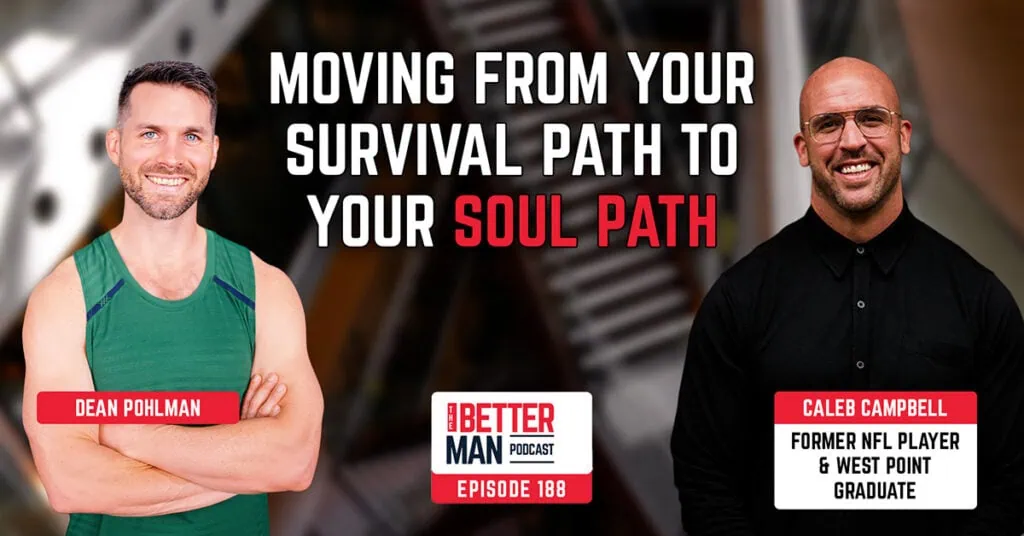
Moving From Your Survival Path to Your Soul Path | Caleb Campbell (Former NFL player & West Point graduate) | Better Man Podcast Ep. 188
If you’re an endlessly striving achiever, you know the path forward lacks clarity. Former NFL linebacker Caleb Campbell used his feelings…

The Ethics & Use Cases of AI | Ted Phaëton | Better Man Podcast Ep. 187
The topic of AI is unavoidable. Ted Phaeton, productivity coach and host of the Modern Man Podcast, joins the show to…
My Personal Experience with Anxiety | Dean Pohlman | Better Man Podcast Ep. 186
After an accidental mushroom trip triggered a panic attack, I realized I’d actually been living with low-grade anxiety my whole life….
Mindset, Limiting Beliefs, and Motivation for Men 40+ | Coach Allan Misner, host of 40+ Fitness Podcast | Better Man Podcast Ep. 185
Prioritizing your career over your health leaves you stuck on a fitness rollercoaster. After a major wake-up call, Coach Allan Misner…